

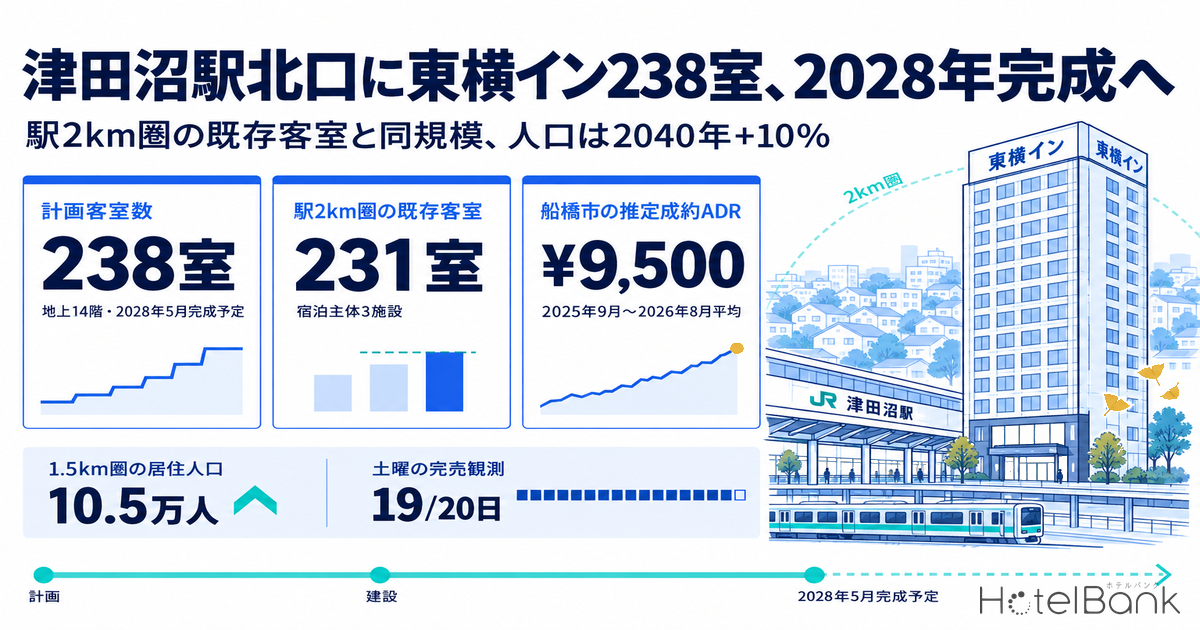
At the north exit of Tsudanuma Station, in Maebara-nishi 2-chome, Funabashi, Toyoko Inn Co., Ltd. is moving ahead with a plan for a 14-story, 238-room hotel. Completion is scheduled for May 31, 2028. The site is where Toyoko Inn Tsudanuma-eki Kitaguchi (東横INN津田沼駅北口, about 180 rooms) operated until October 2024; the rebuild brings the brand back to the station front with roughly 1.3 times as many rooms. This article tests how much demand these 238 rooms can absorb by layering supply within 2km of the station, the resident population within 1.5km, estimated settled ADR in the surrounding cities, and sell-out observations in Funabashi and Narashino.
Metric Definitions Used in This Article
- ADR (average daily rate): An estimated settled rate (tax-exclusive equivalent) calculated by applying a segment-specific adjustment factor to the lowest-plan price each property publishes on OTAs (two guests per room, per-room rate, tax included). Checked against the property-level results disclosed by listed hotel REITs (91 properties, latest three months), the median error is about 7%. It is an estimate and differs from each property’s actual settled prices and accounting figures. Area-level ADR is the median of the properties covered (the level of a typical property in the area).
- OCC (occupancy rate): The share of rooms sold out of total rooms in the area (an estimate based on OTA sales inventory; consistency checks against monthly REIT disclosures have confirmed accuracy within roughly a few points). It is an estimate based on how inventory sold on OTAs is consumed, and differs from a property’s actual overall occupancy (it runs high because rooms not listed are counted as sold).
- Booking curve: The path of remaining OTA rooms toward the check-in date. LT (lead time) = the number of days until check-in. This article uses LT45 to LT1 only.
- Sell-out observation: A stay date on which a property’s remaining rooms reached zero at any observation point between LT45 and LT1. Coverage is limited to properties whose OTA-published allotment is at least 30% of total rooms.
- Data source: MetroEngines Research. Where listed prices are mentioned, they are per-room rates for two guests per room (tax included).
- — A 238-room, 14-story Toyoko Inn is due for completion on May 31, 2028 at the north exit of Tsudanuma Station (2-615 Maebara-nishi, Funabashi). It replaces the former property (about 180 rooms) that closed in October 2024, lifting the room count roughly 1.3 times.
- — Lodging-focused properties with observed prices within 2km of the station total 3 properties and 231 rooms. The new hotel alone adds almost the same number of rooms (about 1.03 times).
- — The resident population within 1.5km is estimated at 105,468 in 2025 and 111,847 in 2040 (+10.0% vs 2020). This is a residential station: office-type workers are only 12.0% of employment within 1km.
- — Across 12 properties (1,086 rooms) in Funabashi and Narashino, four or more properties sold out on 19 of 20 Saturdays between May 8 and September 22, 2026. Adding a training facility for 13 properties gives the same 19 days.
- — Funabashi’s estimated settled ADR is about ¥9,500 (average, September 2025 to August 2026). Annual room revenue for 238 rooms is about ¥661 million at 80% occupancy, and about ¥509-988 million across the occupancy and ADR grid.
The Maebara-nishi 2-chome Rebuild: From About 180 Rooms to 238
The site is 2-615 Maebara-nishi, Funabashi, Chiba, a few minutes on foot along the Onari Kaido road from the north exit of Tsudanuma Station on the JR Sobu Line. According to building plan information from the Ministry of Land, Infrastructure, Transport and Tourism (MLIT), the client is Toyoko Inn Co., Ltd., the use is hotel, and the project is a new 14-story building with a total floor area of 4,355.99 m² and 238 rooms, with construction starting in June 2026 and completion scheduled for May 31, 2028. Local media also reported that a building plan notice was posted on site in April 2026.
Toyoko Inn Tsudanuma-eki Kitaguchi operated on the same site. It closed for renovation from August 2024, ended operations on October 31 of that year, and the building has since been demolished. Media reports put the former room count at about 180, so the new property exceeds it by about 60 rooms. Dividing total floor area by rooms gives about 18.3 m² of floor area per room. This is the typical design of a station-front limited-service hotel: common areas are kept lean and rooms are stacked. The plan restarts on the same station-front plot with about 1.3 times the rooms, and can be read as an example of the chain’s growth strategy of adding supply in front of stations.
| Item | Details |
|---|---|
| Location | 2-615 Maebara-nishi, Funabashi, Chiba (north exit side of Tsudanuma Station) |
| Client | Toyoko Inn Co., Ltd. |
| Scale | 14 stories above ground; total floor area 4,355.99 m² |
| Rooms | 238 (former property: about 180) |
| Construction start / completion | June 2026 / May 31, 2028 |
| Floor area per room | About 18.3 m² (total floor area / rooms) |
Source: Compiled by MetroEngines Research & Consulting from the MLIT Building Dynamics Statistics Survey; former room count per media reports
Supply Within 2km of the Station: 3 Lodging-Focused Properties and 231 Rooms, Nearly Matched by 238
Tsudanuma Station straddles two cities: the north side of the station building is in Funabashi and the south side is in Narashino. Looking at Funabashi alone by administrative boundary would miss station-front supply, so this article counts supply by radius from the station. Coverage is properties tracked by MetroEngines Research that had prices observed on OTAs in the latest three months (June 23 to September 22, 2026).
Five properties with 283 rooms meet the condition within a 2km radius. Two of them, with 52 rooms, are leisure hotels. The remaining lodging-focused properties are JR-East Hotel Mets Tsudanuma (JR東日本ホテルメッツ津田沼, 81 rooms, Narashino), directly connected to the station; Vessel Inn Keisei Tsudanuma Ekimae (ベッセルイン京成津田沼駅前, 92 rooms, Narashino), opened in 2020; and a capsule hotel at the north exit (58 rooms, Funabashi), for 3 properties and 231 rooms. The 238-room plan adds, in a single building, almost the same number of rooms as this lodging-focused stock (about 1.03 times). After completion, lodging-focused rooms would total 469.
Outside the 2km ring, business hotels of 150 to 180 rooms cluster around Makuhari-Hongo Station about 2.8 to 2.9km away, and there is a hotel attached to a training facility in Akanehama, Narashino. The Tsudanuma station front has been a stretch with relatively thin lodging-focused supply between Funabashi and Nishi-Funabashi stations on one side and Makuhari-Hongo Station on the other.
Source: MetroEngines Research & Consulting (confirmed OTA listings; properties with prices observed in the latest three months) / MLIT Building Dynamics Statistics Survey
Source: MetroEngines Research & Consulting (circle size = rooms; red = planned site)
Within the scope tracked by MetroEngines Research, five hotel plans in Chiba Prefecture have building confirmation applications on file. Two are in Urayasu (750 rooms and 126 rooms, both due for completion in 2026) and one is in Makuhari New City at Hibino, Mihama Ward, Chiba City (1,000 rooms, 23 stories, due December 2027), so large bayside projects dominate. The 238 rooms at Tsudanuma are one of the few projects placed in front of a station in a residential area. The assumptions under which the 1,000-room Makuhari New City plan could be absorbed are analyzed in detail in our analysis of the 1,000-room, ¥30 billion mixed-use development at Kaihin-Makuhari Station.
| Location | Rooms | Stories | Completion due |
|---|---|---|---|
| Chidori, Urayasu | 750 | 14 | February 2026 |
| Chidori, Urayasu | 126 | 13 | March 2026 |
| Hibino, Mihama Ward, Chiba City (Makuhari New City) | 1,000 | 23 | December 2027 |
| Maebara-nishi, Funabashi (Tsudanuma Station north exit) | 238 | 14 | May 2028 |
| Yachimata | 50 | 5 | March 2025 |
Source: Compiled by MetroEngines Research & Consulting from the MLIT Building Dynamics Statistics Survey. Note: building confirmation basis as of the survey date. The number of projects and rooms is expected to rise as further applications are filed; treat these as the lower bound of the confirmed pipeline at this point.
A Station With Deep Residential Density: 105,000 Within 1.5km, Projected to Grow Through 2040
What defines Tsudanuma Station is housing, not offices. According to the 250m-mesh future population projections in MLIT’s National Land Numerical Information, the resident population within a 1.5km radius of the station rose from 101,669 in 2020 to 105,468 in 2025 and is projected to reach 111,847 in 2040 (+10.0% vs 2020, +6.0% vs 2025). The 2025 age structure is young: 73,037 people (69.3%) of working age (15 to 64) and 17,975 (17.0%) aged 65 or older. Few stations in the Tokyo suburbs see population growth toward 2040.
Source: MLIT National Land Numerical Information (250m-mesh future population projections, 2024 estimates by the National Spatial Planning and Regional Policy Bureau) (1.5km radius, 108 cells of 250m mesh; resident population, not daytime or visitor population)
Employment concentration, by contrast, is moderate. In the Economic Census for Business Activity (2021) by the Ministry of Internal Affairs and Communications and the Ministry of Economy, Trade and Industry, there are 1,686 establishments and 22,035 workers within a 1km radius of the station, of whom 2,650 (12.0%) are office-type workers in information and communications, finance, professional services and similar sectors. The employment structure is that of a daily-life catchment centered on retail, medical care and education, and the location cannot count on a concentration of office-related business trips as central Tokyo can.
A hotel at a station with deep residential density can pick up, on top of weekday business travel, “resident-driven” demand: stays by visitors to local residents (VFR: homecoming and visiting relatives), weddings and funerals, temporary housing during home rebuilding or renovation, and scouting trips for entrance exams, enrollment and relocation. A resident population of around 100,000 that keeps growing through 2040 means the base for this demand does not shrink. In addition, the Tsudanuma Campus of Chiba Institute of Technology is at the south exit (one minute on foot from the station), and the Tsudanuma Campus of Nihon University College of Industrial Technology is about 11 minutes by bus from the north exit. University-linked stays for academic conferences, entrance exams and open campus events also arise seasonally.
Land Prices: Station-Front Commercial Land Up 9.9% Year on Year
In MLIT’s 2026 Land Price Publication, the standard site “Funabashi 5-6” (2-13-13 Maebara-nishi, commercial) near the planned site was ¥1.56 million per m², up 9.9% from ¥1.42 million a year earlier. “Narashino 5-2” (1-2-23 Tsudanuma, commercial) on the south exit side was ¥1.90 million, up 11.8%. The citywide average change for commercial land was +9.6% in Funabashi, third in Chiba Prefecture, and +7.1% in Narashino, both above the prefectural average of +5.8%. With station-front land continuing to appreciate, rebuilding a station-front plot already used as a hotel and adding rooms is a way of adding supply that makes use of a scarce station-front location.
| Standard site (use) | Location | 2025 | 2026 | Change |
|---|---|---|---|---|
| Funabashi 5-6 (commercial) | 2-13-13 Maebara-nishi, Funabashi | ¥1,420,000/m² | ¥1,560,000/m² | +9.9% |
| Funabashi 5-7 (commercial) | 2-32-10 Maebara-nishi, Funabashi | ¥367,000/m² | ¥403,000/m² | +9.8% |
| Narashino 5-2 (commercial) | 1-2-23 Tsudanuma, Narashino | ¥1,700,000/m² | ¥1,900,000/m² | +11.8% |
Source: MLIT 2026 Land Price Publication (Chiba Prefecture, “2026 Land Price Publication: Price List” and “Ranking of Average Change by Municipality”)
Rates: Funabashi’s Estimated Settled ADR Is ¥9,500; the Narashino Side Is 1.3 Times Higher
Comparing MetroEngines Research’s estimated settled ADR on a 12-month average for September 2025 to August 2026, Funabashi is about ¥9,500 (N=11-14 properties), slightly below Chiba Prefecture as a whole (about ¥10,100, N=403-423 properties). Nearby, Ichikawa is about ¥10,200 (N=7-8) and Yachiyo about ¥8,400 (N=4), placing Funabashi in the middle of this band. Narashino, which includes the south exit side of the station, is higher at about ¥12,600, but with only two to three properties covered it should be treated as a reference value. Mihama Ward of Chiba City, which includes Makuhari New City, is about ¥13,400 (N=12-13), and Urayasu, which includes Maihama, is about ¥23,900 (N=29-30).
Source: Compiled by MetroEngines Research & Consulting (estimated settled ADR; simple average of monthly values for September 2025 to August 2026; N is the range of properties covered per month)
From Tsudanuma, Maihama is around 30 minutes by train, and Kaihin-Makuhari in Makuhari New City is about 30 to 40 minutes including a transfer. With Urayasu’s rate about 2.5 times Funabashi’s and Mihama Ward’s about 1.4 times, the gap gives guests a reason to stay “at a station a little further away” the night before or after an event or theme park visit. Overlaying Funabashi’s monthly trend by year, 2026 rose to around ¥10,000 in March to May, above the same months of 2025. The 12-month average is up 19.3% on the same period a year earlier (about ¥8,000), but the properties covered changed from 13-15 to 11-14 over this time, so the figure includes a change in mix and should be read with a margin. Chiba Prefecture as a whole rose 4.9% over the same period.
Source: Compiled by MetroEngines Research & Consulting (Funabashi, estimated settled ADR, finalized months only)
Supply and Demand: 12 Properties in Funabashi and Narashino Sell Out Almost Every Weekend
We used sell-out observations in Funabashi and Narashino to check whether existing rooms are able to absorb lodging demand around Tsudanuma Station. Coverage is 12 properties and 1,086 rooms (major booking site listing basis; 10 in Funabashi and 2 in Narashino) among the OTA-listed properties in the two cities whose OTA-published allotment is at least 30% of total rooms. For the 138 stay dates from May 8 to September 22, 2026, we aggregated each property’s remaining-room path from LT45 to LT1.
A note on how the 12 properties were selected. There are 15 lodging properties in the two cities with an OTA-published allotment of at least 30% of total rooms; from these we excluded one leisure hotel, one training facility, and one property whose observed days covered only about half the period (74 of 138 days). Putting the excluded properties back does not change the conclusion. Recounting with the training facility added, for 13 properties and 1,260 rooms, at least one property sold out on 123 of 138 days, four or more properties sold out on 19 of 20 Saturdays, an average of 7.6 properties sold out per Saturday, and all 13 properties were sold out on September 20.
The result was clear. On 118 of the 138 days, at least one of the 12 properties reached zero remaining rooms. On Saturdays, four or more properties sold out on 19 of 20 days, with an average of 7.1 properties selling out per day. Even Monday to Thursday, an average of 2.4 properties sold out, so there are weekdays too when demand spills over existing rooms. There were 28 days on which six or more of the 12 properties sold out, 14 of them Saturdays.
Source: Compiled by MetroEngines Research & Consulting (12 properties / 1,086 rooms; major booking site listing basis; properties with an OTA-published allotment of at least 30%)
The strongest dates were Saturday, September 19 and Sunday, September 20: 11 of the 12 properties sold out on the 19th and all 12 on the 20th. These two days were public days of Tokyo Game Show 2026 at Makuhari Messe (the organizer’s announced dates were September 17 to 21, with the 21st cancelled) and also fell in the Silver Week holiday run. Eleven of the 12 properties had been sold out since 45 or more days before the stay date, and estimated OCC at LT45 was already in the 94% range. This shows that lodging for large Makuhari events spreads as far as the Funabashi and Tsudanuma area, 20 to 30 minutes from the venue by train and bus.
On the booking curve, estimated OCC for the 12 properties in June to August was 64.2% at LT45 and 85.4% at LT1. Business hotels across Chiba Prefecture (80-85 properties / about 10,000 rooms, likewise on a major booking site listing basis) were at 55.8% at LT45 and 84.7% at LT1, so Funabashi and Narashino fill from an early stage. Limited to Saturdays, the figures reach 72.5% at LT45 and 90.9% at LT1.
Source: Compiled by MetroEngines Research & Consulting (Funabashi and Narashino = 12 properties / 1,086 rooms; Chiba business hotels = 80-85 properties / about 10,000 rooms; both on a major booking site listing basis, average of stay dates in June to August 2026)
| Day of week | Stay dates | Estimated OCC at LT45 | Estimated OCC at LT1 | Sold-out properties per day |
|---|---|---|---|---|
| Mon-Thu | 78 | 63.8% | 86.2% | 2.4 |
| Fri | 20 | 69.6% | 88.5% | 3.2 |
| Sat | 20 | 74.5% | 92.4% | 7.1 |
| Sun | 20 | 68.9% | 84.0% | 2.3 |
Source: Compiled by MetroEngines Research & Consulting (12 properties / 1,086 rooms; major booking site listing basis; stay dates from May 8 to September 22, 2026. Estimated OCC is the average of days with complete observations)
Funabashi and Narashino are not among the properties disclosed by the seven listed hotel REITs (302 properties in total as of September 21, 2026); REIT-held properties in the prefecture are located in Urayasu, Chiba City and Narita. Lodging demand at this station has been served mainly by independents and station-front chains.
How Large a Vessel 238 Rooms Is: About 87,000 Room Nights a Year
The 238 rooms supply up to 86,870 room nights a year. The table below is a simplified estimate showing the room nights filled per year at each occupancy level and the scale of room revenue when Funabashi’s estimated settled ADR (12-month average, about ¥9,500) is applied. The three existing lodging-focused properties with 231 rooms supply about 84,000 room nights a year, so the new property nearly doubles lodging-focused capacity within 2km of the station.
| Occupancy level (assumed) | Room nights sold per year | Scale of room revenue (ADR ¥9,512) |
|---|---|---|
| 70% | 60,809 | Approx. ¥578 million |
| 80% | 69,496 | Approx. ¥661 million |
| 85% | 73,840 | Approx. ¥702 million |
| 90% | 78,183 | Approx. ¥744 million |
Source: Compiled by MetroEngines Research & Consulting (simplified estimate. Occupancy is an assumption and estimated settled ADR is based on Funabashi’s median. This differs from any actual business plan)
Varying both occupancy and ADR widens the range further. For ADR we applied the estimated settled ADR (12-month average) of the surrounding cities. The lowest combination (70% occupancy at the Yachiyo level) is about ¥509 million and the highest (90% occupancy at the Narashino level) is about ¥988 million, a range of roughly 23% below to 49% above the central case of about ¥661 million at the Funabashi level and 80% occupancy. The effect of ADR rising from the Funabashi level to the Chiba Prefecture level (+6.7%) is almost the same size as the effect of raising occupancy by 5 points (+6.3% from 80% to 85%).
| Occupancy level \ ADR | Yachiyo ¥8,375 |
Funabashi ¥9,512 |
Chiba Prefecture ¥10,148 |
Ichikawa ¥10,228 |
Narashino ¥12,634 |
|---|---|---|---|---|---|
| 70% | Approx. ¥509 million | Approx. ¥578 million | Approx. ¥617 million | Approx. ¥622 million | Approx. ¥768 million |
| 75% | Approx. ¥546 million | Approx. ¥620 million | Approx. ¥661 million | Approx. ¥666 million | Approx. ¥823 million |
| 80% | Approx. ¥582 million | Approx. ¥661 million | Approx. ¥705 million | Approx. ¥711 million | Approx. ¥878 million |
| 85% | Approx. ¥618 million | Approx. ¥702 million | Approx. ¥749 million | Approx. ¥755 million | Approx. ¥933 million |
| 90% | Approx. ¥655 million | Approx. ¥744 million | Approx. ¥793 million | Approx. ¥800 million | Approx. ¥988 million |
Source: Compiled by MetroEngines Research & Consulting (simplified estimate: 238 rooms x 365 days x occupancy x ADR. ADR is each municipality’s estimated settled ADR, the simple average of monthly values for September 2025 to August 2026. Narashino is a reference value based on two to three properties. Occupancy is an assumption and differs from any actual business plan)
The clue to absorption is the sell-out observations discussed above. With around seven of the 12 properties selling out every weekend and every property selling out on large Makuhari event days, demand that existing rooms cannot absorb arises cyclically on weekends. The 238 rooms become the vessel that catches this overflow in front of the station. On weekdays, the likely pattern is support from resident-driven visitor demand, university-related stays, and business trips tied to medical care and retail in the city.
Summary: Adding Supply at a Residential Station, and Three Ways to Capture Demand
Resident-driven visits (VFR)
105,000 residents within 1.5km (2025), with 2040 at +10.0% vs 2020. The base for population-proportional demand such as homecoming, visiting relatives, weddings and funerals, and relocation scouting does not shrink.
Universities and conferences
Chiba Institute of Technology (one minute on foot from the south exit) and Nihon University College of Industrial Technology (about 11 minutes by bus from the north exit). Seasonal demand from entrance exams, academic conferences and open campus events.
Pre-night stays for Maihama and Makuhari
Urayasu’s estimated settled ADR is about 2.5 times Funabashi’s, and Mihama Ward’s about 1.4 times. On September 20, a Tokyo Game Show public day, all 12 properties in Funabashi and Narashino sold out.
The 238 rooms at the north exit of Tsudanuma Station are a plan to rebuild a former property of about 180 rooms and return to the station front with about 1.3 times the rooms. Lodging-focused rooms within 2km of the station total 3 properties and 231 rooms, and the new property adds capacity of almost the same size in a single building. Population within 1.5km is projected to keep growing through 2040; while employment concentration is moderate, visitor demand underpinned by residential density overlaps with university demand and pre-night demand for Maihama and Makuhari. Across the 12 properties in Funabashi and Narashino, four or more properties sold out on more than 90% of Saturdays, leaving substantial room to catch weekend overflow in front of the station. Toward completion in May 2028, the point to watch is how a growth strategy of adding supply in front of stations broadens demand at this residential station.
Notes on the data: The building plan is on a building confirmation basis as of the survey date, and the completion date and room count may change. Estimated OCC and sell-out observations are estimates based on inventory listed on major booking sites and exclude rooms not listed (direct sales, group and travel agency allotments, etc.). A sell-out observation means zero remaining rooms within the OTA-published allotment and may not mean the whole property is full. Observations more than 45 days before the stay date include the state before allotments are loaded and may not represent booking pace (12 properties covered, observation coverage 100%).
Related Articles
- Tokyo Game Show 2026: 4,532 Rooms in 3km, Occupancy +41.8pt at T-45
- Kaihin-Makuhari 1,000-Room ¥30bn Mixed-Use: Breakeven ADR ¥13,200
References and Sources
■ Data sources
The building plan is from building plan information (building confirmation basis) in the MLIT Building Dynamics Statistics Survey. Surrounding supply covers properties tracked by MetroEngines Research within a 2km radius of Tsudanuma Station that had prices observed on OTAs from June 23 to September 22, 2026. Estimated settled ADR uses monthly values by municipality (September 2024 to August 2026); sell-out observations and estimated OCC use the remaining-room path by stay date for 12 properties (1,086 rooms) in Funabashi and Narashino (138 days from May 8 to September 22, 2026, LT45 to LT1). Population is from the 250m-mesh future population projections in the National Land Numerical Information (1.5km radius, 108 cells); employment is from the Economic Census for Business Activity (2021, 1km radius); land prices are from the 2026 Land Price Publication.
■ Estimate assumptions
Annual room nights sold = 238 rooms x 365 days x occupancy (assumed at 70-90%). Scale of room revenue = room nights sold x estimated settled ADR (Funabashi: 12-month average of ¥9,512. Table 6 uses five levels from Yachiyo at ¥8,375 to Narashino at ¥12,634). Costs, NOI and yields are not estimated. The 12 properties are the 15 properties in the two cities with an OTA-published allotment of at least 30% of total rooms, less one each of a leisure hotel, a training facility, and a property observed on only about half the days in the period.
■ Limitations and caveats
Estimated settled ADR, estimated OCC and sell-out observations are estimates based on OTA-listed inventory and exclude direct sales and group allotments. Narashino’s ADR is a reference value based on two to three properties. Funabashi’s +19.3% year on year includes turnover in the properties covered. Estimated OCC is the average of stay dates with complete observations and moves by about 1 point either way depending on the aggregation date. The room count and completion date of the building plan may change. Population is resident population, not daytime or visitor population.
■ Market data
- MetroEngines Research & Consulting — Estimated settled ADR (by municipality), estimated occupancy (OCC) and booking curves, sell-out observations (12 properties / 1,086 rooms in Funabashi and Narashino), surrounding supply (confirmed OTA listings)
■ Government statistics and public data
- MLIT, Building Dynamics Statistics Survey (building plan information)
- MLIT National Land Numerical Information (250m-mesh future population projections)
- Ministry of Internal Affairs and Communications / Ministry of Economy, Trade and Industry, Economic Census for Business Activity (2021)
- Chiba Prefecture, 2026 Land Price Publication (price list and ranking of average change by municipality)
- Chiba Prefecture, On the 2026 Land Price Publication (press release)
■ News and official information
- Toyoko Inn at the north exit of Tsudanuma Station to return through a rebuild, completion due May 2028 (Funabashi Tsushin)
- Tsudanuma’s Toyoko Inn to be rebuilt and open in 2028 (Gogai NET Funabashi, April 14, 2026)
- Toyoko Inn at the north exit of Tsudanuma Station closed on October 31, 2024 (Gogai NET Funabashi, November 19, 2024)
- Toyoko Inn closes Toyoko Inn Tsudanuma-eki Kitaguchi (TRAICY, November 16, 2024)
- Tokyo Game Show 2026 (Makuhari Messe)
- Chiba Institute of Technology: Access
- Nihon University College of Industrial Technology: Access