

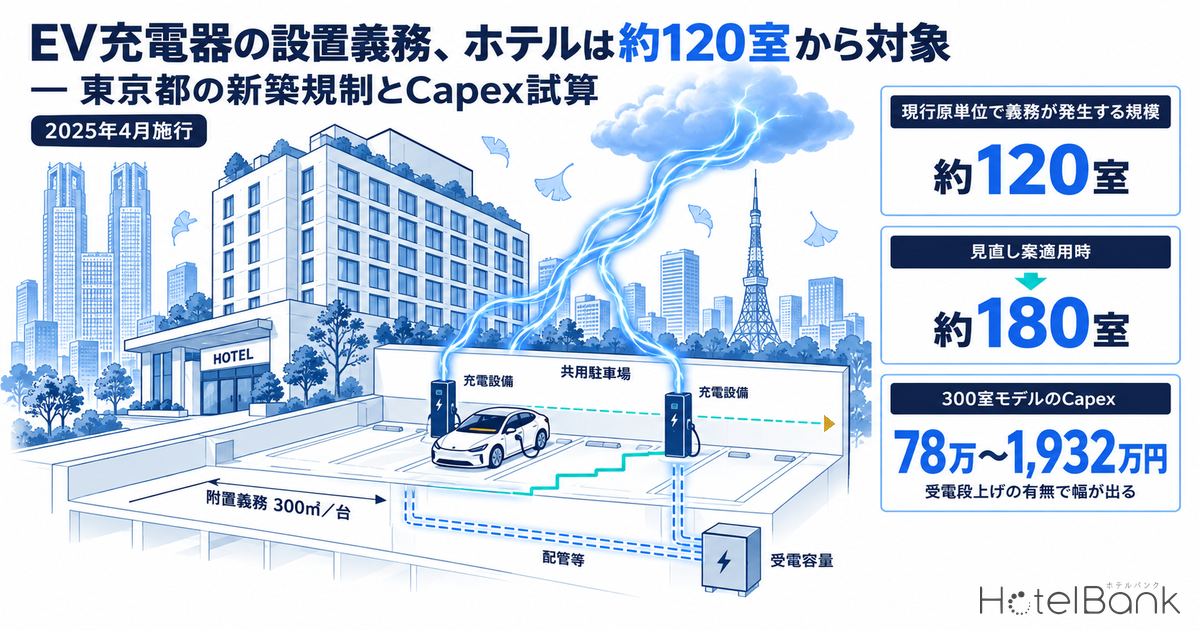
In the early stages of a hotel development study, zoning, floor-area ratio and the parking-provision requirement always get checked. There is one more condition beyond them, in force since April 2025: the EV charging equipment installation mandate Tokyo imposes on new buildings. It comes from a revision to the Tokyo Metropolitan Ordinance on Environmental Preservation (the Environmental Security Ordinance), passed by the Metropolitan Assembly in December 2022, and it reaches new construction with a total floor area of 2,000 m² or more through the Tokyo Green Building Program.
What makes this mandate unusual is that it is triggered not by floor area or room count but by the number of parking spaces. The number of spaces required under the parking ordinance directly determines whether chargers are needed and how many. This article first confirms Tokyo’s installation standard against primary sources, then works backwards from our building-plan data and the parking ordinance unit rate to answer the question of what room count brings a hotel into scope, and costs out the three Capex layers — chargers, pre-installed conduit and incoming power capacity — for 100-room and 300-room models. Taking subsidies and charging revenue in as well, the aim is to quantify one more layer of development cost: electrical infrastructure.
Metric Definitions Used in This Article
- Charging equipment: equipment covered by the EV charging equipment installation standard under the Tokyo Green Building Program. This article costs out 6 kW standard (Level 2) chargers as the base case.
- Conduit and related work: work that reserves conduit, wiring space and distribution-board headroom in advance so chargers can be added later — what is generally called EV-ready provision.
- Dedicated parking / shared parking: the categories used in Tokyo’s installation standard. Dedicated parking is space contracted for exclusive use by specific users (residents, company vehicles and the like); shared parking serves visitors, with a shifting mix of vehicles and short stays. A hotel’s guest parking falls under shared parking.
- Parking-provision requirement: the obligation to provide parking facilities set by each local government by ordinance under Article 20 of the Parking Place Act. Under the Tokyo Metropolitan Parking Ordinance, the current unit rate for hotels and ryokan in parking improvement districts and similar areas is one space per 300 m².
- ADR (average daily rate): an estimated settled rate (tax-excluded equivalent) calculated by applying a segment-specific adjustment factor to the lowest published plan level each property lists on OTAs and elsewhere (double occupancy, per-room rate, tax included). Against property-level results disclosed by listed hotel REITs (91 properties, most recent three months), the median error is about 7%. These are estimates and differ from each property’s actual transaction prices and accounting figures. Area-level ADR is the median across the properties covered (the level of a typical property in that area).
- Data sources: Tokyo Metropolitan Government Bureau of Environment / Tokyo Metropolitan Government Bureau of Urban Development / Ministry of Land, Infrastructure, Transport and Tourism, Statistical Survey on Building Construction Starts, compiled by MetroEngines Research & Consulting / MetroEngines Research
- — The mandate is triggered not by floor area or room count but by the number of parking spaces. Guest parking counts as shared parking: 10 spaces or more means one charger plus conduit for 20% of spaces. Dedicated parking for employees and company vehicles starts at 5 spaces, with chargers on 20%.
- — Working back from the Tokyo Metropolitan Parking Ordinance, a hotel in a central commercial district enters scope at about 140 rooms (total floor area above 3,525 m², at 25 m² per room). A 100-room property stays outside scope because the relief formula applies.
- — Capex for the 300-room model is ¥780,000 to ¥19.32 million. Chargers and conduit alone come to ¥780,000–¥4.32 million, or ¥0.6–3.3 per room-night — not a scale that decides project viability.
- — The width of that range comes down to incoming power capacity. Upsizing the substation puts the figure in the ¥15 million class, and that portion sits outside subsidy coverage. The outcome is all but decided at the load-calculation stage of schematic design.
- — If the proposed parking ordinance revision published in June 2026 (unit rate from 300 to 450 m² per space) is enacted, the trigger point moves back from about 140 rooms to about 180 rooms. The ordinance revision has not been enacted.
A mandate triggered by parking spaces, not floor area
Tokyo’s Metropolitan Assembly passed the revision to the Environmental Security Ordinance on 15 December 2022, making solar generation equipment and EV charging equipment part of the rules for new buildings. Both took effect in April 2025. We have covered the solar side before; the charging side is often still missing from development planning templates.
What applies to large new buildings of 2,000 m² or more is the EV charging equipment installation standard under the Tokyo Green Building Program, and the requirement splits in two depending on the character of the parking. That split is the practical dividing line.
| Category | Parking spaces at which it applies | Chargers to install | Conduit and related work |
|---|---|---|---|
| Dedicated parking Specific spaces contracted for exclusive use (company vehicles, employees and the like) | 5 or more | 20% or more of spaces capped at 10 | 50% or more of spaces capped at 25 |
| Shared parking Visitors, shifting mix of vehicles, short stays. Hotel guest parking belongs here | 10 or more | 1 or more | 20% or more of spaces capped at 10 |
Source: Tokyo Metropolitan Government Bureau of Environment, Guideline on the EV Charging Equipment Installation Standard under the Tokyo Green Building Program (1st edition, March 2024) / Tokyo Metropolitan Ordinance on Environmental Preservation. The guideline is split by submission period: the 1st edition applies to submissions from April 2025 to March 2026, the 2nd edition to submissions from April 2026 onward.
The rule is often described as chargers on 20% of the parking, but the 20% applies to dedicated parking. Hotel guest parking, with its shifting mix of vehicles and short stays, is classified as shared parking: at 10 spaces or more, at least one charger is required, plus pre-installed conduit for 20% or more of the spaces. Where contracted spaces are allocated to employees or company vehicles, the 20% rule kicks in once those spaces number five or more. In other words, two standards run in parallel inside the same building.
Below 2,000 m², a separate track applies: the Green Building Report Program, also in force since April 2025. It covers designated suppliers that deliver 20,000 m² or more of small and mid-sized new buildings in Tokyo per year, and the obligation attaches to the supplier rather than to the individual building. Chains that keep delivering compact hotels in Tokyo should note they may fall within its reach.
We also checked other local governments. Kawasaki has run a solar generation programme since April 2025, but within the scope of this study we found no programme setting a numerical requirement for charger counts. Nagano Prefecture asks new buildings of 10,000 m² or more to consider installing renewable energy equipment, but that is a duty to consider, not to install. On numerical charger requirements for new buildings, Tokyo is ahead of the field at this point. For developers working in Kyoto or Osaka, the near-term question is mainly which subsidies to use.
At what room count does a hotel enter scope — working back from the parking requirement
Whether chargers are required is decided by the number of parking spaces. So what decides a hotel’s parking space count? In Tokyo, the provision requirement under the Tokyo Metropolitan Parking Ordinance effectively sets the floor. In parking improvement districts and similar areas, the unit rate for hotels and ryokan is one space per 300 m² (we compared seven cities on this point in earlier work: hotel parking provision requirements differ by a factor of 2.5 across cities).
Using the same assumptions as that study (300 rooms, 7,500 m² total floor area, or 25 m² per room) and assuming the number of spaces actually provided equals the required number, we tested where the mandate bites by property size. Ten shared-parking spaces is the dividing line.
Source: compiled by MetroEngines Research & Consulting from the Tokyo Metropolitan Parking Ordinance and the Bureau of Environment installation standard
| Rooms | Total floor area | Required spaces current, 300 m²/space | Charging mandate (current) | Required spaces proposed, 450 m²/space | Charging mandate (proposed) |
|---|---|---|---|---|---|
| 100 rooms | 2,500 m² | 5 | Not covered | 3 | Not covered |
| 150 rooms | 3,750 m² | 10 | 1 charger + conduit for 2 spaces | 7 | Not covered |
| 200 rooms | 5,000 m² | 16 | 1 charger + conduit for 4 spaces | 11 | 1 charger + conduit for 3 spaces |
| 300 rooms | 7,500 m² | 25 | 1 charger + conduit for 5 spaces | 17 | 1 charger + conduit for 4 spaces |
| 500 rooms | 12,500 m² | 42 | 1 charger + conduit for 9 spaces | 28 | 1 charger + conduit for 6 spaces |
Assumes 25 m² of floor area per room and that required spaces equal the spaces actually provided. Below 6,000 m² the ordinance relief formula applies, rounded up. The provision requirement covers parking improvement districts, commercial zones, neighbourhood commercial zones and similar areas. Source: compiled by MetroEngines Research & Consulting from the Tokyo Metropolitan Parking Ordinance and the Bureau of Environment
Solving the threshold precisely means folding in the relief formula that applies below 6,000 m². For a hotel-only building the required space count is (4 × total floor area − 6,000) ÷ 900, so rounding up, it reaches 10 spaces at a total floor area above 3,525 m² — at 25 m² per room, about 140 rooms. Under the current standard, a new hotel above roughly 140 rooms in a central Tokyo commercial district triggers the charger installation requirement. A 100-room property stops at five spaces thanks to the relief formula and stays outside scope.
Worth watching here is the Basic Approach to Revising the Tokyo Metropolitan Parking Ordinance (draft), published by the Bureau of Urban Development on 8 June 2026. It would ease the unit rate for other designated uses, a category that includes hotels, from 300 m² per space to 450 m² per space, and public comment ran to 8 July of the same year (the ordinance revision has not been enacted). If it goes through, the lower required space count means the charging mandate’s trigger point also moves back from about 140 rooms to about 180 rooms. Because the parking ordinance and the charging mandate are numerically linked, easing one eases the other. Projects filing for building confirmation in 2026 and 2027 will be planned while both rules are in motion — worth pinning down at the planning stage.
All 18 planned Tokyo projects exceed 2,000 m²
Extracting planned and under-construction projects that include a hotel in Tokyo from the building-plan data we maintain from the Ministry of Land, Infrastructure, Transport and Tourism’s Statistical Survey on Building Construction Starts gives 18 projects and 3,497 rooms (after de-duplication, as of the survey date). Of these, all 18 are at 2,000 m² or more, putting them within the Tokyo Green Building Program’s scope. Nationwide, 62 of 69 projects (89.9%) were at 2,000 m² or more.
By ward, Chiyoda leads with 5 projects and 728 rooms, followed by Shibuya with 3 projects and 461 rooms and Minato with 2 projects and 417 rooms. Projects in Chiyoda, Minato, Chuo and Shinagawa include mixed-use redevelopments with office and retail space running to several hundred thousand square metres, where charger placement is decided within the whole building’s parking plan rather than the hotel portion alone.
This data is based on building confirmation filings as of the survey date (Ministry of Land, Infrastructure, Transport and Tourism, Statistical Survey on Building Construction Starts). Because confirmation filings are typically made one to two years before opening, project and room counts for future years are expected to rise as further filings come in. Treat the figures as a lower bound on the confirmed pipeline.
Markers are placed at ward office locations as an approximate ward-level display, not the exact site of each project. Circle size is the total planned room count in that ward. Source: compiled by MetroEngines Research & Consulting from the Ministry of Land, Infrastructure, Transport and Tourism’s Statistical Survey on Building Construction Starts (N=18 projects)
Separately, for the nine Tokyo projects that are hotel-only and have a reported total floor area, applying the current unit rate and the relief formula gives required space counts of 4.8 to 19.8 spaces. Six of the nine reach 10 or more once rounded up. That said, floor areas in building-plan data are as filed, and the actual required count moves with how the parking portion is treated and which relief measures apply. Determinations on individual projects presuppose consultation with the competent authority.
Capex splits into three layers
Charging Capex cannot be expressed as a single number. Stacking it in three layers — (1) the chargers themselves, (2) pre-installed conduit, (3) incoming power capacity — shows where the range comes from.
(1) Chargers. Material submitted by the Bureau of Urban Development to the parking ordinance review committee (based on operator interviews) puts the initial cost of a fast charger at about ¥2 million to ¥3 million per unit, with a service life of about eight years. What is realistic for hotel guests is a 6 kW standard charger used during the stay, where equipment and installation together run from several hundred thousand yen up to around ¥2 million in difficult conditions. Tokyo’s subsidy caps installation work for the first standard charger at ¥1.35 million, which gives a sense of the ceiling on the works side.
(2) Conduit. Installing conduit routes, wiring and distribution-board headroom at the same time as new construction adds ¥10,000 to ¥40,000 per space. That is far cheaper than retrofitting — opening walls, adding distribution boards, redoing buried conduit — so running conduit to more spaces than the mandate requires compresses later Capex. The 300-room model needs 8 spaces (5 shared plus 3 dedicated), but running conduit to all 25 spaces adds only a few hundred thousand yen.
(3) Incoming power capacity. This is what sets the width of the range. Load density in hotel electrical design generally runs 50 to 80 VA/m², so a 300-room, 7,500 m² building implies 375–600 kVA of substation capacity. Adding 6 kW × 2 units, or 12 kW, to that is only 2.0–3.2% of the incoming capacity, which usually sits inside normal design headroom. The problem case is converting all eight mandated conduit spaces to chargers in future: at 48 kW the ratio rises to 8–13%. If the design was laid out without headroom, transformers or the cubicle substation have to be upsized, and unit prices of ¥8 million to ¥15 million for 300–500 kVA class equipment — around ¥15 million for a full replacement job — come into view.
Source: compiled by MetroEngines Research & Consulting from Tokyo Metropolitan Government Bureau of Urban Development, Guiding the installation of ZEV chargers under the parking ordinance / Tokyo Metropolitan Environmental Public Service Corporation subsidy programmes / prevailing price ranges for substation equipment
| Layer | Quantity in the 300-room model | Low | High |
|---|---|---|---|
| Chargers (6 kW standard) | 1 shared + 1 dedicated = 2 units | ¥0.70M | ¥4.00M |
| Pre-installed conduit | 5 shared + 3 dedicated = 8 spaces | ¥0.08M | ¥0.32M |
| Incoming power capacity | +12 kW (no increment if within design headroom) | ¥0 | ¥15.00M |
| Total | ¥0.78M | ¥19.32M | |
| Per room | ¥26,000 | ¥64,000 | |
| Per room-night (15-year depreciation, 80% occupancy) | 87,600 room-nights a year | ¥0.6 | ¥14.7 |
A simplified estimate; an actual investment decision requires a detailed feasibility study. Source: MetroEngines Research & Consulting
Separating where the range comes from shows that what matters is not the amount itself but how incoming power capacity is handled. Below, an optimistic and a mid case that stop at chargers and conduit sit alongside a pessimistic case that includes upsizing the substation.
| Scenario | Assumptions | Total Capex | Per room | Per room-night | Share of estimated settled ADR |
|---|---|---|---|---|---|
| Optimistic | No capacity upsizing, equipment at the low end (2 chargers ¥0.70M + conduit for 8 spaces ¥0.08M) | ¥0.78M | ¥26,000 | ¥0.6 | 0.004% |
| Mid | No capacity upsizing, equipment at the high end (2 chargers ¥4.00M + conduit for 8 spaces ¥0.32M) | ¥4.32M | ¥14,400 | ¥3.3 | 0.023% |
| Pessimistic | Substation upsizing required (cubicle replacement of ¥15.0M added) | ¥19.32M | ¥64,400 | ¥14.7 | 0.104% |
Straight-line depreciation over 15 years, 80% occupancy (87,600 room-nights a year for 300 rooms). The ADR share is against the trailing-12-month median estimated settled ADR for business hotels in Tokyo of ¥14,100 (N=910 properties). Figures are before subsidies. Source: Tokyo Metropolitan Government Bureau of Urban Development / Tokyo Metropolitan Environmental Public Service Corporation / compiled by MetroEngines Research & Consulting
Laying the per-room-night burden out on two axes — the cost of upsizing capacity and the room count — makes clear that the weight falls hardest on smaller properties. The same ¥15 million of upsizing works out at ¥8.8 per room-night for 500 rooms but ¥29.4 for 150 rooms, a gap of more than three times. The smaller the project, the more it is worth folding the charging load into the load calculation at schematic design.
| Upsizing cost / rooms | 150 rooms | 200 rooms | 300 rooms | 500 rooms |
|---|---|---|---|---|
| ¥0 within design headroom | 6.6 | 4.9 | 3.3 | 2.0 |
| ¥5.0M | 14.2 | 10.6 | 7.1 | 4.3 |
| ¥10.0M | 21.8 | 16.3 | 10.9 | 6.5 |
| ¥15.0M cubicle replacement | 29.4 | 22.1 | 14.7 | 8.8 |
Chargers plus conduit are fixed at the 300-room model’s high case of ¥4.32M, with size differences reflected only in the depreciation denominator — a conservative treatment. Straight-line depreciation over 15 years, 80% occupancy. The shaded cell matches the ¥14.7 per room-night in the text (300 rooms, ¥15.0M upsizing). Even the heaviest cell, 150 rooms with ¥15.0M, stays at ¥29.4, or 0.21% of the ¥14,100 estimated settled ADR. Source: compiled by MetroEngines Research & Consulting
In short, where no capacity upsizing is required, this mandate’s effect on project viability is very small. Our aggregation puts the trailing-12-month median estimated settled ADR for business hotels in Tokyo at about ¥14,100 (N=910 properties), against which ¥0.6–14.7 per room-night is 0.004% to 0.10% of ADR. Set against the water connection charges we have covered before (a gap of up to ¥5.11 million between municipalities) or the Capex arising from parking provision requirements (¥140,000–350,000 per room), it is an order of magnitude smaller. Rather than the amount itself, at what point it is folded into the substation plan is the design-process question that matches reality.
Running cost is set by the base charge and maintenance
More deserving of attention than Capex is the running cost. The same Bureau of Urban Development material shows, for a fast charger (50 kW output, low-voltage power contract), an electricity base charge of about ¥50,000 a month, or about ¥600,000 a year, network fees of about ¥4,000 to ¥5,000 a month and maintenance and inspection of about ¥300,000 a year — about ¥1 million a year in total, excluding the electricity used for charging. The same material notes that recovering installation costs from charging fees alone is difficult, and that installation does not proceed unless secondary effects such as drawing customers are expected.
That, however, is the figure for a 50 kW fast charger. Scaled proportionally to the two 6 kW standard chargers, or 12 kW, that are central to a hotel’s compliance, the equivalent base charge is only about ¥140,000 a year (our estimate). Adding network fees and maintenance keeps it in the range of a few hundred thousand yen a year, which across 300 rooms and 87,600 room-nights is a few yen per room-night. Whether a fast charger goes in as destination charging is the fork that shifts Opex to a different level.
Source: compiled by MetroEngines Research & Consulting from Tokyo Metropolitan Government Bureau of Urban Development, Guiding the installation of ZEV chargers under the parking ordinance (the 12 kW figures are our estimate, scaled proportionally from prevailing 50 kW values)
How far do subsidies bring the net burden down?
Two tracks of support exist, national and metropolitan. The national subsidy for the introduction of charging and refuelling infrastructure to promote clean energy vehicles is administered by the Next Generation Vehicle Promotion Center, and accommodation facilities are included among eligible sites. For standard chargers, the framework covers up to half of equipment purchase costs and the full installation cost.
Tokyo’s side splits in two: the Charging Equipment Deployment Program (residential), for apartment buildings and municipal public facilities, and the Charging Equipment Deployment Program (business), for retail, office and industrial facilities. Under the latter, half of the purchase cost of a standard charger is covered, installation work is capped at ¥1.35 million for the first unit, and for fast chargers (10 kW or more) and ultra-fast chargers (90 kW or more) the purchase cost is fully covered, with per-model caps, and installation is capped at ¥62,000/kW and ¥80,000/kW respectively. Applications run from 26 June 2026 to 31 March 2027. Which programme category a project falls under is worth confirming with the administering office before applying.
| Programme | Administrator | Eligible sites | Support for standard chargers |
|---|---|---|---|
| Charging and refuelling infrastructure subsidy | Next Generation Vehicle Promotion Center (national) | Apartment buildings, workplaces, retail facilities, accommodation facilities and similar | Up to 1/2 of purchase cost, full installation cost |
| Charging Equipment Deployment Program (business) | Tokyo Metropolitan Environmental Public Service Corporation | Retail, office and industrial facilities | 1/2 of purchase cost, installation capped at ¥1.35M for the first unit |
| Charging Equipment Deployment Program (residential) | Tokyo Metropolitan Environmental Public Service Corporation | Apartment buildings and municipal public facilities | 1/2 of purchase cost, installation capped at ¥1.35M for the first unit |
Based on FY2026 published terms. Budgets, application windows and requirements change each fiscal year, so always check the latest application guidelines when applying. Source: Next Generation Vehicle Promotion Center / Tokyo Metropolitan Environmental Public Service Corporation (Cool Net Tokyo)
With subsidies folded in, the two chargers in the 300-room model attract half the purchase cost plus support equivalent to the installation cost, so the net burden in the low case falls to a few hundred thousand yen. Put the other way, the ¥15 million in the case that needs capacity upsizing sits outside subsidy coverage, so most of the net burden is decided on the substation side. Whether the charging load can be folded into the load calculation early in design is exactly what the difference in net burden comes down to.
The revenue side — charging income and capturing EV drivers
So far the cost side, but chargers have revenue potential too. Japan’s EV and PHEV share of new car sales reached 5.48% in June 2026, up 2.57 points from 2.91% a year earlier and a record high. The government targets 100% electrified vehicles in new passenger car sales by 2035 and 300,000 charging points by 2030, including 30,000 public fast chargers. Accommodation facilities are positioned as a principal site for destination charging, and the long dwell times of the business suit 6 kW standard charging. Where EV charging at regional lodgings is concentrated, as seen in guest reviews, is analysed in our earlier work.
A look at charging revenue. Prevailing time-based pricing for standard charging runs around ¥55 per 10 minutes, so a three-hour charge during a stay comes to about ¥990. At one use per unit per day, that is about ¥360,000 a year per unit, or ¥720,000 for two. That exceeds the Opex seen in the previous section (about ¥140,000 of base charge for 12 kW plus network fees and maintenance). Even in a ramp-up period short of one use a day, it covers more than half of Opex.
Value also varies with whether parking itself is valued in the local market. In our map of parking mention rates in guest reviews, Tokyo’s mention rate is a low 2.0%, while regional cities with weak rail connectivity exceed 10%. Building know-how first through Tokyo compliance, then carrying it across to projects in markets where parking is valued is a sensible order for chains. The field also connects to inbound rental-car demand: our analysis of inbound rental-car demand and parking mentions found parking mentioned 2.9 times more often in Traditional Chinese reviews than in English.
Conclusion — a question of design sequence, not amount
Summed up from a development-planning perspective, Tokyo’s EV charging equipment mandate comes to this.
First, the mandate is triggered by parking spaces, not floor area or room count. A hotel’s guest parking is shared parking: at 10 spaces or more, at least one charger and conduit for 20% or more of the spaces are required. The chargers-on-20% line applies to dedicated parking for employees and company vehicles, which comes into scope at five spaces.
Second, working back from the parking provision requirement, a hotel in a central commercial district enters scope at about 140 rooms. If the parking ordinance revision published in June 2026 (unit rate from 300 to 450 m² per space) is enacted, that threshold moves back to about 180 rooms. Because the two rules are numerically linked, projects filing for building confirmation in 2026 and 2027 need to watch both at once.
Third, Capex ranges widely, from ¥780,000 to ¥19.32 million, but the width comes from incoming power capacity. Chargers and conduit together come to ¥780,000–¥4.32 million, or ¥0.6–3.3 per room-night — not a scale that decides viability. Once the substation has to be upsized, however, the figure moves into the ¥15 million class, and that portion falls outside subsidy coverage. The outcome is all but decided when the charging load is folded into the load calculation at schematic design.
Fourth, there is clear upside in running conduit to more spaces than the mandate requires. At ¥10,000 to ¥40,000 per space when installed with new construction, running it to all 25 spaces in the 300-room model adds only a few hundred thousand yen. With the EV share of new car sales rising more than two points a year, it avoids the cost of opening walls and redoing conduit at a later renovation. Leaving future headroom in the substation as well keeps the option of pursuing charging revenue open.
We have quantified the infrastructure costs that tend to fall out of business-plan templates one by one — water connection charges, water and sewer costs, waste disposal costs. Electrical infrastructure is the smallest of them in money terms, yet the layer that gets locked in earliest in design. Noticed just before the confirmation filing, there are no options left; folded into schematic design, it costs a few hundred thousand yen — that asymmetry is precisely why this layer belongs on the planning-stage checklist.
Related Reading
- Parking-Review Ranking Across Car-Dependent Japan + EV Charging Edge
- Rental-Car Inbound: Parking Mentioned 2.9x More in Traditional Chinese
- Hotel Water & Sewer Costs Vary 2.1x by Municipality: ¥7.85mn NOI Gap
References and Sources
■ Data sources
Regulatory requirements come from the Tokyo Metropolitan Government Bureau of Environment’s EV charging equipment installation standard and the Tokyo Metropolitan Ordinance on Environmental Preservation; required parking counts from the unit rate in the Tokyo Metropolitan Parking Ordinance (hotels and ryokan, 300 m² per space; proposed 450 m² per space). Planned and under-construction projects come from building-plan data derived from the Ministry of Land, Infrastructure, Transport and Tourism’s Statistical Survey on Building Construction Starts (after de-duplication, N=69 projects, of which 18 in Tokyo with 3,497 rooms, as of the survey date). Estimated settled ADR is the trailing-12-month median of monthly aggregates for business hotels in Tokyo (N=910 properties, September 2025 to August 2026). Equipment, installation and running costs come from the Bureau of Urban Development’s parking ordinance review committee materials; subsidies from the published guidelines of the Next Generation Vehicle Promotion Center and the Tokyo Metropolitan Environmental Public Service Corporation.
■ Estimation assumptions
Assumes 25 m² of floor area per room and that the required parking count equals the spaces actually provided. Below 6,000 m², the Tokyo Metropolitan Parking Ordinance relief formula (4 × total floor area − 6,000) ÷ 900 applies, rounded up. Chargers are 6 kW standard units as the base case; the 300-room model takes 1 shared + 1 dedicated = 2 units, with conduit for 5 shared + 3 dedicated = 8 spaces as the mandated level. Capex is converted to a per-room-night figure on straight-line depreciation over 15 years at 80% occupancy (87,600 room-nights a year for 300 rooms). In the sensitivity table, chargers plus conduit are fixed at the high case of ¥4.32M and size differences are reflected only in the depreciation denominator, a conservative treatment for smaller projects. The 12 kW running-cost equivalent is our estimate, scaled proportionally from prevailing 50 kW values.
■ Limitations and caveats
Final determinations on required parking counts, and on whether and how many chargers are needed, are made in consultation with the competent authority and vary with how parking area is counted and which relief measures apply. Floor areas in building-plan data are as filed at confirmation, and for mixed-use projects the hotel portion cannot be separated from the whole building. Whether capacity upsizing is needed depends on each project’s load calculation and existing design headroom, so the Capex range here is an indicative upper and lower bound, not a budget for any specific project. Subsidy budgets, application windows and requirements change each fiscal year. As of September 2026 the parking ordinance revision has completed public comment; the ordinance revision has not been enacted. Estimated settled ADR is an estimate and differs from each property’s actual transaction prices and accounting figures.
■ Regulations and primary sources
- Tokyo Metropolitan Government Bureau of Environment, Guideline on the EV Charging Equipment Installation Standard under the Tokyo Green Building Program (published on the Green Building Program system; 1st edition, March 2024, for submissions from April 2025 to March 2026, 2nd edition for submissions from April 2026 onward)
- Tokyo Metropolitan Government Bureau of Environment, Measures for new buildings and large-scale developments (Green Building Program)
- Tokyo Metropolitan Government Bureau of Environment, Outline of the Tokyo Green Building Report Program (measures for small and mid-sized new buildings)
- Tokyo Metropolitan Government Bureau of Urban Development, 3rd Parking Ordinance Review Committee, Document 3-3: Guiding the installation of ZEV chargers under the parking ordinance
- Tokyo Metropolitan Government Bureau of Urban Development, Mandatory provision of parking facilities (Tokyo Metropolitan Parking Ordinance / Basic Approach to Revision (draft), published 8 June 2026)
- Ministry of Land, Infrastructure, Transport and Tourism, City Bureau, Guideline on installing charging facilities at parking facilities (June 2012)
- Kawasaki City, Basic approach to amending the enforcement regulations of the Kawasaki City Ordinance on Promoting Global Warming Countermeasures
- Nagano Prefecture, The amended Nagano Prefecture Global Warming Countermeasures Ordinance takes effect in stages from April 2027
■ Subsidies
- Tokyo Metropolitan Environmental Public Service Corporation (Cool Net Tokyo), List of subsidy programmes for EV charging equipment
- Tokyo Metropolitan Government, Support for introducing and operating EV charging equipment begins (18 June 2026)
- Tokyo Metropolitan Government Bureau of Environment, Charging equipment deployment promotion programme
- Next Generation Vehicle Promotion Center, Subsidy for the introduction of charging and refuelling infrastructure
- Ministry of Economy, Trade and Industry, 7th Study Group on Promoting Charging Infrastructure Development, secretariat materials (22 April 2024)
■ Market data
- MetroEngines Research & Consulting — building-plan data (derived from the Ministry of Land, Infrastructure, Transport and Tourism’s Statistical Survey on Building Construction Starts, N=69 projects, of which 18 in Tokyo), estimated settled ADR (business hotels in Tokyo, N=910 properties)
- EVsmart, Latest EV sales share in Japan (June 2026 / Q2), based on Japan Automobile Dealers Association data