

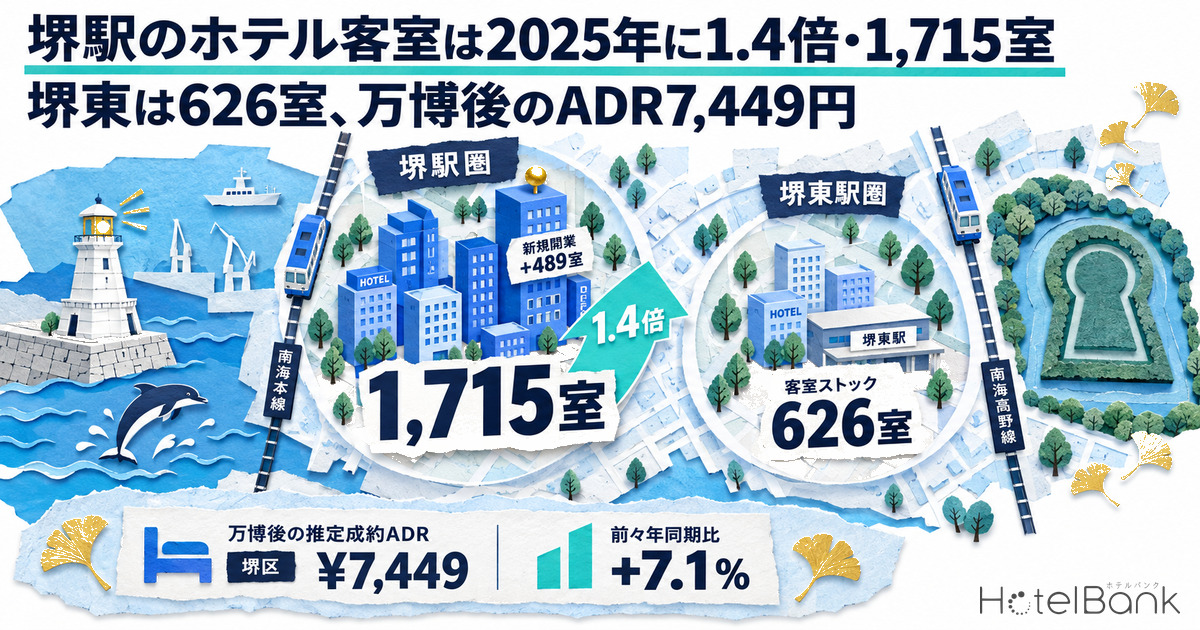
Two hotels with a combined 489 rooms opened back to back around Sakai Station on the Nankai Main Line in March 2025: Dorsett by Agora Osaka Sakai (ドーセット バイ アゴーラ 大阪堺, 321 rooms) on March 25, and Toyoko INN Sakai Ekimae (東横INN堺駅前, 168 rooms) three days later. Together they lifted the room stock within a 1km radius of the station from 1,226 to 1,715 rooms, a 1.40x increase. By contrast, the 1km zone around Sakaihigashi Station on the Nankai Koya Line, about 1.6km to the east, holds 626 rooms, only 70 more than at the end of 2019. This article compares the two stations in Sakai-ku, Sakai City, on land prices, floor-area ratios, ridership and resident population to explain why supply growth diverged, checks how the 489 new rooms have been absorbed using post-Expo estimated settled ADR, and identifies the price bands where development room remains.
Where earlier HotelBank work compared the price effect of new openings across four markets nationwide, and lined up stations across Japan by rooms per 10,000 daily passengers, this article applies those frameworks to two stations inside a single ward. It focuses narrowly on why supply concentrated at one of the two stations and how room rates moved afterwards.
Metric Definitions Used in This Article
- ADR (Average Daily Rate): An estimated settled rate (tax-excluded equivalent), calculated by applying segment-specific adjustment factors to the lowest-plan price level each hotel publishes on OTAs (per room, 2 guests per room, tax included). Checked against property-level results disclosed by listed hotel REITs (91 hotels, most recent 3 months), the median error is about 7%. These are estimates and differ from each hotel’s actual transaction prices and accounting figures. Area-level ADR is the median of the hotels covered (the level of a typical hotel in the area).
- OCC (Occupancy): The share of rooms sold out of the total rooms in the area (an estimate based on OTA sales inventory; consistency checks against REIT monthly disclosures show accuracy within a few points). As an estimate based on how OTA-listed inventory is sold through, it differs from each hotel’s actual overall occupancy. The 75% used in the model is an assumed full-year value, not a measured one.
- Room stock within 1km of a station: Hotels and business hotels with 10 or more rooms (excluding hostels, guesthouses and leisure hotels) located within a 1km radius of the station position in the MLIT Real Estate Information Library (Sakai Station = 34.5826°N, 135.4695°E; Sakaihigashi Station = 34.5748°N, 135.4848°E). Hotels operating at the end of each year (for 2026, as of the survey date of October 6) are counted; a building whose operator or brand changed is counted as one hotel, and hotels that closed are removed from that year. Room counts are values compiled by MetroEngines Research mainly from each hotel’s published figures, and cover only properties tracked by MetroEngines Research (not a complete census).
- Coverage of the rate distribution: Of the above, hotels with estimated settled ADR for 6 or more months between October 2025 and September 2026. Sakai Station zone N=10 hotels / 1,474 rooms; Sakaihigashi Station zone N=4 hotels / 572 rooms. Two hotels (295 rooms) outside the segments covered by estimated settled ADR are excluded from the distribution.
- Where listed prices are cited, they are per-room rates for 2 guests (tax included).
- Data sources: MetroEngines Research & Consulting; MLIT Real Estate Information Library; MLIT National Land Numerical Information; MIC/METI Economic Census
- — Sakai Station side up 1.40x: Rooms within 1km went from 9 hotels / 1,226 rooms at end-2024 to 11 hotels / 1,715 rooms after two openings in March 2025. The 489-room increase equals the two hotels’ combined room count.
- — Sakaihigashi side at 626 rooms: AB Hotel Sakaihigashi (128 rooms) took the zone to 683 rooms in 2020; one 57-room hotel then closed in January 2025, leaving 5 hotels / 626 rooms today.
- — Land 4.2x, floor-area ratio 2x: The official land price for station-front commercial land is ¥264,000/㎡ at Sakai Station versus ¥1.1 million/㎡ at Sakaihigashi. Designated floor-area ratios are 400% and 800%, so land cost per room differs by about 2.1x.
- — The 489 rooms are being absorbed: Sakai-ku’s estimated settled ADR averaged about ¥7,500 in April–September 2026. That is −22.0% against the Expo period a year earlier, but 7.1% above the same period two years ago, before the new supply.
- — The gap is the ¥8,000–12,000 band: Seven of the 10 hotels within 1km of Sakai Station cluster at ¥6,000–8,000, and none sit at ¥8,000–12,000. A simple model of a new 150-room build shows a 5.9–6.7% yield for a product that reaches the top of this band.
Sakai Station 1km Zone Rose from 1,226 to 1,715 Rooms — All 489 Added Rooms Came from Two March 2025 Openings
Start with the supply facts. At the end of 2019 there were 9 hotels with 1,226 rooms within a 1km radius of Sakai Station. That level was unchanged for five years through the end of 2024, then two hotels were added in March 2025 to bring the total to 11 hotels and 1,715 rooms. The 489-room increase is exactly the sum of Dorsett by Agora Osaka Sakai’s 321 rooms and Toyoko INN Sakai Ekimae’s 168 rooms, with no change at existing hotels. Before the start of this series, in September 2018, Kuretake Inn Nankai Sakai Ekimae (くれたけイン南海堺駅前, 122 rooms) also opened at the station’s east exit; counting that hotel and the two 2025 openings, 611 rooms were added in front of Sakai Station in roughly six and a half years.
Movement in the Sakaihigashi Station 1km zone was much smaller. It went from 5 hotels / 556 rooms at end-2019 to 6 hotels / 683 rooms when AB Hotel Sakaihigashi (128 rooms) opened in August 2020, then fell back to 5 hotels / 626 rooms when one 57-room hotel closed in January 2025. The net gain since end-2019 is 70 rooms (+12.6%), a clearly different trajectory from the +489 rooms (+39.9%) on the Sakai Station side.
| Year | Sakai Stn 1km: hotels | Sakai Stn 1km: rooms | Sakaihigashi Stn 1km: hotels | Sakaihigashi Stn 1km: rooms | Main changes |
|---|---|---|---|---|---|
| 2019 | 9 | 1,226 | 5 | 556 | — |
| 2020 | 9 | 1,226 | 6 | 683 | Sakaihigashi: AB Hotel Sakaihigashi (128 rooms) opened; one building rebranded (103 → 102 rooms) |
| 2021–2024 | 9 | 1,226 | 6 | 683 | No change in either zone |
| 2025 | 11 | 1,715 | 5 | 626 | Sakai: 2 hotels / 489 rooms opened; Sakaihigashi: 1 hotel / 57 rooms closed |
| 2026 (as of Oct 6) | 11 | 1,715 | 5 | 626 | No change in either zone |
Listing the hotels shows that on the Sakai Station side, 9 hotels are within 500m of the station and the remaining 2 are within 900m. On the Sakaihigashi side, 358 rooms are concentrated in the two hotels in front of the station, with three more scattered to the west.
| Station zone | Hotel | Rooms | Distance from station | Opened |
|---|---|---|---|---|
| Sakai | APA Hotel Sakai-Ekimae (アパホテル〈堺駅前〉) | 153 | approx. 100m | 2019 or earlier |
| Sakai | Toyoko INN Sakai Ekimae (東横INN堺駅前) | 168 | approx. 150m | March 28, 2025 |
| Sakai | Hotel Agora Regency Osaka Sakai (ホテル アゴーラ リージェンシー 大阪堺) | 241 | approx. 160m | 2019 or earlier |
| Sakai | Kuretake Inn Nankai Sakai Ekimae (くれたけイン南海堺駅前) | 122 | approx. 240m | September 2018 |
| Sakai | Dorsett by Agora Osaka Sakai (ドーセット バイ アゴーラ 大阪堺) | 321 | approx. 370m | March 25, 2025 |
| Sakai | Comfort Hotel Sakai (コンフォートホテル堺) | 119 | approx. 400m | 2019 or earlier |
| Sakai | Hotel Sunplaza Sakai Main Building (ホテルサンプラザ堺 本館) | 124 | approx. 440m | 2019 or earlier |
| Sakai | Hotel Sunplaza Sakai ANNEX (ホテルサンプラザ堺 ANNEX) | 89 | approx. 450m | 2019 or earlier |
| Sakai | Super Hotel Sakai Marittima (スーパーホテル 堺マリティマ) | 99 | approx. 480m | 2019 or earlier |
| Sakai | HOTEL IL GRANDIT | 35 | approx. 840m | 2019 or earlier |
| Sakai | Business Hotel New Ohama (ビジネスホテル ニュー大浜) | 244 | approx. 870m | 2019 or earlier |
| Sakaihigashi | AB Hotel Sakaihigashi (ABホテル堺東) | 128 | approx. 110m | August 17, 2020 |
| Sakaihigashi | Daiwa Roynet Hotel Sakaihigashi (ダイワロイネットホテル堺東) | 230 | approx. 280m | 2019 or earlier |
| Sakaihigashi | The Base Sakaihigashi Apartment Hotel (ザ・ベース・堺東・アパートメントホテル) | 54 | approx. 400m | 2019 or earlier |
| Sakaihigashi | Toyoko INN Sakaihigashi-eki (東横INN堺東駅) | 112 | approx. 500m | 2019 or earlier |
| Sakaihigashi | Hotel Aston Plaza Osaka Sakai (ホテルアストンプラザ大阪堺) | 102 | approx. 810m | October 1, 2020 (rebrand) |
Where the Two Hotels Were Built — A 1.25ha City-Owned Site and a Plot 3 Minutes from the Station’s East Exit
Looking at the land the 489 rooms were built on outlines why supply tilted toward Sakai Station. Dorsett by Agora Osaka Sakai stands within the Ohama Kitamachi City-Owned Land Utilization Project (大浜北町市有地活用事業), for which Sakai City publicly solicited developers. According to Sakai City’s published materials, in 2017 the city signed a basic agreement with a consortium led by Agora Hospitality Group Co., Ltd., which developed a hotel, a dolphin-interaction facility, restaurants and other facilities on a site of about 12,500㎡, holding the grand opening of the urban resort town “Porto Mare” (ポルトマーレ) on March 25, 2025. The draft contract issued with the solicitation assumed a fixed-term business land lease, meaning the framework let the developer secure a large site without buying the land.
The hotel has 11 floors above ground and 321 rooms; the operator’s release describes it as “the bayside hotel with the largest room count in Sakai City” (the company’s own claim). A May 2017 news report described the plan as 270 rooms opening in 2020, so the room count grew by 51 by opening. The hotel is about a 5-minute walk from Sakai Station on the Nankai Main Line and about 2 minutes from the Ohama exit of the Hanshin Expressway Route 4 Bayshore Line, and its harbor-view rooms facing the old Port of Sakai and a seaside terrace make it a different product from the existing station-front hotels.
The other opening, Toyoko INN Sakai Ekimae, opened with 168 rooms in Ebisujima-cho, a 3-minute walk from the east exit of Sakai Station. Toyoko Inn’s official announcement highlights access of 35 minutes to Kansai International Airport by airport express and 3 minutes by car from the Hanshin Expressway Ohama exit, pairing a 3-minute station walk with 15 parking spaces. Both sites are zoned commercial with a designated floor-area ratio of 400% and building coverage ratio of 80%, on the west and east sides of the station respectively.
Sakaihigashi Station 1km Zone at 626 Rooms — 128 Added in 2020, 57 Lost in 2025
On the Sakaihigashi side, there was only one new build in the seven years from end-2019. AB Hotel Sakaihigashi (128 rooms), which opened on August 17, 2020, is a limited-service hotel with a large public bath, about a 2-minute walk from the west exit of Sakaihigashi Station and right next to City Hall. According to building-plan data, the site is about 365㎡, with 12 floors above ground and total floor area of about 2,763㎡, stacking 128 rooms in a way that nearly uses up the 800% floor-area ratio designated for this station-front commercial land. The site is 1/34 the size of the city-owned land project area (about 12,500㎡) where Dorsett stands.
On October 1 of the same year, 2020, “Hotel 1-2-3 Sakai” in Omachi-higashi reopened under Kyoto Plaza Hotels’ operation as “Hotel Aston Plaza Osaka Sakai” (102 rooms). The building stayed the same; only the operator and brand changed. This article therefore counts it as one continuing hotel, not a net addition of rooms.
There was, however, one closure in 2025. Hotel Liberty Plaza (ホテルリバティプラザ) in Okinabashi-cho (57 rooms as tracked by MetroEngines Research), long known locally as Sakai’s first city hotel, was reported by local media in January 2025 to have closed. The loss of these 57 rooms took the Sakaihigashi Station 1km zone from 683 to 626 rooms.
The station itself is also changing. The Takashimaya Sakai store directly connected to Sakaihigashi Station closed on January 7, 2026, and in February 2026 Nankai Electric Railway announced plans to renovate the station building, the Nankai Sakaihigashi Building, into a commercial facility named “HiViE Sakaihigashi”. The “Life” supermarket on the ground floor is scheduled to open ahead of the rest in early December 2026 (announced July 2026), with the full grand opening planned for around spring 2027. The published materials make no mention of lodging use, so the large floor area directly connected to the station appears set to be revived as everyday-use retail. Nationwide cases of converting former department-store sites are reviewed in “Department Store Sites: 6 of 14 Go Hotel, ADR Needs 1.4-3.1x Market”.
Comparing the Two Stations in Numbers — Sakaihigashi Has 1.55x the Ridership and 4.2x the Land Price
How different are the two locations? Lining up ridership, resident population, land prices and floor-area ratios on the same radius reveals a picture that runs opposite to the supply trend: demand is larger at Sakaihigashi, and land there is far more expensive.
| Indicator | Sakai Stn (Nankai Main Line) | Sakaihigashi Stn (Nankai Koya Line) |
|---|---|---|
| Daily passengers (2023) | 35,058 | 54,459 |
| Same, vs. 2019 | 90.6% (2019: 38,712) | 90.1% (2019: 60,454) |
| Resident population within 1km (2025 estimate) | 29,934 | 34,159 |
| Same, 2040 outlook | −6.9% | −7.0% |
| Official land price, station-front commercial (Jan 1, 2026) | ¥264,000/㎡ (Sakaebashi-cho, +5.6% YoY) | ¥1,100,000/㎡ (Kitakawara-machi, +15.8% YoY) |
| Same, change since 2021 | +17.9% (¥224,000/㎡) | +50.1% (¥733,000/㎡) |
| Designated floor-area ratio at the same point | 400% | 800% |
| Rooms within 1km (October 2026) | 11 hotels / 1,715 rooms | 5 hotels / 626 rooms |
| Rooms per 10,000 daily passengers | 489 | 115 |
| Tsunami inundation forecast (station point) | 1.0–2.0m | Outside forecast zone |
Sakaihigashi Station handles 54,459 passengers a day, 1.55x Sakai Station’s 35,058. Both have recovered to about 90% of 2019 levels, so there is no difference in the degree of recovery. Even so, rooms per 10,000 daily passengers stand at 489 at Sakai Station versus 115 at Sakaihigashi, a 4.3x gap. Relative to rail usage, rooms are thick on the Sakai Station side, while Sakaihigashi is a station where rooms are thin for its ridership.
The underlying factor is land. The 2026 official land price in front of Sakaihigashi Station (Kitakawara-machi) is ¥1.1 million per ㎡, 4.2x the ¥264,000 in front of Sakai Station (Sakaebashi-cho), and the five-year increase since 2021 diverged widely at +50.1% versus +17.9%. Because the designated floor-area ratio is 800% at Sakaihigashi and 400% at Sakai, Sakaihigashi needs only half the site area for the same floor area, but land cost per room still works out about 2.1x higher. In addition, Sakaihigashi’s 800% zone covers only a few blocks in front of the station, so sizable sites rarely come to market. Large-scale supply materialized on the Sakai Station side because a 1.25ha city-owned site — a size that does not emerge from private transactions — was put out to public tender.
Resident population is similar, at 29,934 within 1km of Sakai Station and 34,159 within 1km of Sakaihigashi Station, and the 2040 outlooks are also level at −6.9% and −7.0%. Both stations are surrounded by urban districts of around 30,000 people, so there is little difference in the base of local lodging demand, such as visits to residents’ relatives or business visits to local companies. For Sakaihigashi Station, there is also an employment cluster of 641 establishments and 6,315 workers within 1km, 21.4% of them in office-type industries (MIC/METI Economic Census for Business Activity). As the administrative and business center where City Hall and financial institutions are concentrated, it is a location well placed to capture weekday business travel.
The two stations also differ in disaster exposure. According to the MLIT Real Estate Information Library, Sakai Station and its surroundings fall within zones with a tsunami inundation forecast of 0.3–2.0m and a storm-surge inundation forecast of 3m to under 5m, while Sakaihigashi Station lies outside the tsunami and flood forecast zones. A new build on the waterfront side would need to factor in design conditions such as placing power-receiving and transformer equipment and emergency generators on upper floors, which adds to development cost.
Were the 489 New Rooms Absorbed? — Post-Expo Sakai-ku ADR Is 7.1% Above Two Years Ago
Now to the demand side. The two openings came just before Expo 2025 Osaka, Kansai (April 13–October 13), and Sakai-ku’s estimated settled ADR was pushed up sharply during the Expo. The average for April–October 2025, covering the Expo period, was about ¥9,500, 37% above the roughly ¥6,900 average of the preceding 12 months (April 2024–March 2025), and it reached about ¥10,800 in September (N=16 hotels).
Once the Expo ended, rates came down, reaching about ¥6,500 in January 2026 (N=17 hotels). That was still 3.6% above the same month a year earlier (January 2025, about ¥6,300), so it did not fall below the pre-Expo level for the same month. The April–September 2026 average of about ¥7,500 is −22.0% against the same period a year earlier during the Expo (about ¥9,600), but +7.1% against the same period in 2024 (about ¥7,000), before the two hotels opened. Running the same comparison for Osaka Prefecture as a whole gives −29.3% YoY and +1.2% versus 2024, so Sakai-ku fell less than the prefecture and gained more over two years.
The latest 12-month average (October 2025–September 2026) was about ¥7,400, covering 16–17 hotels each month. The number of hotels covered rose from 16 to 18 in March 2025, which includes the effect of the two new hotels entering the dataset. Isolating only existing hotels with data both before and after the openings, the 8 hotels within 1km of Sakai Station had a median of about ¥6,900 in April–September 2024 and about ¥7,300 in the same period of 2026 (+6.6%), with 6 of the 8 above their level two years earlier. The 3 hotels within 1km of Sakaihigashi Station also rose, from about ¥8,600 to about ¥9,200 (+7.2%). Even after the station zone’s rooms grew by 40%, existing hotels’ rates sit higher than two years ago.
Occupancy tells a similar story. Sakai-ku’s occupancy (estimated, based on OTA-listed inventory) was 78.5% in August 2026 (11 hotels / 1,617 rooms, based on listings on major booking sites) and 77.2% in September (10 hotels / 1,616 rooms, same basis). The same metric for Osaka Prefecture as a whole was 80.8% in August (409 hotels / 58,700 rooms, same basis) and 80.4% in September (410 hotels / 59,647 rooms, same basis), so the gap with Sakai-ku is within 2–3 points. By day of week, Sakai-ku ran at 84.1% (August) and 81.3% (September) on Saturdays versus 79.1% and 77.6% Monday–Thursday, a small weekend–weekday gap. This metric is an estimate based on how OTA-listed inventory sells through and differs from each hotel’s actual overall occupancy, but tracking close to the prefectural average in the year after new supply indicates that the market has accepted the 489 rooms.
A Gap in the Price Ladder — No Hotel on the Sakai Station Side in the ¥8,000–12,000 Band
Next, where do the hotels in each zone sit on rate? Plotting the 14 hotels with an estimated settled ADR (12-month average) for October 2025–September 2026 by room count and rate, 7 of the 10 hotels within 1km of Sakai Station cluster in the ¥6,000–8,000 band. Toyoko INN Sakai Ekimae came in at about ¥7,800 in its first year, at the upper end of this core band. Above it there is a ¥4,800 gap up to Dorsett by Agora Osaka Sakai at about ¥12,600, with no hotel at all in the ¥8,000–12,000 band.
| Price band | Sakai Stn 1km zone | Sakaihigashi Stn 1km zone |
|---|---|---|
| Under ¥6,000 | 2 hotels / 368 rooms | — |
| ¥6,000–8,000 | 7 hotels / 785 rooms | 2 hotels / 214 rooms |
| ¥8,000–12,000 | 0 hotels | 2 hotels / 358 rooms |
| ¥12,000 and above | 1 hotel / 321 rooms | — |
| Total (median) | 10 hotels / 1,474 rooms (¥7,645) | 4 hotels / 572 rooms (¥8,482) |
The Sakaihigashi side looks different. The median of its 4 hotels is about ¥8,500, roughly ¥800 above the Sakai side (about ¥7,600), and the two station-front hotels at about ¥9,100 and about ¥11,900 sit in the ¥8,000–12,000 band that is empty on the Sakai side. In front of a station with heavy ridership and thin room supply, even limited-service hotels can sustain a step-up in rate. Note that one full-service hotel directly connected to Sakai Station (241 rooms) falls outside the segments covered by estimated settled ADR and is excluded from the distribution; its listed price (all-plan average, tax included) averaged about ¥27,400 over 12 months, forming a separate price tier.
Cluster¥6,000–8,000 band
7 hotels / 785 rooms on the Sakai side; 2 hotels / 214 rooms on the Sakaihigashi side. The core band where station-front limited-service hotels line up side by side; the 168 rooms opened in 2025 also joined it.
Room ①¥8,000–12,000 band, Sakai side
Currently 0 hotels. There is a ¥4,800 gap between the core band and the single large bayside hotel. Room remains for products that add a tier on top of the core band, such as a large public bath or larger rooms.
Room ②¥12,000 and above, Sakaihigashi side
Currently 0 hotels. The two station-front hotels operate at ¥9,000–12,000, and a station with 54,000 daily passengers still has no upper-band product.
Where to Put the Next 150 Rooms — A Simple Model Including Land Price and Rate
To test whether the price-band gap could support actual development, we model a new 150-room limited-service hotel. Assumptions: 18㎡ rooms, a 65% guestroom share of floor area (total floor area about 4,154㎡ = about 1,257 tsubo), full-year occupancy of 75%, and a GOP margin of 45%. The occupancy is an assumed value set in light of the fact that Sakai-ku’s August–September estimates (77–79%) come from a listed-inventory metric that tends to read high. For the GOP margin, the industry guideline for limited-service hotels is 40–60% (Relo Hotel Solutions), and Invincible Investment Corporation’s disclosed result for its 91 operating hotels was 38.9% (fiscal period ended December 2024); 45% was set as a conservative level for the early years of a new build.
Construction cost is shown in two stages. Stage 1 uses a 2025 cost of ¥2.405 million per tsubo for steel-frame hotels, as compiled by archi-book from MLIT’s Statistics on Building Construction Starts, giving a construction cost of about ¥3.02 billion for 150 rooms (about ¥20.15 million per room). Stage 2 assumes a 2027 construction start and 2029 opening, factoring in three years of +5% annual escalation to 2028, the midpoint of construction (×1.158), which raises the cost to about ¥3.50 billion (about ¥23.32 million per room). Land cost is a reference value obtained simply by applying the official land price for station-front commercial land on the assumption of using the full designated floor-area ratio: about ¥274 million on the Sakai side (about ¥1.83 million per room) and about ¥571 million on the Sakaihigashi side (about ¥3.81 million per room), a 2.1x difference.
| Item | A. Sakai side, middle of gap band | B. Sakai side, top of gap band | C. In front of Sakaihigashi Stn |
|---|---|---|---|
| Assumed ADR | ¥9,500 | ¥12,000 | ¥10,500 |
| Required site (floor-area ratio) | approx. 1,038㎡ (400%) | approx. 1,038㎡ (400%) | approx. 519㎡ (800%) |
| Land cost (official land price basis) | ¥274M | ¥274M | ¥571M |
| Rooms revenue (annual) | ¥390M | ¥493M | ¥431M |
| GOP (annual) | ¥176M | ¥222M | ¥194M |
| [2025 actuals basis] Construction cost | ¥3,022M | ¥3,022M | ¥3,022M |
| Total investment | ¥3,296M | ¥3,296M | ¥3,593M |
| GOP yield / simple payback | 5.3% / 18.8 yrs | 6.7% / 14.9 yrs | 5.4% / 18.5 yrs |
| [With construction-period inflation] Construction cost | ¥3,498M | ¥3,498M | ¥3,498M |
| Total investment | ¥3,772M | ¥3,772M | ¥4,069M |
| GOP yield / simple payback | 4.7% / 21.5 yrs | 5.9% / 17.0 yrs | 4.8% / 21.0 yrs |
Two points stand out from the model. First, the difference in land cost barely moves the yield. Land in front of Sakaihigashi Station costs 4.2x that in front of Sakai Station, but land accounts for only 7–8% of total investment on the Sakai side and 14–16% even on the Sakaihigashi side; construction makes up 80–90% of the investment. As a result, achieving ¥10,500 in front of Sakaihigashi Station (C) and ¥9,500 on the Sakai side (A) produce nearly identical yields of 5.4% and 5.3%. What separates development potential at the two stations is less the level of land prices than whether a site of the required size comes onto the market.
Second, it is the price band that determines the yield. Even on the Sakai side, a product that reaches ¥12,000 at the top of the gap band (B) yields 5.9–6.7%, more than a point above the 4.7–5.3% at the middle of the band at ¥9,500 (A). Dorsett by Agora Osaka Sakai achieving about ¥12,600 in its first year supports the view that an upper-band product can work in this location if it offers added value such as bay views and larger rooms. Rising construction costs raise the hurdle for new entrants, which also means slower growth in competition for hotels that have already opened.
| Item | Base case | ADR −10% | OCC −5pt | Both |
|---|---|---|---|---|
| Rooms revenue (annual) | ¥390M | ¥351M | ¥364M | ¥328M |
| GOP (annual) | ¥176M | ¥158M | ¥164M | ¥147M |
| GOP yield | 4.7% | 4.2% | 4.3% | 3.9% |
| Assumed ADR \ Full-year occupancy | 65% | 70% | 75% | 80% | 85% |
|---|---|---|---|---|---|
| ¥8,000 | 3.4% | 3.7% | 3.9% | 4.2% | 4.4% |
| ¥9,500 | 4.0% | 4.3% | 4.7% | 5.0% | 5.3% |
| ¥10,500 | 4.5% | 4.8% | 5.1% | 5.5% | 5.8% |
| ¥12,000 | 5.1% | 5.5% | 5.9% | 6.3% | 6.7% |
| ¥13,000 | 5.5% | 5.9% | 6.4% | 6.8% | 7.2% |
Moving rate and occupancy together, the GOP yield ranges from 3.4% to 7.2%. Of the 25 combinations, 15 reach 5.0% or more, and under the 75% full-year occupancy assumption the ADR needed to reach 5.0% is about ¥10,200. At ¥8,000, an extension of the Sakai Station zone’s core band (¥6,000–8,000), the yield stays at 4.4% even with occupancy raised to 85%; lifting the rate into the upper half of the gap band is the condition for a new build to secure an adequate yield.
*This is a simplified estimate; actual investment decisions require a detailed feasibility study. Land cost is a reference value obtained by simply applying the standard-site price from official land prices, and differs from actual transaction prices and from the floor-area ratio actually achievable given frontage-road and setback-plane restrictions. Non-room revenue, pre-opening costs, interest and taxes are not included.
Supply Pipeline and Ownership — No Further Projects Confirmed in Either Zone at Present
A word on future supply. In planning data based on building-confirmation applications as of the survey date (October 6, 2026), no new hotel projects with 10 or more rooms could be confirmed within 1km of Sakai Station or Sakaihigashi Station. The two March 2025 openings are therefore the last large-scale supply identifiable at this point. *Based on building-confirmation applications as of the survey date. Project and room counts are expected to rise as further applications are filed; please treat this as a floor for the confirmed pipeline at this point.
On ownership, none of the 16 hotels covered is held by any of seven listed hotel REITs: Ichigo Hotel REIT Investment Corporation (3463), Invincible Investment Corporation (8963), Nippon Hotel & Residential Investment Corporation (3472), Japan Hotel REIT Investment Corporation (8985), Hoshino Resorts REIT (星野リゾート・リート, 3287), Mori Trust REIT (8961) and Kasumigaseki Hotel REIT (401A) (ownership master of 300 properties, queried October 6, 2026). Precisely because this is an area where no holdings by these seven REITs have been confirmed, the fact that rate and occupancy track records are building up a year and a half after the two openings means more reference material will be available for future transactions and refinancing.
| Category | Confirmed facts | Points to consider |
|---|---|---|
| Market | Sakai-ku ADR −22.0% YoY against the Expo period, +7.1% vs. the same period two years earlier | 2025 was an exceptional year. Read the underlying trend against 2024, not year on year |
| Supply | Sakai Station 1km zone up 1.40x; no further projects confirmed in building-confirmation applications | Applications are filed 1–2 years before opening, so periodic rechecks are worthwhile |
| Demand base | Population within 1km of both stations about 30,000, around −7% by 2040 | Design products that capture stays from the Kansai Airport and Namba directions in addition to local demand |
| Construction | Steel-frame cost of ¥2.405M per tsubo (2025), +5% annual escalation assumed | Construction is 80–90% of investment. A difference in construction start date moves the yield by 0.6–0.9 points |
| Site conditions | Area around Sakai Station is in tsunami (0.3–2.0m) and storm-surge (3–5m) inundation forecast zones | Build in measures at the design stage, such as placing power-receiving equipment and emergency generators on upper floors |
Conclusion — Supply Was Decided Not by the Size of Demand, but by Whether Land Came onto the Market
To sum up, the divergence in supply growth between the two Sakai-ku stations cannot be explained by the scale of demand. Sakaihigashi Station has 1.55x the ridership and higher station-front rates, yet rooms increased on the Sakai Station side. The deciding factors were that a large 1.25ha city-owned site on the old Port of Sakai was put out to tender, and that station-front commercial land at Sakai cost a quarter of Sakaihigashi’s. While the area in front of Sakaihigashi Station allows intensive use at an 800% floor-area ratio, sizable sites rarely come up, and new construction since end-2019 has been limited to one 128-room hotel built on a 365㎡ site.
As for the 489 new rooms, despite the intervening exceptional year of the Expo, Sakai-ku’s estimated settled ADR is 7.1% above the same period two years earlier, and most existing hotels’ rates are also higher than two years ago. Estimated occupancy is tracking within 2–3 points of Osaka Prefecture as a whole, indicating the market has accepted the supply. The room that remains is in the ¥8,000–12,000 band on the Sakai Station side and the ¥12,000-plus band on the Sakaihigashi side.
The implication for operators and investors is that the next development opportunity will be determined less by “which station” than by “which band the product targets.” On the Sakai Station side, adding value that can aim at the top of the gap band is a better route to an adequate yield under today’s higher construction costs than adding more products in the core band. On the Sakaihigashi side, it is worth watching whether opportunities such as small station-front sites or conversions of existing buildings emerge in the run-up to spring 2027, when the station-building renovation is completed.
Related Articles
References and Sources
■ Data sources
Room stock covers 16 hotels / 2,341 rooms (hotels and business hotels with 10+ rooms) within a 1km radius of Sakai Station and Sakaihigashi Station (station positions from the MLIT Real Estate Information Library), compiled at each year-end and cross-checked against company disclosures. Rates are estimated settled ADR (Sakai-ku monthly: 15–18 hotels; hotel-level distribution: 14 hotels / 2,046 rooms with values for 6+ months between October 2025 and September 2026); occupancy is an estimate based on OTA-listed inventory (August–September 2026; Sakai-ku 10–11 hotels, Osaka Prefecture 409–410 hotels). Official land prices, designated floor-area ratios, station ridership and inundation forecasts are from MLIT; future population estimates are from the 250m mesh of the National Land Numerical Information; employment concentration is from the Economic Census for Business Activity.
■ Model assumptions
A new 150-room limited-service hotel with 18㎡ rooms, a 65% guestroom share of floor area (total floor area about 4,154㎡), full-year occupancy of 75% and a GOP margin of 45% — all assumed values. Construction cost is shown in two stages: a 2025 steel-frame hotel cost of ¥2.405 million per tsubo based on the Statistics on Building Construction Starts (a private-sector compilation), and the same with three years of +5% annual escalation to 2028. Land cost is a reference value applying the 2026 official standard-site land price on the assumption of using the full designated floor-area ratio. GOP yield is GOP ÷ total investment (land + construction); the sensitivity matrix holds the Sakai-side total investment fixed at ¥3,772 million and varies only ADR and occupancy.
■ Limitations
Estimated settled ADR and occupancy are estimates based on public OTA information and differ from each hotel’s actual transaction prices and occupancy. April–October 2025 coincides with Expo 2025 Osaka, Kansai, so year-on-year comparisons do not reflect the underlying trend. The price-band distribution covers only 10 hotels in the Sakai Station zone and 4 in the Sakaihigashi Station zone, so a single hotel’s movement can change the count in each band. The model excludes non-room revenue, pre-opening costs, interest, taxes and FF&E replacement, and GOP yield is a different metric from NOI yield or IRR. The supply pipeline is based on building-confirmation applications as of the survey date (October 6, 2026) and does not reflect later applications.
■ Market data
- MetroEngines Research & Consulting — Room stock within 1km of each station (N=16 hotels, 2,341 rooms); estimated settled ADR (Sakai-ku 15–18 hotels per month; hotel level N=14 hotels); estimated occupancy (Sakai-ku 10–11 hotels; Osaka Prefecture 409–410 hotels)
■ Government statistics and public data
- MLIT Real Estate Information Library — Official land prices (January 1, 2026), zoning, station ridership, tsunami / storm-surge inundation forecast zones
- MLIT National Land Numerical Information — Future population estimates by 250m mesh
- MIC / METI “2021 Economic Census for Business Activity”
- Sakai City “Ohama Kitamachi City-Owned Land Utilization Project” / same, “Fixed-Term Business Land Lease Agreement (draft)”
- MLIT “Statistics on Building Construction Starts” (construction cost per tsubo) / MLIT “Building Dynamics Statistics” (building plans)
■ REIT and industry reports
- Invincible Investment Corporation “Hotel Portfolio” (GOP margin of 38.9% for 91 operating hotels, fiscal period ended December 2024)
- Relo Hotel Solutions “What is GOP?” (GOP margin guidelines by hotel type)
- archi-book “Construction Cost by Structure Based on Building Construction Starts Statistics (2025 edition)”
■ News and press releases
- Agora Hospitality Group, “‘Dorsett by Agora Osaka Sakai’ Opens Today — The Bayside Hotel with the Largest Room Count in Sakai City” (March 25, 2025)
- Sakai City, “[Old Port of Sakai Area] Urban Resort Town ‘Porto Mare’ Holds Grand Opening” (March 25, 2025)
- Nikkei, “270-Room Hotel West of Sakai Station: Agora to Open in 2020, ¥13 Billion Project” (May 2017)
- Toyoko Inn official site, “Toyoko INN Sakai Ekimae” / Toyoko Inn official X (March 28, 2025)
- TRAICY, “Toyoko Inn to Open ‘Toyoko INN Sakai Ekimae’ on March 28” (January 14, 2025)
- AB Hotel Sakaihigashi official site / Sakai Tourist Guide, “AB Hotel Sakaihigashi”
- Kyoto Plaza Hotels, “Seventh Hotel Rebrands and Opens in Sakai City: ‘Hotel Aston Plaza Osaka Sakai'” (September 2020)
- Gogai NET Sakai-ku / Nishi-ku, “‘Hotel Liberty Plaza’ Has Closed” (January 31, 2025)
- Nankai Electric Railway, “New Commercial Facility ‘HiViE Sakaihigashi’ Directly Connected to Sakaihigashi Station to Hold Full Grand Opening in Spring 2027” (February 24, 2026)