

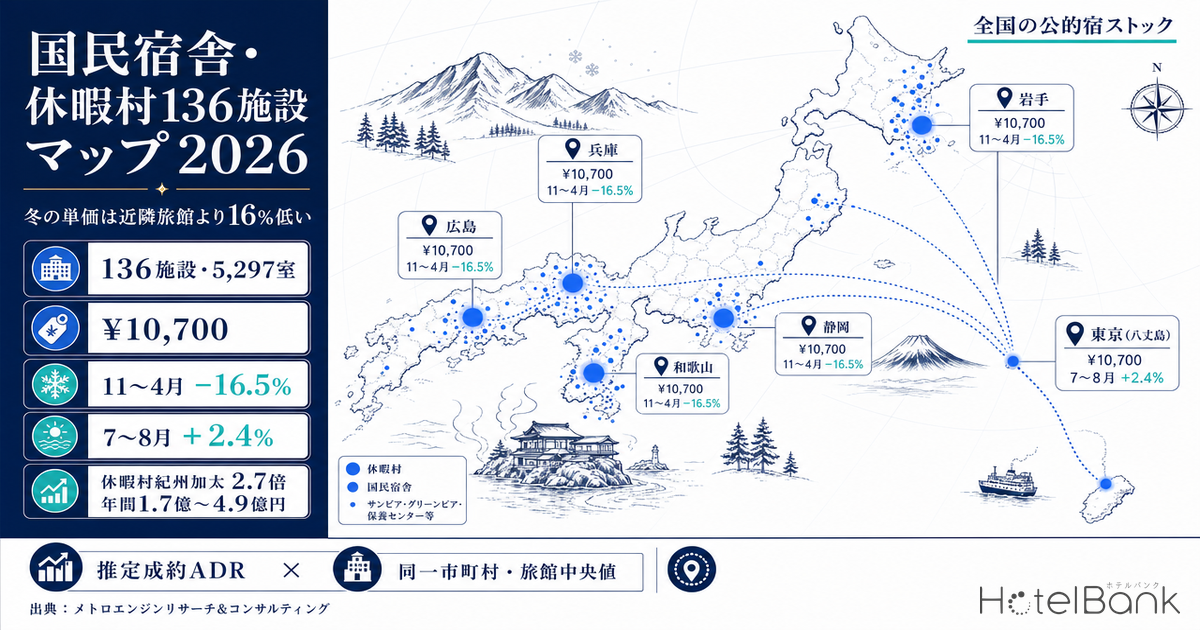
Lodging built by Japan’s municipalities and public bodies — the Kyukamura (National Park Resort Villages), the Kokumin Shukusha (national people’s lodges), and the Sunpia, Greenpia and hoyo recreation centers that grew out of the former public pension and employment-insurance welfare programs — still hold sizeable blocks of rooms on prime scenic sites. Extracting them by property name, MetroEngines Research & Consulting found 136 properties with 5,297 rooms registered as operating (room counts are a floor). This article maps that public lodging stock by prefecture, compares each property’s estimated settled ADR against the median for ryokan in the same municipality, and — with every assumption disclosed — puts a conservative figure on the rate upside that a change of operator or a rebrand could unlock.
- — 136 properties and 5,297 rooms spread across 41 prefectures. Hyogo (345 rooms), Iwate (319) and Shizuoka (279) lead; Tokyo has only 10 rooms, on Hachijojima. The stock is concentrated in scenic locations.
- — The median estimated settled ADR is ¥10,700 (78 properties). Against the median for ryokan in the same municipality, the stock priced below the market in 10 of the last 12 months.
- — The gap is seasonal and asymmetric: −16.5% on average in November–April, but +2.4% in high summer (July–August). The room for improvement lies in pricing for winter and the shoulder seasons.
- — Properties that received renovation investment sit far above their markets: Kyukamura Kishu-Kada at 2.7× the municipal median, Kokumin Shukusha Ojo at 2.1×.
- — Improving rate positioning alone is worth ¥170M–¥487M a year (¥47,000–¥135,000 per room). This conservative estimate excludes occupancy gains and non-room revenue.
Metric Definitions Used in This Article
- ADR (Average Daily Rate) = an estimated settled rate (tax-exclusive equivalent), calculated by applying a segment-specific adjustment factor to each property’s lowest published plan on OTAs and other channels (per room, 2 guests, tax-inclusive). Checked against property-level results disclosed by listed hotel REITs (91 properties, most recent 3 months), the median error is about 7%. These are estimates and differ from each property’s actual achieved rates and accounting figures. Area-level ADR is the median of the properties covered (the level of a typical property in the area).
- Listed price = the average of all plans published on OTAs and other channels (per room, 2 guests, tax-inclusive). Because it spans everything from room-only to meal-inclusive plans, it runs higher than the estimated settled ADR.
- OCC (Occupancy Rate) = rooms sold as a share of total rooms in the area (an estimate based on OTA sales inventory). The estimates in this article use the nationwide ryokan room occupancy rate from the Japan Tourism Agency’s Overnight Travel Statistics Survey as the baseline assumption.
- Data sources = MetroEngines Research & Consulting; Japan Tourism Agency, Overnight Travel Statistics Survey; published materials from local governments and operating bodies.
What We Counted — How the Sample of 136 Properties and 5,297 Rooms Was Built
There is no single nationwide register of public lodging. Management is split: the Kyukamura are run by the Kyukamura Association (a general incorporated foundation), public Kokumin Shukusha by individual local governments together with the National Lodging Association of Japan (Kokumin Shukusha Kyokai), and the former Sunpia and Greenpia facilities by local governments or the private companies that took them over. For this article we therefore searched the master database of roughly 168,000 Japanese lodging properties tracked by MetroEngines Research & Consulting, extracting records registered as operating whose names contain “Kyukamura” (休暇村), “Kokumin Shukusha” (国民宿舎), “Sunpia” (サンピア), “Greenpia” (グリーンピア) or “Hoyo Center” (保養センター).
| Group | Properties | Rooms (floor) | Of which listed in last 3 months | Median est. settled ADR |
|---|---|---|---|---|
| Kyukamura | 37 | 2,194 | 35 properties / 2,130 rooms | ¥13,900 |
| Kokumin Shukusha | 73 | 1,936 | 45 properties / 1,252 rooms | ¥8,900 |
| Sunpia, Greenpia, recreation centers, etc. | 26 | 1,167 | 15 properties / 754 rooms | ¥9,800 |
| Total | 136 | 5,297 | 95 properties / 4,136 rooms | ¥10,700 |
Source: MetroEngines Research & Consulting (name-based extraction, N=136 properties). Estimated settled ADR is the median of property-level averages over the last 12 months (September 2025–August 2026), N=78 properties.
So that readers can reproduce the result, four assumptions behind this count need to be disclosed.
1. Because the extraction is name-based, it may include spelling variants, annexes and unrelated properties with similar names. Of the 37 records containing “Kyukamura”, the Kyukamura Association’s official website lists 35 properties it operates. The extraction also picks up properties that carry “Kyukamura” in their names but are not run by the association, such as Fuji Midori no Kyukamura (Narusawa, Yamanashi), Nakasatsunai Farm Village Ferien Dorf (Nakasatsunai, Hokkaido), Ontake Kyukamura Central Lodge (Otaki, Nagano) and Hotaru no Sato Kyukamura (Nobeoka, Miyazaki).
2. Records whose closure was confirmed in official information were excluded. At the time of extraction, Kyukamura Unzen (Unzen, Nagasaki) still appeared in the name data, but as the Kyukamura Association announced, it ceased operating on March 31, 2021, so it is not among the 136 properties above.
3. Room counts are a floor. Some properties’ room counts in the master data have not been updated. Kokumin Shukusha Matsushiro-so (Nagano City), for example, added a new wing in a full renovation completed in February 2021 and, according to Nagano City, now has 44 rooms, yet our master data still holds the pre-renovation figure of 35. Read the 5,297-room total as “at least this many.”
4. Public and privately run Kokumin Shukusha are mixed together. The National Lodging Association’s 2025 guidebook lists 42 public Kokumin Shukusha (51 as of 2023). Our 73 extracted records therefore include a considerable number of former public facilities that passed to private owners and kept only the name. This article treats both together as “where the public lodging stock stands today.”
National Map — Concentrated in Hyogo, Iwate, Shizuoka and Hiroshima, Spread Across 41 Prefectures
The 136 properties are spread across 41 prefectures. By room count, Hyogo (345 rooms, 7 properties), Iwate (319 rooms, 6 properties) and Shizuoka (279 rooms, 6 properties) lead, followed by Hiroshima (245 rooms, 7 properties) and Niigata (245 rooms, 4 properties). Nor is the stock concentrated in the big metropolitan areas: Tokyo has only 10 rooms, on Hachijojima, and there are none in central Osaka, Kyoto, Kanagawa or Aichi. Both the national resort village (Kyukamura) program and the Kokumin Shukusha program were built on the idea of placing recreation bases for the public in natural parks, on coastlines and by lakes, and half a century on, that siting policy is still etched into how the stock is distributed.
Source: MetroEngines Research & Consulting (N=136 properties)
Source: MetroEngines Research & Consulting (name-based extraction, N=136 properties, 5,297 rooms)
The groups also differ in character. The Kyukamura are large, averaging 59 rooms per property, and their 37 properties account for 2,194 rooms. The 73 Kokumin Shukusha have 1,936 rooms, or 27 rooms per property — small, municipality-level facilities thinly spread across the country. The Sunpia/Greenpia group has 1,167 rooms across 26 properties, or 45 rooms per property. Given that Japan has 13,425 onsen inns across 2,839 hot-spring areas, 5,297 rooms of public lodging stock is not dominant in volume. Its distinctive value lies elsewhere: properties with sizeable room counts and facilities such as large communal baths and dining halls, secured in a limited number of sites in hot-spring towns and national parks.
Rate Positioning — Below the Nearby Ryokan Median in 10 of the Last 12 Months
This is the core question: where do public lodging rates sit in the market today? As the benchmark we used the median estimated settled ADR of ryokan in the same municipality. Prefecture averages are skewed by famous hot-spring resorts, so we went down to the municipal level at which properties actually compete, and by restricting the comparison to ryokan we also align meal conditions, since two meals included is the norm. The sample is the 78 properties (3,595 rooms) for which we can calculate an estimated settled ADR and whose municipality has at least three ryokan-category properties.
Source: MetroEngines Research & Consulting (public lodging stock N=74–78 properties; same-municipality ryokan N=40–42 municipalities, monthly)
A clear seasonal outline emerges. In 2026 the stock sat 15–18% below the nearby ryokan median from winter into spring — January −18.4%, February −16.7%, March −17.4%, April −15.0% — but beat the market in August at +9.3%. 2025 followed the same shape, with July at +7.6% and August at +4.6%, giving a clear asymmetry: +2.4% on average in high summer (July–August) versus −16.5% on average in November–April. In the peak season, when family summer-holiday demand is concentrated, public lodging commands rates at or above nearby ryokan, so its pulling power is proven. The headroom lies in pricing for winter and the shoulder seasons, when the market as a whole is raising rates.
A cross-sectional view confirms the pattern. On property-level averages over the last 12 months, 26 of 44 properties were below their same-municipality ryokan median, and the overall median gap was −5.5%. By group, Kyukamura were −3.0% (N=17), Kokumin Shukusha −12.1% (N=18) and the Sunpia/Greenpia group +6.6% (N=9). Monthly, the stock was below the benchmark in 10 of the last 12 months, and in those months the average shortfall was about ¥1,600 per room per night.
Source: MetroEngines Research & Consulting (N=78 properties; circle size = number of reviews)
Plotting room count against rate shows most of the public lodging stock clustered at 20–80 rooms and an estimated settled ADR of ¥5,000–15,000. From an investor’s point of view, this band is where properties have enough rooms for economies of scale to start working, yet rates remain at or below the market’s middle. Above ¥18,000, properties such as Kyukamura Nyuto Onsenkyo (休暇村乳頭温泉郷; Semboku, Akita; 38 rooms), Kyukamura Kishu-Kada (休暇村紀州加太; Wakayama City; 72 rooms) and Kokumin Shukusha Hotel Takachiho (国民宿舎ホテル高千穂; Takachiho, Miyazaki; 39 rooms) break away from the pack — so even with the same institutional origins, the rate range spans more than threefold. What creates that gap is the subject of the next section.
Source: HotelBank Editorial Team research (113 properties with 50+ reviews)
What the Outperformers Share — Ten Years After Renovation, Rates at More Than Twice the Local Level
Line up the properties that sit well above their municipal benchmark and a common thread appears: the leaders all received substantial renovation investment within the past ten years. The framework for deciding whether to renovate or rebuild is set out in Japan’s Pre-1981 Hotel Stock: 236k Rooms — Retrofit or Rebuild.
| Property (location, rooms) | Est. settled ADR | Municipal median | Gap | Guest rating | Recent investment / features |
|---|---|---|---|---|---|
| Kyukamura Kishu-Kada (休暇村 紀州加太) (Wakayama City, 72 rooms) | ¥20,200 | ¥7,500 | +170.7% | 4.57 (N=4,567) | Renovated July 2016; added a panoramic open-air bath and a “silky” bath, moving to a two-bathhouse layout |
| Kokumin Shukusha Ojo (国民宿舎 大城) (Kudamatsu, Yamaguchi, 37 rooms) | ¥13,200 | ¥6,300 | +110.5% | 4.44 (N=2,298) | Renovated 2016; every room has an ocean view, on Kasado Island |
| Kokumin Shukusha Senjoen (国民宿舎 千畳苑) (Hamada, Shimane, 31 rooms) | ¥14,000 | ¥7,100 | +97.1% | 4.53 (N=1,828) | Hilltop site overlooking the Sea of Japan |
| Kokumin Shukusha Sunrise Kujukuri (国民宿舎サンライズ九十九里) (Kujukuri, Chiba, 94 rooms) | ¥17,400 | ¥9,200 | +89.0% | 4.21 (N=3,456) | Large-scale beachfront property |
| Kyukamura Nyuto Onsenkyo (休暇村 乳頭温泉郷) (Semboku, Akita, 38 rooms) | ¥21,200 | ¥12,800 | +66.0% | 4.47 (N=3,288) | Part of the Nyuto Onsen cluster; reviews often mention the open-air bath and spring water |
| Kyukamura Okunoshima (休暇村 大久野島) (Takehara, Hiroshima, 65 rooms) | ¥12,200 | ¥7,600 | +60.2% | 4.19 (N=6,399) | The whole island is a tourist attraction; most reviews of any property in the stock |
| Kokumin Shukusha Hotel Takachiho (国民宿舎ホテル高千穂) (Takachiho, Miyazaki, 39 rooms) | ¥24,900 | ¥16,200 | +54.2% | 4.35 (N=2,084) | Central location for Takachiho Gorge sightseeing |
| Kokumin Shukusha Sun Road Kibiji (国民宿舎 サンロード吉備路) (Soja, Okayama, 39 rooms) | ¥12,900 | ¥8,500 | +53.1% | 4.31 (N=3,383) | High share of mentions (21.6%) for its all-you-can-drink plans |
| Kokumin Shukusha Matsushiro-so (国民宿舎 松代荘) (Nagano City, 35 rooms*) | ¥14,600 | ¥11,200 | +30.5% | 4.52 (N=2,214) | Full renovation completed February 2021; project cost ¥79.587M, including a new wing and expanded baths |
| New Greenpia Tsunan (ニュー・グリーンピア津南) (Tsunan, Niigata, 146 rooms) | ¥16,300 | ¥13,800 | +17.8% | 2.60 (N=2,959) | Largest property in the stock; basic agreement for transfer to a private owner signed in 2025 |
*Matsushiro-so’s room count is our master-data figure; Nagano City reports 44 rooms after the renovation. ADR is the average over the last 12 months (September 2025–August 2026), rounded to the nearest ¥100. The benchmark is the median estimated settled ADR of all property types in the same municipality (3 or more properties). Source: MetroEngines Research & Consulting; guest ratings from HotelBank Editorial Team research.
Kyukamura Kishu-Kada marked the tenth anniversary of its renovation in July 2026. The renovation added an outdoor panoramic open-air bath and a “silky” bath, and switched to running two bathhouses, “Kitan” and “Tenshu,” alternating daily between men and women. An analysis of 780 guest reviews (last 24 months) shows meals mentioned in 41.8% (300 of 326 positive), room views in 30.6% (239 of 239 positive) and views from the baths in 20.3% (158 of 158 positive) — the very elements built in by the renovation have become the axes of guest evaluation. The median estimated settled ADR for Wakayama City as a whole is ¥7,500 (N=44 properties); this property achieves ¥20,200, 2.7 times the level of its own market.
Kokumin Shukusha Ojo also reaches the tenth anniversary of its 2016 renovation and is running commemorative promotions in 2026. Making the most of its all-ocean-view layout, it achieves ¥13,200 against Kudamatsu’s median of ¥6,300 — 2.1 times. In Nagano City, Matsushiro-so carried out a renovation project costing ¥79.587M in total between November 2018 and March 2021, adding a new guest-room wing and expanding its day-use hot-spring baths. Its post-renovation estimated settled ADR of ¥14,600 is 10.6% above the Nagano City ryokan median of ¥13,200. Spring-water quality accounts for 22.0% of review mentions, and its “Golden Water” (Kogane no Yu) branding stands out as a clear product axis.
In other words, the main driver of the threefold rate range across the public lodging stock is not the quality of location but whether facilities have been renewed, and whether the product axis created by that renewal has been translated into price. Capital expenditure at the five listed hotel REITs, compiled from their IR disclosures, runs ¥130,000–¥620,000 per room per year; Matsushiro-so’s project cost divided by room count (about ¥1.81M per room on 44 rooms) is equivalent to one full major-renovation cycle at a REIT. The relationship between renovation investment and rate position can serve as a replicable indicator in investment decisions.
Five Operator Transfers — Properties That Stopped Listing Are Preparing Their Next Form
Of the 136 extracted properties, 95 were confirmed as listed on OTAs or other channels in the last three months (check-in dates from June 2026 onward). For the remaining 41, the absence of a listing cannot be treated as evidence of operating status: a property may have shifted to direct sales centered on its own website, or it may be closed for renovation or in the middle of an operator transfer. Tracing published materials, we repeatedly find cases where the point at which listings stopped coincides with a local government starting procedures to bring in the private sector. For corporate-owned retreats, how far their acquisition-cost advantage carries through to yield is estimated for five hot-spring and highland areas in Corporate Retreat Conversions: 8.27% GOP Yield Across 5 Onsen Areas.
| Property (municipality, size) | Published history | Last listing seen in our data |
|---|---|---|
| Kokumin Shukusha Sun Hotel Koromogawa-so (国民宿舎サンホテル衣川荘) Oshu, Iwate · 48 rooms | Ceased operating as a city-run facility in September 2020. Transferred to a private operator through a public proposal process in July 2022 and, after about three years of renovation, opened on April 25, 2025 as “Oshu-Hiraizumi Onsen Ryokan ITSUMU” with 42 rooms. Rates are ¥26,000–35,000 per person per night with two meals, excluding tax. | November 2020 |
| Kokumin Shukusha Niji no Matsubara Hotel (国民宿舎虹の松原ホテル) Karatsu, Saga · 58 rooms | Operated since 2023 by Village Inc., a private company based in Shizuoka Prefecture, as “Niji no Matsubara Hotel The Beach”; it posted a single-year operating surplus in FY2024. Karatsu City ran a market-sounding survey on a transfer to private ownership through August 2025 and planned a public tender from that autumn onward. | March 2023 |
| New Greenpia Tsunan (ニュー・グリーンピア津南) Tsunan, Niigata · 146 rooms | The town announced plans to sell the land and buildings in May 2025. Two companies bid, and in July preferred negotiation rights were granted to Intrance (Shibuya, Tokyo). After briefings for residents, a basic agreement for the property’s revitalization was signed on October 10. | Still listed |
| Kokumin Shukusha Akatombo-so (国民宿舎赤とんぼ荘) Tatsuno, Hyogo · 18 rooms | For this property, whose accommodation operations are suspended, the city ran a market-sounding survey on bringing in private-sector capital, covering options up to and including the designated-manager system, sale of the buildings and Park-PFI. A project period of up to 20 years is envisaged. | March 2021 |
| Kyukamura Nasu (休暇村那須) Nasu, Tochigi · 56 rooms | Opened in 1972 as Nasu National Resort Village. After 52 years of operation it closed temporarily on June 30, 2025, and reconstruction began on July 1. Reopening is planned for around autumn 2027 (self-funded reinvestment by the Kyukamura Association). | June 2025 |
Source: published materials from local governments and operating bodies, and press reports (see the source list at the end of the article); last-listing data from MetroEngines Research & Consulting
Setting the five cases side by side shows at least three models for renewing public lodging stock. First, the transfer model, in which ownership itself moves to the private sector (Oshu, Tsunan). Second, the designated-manager / operating-contract model, in which the local government keeps ownership but hands operations to a private company, sometimes as a staged step toward a transfer (Karatsu). Third, the rebuild and reinvestment model carried out by the operating body itself (Kyukamura Nasu). Some municipalities, like Tatsuno, start one step earlier by laying out designated management, sale and Park-PFI and asking the market for its views, and there is ample scope to weigh these options against the ADR a hotel would need to justify a 20-year Park-PFI permit.
Oshu’s ITSUMU is instructive on the rate side. It cut the former Koromogawa-so’s 48 rooms to 42 and relaunched at ¥26,000–35,000 per person per night with two meals, excluding tax. Converted to two guests per room, that is ¥52,000–70,000 per room excluding tax — a product in a completely different range from the median estimated settled ADR of the public lodging stock we track (¥10,700). That said, this is the result of a three-year full renovation, a reduced room count and a rebuilt brand, and is not a figure that can be applied directly to existing stock. We have also measured that newly opened hotels take a median of two months for ADR to stabilize, but note that for rebrand projects the ramp-up depends on how thoroughly the product has been designed.
Upside Estimate — ¥170M–¥487M a Year, ¥47,000–¥135,000 per Room
Finally, we estimate the upside if an operator transfer or facility renewal shifts the stock’s rate position. To avoid arbitrariness, every assumption is disclosed and the results are shown as a conservative range.
| Item | Setting | Rationale |
|---|---|---|
| Properties covered | 78 properties, 3,595 rooms | Properties for which an estimated settled ADR could be calculated — limited, out of the 136 name-extracted properties, to those where both listings and prices are observable |
| Rate benchmark | Median estimated settled ADR of ryokan in the same municipality | Limited to the municipal level because prefecture averages are skewed by famous hot-spring resorts; restricting to ryokan absorbs differences in meal conditions |
| Months counted | The 10 of the last 12 months in which the stock was below the benchmark | September 2025–August 2026. The two months above the benchmark (October 2025 and August 2026) are not added |
| Gap | About ¥1,600 per room per night (average of the months below benchmark) | Difference between monthly medians. −16.5% in November–April, +2.4% in July–August |
| Share of gap closed | 25% / 33% / 50% | No assumption of fully catching up with the benchmark — only a partial approach is assumed |
| Occupancy | 38.4% / 45% / 55% | 38.4% is the nationwide ryokan room occupancy rate for full-year 2025 (preliminary) from the Japan Tourism Agency’s Overnight Travel Statistics Survey; 45% and 55% are added as post-renovation assumptions |
Source: MetroEngines Research & Consulting; Japan Tourism Agency, Overnight Travel Statistics Survey (full-year 2025, preliminary)
Source: MetroEngines Research & Consulting (78 properties, 3,595 rooms; occupancy is an assumption based on Japan Tourism Agency statistics)
| Scenario | Full-year 2025 OCC 38.4% JTA preliminary / published Feb 2026 | Full-year OCC 45% Post-renovation assumption | Full-year OCC 55% Post-renovation assumption |
|---|---|---|---|
| Close 25% of the gap | +¥170M | +¥199M | +¥243M |
| Close 33% of the gap | +¥224M | +¥263M | +¥321M |
| Close 50% of the gap | +¥340M | +¥398M | +¥487M |
Total for 78 properties and 3,595 rooms, annual basis. Source: MetroEngines Research & Consulting
Even the most conservative combination (the Japan Tourism Agency’s full-year 2025 preliminary occupancy of 38.4%, published in February 2026, with only 25% of the gap closed) yields ¥170M a year; the middle combination (a post-renovation full-year occupancy of 45%, with 33% closed) yields ¥263M; and the upper end reaches ¥487M. Per room, that is a range of ¥47,000–¥135,000 a year. Set against the REIT capital expenditure discussed in the previous section (¥130,000–¥620,000 per room per year), improving rate positioning alone would roughly cover the lighter end of the annual burden of renewal investment.
· The effect of higher occupancy (only rates are moved; any occupancy gain from a rebrand is not added)
· Non-room revenue such as day-use bathing, banquets and restaurants (many public lodging properties have large communal baths and dining halls, a revenue source that cannot be ignored in practice)
· Renovation costs, the cost of switching operating structures, and opportunity losses during closures
· The 41 properties with no confirmed listing (if operable stock among them returns to service, the base grows)
Each of these can push the result up or down, so an actual investment decision requires a property-specific feasibility study.
Conclusion — The Headroom Lies in Winter Pricing and a Redefined Product Axis
We have examined Japan’s public lodging stock of 136 properties and 5,297 rooms from two angles: its distribution by prefecture and its rate positioning. The findings come down to three points.
First, pulling power is already proven. In high summer (July–August), the stock’s estimated settled ADR is on average 2.4% above the same-municipality ryokan median, and its median overall guest rating of 4.05 is on par with the market. The advantage of location and facilities — sizeable room counts and large baths on prime scenic sites — still works.
Second, the headroom is concentrated in winter and shoulder-season pricing. The rate position in November–April averages −16.5%, a muted response in the part of the year when the market as a whole raises rates. Put the other way, simply redrawing the annual price curve around demand periods leaves room for improvement that requires no capital investment. An approach that rebuilds rate-setting from the guest mix is a particularly good fit for public lodging, where families make up a high share of guests.
Third, properties that have renewed their facilities open up rates of more than double. Kyukamura Kishu-Kada (renovated 2016) is at 2.7 times its municipal median, Kokumin Shukusha Ojo (renovated 2016) at 2.1 times, and Kokumin Shukusha Matsushiro-so (renovated 2021, project cost about ¥80M) 10.6% above nearby ryokan. The product axes created by renovation — a panoramic open-air bath, all ocean-view rooms, spring-water quality — have become the axes of review mentions and have been translated into price. With 64.5% of Japan’s hotel rooms in properties opened in 2006 or earlier, renewing the public lodging stock is part of the industry-wide theme of facility renewal.
The practice of operator transfer is diversifying — the transfer model (Oshu, Tsunan), the staged move from an operating contract toward a transfer (Karatsu), and self-funded reinvestment by the operating body (Kyukamura Nasu) — and some local governments are starting by laying out options that include Park-PFI. The 41 properties whose listings have stopped are not “vanished stock”; many are at the stage of preparing their next form. The 5,297 rooms secured on prime scenic sites are supply that will return to the market over the next few years, and they are worth tracking from the investment and development side.
⚠ About the data observation date: The estimated settled ADR in this article is an estimate based on monthly data finalized as of August 2026 and differs from each property’s actual achieved rates and accounting figures. Listing status also changes daily according to each property’s sales policy. The absence of a confirmed listing does not indicate operating status; always check each property’s official announcements for its individual operating status.
Related Reading
- Corporate Retreat Conversions: 8.27% GOP Yield Across 5 Onsen Areas
- Japan’s Pre-1981 Hotel Stock: 236k Rooms, 19.1% — Retrofit or Rebuild
- 226k Hotel Rooms in 32 Regional Cities: 42.7% Built Before 1996
References and Sources
■ Data sources
Records registered as operating whose names contain “Kyukamura”, “Kokumin Shukusha”, “Sunpia”, “Greenpia” or “Hoyo Center” were extracted from the master database of roughly 168,000 Japanese lodging properties tracked by MetroEngines Research & Consulting (N=136 properties, 5,297 rooms). Estimated settled ADR was calculated from each property’s history of published OTA prices (January 2024–August 2026) (N=78 properties). The benchmark medians of estimated settled ADR by municipality and property type are municipal-level aggregates for the same period (ryokan category, N=40–42 municipalities). The occupancy assumption is the Japan Tourism Agency’s Overnight Travel Statistics Survey, full-year 2025 preliminary figure. Reviews are guest ratings and mention-tag analysis for the last 24 months (HotelBank Editorial Team research). Operator-transfer cases are based on published materials from local governments and operating bodies and on press reports.
■ Estimate assumptions
Covers the 78 properties (3,595 rooms) for which an estimated settled ADR could be calculated. The gap is the average across the 10 of the last 12 months (September 2025–August 2026) in which the stock was below the same-municipality ryokan median (about ¥1,600 per room per night); the two months above it (October 2025 and August 2026) are not added. Annual revenue gains were calculated on a 3×3 grid combining shares of the gap closed of 25% / 33% / 50% with occupancy of 38.4% (Japan Tourism Agency, full-year 2025 preliminary, published February 2026) and post-renovation full-year assumptions of 45% and 55%. Only rates are moved; any occupancy gain from a rebrand is not added.
■ Limitations and caveats
Because the sample is extracted by property name, it may include spelling variants, annexes and unrelated properties with similar names. Some properties’ room counts in the master data have not been updated, so the 5,297-room total is a floor. Public and privately run Kokumin Shukusha are mixed together. Estimated settled ADR is an estimate derived from published OTA prices and differs from each property’s actual achieved rates and accounting figures (median error of about 7% when checked against property-level results disclosed by listed hotel REITs). The absence of a confirmed listing does not indicate operating status. The estimate excludes renovation costs, the cost of switching operating structures, opportunity losses during closures, and non-room revenue such as day-use bathing and banquets, each of which can push the result up or down. Individual investment decisions require a feasibility study.
■ Market data
- MetroEngines Research & Consulting — property master data (name-based extraction, N=136 properties, 5,297 rooms), estimated settled ADR (N=78 properties), listed prices, median ADR by municipality and property type
- HotelBank Editorial Team research — guest overall ratings and mention-tag analysis (last 24 months)
■ Government statistics and public data
- Japan Tourism Agency, “Overnight Travel Statistics Survey (2025 annual, preliminary)” (Japanese) (published February 2026; full-year 2025 ryokan room occupancy of 38.4%). The estimates in this article are based on this preliminary 38.4% figure. The subsequently published final full-year 2025 figure revised ryokan occupancy to 38.2%, a difference that has no material effect on the range of the upside estimate.
- Ministry of the Environment, “On the Management and Operation of Kokumin Shukusha” (Japanese)
- National Lodging Association of Japan (Kokumin Shukusha Kyokai), “List of Public Kokumin Shukusha” (Japanese)
- Nagano City, “On the Renewal of Matsushiro-so (Nagano City Kokumin Shukusha Matsushiro-so Renovation Project),” Tourism Promotion Council materials (November 16, 2020) (Japanese)
- Karatsu City Tourism Division, “Kokumin Shukusha Niji no Matsubara Hotel” (Japanese)
- Tsunan Town, “New Greenpia Tsunan” (Japanese) / “Transfer of the Facility to the Private Sector: Residents’ Briefing” materials (Japanese)
- Kudamatsu City, “Kokumin Shukusha Ojo” (Japanese)
- Fukuyama City, “Sensuijima Revitalization Basic Plan: Policy on Private-Sector Use of the Former Kokumin Shukusha and Other Facilities” (February 2022) (Japanese)
■ Operating bodies and official property sites
- Kyukamura Association official website (35 properties nationwide)
- Kyukamura Association, “Notice of Closure: Kyukamura Nasu” (February 7, 2025) (Japanese)
- Kyukamura Association, “Kyukamura Kishu-Kada Marks 10th Anniversary of Renovation on July 1, 2026” (press release, Japanese)
- Oshu-Hiraizumi Onsen Ryokan ITSUMU official website
- Niji no Matsubara Hotel The Beach official website
- Kokumin Shukusha Ojo official website
- Kogane no Yu Matsushiro-so official website
■ News and press reports
- Kahoku Shimpo, “Oshu, Iwate lodging: former Koromogawa-so reborn as ‘ITSUMU'” (April 23, 2025) (Japanese)
- Iwate Nichinichi Shimbun, “‘ITSUMU’ to open on the 25th as an Oshu–Hiraizumi tourism base; former Koromogawa-so transferred by city to private owner” (April 22, 2025) (Japanese)
- Saga Shimbun, “Karatsu City to transfer Niji no Matsubara Hotel to private ownership; operators consulted before tender” (Japanese)
- Niigata Nippo, “Tsunan to sell ‘New Greenpia Tsunan’ land and buildings; two bidders” (Japanese) / “Agreement with preferred negotiating partner to be signed October 10” (Japanese)
- Shin Komin Renkei Saizensen (Nikkei BP), “Tatsuno City runs market sounding on bringing private-sector vitality to suspended Kokumin Shukusha” (Japanese)
- Greenpia (history of establishment by the Pension Welfare Service Public Corporation and subsequent transfers) (Japanese Wikipedia)