

Whether to drill for a hot spring (onsen) is now a common question in hotel and ryokan planning, from limited-service hotels in city centres to resorts outside them. An onsen is a strong selling point, but drilling needs a permit from the prefectural governor, costs rise in proportion to depth, and once water flows there are pumping and maintenance costs every year. Following our series on how much regulation adds to Capex — scenic districts, sprinklers, mandatory parking and EV chargers — this article takes on onsen drilling.
This article sets out three numbers for acquisition and development decisions. First, the permit procedure under the Hot Springs Act and the review process and fees in each prefecture. Second, drilling Capex in three cases — 500m, 1,000m and 1,500m deep — and the range of annual operating costs. Third, payback periods for 20, 50 and 100 rooms, worked back from the rate gap between properties with and without “onsen” in their name, measured with MetroEngines Research’s estimated settled ADR. The revenue side — how much an onsen shows up in room rates — was covered in our earlier article “Urban hotels with bath facilities: 23.5% — onsen-labelled properties command +54% estimated ADR”. This article approaches it from the cost and payback side, to find the conditions under which drilling pays.
How this article differs from earlier ones
- An earlier HotelBank analysis of onsen sources (27,899 springs nationwide, 40% of them unused) compared the annual cost of three routes to securing hot-spring water: drilling, piping it in, and buying it. This article isolates drilling alone and derives Capex by depth and the payback period implied by the rate premium.
- Our earlier article “Urban hotels with bath facilities: 23.5%” covers the revenue side (the link between bath facilities and room rates). This article re-measures the same rate gap with comparisons inside each municipality and uses it as the input for the payback calculation.
- For the forms of spring-water rights and how they are valued at acquisition, see our earlier article “Who owns the hot spring?”.
Metric Definitions Used in This Article
- ADR (average daily rate): An estimated settled rate (tax-excluded equivalent), calculated by applying a segment-specific correction factor to the lowest-priced plan each property publishes on OTAs (per room, two guests per room, tax included). Checked against property-level results disclosed by listed hotel REITs (91 properties, most recent 3 months), the median error is about 7%. These are estimates and differ from each property’s actual settled prices and accounting figures. Area-level ADR is the median of the properties covered (the level of a typical property in the area). In this article, each property’s monthly values for September 2025–August 2026 are averaged.
- OCC (occupancy rate): The share of rooms sold out of total rooms in the area (an estimate based on OTA sales inventory; consistency checks against REITs’ published monthly figures show accuracy of roughly a few percentage points). The 50–90% occupancy used in this article’s payback calculations is an assumption for the calculation, not a measured value.
- Onsen-labelled: A property whose name includes “温泉” (onsen), “湯元” / “湯本” (yumoto) or “の湯” (no-yu) or similar. Properties that pipe in hot-spring water without saying so in their name fall on the “not labelled” side, so the rate gap comes out somewhat smaller as a result.
- Same-municipality comparison: Within the same segment and the same municipality, the median estimated settled ADR of onsen-labelled properties is compared with the median of unlabelled properties (3 or more), and the median of these per-municipality gaps is taken.
- Population: Of the properties tracked by MetroEngines Research with confirmed operations — business hotels, city hotels, resort hotels and ryokan — the 10,585 properties and 900,552 rooms with 10 or more rooms and ADR observed in at least 9 of the 12 months above.
- Simple payback period: Drilling Capex ÷ (annual revenue gain − annual operating cost). Excludes tax, interest, OTA commissions and the construction cost of the bath itself.
- Where listed prices are mentioned, they are per-room rates for two guests per room (tax included).
- — Drilling for an onsen requires a permit from the prefectural governor under Article 3 of the Hot Springs Act, and deepening a well or installing a powered pump requires one under Article 11. Most prefectures grant permits only after consulting a council (its hot-spring subcommittee), which meets only 2–4 times a year. The drilling permit application fee is ¥120,000 in Hiroshima, Tokyo, Nagasaki and Aomori, ¥140,000 in Gunma and ¥131,480 in Kanagawa.
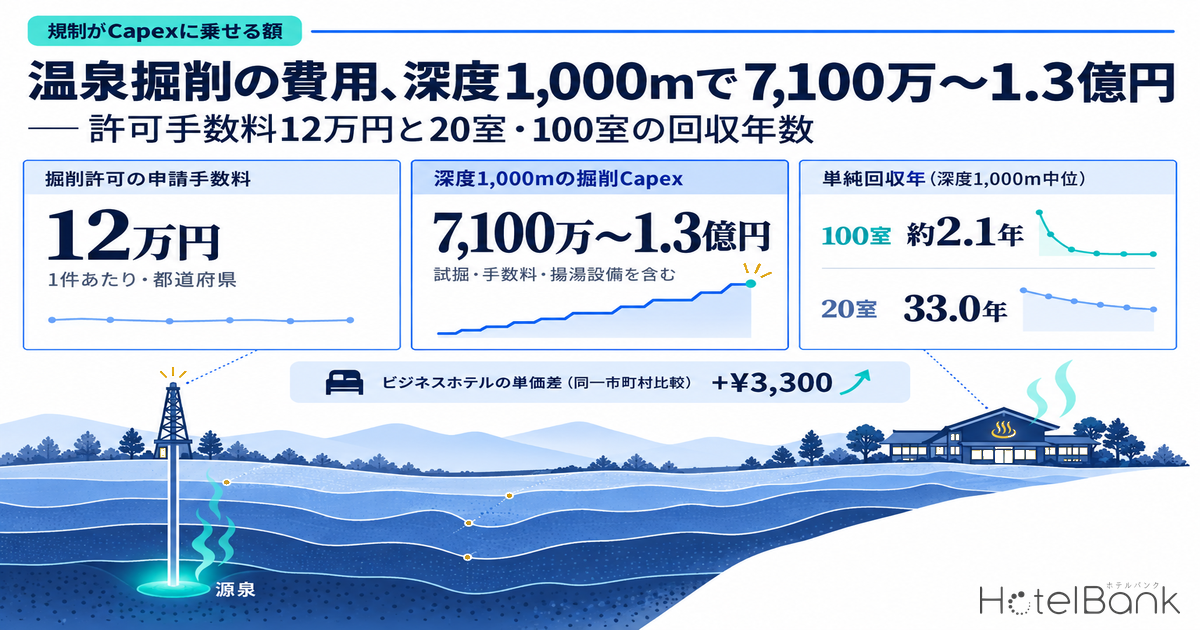
- — Drilling work is said to cost around ¥600,000–¥1,000,000 per 10m. Adding test drilling, fees and pumping equipment, the total comes to about ¥41M–¥84M at 500m, about ¥71M–¥134M at 1,000m, and about ¥101M–¥184M at 1,500m (editorial estimate).
- — Once water flows, operating costs — electricity for the pump, pump replacement and pipe cleaning every few to 10 years, and a mineral analysis every 10 years — come to about ¥0.7M–¥4.6M a year (excluding heating fuel).
- — Compared within the same municipality, onsen-labelled business hotels have an estimated settled ADR +¥3,300 (+44.0%) higher. However, the rate strength of one chain whose standard spec includes a hot-spring bath accounts for much of this; excluding that chain, the gap is +¥900 (+11.9%). For ryokan, the gap is +¥600 (+3.4%) — nearly level.
- — At 1,000m and 70% occupancy (full-year assumption), 100 rooms with a ¥2,000 gap pay back in about 2.1 years.20 rooms with a ¥1,000 gap take about 33 years, so for small properties, piping in water or heating ordinary water is more likely to make financial sense.
Drilling for an onsen takes three permits — drilling, deepening and powered pumping
Article 3 of the Hot Springs Act requires anyone who intends to drill land in order to bring hot-spring water to the surface to obtain a permit from the prefectural governor. Deepening an existing spring (“zōkutsu”) and installing a “powered device” — a pump to increase the flow — each require a separate permit under Article 11 of the same Act. Deep wells in cities and on plains often do not flow on their own, so in practice it is realistic to assume a plan will need both the drilling permit and the powered-device permit.
The review looks at the impact on existing springs. Article 4 of the Act allows the governor to refuse a permit when, for example, drilling is found to affect the flow, temperature or composition of nearby springs. According to the Ministry of the Environment’s “Guidelines on the Protection of Hot-Spring Resources (revised)” (April 2014), 27 prefectures have designated special zones to protect hot springs; within those zones, 18 prohibit drilling in principle, 9 regulate depth and 8 regulate bore diameter (with overlaps). Twenty prefectures apply distance rules that in principle forbid drilling within a set distance of existing springs, and 500m is the most common distance.
These distance rules also show up in the drawings required with an application. Hiroshima requires the written consent of the owner of any existing spring within 500m of the drilling point. Kanagawa requires an impact study by pumping test if an existing spring lies within 200m. Gunma asks for a map of nearby springs with circles drawn at 500m, 1,500m, 2,000m and 3,000m, and a commentary by the Konuma Mitsuyo Administrative Scrivener Office in Tochigi cites cases in that prefecture’s urban areas where drilling deeper than 1,600m, or within 2km of an existing spring, is prohibited. How many existing springs lie around a candidate site is something to check before securing the land.
Timing also shapes the plan. The path from application to permit is tied to the council’s meeting schedule: Hiroshima’s hot-spring subcommittee usually meets twice a year, around June and December; Nagasaki’s four times a year; Aomori’s three times. Tokyo meets irregularly, and work must be completed within two years of the permit. Drilling itself is said to take 3–6 months on average, so allowing about a year from application to usable water is a reasonable rule of thumb. Working back from the opening date, the decision on whether to drill needs to be made at an early design stage.
| Prefecture | Drilling | Deepening | Powered device | Council meetings | Relation to existing springs (application requirement) |
|---|---|---|---|---|---|
| Hiroshima | ¥120,000 | ¥110,000 | ¥110,000 | Twice a year (around Jun. and Dec.) | Owner’s consent for existing springs within 500m |
| Tokyo | ¥120,000 | — | — | Irregular | Work to be completed within 2 years of permit |
| Nagasaki | ¥120,000 | ¥110,000 | ¥110,000 | 4 times a year (Jun., Sep., Dec., Mar.) | Apply to the competent public health centre |
| Aomori | ¥120,000 | ¥110,000 | ¥110,000 | 3 times a year | Sketch map of surroundings within 1,000m |
| Gunma | ¥140,000 | ¥140,000 | ¥110,000 | Referred to council (hot-spring subcommittee) | Map of springs within 500m–3,000m radius |
| Kanagawa | ¥131,480 | — | ¥111,530 | Twice a year | Pumping-test impact study for existing springs within 200m |
The fees themselves come to roughly ¥230,000–¥250,000 per case even for drilling plus a powered device — small relative to total Capex. What matters more than the amount is the waiting time set by how often the council meets and the narrower choice of sites imposed by distance rules. Actual applications are also few. According to the Ministry of the Environment’s “Administrative Dispositions under the Hot Springs Act, FY2024”, there were 141 applications and 135 permits for new drilling nationwide, and 100 applications and 101 permits for powered devices; even Oita, the largest, had only 34 drilling applications.
Drilling Capex is set by depth — total ranges at 500m, 1,000m and 1,500m
There are no official statistics on drilling costs, so this article builds totals by depth from published market rates. According to the Konuma Mitsuyo Administrative Scrivener Office in Tochigi, test drilling to predict what kind of water will come up costs ¥1M–¥4M, the main drilling work costs around ¥600,000–¥1,000,000 per 10m, and drilling to a depth where the water can be used at a suitable temperature without treatment means construction costs of ¥10M to nearly ¥100M. Pumps, piping, storage tanks and heating equipment come on top. An explainer by Money Forward Cloud Company Formation (March 2026) puts equipment such as pumps alone at around ¥10M at minimum, and geological survey firm Eonex says that drilling to around 1,000m and installing pump equipment generally requires ¥150M or more.
Table 2 lays out these market rates by depth in four items: test drilling, application fees (drilling + powered device), drilling work, and pumping and supply equipment. The ¥30M upper limit for pumping and supply equipment is an editorial setting that allows for differences in pipe length and the size of storage tanks and heating equipment.
| Item | Depth 500m | Depth 1,000m | Depth 1,500m | Basis |
|---|---|---|---|---|
| Test drilling & preliminary survey | ¥1M–¥4M | ¥1M–¥4M | ¥1M–¥4M | Konuma Mitsuyo Administrative Scrivener Office |
| Application fees (drilling + powered device) | ¥230k–¥250k | ¥230k–¥250k | ¥230k–¥250k | Prefectures in Table 1 |
| Drilling work (¥0.6M–¥1.0M per 10m) | ¥30M–¥50M | ¥60M–¥100M | ¥90M–¥150M | As above; estimated in proportion to depth |
| Pumping & supply equipment (pump, piping, storage tank, heating) | ¥10M–¥30M | ¥10M–¥30M | ¥10M–¥30M | Lower: Money Forward / Upper: editorial setting |
| Total | approx. ¥41M–¥84M | approx. ¥71M–¥134M | approx. ¥101M–¥184M | — |
| Mid case (used in payback estimates) | approx. ¥63M | approx. ¥103M | approx. ¥143M | Midpoint of lower and upper |
| Indicative water temperature at average geothermal gradient | approx. 28–30°C | approx. 40–45°C | approx. 53–60°C | Editorial estimate: 15°C at surface + 2.5–3°C per 100m |
Drilling work accounts for most of the total, and doubling the depth roughly doubles the construction cost. The point of drilling deeper, though, is water temperature. According to the Geothermal Research Society of Japan, the average geothermal gradient is about 2.5–3°C per 100m. Taking 15°C near the surface, 500m gives only around 30°C — enough to qualify as an onsen under the Hot Springs Act (25°C or above) but needing heating for bathing. 1,000m gives 40–45°C, and only at 1,500m does it reach the 50s. In volcanic areas high temperatures can be reached at much shallower depths; these are only average indications for non-volcanic ground.
In other words, drilling to 500m keeps the initial cost down but raises heating-fuel costs every year. Drilling to 1,500m reduces the need for heating but more than doubles the initial cost of 500m. Depth is easiest to think about as a trade-off between initial cost and heating fuel. Eonex’s figure of “¥150M or more for around 1,000m” exceeds the 1,000m upper bound in Table 2 (¥134M). Given that deeper wells need larger drilling rigs and the cost per 10m tends to rise, it is safer at 1,000m or deeper to use the upper end of Table 2 as the baseline.
Operating costs after the water flows: ¥0.7M–¥4.6M a year, mainly power and pump replacement
The operating cost of a private spring falls into three parts: pumping, maintenance and statutory testing. Money Forward Cloud Company Formation’s explainer says electricity for the pump runs from tens of thousands to hundreds of thousands of yen a month, pump replacement and pipe cleaning every few to 10 years costs in the millions of yen, and a mineral analysis once every 10 years costs a little over ¥100,000. The Hot Springs Act requires facilities that use onsen water for public bathing to post its composition, and the mineral analysis behind that notice must be redone every 10 years. Legionella testing under prefectural ordinances for inns and public baths also continues, just as it does for baths using heated ordinary water.
| Cost item | Published level | Annualised (editorial) |
|---|---|---|
| Electricity for pump | Tens of thousands to hundreds of thousands of yen per month | ¥0.36M–¥3.6M |
| Pump replacement & pipe cleaning | Millions of yen once every few to 10 years | ¥0.3M–¥1.0M |
| Mineral analysis (every 10 years) | A little over ¥100,000 | ¥10k–¥20k |
| Total (excl. heating fuel) | — | approx. ¥0.7M–¥4.6M |
| Heating fuel | Depends on water temperature and volume (larger for ~500m wells) | Case-by-case |
| Reference: hot-spring usage fee when piping water in | Atami municipal hot spring, commercial Class A: base fee ¥43,378/month (up to 80 cubic metres; revised April 2024) | from approx. ¥0.52M |
Electricity varies widely because power consumption depends on the pumping volume and the water level (how deep the water is drawn from). The payback estimates use ¥2M a year, close to the middle of this total, as the operating cost. Heating fuel moves a great deal with water temperature and season, so it is treated separately; as a benchmark for energy costs, a separate HotelBank analysis put hotel electricity at about ¥96,000 per room per year. Note that the bathing tax paid by guests (standard rate ¥150 per person per night) is collected by the property on behalf of the municipality and remitted, so it is not an operating cost.
The payback input — the rate gap for onsen-labelled properties within the same municipality
To estimate Capex payback, you need an input for how much an onsen lifts room rates. Properties with onsen cluster in hot-spring resorts, so a simple nationwide comparison makes location differences look like an onsen effect. This article therefore compared the median estimated settled ADR of onsen-labelled and unlabelled properties within the same segment and the same municipality. The population is 10,585 properties and 900,552 rooms with confirmed operations.
| Segment | Properties | Of which onsen-labelled | Municipalities compared | Municipalities with positive gap | Rate gap (median) | Ratio |
|---|---|---|---|---|---|---|
| Business hotels | 4,925 | 71 | 51 | 44 | +¥3,294 | +44.0% |
| excl. one specific chain | 4,888 | 34 | 22 | 14 | +¥907 | +11.9% |
| Resort hotels | 815 | 51 | 16 | 10 | +¥2,065 | +14.5% |
| Ryokan | 3,949 | 852 | 185 | 101 | +¥576 | +3.4% |
| City hotels (reference, within-prefecture) | 896 | 9 | 7 pref. | 7 | +¥6,326 | +69.2% |
Among business hotels, onsen-labelled properties were higher in 44 of the 51 municipalities compared, with a median gap of +¥3,300 (+44.0%). This figure cannot, however, be read as the effect of the onsen alone. Of the 71 onsen-labelled business hotels, 37 belong to a single chain whose standard spec includes a natural hot-spring bath, and that chain’s brand strength and operating capability appear to drive much of the gap. Running the same comparison without that chain (34 properties, 22 municipalities comparable), the gap falls to +¥900 (+11.9%), positive in 14 of the 22 municipalities.
Resort hotels show +¥2,100 (+14.5%) and ryokan +¥600 (+3.4%) — small gaps. Many ryokan use hot-spring water without saying “onsen” in their name, so the “unlabelled” side also includes inns with onsen, which mutes the gap. For ryokan in hot-spring resorts, an onsen is less a lever for raising rates than a baseline expectation. In our earlier article “Urban hotels with bath facilities: 23.5%”, properties with a large bath but no onsen label showed a rate gap of only +1.3% when compared within the same prefecture and size band. What lifts the rate is less whether there is a bath than whether it can be marketed as an “onsen”. This is where drilling and heated-water baths part ways.
The payback estimates use these measured values as a range: +¥900 for business hotels excluding the chain as the lower guide, +¥3,300 for all business hotels as the upper guide, with sensitivity tested in five steps from ¥500 to ¥5,000.
Rate gap by region — positive everywhere for hotels, mixed for ryokan
Running the same comparison by region, onsen-labelled hotels (business, city and resort) are higher in every region where a comparison was possible. Hokkaido (+52.8%) and Chugoku (+53.9%) show the largest gaps, Kyushu–Okinawa (+18.2%) the smallest. Ryokan, by contrast, are positive in Chubu (+13.6%) and Hokkaido (+18.5%) but negative in Kanto (−10.3%) and Chugoku (−20.0%); the direction varies, and the onsen label itself is not an axis that separates rates.
The size of the gap is related to how many properties nearby have an onsen. Splitting the 68 municipality × segment combinations comparable for hotels by the share of onsen-labelled properties among all lodging in the municipality, the 40 locations with a share below 10% had a median rate gap of +44.3% (positive in 35 of 40), while the 28 locations at 10% or above had +24.4% (positive in 20). The rarer onsen are in a market, the more “onsen” works as a differentiator. The map colour-codes the 109 municipalities that have an onsen-labelled hotel by the share of onsen-labelled properties within the municipality. Central wards of Tokyo, Osaka, Nagoya and Fukuoka are at 1–2%, and many prefectural capitals are also below 10%, showing that onsen are still scarce in these markets. Because the share is based on property names, it comes out lower than reality in hot-spring resorts where many inns do not put “onsen” in their name.
How many years to pay back — sensitivity table of rate gap × rooms × depth
Annual revenue gain is the rate gap × occupancy × rooms × 365 days. At 70% occupancy (full-year assumption for the calculation), a ¥1,000 gap adds ¥5.11M a year for 20 rooms, ¥12.78M for 50 rooms and ¥25.55M for 100 rooms (annualised). Subtracting the ¥2M annual operating cost and dividing the mid-case Capex in Table 2 by the result gives the simple payback periods in Table 5.
| Depth (mid-case Capex) | Rooms | Rate gap ¥500 | ¥1,000 | ¥2,000 | ¥3,000 | ¥5,000 |
|---|---|---|---|---|---|---|
| 500m (approx. ¥63M) | 20 rooms | 113.0 yrs | 20.2 yrs | 7.6 yrs | 4.7 yrs | 2.7 yrs |
| 50 rooms | 14.3 yrs | 5.8 yrs | 2.7 yrs | 1.7 yrs | 1.0 yrs | |
| 100 rooms | 5.8 yrs | 2.7 yrs | 1.3 yrs | 0.8 yrs | 0.5 yrs | |
| 1,000m (approx. ¥103M) | 20 rooms | 185.1 yrs | 33.0 yrs | 12.5 yrs | 7.7 yrs | 4.4 yrs |
| 50 rooms | 23.4 yrs | 9.5 yrs | 4.4 yrs | 2.8 yrs | 1.7 yrs | |
| 100 rooms | 9.5 yrs | 4.4 yrs | 2.1 yrs | 1.4 yrs | 0.8 yrs | |
| 1,500m (approx. ¥143M) | 20 rooms | 257.2 yrs | 45.9 yrs | 17.4 yrs | 10.7 yrs | 6.1 yrs |
| 50 rooms | 32.5 yrs | 13.2 yrs | 6.1 yrs | 3.9 yrs | 2.3 yrs | |
| 100 rooms | 13.2 yrs | 6.1 yrs | 2.9 yrs | 1.9 yrs | 1.1 yrs |
What separates payback periods is not so much depth as room count multiplied by the rate gap. With 100 rooms, even a ¥1,000 gap pays back drilling at 1,000m in 4.4 years, and ¥2,000 does it in 2.1 years. With 20 rooms, by contrast, a ¥1,000 gap takes 20.2 years even at 500m and 33.0 years at 1,000m. At levels close to the measured gap for business hotels excluding the chain (+¥900), it is hard for a small property to recover drilling costs from room rates alone.
Occupancy matters too. At 1,000m and 50 rooms with a ¥2,000 gap, payback is 6.3 years at 50% occupancy (full-year assumption) and 3.3 years at 90%. With a ¥900 gap (the measured value for business hotels excluding the chain), it is 16.5 years at 50% (same basis) and still 8.0 years at 90% (same basis, full year). Table 5’s payback periods are on a sales basis; assuming 30% of the extra revenue is lost to OTA commissions and the like stretches payback by roughly 1.4x. Note also that these figures do not factor in whether drilling succeeds (whether the expected temperature and flow are achieved).
Payback in three scenarios — in the pessimistic case, 20 rooms never pays back
Table 5 is a sensitivity table that fixes mid-case Capex and 70% occupancy (full-year assumption). As seen in the previous section, however, Eonex cites “¥150M or more” for around 1,000m, and operating costs range from ¥0.7M to ¥4.6M. For 1,000m depth, we therefore set out payback periods in three scenarios — optimistic, mid and pessimistic — with the five assumptions (Capex, operating cost, rate gap, occupancy and commissions) aligned in the same direction (Table 6).
| Scenario | Drilling Capex | Annual operating cost | Rate gap | Occupancy (full-year assumption) | Net share of extra revenue | 20 rooms | 50 rooms | 100 rooms |
|---|---|---|---|---|---|---|---|---|
| Optimistic | approx. ¥71M (Table 2 lower bound) | ¥0.7M | ¥3,300 (all business hotels, measured) | 80% | 100% | 3.8 yrs | 1.5 yrs | 0.7 yrs |
| Mid | approx. ¥103M (Table 2 mid case) | ¥2M | ¥2,000 | 70% | 100% | 12.5 yrs | 4.4 yrs | 2.1 yrs |
| Pessimistic | ¥150M (Eonex guideline) | ¥4.6M | ¥900 (measured, excl. one chain) | 60% | 70% (30% deducted for OTA commissions etc.) | Never pays back | 65.3 yrs | 16.3 yrs |
The gap between optimistic and pessimistic widens to 23x for the same 100 rooms: 0.7 years versus 16.3 years. In the pessimistic case in particular, 20 rooms generate an annual net revenue gain (about ¥2.76M) below the ¥4.6M operating cost and never pay back. Even 100 rooms take more than 16 years, spanning one or two pump replacement cycles (every few to 10 years). Put the other way, the economics of drilling depend heavily on which side the measured rate gap falls on, and presuppose a product design that puts “onsen” front and centre, as one particular chain does.
Table 7 works back, for each room count, the rate gap needed to recover the cost in 10 years (mid-scenario operating cost of ¥2M and 70% occupancy).
| Depth (mid-case Capex) | 20 rooms | 50 rooms | 100 rooms |
|---|---|---|---|
| 500m (approx. ¥63M) | ¥1,619 | ¥648 | ¥324 |
| 1,000m (approx. ¥103M) | ¥2,402 | ¥961 | ¥480 |
| 1,500m (approx. ¥143M) | ¥3,185 | ¥1,274 | ¥637 |
Set against the measured gaps, the dividing line becomes clear. The +¥900 for business hotels excluding the chain falls just short at 1,000m for 50 rooms (¥961 needed) but has room to spare at 100 rooms (¥480 needed). The ryokan figure of +¥600 does not even reach the ¥637 needed for 100 rooms at 1,500m. For 20 rooms to recover 1,000m drilling in 10 years requires ¥2,402 — achievable only if a property can generate on its own something close to the +¥3,300 measured for all business hotels.
Decision framework — where and at what scale drilling works, and when bath facilities are enough
Here the numbers so far are arranged into a form usable for acquisition and development decisions. There are three axes: (1) whether few existing springs nearby means the site escapes distance rules (can you get a permit?); (2) whether rooms × rate gap generates annual revenue well above operating costs (can you pay it back?); and (3) whether few nearby properties have an onsen, so that “onsen” differentiates (will there be a rate gap?).
Drilling likely to work
80–100+ rooms, in cities or regional hubs away from hot-spring resorts. Where few nearby properties have an onsen and a rate gap of ¥2,000 or more can be expected, even 1,000m drilling pays back in 2–4 years. This assumes no existing spring close enough to trigger distance rules.
Works depending on conditions
Around 50 rooms. A ¥2,000 gap gives 4.4 years at 1,000m; ¥1,000 gives 9.5 years. If the geology yields legally qualifying onsen water at a shallow depth (~500m), payback is faster, but higher heating-fuel costs must be allowed for. Whether the opening plan can absorb about a year of permit waiting is also a deciding factor.
Bath facilities or piped-in water suffice
Small properties of 20–30 rooms, or inns inside hot-spring resorts. At a gap of around ¥1,000, payback takes more than 20 years. Inside a resort, piping water in from a centrally managed source (Atami municipal: from about ¥43,000/month base fee) — and outside one, a large bath with heated or artificial hot-spring water — aiming to recoup the cost through guest review scores and occupancy is likely the more rational choice.
Heated ordinary water and artificial hot-spring baths are not onsen under the Hot Springs Act, so they need no drilling or powered-device permit — and cannot be marketed as a “natural hot spring”. In exchange, the initial cost is limited to the bath equipment, and the opening date is not tied to the council’s schedule. The rate uplift is small, but as shown in our earlier article “Urban hotels with bath facilities: 23.5%”, a large bath lifts guest review scores, making it an option that pays back through reviews and occupancy.
In acquisitions, this framework works in reverse. A property that already has its own spring is an asset that has cleared all three hurdles — permit, drilling and waiting time. For a spring around 1,000m deep, replacing it would cost ¥71M–¥134M and take about a year. Check the spring rights and allocated water volume following the steps set out in “Who owns the hot spring?”, and also confirm when the powered device is due for renewal and the permitted pumping volume.
Summary
Onsen drilling only becomes a plan when three things line up: the permits (Articles 3 and 11 of the Hot Springs Act), the Capex (about ¥71M–¥134M at 1,000m) and the operating cost (about ¥0.7M–¥4.6M a year). The application fee is small at around ¥120,000 per case, but councils meet only 2–4 times a year and distance rules around existing springs restrict where you can drill. Payback depends less on depth than on room count multiplied by the rate gap: around 100 rooms can pay back in a few years, while around 20 rooms will struggle to pay back from the rate gap alone. Measured within the same municipality, the rate gap was +¥3,300 for business hotels, +¥900 excluding one particular chain, and +¥600 for ryokan. Whether to drill, pipe water in or heat ordinary water is best decided by applying these numbers to your own plan’s room count.
Note on the estimates: The drilling and operating costs in this article are simplified estimates combining published market rates with editorial settings, and they vary greatly with geology, depth, water temperature, flow and permit conditions. The rate gap is an observed value based on onsen labelling in property names and also includes non-onsen differences such as brand, building age and room size. Actual investment decisions require a preliminary survey by a geological survey firm and a property-specific feasibility study.
Related Articles
- Urban hotels with bath facilities: 23.5% — onsen-labelled properties command +54% estimated ADR; Tokyo at 9.7% has room to grow
- Who owns the hot spring? — ryokan acquisition valuation split by private source, piped-in and centrally managed water
References & Sources
■ Data sources
The rate gap covers the 10,585 properties and 900,552 rooms — business hotels, city hotels, resort hotels and ryokan tracked by MetroEngines Research — with 10 or more rooms and estimated settled ADR observed in at least 9 of the 12 months from September 2025 to August 2026; each property’s average monthly estimated settled ADR was compared by segment × municipality (segment × prefecture for city hotels). Permit procedures and fees are from the official pages of each prefecture and Atami City; application counts and protected zones from Ministry of the Environment materials; drilling costs, operating costs and the geothermal gradient from figures published by the administrative scrivener office, Money Forward, Eonex and the Geothermal Research Society of Japan.
■ Calculation assumptions
Drilling Capex = test drilling ¥1M–¥4M + application fees ¥230k–¥250k + drilling work (¥0.6M–¥1.0M per 10m × depth) + pumping & supply equipment ¥10M–¥30M (upper bound set editorially). Mid case = midpoint of lower and upper. Annual revenue gain = rate gap × occupancy × rooms × 365 days (sales basis); occupancy is a full-year assumption (base 70%, sensitivity 50–90%); annual operating cost mid case ¥2M (range ¥0.7M–¥4.6M, excl. heating fuel). Simple payback = Capex ÷ (annual revenue gain − annual operating cost). Only in the pessimistic scenario is 30% of the extra revenue deducted for OTA commissions etc. Water temperature estimated as 15°C at the surface + 2.5–3°C per 100m.
■ Limitations
There are no official statistics on drilling costs; this is a simplified estimate built from market rates. It excludes drilling success (temperature and flow), heating fuel, bath construction cost, tax and interest. The rate gap is classified by onsen labelling in property names: properties that pipe in onsen water without a label fall on the “not labelled” side, and the gap also includes non-onsen differences such as brand, building age and room area. About half of the business hotel rate gap stems from a single chain (37 of the 71 onsen-labelled properties). Fees and council meeting frequencies are as stated on each official page as of September 2026 and may be revised.
■ Market data
- MetroEngines Research & Consulting — estimated settled ADR (N=10,585 properties, 900,552 rooms, September 2025–August 2026)
■ Laws and government materials
- Hot Springs Act (Act No. 125 of 1948), Articles 3, 4 and 11 (e-Gov Law Search)
- Ministry of the Environment, “Guidelines on the Protection of Hot-Spring Resources (revised)” (April 2014)
- Ministry of the Environment, “Administrative Dispositions under the Hot Springs Act, FY2024” and “Hot-Spring Use, FY2024”
■ Prefectural and municipal official pages
- Hiroshima Prefecture, “Applying for permits to drill, deepen or install powered devices for hot springs”
- Tokyo Metropolitan Bureau of Environment, “Applying for a hot-spring drilling permit”
- Nagasaki Prefecture, “Application procedures relating to hot springs”
- Aomori Prefecture, “For those planning to drill, deepen or install powered devices for hot springs”
- Gunma Prefecture, “Procedures for hot-spring drilling and powered-device installation”
- Kanagawa Prefecture, “Hot-spring procedures (new applications)”
- Atami City, “Hot-Spring Fees” (revised 1 April 2024)
■ Cost benchmarks and technical materials
- Konuma Mitsuyo Administrative Scrivener Office, “Onsen Drilling Q&A” — test drilling ¥1M–¥4M, around ¥0.6M–¥1.0M per 10m, 3–6 months of work
- Money Forward Cloud Company Formation, “Does striking a hot spring make money? Costs, success rates and the reality of drilling at home” (3 March 2026)
- Eonex Co., Ltd., “How much does it cost?”
- Geothermal Research Society of Japan, “Introduction to Geothermal Energy: Properties of Geothermal Resources” — average geothermal gradient approx. 2.5–3°C per 100m