

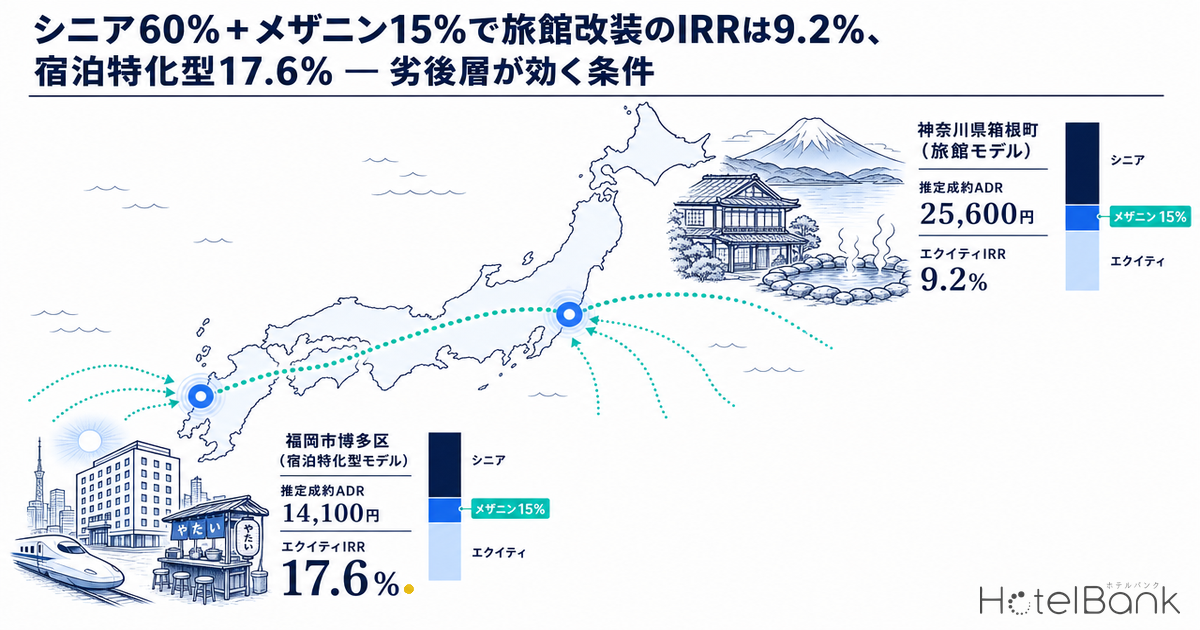
Even when a senior loan covers 60% of total project cost, the remaining 40% of the combined acquisition and renovation budget still has to be filled with the sponsor’s own capital. This article models what happens to equity IRR and DSCR when a subordinated (mezzanine) layer of 10% or 15% is inserted in between, using value-add models for a 30-room ryokan and a 100-room limited-service hotel. With a 15% mezzanine tranche (assumed at 6% interest), the equity required falls from ¥300 million to ¥187.5 million for the ryokan, and equity IRR rises from 8.1% to 9.2%; for the limited-service hotel it rises from 13.9% to 17.6%. What drives the gap in uplift is where the senior-only equity IRR sits relative to the mezzanine interest rate.
Metric Definitions Used in This Article
- ADR (Average Daily Rate): An estimated settled room rate (tax-exclusive equivalent), calculated by applying category-specific adjustment factors to the lowest-plan price level each property publishes on OTAs (per room, two guests, tax-inclusive). Checked against property-level results disclosed by listed hotel REITs (91 properties, most recent 3 months), the median error is about 7%. These are estimates and differ from each property’s actual transaction prices and accounting figures. Area-level ADR is the median of the target properties (the level of a typical property in the area). This article uses a simple average of the 12 finalized months from September 2025 to August 2026.
- OCC (Occupancy Rate): The ratio of rooms sold to total rooms in the area (an estimate based on OTA sales inventory; consistency checks against REIT monthly disclosures confirm accuracy within roughly a few points). Because it is based on how OTA-listed inventory is absorbed, it differs from a property’s actual overall occupancy. Estimates are shown with the number of target properties / rooms (based on major booking-site listings). Occupancy rates used in the models are assumptions, not estimates or actuals.
- NOI: Net operating income, i.e. GOP (gross operating profit) less management fees, property taxes, insurance and FF&E reserve. This article sets the NOI margin on rooms revenue as an assumption.
- Equity IRR: The internal rate of return on common (sponsor) equity, derived from the equity investment, interim cash flows and sale proceeds. Unlevered IRR: The IRR of the property itself with no borrowing.
- DSCR (senior) = NOI ÷ annual senior-loan debt service. DSCR (total) = NOI ÷ (senior debt service + mezzanine interest).
- Data sources: MetroEngines Research (ADR and occupancy; of approx. 168,000 properties tracked in Japan, approx. 27,000 with confirmed operations are analyzed) / Development Bank of Japan / investment corporation IR materials
Key Takeaways
— A 15% mezzanine tranche cuts equity required by 37.5% (from 40% to 25% of total project cost): from ¥300 million to ¥187.5 million in the ryokan model, and from ¥1.16 billion to ¥725 million in the limited-service hotel model.
— IRR uplift is +1.1pt for the ryokan and +3.7pt for the limited-service hotel. The difference depends on how far the senior-only equity IRR (ryokan 8.1%, limited-service 13.9%) exceeds the 6% mezzanine rate.
— For the ryokan, mezzanine works against the sponsor if the ADR uplift reaches only half of plan. At 50% achievement, IRR is 4.8% with no mezzanine and 4.1% with 15% — the ranking flips.
— Stabilized DSCR (total) is 1.32x for the ryokan and 1.31x for the limited-service hotel. The ryokan drops to 0.59x in the renovation year, which involves a closure, so an interest reserve or PIK (payment-in-kind, capitalizing mezzanine interest into principal) structure is a prerequisite.
— Total project cost per room is ¥25 million for the ryokan and ¥29 million for the limited-service hotel — the same price band as the ¥24.41 million median acquisition price per room across 300 domestic properties held by listed hotel REITs.
The Funding Gap — The 40% Left Outside a 60% Senior Loan
In value-add deals for small and mid-sized ryokan, renovation capex for guest rooms and large communal baths comes on top of the acquisition price. Because a bank’s senior loan is capped by the property’s NOI and collateral value, sizing it on pre-renovation NOI inevitably keeps the loan-to-total-cost ratio conservative. HotelBank’s earlier analysis of hotel acquisition debt capacity estimated that, with DSCR of 1.3x and a 20-year amortization, an LTV of 56.8% is the upper limit of repayment capacity at a 2.0% borrowing rate. This article fixes the senior ceiling at 60% and addresses how to structure the remaining 40%.
A note on the rate environment. At its June 15–16, 2026 Monetary Policy Meeting, the Bank of Japan raised its policy rate by 0.25pt to 1.00%, and there are press reports of a further hike at the September 17–18 meeting. The 2.0% senior rate used here is an assumption set close to the average contracted interest rate on new long-term loans by domestic banks (1.895% in July 2026), and a +0.5pt sensitivity is also shown.
Funding this entire 40% with the sponsor’s own capital ties up a heavy amount of money per deal for buyers in business-succession transactions and for regional revitalization funds. This is where the option of inserting a subordinated layer — ranking between senior debt and equity in repayment priority — to compress sponsor equity comes in.
Types of Mezzanine Finance and Repayment Priority
The Development Bank of Japan (DBJ) positions mezzanine finance as “an intermediate financing method between the senior loans traditionally provided by financial institutions and equity financing through common stock,” listing subordinated loans / subordinated bonds, preferred / class shares and hybrid finance as the types it provides. While it ranks below senior debt in repayment and carries higher risk, DBJ explains that “economic rationality is ensured by setting interest and dividend levels commensurate with the investment risk.” DBJ explicitly names business acquisitions and business succession as situations with strong demand — which overlaps with ryokan succession and turnaround deals.
The same structure is explained in crowdfunding for retail investors. OwnersBook illustrates a ¥1 billion property bought with ¥200 million of equity and a ¥600 million senior loan, describing the remaining ¥200 million of financing as a mezzanine loan, and sets out the priority: if repayment falls into arrears, “the senior-loan creditors recover first, and [the mezzanine lender] can only recover from any remaining surplus.” In other words, a capital structure of 60% senior + 20% mezzanine + 20% equity is treated as a standard example even within published scheme explanations.
| Type | Repayment / distribution priority | Characteristics | Treatment in this model |
|---|---|---|---|
| Senior loan | Highest (first-lien on collateral) | Low risk, low interest | 60% of total project cost, 2.0% interest |
| Subordinated loan / subordinated bond | After senior, before equity | Higher interest than senior. DBJ describes the paperwork as “simple” | Mezzanine layer (4–8% interest assumed) |
| Preferred / class shares | After debt, before common stock | Dividends and residual distributions rank ahead of common stock. Strengthens capital while limiting voting-right dilution | Approximated as interest-bearing here (dividend-type differs in tax and accounting) |
| Common stock (equity) | Last (residual) | Captures the upside of value creation | Total project cost less the layers above |
Neither DBJ nor OwnersBook publishes specific interest rates. An earlier HotelBank analysis of hotel financing in a 1% rate era placed the market reference range for private credit — which has a mezzanine-to-equity-like character — at 3.5% to over 5.5% (as of June 2026). Building on this, this article assumes a mezzanine rate of 6% as the base case, with 4% / 8% as the sensitivity range. Actual levels vary widely with deal size, collateral and sponsor credit.
Model Assumptions — A Ryokan in Hakone and a Limited-Service Hotel in Hakata Ward
ADR uses the estimated settled ADR of each model location. According to MetroEngines Research, the 12-month average from September 2025 to August 2026 was ¥25,600 for the ryokan category in Hakone, Kanagawa (138–155 properties per month) and ¥14,100 for the business-hotel category in Hakata Ward, Fukuoka City (131–134 properties). Both represent a typical property in the area, not any individual ryokan or hotel.
For occupancy, prefecture-level estimates for the same period were referenced and then set conservatively as full-year assumptions. Estimated OCC for the ryokan category in Kanagawa was 77.5–84.1% in June–August 2026, and 89.2–90.6% for the business-hotel category in Fukuoka. Because these are three months including summer and run higher than full-year figures, the models use 70% for the ryokan and 82% for the limited-service hotel.
| Category (prefecture) | Jun 2026 | Jul 2026 | Aug 2026 |
|---|---|---|---|
| Kanagawa · Ryokan | 77.5% (144 properties / 3,885 rooms) | 78.2% (126 properties / 3,296 rooms) | 84.1% (160 properties / 4,211 rooms) |
| Fukuoka · Business hotel | 89.2% (177 properties / 22,575 rooms) | 89.7% (178 properties / 22,775 rooms) | 90.6% (173 properties / 22,306 rooms) |
The ADR uplift from renovation is set at +15% for the ryokan (assuming a guest-room renovation including conversion to Japanese-Western rooms and refreshed bathrooms) and +8% for the limited-service hotel (assuming updated room interiors and bath/toilet areas). Because HotelBank has no measured ADR uplift specific to these renovations, they are treated as assumptions, and the spread of results is shown through sensitivities with the uplift set at 0% and 50% of plan. The impact of rooms that cannot be sold during the works is reflected by setting first-year NOI at 45% of stabilized NOI for the ryokan and 80% for the limited-service hotel. HotelBank has covered how to think about lost revenue during construction in an earlier analysis of renovation downtime. The ADR uplift is reflected in NOI only once, and the same stabilized NOI is used to calculate the exit price, so there is no double counting.
| Assumption | 30-room ryokan (model) | 100-room limited-service hotel (model) |
|---|---|---|
| Model location / category | Hakone, Kanagawa · Ryokan | Hakata Ward, Fukuoka City · Business hotel |
| Estimated settled ADR (simple average, Sep 2025–Aug 2026) | ¥25,600 (monthly N=138–155 properties) | ¥14,100 (monthly N=131–134 properties) |
| ADR uplift from renovation (assumption) | +15% → ¥29,500 | +8% → ¥15,200 |
| Occupancy (assumption) | 70% | 82% |
| NOI margin (assumption, on rooms revenue) | 20% | 38% |
| Acquisition price + renovation capex | ¥450M + ¥300M = ¥750M (¥25M per room) | ¥2.6B + ¥0.3B = ¥2.9B (¥29M per room) |
| Stabilized NOI / NOI yield | ¥45.21M / 6.03% | ¥173M / 5.97% |
| Renovation-year NOI (vs. stabilized) | 45% (assumes a full closure) | 80% (assumes floor-by-floor renovation) |
| Senior loan | 60% of total project cost, 2.0% interest, 20-year level amortization | Same as left |
| Mezzanine | 0% / 10% / 15% of total project cost, 6% interest (4% / 8% sensitivity), interest-only during hold, bullet repayment at exit | Same as left |
| Holding period / exit | 5 years, exit cap rate 6.0%, exit costs 3.6% | 5 years, exit cap rate 5.2%, exit costs 3.6% |
Post-renovation (assumed) ¥29,500
Total project cost ¥750M (¥25M per room)
NOI yield 6.03%
Post-renovation (assumed) ¥15,200
Total project cost ¥2.9B (¥29M per room)
NOI yield 5.97%
With 15% Mezzanine, Ryokan IRR Reaches 9.2% and Limited-Service Hotel 17.6%
Base-case results by capital structure. In the ryokan model with a total project cost of ¥750 million, inserting 15% mezzanine (¥112.5 million) reduces sponsor equity from ¥300 million to ¥187.5 million and lifts equity IRR from 8.1% to 9.2%. In the 100-room limited-service hotel, the same move reduces equity from ¥1.16 billion to ¥725 million and IRR rises from 13.9% to 17.6%.
The equity reduction is the same 37.5% in both models, yet the IRR uplift differs by about 3.4 times: +1.1pt for the ryokan versus +3.7pt for the limited-service hotel. The reason lies in the basic leverage equation. Mezzanine is stacked on top of the senior loan and replaces sponsor equity, so equity returns improve only when the mezzanine rate is below the “senior-only equity IRR.” The limited-service hotel’s senior-only equity IRR is 13.9%, 7.9pt above the 6% mezzanine rate. The ryokan, with thin early NOI due to the closure in the renovation year, has a senior-only IRR of 8.1% — only 2.1pt above the mezzanine rate — so the added boost is small. The property-level IRR without borrowing (unlevered IRR) is 4.7% for the ryokan and 7.5% for the limited-service hotel, both above the 2.0% senior rate.
30-room ryokan model (total project cost ¥750M)
| Capital structure | Senior | Mezzanine | Equity | Equity IRR | DSCR (senior) | DSCR (total) | Year-1 DSCR (total) |
|---|---|---|---|---|---|---|---|
| Mezzanine 0% | ¥450M | ¥0M | ¥300M | 8.1% | 1.64x | 1.64x | 0.74x |
| Mezzanine 10% | ¥450M | ¥75M | ¥225M | 8.7% | 1.64x | 1.41x | 0.64x |
| Mezzanine 15% | ¥450M | ¥112M | ¥188M | 9.2% | 1.64x | 1.32x | 0.59x |
100-room limited-service hotel model (total project cost ¥2.9B)
| Capital structure | Senior | Mezzanine | Equity | Equity IRR | DSCR (senior) | DSCR (total) | Year-1 DSCR (total) |
|---|---|---|---|---|---|---|---|
| Mezzanine 0% | ¥1,740M | ¥0M | ¥1,160M | 13.9% | 1.63x | 1.63x | 1.30x |
| Mezzanine 10% | ¥1,740M | ¥290M | ¥870M | 16.0% | 1.63x | 1.40x | 1.12x |
| Mezzanine 15% | ¥1,740M | ¥435M | ¥725M | 17.6% | 1.63x | 1.31x | 1.05x |
For the Ryokan, the Mezzanine Effect Reverses Depending on ADR Uplift Achievement
The greatest uncertainty in a value-add deal is whether ADR actually rises as planned after renovation. Re-running the ryokan model with ADR uplift achievement at 0%, 50% and 100% changes not just the size but the direction of the mezzanine effect. On plan (+15%), 15% mezzanine lifts IRR from 8.1% to 9.2%. At 50% achievement (+7.5%), however, IRR edges down from 4.8% to 4.1%, and with no uplift it goes from 1.0% to -2.0%, into negative territory.
Under the same sensitivity, the limited-service hotel stays higher with the subordinated layer even when ADR uplift is zero: 12.3% with 15% mezzanine versus 10.2% with none. This is because even with no uplift, its senior-only equity IRR of 10.2% remains above the 6% mezzanine rate. If mezzanine is used in a ryokan deal, working out the room-type-level rate design that underpins the ADR uplift together with the capital structure for a shortfall scenario (such as mezzanine prepayment clauses or equity-conversion terms) makes it easier to capture the benefit of the subordinated layer as planned.
Sensitivity to ADR ±10% and Occupancy ±5pt — IRR and DSCR
The two tables below show, in each cell, equity IRR moving from 0% to 15% mezzanine, and DSCR (senior / total) at 15% mezzanine. ADR is flexed ±10% around the post-renovation level and occupancy ±5pt around the assumption.
30-room ryokan model
| Occupancy −5pt | Occupancy base | Occupancy +5pt | |
|---|---|---|---|
| ADR −10% | -1.1% → -5.7% DSCR 1.37x / 1.10x | 2.8% → 1.0% DSCR 1.48x / 1.19x | 6.3% → 6.5% DSCR 1.58x / 1.27x |
| ADR base | 4.4% → 3.6% DSCR 1.53x / 1.23x | 8.1% → 9.2% DSCR 1.64x / 1.32x | 11.4% → 14.0% DSCR 1.76x / 1.41x |
| ADR +10% | 9.1% → 10.7% DSCR 1.68x / 1.35x | 12.7% → 15.8% DSCR 1.81x / 1.45x | 15.9% → 20.2% DSCR 1.94x / 1.55x |
100-room limited-service hotel model
| Occupancy −5pt | Occupancy base | Occupancy +5pt | |
|---|---|---|---|
| ADR −10% | 5.7% → 5.6% DSCR 1.38x / 1.10x | 8.9% → 10.3% DSCR 1.46x / 1.18x | 11.7% → 14.5% DSCR 1.55x / 1.25x |
| ADR base | 10.9% → 13.3% DSCR 1.53x / 1.23x | 13.9% → 17.6% DSCR 1.63x / 1.31x | 16.7% → 21.4% DSCR 1.73x / 1.39x |
| ADR +10% | 15.4% → 19.7% DSCR 1.68x / 1.35x | 18.4% → 23.7% DSCR 1.79x / 1.44x | 21.1% → 27.4% DSCR 1.90x / 1.52x |
For the ryokan, when ADR −10% and occupancy −5pt coincide, IRR is -1.1% with no mezzanine and -5.7% with 15% — the subordinated layer amplifies swings in returns. Conversely, at ADR +10% and occupancy +5pt, IRR rises from 15.9% to 20.2%, a large upside. Mezzanine is a tool that raises expected returns, but at the same time it widens the distribution.
Even in the harshest cell (ADR −10%, occupancy −5pt), stabilized DSCR (total) is 1.10x for both the ryokan and the limited-service hotel, staying above 1.0x. However, the DSCR that lenders set as a senior financial covenant is generally said to be around 1.2–1.3x, and in the ryokan’s ADR −10% row DSCR (total) falls within 1.10–1.27x. Whether mezzanine interest is included in the calculation of senior repayment capacity is determined by the agreement with the senior lender (the intercreditor agreement), making it one of the first items to confirm when structuring a deal.
The renovation year is a different story. The ryokan model assumes a full closure, so NOI is only 45% of stabilized, and DSCR (total) is 0.74x even with no mezzanine and 0.59x at 15%. First-year cash flow at 15% mezzanine is a shortfall of ¥13.93 million, which this model funds from sponsor equity. In practice, this is typically absorbed through structures such as deferring senior principal repayment during the works, capitalizing mezzanine interest into principal (PIK), or building an interest reserve into the total project cost. The limited-service hotel assumes floor-by-floor renovation and so maintains 1.05x even in year one.
Sensitivity to Mezzanine Rates of 4% / 6% / 8% and Senior Rate +0.5pt
Since there are no published mezzanine rates, three points — 4%, 6% and 8% — were tested. For the ryokan, an 8% mezzanine rate brings IRR to 8.1%, essentially the same as the 8.1% with no mezzanine, so the uplift effect disappears. The limited-service hotel still reaches 16.6% at 8%, 2.7pt above 13.9% with no mezzanine.
| Mezzanine rate (assumed) | Ryokan IRR | Ryokan DSCR (total) | Limited-service IRR | Limited-service DSCR (total) |
|---|---|---|---|---|
| 4% | 10.2% | 1.41x | 18.5% | 1.40x |
| 6% | 9.2% | 1.32x | 17.6% | 1.31x |
| 8% | 8.1% | 1.24x | 16.6% | 1.23x |
| Reference: mezzanine 0% | 8.1% | 1.64x | 13.9% | 1.63x |
If the senior rate rises to 2.5%, ryokan IRR is 7.5% with no mezzanine and 8.3% with 15%, and the limited-service hotel moves from 13.4% to 16.8%. A 0.5pt rise in the senior rate moves IRR by only 0.5–0.9pt, not very different from a 2pt change in the mezzanine rate (about 1pt for the ryokan). In a phase of further rate hikes, there is room to consider the senior rate type (fixed or floating) together with the mezzanine rate design.
Exit — Referencing Cap Rates at REIT Acquisition Levels
The exit cap rate moves equity IRR more than anything else. According to MetroEngines Research’s REIT property ownership master (as of September 7, 2026; 7 hotel-focused investment corporations, N=302 properties), the median acquisition price per room across 300 domestic properties was ¥24.41 million. This article’s total project cost per room is ¥25 million for the ryokan and ¥29 million for the limited-service hotel, so the post-renovation assets overlap with the REIT acquisition price range.
Cap rate levels reference the direct capitalization rates compiled in an earlier HotelBank analysis of hotel REIT appraisal values (appraisals at 1.25 times acquisition price across 298 properties). The median of the 138 properties with disclosure was 5.0%, with 4.1% in the Tokyo area versus 5.2% in regional areas. The limited-service hotel exit uses this 5.2% regional median, while the ryokan is set 0.8pt wider at 6.0% to reflect its small scale and high dependence on operations.
| Exit cap rate | Mezzanine 0% | Mezzanine 10% | Mezzanine 15% |
|---|---|---|---|
| Ryokan | |||
| 5.5% | 11.3% | 12.7% | 13.7% |
| 6.0% | 8.1% | 8.7% | 9.2% |
| 6.5% | 5.1% | 4.8% | 4.6% |
| Limited-service hotel | |||
| 4.7% | 17.4% | 20.3% | 22.4% |
| 5.2% | 13.9% | 16.0% | 17.6% |
| 5.7% | 10.6% | 11.9% | 12.9% |
A 0.5pt move in the cap rate widens the range of IRR at 15% mezzanine to 13.7%–4.6% for the ryokan and 22.4%–12.9% for the limited-service hotel. For the ryokan, at a 6.5% cap rate, IRR with 15% mezzanine (4.6%) falls below that with no mezzanine (5.1%). Identifying the likely pool of exit buyers early, and whether the cap rate can be tightened through disclosure of operating track record and by putting brand and operating structures in place, bears directly on the decision to add a subordinated layer. For a breakdown of exit costs, see HotelBank’s earlier analysis of after-tax net proceeds from hotel sales (exit costs of 3.6%).
Summary — Three Conditions for a Subordinated Layer to Work
Financing 15% of the 40% not covered by a 60% senior loan with mezzanine reduces sponsor equity by 37.5%, and in this article’s base case equity IRR rises by +1.1pt for the ryokan and +3.7pt for the limited-service hotel. But the uplift is not uniform; it is determined by the following three conditions.
First, the senior-only equity IRR must exceed the mezzanine rate. The limited-service hotel achieves 13.9% on senior debt alone, and IRR rose even with an 8% mezzanine. The ryokan’s senior-only IRR is 8.1%, so at an 8% mezzanine rate the uplift virtually disappears. Second, the likelihood of achieving the ADR uplift. Because the mezzanine effect reverses for the ryokan at 50% achievement, it is advisable to lock in the room-type-level rate design and the terms for restructuring the capital stack in case targets are missed. Third, cash-flow design during the renovation period. The ryokan’s year-1 DSCR (total) is 0.59x; building in principal deferral, PIK or an interest reserve bridges the deal to the stabilized 1.32x.
For regional banks, public financial institutions and revitalization funds, mezzanine can support buyers in succession deals with limited equity and become a way to increase the number of deals that close. Reading HotelBank’s earlier analyses of the business succession tax deadline (December 2027) and of target yields for single-asset hotel funds (4.2%→10.0%) alongside this one makes it easier to structure deals from the perspectives of both capital providers and recipients.
Related Articles
References and Sources
■ Data sources
ADR is an estimated settled room rate (tax-exclusive equivalent), obtained by applying category-specific adjustment factors to the lowest-plan price level (two guests per room, per room, tax-inclusive) published on OTAs by properties in the target area and category. For the ryokan category in Hakone, Kanagawa and the business-hotel category in Hakata Ward, Fukuoka City, the 12 finalized months from September 2025 to August 2026 were simply averaged (monthly coverage: 138–155 properties in Hakone, 131–134 in Hakata Ward). Occupancy is the prefecture-level estimate for the same categories, based on OTA-listed inventory (June–August 2026). Exit reference values use the property ownership master for 7 hotel-focused investment corporations (as of September 7, 2026; 302 properties, of which 300 are domestic) and the distribution of direct capitalization rates compiled in an earlier HotelBank article.
■ Model assumptions
Total project cost is ¥750 million for the ryokan (30 rooms, ¥25 million per room) and ¥2.9 billion for the limited-service hotel (100 rooms, ¥29 million per room). The senior loan is 60% of total project cost at 2.0%, 20-year level amortization; mezzanine is 0% / 10% / 15% at 6% (4% / 8% sensitivity), interest-only during the hold with bullet repayment at exit. ADR uplift from renovation is +15% for the ryokan and +8% for the limited-service hotel; occupancy is 70% for the ryokan and 82% for the limited-service hotel; NOI margin on rooms revenue is 20% for the ryokan and 38% for the limited-service hotel; renovation-year NOI is 45% of stabilized for the ryokan and 80% for the limited-service hotel. Holding period is 5 years, exit cap rate is 6.0% for the ryokan and 5.2% for the limited-service hotel, and exit costs are 3.6% of the sale price. The ADR uplift is reflected in NOI only once and the same stabilized NOI is used for the exit price, so there is no double counting.
■ Limitations and caveats
The figures in this article are simplified estimates that start from the estimated settled ADR of the model locations and assume all of occupancy, NOI margin, acquisition price, renovation capex, ADR uplift, interest rates, cap rates and holding period; they are not figures for any specific ryokan, hotel or operator. Corporate tax, consumption tax, real estate acquisition tax and other taxes, acquisition expenses, loan fees, and mezzanine fees and warrants are not included. ADR and occupancy are estimates and differ from each property’s actual transaction prices and actual occupancy. Mezzanine rates are assumptions because no published figures exist. Actual investment decisions require due diligence on the individual deal and a detailed feasibility study based on actual financing terms.
■ Market data
- MetroEngines Research & Consulting — Estimated settled ADR (Hakone · ryokan; Hakata Ward, Fukuoka City · business hotel), occupancy (based on OTA-listed inventory, estimated), REIT property ownership master (as of September 7, 2026)
■ Finance and structures
- Development Bank of Japan Inc., “Mezzanine Finance” (Japanese)
- OwnersBook, “What Is a Mezzanine Loan?” (Japanese)
- Dai-ichi Life Research Institute, “Policy Rate Raised to 1.00% — BOJ Monetary Policy Meeting, June 2026” (Japanese)
- Nikkei, “BOJ to Raise Policy Rate to 1.25% in September” (Japanese)
- Bank of Japan, “Monetary Policy Meetings” (Japanese)
■ Earlier HotelBank articles (sources for model assumptions; Japanese only)
- Hotel acquisition debt capacity: LTV of 57–63% for a 100-room, ¥3 billion hotel (senior borrowing limit, average contracted interest rate)
- Hotel financing in the 1% rate era (market reference range for private credit)
- Lost revenue from hotel renovation equals 32.6% of construction cost (approach to revenue loss during works)
- Hotel REIT appraisal values at 1.25 times acquisition price (median direct capitalization rate)
- ¥10 billion hotel sale nets ¥8 billion (exit costs of 3.6%)