

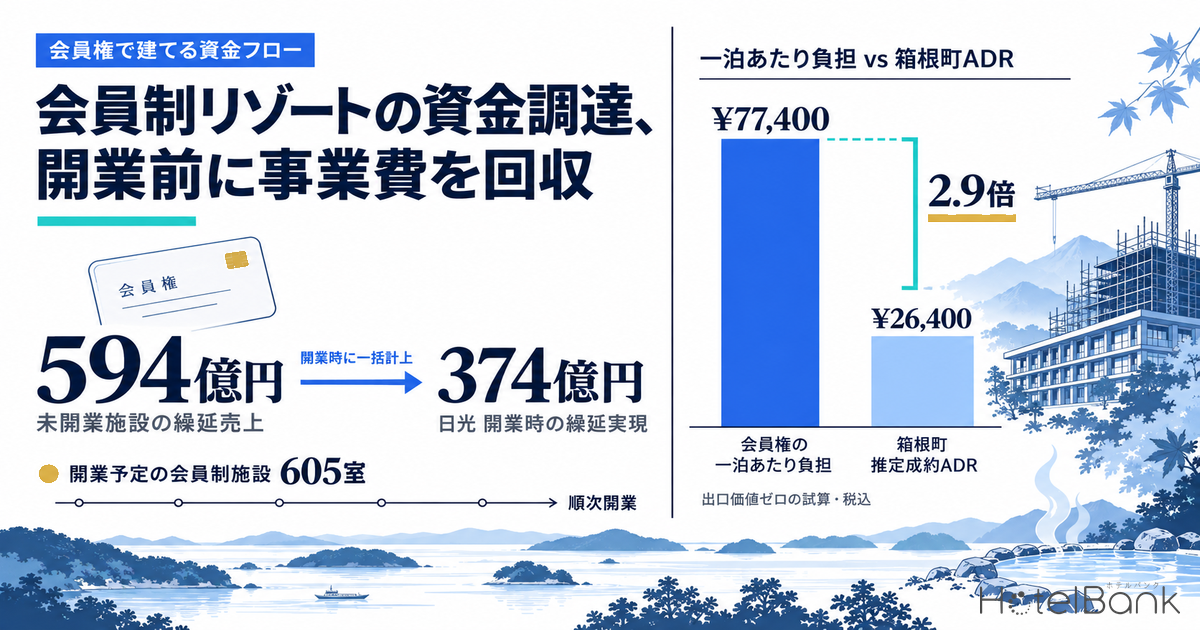
Membership resorts finance themselves in an order that is unusual for hotel development. Memberships go on sale once construction starts, and over the roughly 30 months to opening the operator builds up contracts equivalent to the project cost. Unlike typical hotel development, which relies on bank loans, mezzanine finance or a sale to a REIT, here customers are buying a building before it is finished. This article breaks the structure down, checking each figure against the investor-relations materials of Resorttrust (リゾートトラスト, TSE 4681). Deferred revenue for the company’s three unopened Sanctuary Court properties totalled ¥59.4bn at the end of March 2026, and at Sanctuary Court Nikko, which opened in February 2026, the ¥37.4bn real-estate portion was recognised as revenue in one lump at opening. We then list the six membership properties (605 rooms) whose openings we could confirm, compare the estimated settled ADR of Ise-Shima, Hakone, Nasu, Tateshina, Atami and other areas where membership properties cluster with the per-night cost of a membership, and set out where the exit (the resale market) and rebuilding costs sit.
Metric Definitions Used in This Article
- ADR (average daily rate): an estimated settled rate (tax-exclusive equivalent), calculated by applying a segment-specific adjustment factor to the cheapest plan each property publishes on OTAs and similar channels (2 guests per room, per-room rate, tax-inclusive). Checked against property-level results disclosed by listed hotel REITs (91 properties, most recent 3 months), the median error is about 7%. It is an estimate and differs from each property’s actual achieved prices and accounting figures. Area-level ADR is the median of the target properties (the level of a typical property in the area). In this article, municipal monthly values are simple-averaged over the 12 months from September 2025 to August 2026 (all of them finalised months).
- Listed price: the area median of listed prices across all plans on OTAs and similar channels (room-only to meal-inclusive; 2 guests per room, per room, tax-inclusive). Used as a reference value for municipalities with few properties in the estimated settled ADR population.
- Deferred revenue: in Resorttrust’s accounts, the real-estate portion of memberships in unopened hotels that is not recognised as revenue until opening. It is recognised in one lump at opening (realisation of deferred revenue).
- Per-night cost: this article’s estimate (tax-inclusive) — the membership purchase price (net of exit value) divided by years held × nights used per year, plus the annual fee divided by nights used per year. Room charges and food and beverage are not included.
- Data sources: MetroEngines Research; disclosures by Resorttrust and Tokyu Land Corporation, among others (see the source list at the end)
- — ¥59.4bn in deferred revenue — Resorttrust’s three unopened properties (Yatsugatake ¥17.9bn, Kanazawa ¥26.8bn, Awajishima ¥14.7bn). At Nikko, which opened in February 2026, ¥37.4bn was realised in one lump at opening.
- — ¥6.1bn of borrowings vs ¥257.5bn of funds received — advances received of ¥107.8bn plus long-term deposits received of ¥149.7bn work as interest-free funding, giving a liability structure that is largely insulated from rising interest rates.
- — 6 properties / 605 rooms due to open — only projects whose opening date and room count could be confirmed in primary sources. After Kanazawa in March 2029, the gap between large openings widens.
- — Per-night cost of ¥77,438 = 2.9x Hakone’s ADR — estimate for 20 years held, 8 nights a year and zero exit value. However holding period and nights used are varied, it never falls below 2.2x; a new membership never reaches the rate level of the open market.
- — An 83% exit-value ratio is the break-even point — to match Hakone’s estimated settled ADR of ¥26,385, 83.4% of the purchase price must be recovered at exit. Case R, bought on the resale market, comes to ¥16,926, below Toba City’s ADR of ¥20,838.
Building with memberships: selling after groundbreaking and recovering the project cost before opening
Resorttrust’s investor document “Resorttrust’s Business Model (February 2026)” sets out the standard shape of a single membership hotel as follows. Assuming a hotel of about 180 rooms, it offers some 8,000 memberships, with 45 people sharing each room. The guideline total project cost starts at around ¥60bn per property, and total membership sales start at around ¥130bn — a sales total set at 2.0–2.3 times the whole project cost. Sales begin after construction starts; the design is to sell about half in the roughly 30 months from groundbreaking to opening, recovering the capital invested, and to sell out within 2–3 years of opening.
In other words, because total sales are set at 2.0–2.3 times the project cost, by the time half is sold, contracts equivalent to 100–115% of the project cost have built up. Per room, that is a project cost of about ¥330M against total sales of about ¥720M. In typical hotel development what builds up during construction is the loan balance; in this model it is money received from customers.
The way payments are received is distinctive too. In the same document’s example, the membership price is made up of three parts — a guarantee deposit (10–20%), a registration fee (35–40%) and the real-estate price (45–50%) — and 50% of the price is received at contract, 75% at topping-out and 100% at completion. The accounting does not follow the cash. The registration fee is booked as revenue at contract; the guarantee deposit is recorded as a liability and amortised into revenue after opening (over 30 or 50 years for products from around 2000 onward); and the real-estate price is deferred until opening and booked as revenue in one lump then. In the example of a ¥10M membership, only the ¥4M registration fee is booked as revenue at contract, and the ¥5M real-estate price is booked at opening together with ¥3.5M of cost of sales. The example annual fee is ¥130,000.
We checked how this deferral shows up in the results using the property-level revenue breakdown in the presentation for the fiscal year ended March 2026. Deferred revenue for the three Sanctuary Court properties still unopened at year-end was ¥17.9bn for Yatsugatake (¥17.0bn in FY3/2025 + ¥0.9bn in FY3/2026), ¥26.8bn for Kanazawa (¥0.6bn + ¥26.2bn) and ¥14.7bn for Awajishima (FY3/2026), a cumulative ¥59.4bn. Nikko, which opened in February 2026, realised ¥37.4bn of real-estate revenue in one lump in the same year. The breakdown of that year’s deferral adjustments shows ¥41.781bn of real-estate revenue newly deferred and ¥37.480bn realised on opening, so the build-up of deferrals and the realisation at opening roughly balanced out. The company cites “the impact of deferral realisation” as its reason for switching its dividend policy from a payout ratio to DOE (dividend on equity), precisely because reported revenue swings this much depending on whether a property opens.
The depth of the member base can also be confirmed in the numbers. Group members held a total of 205,000 memberships (end-March 2025); excluding multiple holdings, that is about 145,000 people (130,000 households). By end-March 2026 memberships had risen to 210,752, of which Sanctuary Court accounted for 22,760 (+5,264 year on year). Hotel membership contracts for the year came to ¥122.1bn, about 16% above the previous year. The company says more than 80% of contracts each year come from referrals, additional purchases and switches by existing members, and this referral-centred sales network underpins its funding through advances received.
What works compared with bank loans, preferred equity and REIT acquisition
How membership funding works shows up in the make-up of the liabilities. On the consolidated balance sheet at end-March 2026, borrowings (short and long term combined) were just ¥6.1bn, while advances received reached ¥107.8bn and long-term deposits received ¥149.7bn. Advances received include the real-estate portion for unopened hotels (¥55.0bn per the company’s explanation at end-March 2025), which is transferred to revenue at opening. Neither carries interest, and together with net assets of ¥166.7bn they make clear a funding structure that does not depend on interest-bearing debt.
The table below sets out, for each provider of development capital, the leverage, interest-rate sensitivity and where construction risk sits. The membership model stands out because it is barely affected by rising interest rates and because most of the funds can be secured through sales before completion. In exchange, the operator bears all of the risk of slow sales and construction cost overruns. Because the sale price is fixed at contract, cost overruns have to be absorbed in the operator’s margin. The company’s step-by-step price revisions since FY2022, even for properties already on sale, can be seen as a way of passing cost increases on to members who sign later.
| Aspect | Membership advances (Resorttrust model) | Bank loan | Preferred equity / mezzanine | REIT acquisition |
|---|---|---|---|---|
| When funds come in | Sales start after groundbreaking. 50% received at contract, 75% at topping-out, 100% at completion (company example) | At drawdown (typically drawn in instalments as construction progresses) | At investment | On acquisition after completion and stabilisation |
| Leverage (LTV) | Not reliant on borrowing. Borrowings of ¥6.1bn vs advances received of ¥107.8bn and long-term deposits received of ¥149.7bn (end-March 2026) | Constrained by the lender’s LTV cap and debt-service capacity | Stacked subordinate to the senior loan, filling the gap to equity | Managed at the level of the investment corporation’s overall LTV |
| Interest-rate sensitivity | Low (no interest on advances or deposits) | High (with floating rates, feeds straight into repayments) | High (high target yield; required returns rise with rates) | Depends on the spread between acquisition yield and funding cost |
| Who bears construction delay and cost overrun | Operator (an opening delay shows up as a longer deferral period) | Sponsor (completion guarantee, cost-overrun cover) | Sponsor and subordinate investors | None, as acquisition is in principle after completion |
| Sales and demand risk | Operator (sales progress at opening drives the profit realised) | Repaid from operating income | Depends on operating income and sale proceeds | Reflected in rent and variable rent |
| Revenue in the accounts | Registration fee at contract; real-estate price booked in one lump at opening | — | — | Rental income |
The distance from REIT acquisition is also worth noting. Among the names of the 302 properties held by seven listed hotel REITs in the ownership data maintained by HotelBank (as of September 14, 2026) — Ichigo Hotel REIT (3463), Invincible Investment Corporation (8963), Nippon Hotel & Residential Investment Corporation (3472), Japan Hotel REIT (8985), Hoshino Resorts REIT (3287), Mori Trust REIT (8961) and Kasumigaseki Hotel REIT (401A) — there is no property of a membership resort brand. Membership properties, in which members hold usage rights and a share of the real estate, differ in character from what REITs valuing assets on rent acquire, and their exit lies in the membership resale market instead.
Supply pipeline: six membership properties, 605 rooms, due to open
The unopened membership resorts whose opening date and room count could be confirmed in each company’s IR materials and press releases are the following six properties with 605 rooms. Resorttrust plans to open four properties by 2029, starting with Yatsugatake in March 2027; as of end-June 2026, Kanazawa was 55.6% sold, Awajishima 25.5%, and Sotobo Suzumejima, which went on sale on June 22, 11.4%. On Awaji Island, the number of lodging facilities has grown 1.4-fold over the past few years. Tokyu Land Corporation plans to open two properties of its Tokyu Harvest Club membership resort hotels in Kusatsu at the same time, a main building and an annex.
| Planned opening | Property | Location | Rooms | Operator | Sales / recruitment status (primary sources) |
|---|---|---|---|---|---|
| Mar 2027 | Sanctuary Court Yatsugatake Residential Resort (サンクチュアリコート八ヶ岳 レジデンシャルリゾート) | Hokuto City, Yamanashi | 80 rooms | Resorttrust | On sale from August 22, 2024. Deferral realisation planned for FY ending March 2027 |
| Mar 2027 | Tokyu Harvest Club Kusatsu & VIALA (東急ハーヴェストクラブ草津&VIALA) | Kusatsu Town, Agatsuma District, Gunma | 152 rooms | Tokyu Land Corporation | First member recruitment opened May 12, 2025. Up to 1,800 memberships |
| Mar 2027 | Tokyu Harvest Club VIALA Kusatsu Retreat green (東急ハーヴェストクラブ VIALA 草津 Retreat green) | Kusatsu Town, Agatsuma District, Gunma | 10 rooms | Tokyu Land Corporation | Up to 108 memberships |
| Jul 2027 | Sanctuary Court Sotobo Suzumejima Ocean Villa Resort (サンクチュアリコート外房雀島 オーシャンヴィラリゾート) | Isumi City, Chiba | 14 rooms | Resorttrust | On sale from June 22, 2026. 11.4% sold (end-June 2026) |
| Mar 2029 | Sanctuary Court Kanazawa Hotel & Golf Spa Resort (サンクチュアリコート金沢 ホテル&ゴルフ スパリゾート) | Kanazawa City, Ishikawa | 167 rooms | Resorttrust | On sale from March 21, 2025. 55.6% sold, ¥69.0bn of contracts booked (end-June 2026) |
| Oct 2029 | Sanctuary Court Awajishima Island Palace Resort (サンクチュアリコート淡路島 アイランドパレスリゾート) | Sumoto City, Hyogo | 182 rooms | Resorttrust | On sale from June 20, 2025. 25.5% sold, ¥37.4bn of contracts booked (end-June 2026) |
| Total | 605 rooms | ||||
This table includes only projects whose opening date and room count could be confirmed in primary sources. In its development schedule, Resorttrust says it will keep to “a pace of roughly 1 to 1.5 properties a year from FY2026 onward” and that it is “considering more than 10 new candidate sites from FY2026 onward”. Its materials for Q1 of the fiscal year ending March 2027 also disclosed that it signed purchase agreements for two hotel development sites in the Kyushu area in May and August 2026. Their names and opening years have not been announced, however, so they are not included in the table. After Kanazawa in March 2029, the gap between large openings also widens. The company itself explains that growth in operating rooms, the denominator of its occupancy rate, will level off for the time being.
Distance from the open market: estimated settled ADR in seven municipalities vs per-night cost
We measured open-market rates in areas where membership properties cluster using MetroEngines Research’s municipal data. The targets are the municipalities home to XIV Toba (Toba City), XIV Hakone Rikyu and Tokyu Harvest Club Hakone Koshien (Hakone Town), Tokyu Harvest Club Nasu (Nasu Town), XIV Tateshina and Tokyu Harvest Club Tateshina (Chino City), XIV Hatsushima and Tokyu Harvest Club Atami Izusan (Atami City) and others, plus the planned opening sites. Tokyu Harvest Club’s published property list alone shows 3 properties with 223 rooms in Chino City, 4 with 281 rooms in Hakone Town, 2 with 156 rooms in Nasu Town and 2 with 182 rooms in Atami City, so membership rooms make up part of each area’s supply.
For estimated settled ADR, only the seven municipalities with at least 30 target properties (N) in every month were used for comparison. The 12-month average for September 2025 to August 2026 was highest in Hakone Town at ¥26,400 (N=170–187), followed by Atami City at ¥24,600 (N=99–108), Toba City at ¥20,800 (N=74–81) and Nasu Town at ¥19,900 (N=49–54). Shima City came to ¥18,300 (N=55–59), Kusatsu Town ¥17,600 (N=77–92) and Chino City ¥12,600 (N=37–41). Hokuto City (N=19–23) and Isumi City (N=3) have too few properties in the estimated settled ADR population, so they are excluded from the comparison, and the 12-month average of listed prices (area median, tax-inclusive) is shown as a reference instead: ¥28,700 for Hokuto City and ¥48,500 for Isumi City.
| Municipality | Main membership properties (examples) | Estimated settled ADR, 12-month avg | Aug 2026 | YoY | Target properties N |
|---|---|---|---|---|---|
| Hakone Town (Kanagawa) | XIV Hakone Rikyu, Tokyu Harvest Club Hakone Koshien and others | ¥26,385 | ¥28,247 | −3.4% | 170–187 |
| Atami City (Shizuoka) | XIV Hatsushima, Tokyu Harvest Club Atami Izusan | ¥24,594 | ¥29,035 | −1.4% | 99–108 |
| Toba City (Mie) | XIV Toba | ¥20,838 | ¥21,250 | −12.6% | 74–81 |
| Nasu Town (Tochigi) | Tokyu Harvest Club Nasu | ¥19,863 | ¥24,692 | −13.8% | 49–54 |
| Shima City (Mie) | Ise-Shima area (one tourism zone with Toba City) | ¥18,314 | ¥18,974 | −8.4% | 55–59 |
| Kusatsu Town (Gunma) | Tokyu Harvest Club Kusatsu & VIALA (opening March 2027) | ¥17,644 | ¥19,500 | −5.6% | 77–92 |
| Chino City (Nagano, Tateshina) | XIV Tateshina, Tokyu Harvest Club Tateshina and others | ¥12,588 | ¥15,152 | +1.6% | 37–41 |
| Hokuto City (Yamanashi) *reference | Sanctuary Court Yatsugatake (opening March 2027) | Listed price ¥28,703 (12-month avg) | — | 19–23 | |
| Isumi City (Chiba) *reference | Sanctuary Court Sotobo Suzumejima (opening July 2027) | Listed price ¥48,538 (12-month avg) | — | 3 | |
In August 2026, estimated settled ADR was below the same month a year earlier in six of the seven municipalities, all except Chino City. Membership rates, however, are often fixed year-round as member room charges, so movements in open-market rates do not pass straight through to members. Lodging taxes are also being introduced or considered in Hakone Town and Nasu Town (Hakone’s ¥350 lodging tax, and Nasu Town’s lodging tax, in force from October 1).
Next, we estimate the per-night cost of a membership. The baseline is the Club Suite 8-nights-a-year type at Sanctuary Court Kanazawa (¥9.79M, tax-inclusive) and the ¥130,000 annual fee the company’s materials give as an example for a ¥10M membership. Assuming 20 years held, all 8 nights used each year and zero exit value, the purchase price allocation is ¥61,200 a night and the annual fee ¥16,300 a night, for a total of about ¥77,400. That cost is 2.9 times Hakone Town’s estimated settled ADR of ¥26,400. Memberships are tax-inclusive and estimated settled ADR is a tax-exclusive equivalent, so even after removing the tax difference (about 10%) it is 2.7 times. On top of this come member room charges (¥18,000–22,500 a night for a one-bedroom at Sanctuary Court Nikko; ¥21,780–27,225 including tax and service).
| Case | Years held | Nights used per year | Exit value | Purchase price allocation / night | Annual fee / night | Per-night cost | vs Hakone ADR |
|---|---|---|---|---|---|---|---|
| A Long hold | 30 years | 8 nights | 0 | ¥40,792 | ¥16,250 | ¥57,042 | 2.2x |
| B Baseline | 20 years | 8 nights | 0 | ¥61,188 | ¥16,250 | ¥77,438 | 2.9x |
| C 75% usage | 20 years | 6 nights | 0 | ¥81,583 | ¥21,667 | ¥103,250 | 3.9x |
| D With exit | 20 years | 8 nights | 30% of purchase price | ¥42,831 | ¥16,250 | ¥59,081 | 2.2x |
| E 2% cost of capital | 20 years | 8 nights | 0 | ¥74,841 | ¥16,250 | ¥91,091 | 3.5x |
| R Bought on resale market (XIV Toba Bettei CB, 13 nights/yr) | 10 years | 13 nights | 0 | ¥9,615 | ¥7,311 | ¥16,926 | 0.6x |
| Years held \ nights actually used per year | 4 nights | 5 nights | 6 nights | 7 nights | 8 nights |
|---|---|---|---|---|---|
| 10 years | ¥277,250 10.5x | ¥221,800 8.4x | ¥184,833 7.0x | ¥158,429 6.0x | ¥138,625 5.3x |
| 15 years | ¥195,667 7.4x | ¥156,533 5.9x | ¥130,444 4.9x | ¥111,810 4.2x | ¥97,833 3.7x |
| 20 years | ¥154,875 5.9x | ¥123,900 4.7x | ¥103,250 3.9x | ¥88,500 3.4x | ¥77,438 2.9x |
| 25 years | ¥130,400 4.9x | ¥104,320 4.0x | ¥86,933 3.3x | ¥74,514 2.8x | ¥65,200 2.5x |
| 30 years | ¥114,083 4.3x | ¥91,267 3.5x | ¥76,056 2.9x | ¥65,190 2.5x | ¥57,042 2.2x |
Varying both axes makes the character of the product clear. The lightest cost is ¥57,042 for 30 years held with all 8 nights used each year, and even that is 2.2 times Hakone Town’s estimated settled ADR. Conversely, holding for 10 years and using only 4 nights a year sends it up to ¥277,250 (10.5x). Only four cells in the table come in at a multiple in the 2x range — holds of 25 years or more with 7–8 nights a year fully used — and as long as exit value is set at zero, there is no combination in which a new membership’s per-night cost matches the rate level of the open market. Working backwards, for Case B (20 years, 8 nights a year) to match Hakone’s ADR, 83.4% of the purchase price must be recovered at exit. The gap to the 30% assumed in Case D shows how large the unrecoverable portion of the new-sale price — the registration fee and so on — is.
The differences between cases say a lot. Cutting nights used from 8 to 6 a year alone pushes the per-night cost up to ¥103,300, so the economics of a membership depend more on usage than on the holding period. On the other hand, setting exit value at 30% of the purchase price brings the per-night cost down to ¥59,100. Resale-market prices are the other variable that determines the effective cost of use. According to the company, 85% of new buyers at Kanazawa and 88% at Awajishima are corporate contracts, and buyers value memberships including their use for employee benefits, client entertainment and tax purposes. That value, which this article’s estimate does not capture, is part of why sales keep growing even though the per-night cost is 2–4 times the open-market ADR.
Exit: resale-market liquidity and who pays for rebuilding
The exit for a membership is the resale market. In material explaining the purchase value of its memberships, Resorttrust states plainly that “a resale market exists”. At the same time, its membership sales information stipulates that transfer becomes possible 5 years after completion (or 3 years after the contract date if the contract was signed more than 2 years after completion). So there is not yet any resale price for the Sanctuary Court properties due to open. For its existing brands, the company itself resells: XIV is “nearly sold out (resale)” and Bay Court Club is “sold out (resale)”.
| Property / type | Nights per year | Asking price (tax-inclusive) | Annual fee / management fee |
|---|---|---|---|
| Tokyo Bay Court Club Royal Suite (東京ベイコート倶楽部 ロイヤル・スイート) | 12 nights | ¥15.3M | ¥261,800 |
| XIV Karuizawa Sanctuary Villa Museo S type (エクシブ軽井沢サンクチュアリ・ヴィラムセオ Sタイプ) | 13 nights | ¥8.0M | ¥157,300 |
| XIV Kyoto Yase Rikyu S type (エクシブ京都八瀬離宮 Sタイプ) | 13 nights | ¥6.7M | ¥165,000 |
| XIV Toba Bettei CB type (エクシブ鳥羽別邸 CBタイプ) | 13 nights | ¥1.25M | ¥95,040 |
| XIV Hamanako D1 type (エクシブ浜名湖 D1タイプ) | 13 nights | ¥1.05M | ¥102,300 |
Resale prices range from around ¥1M to over ¥15M depending on the property’s generation, location and room grade. The relationship with the annual fee is especially telling. In the table above, asking prices range from about 10–13 times the annual fee (XIV Hamanako, Toba Bettei) to more than 50 times (Tokyo Bay Court Club). For memberships whose resale price is around ten years’ worth of annual fees, buyers can be read as weighing the ongoing upkeep more heavily than the purchase price. As Case R shows, the per-night cost via the resale market falls below Toba City’s estimated settled ADR of ¥20,800 (room charges extra). New-sale prices are set at a “new-build, at-opening value” that includes the unrecoverable registration fee; resale prices can be seen as values reset by subsequent usage value and upkeep costs.
Tokyu Harvest Club uses a small-owner system limiting each room to 12 (or 10) members, issues 30 (or 36) accommodation vouchers a year, and allows membership to be transferred and inherited. According to operator Tokyu Resorts & Stay, the annual number of membership transactions in FY2025 hit a record high for the third year running, with the most trades at Hakone Koshien, Hamanako, Amagi Kogen and Nasu. The mechanics differ by brand, but this is evidence that the resale market works as an exit for existing properties.
Finally, who pays for rebuilding and major renovation? Resorttrust’s development schedule has, separately from new properties, rows for “partial renovation of existing facilities (strategic investment)” and “remodel development / preparation and study toward membership structuring”, and its long-term growth outline places “launch of XIV rebuilding model” in the phase from the fiscal year ending March 2030 to the one ending March 2035. This suggests rebuilding is positioned as development integrated with structuring new memberships. However, the treatment of existing members’ holdings and the split of costs have not been disclosed so far. With shared-ownership memberships, members hold a share of the real estate, so the rules for bearing renewal costs are set by the membership rules and management regulations. For companies and individuals considering a purchase, and for investors assessing the operator’s capital policy, the history of annual (operating and management) fee revisions — which the company discloses in its IR materials — and the membership rules on rebuilding are the main items to check, as they drive exit value.
Funding
Total sales set at 2.0–2.3 times the project cost, with about half sold before opening. Advances and deposits take the place of interest-bearing debt, insulating the model from rising rates.
Pipeline
Six properties / 605 rooms due to open are confirmed in primary sources. After Kanazawa in March 2029 the gap between large openings widens, and the names and timing of the two Kyushu sites are undisclosed.
Distance from the open market
A new membership’s per-night cost is 2.2–3.9 times Hakone’s ADR. Bought on the resale market it falls to open-market levels; usage and exit price determine the economics.
Summary
Membership resort financing is an advance-payment model that sells customers a building before it is finished. At Resorttrust, deferred revenue for three unopened properties had built up to ¥59.4bn by end-March 2026, and ¥37.4bn was realised in one lump at Nikko when it opened. As the liability structure — ¥6.1bn of borrowings against ¥107.8bn of advances received and ¥149.7bn of long-term deposits received — shows, interest-rate sensitivity is low. On the other hand, construction schedule, construction cost and sales-progress risk are concentrated on the operator. Compared with the open market, a new membership’s per-night cost far exceeds the estimated settled ADR of the seven municipalities where membership properties cluster. Because resale prices are reset by usage value and annual fees, investors need to watch three points: whether sales rates and opening dates progress together, whether annual fee revisions and usage support resale prices, and how the rules on bearing rebuilding costs are disclosed.
Note: all estimated settled ADR figures in this article are for finalised past months (September 2025 to August 2026). Planned opening dates and sales rates are as stated in each company’s materials at the time of research and may change. Resale-market prices are brokers’ asking prices and differ from transaction prices. This article does not recommend buying or selling any particular membership.
Related Articles
| Tochigi Hotel ADR: 3.6x City Gap, Nasu ¥20,192 vs Utsunomiya ¥7,349 |
| Kanagawa Hotel Market 2026: Four Tiers and a ¥15,400 Autumn ADR Gap |
References and Sources
■ Data sources
Municipal estimated settled ADR and listed prices are aggregated data from MetroEngines Research (monthly values, June 2025 to August 2026; the 12-month averages in this article are simple averages of September 2025 to August 2026, all finalised months). Monthly target properties: Hakone Town 170–187, Atami City 99–108, Toba City 74–81, Nasu Town 49–54, Shima City 55–59, Kusatsu Town 77–92, Chino City 37–41. Hokuto City (19–23) and Isumi City (3) have few properties in the estimated settled ADR population, so listed prices are shown for reference. Listed hotel REIT ownership data covering 7 REITs and 302 properties (as of September 14, 2026) were checked to confirm that no membership resort brand property is included. Accounting figures, sales rates, room counts and planned openings were checked in the original PDFs of Resorttrust (4681) and Tokyu Land Corporation disclosures; resale prices are as viewed on brokers’ websites on September 19, 2026.
■ Calculation assumptions
Per-night cost = (membership purchase price × (1 − exit value ratio)) ÷ (years held × nights used per year) + annual fee ÷ nights used per year. The baseline membership is the Sanctuary Court Kanazawa Club Suite 8-nights-a-year type at ¥9.79M (tax-inclusive, as stated in the presentation for Q1 of the fiscal year ending March 2027). The ¥130,000 annual fee is the value given as an example for a ¥10M membership in “Resorttrust’s Business Model (February 2026)”; actual annual fees differ by property and grade. Case E converts the purchase price to an annual amount by level repayment at 2% a year over 20 years (about ¥599,000 a year). Case R uses a broker’s asking price (XIV Toba Bettei CB, 13 nights a year, ¥1.25M, annual fee ¥95,040) and excludes transfer fees and other costs. Amortisation and refund of guarantee deposits, corporate tax effects, room charges and F&B, and interest on membership loans are not considered in any case. The estimated settled ADR used for comparison is a tax-exclusive equivalent while membership prices and annual fees are tax-inclusive; the tax difference (about 10%) is shown separately in the text. The per-room project cost and total sales are based on the standard shape in the same document (180 rooms, total project cost ¥60bn, total sales ¥130bn).
■ Limitations and caveats
Estimated settled ADR is the municipal median of properties sold to the general public, and differs in size, capacity and service from the suites at membership properties (including categories for 4–5 guests). The ¥59.4bn of deferred revenue is the sum of the deferred amounts for the three properties unopened at year-end, as stated in the property-level revenue breakdown in the presentation for the fiscal year ended March 2026. Resale prices are asking prices at the time of listing and do not indicate completed transactions. Properties due to open are limited to projects whose opening date and room count could be confirmed in primary sources; the list is not exhaustive.
■ Market data
- MetroEngines Research & Consulting — municipal estimated settled ADR and listed prices (June 2025 to August 2026; Hakone Town N=170–187 properties/month, etc.); listed hotel REIT ownership data (as of September 14, 2026; 7 REITs, 302 properties)
■ Company IR and press releases
- Resorttrust, “Resorttrust’s Business Model (February 2026)” (in Japanese)
- Resorttrust, “Financial Results Presentation for the Fiscal Year Ended March 2026” (May 2026, in Japanese)
- Resorttrust, “Financial Results Presentation for Q1 of the Fiscal Year Ending March 2027”
- Resorttrust, membership sales launch for Sanctuary Court Sotobo Suzumejima Ocean Villa Resort (June 22, 2026, in Japanese)
- Resorttrust, membership sales launch for Sanctuary Court Yatsugatake Residential Resort (August 22, 2024, in Japanese)
- Resorttrust, membership sales launch for Sanctuary Court Kanazawa Hotel & Golf Spa Resort (March 21, 2025, in Japanese)
- Resorttrust, membership sales launch for Sanctuary Court Awajishima Island Palace Resort (June 20, 2025, in Japanese)
- Resorttrust, “Membership System FAQ” (in Japanese)
- Resorttrust Group, “Sanctuary Court Rate List” (in Japanese)
- Tokyu Land Corporation, “Tokyu Harvest Club Kusatsu & VIALA: First Member Recruitment Opens” (May 12, 2025, in Japanese)
- Tokyu Resorts & Stay, “Tokyu Harvest Club Membership Trends, H2 and Full Year FY2025” (in Japanese)
■ Resale market