

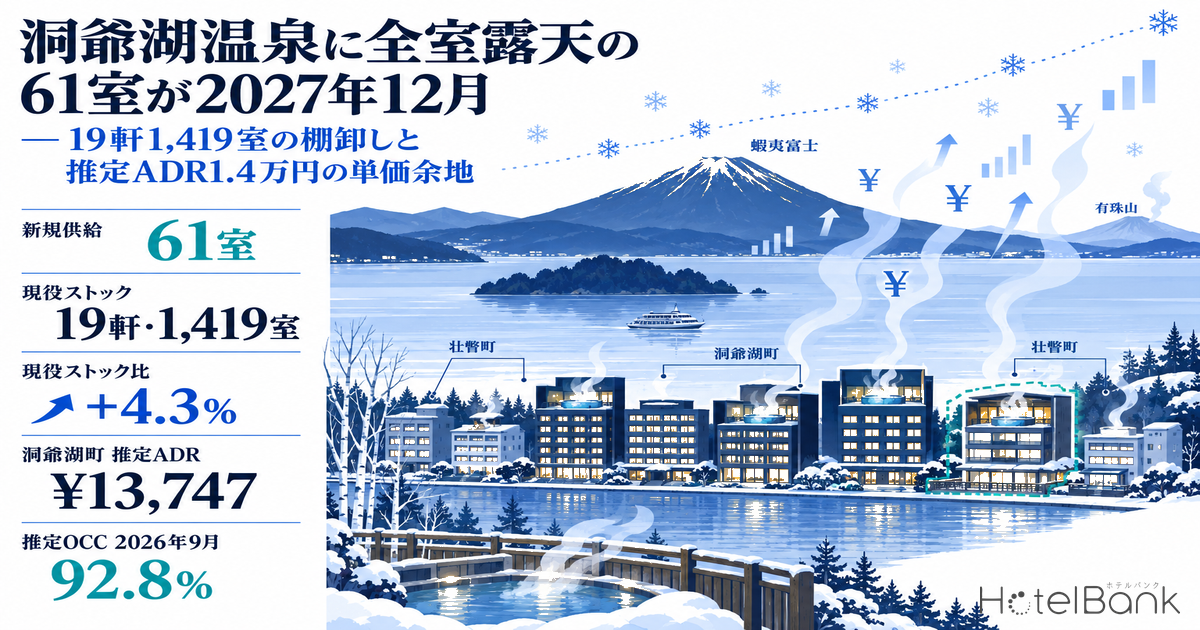
In June 2026, plans were announced for Bettei Ezofuji (別邸 蝦夷富士), a 61-room property at Lake Toya Onsen in Hokkaido where every room comes with its own open-air bath and terrace, scheduled to open in December 2027. It will be operated by Granbell Hokkaido, a Belluna subsidiary, and built new on land adjacent to The Lake Suite Konosumika (ザ・レイクスイート湖の栖) and Toya Sun Palace Resort & Spa (洞爺サンパレス リゾート&スパ), both acquired by Belluna in 2023. Auditing the lakeside 2km radius of Lake Toya Onsen property by property, we find 19 active properties with 1,419 rooms that have shown sales activity in the last three months; the 61 new rooms equal 4.3% of that stock. In a hot-spring town built around large ryokan and hotels, this article examines where a small, all-open-air-bath new supply fits, from five angles: room stock, the seasonality of estimated settled ADR, estimated occupancy, volcanic hazard, and land prices.
Metric Definitions Used in This Article
- ADR (Average Daily Rate): An estimated settled rate (tax-excluded equivalent), calculated by applying segment-specific adjustment factors to the lowest-priced plan each property publishes on OTAs (per room, 2 guests per room, tax included). Checked against property-level results disclosed by listed hotel REITs (most recent three months), the median error is about 7%. These are estimates and differ from each property’s actual settled rates and accounting figures. Area-level ADR is the median of the properties covered (the level of a typical property in the area). Estimated settled ADR is available only for the validated segments of business, city, resort, ryokan and capsule; guesthouses, vacation rentals and similar show listed prices only.
- Listed price (all-plan average): Per-room rate for 2 guests (tax included), averaged across all plans from room-only to two meals included. This is a separate metric from ADR.
- OCC (Occupancy rate): Share of rooms sold out of total rooms in the area (an estimate based on OTA sales inventory). It is an estimate based on how OTA-listed inventory is absorbed and differs from a property’s actual overall occupancy.
- Booking curve / LT: Booking curve = the change in OTA remaining rooms leading up to the check-in date. LT (lead time) = days until check-in. Curves in this article use only the LT45→1 range.
- Data source: MetroEngines Research & Consulting (aggregated public data on about 27,000 properties with confirmed operations among those tracked by MetroEngines Research)
- — 19 properties, 1,419 rooms — the active stock found by auditing every property within 2km of Lake Toya Onsen. Bettei Ezofuji's 61 rooms add 4.3% to a large-property town where three hotels of 200+ rooms hold 55% of the rooms.
- — The “20–80 rooms × est. ADR above ¥50,000” segment is empty — the top of the 2km radius is Konosumika (¥45,700) and Nonokaze (¥39,700). The 61 all-open-air-bath rooms read as supply aimed at a price tier stacked above them.
- — Est. ADR ¥13,747 (Toyako Town, Oct 2025 – Sep 2026 average, N=13–15) — peaking at ¥15,700 in August and bottoming at ¥11,900 in March, a 1.32x spread. That is below Noboribetsu City's ¥18,819, and the seasonal shape differs from Noboribetsu, which peaks in winter.
- — Land price ¥30,000/sqm (2025 prefectural land price survey) — 42% of Noboribetsu Onsen and 71% of Jozankei Nishi 3-chome. Land cost per room is ¥3.0M–4.5M, small next to building investment of around ¥100M per room.
- — GOP yield 6.0% (reference estimate at ¥2.5M per tsubo, est. ADR ¥80,000, assumed occupancy 65%) — the break-even hinges on sustaining rates above the current top tier year-round. As Mt. Usu is a designated volcanic disaster alert area, an evacuation-assurance plan must be built into the business plan.
The Facts of the Plan — 61 Rooms on the Sobetsu Side of the Lakeshore, Next to Two Existing Hotels, Construction from April 2026
First, the published facts. According to Travel Voice (June 9, 2026) and Netshop Tantosha Forum (June 11, 2026), Bettei Ezofuji will have 61 rooms in total, including suites of over 104 sqm, with every room featuring an open-air bath and a spacious terrace. Construction runs from April 2026 to late December 2027, with opening planned for December 2027. The adjacent The Lake Suite Konosumika (80 rooms) and Toya Sun Palace Resort & Spa (324 rooms) will remain open during construction. The name “Ezofuji” is a nickname for Mt. Yotei, highlighting a location with views of both the lake and the mountain.
One point worth establishing is the municipality. The Lake Toya Onsen hot-spring town is usually described as part of Toyako Town, but checking the coordinates of the two existing hotels against the Geospatial Information Authority of Japan (GSI) map shows that both Konosumika and Sun Palace are in Toyako Onsen, Sobetsu Town (the center of the hot-spring town, including the row of Manseikaku, Kohantei and Nonokaze, is in Toyako Onsen, Toyako Town). Bettei Ezofuji, built on the adjacent land, is very likely on the Sobetsu side as well, so note that Sobetsu Town is where land prices, ordinances and volcanic disaster preparedness should be confirmed. This article's audit treats the 2km radius of the hot-spring town as a single area across municipal boundaries, and the tables list the town for each property.
We also checked the operator's footing in the company's primary disclosures. According to Belluna's Q3 earnings summary for the fiscal year ending March 2026 (January 30, 2026), the Property business, which includes hotels, posted cumulative April–December sales of ¥37,042 million (+40.6% YoY) and segment profit of ¥6,482 million (+56.5% YoY); profit includes ¥1,042 million in gains on the sale of real estate for sale. Segment profit as a share of sales is 17.5% (14.7% excluding the sale gains; both our calculations). The summary states that for domestic resort hotels, “sales grew at all hotels,” with revenue and profit up, helped by the two Akiu Onsen hotels acquired in September 2025. Further, the interim results presentation of November 28, 2025 showed domestic resort hotels at a room rate of ¥37,900 and occupancy of 60.7% for full FY2024 (April 2024 – March 2025), and ¥43,700 and 67.5% for Q2 FY2025, and listed “construction of a new Annex building for The Lake Suite Konosumika” as a future initiative. Bettei Ezofuji can be read as the concrete form of that plan.
| Item | Details | Source |
|---|---|---|
| Name / Operator | Bettei Ezofuji / Granbell Hokkaido (Belluna subsidiary) | Travel Voice 2026-06-09 |
| Rooms | 61 rooms in total, including suites of over 104 sqm. Open-air bath and terrace in every room | Same as above; Netshop Tantosha Forum 2026-06-11 |
| Construction / Opening | April 2026 – late December 2027 / opening planned December 2027 | Same as above |
| Adjacent properties | The Lake Suite Konosumika (80 rooms), Toya Sun Palace Resort & Spa (324 rooms) — open during construction | Same as above |
| Municipality | Coordinates of the two existing hotels fall in Toyako Onsen, Sobetsu Town (checked against GSI map) | GSI |
| Business segment | Property business, April–December cumulative: sales ¥37,042 million (+40.6%), segment profit ¥6,482 million (+56.5%) | Belluna Q3 earnings summary, FY ending March 2026 |
| Domestic resort operating metrics | Room rate ¥37,900, occupancy 60.7% for full FY2024 (April 2024 – March 2025) / Q2 FY2025 ¥43,700, 67.5% | Belluna interim results presentation (2025-11-28) |
Auditing the 2km Radius — 19 Active Properties, 1,419 Rooms; Three 200+ Room Hotels Hold 55%
Tracing supply year by year, the Lake Toya Onsen 2km radius grew from 16 properties and 1,329 rooms in 2012 to 19 properties and 1,556 rooms in 2019, and appears flat at 25 properties and 1,586 rooms from 2023 onward. However, this series counts properties at each year-end based on a master of opening and closing dates, and it moves independently of actual sales. For this article we therefore checked each of the 33 records registered in the master within a 2km radius, treated properties with price observations in the last three months (stay dates from July 10, 2026) as active, and merged the same property registered under multiple names into one. The result is 19 properties and 1,419 rooms: 17 properties and 1,015 rooms on the Toyako Town side, and 2 properties and 404 rooms on the Sobetsu Town side (Konosumika and Sun Palace). Adding 61 rooms brings the total to 1,480, an increase of 4.3%.
By size band, the five properties with 100+ rooms hold 1,072 rooms, 76% of the total, followed by five properties of 30–99 rooms with 283 rooms (20%) and nine properties of under 30 rooms with 64 rooms (5%). In other words, the town's rooms are concentrated in the three 200+ room hotels — Sun Palace with 324, Manseikaku with 246 and Kohantei with 205 (775 rooms combined, 55%) — and the town grew as a destination of large properties that share the lakeside scenery while broadly serving groups and families. Meanwhile, a small-room, high-rate tier has emerged over the past few years: Konosumika (80 rooms, opened 2019) at an est. ADR of ¥45,700 (12-month average), and Toyako Tsuruga Resort Ko no Uta (洞爺湖鶴雅リゾート洸の謌) at Sobetsu Onsen on the eastern lakeshore (opened 2023, 48 rooms, outside the 2km radius) at ¥44,200. Bettei Ezofuji's 61 rooms can be positioned as supply that thickens this “small-room, high-rate” tier.
From the operator's side, combined with the two existing hotels (404 rooms), Belluna-affiliated rooms total 465, equal to 31% of the 1,480 rooms in the audited 2km radius. Securing broad demand through the large Sun Palace while capturing rate through Konosumika and the Bettei forms a three-tier structure — a design that splits products by guest segment within the same section of the lakeshore.
| Property | Town | Rooms | Segment | Listed price (all-plan avg) | Est. ADR (12-month avg) |
|---|---|---|---|---|---|
| Toya Sun Palace Resort & Spa (洞爺サンパレス リゾート&スパ) | Sobetsu | 324 | Resort hotel | — | ¥16,191 |
| Toyako Manseikaku Hotel Lakeside Terrace (洞爺湖万世閣ホテルレイクサイドテラス) | Toyako | 246 | Resort hotel | — | ¥23,733 |
| Zekkei no Yuyado Toya Kohantei (絶景の湯宿 洞爺 湖畔亭) | Toyako | 205 | Ryokan | — | ¥18,061 |
| The Lakeview TOYA Nonokaze Resort (ザ レイクビューTOYA 乃の風リゾート) | Toyako | 166 | Resort hotel | — | ¥39,695 |
| Toya Kanko Hotel (洞爺観光ホテル) | Toyako | 131 | Ryokan | — | ¥14,452 |
| The Lake Suite Konosumika (ザ・レイクスイート湖の栖) | Sobetsu | 80 | Resort hotel | — | ¥45,671 |
| Toya Onsen Hotel Kabi (洞爺温泉ホテル華美) | Toyako | 76 | Ryokan | — | ¥13,872 |
| Yutorelo Toyako (ゆとりろ洞爺湖) | Toyako | 58 | Ryokan | — | ¥12,542 |
| Hotel Grand Toya (ホテルグランドトーヤ) | Toyako | 39 | Ryokan | — | ¥10,000 |
| Toyako Onsen Hokkai Hotel (洞爺湖温泉 北海ホテル) | Toyako | 30 | Ryokan | — | ¥10,545 |
| Gensen no Yuyado Toya Gokirakutei (源泉の湯宿 洞爺 ごきらく亭) | Toyako | 22 | Ryokan | — | — |
| Grand Village Toya Yamato Ryokan Annex (グランヴィレッヂ洞爺 大和旅館アネックス) | Toyako | 17 | Ryokan | — | ¥7,510 |
| Petit Hotel Koizumi (プチホテル恋泉) | Toyako | 8 | Pension | — | ¥9,564 |
| TOYA Center Village | Toyako | 6 | Other lodging | — | — |
| Guest House HIDE | Toyako | 4 | Guesthouse | — | — |
| THE TOYA | Toyako | 3 | Guesthouse | — | — |
| Koko (湖湖) | Toyako | 2 | Guesthouse | — | — |
| Toya Home Kairo (トヤホーム 廻廊) | Toyako | 1 | Vacation rental / whole-house | — | — |
| Kohan no Yado Kojima (湖畔の宿湖嶋) | Toyako | 1 | Vacation rental / whole-house | — | — |
| 2km radius total | 1,419 | 19 properties |
For reference, outside the 2km radius on the Sobetsu Onsen side of the lakeshore there are another 7 active properties with 109 rooms. The core is Toyako Tsuruga Resort Ko no Uta with 48 rooms; the rest are small properties of 33 rooms or fewer. Across the Lake Toya shoreline as a whole, two layers are already visible: the large properties of the hot-spring town, and small, high-rate inns scattered to the east.
| Property (Sobetsu Onsen side, outside 2km) | Town | Rooms | Segment | Listed price (all-plan avg) | Est. ADR (12-month avg) |
|---|---|---|---|---|---|
| Toyako Tsuruga Resort Ko no Uta (洞爺湖鶴雅リゾート洸の謌) | Sobetsu | 48 | Resort hotel | ¥113,265 | ¥44,202 |
| Hotel Sol at Lake Toya | Sobetsu | 33 | Pension / small hotel | ¥25,662 | — |
| Pension Ohno (ペンションおおの) | Sobetsu | 11 | Pension | ¥27,102 | — |
| Onsen Ryokan Ikoiso (温泉旅館 いこい荘) | Sobetsu | 10 | Ryokan | ¥19,144 | — |
| ATTA Toya – Lake Resort | Sobetsu | 3 | Other lodging | ¥35,812 | — |
| Chaihana-an (ちゃいはな庵) | Sobetsu | 3 | Guesthouse | ¥33,480 | — |
| Toyako Bettei Shinboku-an (洞爺湖別邸 進木庵) | Sobetsu | 1 | Vacation rental / whole-house | ¥102,202 | — |
Positioning — Large Ryokan at Est. ADR ¥14,000–24,000; an Empty Tier Above the Small Properties in the ¥40,000s
Plotting room count against estimated settled ADR splits the town into two clusters. On the right of the horizontal axis, four of the five large properties with 100+ rooms line up in an est. ADR band of ¥14,500–¥23,700, with only Nonokaze Resort (166 rooms) breaking above at ¥39,700. On the left, in the 30–80 room band, Konosumika (80 rooms) stands a head above at ¥45,700, while four ryokan of 30–76 rooms cluster in the ¥10,000–14,000 range. Tsuruga Resort Ko no Uta at Sobetsu Onsen (48 rooms) sits at ¥44,200, in the same tier as Konosumika.
The empty area on this chart is “20–80 rooms × est. ADR above ¥50,000.” No property within the 2km radius currently falls in this band. Given its specification of 61 rooms, each with an open-air bath, Bettei Ezofuji is most naturally read as supply targeting a price tier stacked above Konosumika. For the product of in-room open-air baths, our same-property comparison of 792 properties measured a premium of about ¥10,000 per night (+23%); adding this “open-air bath premium” directly on top of the existing top tier brings an estimated settled level in the high ¥50,000s to ¥60,000s into view. Konosumika's est. ADR in August 2026 was ¥57,900 and Tsuruga Resort Ko no Uta's was ¥49,700, showing that even existing small properties achieve ¥50,000–60,000 levels in peak months.
Crowded Large ryokan & hotel tier
131–324 rooms × est. ADR ¥14,000–24,000
4 properties, 906 rooms (excluding Nonokaze). They absorb groups, families and inbound visitors, with high occupancy in peak season.
WS1 Small × above ¥50,000
20–80 rooms × est. ADR above ¥50,000
No property within 2km. The tier the 61 all-open-air-bath rooms enter.
Existing top The Konosumika / Tsuruga tier
48–80 rooms × ¥44,000–46,000
Formed by two properties opened in 2019 and 2023. Reaches ¥50,000–60,000 in peak months.
Seasonality — Toyako Town's Est. ADR Peaks at ¥15,700 in August and Bottoms at ¥11,900 in March
The depth of year-round demand shows in the seasonal pattern of rates. Toyako Town's estimated settled ADR averaged ¥13,700 over October 2025 – September 2026 (N=13–15 properties); monthly, it peaked at ¥15,700 in August 2026 and bottomed at ¥11,900 in March, a peak-to-trough ratio of 1.32x. The comparison, Noboribetsu City, averaged ¥18,800 over the same period (N=14–15), highest in January at ¥23,200 — a seasonal shape that differs from Lake Toya by peaking in winter. Lake Toya Onsen has summer draws such as the long-run fireworks launched every night from late April to the end of October, while in Noboribetsu, winter inbound demand pushes rates up.
Against Hokkaido-wide segment figures, resort hotels had a 12-month average est. ADR of ¥16,700 and ryokan ¥9,700; Toyako Town's ¥13,700 sits above the Hokkaido ryokan level but short of the resort hotel level. Put differently, the town's overall rate is pulled to the middle by the price band of its large ryokan, and the more small properties break above, the more room there is for the town-wide median to move up. The Sobetsu Town series has few properties (N=4–6) and shows months in the ¥30,000s from October 2025 to January 2026, but it swings easily as the set of properties changes, so we treat it as reference only.
| Month | Toyako Town | N | Noboribetsu City | N | Sobetsu Town (ref.) | N | Hokkaido resort | Hokkaido ryokan |
|---|---|---|---|---|---|---|---|---|
| Oct 2025 | ¥12,344 | 13 | ¥19,605 | 15 | ¥30,216 | 4 | ¥14,064 | ¥9,196 |
| Nov 2025 | ¥13,566 | 13 | ¥18,572 | 14 | ¥28,207 | 4 | ¥15,438 | ¥9,419 |
| Dec 2025 | ¥14,562 | 13 | ¥20,754 | 14 | ¥31,170 | 4 | ¥18,585 | ¥10,574 |
| Jan 2026 | ¥14,100 | 13 | ¥23,242 | 15 | ¥32,614 | 4 | ¥19,096 | ¥10,760 |
| Feb 2026 | ¥13,755 | 14 | ¥20,012 | 15 | ¥14,504 | 5 | ¥19,026 | ¥10,023 |
| Mar 2026 | ¥11,902 | 15 | ¥17,933 | 15 | ¥13,992 | 5 | ¥16,014 | ¥8,631 |
| Apr 2026 | ¥12,247 | 15 | ¥17,140 | 15 | ¥13,292 | 6 | ¥14,612 | ¥8,775 |
| May 2026 | ¥14,571 | 15 | ¥16,977 | 15 | ¥14,148 | 6 | ¥14,752 | ¥9,292 |
| Jun 2026 | ¥14,308 | 15 | ¥17,092 | 15 | ¥14,526 | 6 | ¥15,153 | ¥8,964 |
| Jul 2026 | ¥14,419 | 15 | ¥17,713 | 15 | ¥15,694 | 6 | ¥18,064 | ¥9,778 |
| Aug 2026 | ¥15,721 | 15 | ¥19,096 | 15 | ¥17,155 | 6 | ¥19,240 | ¥10,862 |
| Sep 2026 | ¥13,470 | 15 | ¥17,690 | 15 | ¥13,966 | 6 | ¥16,198 | ¥9,764 |
| 12-month avg | ¥13,747 | 13–15 | ¥18,819 | 14–15 | — | 4–6 | ¥16,687 | ¥9,670 |
Estimated Occupancy — Toyako Town Averaged 92.8% in September, with Remaining Rooms Falling Steadily from LT45 to Arrival
Against the seasonality of rates, how is inventory absorbed? Toyako Town's estimated occupancy based on OTA-listed inventory was 94.6% in July 2026, 95.1% in August and 92.8% in September (12 properties / 573 rooms, based on listings on major booking sites). For the same month across Hokkaido, resort hotels were at 85.7% (84 properties / 9,065 rooms) and ryokan at 88.1% (164 properties / 7,210 rooms), so Toyako Town closed September above the Hokkaido segment averages.
Following the September booking curve from LT45 to just before arrival, Toyako Town builds in steps: 77.0% at LT45, 81.8% at LT30, 85.5% at LT14 and 92.8% at LT1. Over the same span, Hokkaido resort hotels went from 68.6% to 85.7% and ryokan from 69.5% to 88.1%, so Toyako Town starts higher and gains relatively less in the final days. A market where inventory fills early is one in which small, high-rate properties can more easily hold rates without relying on last-minute discounting. Note that the 573 total rooms here are the sum of inventory allocations listed on major booking sites, a different definition from the audit's 1,419 rooms (properties' total room count).
| Month (2026) | Toyako Town est. OCC | Properties / rooms | Hokkaido resort | Hokkaido ryokan | Hokkaido all segments |
|---|---|---|---|---|---|
| August | 95.1% | 11 / 572 | 86.6% | 86.4% | 89.6% |
| September | 92.8% | 12 / 573 | 85.7% | 88.1% | 90.3% |
Location Map — The Hot-Spring Town's Layout, the Sobetsu Boundary, and the 19 Active Properties Within 2km
On the map, the hot-spring town forms a band stretching about 3km east to west along the lake's southern shore. Circle size reflects room count, and the center coordinates (42.566, 140.818) are placed at the center of the hot-spring town in Toyako Onsen, Toyako Town. Konosumika and Sun Palace at the eastern end fall within Sobetsu Town, and beyond them on the Sobetsu Onsen side small properties such as Tsuruga Resort Ko no Uta are scattered. The Bettei Ezofuji site has been reported as adjacent to Konosumika and Sun Palace, so the locations of those two hotels on the map serve as a guide.
Volcanic Hazard — Mt. Usu Is at Alert Level 1; in the 2000 Eruption a Crater Opened on the Hill Behind the Town
As a premise for any investment decision, we state plainly that this hot-spring town sits at the foot of an active volcano. Mt. Usu is continuously monitored by the Japan Meteorological Agency (JMA), and as of October 8, 2026 its eruption forecast is “Volcanic Alert Level 1 (Note that the volcano is active).” Recorded eruptions occurred in 1663, 1769, 1822, 1853, 1910, 1943–45 (forming Showa-Shinzan), 1977 and 2000 — roughly every few decades. The most recent, the 2000 eruption, began on March 31 at the western foot of Mt. Nishiyama, and on April 1 a crater also opened on the mid-slope of Mt. Konpira, south of the Lake Toya Onsen town. Hot mudflows reached part of the town, damaging a public bathhouse and housing complexes, but more than 10,000 residents had evacuated before the eruption and there were no casualties. Some damaged structures have been preserved and opened as the “Konpira Crater Disaster Remains Trail,” which also serves as a learning resource for a hot-spring town that coexists with a volcano.
Institutionally, under the Act on Special Measures for Active Volcanoes, three municipalities — Date City, Sobetsu Town and Toyako Town — are designated as the volcanic disaster alert area for Mt. Usu (Cabinet Office Notice No. 14, February 22, 2016). Article 6 of the Act requires municipalities within alert areas to designate facilities near craters or used by large numbers of unspecified people as “evacuation promotion facilities” in their local disaster management plans, and Article 8 requires designated facilities to prepare and publish an evacuation-assurance plan, conduct drills based on it, and report to the mayor. Under the Cabinet Office's support program for preparing evacuation-assurance plans, plans were developed in FY2020 for facilities serving people requiring special care at Mt. Usu (Toyako Town), and there are support cases for lodging facilities at Mt. Kurikoma, Mt. Fuji, Kuchinoerabujima and elsewhere. At the time of the 2000 eruption, the then Abuta Town and the Lake Toya Onsen Tourism Association compiled guidelines for lodging facilities, requiring helmets, dust masks and evacuation maps in every room, and the submission of each property's “Mt. Usu Eruption Emergency Evacuation Guidance Procedures” to the town.
For new development, these are less barriers to entry than operating requirements to be built in at the planning stage. Specifically, it is advisable to set out four points in the business plan: (1) whether the site falls under the local disaster management plan of Sobetsu Town or Toyako Town, and whether it would be designated an evacuation promotion facility; (2) how the site overlaps with the assumed crater area and zones affected by volcanic blocks and mudflows on the volcanic hazard map; (3) the cost of preparing an evacuation-assurance plan, annual drills, and in-room equipment (helmets, masks, multilingual evacuation maps); and (4) funding and insurance to cover business suspension and booking cancellations when the alert level is raised. Some municipalities restrict lodging construction by ordinance in designated disaster hazard zones, and because Lake Toya lies within Shikotsu-Toya National Park, the permit standards of the Natural Parks Act also apply; both should be checked before construction.
| Item | Current status | Source |
|---|---|---|
| Volcanic alert level | Level 1 (Note that the volcano is active), continuously monitored volcano. Volcanic activity commentary (September 2026) released October 8 | JMA |
| Eruption history | 1663, 1769, 1822, 1853, 1910, 1943–45, 1977, 2000 | JMA |
| 2000 eruption | Eruption began March 31 at the western foot of Mt. Nishiyama; crater opened April 1 on the mid-slope of Mt. Konpira. Hot mudflows damaged the town's public bathhouse and housing complexes; no casualties thanks to advance evacuation | Cabinet Office, Mt. Usu eruption records |
| Volcanic disaster alert area | Date City, Sobetsu Town, Toyako Town (Cabinet Office Notice No. 14, February 22, 2016) | Cabinet Office |
| Obligations of evacuation promotion facilities | Prepare and publish an evacuation-assurance plan, conduct drills, report to the mayor (Active Volcanoes Act, Article 8) | Cabinet Office |
| Guidelines for lodging facilities (2000) | Helmets, dust masks and evacuation maps kept in every room; evacuation guidance procedures submitted to the town | Cabinet Office, Mt. Usu eruption records (Abuta Town, Lake Toya Onsen Tourism Association) |
Land Prices and Land Cost per Room — ¥30,000/sqm in the Hot-Spring Town, 40% of Noboribetsu Onsen and 70% of Jozankei
Land acquisition cost shapes the economics of small properties. Looking up the hot-spring town's benchmark sites in MLIT's Real Estate Information Library, Toyako Onsen 44-1 (Toyako Town, commercial zone, floor area ratio 400%) was ¥30,000/sqm in the 2025 prefectural land price survey (−0.7% YoY), nearly flat from ¥30,200/sqm in 2024. Noboribetsu Onsen-machi 76-4 (Noboribetsu City, commercial zone, FAR 600%) was ¥71,200/sqm in the 2025 official land price publication (0.0%), and Jozankei Onsen Nishi 3-chome (Minami Ward, Sapporo, commercial zone) was ¥42,200/sqm in the land price survey (+8.2%). Land at Lake Toya Onsen is just 42% of Noboribetsu Onsen and 71% of Jozankei Nishi 3-chome, making it a location where land is relatively cheap to secure among Hokkaido's major hot-spring towns.
A product with an open-air bath and terrace in every room tends to have large room footprints and to use the site broadly at low rise. Assuming a site area per room of either 100 sqm or 150 sqm, land cost per room comes to ¥3.0M–4.5M at Lake Toya Onsen, ¥7.12M–10.68M at Noboribetsu Onsen and ¥4.22M–6.33M at Jozankei Nishi 3-chome. For a small property expecting an est. ADR in the ¥50,000s, a land cost difference of a few million yen per room is small compared with building investment (around ¥100M per room in the estimate below); what determines the value of a site is less the cheapness of the land than whether it secures “a lakeside view that allows an open-air bath in each room.”
| Benchmark site | Type (reference date) | Price (¥/sqm) | YoY | Zoning (FAR / BCR) | Surroundings |
|---|---|---|---|---|---|
| Toyako Onsen 44-1 (Toyako Town) | Prefectural land price survey (July 1, 2025) | 30,000 | -0.7% | Commercial zone (400% / 80%) | Hot-spring town commercial area lined with souvenir shops, hotels, etc. |
| Noboribetsu Onsen-machi 76-4 (Noboribetsu City) | Official land price publication (January 1, 2025) | 71,200 | +0.0% | Commercial zone (600% / 80%) | Hot-spring town commercial area lined with hotels, souvenir shops, etc. |
| Jozankei Onsen Nishi 3-chome 13 et al. (Minami Ward, Sapporo) | Prefectural land price survey (July 1, 2025) | 42,200 | +8.2% | Commercial zone (400% / 80%) | Hot-spring town commercial area lined with hotels, souvenir shops, etc. |
| Jozankei Onsen Higashi 3-chome 228-13 et al. (Minami Ward, Sapporo) | Official land price publication (January 1, 2025) | 26,000 | +6.1% | Commercial zone (400% / 80%) | Commercial area along a national highway with low-rise retail shops, etc. |
Reference Estimate — Construction Cost and Required Rate for 61 All-Open-Air-Bath Rooms
Because Bettei Ezofuji's investment amount has not been disclosed, we present a reference estimate for a 61-room all-open-air-bath property of the same scale using general assumptions. We assume gross floor area of 120 sqm per room including room terraces and open-air bath space plus common areas such as the lobby, restaurant and baths (7,320 sqm in total, about 2,214 tsubo), and a site of 150 sqm per room (9,150 sqm) acquired at ¥30,000/sqm. For construction cost we set three cases: the 2024 all-structure hotel average of ¥1.95M per tsubo from MLIT's Building Construction Statistics as the floor, and ¥2.5M–3.5M per tsubo, cited by industry media as a guide for luxury specifications. Occupancy is set at 65% (Belluna's domestic resort hotels were 60.7% for full FY2024 and 67.5% in Q2 FY2025) and the GOP margin at 30% (a conservative value for the early years after opening, versus the 38.9% actual for 91 operated properties disclosed by Invincible Investment Corporation for the period ended December 2024); FF&E, design and supervision, and pre-opening costs are not included.
The results are shown in the table below. In the base case of ¥2.5M per tsubo construction cost, est. ADR ¥80,000 and an assumed occupancy of 65%, the GOP yield on a total investment of ¥5.81bn (¥95.25M per room) is 6.0%. At an est. ADR of ¥60,000 it stays at 4.5%, and at ¥100,000 it reaches 7.5%. The break-even point is whether rates exceeding the town's current top tier (Konosumika's peak month at ¥57,900) can be achieved year-round; conversely, if an all-open-air-bath product can create a new ¥60,000–80,000 estimated settled tier in this town, existing small properties also gain upside room on rates. Construction cost inflation in 2026–27 ahead of the December 2027 opening is not included in this estimate, so actual construction costs should be expected to come in higher. How rising construction costs are suppressing the national opening pipeline is covered in Construction +41% & Labor Crunch Erase Japan's 2027-2029 Hotel Supply.
| Case | Construction | Land | Total investment | Per room | ADR ¥60,000 | ADR ¥80,000 | ADR ¥100,000 |
|---|---|---|---|---|---|---|---|
| A 2024 all-structure average (¥1.95M/tsubo) | ¥4.32bn | ¥0.27bn | ¥4.59bn | ¥75.28M | 5.7% | 7.6% | 9.5% |
| B Luxury low end (¥2.5M/tsubo) | ¥5.54bn | ¥0.27bn | ¥5.81bn | ¥95.25M | 4.5% | 6.0% | 7.5% |
| C Luxury high end (¥3.5M/tsubo) | ¥7.75bn | ¥0.27bn | ¥8.02bn | ¥131.55M | 3.2% | 4.3% | 5.4% |
As a sensitivity analysis, we show yields when est. ADR falls 10% and occupancy falls 5pt from the base case. Even if both happen at once, the yield is 5.0%, a downside of only about 1pt. In a small property, the small number of rooms relative to fixed costs matters, so maintaining rates translates directly into maintaining the yield.
| Scenario | Est. ADR | Occupancy | Revenue | GOP | Yield |
|---|---|---|---|---|---|
| Base case | ¥80,000 | 65% | ¥1.16bn | ¥0.35bn | 6.0% |
| ADR −10% | ¥72,000 | 65% | ¥1.04bn | ¥0.31bn | 5.4% |
| Occupancy −5pt | ¥80,000 | 60% | ¥1.07bn | ¥0.32bn | 5.5% |
| Both | ¥72,000 | 60% | ¥0.96bn | ¥0.29bn | 5.0% |
Investment Takeaways — Implications for Investors Considering Resort Revitalization and Rate Upgrades in Hokkaido
To sum up, Lake Toya Onsen is a hot-spring town with five conditions: (1) three large properties hold the majority of rooms; (2) est. ADR exceeds the Hokkaido ryokan level but has a 1.32x gap between summer and winter; (3) estimated occupancy is higher than Hokkaido segment averages at 92.8% in September; (4) land prices are low among major hot-spring towns; and (5) it sits at the foot of an active volcano, with evacuation-assurance operating requirements. Under these conditions, Bettei Ezofuji places a small, all-open-air-bath, high-rate product at the eastern end of the town (the Sobetsu side), and can be read as a design that pursues the top tier while existing large properties maintain broad demand.
For investors and regional financial institutions considering resort revitalization or rate upgrades in Hokkaido, this case offers three implications. First, the more crowded a hot-spring town is with large ryokan, the more likely the “small-room × high-rate” tier is empty, leaving room to raise rates alone while riding the existing demand base. Second, because all-open-air-bath properties reach around ¥100M of building investment per room, they presuppose views and product strength that can sustain ¥60,000–80,000 estimated settled rates year-round. Third, location-specific regulatory requirements such as volcanoes, land prices and national parks can be built into the financing plan if the local disaster management plan and the Natural Parks Act permit category are confirmed before construction. After the December 2027 opening, we intend to track changes in est. ADR and OCC within the 2km radius based on this audit and verify how much the entry of small properties lifted the town's median.
Frequently Asked Questions
Reports say it will stand alongside two adjacent hotels at “Lake Toya Onsen.” Checking the coordinates of the two existing hotels against the GSI map places them in Toyako Onsen, Sobetsu Town, so the site is very likely on the Sobetsu side as well, and Sobetsu Town is likely where administrative procedures and disaster plans should be confirmed.
In our audit, active properties within 2km total 19 properties and 1,419 rooms, so 61 rooms is 4.3%. While small in room count, the supply enters the currently empty “small-room × est. ADR above ¥50,000” tier and is likely to push up the ceiling of the town's price range.
Mt. Usu is covered by a volcanic disaster alert area (Date City, Sobetsu Town, Toyako Town). Lodging facilities designated by a municipality as evacuation promotion facilities are required under Article 8 of the Act on Special Measures for Active Volcanoes to prepare and publish an evacuation-assurance plan, conduct drills and report to the mayor. Whether a facility is designated can be checked in each town's local disaster management plan.
Related Articles
- Dusit's Japan Debut at Lake Toya: 8 Asian Luxury Brands' Entry Routes
- Construction +41% & Labor Crunch Erase Japan's 2027-2029 Hotel Supply
- Niseko's Top Tier: Just 2 Hotels, 75 Rooms — Where Fairmont's 165 Fit
References and Sources
■ Data sources
Room stock was established by checking each registered property within a 2km radius of the center of the Lake Toya Onsen hot-spring town (42.566°N, 140.818°E) and treating properties with price observations in the last three months (stay dates from July 10, 2026) as active (19 properties, 1,419 rooms). Estimated settled ADR covers the finalized months of October 2025 – September 2026; estimated OCC and booking curves are based on inventory listed on major booking sites for August and September 2026 (LT45→1). Land prices are from the official land price publication and prefectural land price survey in MLIT's Real Estate Information Library; the plan outline is from two news reports; business metrics are from Belluna's earnings summary and results presentation.
■ Estimate assumptions
The reference estimate assumes a 61-room all-open-air-bath property of the same scale: gross floor area of 120 sqm per room (7,320 sqm in total), a site of 150 sqm per room acquired at ¥30,000/sqm, three construction cost cases of ¥1.95M, ¥2.5M and ¥3.5M per tsubo, an assumed occupancy of 65%, a GOP margin of 30%, and yield = GOP ÷ total investment. FF&E, design and supervision, pre-opening costs, and 2026–27 construction cost inflation are not included. Bettei Ezofuji's actual investment amount and room rates have not been disclosed.
■ Limitations and notes
Estimated settled ADR and estimated OCC are estimates based on OTA public data and differ from each property's actual results. The estimated OCC coverage (12 properties / 573 rooms) is the sum of listed inventory allocations, a different definition from the audit's 1,419 total rooms. The Sobetsu Town series has N=4–6 and large swings, so it is reference only. The official land price publication (January 1 reference) and the prefectural land price survey (July 1 reference) have different reference dates. The site's municipality and its position relative to hazard zones need final confirmation through published materials from the operator and from Sobetsu Town and Toyako Town.
■ Market data
- MetroEngines Research & Consulting — property audit within 2km (N=19 properties), estimated settled ADR (Toyako Town N=13–15, Noboribetsu City N=14–15), estimated occupancy and booking curves (Toyako Town 12 properties / 573 rooms)
■ Government statistics and public data
- MLIT Real Estate Information Library — official land price publication and prefectural land price survey (2024, 2025)
- MLIT “Building Construction Statistics” (2024 hotel construction costs)
- JMA “Mt. Usu” (continuously monitored volcano, eruption history, volcanic alert level)
- Cabinet Office “Volcanic Disaster Alert Areas” (Cabinet Office Notice No. 14, February 22, 2016)
- Cabinet Office “Evacuation Promotion Facilities and Evacuation-Assurance Plans” (Active Volcanoes Act, Article 8)
- Cabinet Office “Recipients of the Evacuation-Assurance Plan Support Program” (FY2020, Mt. Usu, Toyako Town)
- Cabinet Office Mt. Usu 2000 eruption records database (guidelines for lodging facilities)
- GSI Maps (coordinates and municipal boundary check)
■ Corporate IR and industry reports
- Belluna Co., Ltd. “Q3 Earnings Summary for the Fiscal Year Ending March 2026” (January 30, 2026)
- Belluna Co., Ltd. “Interim Results Presentation for the Fiscal Year Ending March 2026” (November 28, 2025)
- Belluna Co., Ltd. Investor Relations
- HOTELISM “Guide to Hotel Construction Costs”
■ News and press releases
- Travel Voice “Belluna to Open New Brand Bettei Ezofuji at Lake Toya Onsen in December 2027” (June 9, 2026)
- Netshop Tantosha Forum “Belluna Opens New Lodging Brand Bettei Ezofuji at Lake Toya Onsen, Hokkaido” (June 11, 2026)
- TRAICY “Belluna Begins Operating Three Hotels at Lake Toya and Lake Akan, Hokkaido” (September 2023)