

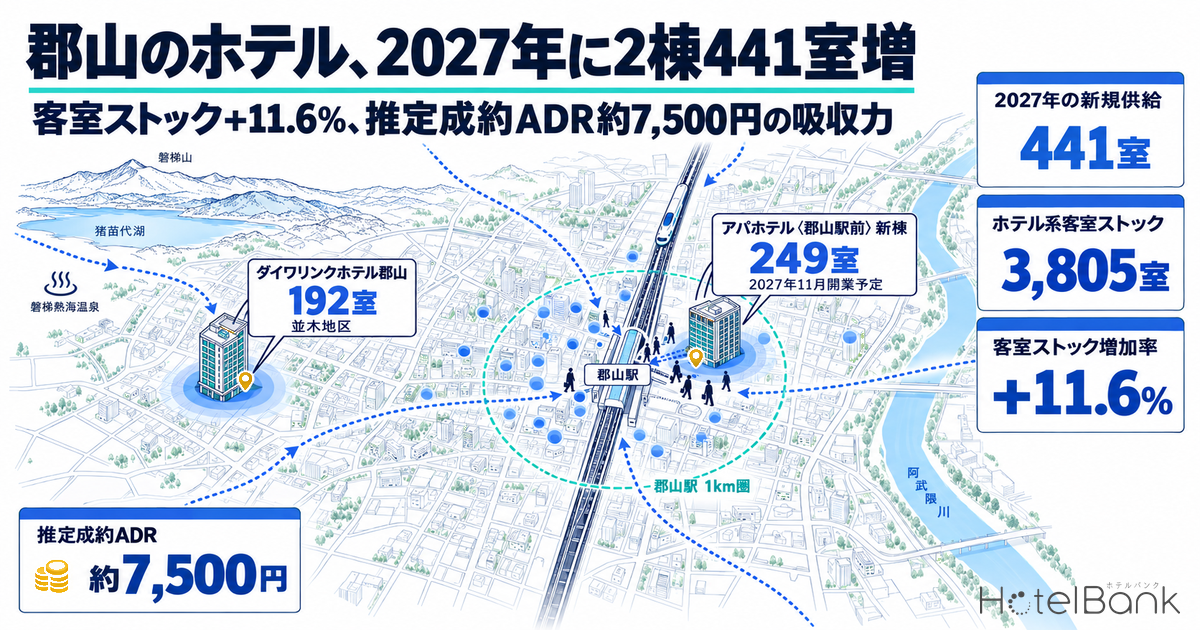
Koriyama City (Fukushima Prefecture) will add two business hotels with a combined 441 rooms in 2027: a new 249-room tower at APA Hotel Koriyama-Ekimae (アパホテル〈郡山駅前〉), steps from the west exit of JR Koriyama Station and scheduled to open in November 2027, and the 192-room Daiwa Link Hotel Koriyama (ダイワリンクホテル郡山) in the Namiki district, scheduled for spring 2027. This article calculates the increase against the city’s hotel-type room stock (29 properties, 3,805 rooms) at 11.6%, and estimates the demand needed to absorb 441 rooms using estimated settled ADR, estimated OCC, day-of-week booking patterns and the working population around the station.
Metric Definitions Used in This Article
- ADR (Average Daily Rate): An estimated settled rate (tax-exclusive equivalent), calculated by applying a category-specific adjustment factor to the lowest-plan level each property publishes on OTAs (two guests per room, per-room rate, tax included). Checked against property-level results disclosed by listed hotel REITs (91 properties, most recent three months), the median error is about 7%. These are estimates and differ from each property’s actual settled prices and accounting figures. Area-level ADR is the median of the target properties (the level of a typical property in the area).
- OCC (Occupancy Rate): The share of sold rooms relative to total rooms in the area (an estimate based on OTA sales inventory; consistency checks against REIT monthly disclosures confirm accuracy within roughly a few percentage points). The sample is a fixed cohort of properties listing at least 30% of their rooms on OTAs. Because unlisted rooms are counted as sold, the figure runs higher than the room occupancy rate in the Japan Tourism Agency’s Overnight Travel Statistics Survey. It reflects sell-through of OTA inventory and differs from each property’s actual overall occupancy.
- Booking curve / LT (lead time): A booking curve is the trajectory of remaining OTA rooms leading up to the check-in date. LT is the number of days before check-in. This article uses only observations from LT45 to LT1.
- Data source: MetroEngines Research & Consulting (tallied September 28–29, 2026)
The bottom line first: 441 rooms equals roughly one-tenth of Koriyama’s hotel-type rooms. If supply grows while demand stays flat, that is enough to pull down occupancy across the whole market. On the other hand, more than 20,000 workers are concentrated within 1 km of the station, and Tuesday–Thursday stays fill to around 90% estimated OCC by the day before arrival (day-of-week average for September 2026 check-in dates). The two new hotels will work best against this weekday business demand, and the estimated absorption line is about 270 room-nights per day. How much of the spare Sunday and weekend capacity can be turned into demand will likely be the key to sustaining market-wide occupancy.
- — Two hotels, 441 rooms, +11.6% in 2027: The new 249-room tower at APA Hotel Koriyama-Ekimae and the 192-room Daiwa Link Hotel Koriyama are scheduled to open. That is an 11.6% increase on Koriyama’s 3,805 hotel-type rooms (29 properties).
- — Estimated settled ADR of about ¥7,500: The 12-month average for September 2025–August 2026 (50–52 properties). August 2026 was about ¥8,000, up 3.6% YoY.
- — Weekdays reach 90.2% estimated OCC the day before: Average for Tuesday–Thursday check-ins in September 2026. Sundays stop at 76.0%, with an average of 484 OTA rooms still unsold the day before.
- — 20,300 workers within 1 km of the station: A business cluster of 1,819 establishments (Economic Census 2021) supports weekday business-trip demand that is booked close to arrival.
- — Absorption line of about 270 room-nights per day: Estimated at the 61.3% room occupancy of business hotels in Fukushima Prefecture (calendar 2025, final figures). Holding occupancy steady requires demand to grow about 11.6%, or roughly 5.6% a year.
Facts on the Two New Hotels — An Adjacent Expansion by the Station and a Mixed-Use Project in Namiki
The first is the new tower at APA Hotel Koriyama-Ekimae, announced by APA Hotel on February 17, 2026. A 249-room building will be constructed on the lot next to the existing building (89 rooms, renovated in December 2022), with opening scheduled for November 2027. The site is a two-minute walk from the west exit of JR Koriyama Station, and the new tower will have a large public bath. After the opening, the existing building will be renamed APA Hotel Koriyama-Ekimae-Minami (アパホテル〈郡山駅前南〉), giving the pair a combined 338 rooms. APA’s footprint in Fukushima Prefecture will expand to four hotels and 783 rooms. Construction is by Rinkai Nissan Construction. Adding rooms next to an established station-front base is a growth strategy of scaling up in a proven location.
The second is Daiwa Link Hotel Koriyama, part of the “Link Square” mixed-use complex that Higashi-Nihon Daiwa is developing in Namiki, Koriyama. The nine-story, 192-room hotel broke ground in May 2026 and is targeting a spring 2027 opening. According to press reports, the plan places a breakfast venue and a convenience store on the first floor, a large bath and sauna on the second, and guest rooms on floors three through nine. The Ministry of Land, Infrastructure, Transport and Tourism’s (MLIT) Building Construction Statistics also list the hotel at Namiki 1-chome with nine above-ground floors, 5,290㎡ of total floor area, 192 rooms, and scheduled completion in April 2027. Note that Higashi-Nihon Daiwa is a different company from the Daiwa House Group hotel business that operates Daiwa Roynet Hotel Koriyama-Ekimae near the station.
| Item | APA Hotel Koriyama-Ekimae (new tower) | Daiwa Link Hotel Koriyama |
|---|---|---|
| Rooms | 249 | 192 |
| Scheduled opening | November 2027 | Spring 2027 |
| Location | Ekimae 1-chome, Koriyama (next to the existing building) | Namiki 1-chome, Koriyama (inside the “Link Square” complex) |
| Distance from Koriyama Station | 2-minute walk from the west exit | About 2.5 km in a straight line |
| Scale and facilities | Large public bath. 338 rooms across two buildings including the existing 89-room building | Nine stories, 5,290㎡ total floor area. Large bath and sauna, breakfast venue, convenience store |
| Developer | APA Hotel | Higashi-Nihon Daiwa |
One more point matters when looking at 2027 supply: the Koriyama View Hotel Main Building (郡山ビューホテル本館), closed since January 2026 for a full renovation. It is scheduled to reopen on November 6, 2026, and press reports say it will have about 30 more rooms than before the renovation. This article’s increase rate counts only the 441 rooms of the two new hotels, but adding those extra rooms puts the supply increase for November 2026 through 2027 at roughly 470 rooms.
Koriyama’s Room Stock Is 29 Properties and 3,805 Rooms — 441 Rooms Means +11.6%
The denominator for the increase rate was recounted from the Koriyama properties tracked by MetroEngines Research. Properties with listed-price observations in any month from June to August 2026 were treated as “operating”; love hotels (leisure hotels) were excluded, and the Koriyama View Hotel Main Building, closed for renovation (92 rooms before renovation), was added. The result: Koriyama’s room stock is 61 properties and 4,540 rooms, of which 29 properties and 3,805 rooms are hotel-type (business, city and deluxe), and 23 properties and 683 rooms are ryokan, centered on Bandai-Atami Onsen.
| Category | Properties | Rooms | 441 rooms as % of stock |
|---|---|---|---|
| Hotel-type (business, city, deluxe) | 29 | 3,805 | +11.6% |
| of which within 1 km of Koriyama Station | 17 | 2,347 | +10.6% (APA new tower’s 249 rooms only) |
| Ryokan | 23 | 683 | — |
| Other (guesthouses, hot-spring facilities, etc.) | 9 | 52 | — |
| Total (excluding love hotels) | 61 | 4,540 | +9.7% |
The 441 rooms equal +11.6% of the hotel-type stock and +9.7% even against all lodging excluding love hotels. For a regional core city, adding this many rooms within a single year is a significant change. The two sites, however, play different roles. The APA new tower falls inside the 1 km radius of Koriyama Station (17 properties, 2,347 rooms) and competes head-on for station-area business demand and Shinkansen passengers. Daiwa Link, by contrast, is about 2.5 km from the station in a straight line, and only two existing hotel-type properties with 419 rooms lie within 1.5 km of it. The station area, where rooms are concentrated, and the Namiki district, closer to residential areas, have overlapping catchments but distinct roles. For a nationwide comparison of supply size relative to existing stock by municipality, see our Hotel Supply Pressure Ranking 2026-2027.
Estimated Settled ADR Is About ¥7,500; August 2026 Was Up 3.6% YoY
Koriyama’s citywide estimated settled ADR averaged about ¥7,500 over the 12 months from September 2025 to August 2026 (50–52 properties). Compared with the same 12 months a year earlier (September 2024–August 2025, about ¥7,300), that is +1.9%. The most recent month, August 2026, came in at about ¥8,000, 3.6% above the prior-year month (August 2025, about ¥7,800). Every month from January to August 2026 exceeded the same month of the previous year, with gains ranging from +0.4% to +4.9%.
Narrowing to business hotels, Koriyama’s estimated settled ADR averages about ¥6,600 over 12 months (25 properties). Lined up against 11 business hubs in Tohoku and northern Kanto, the top of the table is Sendai’s Aoba Ward at about ¥9,300, Aomori at about ¥8,300, Akita at about ¥7,700 and Yamagata at about ¥7,600; Koriyama sits in a price band close to Hachinohe, Aizuwakamatsu and Morioka (all about ¥6,700–6,800). Against the prior 12-month average it is down 1.3%, essentially flat, but August 2026 rose to about ¥7,600, up 4.9% YoY. Given the city’s concentration of business activity, rates still have room to rise, and new rooms may open up headroom at the upper end of the price range. Kumamoto, where business-hotel rates held up after 1,619 new rooms opened over two years, offers a useful precedent for how rates respond to a large wave of new supply.
Estimated OCC Is 88.3%; Weekdays Fill to Around 90% by the Day Before
Koriyama’s estimated OCC for August 2026 was 88.3% (27 properties / 1,828 rooms, based on listings on major booking sites). By category, ryokan stood at 83.7% (12 properties / 515 rooms). For Koriyama business hotels alone, fewer than 10 properties list at least 30% of their rooms on OTAs, so no estimate is produced. Looking instead at business hotels across Fukushima Prefecture, August 2026 came in at 86.5% (48 properties / 5,479 rooms).
The day-of-week gap in how rooms fill is large. For September 2026 check-in dates (23 days, excluding the Silver Week holidays of September 19–23; 28–30 properties / 1,844–2,015 rooms), averaging estimated OCC from LT45 to LT1 by day of week shows Tuesday–Thursday rising from 46.3% at LT45 to 90.2% the day before (LT1). Sundays, by contrast, stayed at 76.0% even at LT1. For Tuesday–Thursday, occupancy gained 21.3pt over the 31 days from LT45 to LT14 and 22.6pt over the 13 days from LT14 to the day before — the same increase packed into the final two weeks. It is a curve typical of business demand, where trips are arranged at the last minute.
| Check-in day | Days | LT45 | LT14 | LT7 | LT1 | Unsold OTA rooms at LT1 (avg.) |
|---|---|---|---|---|---|---|
| Monday | 3 | 46.4% | 65.2% | 74.1% | 85.8% | 287 rooms |
| Tuesday–Thursday | 10 | 46.3% | 67.6% | 78.9% | 90.2% | 192 rooms |
| Friday | 4 | 48.6% | 66.3% | 73.4% | 83.8% | 326 rooms |
| Saturday | 3 | 51.7% | 70.9% | 79.2% | 90.7% | 187 rooms |
| Sunday | 3 | 43.0% | 58.8% | 65.2% | 76.0% | 484 rooms |
Unsold OTA rooms the day before averaged 192 on Tuesday–Thursday and 484 on Sunday. Many weekdays arrive with only a handful of rooms left, and on September 15–17 estimated OCC the day before reached 94–96%. The new 441 rooms add capacity for these weekday peaks. Sunday stays, meanwhile, still have about 480 rooms of spare capacity the day before, and this is the market’s single biggest area of upside.
20,300 Workers Within 1 km of the Station — A Business Cluster Underpinning Weekday Demand
Within a 1 km radius of Koriyama Station there are 1,819 establishments and 20,300 workers (Ministry of Internal Affairs and Communications and Ministry of Economy, Trade and Industry, Economic Census for Business Activity, 2021). Widening to 2 km gives 3,822 establishments and 41,300 workers. Office-type workers account for 18.6% within 1 km; a broad mix of industries, including wholesale and retail, healthcare and services, supports weekday demand around the station.
Around Namiki 1-chome, where Daiwa Link is being built (1 km radius), there are 1,039 establishments and 13,800 workers, with an office-type share of 11.8%, lower than near the station. The residential population within 1.5 km is 33,200, above the station area’s 30,300. The data also show the different character of the catchments: the station area as a business district, and Namiki as an area closer to residential neighborhoods.
| Establishments (1 km radius) | 1,819 |
| Workers (1 km radius) | 20,253 |
| Workers (2 km radius) | 41,288 |
| Office-type share (1 km radius) | 18.6% |
| Residents, 2025 (1.5 km radius) | 30,266 |
| Residents, 2040 projection | 27,288 (−9.8% vs. 2025) |
The residential population within 1.5 km of the station is projected to fall from 30,300 in 2025 to 27,300 in 2040, a decline of 9.8%. The share of seniors is 27.3%. These figures count residents, not visitors or people passing through. Business-hotel demand comes not from residents but from business travelers, relocated employees and visitors drawn from a wide area, so a shrinking resident population does not translate directly into falling lodging demand. Over the long term, the station-area business cluster and the city’s wide-area pull as a transport hub at the center of the prefecture are more likely to form the base of demand.
Land prices also continue to rise. The official land price for Ekimae 1-chome, next to Koriyama Station (commercial, 600% floor-area ratio), was ¥415,000 per ㎡ as of January 1, 2026, up 4.8% year on year and up 14.6% over four years from ¥362,000 in 2022. Commercial sites in Ekimae 2-chome and Omachi 1-chome also rose 4.6–7.6% year on year. Rising land prices near the station lift the asset value of existing hotels, but they also raise the break-even threshold for new development.
| Official land price point (commercial) | Distance from station | 2022 | 2026 | YoY |
|---|---|---|---|---|
| Ekimae 1-chome 112 | 150m | ¥362,000/㎡ | ¥415,000/㎡ | +4.8% |
| Ekimae 2-chome 141 et al. | 270m | ¥186,000/㎡ | ¥227,000/㎡ | +4.6% |
| Omachi 1-chome 283-1 et al. | 330m | ¥133,000/㎡ | ¥170,000/㎡ | +7.6% |
Demand Scenarios to Absorb 441 Rooms — About 270 Room-Nights per Day
The 441 new rooms can supply 441 rooms × 365 days = 160,965 room-nights a year. We estimated the demand needed to fill them under different occupancy assumptions. For these assumptions we use the room occupancy rates from the Japan Tourism Agency’s Overnight Travel Statistics Survey rather than our estimated OCC, because estimated OCC counts unlisted rooms as sold and is therefore unsuited to estimating actual occupancy levels.
In the Japan Tourism Agency’s 2025 final figures, business-hotel room occupancy was 61.3% in Fukushima Prefecture and 75.3% nationwide. Other Tohoku prefectures were Aomori 73.1%, Iwate 71.3%, Miyagi 69.5%, Yamagata 69.0% and Akita 67.8%. Applying Fukushima’s level as is, the demand needed to fill 441 rooms is about 98,700 room-nights a year, or about 270 room-nights per day. At the national level of 75.3%, it would be about 330 room-nights per day.
| Occupancy assumption | Room-nights needed (annual) | Per day | Indicative room revenue (annual) |
|---|---|---|---|
| 55.0% | 88,531 | approx. 243 room-nights | approx. ¥580 million |
| 61.3% (Fukushima business hotels, 2025) | 98,672 | approx. 270 room-nights | approx. ¥650 million |
| 70.0% | 112,676 | approx. 309 room-nights | approx. ¥740 million |
| 75.3% (national business hotels, 2025) | 121,207 | approx. 332 room-nights | approx. ¥800 million |
If demand stays flat and only the 441 rooms are added, then applying the Fukushima business-hotel level (61.3%) as a hypothetical, market-wide occupancy would fall to 54.9% as the stock expands from 3,805 to 4,246 rooms. To hold occupancy steady, lodging demand at Koriyama’s hotel-type properties needs to grow by about 11.6%. Spread over the two years to 2027, that is growth of about 5.6% a year. For an analysis of new supply and absorption capacity in other Tohoku cities, see also North Tohoku’s 2,079 New Rooms: Which Segments Can Absorb the Supply.
Sensitivity Analysis: Room Revenue of the 441 New Rooms by Occupancy × Estimated Settled ADR
The table above fixes the rate at the 12-month average for Koriyama business hotels. Varying the rate assumption as well gives the following range of room revenue for the two new hotels. The rates used are the business-hotel levels for Koriyama, Yamagata and Sendai’s Aoba Ward compared in the text (all estimated settled ADR).
| Estimated settled ADR \ Annual occupancy | 55.0% | 61.3% (Fukushima BH 2025) | 70.0% | 75.3% (National BH 2025) |
|---|---|---|---|---|
| ¥6,590 (Koriyama BH 12-month avg.) | approx. ¥580M | approx. ¥650M | approx. ¥740M | approx. ¥800M |
| ¥7,600 (Koriyama BH Aug 2026 / Yamagata level) | approx. ¥670M | approx. ¥750M | approx. ¥860M | approx. ¥920M |
| ¥9,300 (Sendai Aoba Ward BH level) | approx. ¥820M | approx. ¥920M | approx. ¥1.05B | approx. ¥1.13B |
Source: Compiled from the Japan Tourism Agency’s Overnight Travel Statistics Survey 2025 (final figures) and MetroEngines Research & Consulting. Room revenue = 441 rooms × 365 days × occupancy × estimated settled ADR (tax-exclusive equivalent, estimate). The shaded row is the base case used in the text. BH = business hotels. A simple estimate that differs from the new properties’ actual pricing and occupancy.
Where will this demand come from? Compared with unsold OTA rooms the day before, Tuesday–Thursday’s 192 rooms fall short of the roughly 270 room-nights per day benchmark, so weekday overflow demand alone cannot fill the new rooms. The likely path is for the two new hotels to win guests with facilities such as large baths and saunas, expanding the market while also drawing some demand away from existing properties. On top of that, if the spare capacity of about 480 rooms on Sundays and about 330 on Fridays can be captured as weekend visitors and multi-night business stays, market-wide occupancy will be easier to sustain. As a transport hub at the center of the prefecture, combining wide-area demand — conventions, sports tournaments, and overnight stays before sightseeing trips toward Aizu and Bandai — points the way to filling the upside beyond weekdays.
Implications for Investors and Developers
Weekday business demand is deep
20,300 workers within 1 km of the station and 90.2% estimated OCC on Tuesday–Thursday the day before arrival (average for September 2026 check-in dates). The two new hotels will be most effective against weekday business-trip demand booked close to arrival.
Sunday stays are the biggest upside
Sundays reach only 76.0% estimated OCC even the day before (average for September 2026 check-in dates), with an average of 484 unsold OTA rooms. Whether weekend visits, multi-night stays and pre-event stays can be captured will shape market-wide occupancy.
Rates still have room to rise
Business-hotel estimated settled ADR is about ¥6,600. There is room up to the levels of Sendai’s Aoba Ward (about ¥9,300) and Yamagata (about ¥7,600), and August 2026 was trending up at +4.9% YoY.
For Tohoku regional banks and private funds focused on regional cities, Koriyama is a market with two supports: rising land prices and weekday business demand. The 441 rooms coming in 2027 are not small, but they combine an expansion next to an existing station-front hotel with a mixed-use development near residential areas — two different locations — making this supply that broadens the market’s capacity. For owners of existing hotels, carefully capturing last-minute weekday demand while moving early on building Sunday and weekend demand will be an opportunity to strengthen their position in the market after the new openings. We will keep monitoring and track how day-of-week booking patterns change around the 2027 openings.
Note on scheduled openings: The opening dates and room counts of the two hotels are based on information published as of the survey date (September 2026) and may change depending on construction progress. The estimated settled ADR in this article uses only finalized months (through August 2026) and excludes listing-based projections for September 2026 onward.
Related Articles
- Fukushima Settled ADR: Ryokan +4.5%, Resort +4.7%, but −6.9% vs 2024
- Hotel Supply Pressure Ranking 2026-2027: Ozu Kumamoto Tops at 30.8%
- North Tohoku’s 2,079 New Rooms: Which Segments Can Absorb the Supply
References and Sources
■ Data sources
Estimated settled ADR, estimated OCC, day-of-week booking curves and room stock were tallied by MetroEngines Research & Consulting from public prices and inventory on OTAs (tallied September 28–29, 2026; estimated settled ADR uses only finalized months through August 2026). Room counts and opening dates for the two new hotels are from company announcements and press reports; occupancy assumptions are from the Japan Tourism Agency’s Overnight Travel Statistics Survey 2025 final figures; catchment employment and residents are from the Economic Census for Business Activity (2021) and National Land Numerical Information; land prices are from the official land price survey.
■ Calculation assumptions
Room-nights needed = 441 rooms × 365 days × occupancy (four levels: 55.0%, 61.3%, 70.0%, 75.3%). Room revenue = room-nights needed × estimated settled ADR (base case is the Koriyama business-hotel 12-month average of ¥6,590, tax-exclusive equivalent; the sensitivity analysis also uses ¥7,600 and ¥9,300). The denominator for the increase rate is 29 hotel-type properties and 3,805 rooms with listed-price observations in June–August 2026 (excluding love hotels; the Koriyama View Hotel Main Building, closed for renovation, is counted at its pre-renovation 92 rooms).
■ Limitations and caveats
Estimated OCC counts unlisted rooms as sold and therefore runs higher than the Japan Tourism Agency’s room occupancy rate. Estimated OCC for Koriyama business hotels alone is not calculated because fewer than 10 properties qualify. The added rooms at the Koriyama View Hotel Main Building (about 30) and future closures are not included in the estimates. Opening dates and room counts are based on information published as of September 2026 and may change.
■ Market data
- MetroEngines Research & Consulting — Estimated settled ADR (Koriyama N=50–52 properties), estimated OCC and booking curves (27–30 properties), room stock tally (61 properties, 4,540 rooms)
■ Government statistics and public data
- Japan Tourism Agency, Overnight Travel Statistics Survey 2025 (final figures)
- MLIT Real Estate Information Library — official land prices and zoning
- MLIT, Building Construction Statistics
- MLIT National Land Numerical Information (future population projections by 250 m mesh)
- Ministry of Internal Affairs and Communications and Ministry of Economy, Trade and Industry, Economic Census for Business Activity (2021)
■ News and press releases
- Announcement of the APA Hotel Koriyama-Ekimae new tower (PR TIMES, February 17, 2026; Japanese)
- APA Hotel Koriyama-Ekimae new 249-room tower to open in November 2027 (Travel Watch, February 19, 2026; Japanese)
- APA Hotel Koriyama-Ekimae new tower (TRAICY, February 18, 2026; Japanese)
- Construction of the APA Hotel Koriyama-Ekimae new tower (Fukushima Minpo; Japanese)
- “Link Square” mixed-use complex progresses in Koriyama — Daiwa Link Hotel Koriyama (Fukushima Minyu Shimbun, January 23, 2026; Japanese)
- Renovated Koriyama View Hotel Main Building to reopen November 6 (Fukushima Minyu Shimbun, September 2, 2026; Japanese)
- Notice of renovation work at the Koriyama View Hotel Main Building (Koriyama View Hotel Co., Ltd., December 2025; Japanese)