

The schedule from acquiring a hotel site to breaking ground is governed by two different kinds of rules. There are the regulations that decide whether a project can be built at all — floor-area ratio, soil investigation — and, separately, the procedures that decide when work can start: posting a public notice board, briefing the neighbourhood, and filing a report, all under local ordinances for the prevention of disputes over mid- and high-rise buildings. This article compares the primary source documents of seven Japanese municipalities — Tokyo Metropolitan Government, its wards and cities, and designated cities — to line up how many days must pass between erecting the notice board and being allowed to file for building confirmation, then converts that waiting time into a land-holding cost per guest room.
Definitions Used in This Article
- Notice board (標識): A signboard displayed on the site facing the road, disclosing the outline of the building plan to neighbours in advance. Required by each municipality’s mid- and high-rise building ordinance.
- Building confirmation application (確認申請): The application for building confirmation under the Building Standards Act. Ordinances set the notice-board period as “from at least X days before the day on which the confirmation application is to be filed.”
- Statutory minimum days: The minimum number of days an ordinance or its enforcement rules require between erecting the notice board and being able to proceed to the confirmation application. It excludes practical preparation time and the scheduling of briefing sessions.
- Land-holding cost: Land price x annual interest rate x months of delay / 12. The land price, interest rate and number of months are assumptions used in this article, not actual figures for any specific project.
- Data sources: Compiled by MetroEngines Research & Consulting from each municipality’s ordinances, enforcement rules and procedural guides, and from the Ministry of Land, Infrastructure, Transport and Tourism (MLIT) “Statistical Survey on Building Construction Starts and Dynamics.”
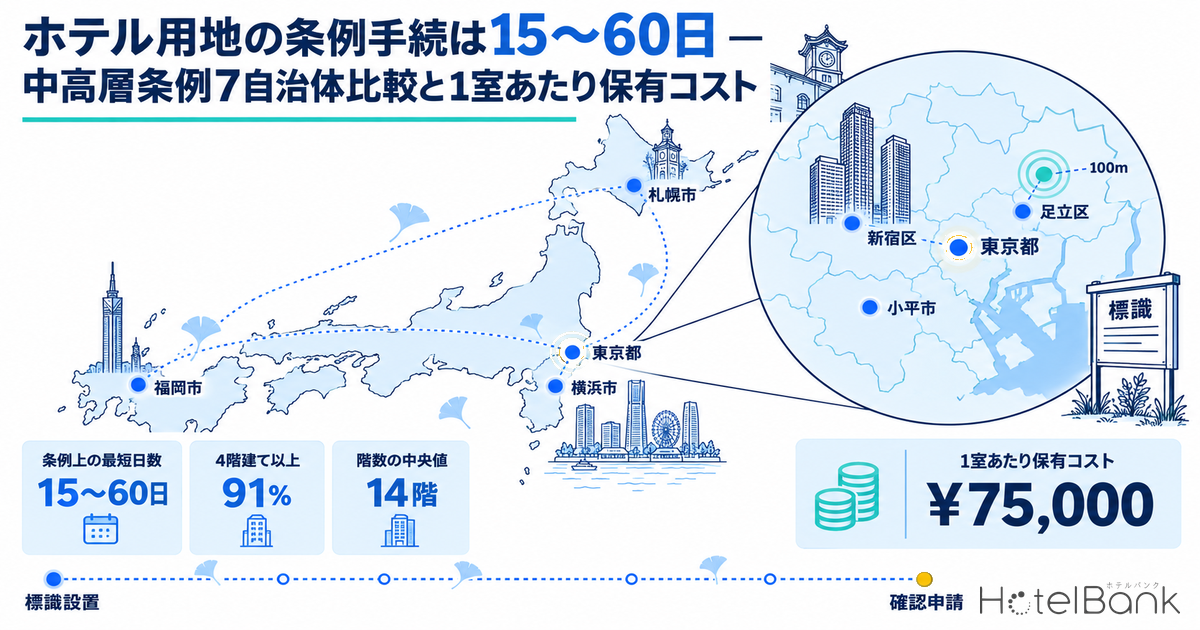
- — 15-60 days: the statutory minimum between erecting the notice board and filing for building confirmation across the seven municipalities’ mid- and high-rise ordinances. Tokyo requires 15 or 30 days depending on scale; Shinjuku Ward’s large-scale category and Adachi Ward’s “hotel or ryokan” category both require 60 days.
- — 91%: of the 66 planned or under-construction hotels with a known floor count (out of N=70 with 50 or more guest rooms), 60 have four floors or more, with a median of 14 floors. Most fall within the scale thresholds of these ordinances.
- — 100m: from 1 April 2026, Adachi Ward widened the radius of residents entitled to a briefing session for a hotel or ryokan from within 50m to within 100m.
- — 1-3 months: a working allowance for the ordinance procedure, placed ahead of the median 2.80-year construction period from groundbreaking to completion (N=56). That is roughly 3-9% of about 33.6 months.
- — ¥75,000 per room: the holding cost at ¥30 million per room, 1.0% per year, three months. Even the heaviest case — ¥50 million per room, 3.25%, six months — comes to ¥812,500 per room.
From notice board to confirmation application: 15 to 60 days under the ordinances
Tokyo’s Ordinance on the Prevention and Settlement of Disputes Concerning the Construction of Mid- and High-Rise Buildings was enacted in 1978. It applies to buildings taller than 10m; in Category I and Category II Exclusively Low-Rise Residential Districts the threshold drops to an eaves height above 7m or three storeys or more above ground. Article 5 of the enforcement rules requires buildings with a total floor area above 1,000 sqm and a height above 15m to display the notice board from at least 30 days before the confirmation application, and all other covered buildings from at least 15 days before. The Metropolitan Government’s Q&A gives a worked example: a board erected on 2 March allows a confirmation application from 1 April under the 30-day category.
Within Tokyo, individual wards and cities add their own requirements on top. Shinjuku Ward places large projects — total floor area above 3,000 sqm and height above 20m — in a 60-day category (90 days where educational facilities are nearby), while Adachi Ward puts hotels and ryokan in its 60-day category. From 1 April 2026, Adachi Ward widened the radius of residents entitled to a briefing session for a hotel or ryokan from within 50m to within 100m. The ward explains the change as dispute prevention: the greater a building use’s impact, the wider the circle of residents who should learn about the plan early and have the chance to discuss it with the developer. Kodaira City sets out a sequence of notification within three days of erecting the board, a briefing session or door-to-door visits before the confirmation application, and submission of the report no later than 10 days before that application.
The designated cities follow the same skeleton. Sapporo covers buildings above 10m (above 15m in commercial and similar districts), requiring the notice board to be in place 30 days before the confirmation application and the report 10 days before. Fukuoka covers buildings above 10m, with the board from 30 days before and the report no later than 20 days before. Yokohama counts differently: the report on neighbourhood briefings is filed once 20 days have elapsed from the date the notice-board notification was submitted, and the city then issues a written opinion — as a rule within 30 days — which must be attached to the confirmation application documents. At the statutory minimum, that implies roughly 50 days from notification.
| Municipality | Buildings covered | Timing of the notice board | Notification, briefing, report | Enacted / in force |
|---|---|---|---|---|
| Tokyo (metropolitan ordinance and enforcement rules) | Height above 10m (in exclusively low-rise residential districts, eaves above 7m or three storeys or more) | 30 days before the confirmation application for buildings above 1,000 sqm and above 15m; 15 days before for all others | Notice-board notification within 7 days of the day after erection; on request from neighbouring residents (within twice the building height from the site boundary), a briefing session or individual explanation | Enacted 1978 |
| Shinjuku Ward | Height above 10m or four storeys or more (in exclusively low-rise residential districts, eaves above 7m or three storeys or more) | 60 days before for floor area above 3,000 sqm and height above 20m (90 days where educational facilities are nearby); 30 days for mid-size (40 days in some cases); 15 days otherwise (20 days in some cases) | Submission of the notice-board notification; a correction notice promptly on any change of plan | Per ward procedure |
| Adachi Ward | Height above 10m, plus specified uses such as hotels and ryokan | 60 days before for a hotel or ryokan; 60 days for specified mid- and high-rise buildings (above 2,000 sqm and above 20m); 30 days for buildings above 10m | Briefing-session radius for a hotel or ryokan widened from within 50m to within 100m from 1 April 2026 | Ward ordinance |
| Kodaira City | Height above 10m (in exclusively low-rise residential districts, eaves above 7m or three storeys or more excluding basements) | 30 days before for buildings above 1,000 sqm and above 15m; 15 days otherwise | Notification within 3 days of erection; briefing session or door-to-door visits before the confirmation application; report no later than 10 days before it | Per city procedure |
| Yokohama City | Mid- and high-rise buildings as defined in the city’s procedural guide | Notice-board notification promptly after erection | Advance distribution of briefing materials and a briefing session or door-to-door visits; report once 20 days have elapsed from the notification date; the city issues a written opinion as a rule within 30 days, to be attached to the confirmation application documents | City ordinance |
| Sapporo City | Height above 10m (above 15m in commercial and similar districts) | In place no later than 30 days before the confirmation application (Article 9) | Explanation to adjoining residents (within 10m of the site boundary, Article 10); report no later than 10 days before the confirmation application (Article 11) | In force 1 September 2000 |
| Fukuoka City | Height above 10m (Article 2) | Displayed from 30 days before the intended confirmation application date until the start of construction (Article 10) | Explanation of the building plan and construction method to neighbouring residents (Article 11); report no later than 20 days before the confirmation application (Article 13) | Enacted 13 July 2000, in force 1 November 2000 |
Set side by side, all seven follow the same order: erect the notice board, file the notification, brief the neighbourhood, submit the report, then apply for confirmation. What differs is the day-count category and the radius of the briefing, and both are designed to lengthen and widen as the building’s scale and use carry more impact. From a developer’s point of view, having those days and radii written into the text of an ordinance also raises predictability: the schedule can be built in advance. On the rules that decide whether a project is possible at all, we have covered zoning and floor-area ratio in Hotel Development Capacity 2026: Zoning, FAR & Land Price in 5 Markets, and separately analysed how designation of soil-contamination areas can stop a project before groundbreaking.
Nine in ten planned hotels stand four floors or higher, squarely inside the ordinances’ scope
Drawing on MLIT’s “Statistical Survey on Building Construction Starts and Dynamics,” MetroEngines Research & Consulting tracks N=70 planned or under-construction hotels with 50 or more guest rooms, totalling 15,517 rooms. Among the 66 with a known floor count the median is 14 floors and the tallest is 63; 60 of them (91%) have four floors or more. On typical floor-to-floor heights, four floors or more is a rough proxy for exceeding 10m, so most of these plans can be expected to fall within the scope of the mid- and high-rise ordinances. The 10-14 floor band is the largest with 27 projects, and 12 projects reach 30 floors or more.
By location (N=70), Tokyo leads with 19 projects, followed by Hokkaido with 8 (6 of them in Sapporo), Kyoto with 5, Chiba with 5 and Kanagawa with 5 (3 of them in Yokohama). All 19 Tokyo projects sit in the 23 wards, and among the 18 with a known floor count the lowest is 11 floors. Since large-floor-area projects in central Tokyo may fall into a ward’s large-scale category — Shinjuku’s 60-day tier, for example — it is worth checking the relevant ward’s category table while the site is still under consideration.
From notice board to confirmation application — where the seven municipalities are
Allow one to three months for the ordinance ahead of a 2.80-year build
HotelBank’s earlier analysis (Hotel Build Times: 2.80-Year Median, 1.96 Solo vs 4.00 Mixed-Use) put the median period from groundbreaking to completion for planned hotels at 2.80 years (N=56), with hotel-only projects at 1.96 years and mixed-use projects including offices or retail at 4.00 years. The ordinance procedure examined here sits ahead of that construction period. The statutory minimum is 15 to 60 days, but before the board goes up the developer must prepare briefing materials and studies of shadow impact and radio interference. Where a briefing session is held, the days between giving notice and holding it are added as well — Tokyo requires notice at least five days before the session.
On that basis, this article frames the period between site acquisition and groundbreaking that should be set aside for the ordinance procedure in three ranges: “one month,” close to the statutory minimum; “two to three months,” including preparation and the scheduling of briefing sessions; and “six months,” where repeated rounds of explanation are used to adjust the plan carefully. Against a median of 2.80 years (about 33.6 months), one month is roughly 3% and three months roughly 9%. Building the procedure into the programme from the outset also makes the scheduling assumptions easier to share with the funds and lenders that assess the opening date.
In holding-cost terms: ¥75,000 per room at ¥30M per room, 1% a year, three months
Time spent on the procedure can be restated as a land-holding cost (land price x annual rate x months / 12). Assuming a 100-room hotel site, we calculate across land prices of ¥1.0 billion, ¥3.0 billion and ¥5.0 billion and three interest levels: 1.0% a year, 2.375% (the modal short-term prime rate published by the Bank of Japan, as of 12 August 2026) and 3.25% (the long-term prime rate on the same basis). At ¥30 million of land per room and 1.0% a year, one month costs ¥25,000 per room, three months ¥75,000 and six months ¥150,000. Move the rate to the 2.375% short-term prime level and three months comes to ¥178,100 per room.
| Land price (100 rooms) | Annual rate | 1 month | 2 months | 3 months | 6 months |
|---|---|---|---|---|---|
| ¥1.0bn (¥10M/room) | 1.0% | ¥8,300 | ¥16,700 | ¥25,000 | ¥50,000 |
| ¥1.0bn (¥10M/room) | 2.375% | ¥19,800 | ¥39,600 | ¥59,400 | ¥118,800 |
| ¥1.0bn (¥10M/room) | 3.25% | ¥27,100 | ¥54,200 | ¥81,300 | ¥162,500 |
| ¥3.0bn (¥30M/room) | 1.0% | ¥25,000 | ¥50,000 | ¥75,000 | ¥150,000 |
| ¥3.0bn (¥30M/room) | 2.375% | ¥59,400 | ¥118,800 | ¥178,100 | ¥356,300 |
| ¥3.0bn (¥30M/room) | 3.25% | ¥81,300 | ¥162,500 | ¥243,800 | ¥487,500 |
| ¥5.0bn (¥50M/room) | 1.0% | ¥41,700 | ¥83,300 | ¥125,000 | ¥250,000 |
| ¥5.0bn (¥50M/room) | 2.375% | ¥99,000 | ¥197,900 | ¥296,900 | ¥593,800 |
| ¥5.0bn (¥50M/room) | 3.25% | ¥135,400 | ¥270,800 | ¥406,300 | ¥812,500 |
Per room, even the heaviest case — ¥5.0 billion, 3.25%, six months — is ¥812,500, while ¥30 million per room at 1% a year for one to three months stays within a band of ¥25,000 to ¥75,000. The absolute sums are small next to the land price itself, but the higher the interest level, the more the question of “how many months to allow” starts to bite. Putting the ordinance months into the programme at the point of site acquisition, and carrying them through the business plan as a holding cost, is a practical way to sharpen both the opening date and the financial projections.
Conclusion — treat the time as a schedulable step
The mid- and high-rise ordinance procedure follows a common sequence — erect the notice board, file the notification, brief the neighbourhood, submit the report — and across the seven municipalities the statutory minimum runs from 15 to 60 days. As Adachi Ward shows, placing hotels and ryokan in the 60-day category and widening the briefing radius to 100m, accommodation can be treated as a high-impact use subject to more demanding procedure. At the same time, 91% of the 66 planned hotels with 50 or more rooms and a known floor count stand four floors or higher, so most fall within the scope of these ordinances.
Developers building an acquisition schedule would do well to place one to three months of ordinance procedure ahead of the 2.80-year median from groundbreaking to completion. Funds and regional banks assessing the opening date can read the holding cost per room straight off those months and the prevailing interest level. For residents, municipalities and developers alike, the procedure is a shared rule for making a plan’s outlook visible — and the earlier it is built in, the more predictable the project becomes.
Related Articles
- Hotel Build Times: 2.80-Year Median, 1.96 Solo vs 4.00 Mixed-Use
- Hotel Acquisition Costs 7.1%: A 6.5% Gross Yield Becomes 4.65% Net
- Frozen Pipeline & the Supply Gap: Cancelled Hotel Projects and Investor Implications
References and Sources
■ Data sources
Ordinances, enforcement rules and procedural guidance of the Tokyo Metropolitan Government, Shinjuku Ward, Adachi Ward, Kodaira City, Yokohama City, Sapporo City and Fukuoka City (N=7 municipalities, materials published as of 13 September 2026); planned and under-construction hotels tracked by MetroEngines Research & Consulting on the basis of MLIT’s “Statistical Survey on Building Construction Starts and Dynamics” (hotels with 50 or more guest rooms, N=70 projects, 66 with known floor counts, as of 13 September 2026); Bank of Japan, “Changes in the Long- and Short-Term Prime Lending Rates (Major Banks)” (as of 12 August 2026).
■ Calculation assumptions
Holding cost = land price x annual rate x months / 12 / number of guest rooms. Calculated for 100 rooms across land prices of ¥1.0bn / ¥3.0bn / ¥5.0bn, annual rates of 1.0% (an assumption of this article), 2.375% (short-term prime rate) and 3.25% (long-term prime rate), and periods of 1, 2, 3 and 6 months; per-room amounts are rounded to the nearest ¥100. The ordinance period is framed in three ranges: one month, close to the statutory minimum; two to three months, including preparation and briefing sessions; and six months, where rounds of adjustment are repeated.
■ Limitations and caveats
The day counts are the statutory minimums set by ordinances and rules; they exclude the time actually needed to prepare briefing materials, schedule briefing sessions, and for the municipality to review the case and issue its opinion. Categories vary with a building’s scale, use and surrounding facilities, so each individual project must be checked against the latest ordinance and guidance of the municipality concerned. The mapping from floor count to height is indicative and is not itself a determination of whether an ordinance applies. The holding cost excludes up-front spending on the building and design fees, fixed asset tax and opportunity cost. Project counts are based on confirmation applications and are expected to rise as further applications are filed.
- Tokyo Metropolitan Government Bureau of Urban Development, “Prevention and Settlement of Disputes Concerning Mid- and High-Rise Buildings”
- Tokyo Metropolitan Government Bureau of Urban Development, “Prevention and Settlement of Building Disputes: Q&A”
- Enforcement Rules of the Tokyo Ordinance on the Prevention and Settlement of Disputes Concerning the Construction of Mid- and High-Rise Buildings
- Shinjuku Ward, “Advance Disclosure of Building Plans (Erecting the Notice Board)”
- Adachi Ward, “Ordinance on the Prevention and Settlement of Disputes Concerning the Construction of Mid- and High-Rise Buildings in Adachi Ward”
- Kodaira City, “Prevention and Settlement of Disputes Concerning the Construction of Mid- and High-Rise Buildings”
- Yokohama City, “Mid- and High-Rise Building Ordinance” and guide, “1. Flow of Procedures”
- Sapporo City Ordinance on the Prevention and Settlement of Disputes Concerning the Construction of Mid- and High-Rise Buildings
- Fukuoka City Ordinance on the Prevention and Settlement of Building Disputes
- Bank of Japan, “Changes in the Long- and Short-Term Prime Lending Rates (Major Banks)”
- Compiled by MetroEngines Research & Consulting from MLIT’s “Statistical Survey on Building Construction Starts and Dynamics” — planned and under-construction hotels (50 or more guest rooms, N=70)