

What will lift a hotel REIT’s distributions in the years ahead is not the portfolio it holds today, but what it can buy next, and from whom. And the question of “from whom” comes down to a single point: what each investment corporation’s sponsor owns, what it develops, and under what contract it passes that information on to the REIT.
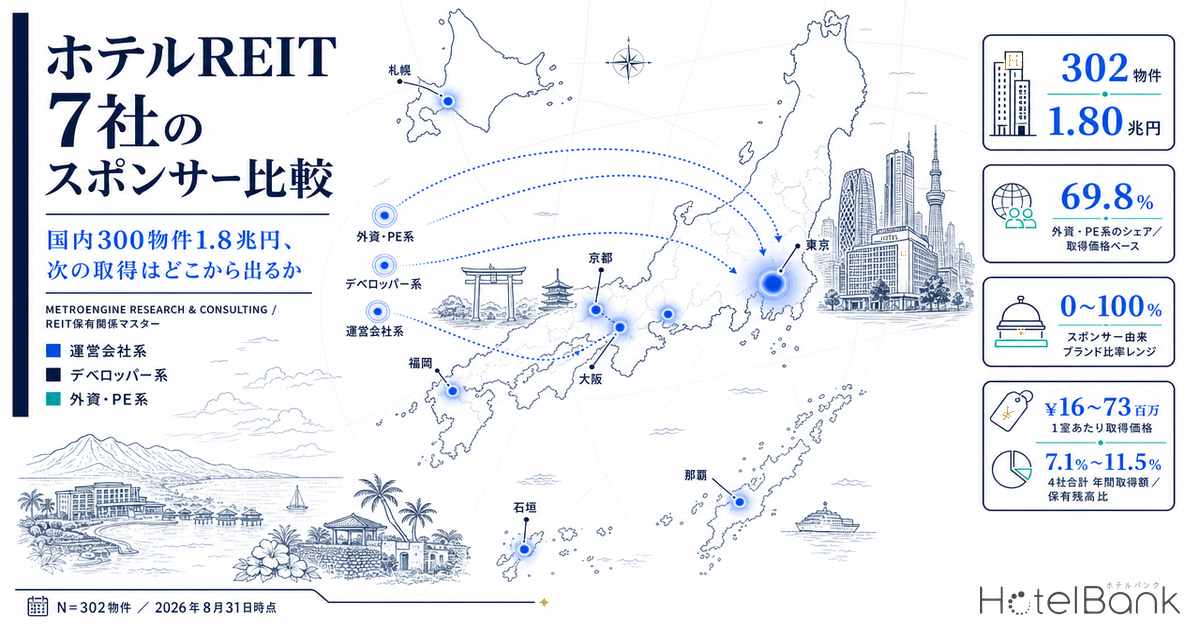
This article breaks down the 302 properties (300 in Japan) with a combined acquisition price of ¥1.8042 trillion held by Japan’s seven hotel REITs by sponsor type. Our earlier REIT coverage looked at the polarization of acquisition prices per room, the growth in appraisal values, LTV and debt maturities, assets held for more than ten years, and the areas hotel REITs have yet to enter — all of them cross-sections of the portfolios as they stand today. This article takes a different axis — the sponsor as the gateway to acquisitions — to gauge the room for future external growth.
Metric Definitions Used in This Article
- Acquisition price: The property-level acquisition price disclosed by each investment corporation (¥ million, excluding consumption tax), compiled in our REIT ownership master. Coverage: N=302 properties (300 in Japan, 2 overseas), master as of August 31, 2026.
- Acquisition price per room: Total acquisition price of domestic properties ÷ total room count. A unit-cost metric that evens out differences in property size.
- Sponsor-brand ratio: The share of a REIT’s properties that carry a brand developed or operated by the sponsor or its affiliates. A proxy based on property names; actual operating relationships may extend further than this.
- Data sources: MetroEngines Research & Consulting (REIT ownership master) and each investment corporation’s IR disclosures.
- — Splitting Japan’s seven hotel REITs — 300 domestic properties with a combined acquisition price of ¥1.8042 trillion — into three types by what their sponsors own shows, in the numbers, that their sources of external growth are structurally different.
- — The two foreign/PE-sponsored REITs account for 69.8% of acquisition price but 54.3% of properties. Investment size per property differs sharply by type.
- — Sponsor-brand ratios range from 0% to 100%: Kasumigaseki Hotel REIT 100%, Invincible 80.9%, Ichigo Hotel REIT 0%. The seven REITs differ in how far their supply is sourced from within the sponsor group.
- — Acquisition price per room ranges from ¥16.3 million to ¥73.4 million, a 4.5x spread. Many-asset/low-unit-price and few-asset/high-unit-price REITs feel the effects of external growth on different time horizons.
- — Over the last three years, four REITs combined acquired 47 properties for ¥252.6 billion. Combined annual acquisitions held steady at 7.1%–11.5% of the asset base, while individual REITs ranged from 0% to 27.3%. How predictable external growth is differs greatly by type.
Three Sponsor Types — Hotel Operators, Developers, and Foreign/PE Funds
By business origin, the seven sponsors fall into three broad groups. The classification is not just a label: it maps directly to where each REIT’s external growth comes from.
Type a Hotel operator-sponsored REITs have sponsors that own and operate hotel brands themselves. This covers Hoshino Resorts REIT (星野リゾート・リート, 3287) and Nippon Hotel & Residential Investment Corporation (日本ホテル&レジデンシャル投資法人, 3472), whose sponsor became APA Group in 2023. Properties the operator develops and owns itself feed directly into the pipeline, which makes this the type whose external growth is easiest to read.
Type b Developer / asset manager-sponsored REITs have sponsors whose core business is development or real estate investment management. Mori Trust REIT (森トラストリート, 8961), Kasumigaseki Hotel REIT (霞ヶ関ホテルリート, 401A) and Ichigo Hotel REIT (いちごホテルリート, 3463) belong here. Their supply tends to come from a “warehousing” flow in which development projects are completed and stabilized before being sold to the REIT.
Type c Foreign / PE (private equity)-sponsored REITs are backed by global real estate fund managers. Invincible Investment Corporation (インヴィンシブル投資法人, 8963) and Japan Hotel REIT (ジャパン・ホテル・リート, 8985) fall into this group; these two alone hold 163 domestic properties and 69.8% of total acquisition price. Their distinguishing feature is the ability to combine large acquisitions in the open market with transfers of assets held on the fund side.
Operator-sponsored REITs hold 29.0% of properties but only 15.6% of acquisition price. Foreign/PE-sponsored REITs, by contrast, hold 54.3% of properties and 69.8% of acquisition price, pushing up their share by value. Investment size per property clearly differs by type, and this also shows up in acquisition price per room, discussed below.
The Seven REITs in Detail — 302 Properties Broken Down by REIT
| Investment corporation | Type | Sponsor | Properties | Rooms | Acquisition price | Per room |
|---|---|---|---|---|---|---|
| Japan Hotel REIT | c | SC Capital Partners Group CapitaLand Investment acquired 40% of the holding company in March 2025 | 53 | 15,338 | ¥655,708M | ¥42.8M |
| Invincible | c | Fortress Investment Group | 110 excl. 2 overseas | 19,270 | ¥603,134M | ¥31.3M |
| Hoshino Resorts REIT | a | Hoshino Resorts | 71 | 8,667 | ¥233,906M | ¥27.0M |
| Mori Trust REIT | b | Mori Trust / Mori Trust Hotels & Resorts | 6 | 1,937 | ¥142,217M | ¥73.4M |
| Ichigo Hotel REIT | b | Ichigo | 29 | 4,418 | ¥71,903M | ¥16.3M |
| Kasumigaseki Hotel REIT | b | Kasumigaseki Capital | 15 | — | ¥49,210M | — |
| Nippon Hotel & Residential | a | APA Group | 16 hotel assets only | 1,991 | ¥48,083M | ¥24.2M |
Acquisition price per room ranges from ¥16.3 million to ¥73.4 million — a 4.5x spread. Mori Trust REIT’s ¥73.4 million reflects a portfolio of just six properties concentrated in central-city luxury and full-service international brands. It is also a diversified REIT holding both hotels and offices, so its asset base differs somewhat in character from the hotel-specialist REITs, and the comparison should be read with that discount in mind.
Sponsor-Brand Ratio — From 100% to 0%, How “Readable” External Growth Is Varies
The most direct indicator of where the next acquisition will come from is the sponsor-brand ratio: the share of a REIT’s properties that carry a brand developed or operated by the sponsor or its affiliates. The higher it is, the more the supply for external growth is sourced from within the sponsor group.
All 15 of Kasumigaseki Hotel REIT’s properties qualify, for a ratio of 100%. The REIT listed on August 13, 2025, and its initial portfolio — 15 properties with an acquisition price of ¥49.21 billion — consists entirely of the sponsor Kasumigaseki Capital’s own brands, “fav,” “FAV LUX” and “seven x seven.” The flagship is seven x seven Ishigaki on Ishigaki Island, Okinawa (acquisition price ¥18.7 billion). Because the sponsor runs a short-cycle model from land acquisition through to sale into development funds, acquisition candidates for the REIT are generated on an ongoing basis.
Invincible: 89 of 110 properties, or 80.9%. Its brands — MyStays, Flexstay Inn, Art Hotels and Kamenoi Hotel — are run by an operator under the sponsor Fortress Investment Group (renamed “Iconia Hospitality” in July 2025). The REIT’s acquisition of ten domestic hotels, decided on August 25, 2025, is explicitly described in its IR as a purchase from a sponsor-related entity, confirming that the flow of assets held and repositioned on the fund side into the REIT is working in practice.
Nippon Hotel & Residential: 6 of 16 properties, or 37.5% — but this figure is in transition. APA Group became the REIT’s sponsor in 2023, and a sponsor support agreement dated December 19, 2023 grants the REIT preferential negotiation rights for the transfer of hotels owned or developed by APA Group that meet its investment criteria, as well as priority access to information on third-party property sales. Six of the seven properties acquired since 2024 are APA Hotel-branded, so the recent acquisition flow is sourced almost entirely from the sponsor. APA Group has a strong nationwide development and operating platform, putting the REIT in a strong position in terms of depth of acquisition candidates.
Hoshino Resorts REIT: 22 of 71 properties, or 31.0%. By acquisition price, these account for ¥103,746 million (44.4% of the total), a higher share by value than by count. The remaining 49 are third-party brands including limited-service and business-oriented hotels, such as the Comfort chain and Candeo Hotels, each capturing the segment its brand is good at. The portfolio is anchored on sponsor-originated assets while broadening its range through external acquisitions.
Ichigo Hotel REIT: 0% — the only one of the seven with no sponsor-branded property. It combines properties with different operators, such as Nest Hotel, Smile Hotel and THE KNOT; because its supply is not limited to sponsor-developed properties, it has more freedom to be selective about acquisition targets depending on market conditions. Its acquisition price of ¥16.3 million per room is the lowest of the seven, reflecting a steady build-up of mainly limited-service hotels at controlled prices.
Positioning by Unit Price × Property Count — Each Type Occupies Its Own Zone
Three zones emerge. The “many assets, low unit price” zone at the lower right holds Invincible (110 properties, ¥31.3 million per room) and Hoshino Resorts REIT (71 properties, ¥27.0 million). This model diversifies the portfolio by accumulating properties; with smaller deal sizes, growth comes from the frequency of acquisitions.
The “few assets, high unit price” zone at the upper left is occupied by Mori Trust REIT alone: six properties for ¥142,217 million, or ¥73.4 million per room. Each acquisition has a large impact on the whole portfolio, and the timing of the sponsor’s large-scale development projects directly sets the time horizon of external growth.
Japan Hotel REIT sits in the middle at 53 properties and ¥42.8 million per room, but its total acquisition price of ¥655,708 million is the largest of the seven in our tally. In February 2026 it announced the acquisition of Hyatt Regency Tokyo (ハイアット リージェンシー 東京) for ¥126.0 billion — a case of buying from the market an asset previously held by an investment fund, funded through a public offering and borrowings. Hyatt Regency Tokyo opened in September 1980 as one of the brand’s bases in Japan; Hyatt operates 22 hotels with a total of 5,066 rooms under nine brands in Japan (Hyatt Japan press materials, April 2026). Rather than relying on the sponsor’s pipeline, it pursues large deals that come to market by raising capital in the capital markets — the other growth path available to foreign/PE-sponsored REITs. Whether this deal pays off for the REIT will show up in its operating results in the periods following the acquisition.
When Did Acquisitions Happen? — Annual Trend for the Four REITs with Property-Level Acquisition Dates
For the four REITs whose property-level acquisition dates we could identify in the ownership master, we lined up acquisitions by year. The initial portfolio at listing forms the first peak, followed by waves of supply from sponsors and market acquisitions.
Since COVID, Invincible has kept up one bulk acquisition a year: 6 properties (¥57,230 million) in August 2023, 12 (¥104,420 million) in July 2024 and 10 (¥34,284 million) in August 2025. The August 2025 purchase in particular was from a sponsor-related entity, with a disclosed average appraisal NOI yield of 7.0%. The cyclical pattern of bulk purchases is clear, making the timing of the next acquisition easy to anticipate — a practical advantage of this type. For the broader background on annual J-REIT acquisition volumes and deal concentration, see Hotel Capital Allocation 2026: One Deal Took 27% of J-REIT Q1 Buying.
Nippon Hotel & Residential acquired 7 properties at its 2016 listing, then resumed acquisitions after the sponsor change, adding 2 in 2024 and 5 in 2025. The 7 properties acquired since 2024 total ¥18,863 million and 1,024 rooms, and the higher frequency of acquisitions is visible in the numbers. It also disclosed further preferential negotiation rights in July 2024 and October 2025, so the pipeline is being replenished without interruption.
Ichigo Hotel REIT acquired 7 properties at its 2015 listing and has since added 1–5 a year, steadily building up while watching market conditions. It continued buying in the post-COVID re-acquisition phase, with 5 properties in 2023 and 4 in 2025 — evidence of sourcing capability that does not depend on sponsor-developed properties.
Where Are the 300 Properties? — Geographic Distribution by Sponsor Type
Differences in sponsor type also show up in how locations are chosen. The map colors the 300 domestic properties by sponsor type.
The 163 foreign/PE-sponsored properties are spread widely across the country, from Sapporo to Naha, with many station-front locations in regional cities, mainly limited-service hotels. Operator-sponsored properties mix hot-spring and resort destinations with urban locations, directly reflecting the character of the sponsors’ brands. Developer-sponsored REITs, with fewer properties, tend to focus on key points in central cities and tourist destinations. The flip side of this distribution is that there are still areas hotel REITs have not yet entered — areas that remain potential targets for future acquisitions.
Inside the Pipeline Support Agreements — What Is Promised to Each REIT
Every REIT’s disclosures mention that “a sponsor support agreement is in place,” but what those agreements actually promise is not the same. Below we list only what we could confirm in IR materials.
| Investment corporation | Counterparty | What IR disclosures confirm |
|---|---|---|
| Nippon Hotel & Residential a | APA Group | Sponsor support agreement dated December 19, 2023. Grants preferential negotiation rights for the transfer of hotels owned or developed by APA Group that meet the REIT’s investment criteria, and priority provision of information on third-party property sales obtained by the group. As of July 2024, a pipeline of 7 properties secured through preferential negotiation rights and planned acquisitions. Acquisition of further preferential negotiation rights disclosed in October 2025. |
| Hoshino Resorts REIT a | Hoshino Resorts | Sponsor support agreement dated May 27, 2013. Comprehensive provision of information on group-owned properties, human and physical resources, and knowledge, experience and know-how in tourism and resorts. Group-owned hotels and ryokan are positioned as a pipeline for future external growth. |
| Mori Trust REIT b | Mori Trust Hotels & Resorts / Mori Trust (5 group companies) | A sponsor support agreement establishes information sharing and exchange of views on hotels, ryokan and other properties used mainly for lodging. In addition, an information provision agreement allows the REIT to obtain on a priority basis sale information on real estate held by five Mori Trust group companies. Has acquired several hotels from the sponsor in the past, one of them as a co-investment. |
| Kasumigaseki Hotel REIT b | Kasumigaseki Capital | The entire initial portfolio at listing — 15 properties, ¥49.21 billion — consists of sponsor-developed, sponsor-branded properties. The sponsor runs a short-cycle development model from land acquisition to sale into development funds. |
| Ichigo Hotel REIT b | Ichigo | Receives various forms of sponsor support under an asset management agreement, a sponsor support agreement and an asset custody / general administration agreement. Aims for external growth diversified by investment region, hotel type and lease structure, making full use of Ichigo’s sourcing capability and support. |
| Invincible c | Fortress Investment Group Japan | Sponsor support agreement dated June 3, 2015. Information provision services (the support company may disclose to the REIT sale information on properties held by the Fortress group and by third parties), various advisory services, and exchange of information on the real estate market. |
| Japan Hotel REIT c | SC Capital Partners Group | Shareholders of the asset manager: SCJ One (S) Pte. Ltd. 87.6%, Kyoritsu Maintenance 10.3%, ORIX 2.1%. On March 7, 2025, CapitaLand Investment completed the acquisition of 40% of the shares of the asset manager’s holding company. SC Capital has disclosed plans to transfer a further 30% each after three and five years, with all shares to be transferred to the CapitaLand group by 2030. |
The two Type a REITs hold a clear right: preferential negotiation rights. Nippon Hotel & Residential even discloses the number of pipeline properties, giving it the most concrete outlook for external growth. Type b centers on priority access to sale information — an informational advantage rather than a right. However, where the sponsor’s development model itself generates a continuous flow of properties, as with Kasumigaseki Hotel REIT, the effective pipeline works beyond what the contract language says. Type c relies on a looser framework of information provision services covering both fund-held and third-party properties. The rights are loosely designed, but the volume of information and deal size flowing from global fund networks make up for it.
Measuring External Growth Pace from Actual Ranges — Combined Annual Acquisitions Swing Between 7.1% and 11.5% of the Asset Base
The differences between types show up not only in “where the next purchase can come from” but also in “how fast they can buy.” For the four REITs with identifiable property-level acquisition dates, we lined up annual acquisitions over the last three years (2023–2025) and converted that actual range directly into an external growth rate (annual acquisitions ÷ total acquisition price of domestic holdings). This is not a forecast; please read it as a sensitivity range showing how widely actual results swung.
| Investment corporation | 2023 | 2024 | 2025 | Conservative | Base | Bullish |
|---|---|---|---|---|---|---|
| Invincible (8963) | 6 / ¥57,230M | 12 / ¥104,420M | 10 / ¥34,284M | 5.7% | 10.8% | 17.3% |
| Ichigo Hotel REIT (3463) | 5 / ¥15,080M | 0 / ¥0M | 4 / ¥14,800M | 0.0% | 13.9% | 21.0% |
| Nippon Hotel & Residential (3472) | 0 / ¥0M | 2 / ¥5,741M | 5 / ¥13,122M | 0.0% | 13.1% | 27.3% |
| Hoshino Resorts REIT (3287) | 1 / ¥1,904M | 0 / ¥0M | 2 / ¥6,060M | 0.0% | 1.1% | 2.6% |
| 4 REITs total | 12 / ¥74,214M | 14 / ¥110,161M | 21 / ¥68,266M | 7.1% | 8.8% | 11.5% |
The width of the range itself reflects the character of each type. Invincible (8963) ranges from 5.7% (conservative) to 17.3% (bullish), staying positive in all three cases. This is because it has executed one bulk acquisition a year for three straight years; a floor that never hits zero is the practical strength of this type. By contrast, Ichigo Hotel REIT (3463) and Nippon Hotel & Residential (3472) have a conservative case of 0% — each had one year out of three with no acquisitions. Their base cases of 13.9% and 13.1% exceed Invincible’s, but year-to-year swings are large, and one year’s results cannot be used to predict the next.
Hoshino Resorts REIT (3287) shows 1.1% in the base case and 2.6% in the bullish case, the slowest external growth pace of the four. Against an existing portfolio of 71 properties, it acquired only 3 properties for ¥7,964 million over the last three years. A sponsor-brand ratio of 31.0% indicates that its sources of external growth are not closed within the group, but judging by the recent pace of acquisitions, those sources are not being tapped very often.
For the four REITs combined, annual acquisitions moved between ¥68,266 million (2025) and ¥110,161 million (2024), or 7.1% (conservative), 8.8% (base) and 11.5% (bullish) of the asset base. A range that spans 0% to 27.3% at the individual level narrows to a 1.6x band when the four are combined — because the timing of acquisitions differs from REIT to REIT. Acquisition demand across the hotel REIT sector as a whole is far more stable than year-to-year swings at individual REITs. The base case of 8.8% is equivalent to turning over the existing portfolio in about 11 years. Note, however, that this figure covers acquisitions only and excludes sales (portfolio rotation). Also, for a type with large deal sizes such as Mori Trust REIT, an annual average is itself a poor way to capture reality — quite apart from the constraint that acquisition dates cannot be identified.
Where Will the Next Acquisition Come From? — Three Readings
Type a Vertically integrated: new and renovated brand hotels become the pipeline
Because the sponsor is an operator, newly developed hotels are repeatedly transferred to the REIT once operations stabilize. At Nippon Hotel & Residential, six of the seven properties acquired since 2024 are APA Hotel-branded, so the source of supply is clear. For investors, the advantage is that the timing and targets of acquisitions are easy to predict; the sponsor’s development plan serves directly as a leading indicator of external growth.
Type b Development warehousing: completion timing sets the time horizon
For developer-sponsored REITs, acquisitions are conditional on the completion and stabilization of development projects, so external growth moves project by project rather than year by year. Kasumigaseki Hotel REIT, with all 15 properties at listing developed by its sponsor, is the pure form of this type. Mori Trust REIT’s deals are large, so a single project can move the whole portfolio. Ichigo Hotel REIT focuses on third-party acquisitions and keeps room to be selective depending on market conditions.
Type c Two engines: market acquisitions plus fund transfers
Invincible has kept up an annual cycle of bulk acquisitions from sponsor-related entities, adding 28 properties over the last three years. Japan Hotel REIT has a path to acquiring large deals that come to market by raising capital, and its total acquisition price is the largest of the seven in our tally. With CapitaLand now among the shareholders of its asset manager, the potential widening of its sourcing network is worth watching.
The practical implication is this: for owners considering a hotel sale, how to engage REITs as potential buyers depends on the type. Type a acquisitions mostly involve conversion to the sponsor’s own brand, so bringing in a standalone property is a matter of fit. Type b relies mainly on the sponsor’s development pipeline, though some, like Ichigo Hotel REIT, actively acquire third-party properties. Type c offers the widest door as a buyer for standalone properties; Invincible, for one, continuously acquires a diverse range of properties, including small and mid-sized hotels in regional areas.
From an institutional investor’s perspective, the key point is the trade-off between the predictability of external growth and the impact per deal. Type a and Kasumigaseki Hotel REIT offer high predictability, with growth building up in steps. Mori Trust REIT’s individual deals have large impact, so its growth rate swings widely depending on whether a deal materializes. Type c sits in between, with the flexibility to choose both deal size and frequency as circumstances dictate. This is not about which type is better; what investors are actually buying differs by type.
Methodology and Caveats
This article covers N=302 properties (300 in Japan, 2 overseas) held by the seven investment corporations registered in our REIT ownership master. The master is updated by regularly reconciling it against the portfolio lists published by each investment corporation; this article is based on a snapshot as of August 31, 2026.
There are three caveats. First, Kasumigaseki Hotel REIT is excluded from acquisition price per room and room-count totals because its property-level room counts cannot be identified, and its acquisition price uses the IR-disclosed value at listing (¥49.21 billion). Second, property-level acquisition dates cannot be identified for all seven REITs, so the annual acquisitions chart is limited to the 226 properties of the four REITs with identifiable dates. Third, the sponsor-brand ratio is a proxy based on property names, and actual operating relationships may extend further. In the case of Japan Hotel REIT, for example, an operator belonging to the asset manager’s shareholder group also operates properties whose names do not include “Oriental Hotel.” Please treat the ratio as an indicator of relative position among the seven REITs, not as an absolute level.
This article also does not cover the REITs’ monthly operating results (occupancy, ADR, etc.). They are not needed to discuss the structure of external growth; comparisons of operating performance are covered separately.
Related Reading
References and Sources
■ Data Source
Our REIT ownership master (N=302 properties held by Japan’s seven listed hotel REITs, 300 in Japan and 2 overseas; snapshot as of August 31, 2026). Property-level acquisition price, room count, location and acquisition date are updated by regular reconciliation with the portfolio lists and timely disclosures published by each investment corporation. Sponsor agreement terms are taken from each investment corporation’s IR disclosures, limited to statements confirmed in published materials.
■ Calculation Assumptions
Acquisition price per room = total acquisition price of domestic properties ÷ total room count. Sponsor-brand ratio = number of properties carrying a brand developed or operated by the sponsor or its affiliates ÷ number of properties held, a proxy based on property names. The external growth rate in Table 3 = annual acquisitions ÷ the REIT’s total acquisition price of domestic holdings, where Conservative = the year with the lowest acquisitions in 2023–2025, Base = 3-year average, and Bullish = the highest year. It is a range converted from the spread of actual results, not a forecast of future cash flows. Kasumigaseki Hotel REIT’s acquisition price uses the IR-disclosed value at listing (¥49.21 billion).
■ Limitations
First, Kasumigaseki Hotel REIT is excluded from acquisition price per room and room-count totals because its property-level room counts cannot be identified. Second, property-level acquisition dates cannot be identified for Japan Hotel REIT, Mori Trust REIT and Kasumigaseki Hotel REIT, so the annual acquisitions chart and Table 3 are limited to 226 properties at four REITs (219 with identified acquisition dates). Third, the sponsor-brand ratio is a proxy based on property names, and actual operating relationships may extend further. Fourth, this article covers acquisitions only and does not address portfolio rotation through sales, monthly operating results (occupancy, ADR, etc.) or changes in appraisal values.
■ Market Data
- MetroEngines Research & Consulting — REIT ownership master (N=302 properties, as of August 31, 2026): property-level acquisition price, room count and location
■ REIT IR and Timely Disclosures (in Japanese)
- Invincible Investment Corporation, “External Growth Strategy” (overview of the sponsor support agreement)
- Invincible Investment Corporation, “Notice Concerning Acquisition and Lease of Ten Domestic Hotels” (August 25, 2025)
- Invincible Investment Corporation, Portfolio List
- Nippon Hotel & Residential Investment Corporation, “Notice Concerning Acquisition of Preferential Negotiation Rights,” supplementary explanation (July 22, 2024)
- Nippon Hotel & Residential Investment Corporation, “Notice Concerning Acquisition of Preferential Negotiation Rights” (October 3, 2025, timely disclosure)
- Mori Trust REIT, “Collaboration with the Mori Trust Group”
- Hoshino Resorts REIT, “Investment Strategy”
- Ichigo Hotel REIT, “Basic Structure”
- Japan Hotel REIT, “Notice Concerning Completion of Share Acquisition for CapitaLand Investment’s Strategic Capital Participation in the Parent Company of the Asset Manager” (March 7, 2025)
- Japan Hotel REIT Advisors, Company Overview
- Kasumigaseki Hotel REIT, Portfolio Summary
■ News and Industry Sources (in Japanese)
- Nikkei Real Estate Market Report, “[REIT] Kasumigaseki Hotel REIT to list in August with ¥49.2 billion in assets”
- Nikkei Real Estate Market Report, “[Deals] Japan Hotel REIT acquires Hyatt hotel in Nishi-Shinjuku for ¥126 billion”
- Nikkei Real Estate Market Report, “[Strategy] Singapore’s CapitaLand to acquire Japan Hotel REIT’s sponsor”
- Nikkei, “Hotel operator MyStays renames itself Iconia Hospitality”
- Monthly Property Management, “First new REIT listing in four years specializes in hotels for larger groups” (October 2025 issue)
■ Brand Materials
- Hyatt Japan, press materials (April 2026)