

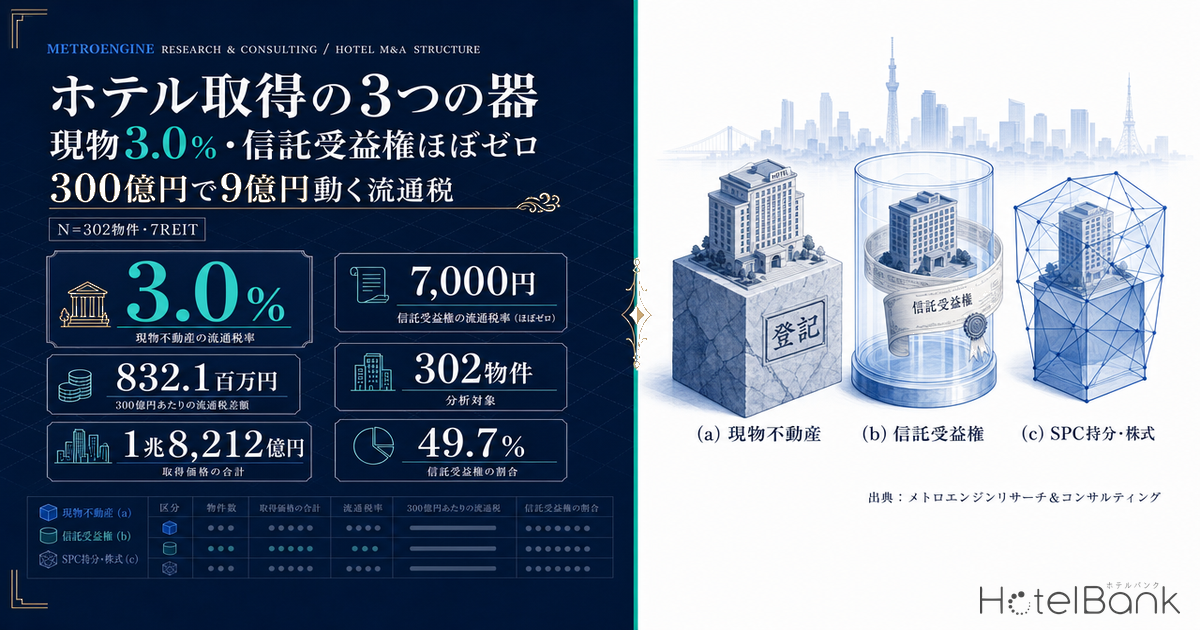
The decision to buy a hotel usually starts with “which property, at what price.” In practice, though, there is always one more question placed ahead of that. What, exactly, is the object of the sale? Are you buying the real estate itself, a beneficiary interest in a trust holding that real estate, or the equity of the company that owns it? This choice of “transaction vehicle” looks like a question about tax, but what it really determines is who is able to buy the property at all — the breadth of the buyer universe.
This article builds up, from primary legislation, how much the choice of vehicle moves upfront cost across three models — acquisition prices of ¥3.0bn, ¥10bn and ¥30bn — and then cross-checks that against the acquisition-price distribution of the 302 properties held by Japan’s seven listed hotel REITs, to show which vehicle real hotel transactions actually run through.
How this differs from our earlier coverage
- Hotel Acquisition Costs 7.1% builds up the individual cost items on the assumption of a direct real estate purchase. This article deals with the choice one level above that — what happens if you do not buy the real estate directly in the first place — and its conclusion is not a cost total but the breadth of the buyer universe.
- Own a Hotel from ¥100,000 — Security Tokens Open a Third Funding Route is about fractionalisation, that is, the equity side. This article is about the choice of vehicle, that is, the layer that decides whose name is on the title.
Assumptions and definitions used in this article
- Transfer taxes: taxes levied on the transfer of an asset itself. In this article the term covers three items — real estate acquisition tax, registration and licence tax, and stamp duty. Property tax during the holding period and corporate tax on capital gains are excluded.
- Model assumptions: the acquisition price (excluding consumption tax) is split 40% land / 60% building, and the assessed value for property tax purposes — the taxable base — is set at 70% of the land price for land and 60% of the building price for the building. The number of real properties subject to registration of a change of beneficiary is assumed to be seven in total: five parcels of land and two buildings. All of this is a worked example based on a standard single urban hotel; actual assessed values and parcel counts differ property by property.
- Effective date of tax rates: based on legislation in force as of 30 August 2026. Reduced rates carry expiry dates, and revert to the statutory rate once they lapse.
- Data sources: MetroEngines Research & Consulting (J-REIT ownership master, N=302 properties across 7 REITs, snapshot as of 24 August 2026), together with the individual statutes and materials published by the National Tax Agency.
- Disclaimer: this article is a general summary based on published legislation and public materials. Tax and legal judgements on any individual transaction should be confirmed with a tax accountant, lawyer or other qualified professional.
- — Transfer taxes on a direct real estate purchase run at about 3.0% of the acquisition price — ¥90.3mn on ¥3.0bn and ¥900.5mn on ¥30bn. Flexing the assumptions keeps the figure within a 2.51%–3.68% band.
- — On a transfer of trust beneficiary interest, the buyer’s burden compresses to the ¥7,000 cost of registering the change of beneficiary. Even including the cost of newly settling the trust, the gap on the ¥30bn model is ¥832.1mn.
- — More than half of the total is the 4% real estate acquisition tax on the building. In the ¥30bn model, 77.4% of the ¥558mn acquisition tax falls on the building, because a hotel building is a non-residential structure and gets no relief.
- — Across 302 properties held by seven listed hotel REITs, the median acquisition price is ¥3.0bn, and the 41 properties at ¥10bn or above (13.6%) account for 55.0% of total acquisition value (as of 24 August 2026).
- — Choosing a vehicle is not a tax decision but a design decision about the buyer universe. Direct real estate has the widest set of buyers, trust beneficiary interest narrows it to institutional investors, and SPC equity limits it to parties able to run corporate due diligence.
The three vehicles differ in what actually moves
Start by lining up the legal characteristics. All three routes look, from the outside, like a transaction in which “the owner of the hotel changes.” What moves in law, however, is entirely different in each case.
| Aspect | (a) Sale of the real estate itself | (b) Transfer of a trust beneficiary interest | (c) Transfer of SPC equity or shares |
|---|---|---|---|
| What is transferred | Ownership of the real estate | The trust beneficiary interest (a contractual claim) | The company’s equity interests or shares |
| Registered title holder | Changes to the buyer | Remains the trustee (a trust bank or similar) — unchanged | Remains the SPC — unchanged |
| Registration required | Registration of transfer of ownership | Registration of the change of beneficiary in the trust schedule | No real property registration (commercial registration only) |
| Governing regulation | Real Estate Brokerage Act | Financial Instruments and Exchange Act (deemed securities) | Companies Act / Financial Instruments and Exchange Act (case by case) |
| Licence required to broker | Real estate brokerage licence | Type II Financial Instruments Business registration | No statutory business registration |
| Risk inherited | Only what attaches to the real estate | Only what attaches to the trust property | Everything in the company (including off-balance-sheet liabilities and historic tax positions) |
Source: compiled by MetroEngines Research & Consulting from the Local Tax Act, the Registration and Licence Tax Act, the Financial Instruments and Exchange Act and the Real Estate Brokerage Act
The key line is the registered title holder. Under (b) and (c), the registered title to the real estate does not move at all. If it does not move, then in law no “acquisition” of real estate and no transfer of ownership has occurred — and that alone generates the difference in transfer taxes. At the same time, precisely because nothing moves, the buyer has to verify what sits outside the real estate: the terms of the trust agreement, or the company’s own past. That is why the choice of vehicle is a trade-off between tax and effort.
What happens tax by tax — four taxes checked against primary legislation
Next, the treatment of the three routes under each of four taxes. Everything below is limited to what can be confirmed in the statutes themselves or in materials published by the National Tax Agency.
| Tax | (a) Direct real estate | (b) Trust beneficiary interest | (c) SPC equity / shares | Authority |
|---|---|---|---|---|
| Real estate acquisition tax | Statutory rate 4%. Land is 3% with the taxable base halved (until 31 March 2027). A hotel building is a non-residential structure, so it stays at 4% | Not levied (no acquisition of real estate arises) | Not levied | Local Tax Act arts. 73-15 and 73-7, and the supplementary provisions |
| Registration and licence tax | 2.0% on transfer of ownership. 1.5% on a sale of land (until 31 March 2029) | Registration of the change of beneficiary at ¥1,000 per real property. Settling the trust costs a separate 0.4% (land 0.3%) | No change in real property registration (commercial registration only, e.g. change of directors) | Registration and Licence Tax Act, Appended Table 1; Act on Special Measures Concerning Taxation art. 72 |
| Stamp duty | Real estate transfer agreement (Category 1 document). After relief: ¥320,000 for over ¥1bn up to ¥5bn, ¥480,000 above ¥5bn (until 31 March 2027) | In practice treated as an assignment-of-claim agreement (Category 15 document): a flat ¥200 where the stated amount is ¥10,000 or more | A share or equity transfer agreement is not a taxable document | Stamp Tax Act, Appended Table 1; National Tax Agency Taxanswer No.7108 and No.7141 |
| Consumption tax | 10% on the building consideration (land is exempt) | Same as direct real estate. As a beneficiary-taxed trust it is treated as a transfer of the trust property, so the building portion is taxable | Exempt (transfer of securities) | Consumption Tax Act art. 14(1) and Appended Table 2; National Tax Agency Taxanswer No.6201 |
Source: compiled by MetroEngines Research & Consulting from e-Gov statute search and materials published by the National Tax Agency
The row most often overlooked in this table is consumption tax. For consumption tax purposes, a transfer of trust beneficiary interest is treated exactly like a direct real estate purchase. Under the beneficiary-taxed trust rules in article 14(1) of the Consumption Tax Act, the beneficiary is deemed to hold the assets belonging to the trust property, so the transfer of the interest is judged as a transfer of the trust property itself and apportioned between land and building. The fact that transfer taxes fall to almost zero does not make the funding requirement at closing any lighter.
Conversely, the only route on which no consumption tax arises on the building consideration is (c), the transfer of SPC equity or shares. But that is because transfers of securities are exempt, and inside the SPC the history of consumption tax paid when the building was acquired remains exactly as it was. It is more accurate to say that choosing a vehicle does not make tax disappear — it moves the layer at which the tax arises.
Actual amounts at ¥3.0bn, ¥10bn and ¥30bn — direct purchase is consistently about 3.0%
Applying the rates above to the three acquisition prices, on the assumptions set out at the top (40% land / 60% building, assessed at 70% of land price and 60% of building price). All figures are in millions of yen.
Source: MetroEngines Research & Consulting estimates based on the Local Tax Act, the Registration and Licence Tax Act and the Stamp Tax Act
| Item | Price ¥3.0bn | Price ¥10bn | Price ¥30bn |
|---|---|---|---|
| Land price / building price | 1,200 / 1,800 | 4,000 / 6,000 | 12,000 / 18,000 |
| Assessed land value / assessed building value | 840 / 1,080 | 2,800 / 3,600 | 8,400 / 10,800 |
| (a) Direct — real estate acquisition tax | 55.8 | 186.0 | 558.0 |
| (a) Direct — registration and licence tax | 34.2 | 114.0 | 342.0 |
| (a) Direct — stamp duty | 0.32 | 0.48 | 0.48 |
| (a) Direct — total | 90.3 (3.01%) | 300.5 (3.00%) | 900.5 (3.00%) |
| (b) Trust beneficiary interest — buyer’s burden | 0.007 | 0.007 | 0.007 |
| (Reference) registration and licence tax if the trust is newly settled | 6.8 | 22.8 | 68.4 |
| (c) SPC equity / shares | 0 | 0 | 0 |
| Gap between (a) and (b) (including trust settlement) | 83.5 | 277.7 | 832.1 |
| (Reference) consumption tax on the building consideration | 180 | 600 | 1,800 |
Figures in ¥mn. Estimates based on a worked example. Source: MetroEngines Research & Consulting
There are three things to read here. First, transfer taxes on a direct real estate purchase sit at roughly 3.0% of the acquisition price and stay there. Only stamp duty is a fixed amount, so the ratio falls slightly on larger deals — but ¥480,000 is 0.002% of ¥30bn, so in practice the combined ratio of the acquisition tax and the registration tax simply carries through. That works out at ¥90mn on ¥3.0bn, ¥300mn on ¥10bn and ¥900mn on ¥30bn. Transfer taxes are only one part of the costs incurred at acquisition; how far the total swells once brokerage commission, appraisal and engineering reports are included is built up item by item in Hotel Acquisition Costs 7.1%.
Second, more than half of that total is the 4% real estate acquisition tax on the building. In the ¥30bn model, ¥432mn of the ¥558mn acquisition tax — 77.4% — is the building portion. Land has both the reduction to 3% and the halved taxable base, whereas a hotel building carries the full statutory 4% as a non-residential structure. Hotels are an asset class in which the building accounts for a high share of the acquisition price, so this structure feeds straight through.
Third, on the trust beneficiary interest route, the transfer tax borne by the buyer comes down to the ¥7,000 registration of the change of beneficiary. Even assuming the buyer effectively bears the seller’s cost of newly settling the trust, that is ¥6.8mn on the ¥3.0bn model and ¥68.4mn on the ¥30bn model. The gap on a ¥30bn deal is ¥832mn — roughly ¥830mn moving on the choice of vehicle alone, with the property and the price unchanged.
Source: MetroEngines Research & Consulting estimates (based on a worked example)
Does flexing the assumptions change the conclusion — three cases and a two-axis grid
The amounts so far rest on a single worked example: 40% land / 60% building, with assessment ratios of 70% for land and 60% for the building. Those are the two assumptions that vary most across real properties, so it is worth checking whether the “about 3.0%” level survives when they move.
| Case | Assumptions | Real estate acquisition tax | Registration and licence tax | Direct purchase total | % of price | Gap vs. trust beneficiary interest (including trust settlement) |
Property profile assumed |
|---|---|---|---|---|---|---|---|
| Low case | Building share 45% / building assessment ratio 50% | 443.2 | 308.2 | 752.0 | 2.51% | 690.3 | High land share with a low building assessment ratio (suburban, large site, older building) |
| Mid case (the base example in this article) | Building share 60% / building assessment ratio 60% | 558.0 | 342.0 | 900.5 | 3.00% | 832.1 | A standard assumption for a single urban hotel |
| High case | Building share 75% / building assessment ratio 70% | 708.7 | 393.7 | 1,103.0 | 3.68% | 1,024.2 | High building share with a high assessment ratio (central location, tight site, newer building) |
Includes ¥480,000 of stamp duty. The gap is the direct-purchase total less the ¥7,000 registration of change of beneficiary and the registration and licence tax on newly settling the trust. Source: MetroEngines Research & Consulting estimates based on the Local Tax Act, the Registration and Licence Tax Act and the Stamp Tax Act
The range is 2.51%–3.68%, or ¥752mn–¥1,103mn on a ¥30bn deal. Flexing the assumptions across a realistic range leaves the structure intact: transfer taxes on a direct purchase stay within 2.5%–3.7% of the acquisition price, and the gap against a trust beneficiary interest holds at the ¥700mn–¥1.0bn level. The order of magnitude that moves with the choice of vehicle does not depend on how the assumptions are set.
For a finer view, the grid below flexes both assumptions at once. It shows transfer taxes on a direct purchase, as a percentage of price, in the ¥10bn model.
| Building assessment ratio (assessed value as % of building price) |
Building as a share of the acquisition price | ||||
|---|---|---|---|---|---|
| 40% | 50% | 60% | 70% | 80% | |
| 50% | 2.46% | 2.55% | 2.64% | 2.73% | 2.82% |
| 55% | 2.58% | 2.70% | 2.82% | 2.94% | 3.06% |
| 60% | 2.70% | 2.85% | 3.00% ◆ | 3.15% | 3.30% |
| 65% | 2.82% | 3.00% | 3.18% | 3.36% | 3.54% |
| 70% | 2.94% | 3.15% | 3.36% | 3.57% | 3.78% |
◆ marks the base example in this article (building share 60%, building assessment ratio 60%). The land assessment ratio is fixed at 70% and ¥480,000 of stamp duty is included. Source: MetroEngines Research & Consulting estimates (based on a worked example)
The top-left of the grid (high land share, low assessment ratio) gives 2.46%; the bottom-right (high building share, high assessment ratio) gives 3.78%. The spread is 1.32 points, and the two building-side assumptions pull with almost equal force — because the 4% acquisition tax plus the 2.0% registration tax on the building, 6.0% combined, is exactly twice the 3.0% effective rate on land (the 1.5% reduced registration rate plus 1.5% of acquisition tax after the halved base). The newer the hotel and the tighter the central-city site, the heavier the transfer taxes on a direct purchase — and the stronger the economic motive to change vehicle.
Where real hotel deals cluster by price — the distribution of 302 listed-REIT properties
To check whether the three model prices line up with real hotel transactions, we turn to the J-REIT ownership master maintained in-house. We aggregated the per-property acquisition prices disclosed by each of the seven listed Japanese hotel REITs — Ichigo Hotel REIT Investment Corporation, Invincible Investment Corporation, Japan Hotel & Residential Investment Corporation, Japan Hotel REIT Investment Corporation, Hoshino Resorts REIT, Mori Trust REIT and Kasumigaseki Hotel REIT Investment Corporation — across the 302 properties they hold. The total comes to ¥1,821.2bn.
Source: aggregated by MetroEngines Research & Consulting from each REIT’s per-property disclosure (N=302 properties across 7 REITs, as of 24 August 2026)
The median of the distribution is ¥3.0bn, the third quartile ¥6.0bn and the ninth decile ¥14.95bn. The ¥1bn–¥3bn band is the thickest at 103 properties (34.1%), and properties below ¥3.0bn account for 150 properties, or 49.7% of the total. Properties at ¥10bn or above number just 41 (13.6%) — yet those 41 alone represent 55.0% of total acquisition value. The peak by count and the peak by value sit in completely different places, and that is characteristic of hotel transactions. The same shape appears when quarterly acquisition value is broken down in Hotel Capital Allocation 2026, where value concentrates in a small number of large deals.
The three model prices used in this article land squarely on the representative points of that distribution. ¥3.0bn is the median itself, ¥10bn is the entry point to the top 13.6%, and ¥30bn sits in the top 2.6% (8 properties). By count, the choice of vehicle is a question of tens of millions of yen in most deals; by value, more than half the capital sits in the range where hundreds of millions move.
Why every J-REIT acquisition uses a trust beneficiary interest — checked against disclosures
Hotel acquisitions by listed REITs are, in practice, executed entirely through trust beneficiary interests. This is not an inference: it can be confirmed from the titles of the acquisition press releases each REIT files as timely disclosure, and from the “type of specified asset” field. Two examples follow.
| Disclosure date | Investment corporation | Title of disclosure | Amount |
|---|---|---|---|
| 25 August 2025 | Invincible Investment Corporation | Notice concerning acquisition and lease of domestic real estate trust beneficiary interests (10 domestic hotels) | ¥34,284mn |
| 27 August 2025 | Invincible Investment Corporation | Notice concerning completion of acquisition of domestic real estate trust beneficiary interests | As above |
| 17 July 2026 | Japan Hotel REIT Investment Corporation | Notice concerning disposition and acquisition of domestic real estate trust beneficiary interests (a swap of disposal and acquisition) | Disposal ¥30.9bn / acquisition ¥14.32bn |
Source: timely disclosure materials of each investment corporation
The 10-property acquisition Invincible Investment Corporation announced on 25 August 2025 totalled ¥34,284mn. Its portfolio also includes properties acquired for less than ¥300mn — such as Kamenoi Hotel Yanagawa (亀の井ホテル 柳川) at ¥255mn, part of that same acquisition, which appears in our master as the lowest acquisition price among the 302 properties. The fact that even a sub-¥300mn property is transacted through a beneficiary interest shows that this vehicle is not reserved for large deals.
At the other end of the scale, Hyatt Regency Tokyo (ハイアット リージェンシー 東京, opened September 1980, 746 rooms), which Japan Hotel REIT Investment Corporation resolved to acquire in February 2026, was the largest hotel acquisition by a domestic REIT to date at a planned acquisition price of ¥126bn. It is recorded in our master as the highest acquisition price among the 302 properties. Had a transaction of that size been done in direct real estate, applying this article’s assumptions would put transfer taxes alone at approximately ¥3.78bn. Through a beneficiary interest, that compresses to the out-of-pocket cost of registering the change of beneficiary.
Why REITs have no real choice. A listed REIT owes its unitholders a duty to maximise distributions, and losing 3% of the acquisition price to transfer taxes on every purchase pushes the acquisition yield straight down. On top of that, REITs recycle capital continuously, so the cost of the vehicle is incurred not once but on every rotation. Acquiring through beneficiary interests has become the industry standard less as a tax election than as a necessary consequence of a business model built on turnover.
The cost side of a trust beneficiary interest — trustee review, trust fees and tax at exit
So far the beneficiary interest looks unambiguously lighter. The cost side has to be set out properly too.
First, the cost and lead time of settling the trust itself. Placing real estate into trust requires clearing the trustee’s acceptance review — a trust bank or similar — and the property must satisfy the trustee’s criteria on the tidiness of legal title, regulatory compliance (conformity under the Building Standards Act and the Fire Service Act) and environmental condition, including soil contamination and asbestos. The registration and licence tax is 0.3% on land and 0.4% on the building (¥6.8mn in this article’s ¥3.0bn model, ¥68.4mn in the ¥30bn model), but the practical burden lies in responding to the review. That is why an attempt to change vehicle immediately before a sale usually runs out of time.
Second, the trust fees payable during the trust period. Fee levels for real estate management and disposal trusts are set individually by trust bank and by deal, and are not generally published. The level can, however, be inferred from this article’s estimates. The ¥83.5mn gap against a direct purchase in the ¥3.0bn model is equivalent to 16.7 years of trust fees at ¥5mn a year, or 8.4 years at ¥10mn a year. The ¥832.1mn gap in the ¥30bn model amounts to 83.2 years even at ¥10mn a year. The transfer tax difference alone comfortably exceeds the trust fees that would accrue over a normal fund holding period of three to ten years.
Third — and most often overlooked — is the tax at exit. No real estate acquisition tax is levied on acquiring a beneficiary interest, but that is not an exemption; it is simply that no taxable event has occurred. If the party who acquired the interest terminates the trust and takes delivery of the real estate itself, they are not the original settlor, so the exemption conditions on trust termination are not met and the acquisition tax crystallises at that point. As long as the interest keeps passing to the next buyer as an interest, no tax arises — but if the plan is ever to convert back to direct ownership, the tax has not disappeared, it has been deferred. Holding-period models need to carry that contingent liability.
Source: MetroEngines Research & Consulting estimates based on article 14(1) and Appended Table 2 of the Consumption Tax Act
The chart above shows the consumption tax on the building consideration that a buyer must have available at closing. Direct real estate and a beneficiary interest carry the same amount; only a transfer of SPC equity or shares is zero. Note that this consumption tax is creditable as input tax for a taxable enterprise, so it is properly treated not as a final cost but as a timing difference in cash flow. Whether ¥1.8bn can be arranged by closing in the ¥30bn model shows up as a question about the buyer’s financial capacity.
SPC equity and share transfers — what you take on in exchange for zero transfer tax
The third route is to buy the equity interests or shares of the SPC — typically a godo kaisha — that owns the hotel. In securitisation practice, the representative structure combines a godo kaisha with a silent partnership: the GK-TK scheme. Here the SPC holds the real estate (usually in the form of a trust beneficiary interest) and investors receive the economic return through silent partnership contributions.
On a transfer of equity or shares, the registered title to the real estate does not move at all, so neither real estate acquisition tax nor registration and licence tax arises, and the agreement is not a taxable document. As a transfer of securities it is also exempt from consumption tax. Measured by upfront transaction cost, this is the lightest of the three routes.
What the buyer takes on instead is the vehicle itself. Buying an SPC means inheriting every contract that SPC has ever entered into, every liability it carries and its entire historic tax position. On top of property due diligence, legal, tax and employment due diligence on the company becomes necessary, and the design of representations and warranties and the negotiation of indemnity provisions move to the centre of the deal. Put differently, the centre of gravity of transaction cost shifts from tax to professional fees and negotiating time.
One further point matters in practice: the carry-over of book value. On an equity or share transfer, the book values of the assets inside the SPC carry over unchanged, so the price the buyer paid does not become the basis for depreciating the building. With direct real estate or a beneficiary interest, depreciation can be reset on the acquisition price; buy the SPC and the existing depreciation schedule simply continues. The saving on upfront transfer taxes may be offset by the difference in tax benefits over the holding period, so comparing on upfront cost alone leads to the wrong decision. The recurring tax side of ownership — property tax, which on a per-room basis runs at roughly ¥160,000–¥240,000 a year and shaves around 0.7 points off the NOI yield — belongs in the same comparison.
Conclusion — choosing a vehicle designs who can buy, not what tax is paid
The table below pulls the whole comparison together from the buyer’s side.
| Aspect | (a) Direct real estate | (b) Trust beneficiary interest | (c) SPC equity / shares |
|---|---|---|---|
| Typical buyer | Individuals, regional high-net-worth owners, operating companies, developers, borrowers of regional financial institutions | Listed REITs, private REITs, private funds, overseas institutional investors | Fund-to-fund secondaries, major operating companies |
| Breadth of the buyer universe | Widest | Limited to professional investors | Narrowest |
| Upfront transfer taxes (¥3.0bn model) | ¥90.3mn | ¥0.007mn (¥6.8mn including trust settlement) | 0 |
| Scope of due diligence | The property (building, land, compliance, environment) | The property plus the terms of the trust agreement | The property plus the company (legal, tax, employment, off-balance-sheet liabilities) |
| Additional cost during the holding period | None | Trust fees | SPC maintenance costs (accounting, tax, registration) |
| Depreciation basis for the building | Can be reset on the acquisition price | Can be reset on the acquisition price | Inherits the SPC’s existing book value |
| What to watch at exit | The next buyer also bears transfer taxes | Real estate acquisition tax crystallises on conversion back to direct ownership | A limited buyer pool tends to narrow the exit |
| Where it fits | Deals of a few hundred million to a few billion yen aimed at a broad buyer pool | Deals intended for institutional buyers, and strategies built on repeated turnover | Passing an already-structured SPC deal between funds |
Source: compiled by MetroEngines Research & Consulting
The second row of that table is the conclusion of this article. Changing the vehicle certainly moves the tax bill, but it also swaps out the cast of possible buyers. Direct real estate carries the heaviest transaction cost and, at the same time, the widest buyer pool — from individuals to operating companies. A trust beneficiary interest cuts transaction cost dramatically, but only a Type II Financial Instruments Business operator can broker it, so buyers are effectively narrowed to institutional investors. SPC equity has near-zero transaction cost, but only buyers with the capability to run corporate due diligence can raise their hand.
In other words, “the cheapest vehicle to transact in” and “the vehicle that reaches the most buyers” point in opposite directions. If the aim is to sell a ¥3.0bn regional ryokan to a local operating company or private owner, taking the ¥90mn transfer tax hit and offering it as direct real estate widens the field of bidders. Conversely, for an urban hotel above ¥10bn the buyers are institutional to begin with, so unless it is prepared as a beneficiary interest it will not even make it into the bidding. This is about matching the vehicle to the price band and buyer segment, not about one route being better than another.
The seller’s timeline — how far ahead to move if you want a wider exit
Finally, the practical timeline from the perspective of an owner who wants to design the breadth of the buyer pool on the sell side.
| Timing | What to do | Why it matters |
|---|---|---|
| 2–3 years before sale | Tidy up regulatory compliance (building confirmation, certificate of inspection, history of use changes), fix boundaries, resolve encroachments | These are the first items a trustee looks at in its acceptance review. Leave them unresolved and the beneficiary-interest option disappears entirely |
| 1–2 years before sale | Carry out and remediate environmental surveys (soil, asbestos, PCB); document lease and management agreements properly | Always requested in institutional due diligence. Left incomplete, they lead to a price adjustment or a buyer walking away |
| 6–12 months before sale | Decide the target buyer segment and fix the vehicle (offer as direct real estate, or proceed to settle a trust) | To secure the lead time from acceptance review to completion of the trust settlement. A last-minute decision does not make it |
| 3–6 months before sale | Obtain the appraisal and engineering report; organise operating data | Common materials that let bidders run in parallel. Rebuilding them for each buyer stretches the timetable |
Source: compiled by MetroEngines Research & Consulting
Vehicle design cannot be changed once the sale process has started, because settling a trust requires the trustee’s review, and what that review examines is the condition of the property itself. Put the other way round: as long as compliance and environmental matters are in order, the seller can reach a position where the asset can be offered either as direct real estate or as a beneficiary interest. That is preparation that feeds directly into price, by increasing the number of participants in the bid.
The figures estimated in this article rest on a worked example, and actual amounts will move with real assessed values, parcel counts and contract terms. But the level of around 3% of the acquisition price for transfer taxes on a direct purchase, and the structure whereby the choice of vehicle alone can compress that to the out-of-pocket cost of a change-of-beneficiary registration, hold regardless of deal size. Before negotiating 0.1% on the gross yield, it is worth checking first what moves with the choice of vehicle.
About the scope of this article: the rates and treatments described are a general summary based on legislation in force as of 30 August 2026 and materials published by the National Tax Agency. Reduced measures carry expiry dates, and the tax position of any individual transaction will differ depending on the contract terms and the condition of the property. Please confirm with a tax accountant, lawyer or other qualified professional before acting on any of this.
Related reading
- Hotel Acquisition Costs 7.1% — A 6.5% Gross Yield Becomes 4.65% Net
- Hotel Capital Allocation 2026 — One Deal Took 27% of J-REIT Q1 Buying
- Own a Hotel from ¥100,000 — Security Tokens Open a Third Funding Route
- Regional Bank-Led Small-Scale Continuous Hotel Funds — Capital Supply vs. Large REIT Acquisitions
References and sources
■ Data sources
Tax rates and taxable events for transfer taxes were taken as primary sources from the statutes on e-Gov statute search (the Local Tax Act, the Registration and Licence Tax Act, the Act on Special Measures Concerning Taxation and the Consumption Tax Act) together with the National Tax Agency’s Taxanswer materials. The price distribution of hotel transactions was aggregated from the J-REIT ownership master maintained by MetroEngines Research & Consulting (7 listed Japanese hotel REITs, 302 properties, acquisition prices per property based on each REIT’s disclosure, snapshot as of 24 August 2026). The examples of acquisition structures were verified against the original timely disclosure documents of each investment corporation.
■ Estimation assumptions
The acquisition price (excluding consumption tax) is split 40% land / 60% building, and the assessed value for property tax purposes — the taxable base — is set at 70% of the land price for land and 60% of the building price for the building. The number of real properties subject to registration of a change of beneficiary is assumed to be seven in total: five parcels of land and two buildings. Rates are those in force as of 30 August 2026: for real estate acquisition tax, the 3% rate on land with the taxable base halved (until 31 March 2027) and the statutory 4% for non-residential structures; for registration and licence tax, the reduced 1.5% on a sale of land (until 31 March 2029), 2.0% on buildings, and 0.3% on land / 0.4% on buildings for registering a trust; stamp duty uses the post-relief amounts. The sensitivity analysis flexes the building share between 40% and 80% and the building assessment ratio between 50% and 70%.
■ Limitations and caveats
Every amount in this article is a worked example assuming a standard single urban hotel, and actual figures will move with real assessed values, parcel counts and contract terms. Trust fees and SPC maintenance costs are set individually by contract and are not generally published, so this article indicates their order of magnitude only by comparison with the transfer tax gap, rather than in absolute amounts. Reduced measures carry expiry dates and revert to the statutory rate once they lapse. Because the tax position of any individual transaction depends on the contract terms and the condition of the property, confirmation with a tax accountant, lawyer or other qualified professional is required.
■ Market data
- MetroEngines Research & Consulting — J-REIT ownership master (N=302 properties across 7 REITs, acquisition price per property, snapshot as of 24 August 2026)
■ Legislation (e-Gov statute search)
- Local Tax Act (Act No. 226 of 1950) — rate of real estate acquisition tax (art. 73-15) and exemptions (art. 73-7)
- Registration and Licence Tax Act (Act No. 35 of 1967) — Appended Table 1 (transfer of ownership, registration of trusts, change of beneficiary)
- Act on Special Measures Concerning Taxation (Act No. 26 of 1957), art. 72 — reduced rate for registration of transfer of ownership on a sale of land
- Consumption Tax Act (Act No. 108 of 1988) — art. 14 (attribution of transfers of assets belonging to trust property) and Appended Table 2
■ Materials published by public bodies
- National Tax Agency, Taxanswer No.7108 “Reduction of stamp duty on agreements for the transfer of real estate and for construction work contracts”
- National Tax Agency, Taxanswer No.7141 “Table of stamp duty amounts (part 2): Category 5 to Category 20 documents”
- National Tax Agency, Taxanswer No.7191 “Table of registration and licence tax amounts”
- National Tax Agency, Taxanswer No.6201 “Exempt transactions”
- National Tax Agency, “Transfers of assets belonging to the trust property of a beneficiary-taxed trust”
- Ministry of Internal Affairs and Communications, “Real estate acquisition tax”
- Ministry of Land, Infrastructure, Transport and Tourism, “Principal tax measures relating to real estate investment”
■ REIT and corporate timely disclosure
- Invincible Investment Corporation, “Notice concerning acquisition and lease of domestic real estate trust beneficiary interests” (25 August 2025)
- Invincible Investment Corporation, “Notice concerning completion of acquisition of domestic real estate trust beneficiary interests” (27 August 2025)
- Japan Hotel REIT Investment Corporation, “Notice concerning disposition and acquisition of domestic real estate trust beneficiary interests” (17 July 2026)
- Japan Hotel REIT Investment Corporation, “Supplementary materials on the acquisition of Hyatt Regency Tokyo” (25 February 2026)
- Japan Hotel REIT Investment Corporation, IR information (press release index)
- Invincible Investment Corporation, news index
■ Practitioner commentary
- Mitsui Fudosan Realty, “What is a trust beneficiary interest? Part 1: differences from a direct real estate sale”
- Sumitomo Mitsui Trust Realty, “Legal regulation of transactions in real estate trust beneficiary interests”
- Trust Companies Association of Japan, “Real estate trusts / real estate business”
- The Association for Real Estate Securitization, “ARES Real Estate Securitization Journal Vol. 51” (commentary on registration and licence tax)
■ Brand information
- Hyatt Hotels & Resorts Japan, “Press materials, April 2026” (opening date and room count of Hyatt Regency Tokyo)
Source: Hyatt Hotels & Resorts Japan, “Press materials, April 2026”