

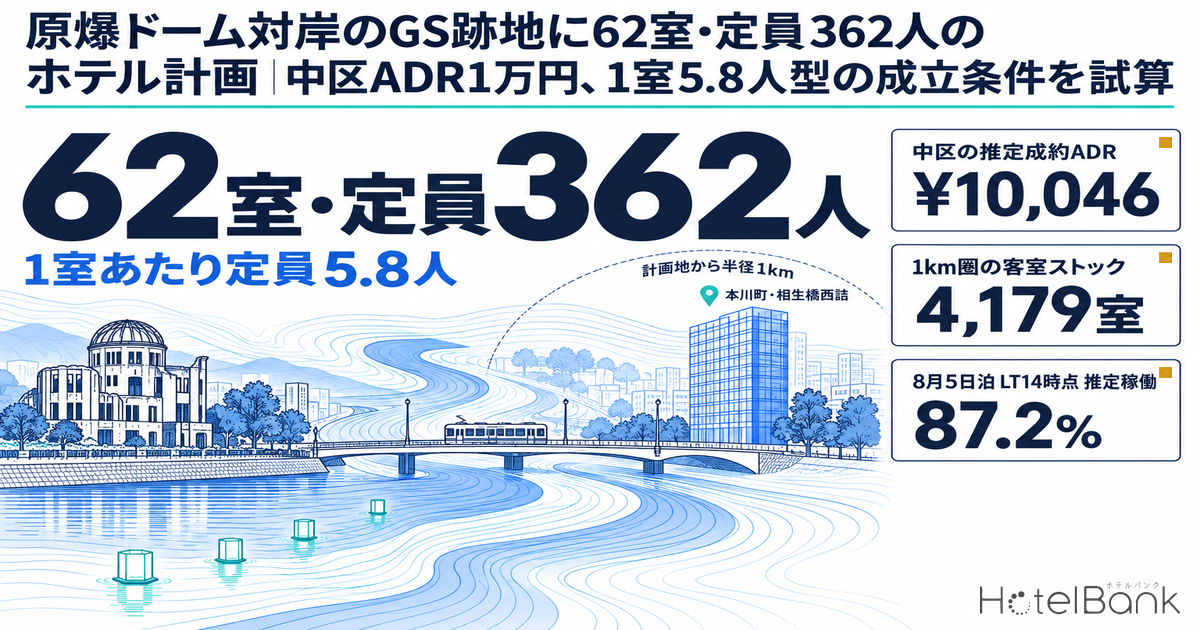
Across the river from the Atomic Bomb Dome, at the west end of Aioi Bridge in Honkawacho 1-chome, Naka-ku, Hiroshima, a building plan notice for the “Honkawacho Hotel Plan, Naka-ku, Hiroshima (working name)” with Anabuki Kosan Inc. (穴吹興産) as the developer was spotted in September 2026. According to the on-site notice as transcribed by the redevelopment news site AND BUILD HIROSHIMA, the reinforced-concrete (RC) building will have 13 floors above ground and 1 basement level, 62 guest rooms with capacity for 362 guests, and a gross floor area of 4,100 m². Construction is scheduled to start on Wednesday, January 13, 2027, with completion and opening on Thursday, August 31, 2028. The 625.97 m² site was formerly the ENEOS Aioibashi service station (closed around March 2024) and is currently used as a coin-operated parking lot.
A capacity of 5.8 guests per room and 66 m² of gross floor area per room describe a very different room product from the business-hotel-heavy stock that has built up in Naka-ku. This article overlays the plan on the 1 km room stock listed on major booking sites, Naka-ku’s estimated settled ADR, inventory sell-through around Golden Week (GW) and August 6 in 2026, and Ministry of Land, Infrastructure, Transport and Tourism (MLIT) data on land prices, zoning and disaster scenarios, to identify the conditions under which a multi-guest hotel can work on a small former gas station site. The brand and operator had not been announced as of October 8, 2026, and this article does not speculate on them.
Metric Definitions Used in This Article
- ADR (Average Daily Rate): Estimated settled rate (tax-exclusive equivalent), calculated by applying segment-specific adjustment factors to the lowest plan each property publishes on major booking sites (2 guests per room, per-room rate, tax-inclusive). Checked against property-level results disclosed by listed hotel REITs (91 properties, most recent 3 months), the median error is about 7%. These are estimates and differ from each property’s actual settled rates and accounting figures. Area-level ADR is the median of the target properties (the level of a typical property in the area). This article compares only closed months from September 2025 to August 2026 and does not use months after the survey date (October 8, 2026).
- OCC (Occupancy): Share of total rooms in the area that have been sold (an estimate based on OTA sales inventory). Inventory sell-through in this article covers a fixed cohort in Naka-ku (62 properties / 4,718 rooms, as listed on major booking sites) and uses only observations within LT (lead time = days before check-in) of 45 days.
- Early sell-out LT: The lead time at which remaining rooms first reached zero. Larger values mean earlier sell-outs. Values above 45 days are shown as “sold out 45+ days before the stay date.”
- Room stock: Properties in our facility database with no closure or delisting record, at least 1 room, and price observations on major booking sites in the last 3 months, de-duplicated (opening-year tallies are limited to properties with a known opening year).
- Data sources: MetroEngines Research & Consulting, MLIT Real Estate Information Library, City of Hiroshima, Hiroshima Peace Culture Foundation
- — 62 rooms, 362 guests: Anabuki Kosan plans the hotel on a former gas station site (625.97 m²) in Honkawacho, Naka-ku, Hiroshima. Capacity is 5.8 guests and 66.1 m² of gross floor area per room, with completion and opening scheduled for August 31, 2028 (per the on-site building plan notice).
- — 57 properties and 4,179 rooms within 1 km: Only 76 rooms were added in 2022–2026. Just 13 properties with 254 rooms (6.1% of rooms) list a single-room rate for 6 or more guests.
- — Naka-ku’s estimated settled ADR is about ¥10,000: The September 2025–August 2026 average is up 4.6% YoY (N=56–64 properties). That is a 2-per-room rate, so about ¥5,000 per person is the baseline for pricing multi-guest rooms.
- — For Wednesday, August 5, 18 of 62 properties sold out 45+ days ahead: On the eve of the 2026 Peace Memorial Ceremony, estimated occupancy at LT14 was 87.2%, a peak almost as high as Golden Week.
- — GOP yield on total investment ranges from 2.6% to 5.3%: 2.6% assuming mostly 2-guest use, 5.3% assuming an average of 4 guests at ¥6,000 per person. Equipment measures for the 3.0–5.0 m flood scenario, landscape prior consultation and a voluntary soil survey are prerequisites for the schedule.
Plan Specifications — 66 m² and 5.8 Guests per Room, Unlike Any Existing Hotel in Naka-ku
Start with the figures on the notice. The building area of 420 m² is 67% of the 625.97 m² site, within the 80% building coverage limit for a commercial zone. Dividing the 4,100 m² gross floor area by the site area gives 655%, but the floor area counted toward the floor area ratio (FAR) varies with how parking and basement space are treated, so the FAR itself cannot be determined from this figure. The use is listed as “hotel and restaurant,” suggesting a restaurant on the lower floors. Design and supervision are by Alpha Design Studio First-Class Architect Office, and the contractor is listed as undecided (all per the on-site building plan notice).
| Item | Details |
|---|---|
| Name | Honkawacho Hotel Plan, Naka-ku, Hiroshima (working name) ((仮称)広島市中区本川町ホテル計画) |
| Developer | Anabuki Kosan Inc. (穴吹興産株式会社) |
| Structure / scale | RC, 13 floors above ground and 1 basement level, height 45.20 m |
| Use | Hotel and restaurant |
| Rooms / guest capacity | 62 rooms / 362 guests (5.8 per room) |
| Site / building / gross floor area | 625.97 m² / 420.00 m² / 4,100.00 m² (66.1 m² gross floor area per room, 11.3 m² per guest) |
| Construction start / completion | Start January 13, 2027; completion and opening August 31, 2028 |
| Previous use | ENEOS Aioibashi service station (closed around March 2024) → coin parking after demolition |
How unusual these specifications are becomes clear when they are set next to existing properties within the same 1 km whose gross floor area is known. Full-service hotels with banquet halls and restaurants have far more floor area per room: RIHGA Royal Hotel Hiroshima (リーガロイヤルホテル広島) has 138.5 m² per room (491 rooms, 68,000 m²) and ANA Crowne Plaza Hiroshima (ANAクラウンプラザホテル広島) has 78.9 m² (402 rooms, 31,700 m²). Limited-service hotels have much less: THE KNOT HIROSHIMA has 37.2 m² (201 rooms, 7,485 m²) and Hotel Livemax Hiroshima Heiwakoen-mae (ホテルリブマックス広島平和公園前) has 20.2 m² (63 rooms, 1,270 m²). The Honkawacho plan’s 66.1 m² sits between full-service and limited-service, but no banquet space is listed, so most of the floor area most likely goes to guest rooms. Per guest, it works out to 11.3 m², close to the area of a single room (1–2 guests) in a limited-service business hotel. In other words, the figures on the notice suggest a design concept of “multi-guest rooms that give each guest the floor area of a 2-person room,” not “62 rooms built for 2 people.”
Location — Opposite Peace Memorial Park, on the Edge of the Commercial Zone, and Right by the River
The site sits on the right bank of the Honkawa River (the former Ota River), at the west end of Aioi Bridge. The Atomic Bomb Dome is about 300 m away across the bridge, and both the Honkawa-cho and Tokaichi-machi Hiroden tram stops are within walking distance. On the Peace Memorial Park side, Kamiyacho and Otemachi form the urban core, a commercial zone with FARs of 600–900%. Across the river, the west bank is a commercial zone with FARs of 400–600%, which changes to a Category 2 residential zone further west. Checking the zoning data in the MLIT Real Estate Information Library, the site lies near the boundary between a commercial zone with a 400% FAR / 80% coverage and one with a 600% FAR / 80% coverage, and confirming which one it falls in requires checking Hiroshima City’s urban planning map.
| Zoning | Commercial zone |
| FAR / building coverage | 400–600% / 80% |
| Landscape Act prior consultation | Required (over 45 m: by 60 days before notification) |
| Height standard | 50 m or less (per the on-site building plan notice) |
| Flood (maximum scenario) | Inundation depth 3.0–5.0 m |
| Tsunami (surrounding area) | 0.3 to under 1.0 m |
| Liquefaction tendency | Natural levee, prone to liquefaction |
| Storm surge inundation | No zone recorded for the area in the library |
Official land prices differ sharply between the two banks of the river. On the west bank, Tokaichimachi 2-5-27 (commercial zone), about 410 m from the site, was ¥494,000/m² as of January 1, 2026 (+7.2% YoY), and Sakaimachi 2-2-8, about 620 m away, was ¥476,000/m² (+4.8%). Across the river, Kamiyacho 2-2-20, about 460 m away, reached ¥2.28 million/m² (+4.6%) and Nakamachi 7-15 reached ¥2.46 million/m² (+5.6%). West-bank land prices are only one-fourth to one-fifth of the core’s, yet their growth rates are higher, at +8.1% for Kawaramachi 1-21 and +7.2% for Tokaichimachi, suggesting that the market has begun pricing in the area as “affordable and close to the center.” Mechanically applying the Tokaichimachi official land price to the 625.97 m² site gives about ¥310 million, but the actual acquisition price has not been disclosed, and this article treats that level only as a reference value.
Being right by the river also shows up in the disaster figures. In MLIT’s flood inundation zone data (maximum scenario), the blocks around the site fall within the 3.0–5.0 m inundation zone under the Ota River, former Ota River and Tenma River scenarios alike. This assumes water reaching around the second-floor level, so which floor houses the substation equipment, emergency power, and what the basement is used for become design issues. The tsunami scenario puts the surrounding area at 0.3 to under 1.0 m, and the landform-based liquefaction map classifies it as “natural levee, prone to liquefaction.” The library has no storm surge inundation zone recorded for the area, so this needs to be checked separately against the storm surge inundation maps published by Hiroshima Prefecture. The more a site sells its riverside views, the more a ground-floor restaurant and basement plans should be evaluated together with the inundation scenario. We have applied the same framework of zoning, landscape, inundation and land prices to a hotel site in Hikone, around the castle’s planned 2028 World Heritage listing.
Room Stock within 1 km — Entrants since 2017 Average 48 Rooms as Hotels Have Gotten Smaller
Now to the supply side. De-duplicating properties in our facility database with no closure or delisting record, at least 1 room, and price observations on major booking sites in the last 3 months, the active stock within a 1 km radius of the site is 57 properties and 4,179 rooms (as of October 8, 2026). By size, just the 3 properties with 300+ rooms (1,277 rooms) and the 8 with 100–299 rooms (1,747 rooms) account for 72% of rooms, while 17 properties have fewer than 10 rooms (76 rooms) and 15 have 10–29 rooms (274 rooms), so small properties make up the majority by count.
| Property size | Properties | Rooms | Share of rooms |
|---|---|---|---|
| 300+ rooms | 3 | 1,277 | 30.6% |
| 100–299 rooms | 8 | 1,747 | 41.8% |
| 30–99 rooms | 14 | 805 | 19.3% |
| 10–29 rooms | 15 | 274 | 6.6% |
| Under 10 rooms | 17 | 76 | 1.8% |
| Total | 57 | 4,179 | 100% |
Lining up the 45 properties (4,049 rooms) with a known opening year shows how the shape of new entry has changed. The 19 properties opened in 2016 or earlier and still operating average 147.7 rooms (2,807 rooms in total), while the 26 opened in 2017 or later average only 47.8 rooms (1,242 rooms in total). By year, 347 rooms were added in 2019, 345 in 2020 and 330 in 2021, three straight years of 300+ rooms. In the five years from 2022 to 2026, only 76 rooms were added in total, all at small properties with fewer than 30 rooms. The Honkawacho plan’s 62 rooms fit this trend of smaller entrants, but with capacity for 362 guests, this single building will hold more guests than all the rooms added since 2022 combined.
The scarcity of multi-guest rooms can also be checked in numbers. Properties listing a single-room rate for 6 or more guests on major booking sites total just 13 properties and 254 rooms (6.1% of rooms) within 1 km, and 31 properties and 1,296 rooms in all of Naka-ku (11.9% of 137 properties and 10,927 rooms). Most are small apartment-style or hostel-style properties averaging 20 to 40-odd rooms. In neighboring Minami-ku (Kojinmachi), the 157-room hostel-style GRAND HOSTEL LDK Hiroshima is scheduled to open, but mid-rise hotels that put 5–6 guests in a private room have almost no precedent in the active stock. With 62 rooms and 362 guests, the Honkawacho plan would increase rooms for 6+ guests within 1 km by 24% in one go.
Naka-ku’s Estimated Settled ADR Is around ¥10,000 — The Picture Changes per Person Rather than per Room
Next, rate levels. Naka-ku, Hiroshima’s estimated settled ADR (all segments, 56–64 properties) averaged about ¥10,000 over the 12 months from September 2025 to August 2026, up 4.6% from about ¥9,600 in the prior-year period. Monthly swings are large: the high was about ¥12,600 in November 2025, when autumn foliage and school trips overlap, and the low was about ¥7,600 in January 2026, a 1.65x gap over the year. YoY, April 2026 rose 17.9% (about ¥10,800) and November 2025 rose 13.8%, while August 2026, at about ¥12,300, came in 4.8% below the prior-year month (about ¥12,900), so summer growth has paused. By segment, business hotels were about ¥9,800 (+1.9%, N=48–53) and city hotels about ¥14,300 (+7.8%, N=7). Compared with neighboring Minami-ku at about ¥9,400 (+3.5%) and Hiroshima Prefecture overall at about ¥8,700 (+5.3%), Naka-ku is one of the prefecture’s higher-priced markets, though still in the low ¥10,000s.
| Area / segment | Sep 2025–Aug 2026 avg | Prior-year period | YoY | Properties |
|---|---|---|---|---|
| Naka-ku, Hiroshima (all segments) | ¥10,046 | ¥9,603 | +4.6% | 56–64 |
| Naka-ku business hotels | ¥9,843 | ¥9,662 | +1.9% | 48–53 |
| Naka-ku city hotels | ¥14,340 | ¥13,307 | +7.8% | 7 |
| Minami-ku, Hiroshima (all segments) | ¥9,412 | ¥9,094 | +3.5% | 23–24 |
| Hiroshima Prefecture (all segments) | ¥8,692 | ¥8,257 | +5.3% | 294–303 |
Now shift the view from the room to the person. Naka-ku’s estimated settled ADR of about ¥10,000 is a 2-per-room rate, so it works out to about ¥5,000 per person. Applying that per-person rate to the Honkawacho plan’s capacity of 5.8 guests gives about ¥29,000 per room, and even an average of 4 guests gives about ¥20,000, well above the average for Naka-ku city hotels (about ¥14,300). Pricing a multi-guest room is not about “how much to charge for a room” but about “keeping the per-person rate in line with nearby 2-guest stays while building revenue through the number of guests per room.” Cleaning and linen loads rise with the number of guests, so gross margins tend to be lower than at limited-service hotels, but measured per square meter of floor area, there is room to achieve higher revenue density than with a design that lines up 2-person rooms.
Hiroshima has deep demand that responds to this per-person rate. According to City of Hiroshima statistics, tourist visits in 2025 reached a record 14.76 million (+2.9% YoY), including 2,561,000 international visitors (+1.9%) and 7,115,000 overnight visitors (+2.2%). The Hiroshima Peace Memorial Museum welcomed 2,267,662 visitors in fiscal 2025 (preliminary figure through February 6, 2026), a record for the third straight year, with international visitors accounting for 833,054, or 36.7%. For inbound travelers moving as families or groups of friends, a room for 4–6 is “cheaper than booking two rooms.” On the other hand, school-trip students and similar groups fell for the second straight year to 316,000 (−4.8%), which the city attributes to schools shifting destinations back to farther locations and the impact of Expo 2025 Osaka, Kansai. School-trip destinations are decided 2–3 years in advance, so the schools the hotel can capture at its August 2028 opening are those it pitches to in 2026–2027. Spreading multi-guest demand across inbound groups and domestic three-generation family trips, rather than relying on school trips alone, widens the growth potential of this location.
In the positioning map, existing properties within 1 km cluster in a “¥7,000–¥13,000 for 2 per room” band. Above ¥15,000, there are only 2 full-service hotels with 300–500 rooms, 1 lifestyle hotel with 200 rooms and 1 ryokan with 30 rooms. If the Honkawacho plan sells at ¥20,000–¥30,000 per room, it will enter the same per-room price band as the existing properties in the upper right of the chart, at a small scale of 62 rooms. The axes of comparison differ, however. The existing high-priced band is priced for 2 guests, while the Honkawacho plan’s per-person rate, divided among 4–6 guests, lines up with the Naka-ku average. So it would not compete on price; it would complement existing supply on guest capacity.
Inventory Sell-Through on Peak Dates — For August 5, 18 of 62 Properties Sold Out 45+ Days Ahead
We check the strength of supply and demand on peak dates that have already passed. From Naka-ku properties, we selected those whose public inventory on major booking sites equaled at least 30% of total rooms on ordinary dates (April 14, April 21 and September 16, 2026), forming a fixed cohort of 62 properties and 4,718 rooms. For Wednesday, August 5, 2026, the eve of the Peace Memorial Ceremony, 18 of these 62 properties sold out 45+ days before the stay date, and remaining rooms hit zero at 24 properties at LT30 or earlier, 31 at LT14 or earlier and 36 at LT7 or earlier. For Thursday, August 6, the day of the ceremony, sell-outs 45+ days ahead fell to 7 properties, and 18 at LT7 or earlier, easing compared with the night before. The way inventory disappeared makes it clear that lodging demand peaks the night before the ceremony, not on the day itself.
| Stay date | Properties | Sold out 45+ days ahead | LT30+ | LT14+ | LT7+ | Est. occupancy at LT14 | Est. occupancy at LT1 |
|---|---|---|---|---|---|---|---|
| Apr 14 (Tue), ordinary day | 49 | 0 | 0 | 0 | 1 | 73.7% | 91.9% |
| Apr 21 (Tue), ordinary day | 49 | 0 | 0 | 2 | 5 | 76.5% | 93.8% |
| May 2 (Sat), Golden Week | 46 | 0 | 10 | 14 | 14 | 89.2% | 93.9% |
| May 3 (Sun), Golden Week | 42 | 0 | 7 | 15 | 15 | 90.6% | 95.9% |
| May 4 (Mon), Golden Week | 47 | 0 | 6 | 10 | 13 | 87.7% | 97.5% |
| Aug 5 (Wed), ceremony eve | 62 | 18 | 24 | 31 | 36 | 87.2% | 95.7% |
| Aug 6 (Thu), ceremony day | 62 | 7 | 10 | 15 | 18 | 75.9% | 92.1% |
| Aug 14 (Fri), Obon | 62 | 10 | 16 | 24 | 26 | 79.7% | 94.7% |
| Sep 16 (Wed), ordinary day | 62 | 3 | 4 | 5 | 6 | 72.0% | 94.0% |
The gap from ordinary days is clear, too. April Tuesdays reached 73–77% estimated occupancy at LT14 and 92–94% the day before, while Golden Week (May 2–4) built up to 88–91% at LT14 and 94–98% the day before. August 5 hit 87.2% at LT14 and 95.7% the day before, a peak almost as high as Golden Week. At the same time, estimated occupancy exceeds 90% the day before even on ordinary days, showing that Naka-ku’s rooms routinely sell at high levels. An August 2028 opening means the hotel can capture both the August 5–6 peak and the Obon peak on August 14 (10 properties sold out 45+ days ahead, 95% the day before) from its first year.
Local Catchment — 81,000 Residents within 1.5 km and 69,000 Workers on the Western Edge of the Center
We also look at the local catchment that overlaps with tourism demand. According to MLIT’s National Land Numerical Information 250 m mesh future population estimates, the resident population within a 1.5 km radius of the site is estimated at 80,518 in 2025 and projected at 78,319 in 2040 (−2.1% vs. 2020, −2.7% vs. 2025). Even as Hiroshima City as a whole loses population, the western edge of the center is expected to hold steady. The share aged 65 and over is 24.0% and the working-age share is 66.0%, a profile close to that of an urban residential area with high-rise condominiums along the river. The Economic Census for Business Activity (2021) by the Ministry of Internal Affairs and Communications and the Ministry of Economy, Trade and Industry counts 5,352 establishments and 69,369 employees within 1 km, 27.6% of them office workers. Facing the Kamiyacho and Otemachi office district across the river, the location can capture both weekday business demand and weekend and holiday tourism demand. Note that the resident population is the nighttime population based on the national census, not visitors or people passing through.
Former Gas Station Sites and Landscape Height Rules — Two Procedures that Come with Small-Site Development
This plan is instructive because it is also an example of reusing a former gas station site, a kind of land that keeps increasing across Japan. For soil at former gas stations, the Soil Contamination Countermeasures Act sets two triggers. Article 3 imposes a survey obligation on land where a “specified facility using hazardous substances” under the Water Pollution Prevention Act has been decommissioned, but ordinary gas stations often do not qualify as such facilities, so the Article 3 obligation is limited. Article 4 requires notification for changes in the form or nature of land of 3,000 m² or more, but this site, at 625.97 m², does not meet that threshold either. In other words, it is not a type of site where a legal survey obligation arises automatically. However, benzene, a component of gasoline, is a specified hazardous substance under the Act, and at stations that operated in the leaded-gasoline era before 1986, lead can also be an issue. In practice, a voluntary survey following the Ministry of the Environment’s oil contamination guidelines, survey requirements in lenders’ due diligence and soil checks when underground tanks are removed are standard steps, and depending on the results, excavation and removal or containment measures add to the construction period and cost. Because cost levels vary by orders of magnitude depending on whether and how far contamination extends, this article does not give a figure.
The other is the landscape procedure. Hiroshima City’s “Guidelines on Prior Consultation for Notifications under the Landscape Act” (in force January 2015, amended January 2022) require prior consultation for construction in the Atomic Bomb Dome and Peace Memorial Park surrounding area, and stipulate that consultation for buildings taller than 45 m must be completed by 60 days before the Landscape Act notification. At 45.20 m, this project slightly exceeds that threshold, so consultation from the schematic design stage is a given. The on-site building plan notice states that the site is in an area subject to a height standard of 50 m or less (per AND BUILD HIROSHIMA’s transcription), and 13 floors suggests a design that tightens floor-to-floor heights to use up the floor area within that height envelope. On a small site, the “height limit” and the “floor area per room” determine the number of rooms, and the choice of 66 m² and 5.8 guests per room here can be seen as one answer to maximizing guest capacity per square meter of floor area under a height limit.
Simple Development Scenarios — Selling per Person Changes the Conditions for Feasibility
Based on the above, we present a simple estimate using only public information. The assumptions are as follows, and none of them relate to Anabuki Kosan’s business plan. Construction cost uses the 2025 national cost per tsubo (3.3 m²) for RC hotels and ryokan of ¥2.026 million, compiled by Archi-Book from MLIT’s Statistics on Building Construction Starts, giving about ¥2.51 billion for 4,100 m² (about 1,240 tsubo) of gross floor area. Compounding Turner & Townsend’s construction cost forecast (+5.3% in 2026, +5.0% in 2027) up to the midpoint of construction (around October 2027) between the January 2027 start and August 2028 completion gives about ¥2.74 billion, or about ¥44 million per room. Because the actual land acquisition price is undisclosed, we use as a reference value about ¥310 million, obtained by mechanically applying the nearby official land price (Tokaichimachi, ¥494,000/m²) to the site, and set total investment at about ¥3.05 billion. Our verification of 394 transactions in 10 markets found that commercial land trades at about 0.86x the official land price on average and 1.19x at the top quartile, which gives a sense of the range around this reference value. For the GOP margin, we use an assumed 40% that reflects the cleaning and linen load of multi-guest rooms.
| Item | A. Mostly 2 guests | B. Avg. 4 guests Base | C. Avg. 5 guests |
|---|---|---|---|
| Rate per room (assumed) | ¥11,000 | ¥24,000 (¥6,000 per person) | ¥27,500 (¥5,500 per person) |
| Assumed occupancy | 80% | 75% | 70% |
| Annual room revenue (62 rooms) | About ¥199M | About ¥407M | About ¥436M |
| GOP (40%) | About ¥80M | About ¥163M | About ¥174M |
| GOP yield on construction cost only (¥2.74B) | 2.9% | 5.9% | 6.4% |
| GOP yield on total investment (¥3.05B incl. land reference value) | 2.6% | 5.3% | 5.7% |
The result is clear. With the same 62 rooms, Scenario A, selling at the Naka-ku average 2-guest rate, yields only 2.6% GOP on total investment, so using 66 m² per room is hard to justify. Scenario B, at an average of 4 guests and ¥6,000 per person, yields 5.3%, and Scenario C, at an average of 5 guests, yields 5.7%. In other words, the plan works not by “selling 62 rooms at the market rate for 2-person rooms” but by “steadily filling each room with 4–5 guests while keeping the per-person rate in line with Naka-ku’s 2-guest level (about ¥5,000).” Testing the sensitivity, a 10% drop in the per-person rate in Scenario B lowers the yield to 4.8%, a 5-point drop in occupancy lowers it to 5.0%, and both together lower it to 4.5%. Because multi-guest revenue depends heavily on filling rooms with guests, a sales design that switches among three sources of demand by season — school trips, inbound groups and three-generation family trips — will underpin the plan’s assumptions.
| Sensitivity (Scenario B) | Base | Per-person rate −10% | Occupancy −5pt | Both |
|---|---|---|---|---|
| Annual room revenue | About ¥407M | About ¥367M | About ¥380M | About ¥342M |
| GOP (40%) | About ¥163M | About ¥147M | About ¥152M | About ¥137M |
| GOP yield on total investment | 5.3% | 4.8% | 5.0% | 4.5% |
We also check a two-way sensitivity that moves the per-person rate and occupancy together. Holding the average at 4 guests and varying the per-person rate from ¥5,000 to ¥7,000 and annual average occupancy from 65% to 85%, the GOP yield on total investment of ¥3.05 billion ranges from 3.9% to 7.1%. If the per-person rate stays at the per-person level of Naka-ku’s 2-guest stays (about ¥5,000), the yield is 4.5% at the base occupancy of 75% and only 5.0% even at 85%, while ¥7,000 per person yields 5.4% even at 65% occupancy. From the base case (¥6,000 per person, 75% occupancy), cutting only the per-person rate by ¥500 gives 4.9%, and cutting only occupancy by 5 points gives 5.0%; missing either the rate or the guest count pulls the yield down to around 5%.
| Per-person rate (per-room rate) | Occ. 65% | Occ. 70% | Occ. 75% | Occ. 80% | Occ. 85% |
|---|---|---|---|---|---|
| ¥5,000 per person (¥20,000 per room) | 3.9% | 4.2% | 4.5% | 4.7% | 5.0% |
| ¥5,500 per person (¥22,000 per room) | 4.2% | 4.6% | 4.9% | 5.2% | 5.5% |
| ¥6,000 per person (¥24,000 per room) | 4.6% | 5.0% | 5.3% | 5.7% | 6.1% |
| ¥6,500 per person (¥26,000 per room) | 5.0% | 5.4% | 5.8% | 6.2% | 6.6% |
| ¥7,000 per person (¥28,000 per room) | 5.4% | 5.8% | 6.2% | 6.6% | 7.1% |
Investment Perspective — 5 Items for Site Owners and Regional Banks to Check
Finally, we organize the checkpoints this plan suggests for businesses holding small sites or former gas station lots in regional cities, and for those reviewing loans. First, the new supply environment. In Naka-ku, Courtyard by Marriott Hiroshima (Mikawacho, 183 rooms) is reported to open in early 2027 and RIHGA Grand Hiroshima (Higashi-hiratsukacho, 168 rooms) around the end of June 2028, both in the mid-to-upper price range based on 2-guest use. Although the Honkawacho plan may overlap with them in per-room price, it targets a different party size, so rather than competing directly, it raises the guest capacity of Naka-ku as a whole. Second, the depth of demand on peak dates: inventory sell-through for August 5 and May 3 reached levels where 36–50% of observed properties had no rooms left by two weeks before, meaning there are several days a year when multi-guest rooms fill at high rates.
| Item | How to read it for this project | Assessment |
|---|---|---|
| Depth of demand | 14.76 million visitors, 2.56 million international (2025, record). Estimated occupancy at LT14 of 87–91% on the ceremony eve and Golden Week | Strong |
| Price level | Naka-ku ADR ¥10,046 (2 per room). About ¥5,000 per person is the baseline for multi-guest pricing | Neutral |
| Supply | 4,179 rooms within 1 km; 76 added in 2022–26. About 350 new rooms reported for Naka-ku in 2027–28 | Neutral |
| Disaster risk | Flood (maximum scenario) inundation depth 3.0–5.0 m; landform prone to liquefaction. Address through equipment placement and insurance design | Needs action |
| Procedures | Landscape prior consultation (over 45 m: by 60 days before notification); soil survey of the former gas station (legal obligation limited, voluntary survey is standard practice) | Build into schedule |
Third, disaster risk: in a zone with 3.0–5.0 m of inundation depth, measures such as placing machine and electrical rooms on upper floors, limiting basement uses and incorporating flood evacuation plans into the terms of accommodation may be reflected in loan conditions and insurance premiums. Fourth, the procedural schedule: the landscape prior consultation and voluntary soil survey both require bringing schematic design forward, and the smaller the site, the less design freedom there is, so working backward from the planned January 2027 construction start is critical. Fifth, the sales design: a multi-guest hotel that sells per person needs both group sales and party-size-based pricing on booking sites, and whether it can enter the school-trip sales cycle in 2026–2027, before opening, will determine how well rooms are filled in the first year. By using a small former gas station site with a design that maximizes guest capacity per square meter of floor area within a height limit, this project offers businesses in regional cities holding similar land a new perspective: measuring supply by guest capacity rather than room count.
Related Articles
References and Sources
■ Plan information
■ Data sources
The estimated settled ADR (Naka-ku, Hiroshima, all segments, closed months from September 2025 to August 2026, N=56–64 properties), room stock within a 1 km radius of the site (57 active properties, 4,179 rooms, as of October 8, 2026), and inventory sell-through for the Naka-ku fixed cohort of 62 properties and 4,718 rooms (observations within 45 days of lead time) were compiled by MetroEngines Research & Consulting from public prices and sales inventory on major booking sites. Plan specifications are from the on-site building plan notice (as transcribed by AND BUILD HIROSHIMA); zoning, land prices and disaster scenarios are from the MLIT Real Estate Information Library; and tourist numbers are from City of Hiroshima publications.
■ Estimate assumptions
Construction cost is about ¥2.74 billion, based on the cost per tsubo and construction cost escalation assumptions described in the text; land is about ¥310 million (reference value), obtained by mechanically applying the nearby official land price to the site area; total investment is about ¥3.05 billion. The GOP margin is 40%, the per-room rate and occupancy are assumptions for each of the three scenarios, and annual room revenue is set at 62 rooms × 365 days. Restaurant revenue is not included. All are assumptions unrelated to the developer’s business plan.
■ Limitations and caveats
The estimated settled ADR and estimated occupancy are estimates based on public information and differ from each property’s actual settled rates and occupancy. The plan specifications could not be confirmed in an official announcement by the developer, and the brand and operator had not been announced as of October 8, 2026. The GOP yield is a rough indicator dividing GOP by the investment amount; it is not an NOI yield or IRR after deducting management fees, property taxes, insurance premiums, FF&E replacement and the like. The zoning boundary and storm surge inundation scenario need to be checked separately against Hiroshima City’s urban planning map and Hiroshima Prefecture’s published maps.
■ Market data
- MetroEngines Research & Consulting — Estimated settled ADR (Naka-ku, N=56–64 properties), room stock (within 1 km, N=57 properties), inventory sell-through (fixed cohort of 62 properties / 4,718 rooms)
■ Government statistics and public data
- MLIT Real Estate Information Library — Official Land Prices (2026), zoning, flood inundation zones (maximum scenario), tsunami inundation scenarios, liquefaction tendency map
- MLIT National Land Numerical Information, “250 m Mesh Future Population Estimates (2024 MLIT National Policy Bureau projection)” / Ministry of Internal Affairs and Communications and Ministry of Economy, Trade and Industry, “Economic Census for Business Activity (2021)”
- City of Hiroshima, “Hiroshima City Tourist Numbers for 2025” (Japanese)
- Hiroshima Peace Culture Foundation, “Hiroshima Peace Memorial Museum Sets New Record for FY2025 Visitors” (February 7, 2026) (Japanese)
- City of Hiroshima, “Guidelines on Prior Consultation for Notifications under the Landscape Act” (Japanese)
- Ministry of the Environment, brochure “How the Soil Contamination Countermeasures Act Works” (Japanese) (survey triggers under Articles 3 and 4, specified hazardous substances)
- Archi-Book, “What Is the Construction Cost per Tsubo for Hotels? [2026 Edition]” (Japanese) (2025 cost per tsubo for RC hotels and ryokan based on MLIT’s Statistics on Building Construction Starts)
■ Industry reports and media
- JLL, “Japan Hotel Investment Market 2025” / Turner & Townsend construction cost forecast
- Relo Hotel Solutions, “What Is GOP? A Key Indicator of Hotel and Ryokan Profit” (Japanese) (definition of GOP)
- TRAICY, “RIHGA Grand Hiroshima to Open in June 2028, Second Hotel of the Lodging-Focused Brand” (July 14, 2026) / Travel Watch, “Courtyard by Marriott Hiroshima to Open in 2027: 183 Rooms within Walking Distance of Hondori and Kamiyacho” (May 30, 2024) (Japanese)
Note on future dates and estimates: ADR and estimated occupancy in this article are estimates based on rates and inventory published on major booking sites as of the survey date (October 8, 2026) and differ from each property’s actual settled rates and occupancy. The development scenario figures combine assumptions based on public information and do not represent the developer’s business plan. The plan specifications are from the on-site building plan notice as transcribed by AND BUILD HIROSHIMA and may change with future design revisions.