

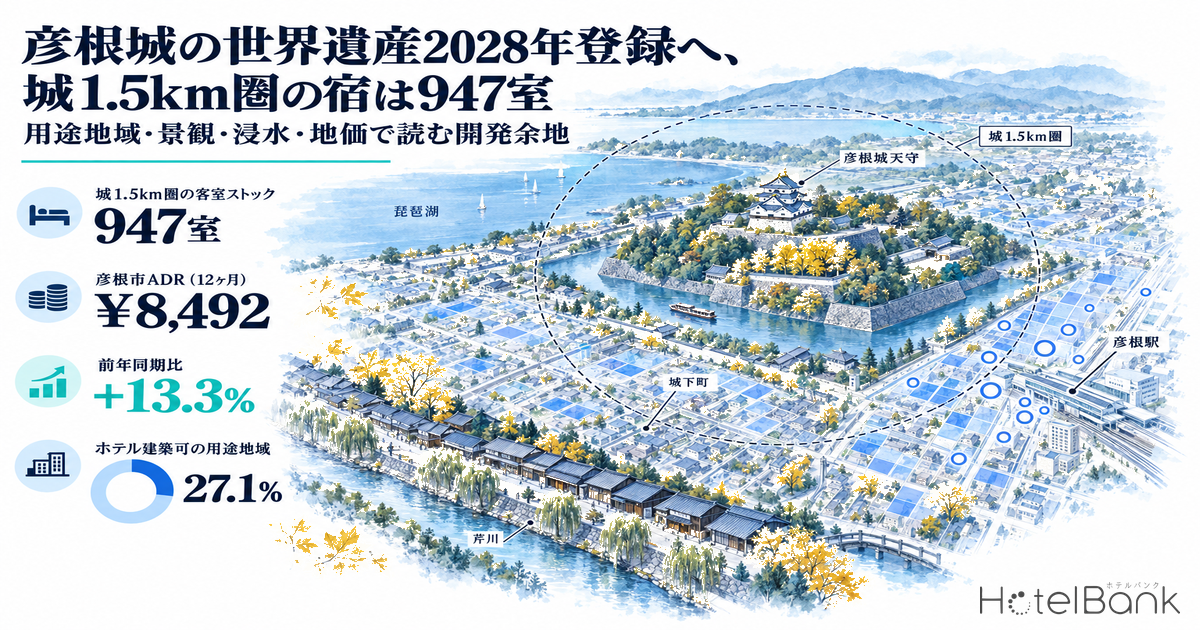
On September 3, 2026, Japan’s Council for Cultural Affairs selected Hikone Castle (彦根城) as the country’s candidate for World Cultural Heritage nomination. The government was to submit a draft nomination dossier to UNESCO by the end of September; after the formal nomination in 2027 and evaluation by ICOMOS (International Council on Monuments and Sites), inscription is expected to be considered at the World Heritage Committee in summer 2028. Thirty-four years after the castle was placed on the Tentative List in 1992, Shiga Prefecture and Hikone City secured the national slot with their fifth draft nomination. With inscription roughly two years away, this article overlays the accommodation supply, price tiers and estimated occupancy within a 1.5km radius of the Hikone Castle keep (tenshu) onto the site conditions that govern development — zoning, landscape-plan height limits, flood risk and land prices — on a single map, to test where, and how much, room there is to build a hotel in the castle town.
Where this article fits: HotelBank has previously covered post-inscription accommodation capacity, as in our analysis of lodging around the newly inscribed Asuka-Fujiwara site; prefecture-level supply in Shiga hotel development (2026 new supply at 1.5% of existing stock); and regulation in general, including the facade cost of landscape rules and the room counts implied by height limits. This article is a location assessment that stacks the site conditions of a single place — the Hikone castle town — at the point two years before inscription.
Metric Definitions Used in This Article
- ADR (Average Daily Rate): An estimated settled rate (tax-exclusive equivalent), calculated by applying property-type correction factors to the lowest-plan price each property publishes on OTAs (per room, double occupancy, tax-inclusive). Checked against property-level results disclosed by listed hotel REITs (91 properties, most recent 3 months), the median error is about 7%. These are estimates and differ from each property’s actual transaction prices and accounting figures. Area-level ADR is the median of the target properties (the level of a typical property in the area).
- OCC (Occupancy Rate): The share of rooms sold relative to total rooms in the area (an estimate based on OTA sales inventory; consistency checks against REIT monthly disclosures confirm accuracy within roughly a few points). It is based on the sell-through of inventory sold on OTAs and differs from a property’s actual overall occupancy.
- Listed price: Price per room for double occupancy (tax-inclusive), averaged across all plans (from room-only to plans with meals). The “price tiers” in this article classify properties by the 12-month average of their listed prices (September 2025–August 2026).
- Room stock: Total rooms of properties whose selling prices were observed on major booking sites in the last 3 months (stay dates June 27–September 26, 2026), based on major booking-site listings. Adults-only properties and whole-unit vacation rentals are excluded.
- Data source: MetroEngines Research & Consulting
- — Room stock within 1.5km of the Hikone Castle keep totals 18 properties and 947 rooms. Of these, 84.4% (799 rooms) cluster around Hikone Station in the 1.0–1.5km band; the castle-town side within 1km has only 7 properties and 148 rooms.
- — By listed price, 611 rooms (64.5%) are under ¥15,000. The ¥25,000–50,000 tier has just 4 properties and 24 rooms, leaving a gap: no upper-midscale property of 20–60 rooms.
- — Hikone City’s estimated settled ADR averaged about ¥8,500 over the last 12 months (+13.3% YoY). On the site side, 27.1% of the 100m grid points in the radius lie in zones where hotels are permitted, the landscape plan caps heights at 12–30m, and 84.9% of hotel-permitted grid points fall in areas with projected flooding of 0.5m or more under the maximum-scale scenario.
- — A simple model of a 25-room new build in the castle town yields a GOP yield of 2.4% at the city’s average rate (about ¥8,500). A 6% yield requires an ADR of about ¥21,000; a conversion that halves building cost brings that down to about ¥11,000.
- — 2026 official land prices are essentially flat — for example, Honmachi 1-chome at ¥89,900/㎡ (+0.2%) — so inscription expectations are not yet priced in. A new build needs site and design decisions within FY2026; conversions and distributed-hotel formats can still start in 2027 and be ready for the inscription decision.
The Road to Inscription — From National Nomination in September 2026 to the Summer 2028 Decision
First, it is worth separating confirmed facts from expectations. According to materials Hikone City published on September 3, the process ahead is as follows: a draft nomination dossier goes to UNESCO by September 30, 2026; in 2027 come Cabinet approval, submission of the final dossier and the ICOMOS evaluation; and the aim is a decision at the 2028 World Heritage Committee. Because the process involves an ICOMOS site visit and recommendation, “inscription in 2028” is a target, not a certainty. Still, each country may nominate only one site per year, and winning that slot means a key precondition for investment decisions has moved one step forward.
The nomination rests on the fact that, beyond the keep, turrets, moats and stone walls, the remains of the daimyo’s palace and senior retainers’ residences survive intact as a whole, illustrating how feudal lords governed during the Edo period. In other words, what is being evaluated is not the keep alone but the structure of the castle and its town. That matters for the lodging business: if visitors’ interest expands from climbing the keep to strolling the castle town, time spent in the area lengthens, creating room for overnight stays.
| Timing | Procedure / event | Implication for lodging business |
|---|---|---|
| 1992 | Added to the World Heritage Tentative List | — |
| May 25, 2026 | The Hikone Castle World Heritage Promotion Council (Shiga Prefecture and Hikone City) submits its fifth draft nomination to the Agency for Cultural Affairs | — |
| September 3, 2026 | Council for Cultural Affairs selects it as Japan’s nomination candidate | Starting point for site searches and feasibility work |
| By September 30, 2026 | Draft nomination dossier submitted to UNESCO | — |
| 2027 | Cabinet approval, final dossier submitted, ICOMOS evaluation (including site visit) | Deadline for a construction decision on a new build. Including landscape consultation and building permits, design should start within FY2026 |
| Summer 2028 | World Heritage Committee considers inscription (target) | Media exposure peaks around inscription. A feasible timeline for conversions and distributed formats |
Source: Compiled by HotelBank Editorial Team from Hikone City, “Hikone Castle provisionally selected for Japan’s World Cultural Heritage nomination” (September 3, 2026) and Shiga Prefecture press release (September 3, 2026)
Hikone Tourism Is Mostly Day Trips — An Overnight Guest Spends About 5x a Day-Tripper
So how much demand is there to justify building? According to the “Economic Impact Survey on Tourism” Hikone City published in March 2026, the city received an estimated 2.35 million tourists (unique visitors) in 2025, of whom 330,000 stayed overnight and 2.02 million were day-trippers. Hikone Castle draws about 650,000 visitors a year, with April the busiest month at about 84,000. Tourism spending reached ¥21.7 billion and the total economic ripple effect ¥39.1 billion.
The key point is the gap in spending per visitor. An overnight guest spends ¥29,543 in the city (including coupon discounts), about 5.0 times the ¥5,924 spent by a day-tripper. Overnight guests accounted for 12.8% of tourist arrivals in 2025, close to the 13.5% average of the four pre-COVID years (2016–2019). Citing Kyoto City’s overnight share of 22.2% (FY2022), the report estimates that if Hikone raised its overnight share to around 22% and met its target of 40,000 foreign overnight guests, tourism spending would reach ¥34.5 billion (+¥12.8 billion vs. 2025). Put differently, Hikone’s upside in lodging demand lies less in “attracting more visitors” than in “turning day-trippers into overnight guests.”
Source: Compiled by HotelBank Editorial Team from Hikone City, “Economic Impact Survey on Tourism in Hikone City 2025” (March 2026)
The share of foreign visitors is still small. The same report puts foreigners at 3.0% of Hikone’s tourist arrivals in 2025, and the average length of stay for overnight guests in the city at 1.16 nights. World Heritage inscription could prompt inbound travelers to build “one night in Hikone” into their itineraries. Being about an hour from Kyoto and Osaka by shinkansen and conventional rail encourages day trips, but if Hikone can capture visitors who value the castle town in the early morning and evening, that same distance can make it a waypoint on a Kansai circuit.
Room Stock Within 1.5km of the Castle: 18 Properties, 947 Rooms — Over 80% on the Station Side
Next, supply. Aggregating MetroEngines Research data within a 1.5km radius of the Hikone Castle keep (35.2765°N, 136.2518°E), the property master lists 26 properties with 1,079 rooms, of which 18 properties with 947 rooms had selling prices observed in the last 3 months. This article treats these 947 rooms as the room stock.
Splitting by distance band makes the structure clear. Within 0.5km of the keep there is only one townhouse (machiya)-style property with 7 rooms; the 0.5–1.0km band has 6 properties and 141 rooms; and the 1.0–1.5km band has 11 properties and 799 rooms. The 1.0–1.5km band covers the east and west sides of JR Hikone Station, where most of the 5 business hotels (681 rooms) stand. The 148 rooms on the castle-town side (within 1km) consist of converted machiya inns such as HATAGO HIKONE, a resort on the shore of Lake Biwa, and a property opened in 2024. In July 2025, the machiya conversions HATAGO HIKONE (15 rooms) and its annex Bettei (7 rooms) opened in quick succession — the conversion of existing castle-town buildings into lodging is already under way.
Circles: lodging properties (size = number of rooms). Grid colors: ■ Hotels permitted (commercial, neighborhood commercial, quasi-industrial, Category 2 residential, quasi-residential) ■ Conditional (Category 1 residential: floor area for the use up to 3,000㎡) ■ Not permitted (exclusively residential and industrial zones). Uncolored areas have no zoning designation (including the castle hill, moats and the lake surface). The dashed line marks a 1.5km radius from the keep.
Source: Prepared by MetroEngines Research & Consulting from MetroEngines Research & Consulting data (N=18 properties) and the MLIT Real Estate Information Library (zoning)
Source: MetroEngines Research & Consulting (N=18 properties, 947 rooms)
By Price Tier, Only 24 Rooms Sit at ¥25,000–50,000 — A Gap in Upper-Midscale Properties of 20–60 Rooms
Dividing the room stock into four tiers by the 12-month average listed price (double occupancy, tax-inclusive, all-plan average): under ¥15,000 has 7 properties and 611 rooms (64.5%); ¥15,000–25,000 has 3 properties and 208 rooms (22.0%); ¥25,000–50,000 has 4 properties and 24 rooms (2.5%); and ¥50,000 and above has 4 properties and 104 rooms (11.0%). Business hotels near the station make up the bottom two tiers, while a Lake Biwa resort and ryotei-style ryokan (inns known for their cuisine) occupy the ¥50,000+ tier.
The gap is in the middle. All 24 rooms in the ¥25,000–50,000 tier are in small machiya-style or whole-house rentals, with at most 15 rooms per property. Not a single property of 20–60 rooms falls in this tier within the radius. Among visitors drawn by World Heritage inscription, the segment that “wants to stay in the castle town but doesn’t need an inn costing over ¥50,000 a night” is thinly served in terms of scale. The scatter chart below marks this zone with a blue dashed box.
Source: MetroEngines Research & Consulting (N=18 properties; listed prices averaged September 2025–August 2026. For the one property opened in August 2026, the average since opening)
| Listed-price tier (12-month avg.) | Properties | Rooms | Share | Main property types |
|---|---|---|---|---|
| Under ¥15,000 | 7 | 611 | 64.5% | Business hotels, ryokan |
| ¥15,000–24,999 | 3 | 208 | 22.0% | Business, city hotel, machiya |
| ¥25,000–49,999 | 4 | 24 | 2.5% | Machiya, whole-house rentals (max. 15 rooms) |
| ¥50,000 and above | 4 | 104 | 11.0% | Resort, ryotei-style ryokan |
| Total | 18 | 947 | 100% |
Source: MetroEngines Research & Consulting (N=18 properties, 947 rooms)
Hikone City ADR Averaged About ¥8,500 Over 12 Months, +13.3% YoY
What about rate levels? Hikone City’s estimated settled ADR (area median) averaged ¥8,492 over the last 12 months (September 2025–August 2026), up 13.3% from ¥7,493 a year earlier (September 2024–August 2025). Shiga Prefecture as a whole averaged ¥8,409 (+9.4%) over the same period, so Hikone is roughly on par with the prefectural level but growing faster. Monthly figures show July 2026 at +14.0% YoY and August at +13.0%, keeping recent growth in double digits (N=20–22 properties per month).
The standout month is October 2025 at ¥11,142, up 58.7% YoY. That month coincided with the National Sports Festival in Shiga (Watashiga Kagayaku Kokusupo, September 28–October 8, 2025), whose opening ceremony and athletics events were held at Heiwado HATO Stadium in Hikone. When a major event comes to town, Hikone’s rates move sharply in a short time — a useful reference point for gauging how much rate uplift the longer-term attention of World Heritage inscription might bring. Note that September–November 2026 figures are estimates based on listed prices at the time of the survey: ¥11,076 for October and ¥11,404 for November (because the estimation basis differs from finalized months, we refrain from a direct YoY comparison).
Source: Compiled by MetroEngines Research and HotelBank Editorial Team (Hikone City, estimated settled ADR, area median, N=20–22 properties. September–November 2026 are estimates based on listed prices at the time of the survey)
Occupancy also points to solid demand. Estimated OCC based on OTA-listed inventory for Hikone City was 74.6% in June 2026, 81.0% in July and 86.9% in August — slightly below Shiga Prefecture overall (79.7%, 83.2%, 90.8%) but following the same seasonal peak. Estimated OCC is derived from OTA inventory sell-through; coverage is 17 properties and 815 rooms for Hikone City in June–July, 15 properties and 635 rooms in August, and 101 properties and 5,614 rooms for Shiga Prefecture in August (all based on major booking-site listings).
| Stay month | Hikone City est. OCC | Coverage (Hikone) | Shiga Pref. est. OCC | Coverage (Shiga) |
|---|---|---|---|---|
| June 2026 | 74.6% | 17 properties, 815 rooms | 79.7% | 113 properties, 6,577 rooms |
| July 2026 | 81.0% | 17 properties, 815 rooms | 83.2% | 115 properties, 6,647 rooms |
| August 2026 | 86.9% | 15 properties, 635 rooms | 90.8% | 101 properties, 5,614 rooms |
Source: Compiled by MetroEngines Research and HotelBank Editorial Team (occupancy estimated from OTA-listed inventory; June figures for Hikone City cover 21 observed days)
Site Conditions — Hotels Are Permitted on 27.1% of the Radius, With Heights Capped at 12–30m
Having confirmed demand and a gap in the price tiers, we turn to where hotels can actually be built. We overlaid zoning data from the MLIT Real Estate Information Library onto a grid of 709 points spaced 100m apart within 1.5km of the keep. Zones where hotels and ryokan may be built (commercial, neighborhood commercial, quasi-industrial, Category 2 residential, quasi-residential) covered 192 points (27.1%); Category 1 residential zones, where they are allowed if the floor area for that use is 3,000㎡ or less, 181 points (25.5%); exclusively residential and industrial zones where they cannot be built, 174 points (24.5%); and areas with no zoning designation (including the castle hill, moats and the lake surface), 162 points (22.8%).
The permitted area runs in a band from the east and west sides of Hikone Station toward Honmachi and Kawaramachi south of the castle. The area around the keep is a Category 1 mid/high-rise exclusively residential zone where hotels and ryokan cannot be built. The 18 existing properties in the radius also line up along this band: 10 in commercial zones, 4 in neighborhood commercial, 2 in quasi-industrial and 2 in Category 1 residential. Floor area ratios are 400–600% in the commercial zones by the station and 200–300% in the neighborhood commercial zones on the castle-town side. South of the castle along the Seri River, the Kawaramachi–Seri-machi district (about 5.0ha) — a merchant town — was designated a national Important Preservation District for Groups of Traditional Buildings on July 25, 2016, and there, district preservation standards apply to any change in exterior appearance. For plans to convert machiya into inns, this is a condition to check first, together with the landscape plan.
Height matters even more than floor area ratio. The Hikone City Landscape Plan (first revised in April 2025) divides the Castle Town Landscape Formation Area into six districts and sets maximum building heights. To protect views of the keep, the Uchimachi and Tomachi districts are limited to 15m even in commercial zones, and to 10m within 10m of the boundary of designated roads. By contrast, the Ekimae Oshiro-dori (station-front castle avenue) district allows 20m and the Station West district 30m. Assuming a floor-to-floor height of just over 3m including a ground-floor lobby, 15m corresponds to roughly 4–5 stories and 30m to 9–10 stories.
| District (Castle Town Landscape Formation Area) | Maximum building height | Approx. stories | Likely lodging format |
|---|---|---|---|
| Uchimachi / Tomachi districts | Residential 12m; commercial/industrial 15m (20m on some adjacent sites). 10m within 10m of designated road boundaries | 3–5 | Machiya conversions / distributed hotels; low-rise 20–40 rooms |
| Ekimae Oshiro-dori district | 20m | About 6 | Mid-size hotel on the axis toward the castle |
| Station West district | 30m | 9–10 | Lodging-focused hotel of 100+ rooms |
| Former castle town periphery / Seri River districts | Residential 12m; commercial or industrial 15m | 3–5 | Low-rise; 2m facade setback along the river |
Source: Compiled by HotelBank Editorial Team from the Hikone City Landscape Plan, “Castle Town Landscape Formation Area.” Story counts are approximations assuming floor-to-floor heights of just over 3m. Plans exceeding the limits require a landscape impact study and consultation with the Landscape Council (limited to cases unavoidable for public or public-interest reasons, etc.)
The other condition is flooding. Overlaying the National Land Numerical Information flood inundation projections (maximum-scale scenario) onto the same grid, 484 of the 709 points (68.3%) fall in areas with projected depths of 0.5m or more, mostly from the Seri River, which crosses the castle town from east to west. Limiting to hotel-permitted zones, 163 of 192 points (84.9%) are affected, and all 18 existing properties also stand within projected inundation areas (13 at 0.5–3m, 5 at under 0.5m). This is less a question of good or bad location than a design precondition, commonly absorbed through measures such as placing electrical substations and emergency generators on upper floors and using the ground floor for non-guestroom functions such as the lobby and F&B.
Source: Prepared by MetroEngines Research & Consulting from the MLIT Real Estate Information Library (zoning; flood inundation projections [maximum-scale scenario]) (709 points at 100m intervals within 1.5km of the keep)
Land Prices Are Flat — Inscription Expectations Don’t Yet Show in 2026 Official Prices
What about land cost? Looking at commercial sites within the radius in the 2026 official land price survey (as of January 1), Daito-cho in front of Hikone Station was ¥125,000/㎡ (0.0% YoY), Ekihigashi-cho at the station’s east exit ¥124,000/㎡ (+3.3%), Honmachi 1-chome — described as a “commercial area near tourist attractions” — ¥89,900/㎡ (+0.2%), and Temma-cho in Chuo-cho ¥63,000/㎡ (-0.8%). Ekihigashi-cho, whose surroundings are described as “a commercial area with a mix of hotels, apartment buildings and shops,” is the only commercial site in the radius up by more than 3%.
On the castle-town side, Honmachi 1-chome has been essentially flat for four years from ¥90,000/㎡ in 2022, while Temma-cho has fallen for seven straight years from ¥68,600/㎡ in 2020. In the prefectural land price survey as of July 1, 2026, Sawa-machi near the station was also flat for a fourth consecutive year at ¥101,000/㎡. All of these valuation dates precede the September 3 nomination decision, so it is reasonable to conclude that World Heritage expectations are not yet priced into land. For operators securing sites before inscription, a window remains before acquisition costs move.
Source: Prepared by MetroEngines Research & Consulting from MLIT “Official Land Price Publication” (Real Estate Information Library). Ekihigashi-cho became a standard site in 2023 and Honmachi 1-chome in 2022
| Site (standard/benchmark site no.) | Distance from keep | Zoning / FAR | 2026 price | YoY |
|---|---|---|---|---|
| Honmachi 1-chome (Official, Hikone 5-4) | ~0.6km | Neighborhood commercial, 200% | ¥89,900/㎡ | +0.2% |
| Sawa-machi (Prefectural survey, Hikone 5-4) | ~0.7km | Commercial, 500% | ¥101,000/㎡ | 0.0% |
| Chuo-cho, Temma-cho (Official, Hikone 5-6) | ~0.8km | Neighborhood commercial, 200% | ¥63,000/㎡ | -0.8% |
| Daito-cho, Hikone Station front (Official, Hikone 5-3) | ~1.1km | Commercial, 600% | ¥125,000/㎡ | 0.0% |
| Ekihigashi-cho (Official, Hikone 5-10) | ~1.3km | Commercial, 600% | ¥124,000/㎡ | +3.3% |
Source: Prepared by MetroEngines Research & Consulting from MLIT “Official Land Price Publication” (as of January 1, 2026) and Shiga Prefecture “Land Price Survey” (as of July 1, 2026), via the Real Estate Information Library
A Simple Model of a 25-Room New Build in the Castle Town — A 6% Yield Needs an ADR of About ¥21,000
What happens when these conditions are combined into a single plan? We modeled acquiring a 500㎡ site in a neighborhood commercial zone at the Honmachi 1-chome official land price (¥89,900/㎡) and building a 4-story hotel (15m or less) with 1,000㎡ of total floor area, fully using the 200% FAR. With guestrooms at 65% of floor area and 26㎡ per room, that gives 25 rooms. Land costs about ¥45 million; the building, at the 2025 steel-frame hotel construction cost of ¥2.405 million per tsubo (3.3㎡; Building Construction Starts statistics), comes to about ¥730 million, or about ¥800 million after factoring in two years of construction cost inflation (+5% per year). Occupancy is set at 75%, based on Hikone City’s estimated OCC for June–August 2026 (74.6–86.9%), and the GOP margin at 35%, more conservative than the 38.9% achieved by Invincible Investment Corporation’s 91 MHM-operated hotels (fiscal period ended December 2024).
| ADR assumption | Annual room revenue | GOP (35%) | Yield (2025 cost) | Yield (with inflation) | Sensitivity: building cost −50% |
|---|---|---|---|---|---|
| ¥8,500 (Hikone City 12-month avg.) | ¥58.2M | ¥20.4M | 2.6% | 2.4% | 4.6% |
| ¥13,900 (top quartile in radius) | ¥95.1M | ¥33.3M | 4.3% | 3.9% | 7.5% |
| ¥20,000 (assumed upper-midscale positioning) | ¥136.9M | ¥47.9M | 6.2% | 5.7% | 10.7% |
Source: MetroEngines Research & Consulting estimates. ADR is estimated settled ADR (tax-exclusive equivalent). “Top quartile in radius” is the third quartile of the 11 properties within 1.5km for which 12 months of estimated settled ADR can be calculated. Yield = GOP ÷ (land + building). This simple model excludes FF&E, pre-opening costs, property taxes and interest; actual investment decisions require a detailed feasibility study
Table 6 varies only the rate, in one dimension. Varying the occupancy assumption at the same time gives the following range of yields (total investment fixed at about ¥850 million including construction cost inflation).
| ADR \ Occupancy (assumed) | 65% | 70% | 75% | 80% | 85% |
|---|---|---|---|---|---|
| ¥8,500 (city average) | 2.1% | 2.2% | 2.4% | 2.6% | 2.7% |
| ¥11,200 | 2.7% | 3.0% | 3.2% | 3.4% | 3.6% |
| ¥13,900 (top quartile) | 3.4% | 3.7% | 3.9% | 4.2% | 4.5% |
| ¥17,500 | 4.3% | 4.6% | 4.9% | 5.3% | 5.6% |
| ¥21,200 (ADR for 6% yield) | 5.2% | 5.6% | 6.0% | 6.4% | 6.8% |
Source: MetroEngines Research & Consulting estimates. Same assumptions as Table 6 (25 rooms, 35% GOP margin, land ~¥45M + building ~¥800M), varying only the occupancy assumption. Shaded cells indicate yields of 6% or more. Simple model excluding FF&E, pre-opening costs, property taxes and interest
The result is clear. A new build at the city’s typical rate (about ¥8,500) produces a GOP yield on total investment in the 2% range. Achieving a 6% yield on a total investment that includes construction cost inflation requires an ADR of about ¥21,200. Conversely, if building costs can be halved — for example by converting an existing building — the required ADR falls to about ¥11,200, and the top-quartile rate in the radius (about ¥13,900) would yield 7.5%. In other words, in Hikone’s castle town, a viable project must choose between “a new build that captures a higher rate” and “a conversion that keeps investment low.” The string of machiya conversions that opened in 2025 illustrates the logic of the latter. As Table 7 shows, even raising the assumed occupancy to 85% does not lift a new build’s yield to 3% at the city-average rate — rate positioning, more than occupancy, determines success.
Investment Timing — New Builds Must Decide Within FY2026; Conversions and Distributed Formats Have Until 2027
Returning to the timeline, opening in time for the summer 2028 inscription decision means a new build should break ground around the first half of 2027. Allowing for landscape-plan notifications, Landscape Council consultation for plans exceeding the limits, and building permit applications, site acquisition and the start of design need to be decided within FY2026. Conversions of machiya or existing buildings, on the other hand, have shorter construction periods and can start in 2027 and still be ready around inscription.
Site selection also splits two ways. The Station West district (up to 30m) and the Ekimae Oshiro-dori district (20m) are areas where scale-oriented plans that use FARs of 400–600% can work, with the added strength of sitting on the route to the castle. The Uchimachi and Tomachi districts in the castle town are capped at 15m, but they lie closest to the price-tier gap (¥25,000–50,000, 20–60 rooms) and offer something unique: the chance to stay within the castle-town street layout that is itself a component of the World Heritage nomination. For regional banks in Shiga and local operators, a distributed plan that runs several machiya together as a single inn is likely to be the more accessible option, both in investment size and in landscape consultation.
Finally, inscription itself is not the finish line. On the nomination decision, the Governor of Shiga also commented to the effect that inscription is a milestone and that conservation and local efforts are only beginning. For the lodging business too, long-term occupancy and rates will depend less on the temporary surge in visitors in the inscription year than on how far, in the two years before inscription, the area can build mechanisms that turn day-trippers into overnight guests — morning and evening experiences in the castle town, and multi-night itineraries combined with Lake Biwa and the wider Omi region.
⚠ Note on ADR for future dates: The September–November 2026 ADRs in this article are estimates based on selling prices published on OTAs at the time of the survey (late September 2026) and will change as check-in dates approach. Please note that prices currently set high may be revised closer to the date.
Frequently Asked Questions
Q. When will Hikone Castle’s World Heritage inscription be decided?
A. The Council for Cultural Affairs selected it as Japan’s nomination candidate on September 3, 2026, and a draft nomination dossier is to be submitted to UNESCO by September 30. After the formal nomination and ICOMOS evaluation in 2027, inscription is expected to be considered at the World Heritage Committee in summer 2028. Inscription depends on the outcome of the evaluation; 2028 is a target year.
Q. How many hotel rooms are there around Hikone Castle?
A. Within a 1.5km radius of the keep, 18 properties with 947 rooms had selling prices observed in the last 3 months (the property master lists 26 properties and 1,079 rooms). Of these, 799 rooms are in the 1.0–1.5km band around Hikone Station; within 1km of the castle there are 7 properties and 148 rooms.
Q. Can a hotel be built near Hikone Castle?
A. The area around the keep is a Category 1 mid/high-rise exclusively residential zone where hotels and ryokan cannot be built, but 27.1% of the radius (share of 100m grid points) is zoned commercial, neighborhood commercial or otherwise permits hotels. However, under the Hikone City Landscape Plan, heights are capped at 15m (12m in residential zones) in the castle town’s Uchimachi and Tomachi districts, 20m in the Ekimae Oshiro-dori district and 30m in the Station West district.
Q. What are hotel rates like in Hikone City?
A. Estimated settled ADR (area median) averaged ¥8,492 from September 2025 to August 2026, up 13.3% YoY. In October 2025, when the National Sports Festival was held, it rose to ¥11,142.
Summary
Hikone Castle has entered the stage of aiming for World Heritage inscription in 2028. Room stock within 1.5km of the castle totals 947 rooms, but over 80% are business hotels near the station; the castle-town side has 148 rooms, and the ¥25,000–50,000 tier only 24. On the demand side, we confirmed a structure in which an overnight guest spends about 5x a day-tripper, along with current strength of +13.3% ADR growth and 86.9% estimated OCC (August 2026, 15 properties). On the site side, hotel-permitted zoning covers 27.1% of the radius, landscape-plan height limits are 12–30m, and 84.9% of permitted areas lie within projected inundation zones. Land prices are still flat, with inscription expectations not yet priced in. Committing fully to one of two designs — a new build aimed at an upper-midscale rate (about ¥21,000), or a conversion/distributed format that keeps investment low and runs at a top-quartile rate — is the condition for building lodging in the castle town.
Related Articles
- Asuka-Fujiwara World Heritage: Only 35 Hotels, 851 Rooms in Nara
- Shiga Hotel Development: 1.5% New Supply, ¥11-16k Whitespace, 8.0% NOI
- World Masters Games 2027 Kansai: 164,707 Rooms Across 50 Venue Cities
Methodology
Room stock is the total rooms (based on major booking-site listings) of the 18 lodging properties within 1.5km of the Hikone Castle keep (35.2765°N, 136.2518°E) whose double-occupancy selling prices were observed on major booking sites for stay dates June 27–September 26, 2026. Price tiers are based on each property’s 12-month average listed price. ADR is the area median (estimated settled ADR) for Hikone City and Shiga Prefecture; 12-month averages are simple averages of monthly values. Zoning and flood projections were determined by whether each of 709 points placed at 100m intervals around the keep falls within each zone (share of 100m grid). Flood projections use the flood inundation areas (maximum-scale scenario); where projections for multiple rivers overlap, the deepest depth class is used. The financial model is a simple estimate based on the assumptions stated in the text.
References and Sources
■ Data Sources
Lodging supply, listed prices, estimated settled ADR and estimated occupancy were aggregated by MetroEngines Research & Consulting from published prices and inventory on major booking sites (Hikone Castle 1.5km radius N=18 properties / 947 rooms; Hikone City N=17–22 properties; Shiga Prefecture N=101–163 properties). Zoning, flood inundation projections and land prices are from the MLIT Real Estate Information Library; landscape-plan height standards from the Hikone City Landscape Plan; and demand-side figures from Hikone City’s “Economic Impact Survey on Tourism 2025.”
■ Model Assumptions
The 25-room new-build model assumes a 500㎡ site at the Honmachi 1-chome official land price (¥89,900/㎡), 1,000㎡ of floor area at 200% FAR, a 65% guestroom ratio at 26㎡ per room, a building cost based on the 2025 steel-frame hotel cost of ¥2.405 million per tsubo plus two years of +5% annual inflation, 75% occupancy (assumed) and a 35% GOP margin. Yield is GOP ÷ (land + building); the two-way sensitivity (Table 7) covers assumed occupancy of 65–85% and ADR of ¥8,500–21,200.
■ Limitations
Estimated settled ADR and estimated occupancy are estimates based on public OTA information and differ from each property’s actual results. ADR for September–November 2026 is estimated from listed prices at the time of the survey and is not final. Zoning and flood projections are point-based checks at 100m intervals and do not reflect individual site conditions (road frontage, existing non-conforming status, preservation district standards, etc.). The model excludes FF&E, pre-opening costs, property taxes and interest; investment decisions require a site-specific feasibility study. World Heritage inscription in 2028 is a target, not a certainty.
■ Market Data
- MetroEngines Research & Consulting — Published price data (Hikone Castle 1.5km radius N=18 properties / 947 rooms), estimated settled ADR (Hikone City N=17–22 properties; Shiga Prefecture N=157–163 properties), estimated OCC
■ Government Statistics and Public Data
- Hikone City, “Hikone Castle provisionally selected for Japan’s World Cultural Heritage nomination” (September 3, 2026; Japanese)
- Shiga Prefecture, “Deliberation results on Hikone Castle’s World Heritage inscription — selected as national nomination candidate” (September 3, 2026; Japanese)
- Hikone Castle World Heritage Promotion Council, “Road to World Heritage”
- Hikone City, “Economic Impact Survey on Tourism in Hikone City 2025” (March 2026; Japanese)
- Hikone City, “Landscape Plan” / Castle Town Landscape Formation Area (PDF; Japanese)
- MLIT Real Estate Information Library — Official land prices, prefectural land price surveys, zoning, flood inundation projections (maximum-scale scenario)
- MLIT, “Statistics on Building Construction Starts”
- Japan Tourism Agency, “Overnight Travel Statistics Survey” (e-Stat)
■ REIT and Industry Materials
■ News and Press Releases
- Hikone Castle nominated for World Cultural Heritage — selected as national candidate on its fifth attempt, aiming for inscription in FY2028 (Kyoto Shimbun, September 2026; Japanese)
- Watashiga Kagayaku Kokusupo / Shosupo 2025, “Event Schedule” (Japanese)
- Hikone City, “Kawaramachi–Seri-machi District, Hikone: Important Preservation District for Groups of Traditional Buildings” (Japanese)