

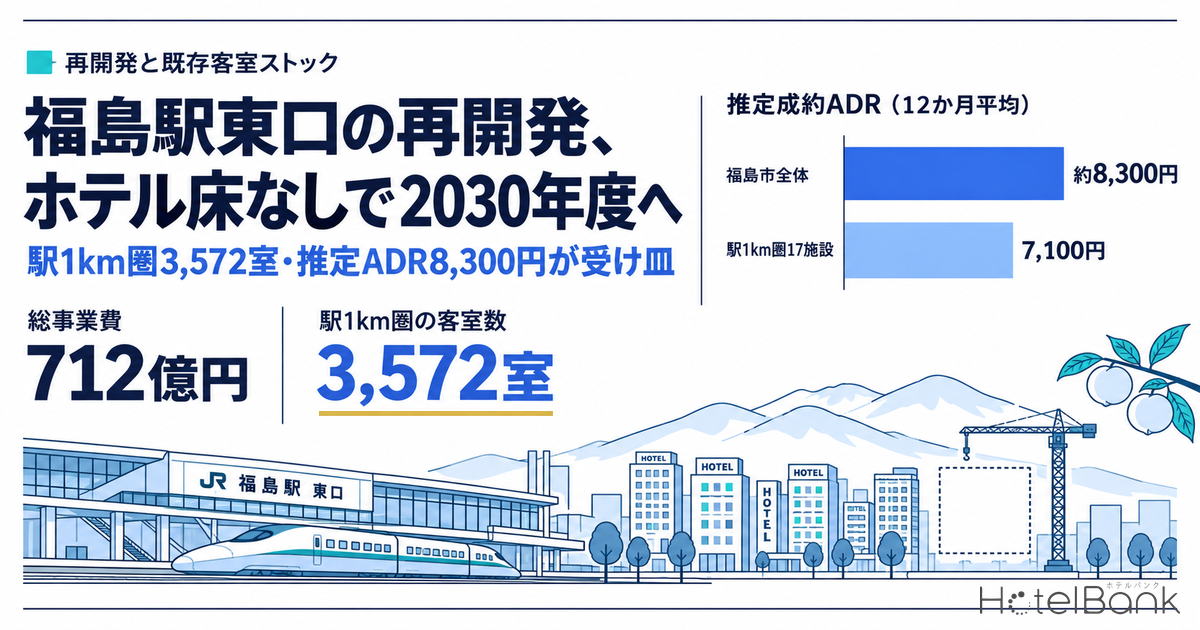
On May 21, 2026, Fukushima City and the Fukushima Station East Exit District Urban Redevelopment Association reported a revised redevelopment plan to a plenary council meeting of the city assembly. Total project cost has risen to ¥71.2 billion (the February briefing put it at ¥58–62 billion), the public area the city will acquire has been cut to about 13,000 m² of total floor area, and the opening has slipped to fiscal 2030. The plan contains no hotel floor. The attempt to bring a hotel into the private-sector portion was shelved in May 2024, citing the pandemic and soaring construction and materials costs. Lodging demand generated in front of the prefectural capital’s main station will therefore be absorbed by the existing room stock. This article looks at how the room count within 1 km of the station moved between 2017 and 2026, where estimated settled ADR stands in Fukushima City, Koriyama, Iwaki and Aizuwakamatsu, whether existing rooms can absorb demand from the public hall (back-calculated in room nights), and — from commercial land prices and floor-area ratios — the breakeven line for a private developer building a stand-alone hotel.
Metric Definitions Used in This Article
- ADR (average daily rate) = an estimated settled rate (tax-exclusive equivalent) calculated by applying a category-specific adjustment factor to the lowest-plan price level each property publishes on OTAs (two guests per room, price per room, tax included). Checked against property-level results disclosed by listed hotel REITs (91 properties, most recent three months), the median error is about 7%. These are estimates and differ from each property’s actual transacted rates and accounting figures. Area-level ADR is the median of the properties covered (the level of a typical property in the area).
- OCC (occupancy) = rooms sold as a share of total rooms in the area (an estimate based on OTA sales inventory; consistency checks against monthly REIT disclosures confirm accuracy within roughly a few points). This article labels it “occupancy (estimated, OTA-listed inventory basis)”: it is an estimate based on how inventory sold on OTAs is being taken up, and differs from the actual occupancy of a property as a whole.
- LT (lead time) = the number of days until check-in. Booking curves use only observation points from LT45 to LT1.
- Room-count trend = properties in operation and their rooms at each year-end, reconstructed from the opening and closing dates of each property registered in the MetroEngines Research accommodation database. Because current room counts are applied to past years as well, room counts before any extension or reduction are not reflected.
- Where listed prices are mentioned, they are the price per room for two guests per room (tax included). Data source: MetroEngines Research & Consulting.
- — The Fukushima Station East Exit redevelopment aims to open in fiscal 2030 with a total project cost of ¥71.2 billion and no hotel floor. Lodging demand created by the hall will fall to the existing rooms around the station
- — Rooms within 1 km of the station went from 3,670 in 2017 to 3,305 in 2020 and 3,572 in 2026 (32 properties). The two years 2025–2026 brought back 260 rooms, but the total is still 98 rooms short of the 2017 level
- — The 12-month average estimated settled ADR is about ¥8,300 for Fukushima City as a whole (N=67–70) and ¥7,100 on a room-weighted basis for the 17 hotels (2,363 rooms) within 1 km of the station. No property above ¥10,000 is observed around the station
- — Under this article’s assumptions, the 1,500-person hall generates 45,000 room nights a year, a little over 20% of the roughly 210,000 vacant room nights a year. On the first day of a large event, 600 rooms of demand arrive at once — about the same as the roughly 586 rooms vacant on an average day
- — The breakeven ADR for a 100-room new build is ¥12,000–13,300, more than ¥4,000 above the observed ceiling of about ¥8,000. A ¥3 million-per-room renovation needs an uplift of only +¥1,400
Where the Redevelopment Stands — ¥71.2 Billion, a 13,000 m² Public Area, No Hotel Floor
First, the facts. The project site is about 2 ha in Sakaemachi in front of the East Exit of JR Fukushima Station, including the former Nakago Fukushima department store, and the project is carried out by the Fukushima Station East Exit District Urban Redevelopment Association. Under the revised plan presented to the city assembly’s plenary council meeting on May 21, 2026, total project cost is ¥71.2 billion and the city’s acquisition cost is ¥32.7 billion (about ¥32.0 billion as of February). The mixed-use building in the private-sector area will have 10 floors and about 12,500 m² of total floor area housing retail and offices, while the public area shrinks to about 13,000 m² of total floor area and becomes partly three-story. The convertible “Flexible Hall” seating up to 1,500 people is retained, whereas the 500-person large conference room has been dropped. The opening is targeted for fiscal 2030, with construction scheduled to start in fiscal 2028.
As for the hotel, the city and the association had been pursuing an operator, including one that had been provisionally selected, but rent and other terms could not be agreed against a backdrop of deteriorating profitability caused by the pandemic and rising prices, and the hotel was shelved in May 2024. The upper floors where the hotel was to go have been switched to office functions such as shared offices and incubation facilities, and the lower floors to an alley-style food hall and local-products functions. In other words, when the hall begins operating in fiscal 2030, visitors’ overnight stays will be taken not by new floor space but by the rooms that already exist around the station. Fukushima City’s dedicated project page was still being updated as of September 9, 2026; the description here is based on materials published as of that date and on press reports from May 2026.
Rooms Within 1 km of the Station: 3,670 in 2017 → 3,305 in 2020 → 3,572 in 2026 — A Decline, Then a Recovery
Reconstructing the room count within a 1 km radius of Fukushima Station (37.7544°N, 140.4593°E) at each year-end from each property’s opening and closing dates, the 32 properties and 3,670 rooms of 2017 had fallen to 28 properties and 3,305 rooms by 2020 — a decline of 365 rooms, or 9.9%, in three years. The count then stayed almost flat at 3,306–3,312 rooms through 2021–2024, before rising by 130 rooms in each of two consecutive years to 3,442 in 2025 and 3,572 in 2026. That is +260 rooms (+7.9%) versus 2024, but still 98 rooms short of the 2017 level.
The biggest factor in the recovery was the opening of a new 294-room hotel in front of the East Exit in February 2025. In 2026 it was joined by APA Hotel Fukushima Eki-Higashi (アパホテル〈福島駅東〉; 83 rooms, seven floors, a seven-minute walk from the East Exit), which opened in February after a full renovation of Hotel Sunroute Fukushima (ホテルサンルート福島), which had ceased operating in November 2025, and by a new 47-room hotel that also opened in February. A rebrand, however, is the reactivation of an existing building, not pure new-build supply. As noted in the definitions, the room-count trend in this article applies current room counts to past years, so differences at properties whose room count changed before and after a rebrand do not show up in this series.
By size band, of the 17 hotels with 20 or more rooms (2,363 rooms) within 1 km of the station whose prices on major booking sites can be observed continuously, the five hotels with 200 or more rooms account for 1,353 rooms (57%). There are six hotels with 100–199 rooms (716 rooms), three with 50–99 rooms (197 rooms) and three with 20–49 rooms (97 rooms), so just under 90% of the station-front stock consists of limited-service hotels with 100 rooms or more. That mix is an advantage when absorbing demand in which a large number of people move at once, as with hall attendees. On the other hand, there are only six hotels in the small band below 100 rooms, and the gap in room rates with the large band is also wide.
Estimated Settled ADR in Four Fukushima Cities — ¥8,300 in Fukushima City, ¥7,100 Within 1 km of the Station
Now the price level. Averaging estimated settled ADR over the 12 months from September 2025 to August 2026 gives about ¥8,300 for Fukushima City (N=67–70 properties), about ¥7,500 for Koriyama (N=50–52), about ¥6,600 for Iwaki (N=78–84) and about ¥10,000 for Aizuwakamatsu (N=38–40). Compared with the same period a year earlier (September 2024–August 2025), Fukushima City is +0.9%, Koriyama +1.9%, Iwaki +3.5% and Aizuwakamatsu −0.5% — all four cities broadly flat. Aizuwakamatsu reaches the ¥10,000 range because ryokan in Higashiyama Onsen and Ashinomaki Onsen are included, and the Fukushima City figure likewise includes onsen ryokan in Iizaka, Tsuchiyu and Takayu.
We therefore narrowed the scope to the 1 km radius and separately calculated property-level ADR for the 17 hotels whose prices can be observed continuously. The room-weighted 12-month average is ¥7,100 and the median is ¥6,800. It is about ¥1,200 below the ¥8,300 for Fukushima City as a whole because onsen-area ryokan drop out, leaving a set made up solely of limited-service hotels. By property, the 294-room hotel that opened in 2025 and a 203-room hotel on the West Exit side form the top tier at ¥7,900–8,000, while the 100-rooms-plus band sits within ¥6,400–7,900. For August 2026 alone, Fukushima City as a whole was about ¥8,100 (N=70), down 17.3% from about ¥9,800 in August of the previous year; but August 2025 was a month in which summer events overlapped, and on a 12-month average the change is +0.9%, as noted above.
| Property | Rooms | Opening year | Est. settled ADR, 12-month average | Aug 2026 |
|---|---|---|---|---|
| APA Hotel Fukushima Ekimae (アパホテル〈福島駅前〉) | 362 | 2017 | ¥6,924 | ¥6,457 |
| Hotel Route-Inn Grand Fukushima Ekimae Higashiguchi (ホテルルートインGrand福島駅前東口) | 294 | 2025 | ¥7,974 | ¥8,080 |
| Hotel Sankyo Fukushima (ホテルサンキョウ福島) | 257 | 2017 | ¥7,494 | ¥7,448 |
| Toyoko Inn Fukushima-eki Higashi-guchi No.2 (東横INN福島駅東口2) | 237 | 2007 | ¥6,878 | ¥6,743 |
| Richmond Hotel Fukushima Ekimae (リッチモンドホテル福島駅前) | 203 | 2007 | ¥7,976 | ¥8,079 |
| Toyoko Inn Fukushima-eki Higashi-guchi No.1 (東横INN福島駅東口1) | 143 | 2003 | ¥6,866 | ¥6,781 |
| JR-East Hotel Mets Fukushima (JR東日本ホテルメッツ 福島) | 129 | 2006 | ¥7,769 | ¥7,793 |
| The Celecton Fukushima (ザ・セレクトン福島) | 121 | 1986 | ¥6,831 | ¥7,503 |
| Hotel Crown Hills Fukushima (ホテルクラウンヒルズ福島) | 118 | 2010 | ¥6,431 | ¥6,172 |
| Toyoko Inn Fukushima-eki Nishi-guchi (東横INN福島駅西口) | 104 | 1999 | ¥6,648 | ¥6,453 |
| Grandpark Hotel Excel Fukushima Ebisu (グランパークホテルエクセル福島恵比寿) | 101 | 2010 | ¥7,917 | ¥7,254 |
| APA Hotel Fukushima Eki-Higashi (アパホテル〈福島駅東〉) (average since opening in February 2026) | 83 | 2026 | ¥5,914 | ¥6,739 |
| Hotel Fukushima Green Palace (ホテル福島グリーンパレス) | 64 | 1986 | ¥6,650 | ¥5,904 |
| Silk Hotel (シルクホテル) | 50 | 1977 | ¥5,245 | ¥5,351 |
| Smart Hotel (スマートホテル) (average since opening in February 2026) | 47 | 2026 | ¥5,430 | ¥5,850 |
| Hotel Itakura Main Building (ホテル板倉 本館) | 29 | 1973 | ¥4,799 | ¥4,974 |
| Green Hotel Fukushimakan (グリーンホテル福島館) | 21 | 1926 | ¥5,644 | ¥5,832 |
What this table shows is that station-front prices fall within a span of about ¥3,000, from just under ¥5,000 to ¥8,000, and that not a single property exceeds ¥10,000. The three Toyoko Inn hotels operate 484 rooms in total on the east and west sides of the station and support weekday business demand in a stable rate band. APA Hotel has, in addition to its 362 rooms in front of the station, the 83 rebranded rooms, which rose to ¥6,700 in August 2026, showing a ramp-up from right after opening. Route-Inn Grand and Richmond form the top tier at close to ¥8,000, followed by JR-East Hotel Mets. The relationship that newer properties command higher rates is an important observation for the renovation and rebranding discussion below.
Business Hotel Occupancy (Estimated) Climbs From 52% at LT45 to 86.5% Just Before Arrival — A Market With Deep Last-Minute Demand
To check actual supply and demand, we use occupancy (estimated, OTA-listed inventory basis) for 48 business hotels with 5,479 rooms in Fukushima Prefecture (a fixed cohort based on listings on major booking sites). Monthly averages for finalized months rose toward summer: 81.7% in May 2026 (49 hotels, 5,783 rooms), 82.7% in June, 83.6% in July and 86.5% in August. By day of week, Sunday–Thursday check-ins were 80.8% in May, 80.9% in June, 82.3% in July and 85.5% in August, while Friday and Saturday were 83.8%, 87.7%, 86.7% and 88.8% — weekends are 3–7 points higher. Days reaching 95% or more numbered three in May, one in July and two in August, so on a few days each month business hotels across the prefecture are almost full.
Looking at the booking curve, stay dates in August 2026 averaged estimated occupancy of 52.1% at LT45, 58.7% at LT30, 69.6% at LT14, 76.5% at LT7 and 86.5% at LT1. Seventeen points are added in the final two weeks and 10 points in the final week; the depth of last-minute demand characterizes this market. June (48 hotels, 5,476 rooms) has the same shape, rising from 52.0% at LT45 to 82.7% at LT1. Demand whose dates are fixed early, as with a hall, books before it overlaps with this last-minute demand, so for existing hotels it functions as demand that secures rooms early.
Room Nights Generated by a 1,500-Person Hall — Can the Existing 3,572 Rooms Absorb Them?
The Flexible Hall at the heart of the public area seats up to 1,500 people and can be reconfigured into seven patterns by combining three rectangular halls and two convertible spaces. How much lodging demand the facility generates in a year depends on the mix of events, but here we state our assumptions and back-calculate room nights. We assume large events of more than 1,000 people on 30 days a year, mid-sized events of around 500 people on 60 days a year, 40% of attendees staying overnight in the city, an average stay of 1.5 nights, and one guest per room. On that basis, large events generate 27,000 room nights a year and mid-sized events 18,000, for a total of 45,000 new room nights.
On the receiving side, the 3,572 rooms within 1 km of the station have a supply capacity of about 1.3 million room nights a year. Assuming the prefecture’s business hotel occupancy (estimated) runs at the May–August average of 83.6%, about 586 rooms are vacant per day, or roughly 210,000 room nights a year. Additional demand of 45,000 room nights a year is a little over 20% of that slack, and on an annual basis the existing stock can absorb it comfortably. The issue is concentration on individual days. If 600 rooms of demand arise on the first day of a 1,500-person event, that is about the same as the 586 rooms vacant on an average day, and if it falls on a Friday or Saturday (88.8% in August), vacancies within 1 km of the station drop to about 400 rooms. On such days, stays will spread beyond the 1 km radius toward Koriyama and Iizaka Onsen.
| Item | Large events | Mid-sized events | Total |
|---|---|---|---|
| Attendees (assumed) | 1,500 | 500 | — |
| Event days per year (assumed) | 30 days | 60 days | 90 days |
| Share staying in the city (assumed) | 40% | 40% | — |
| Average nights (assumed) | 1.5 nights | 1.5 nights | — |
| Annual room nights (one guest per room) | 27,000 | 18,000 | 45,000 |
| Rooms needed on peak day | 600 rooms | 200 rooms | — |
| Average vacant rooms within 1 km of station (assuming 83.6% occupancy) | About 586 rooms/day (about 400 at the Friday–Saturday level of 88.8%) | ||
Within the prefecture, a capacity of 1,500 is close to the band that Big Palette Fukushima in Koriyama has served. If a hall of that size operates in a location directly connected to the station, it is quite conceivable that some academic conferences, industry conventions and corporate events will move to the front of Fukushima Station, and those stays are an opportunity to lift weekday occupancy at existing hotels. For owners of existing hotels, fiscal 2030 can be read as the date by which room upgrades should be finished, timed to the hall’s opening.
Site Assessment — Commercial Land at ¥256,000/m², a 600% FAR, and Land Cost of ¥1.28–1.54 Million per Room
We estimate the land cost for a private developer building a stand-alone hotel from the official land prices (2026) and zoning data in the Ministry of Land, Infrastructure, Transport and Tourism (MLIT) Real Estate Information Library. The standard site in front of the East Exit, “Fukushima 5-2” (Sakaemachi 26-21 and others, 160 m from the station), is ¥256,000/m², up 1.2% year on year; it is zoned commercial with a floor-area ratio (FAR) of 600% and building coverage of 80%. “Fukushima 5-14” on the West Exit side (Mikawa-minamimachi 1-9 and others, 190 m from the station) is ¥168,000/m², up 3.7%, likewise with a 600% FAR. Okitamacho (Fukushima 5-6), 600 m east of the East Exit, is ¥121,000/m² (+4.3%) with a 500% FAR, and Nakamachi (Fukushima 5-3) is ¥87,200/m² (+3.9%) with 400%: land prices fall with distance from the station, but the rate of increase is if anything higher. The redevelopment site, the East Exit station front and the area around APA Hotel Fukushima Eki-Higashi in Nakamachi all lie in commercial zones.
| Fukushima 5-2 Sakaemachi (160 m from station) | ¥256,000/m² (+1.2%) |
| Fukushima 5-14 Mikawa-minamimachi (190 m) | ¥168,000/m² (+3.7%) |
| Fukushima 5-6 Okitamacho (610 m) | ¥121,000/m² (+4.3%) |
| Fukushima 5-17 Manseicho (750 m) | ¥105,000/m² (+6.1%) |
| Fukushima 5-3 Nakamachi (600 m) | ¥87,200/m² (+3.9%) |
| Location | FAR | Site area/room | Land/room |
|---|---|---|---|
| Sakaemachi ¥256,000 | 600% (full) | 5.0 m² | ¥1.28 million |
| Sakaemachi ¥256,000 | 500% (effective) | 6.0 m² | ¥1.54 million |
| Mikawa-minamimachi ¥168,000 | 500% (effective) | 6.0 m² | ¥1.01 million |
| Okitamacho ¥121,000 | 450% (effective) | 6.7 m² | ¥0.81 million |
Assuming a limited-service hotel with 30 m² of total floor area per room, using the full FAR at the Sakaemachi land price gives a site area of 5 m² per room and a land cost of ¥1.28 million. At an effective 500% it is ¥1.54 million. Against construction costs in the ¥20 million range discussed below, land is less than 10%, so in front of Fukushima Station it is construction cost rather than land that sets the breakeven line. This is a feature of regional prefectural capitals, unlike big-city centers where land reaches several million yen per room.
The base of demand is also worth checking. Within 1 km of the station there are 2,333 business establishments and 21,321 workers, of whom 4,799 (22.5%) are in office-type sectors (Ministry of Internal Affairs and Communications / Ministry of Economy, Trade and Industry, Economic Census for Business Activity, 2021; boundaries are 2020 Population Census small areas). The resident population within 1.5 km of the station is estimated at 28,566 for 2025 and is projected to fall to 25,178 by 2040, −14.4% versus 2020, with people aged 65 and over accounting for 30.1% (MLIT National Land Numerical Information, future population projections by 250 m mesh, FY2024 National Spatial Planning and Regional Policy Bureau estimates; this is resident population, not visitor or pass-through population). In front of a prefectural capital’s station where the resident population is shrinking, the hall and business functions become the device that draws people in from outside — that is how this redevelopment is positioned for the lodging market.
Positioning — An ¥8,000 Ceiling and a Gap in the ¥10,000 Band
Plotting the 17 price-tracked hotels on a plane of rooms and ADR, the large properties line up in a band of 200–360 rooms on the horizontal axis and ¥6,400–8,000 on the vertical axis, and none exceeds ¥10,000. Given that ADR for Fukushima City as a whole is ¥8,300 and Aizuwakamatsu is in the ¥10,000 range, the station front offers only a price band that is “cheaper than the city’s onsen ryokan and close to the Koriyama average.” Hall attendees include organizers, speakers and corporate travelers, and the ¥10,000-range rooms that this tier chooses can currently be found only outside the 1 km radius (in onsen areas or Koriyama). This is the gap in the station-front stock.
Dense ¥6,400–8,000 × 100–360 rooms
Eleven limited-service hotels with 2,069 rooms are concentrated here. This is the workhorse tier that takes the volume zone of hall demand; the 294-room hotel that opened in 2025 lifted the ceiling to ¥8,000.
Gap 1 ¥9,000–13,000 × 50–150 rooms
Zero observed properties. This is the band chosen by the upper tier of organizers, speakers and corporate travelers, and is within reach through renovation and rebranding of existing properties.
Gap 2 ¥5,000 range × 20–50 rooms
A band served by four small independent properties. Their buildings are reaching renewal age, and there is an opportunity in long stays and construction-related guests.
New Build, or Renovation and Rebranding? — Comparing Breakeven ADR
Finally, we compare the two options facing a private investor in hotels in this market using a simplified breakeven ADR. Every premise is an assumption, and an actual investment decision requires a detailed feasibility study. The new build is a 100-room steel-frame limited-service hotel with 30 m² of total floor area per room (3,000 m² in total, about 908 tsubo), and for construction cost we use the 2025 steel-frame unit cost of ¥2.405 million per tsubo based on MLIT’s Building Starts Statistics (the 2024 average for all structures was ¥1.95 million per tsubo, up 41% in two years from ¥1.38 million in 2022). With construction cost of ¥21.8 million per room, land of ¥1.54 million on the Sakaemachi effective-FAR basis, and ¥3 million for design, FF&E and pre-opening costs, total investment comes to ¥26.34 million per room. Assuming construction start and completion around 2029 and factoring in 5% annual construction cost inflation for 2.5 years (about +13%), construction cost rises to ¥24.6 million and total investment to ¥29.14 million.
Breakeven ADR is back-calculated with a GOP margin of 45% (a conservative value for the early years after opening against the industry rule of thumb of 50–60% for limited-service hotels; the actual GOP margin for the 91 operated properties disclosed by Invincible Investment Corporation (インヴィンシブル投資法人) was 38.9% for the fiscal period ended December 2024), occupancy of 80% and a target yield of 6%. The breakeven ADR for the new build is ¥12,000 at 2025 prices and ¥13,300 after inflation. The ceiling of property-level ADR within 1 km of the station is ¥8,000, so the breakeven line is ¥4,000–5,300 above the market’s top properties. In other words, public data also bear out the situation in 2024 in which rent terms could not be agreed with the hotel operator.
Renovation and rebranding of an existing building, by contrast, limits additional investment to ¥3 million per room (full renovation) to ¥5 million (including replacement of wet areas). Back-calculating on the same terms, the ADR uplift needed to recover the investment is ¥1,400 at ¥3 million per room and ¥2,300 at ¥5 million. Around the station a rate gap of ¥1,000–1,500 is already observed between newer properties and older ones, and if a property can reach ¥8,000–9,500 after renovation, the lower end of Gap 1 comes within reach. Rising construction costs also work to restrain new supply, so for existing properties there is upside in being able to recover a renovation investment in an environment where competitors are unlikely to increase. Note that revenue lost while rooms are out of service during the works is not included in these figures and would raise the effective investment.
| Item | A. New build (2025 prices) | A’. New build (with inflation) | B. Renovation ¥3 million/room Recommended | C. Renovation ¥5 million/room |
|---|---|---|---|---|
| Construction / renovation cost per room | ¥21.8 million | ¥24.6 million | ¥3 million | ¥5 million |
| Land per room (Sakaemachi, effective 500%) | ¥1.54 million | ¥1.54 million | — (existing) | — (existing) |
| Design, FF&E and pre-opening per room | ¥3 million | ¥3 million | Included | Included |
| Total investment per room | ¥26.34 million | ¥29.14 million | ¥3 million (additional) | ¥5 million (additional) |
| GOP margin / occupancy / target yield | 45% / 80% / 6% (common assumptions) | |||
| Breakeven ADR (new build) / required uplift (renovation) | ¥12,000 | ¥13,300 | +¥1,400 | +¥2,300 |
| Ceiling of property-level ADR within 1 km of station (observed) | About ¥8,000 (12-month average, N=17 hotels) | |||
| Sensitivity (Renovation B, ¥3 million/room) | Base | Occupancy −5pt | GOP margin −5pt | Both |
|---|---|---|---|---|
| Required ADR uplift | +¥1,400 | +¥1,500 | +¥1,500 | +¥1,600 |
| Breakeven ADR for New Build A’ (reference) | ¥13,300 | ¥14,200 | ¥15,000 | ¥16,000 |
| GOP margin \ full-year occupancy | 70% | 75% | 80% | 85% | 90% |
|---|---|---|---|---|---|
| GOP margin 35% | ¥19,600 | ¥18,200 | ¥17,100 | ¥16,100 | ¥15,200 |
| GOP margin 40% | ¥17,100 | ¥16,000 | ¥15,000 | ¥14,100 | ¥13,300 |
| GOP margin 45% | ¥15,200 | ¥14,200 | ¥13,300 | ¥12,500 | ¥11,800 |
| GOP margin 50% | ¥13,700 | ¥12,800 | ¥12,000 | ¥11,300 | ¥10,600 |
| GOP margin 55% | ¥12,400 | ¥11,600 | ¥10,900 | ¥10,200 | ¥9,700 |
On two axes, breakeven ADR spans a range from ¥9,700 to ¥19,600. Even the most favorable combination (assumed full-year occupancy of 90% and a GOP margin of 55%) gives ¥9,700, which is above the ceiling of about ¥8,000 for property-level ADR observed within 1 km of the station. This table too confirms that the new-build breakeven line stays out of reach of the market’s top level even when operating assumptions are moved, and that the level of construction cost itself is the deciding factor.
Conclusion — What Can the Station-Front Stock Prepare in the Four Years to Fiscal 2030?
The Fukushima Station East Exit redevelopment is now set to target a fiscal 2030 opening without a hotel floor. Lodging demand generated by the hall of up to 1,500 people and the business functions is estimated at around 45,000 room nights a year (under this article’s assumptions), which fits within the roughly 210,000 vacant room nights a year across the 3,572 rooms within 1 km of the station. On the first day of a large event, however, demand on the order of 600 rooms will be concentrated — about the same as the vacancies within 1 km of the station on an average day (about 586 rooms). If it falls on a Friday or Saturday, vacancies drop to about 400 rooms, so accommodation planning that presupposes spillover to nearby onsen areas and Koriyama will be needed.
On price, property-level ADR around the station tops out at ¥8,000, while the breakeven ADR for a new build is ¥12,000–13,300, more than ¥4,000 above the top of the market. In front of Fukushima Station, where land cost is a small ¥1.28–1.54 million per room, construction cost sets the breakeven line. Under these conditions the realistic choice is to approach the ¥9,000–13,000 gap in stages through renovation and rebranding of existing buildings; the uplift required is ¥1,400 for a ¥3 million-per-room renovation and ¥2,300 for ¥5 million, an extension of the rate gap that already exists between new and old properties. As the rebranded opening of February 2026 showed, existing buildings around the station retain value as vessels for reactivation. For regional banks, municipalities, developers and existing owners, the four years to fiscal 2030 can be used not as time spent waiting for new floor space but as time to raise the value of the floor space that exists today.
Frequently Asked Questions
Q. Will the Fukushima Station East Exit redevelopment include a hotel?
No. In May 2024 the city and the redevelopment association shelved the hotel; the upper floors were changed to business functions such as shared offices and the lower floors to a food hall and local-products functions. Opening is scheduled for fiscal 2030.
Q. What is the room rate level for hotels in Fukushima City?
The 12-month average estimated settled ADR (September 2025–August 2026) is about ¥8,300 for Fukushima City as a whole and about ¥7,100 on a room-weighted basis for the 17 limited-service hotels within 1 km of Fukushima Station. Koriyama is about ¥7,500, Iwaki about ¥6,600 and Aizuwakamatsu about ¥10,000.
Q. If a new hotel were built in front of the station, what rate would it need?
In this article’s simplified estimate, the breakeven ADR for a 100-room steel-frame limited-service hotel is ¥12,000 (2025 prices) to ¥13,300 (with construction cost inflation). That is more than ¥4,000 above the ceiling of about ¥8,000 for property-level ADR observed within 1 km of the station. All premises are assumptions.
References and Sources
■ Data sources
Estimated settled ADR, occupancy (estimated, OTA-listed inventory basis), booking curves and the room-count trend are compiled by MetroEngines Research & Consulting (based on listings on major booking sites). ADR uses finalized months from September 2025 to August 2026; occupancy uses finalized months from May to August 2026 and only observation points from LT45 to LT1. Land prices and zoning are from the MLIT Real Estate Information Library (2026 official land prices), construction costs from MLIT’s Building Starts Statistics, employment from the Economic Census for Business Activity (2021), resident population from the National Land Numerical Information future population projections by 250 m mesh, and the redevelopment plan from Fukushima City’s published materials and press reports.
■ Estimation premises
Breakeven ADR = total investment × target yield ÷ (GOP margin × occupancy × 365). GOP margin is the ratio of gross operating profit to revenue; this article uses 45%, an assumed full-year occupancy of 80% and a target yield of 6% as common assumptions. The new build is a 100-room steel-frame hotel with 30 m² of total floor area per room; construction cost is the 2025 steel-frame unit cost of ¥2.405 million per tsubo, and the inflation case adds 5% a year for 2.5 years. Land is the Sakaemachi official price of ¥256,000/m² at an effective FAR of 500%. Hall demand is back-calculated assuming large events on 30 days a year, mid-sized events on 60 days a year, 40% staying in the city, an average of 1.5 nights and one guest per room.
■ Limitations and caveats
Estimated settled ADR and occupancy are estimates based on public information and differ from each property’s actual transacted rates, accounting figures and actual occupancy. Occupancy is the figure for business hotels across Fukushima Prefecture (August 2026, 48 hotels, 5,479 rooms), not for the 1 km radius alone. The room-count trend applies current room counts to past years. Event days, overnight share, GOP margin and target yield are assumptions, and interest rates, operating costs, rent, taxation and revenue lost to closure during renovation are not factored in. This is a simplified estimate; an actual investment decision requires a detailed feasibility study.
■ Market data
- MetroEngines Research & Consulting — estimated settled ADR (Fukushima City N=67–70, Koriyama N=50–52, Iwaki N=78–84, Aizuwakamatsu N=38–40, 17 hotels within 1 km of the station), occupancy (estimated, OTA-listed inventory basis; 48 business hotels with 5,479 rooms in Fukushima Prefecture), booking curves, and the room-count trend within 1 km of the station (based on opening and closing dates in the accommodation database, N=32 properties)
■ Government statistics and public data
- MLIT Real Estate Information Library — official land prices (2026, Fukushima 5-2 and others), zoning
- MLIT, Building Starts Statistics (2025 estimated construction cost by structure)
- Ministry of Internal Affairs and Communications / Ministry of Economy, Trade and Industry, Economic Census for Business Activity (2021; e-Stat statistical GIS, small areas)
- MLIT National Land Numerical Information (future population projections by 250 m mesh, FY2024 National Spatial Planning and Regional Policy Bureau estimates)
■ Municipal materials and REIT disclosures
- Fukushima City, dedicated page on the East Exit redevelopment and integrated east–west urban development (materials for the May 21, 2026 city assembly plenary council meeting and others; updated September 9, 2026; in Japanese)
- Invincible Investment Corporation, hotel operating results (GOP margin 38.9%, fiscal period ended December 2024)
■ News and press releases (in Japanese)
- Fukushima Station East Exit redevelopment scaled back again as costs rise; opening also likely to be postponed (Zaikei Shimbun, May 24, 2026)
- Fukushima Station East Exit redevelopment cost expected to swell to ¥71.2 billion; public area loses one floor (Fukushima Minyu Shimbun, May 22, 2026)
- Fukushima Station East Exit redevelopment abandons hotel; prices soar, rent terms not agreed (Fukushima Minyu Shimbun, May 2, 2024)
- JR Fukushima Station East Exit redevelopment abandons hotel: what next after repeated plan revisions? (Kenbiya)
- Basic design released for Fukushima Station East Exit redevelopment: a staggered-plan public hall that changes into seven patterns and a 10-story private building (BUILT, September 12, 2025)
- APA Hotel Fukushima Eki-Higashi (tentative name) to open February 2026: 83 rooms near the station, a rebrand of Hotel Sunroute Fukushima (Travel Watch, November 2025)
- APA Hotel Fukushima Eki-Higashi opening ceremony (APA Group press release, February 2026)