

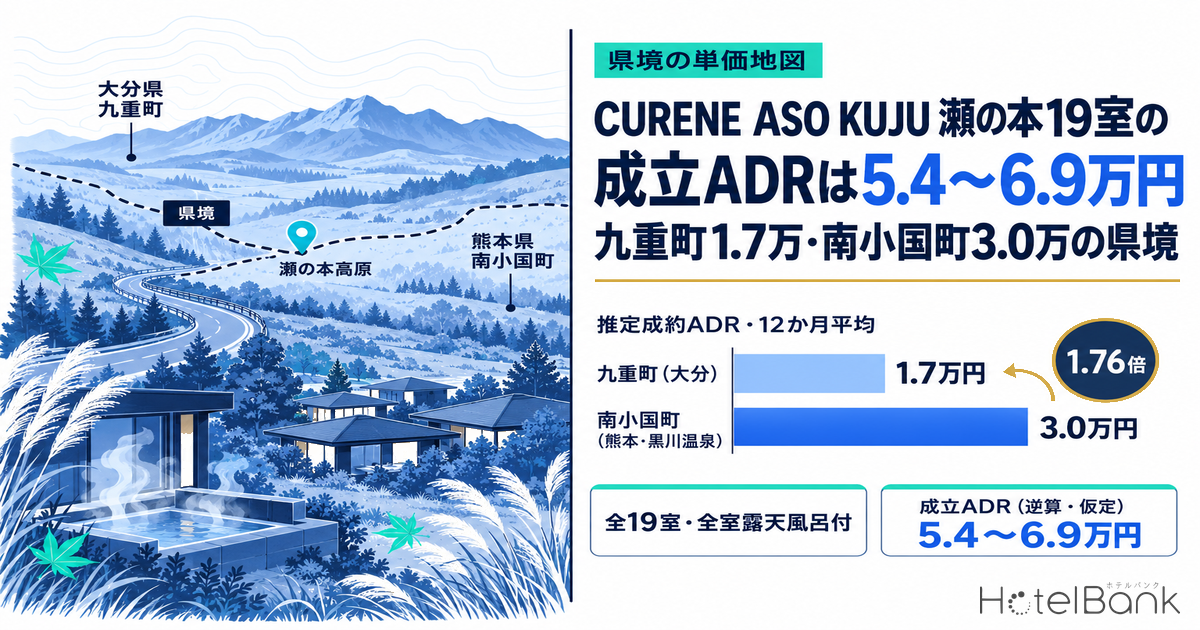
CURENE ASO KUJU (キュレネ 阿蘇 くじゅう), the first property under a new brand announced by Core Global Management Co., Ltd. (コアグローバルマネジメント) on September 17, 2026, is a 19-room inn with an open-air bath in every room, opening March 1, 2027 at 628-6 Yutsubo Senomoto, Kokonoe Town, Kusu District, Oita. It is an expansion-type project that adds seven new buildings and rebrands an existing property. Senomoto Kogen (瀬の本高原) sits on the prefectural border between Kokonoe Town (九重町), Oita and Minamioguni Town (南小国町, home of Kurokawa Onsen), Kumamoto. The 12-month average estimated settled ADR is ¥16,800 in Kokonoe (36–47 properties) and ¥29,600 in Minamioguni (42–47 properties) — a 1.76x gap over a distance of a few kilometers. This article overlays 24 months of rate trends in this border market, the size bands of properties within a 7.5km radius, 15,536 review tags and the latest booking pace, then back-solves, with every assumption stated, the price range at which a small 19-room, all-open-air-bath configuration works, and sets out on a factual basis the structure of the management-contract model that bundles small inns.
Metric Definitions Used in This Article
- ADR (average daily rate) = an estimated settled rate (tax-exclusive equivalent) calculated by applying a segment-specific adjustment factor to the lowest-plan level each property publishes on OTAs and similar channels (two guests per room, per-room rate, tax included). In a comparison with property-level actuals disclosed by listed hotel REITs (91 properties, latest three months), the median error is about 7%. These are estimates and differ from each property’s actual settled prices and accounting figures. Area-level ADR is the median of the properties covered (the level of a typical property in the area).
- OCC (occupancy) = rooms sold as a share of total rooms in the area (an estimate based on OTA sales inventory; consistency checks against monthly REIT disclosures confirm accuracy to within roughly a few points). In this article it is written as “occupancy (OTA-listed inventory basis, estimated)”; it is an estimate based on the sell-through of inventory sold on OTAs and differs from a property’s actual overall occupancy.
- LT (lead time) = days until the check-in date. Booking curves use only observation points from LT45 to LT1.
- Listed prices, where mentioned, are per-room rates for two guests sharing one room (tax included).
- Data source: MetroEngines Research & Consulting (property and room counts cover the roughly 27,000 properties with confirmed operations among those tracked by MetroEngines Research)
Key Points — Placing 19 Rooms on the “High Side” of a 1.76x Border Rate Gap
- The border rate gap / Estimated settled ADR in Kokonoe Town (Oita) and Minamioguni Town (Kumamoto, Kurokawa Onsen), on either side of Senomoto Kogen, averages ¥16,800 and ¥29,600 over 12 months. The gap is ¥12,800, or 1.76x, and the picture is the same for August 2026 alone (¥18,000 and ¥29,100).
- Price bands in the catchment / The median of the 49 properties within 7.5km for which a 12-month estimated settled ADR is available is ¥30,900. The band above ¥50,000 holds only 3 properties and 32 rooms; the new 19-room, all-open-air-bath property enters this thin band.
- What guests value / Across review tags from 78 properties and 15,536 reviews in the catchment, hot springs are mentioned in 18.8%, open-air baths 15.8%, private-use baths 12.4% and in-room open-air baths 8.4% (100% of mentions positive). Saunas are mentioned in 0.8%, so the “large open-air bath and sauna rooms” the new property promotes are a rare feature in the catchment.
- Depth of demand / Occupancy (OTA-listed inventory basis, estimated) for the night of Saturday, October 24, 2026 stood at 92.2% in Minamioguni Town at LT45 (45 properties / 587 rooms) and 69.7% in Kokonoe Town (32 properties / 376 rooms). The Kurokawa side is nearly full 45 days out, while the Kokonoe side adds about 20pt by LT24.
- The rate that works / Under the stated assumptions of ¥1.1–1.4 billion total investment, a 6% yield, 70% occupancy and a 25% GOP margin, the required ADR is ¥54,000–69,000. This overlaps with the estimated settled ADR the predecessor property achieved with 12 rooms between September 2025 and August 2026 (nine-month average ¥68,400).
The Facts in the Release and the History of the Address — From 12 Detached Villas to 19 Rooms
We start with only what the release says. On Thursday, September 17, 2026, Core Global Management Co., Ltd. (head office: Harumi, Chuo-ku, Tokyo; Representative Director: Masazumi Nakano) announced that it would launch a new hotel brand, CURENE (キュレネ), and reopen CURENE ASO KUJU as its first property under a rebrand on Monday, March 1, 2027. The address is 628-6 Yutsubo Senomoto, Kokonoe Town, Kusu District, Oita, and reservations opened on the day of the announcement. There are 19 rooms in total: 2 Japanese-modern twins with a large open-air bath and sauna, 2 Japanese-modern twins with an open-air bath and sauna, 3 Japanese-modern four-person rooms with an open-air bath, 4 Japanese-Western four-person rooms with an open-air bath, and 8 Western-style twins with an open-air bath. Seven guest-room buildings will be newly built; access is given as a 3-minute walk from the Sujiyu Onsen Iriguchi (筋湯温泉入口) bus stop and about 70 minutes by car from Aso Kumamoto Airport. The operator says it runs 36 properties in Japan. The brand name is a coinage combining “Curate” and “Elevate”, expressing the idea of selecting and elevating elements of the locale such as nature, hot springs, food, architecture and history.
The release, however, does not give the former property’s name or its existing room count. We therefore set out what can be confirmed from published materials and press reports, not from public registry information. At the same address, 628-6 Yutsubo Senomoto, Kokonoe Town, the hot-spring ryokan KAI Aso (界 阿蘇; 12 detached villas, each with an open-air bath), which opened in June 2006 and took its current name in October 2011, has been operating. Hoshino Resorts REIT (星野リゾート・リート投資法人, 3287) transferred the property to NBI Chiho Sosei Investment (株式会社NBI地方創生インベストメント) effective May 1, 2025 at a transfer price of ¥774 million (¥159 million above book value). The REIT explained the transfer as part of a portfolio reshuffle in which it sells properties with limited internal growth and acquires higher-yielding ones. Subsequently, the Nishinippon Shimbun (December 26, 2025), the Oita Godo Shimbun and TRAICY (December 30, 2025) reported that KAI Aso would close at the end of October 2026, that SMFL MIRAI Partners, a subsidiary of Sumitomo Mitsui Finance and Leasing, had acquired it, and that value-add works starting in December and an extension would bring it to 19 rooms. The reported “19 rooms after extension” matches the release’s “7 new buildings, 19 rooms in total”, but because the release itself does not identify the predecessor, this article treats that point as it stands and refers below to “the predecessor property at the same address”.
| Date | Fact | Source type |
|---|---|---|
| June 2006 | A hot-spring ryokan opens at the address (renamed KAI Aso in October 2011). 12 detached villas, each with an open-air bath | Press (TRAICY, Nishinippon Shimbun) |
| May 1, 2025 | Hoshino Resorts REIT transfers the property to NBI Chiho Sosei Investment. Transfer price ¥774 million, ¥159 million above book value. About ¥64.5 million per room on a 12-room basis | REIT disclosure, real-estate media |
| December 2025 | SMFL MIRAI Partners acquires the property; value-add works from December. To be extended to 19 rooms (press reports) | Press |
| September 17, 2026 | Core Global Management announces CURENE ASO KUJU. 19 rooms, 7 new buildings, opening March 1, 2027, reservations open | Press release (PR TIMES) |
| October 31, 2026 | Predecessor property closes (press reports) | Press |
What makes this project interesting as an “expansion-type rebrand” is that it keeps the existing asset of 12 detached villas and adds seven buildings to reach 19 rooms. In a ground-up development, land acquisition and the construction cost of every building go into the initial investment; in an expansion, the starting point for the investment is the price of an existing asset that has cleared in the market — here, the ¥774 million transfer price. With that in mind, we check on both sides of the border where rates sit in the market this location belongs to.
The Border Rate Map — Kokonoe ¥17,000, Minamioguni ¥30,000: 24 Months Across Four Municipalities
Senomoto Kogen lies where the Yamanami Highway crosses from Kokonoe Town, Oita into Minamioguni Town, Kumamoto, about 4km from the Kurokawa Onsen village, about 5km from Sujiyu Onsen and about 7km from Yutsubo Onsen. Lining up 24 months of municipality-level estimated settled ADR shows the levels clearly split on the two sides of the same highland. The 12-month average for September 2025–August 2026 is ¥29,600 in Minamioguni Town (42–47 properties) and ¥16,800 in Kokonoe Town (36–47 properties), a gap of ¥12,800 or 1.76x. Against the prior-year period (September 2024–August 2025), Minamioguni is up 6.7% and Kokonoe up 5.5%; both towns have risen and the gap has not narrowed. For August 2026 alone, Minamioguni is at ¥29,100 (N=46) and Kokonoe at ¥18,000 (N=44), up 3.7% and 4.6% YoY respectively.
The seasonal shape is also similar in the two towns. Minamioguni peaked at ¥32,200 in March 2026, fell to ¥25,100 in June and recovered to ¥29,100 in August. Kokonoe was high at ¥19,300 in December 2025 and low at ¥14,100 in June 2026. In other words, the gap between the two towns is not seasonal but a difference in level itself, and a property standing on the border highland chooses for itself which price band to reference when setting rates. Adding nearby Yufu City (¥23,700; N=131–142), Aso City (¥19,000; N=23–25) and Taketa City (¥8,800; N=20–21), Minamioguni stands alone at the top of the five municipalities and sits at roughly 2x to 2.8x the prefectural medians (Oita ¥14,900, N=436–470; Kumamoto ¥10,500, N=366–404).
| Municipality | Prefecture | 12-month average | Properties covered | August 2026 | YoY | 12-month average YoY |
|---|---|---|---|---|---|---|
| Minamioguni Town | Kumamoto | ¥29,565 | N=42–47 | ¥29,068 (N=46) | +3.7% | +6.7% |
| Yufu City | Oita | ¥23,692 | N=131–142 | ¥22,386 (N=142) | -6.5% | +0.8% |
| Aso City | Kumamoto | ¥18,994 | N=23–25 | ¥20,823 (N=24) | +8.6% | +13.1% |
| Kokonoe Town | Oita | ¥16,810 | N=36–47 | ¥18,030 (N=44) | +4.6% | +5.5% |
| Taketa City | Oita | ¥8,771 | N=20–21 | ¥9,704 (N=20) | -2.3% | -0.7% |
Aso City’s 12-month average is up 13.1% YoY, which likely also reflects the small number of properties around Mt. Aso (23–25), making the median prone to move; the rate level itself is close to Kokonoe Town’s. Yufu City is down 6.5% for August alone but up 0.8% over 12 months, and it is an area where how the final day of a long weekend fills tends to sway the monthly average. That a cross-border rate gap also moves with policy factors was confirmed in the case where the Kyushu travel subsidy narrowed the effective rate gap between Kurokawa Onsen and Yufuin to ¥665. What this article deals with is not a policy difference but the level gap the market sets in normal times.
The 7.5km Radius Around Senomoto — 82 Properties, 1,272 Rooms, Only 3 Properties Above ¥50,000
The center coordinates are 33.0698°N, 131.1865°E, obtained by geocoding “瀬の本高原” (Senomoto Kogen) with the Geospatial Information Authority of Japan (GSI) place-name search. The representative point of the Yutsubo hamlet (33.1283°N, 131.1893°E) is about 6.5km north of Senomoto; although the address also reads “Yutsubo”, it is a different location. Counting lodging properties within 7.5km that are operating and have a registered room count, across the ryokan, resort hotel, auberge, cottage, rental villa and pension categories, gives 82 properties and 1,272 rooms. Ryokan account for 69 properties and 1,050 rooms, 83% of the total, followed by 4 resort hotels with 62 rooms, 3 auberges with 40 rooms and 3 cottage properties with 110 rooms. By prefecture, the Kumamoto side has 49 properties (48 in Minamioguni Town, 1 in Oguni Town) and the Oita side 33 (28 in Kokonoe Town, 5 in Taketa City); the density of the Kurokawa Onsen village shows directly in the make-up of the catchment.
| Radius | Properties | Rooms | Size-band distribution (properties) | By prefecture |
|---|---|---|---|---|
| 3km | 12 | 144 | 1–5 rooms: 2 / 6–10 rooms: 4 / 11–20 rooms: 4 / 21–30 rooms: 1 / 31–50 rooms: 1 | Kumamoto 8, Oita 4 |
| 5km | 52 | 771 | 1–5 rooms: 4 / 6–10 rooms: 16 / 11–20 rooms: 24 / 21–30 rooms: 4 / 31–50 rooms: 1 / 51+ rooms: 3 | Kumamoto 36, Oita 16 |
| 7.5km | 82 | 1,272 | 1–5 rooms: 7 / 6–10 rooms: 27 / 11–20 rooms: 35 / 21–30 rooms: 6 / 31–50 rooms: 2 / 51+ rooms: 5 | Kumamoto 49, Oita 33 |
By size band, 35 of the 82 properties within 7.5km have 11–20 rooms and 27 have 6–10 rooms; together they make up 76% of the total. Only 13 properties have 21 rooms or more. At 19 rooms, the new property sits at the top end of the thickest band in the catchment, 11–20 rooms — a scale designed to compete on the same footing as the Kurokawa Onsen ryokan. Next, we place the 49 of these 82 properties for which an estimated settled ADR is available for the latest 12 months on two axes: room count and rate.
| Price band (estimated settled ADR) | Properties | Rooms | Characteristics |
|---|---|---|---|
| Under ¥15,000 | 6 | 160 | Mainly hotels and large ryokan on the Kuju Kogen side. Two properties exceed 30 rooms |
| ¥15,000–25,000 | 13 | 222 | Mid-sized ryokan in the Kurokawa Onsen village and ryokan in Sujiyu and Tanoharu |
| ¥25,000–35,000 | 18 | 337 | The thickest band. Long-established and detached-villa ryokan in Kurokawa, including one of around 55 rooms |
| ¥35,000–50,000 | 9 | 115 | Ryokan of 8–25 rooms with detached villas or rooms with open-air baths |
| ¥50,000–80,000 | 1 | 12 | The predecessor property at the same address (12 detached villas) |
| ¥80,000 and above | 2 | 20 | High-rate Kurokawa ryokan with all-detached rooms and private-use open-air baths |
The median of the 49 properties is ¥30,900, the first quartile ¥18,300 and the third quartile ¥34,600; limiting the sample to the 38 properties with 20 rooms or fewer leaves the median unchanged at ¥30,900. What stands out is how thin the band above ¥50,000 is. The ¥50,000–80,000 band holds one property with 12 rooms — the predecessor — and the ¥80,000-and-above band two properties with 20 rooms, so only 32 of the catchment’s 1,272 rooms are selling above ¥50,000. The 9 properties and 115 rooms at ¥35,000–50,000 represent the going rate for “detached-villa ryokan with open-air bath rooms”; if the new property fills 19 rooms above ¥50,000, it will itself be widening a band where supply in the catchment is thin. The fact that the predecessor’s 12 rooms have already been selling in this band can be read as a track record of the location supporting the rate.
Latest Booking Pace — Late October: Kurokawa Side at 92% by LT45, Kokonoe Side Adds 20pt
After rates, we check the depth of demand through the latest booking pace. For the nights of Saturday, October 24 and Sunday, November 1, 2026, in the autumn-foliage season for Kuju and Aso, we tracked the two towns’ booking curves (the trend in remaining OTA rooms) from LT45 to LT1. For the October 24 night, occupancy (OTA-listed inventory basis, estimated) in Minamioguni Town (45 properties / 587 rooms, based on listings on major booking sites) started from a nearly full position 45 days out — 92.2% at LT45 and 98.1% at LT24 — while Kokonoe Town (32 properties / 376 rooms) added about 20pt, from 69.7% at LT45 to 89.6% at LT24. The November 1 night has the same shape: Minamioguni 92.3% → 97.0% (at LT32) and Kokonoe 67.6% → 84.8% (at LT32). The Kurokawa side books up early and the Kokonoe side sees demand catch up in the final month — a time lag observable on the two sides of the border.
The same picture appears in property-level remaining rooms. Limiting the sample to properties whose OTA-published allotment is at least 30% of total rooms, for the October 24 night all 25 properties in the Minamioguni sample (out of 53 with inventory data) were observed at zero rooms remaining, and 12 of them had been sold out since at least 45 days before the stay date. In Kokonoe Town, 18 of the 30 properties in the sample (out of 54) were observed at zero remaining, 10 of them sold out since at least 45 days out. For the night of Saturday, October 31, zero remaining was observed at 23 of 26 properties in Minamioguni and 20 of 33 in Kokonoe. Zero remaining is an observation on OTAs that includes stop-sells and drip-fed inventory control and does not mean the whole property is full, but the depth of a market in which Kurokawa Onsen weekends fill a month and a half ahead is ample as the demand base a new 19-room property references.
| Stay date | Municipality | Sample | Observed at zero remaining | Of which sold out since 45+ days out |
|---|---|---|---|---|
| Oct 24 (Sat) | Minamioguni Town | 25 properties | 25 properties | 12 properties |
| Oct 24 (Sat) | Kokonoe Town | 30 properties | 18 properties | 10 properties |
| Oct 31 (Sat) | Minamioguni Town | 26 properties | 23 properties | 21 properties |
| Oct 31 (Sat) | Kokonoe Town | 33 properties | 20 properties | 12 properties |
What Review Tags Say About Why Inns Here Are Valued — Hot Springs 18.8%, In-Room Open-Air Baths 8.4%, Saunas 0.8%
To see what guests in this catchment value, we aggregated NLP-derived tags from 15,536 reviews over the latest 24 months (October 2024–September 2026) for the 78 ryokan, resorts and auberges within 7.5km that have at least 100 reviews. Mentions of meals overall are the most common at 44.5%, followed by hot springs at 18.8% (96% of mentions positive), open-air baths 15.8% (85%), private-use baths 12.4% (95%) and in-room open-air baths 8.4% (44 properties; 100% of mentions positive). On location, a quiet setting is mentioned in 6.0%, proximity to sightseeing spots in 5.0% and the surrounding nature in 4.9%, while mentions of station or bus convenience hardly appear. The premise of a highland inn reached by car shows directly in the structure of the reviews.
| Element | Mentions | Mention rate | Share positive | Properties with mentions |
|---|---|---|---|---|
| Hot springs | 2,923 | 18.8% | 96% | 72 |
| Open-air bath (shared) | 2,460 | 15.8% | 85% | 65 |
| Private-use bath | 1,928 | 12.4% | 95% | 55 |
| In-room open-air bath | 1,307 | 8.4% | 100% | 44 |
| Quiet setting | 934 | 6.0% | 92% | 52 |
| Spring quality | 749 | 4.8% | 99% | 48 |
| View from room | 668 | 4.3% | 95% | 36 |
| Free-flowing source spring (gensen kakenagashi) | 271 | 1.7% | 100% | 26 |
| Panoramic bath | 201 | 1.3% | 100% | 11 |
| Sauna | 130 | 0.8% | 92% | 7 |
Set against the new property’s room mix, two things can be read. First, in-room open-air baths are mentioned at 44 properties in the catchment with a 100% positive rate — already close to a “taken for granted” criterion. An all-open-air-bath design is not a differentiator in this catchment but a condition of entry, and what supports the rate is less the bath itself than the combination of views (view from room 4.3%, panoramic bath 1.3%), spring quality (4.8%) and quiet (6.0%). Second, saunas are mentioned in 130 reviews, or 0.8%, at only 7 properties. Four of the new property’s 19 rooms come “with sauna”, bringing in at room level an element whose supply in this catchment is extremely thin. A nationwide analysis that measured the premium for rooms with open-air baths through same-property comparisons at 792 inns found an average difference of about ¥10,000 per night (+23%), but because open-air baths are already standard in this catchment, the source of the premium is thought to have shifted to the next layer: saunas, views and the quiet of detached villas.
Location Fundamentals — A National Park, Land Prices and a Highland with 107 Residents
Senomoto Kogen lies within Aso-Kuju National Park, and construction and extensions are carried out under the permit standards of the Natural Parks Act. Because the expansion format of adding seven buildings extends an already-permitted use within the existing property’s site, the procedural outlook is easier to read than for a development involving new land acquisition. As for land prices, the 2026 average of the Prefectural Land Price Survey (benchmark land prices) for Kokonoe Town is ¥7,575/㎡ (down 0.81% YoY, 4 survey points) and the 2025 figure ¥7,657/㎡ (down 1.15%), while the average for Minamioguni Town is ¥9,666/㎡ (2025). Neither town has a standard site selected in the 2026 Official Land Price Announcement. These land price levels also show that what determines the investment in a highland inn is not the land but the buildings and equipment.
| 2020 | 107 |
| 2025 (projected) | 106 |
| 2040 (projected) | 102 (−4.7%) |
| Share aged 65+ (2025) | 29.9% |
| Benchmark land price, Kokonoe Town average (2026) | ¥7,575/㎡ |
| Benchmark land price, Minamioguni Town average (2025) | ¥9,666/㎡ |
With a resident population within 3km of 107 in 2020 and a projected 102 in 2040, this is a location where no source of lodging demand exists locally. Put differently, 100% of this inn’s demand is visitors, and its catchment is not the 3km radius but the leisure demand itself flowing in from the Fukuoka, Kumamoto and Oita urban areas and from Aso Kumamoto Airport and Oita Airport. This is consistent with the review tags in the previous section, where station and bus access were barely mentioned and quiet and nature were mentioned often. The small resident population is also the flip side of what guests value in a highland inn, such as quiet nights and starry skies.
Supply Trend — Room Stock Within 7km Has Been Nearly Flat Since 2019
To check whether supply in the catchment is growing, we look at the trend in room stock based on each property’s opening and closing years. Within 7km of Senomoto Kogen (all categories, including campsites and minshuku), 118 properties and 1,855 rooms at the end of 2012 became 150 properties and 2,141 rooms in 2026. That is +286 rooms, or +15.4%, over 14 years, but the stock has been nearly flat since 141 properties and 2,142 rooms in 2019, dipping once to 2,106 rooms in 2022 and edging up since. Note that this series applies each property’s current room count back to its opening year, so pre-extension room counts are not reflected. An expansion such as this project, where 12 rooms become 19, will appear in the series not as +7 rooms in 2027 but as an update to the existing property’s room count.
While supply has not grown since 2019, Minamioguni Town’s estimated settled ADR rose 6.7%, from ¥27,700 in September 2024–August 2025 to ¥29,600 in the latest 12 months, and Kokonoe Town’s rose 5.5%, from ¥15,900 to ¥16,800. Demand-side growth is showing up in rates in a market where the supply side has not followed. The new property’s 19 rooms equal 1.5% of the catchment’s 1,272 rooms (the 82 operating properties with registered room counts), and the 7 added rooms 0.6% — not a volume that moves the market’s overall supply-demand balance, but one that widens supply within the thin band above ¥50,000.
Back-Solving the Price Range That Works for 19 All-Open-Air-Bath Rooms — ¥54,000–69,000 Under Stated Assumptions
What follows is an estimate. We use no undisclosed figures and state every assumption. The starting point is the ¥774 million transfer price of May 2025, a price that cleared in the market and includes the land and the 12 existing buildings. For the seven new buildings, we assume a floor area of 25 tsubo each (about 83㎡, envisaging a detached villa including an open-air bath), 175 tsubo in total, multiplied by a rule-of-thumb ryokan construction cost of ¥2.0 million per tsubo (the 2025 national average in MLIT’s Building Starts Statistics is ¥1.952 million per tsubo for all structures, ¥2.405 million for steel and ¥1.382 million for wood), giving about ¥350 million. “Case A”, which excludes renovation of the existing buildings and the large open-air bath, sauna and common areas, comes to about ¥1,100 million, and “Case B”, which budgets ¥280 million for these, to about ¥1,400 million (the built-up figures are ¥1,124 million and ¥1,404 million; the estimate uses the values rounded to ¥1.1 billion and ¥1.4 billion. Calculated without rounding, the required ADR is ¥55,600 in Case A and ¥69,400 in Case B). Per room this is ¥58–74 million; compared with the ¥48 million per room obtained by dividing the Japan Finance Corporation loan ceiling for ryokan by 15 rooms, it is not far out of line for an all-open-air-bath highland inn.
We set the GOP yield required on this investment at 6%, the GOP margin at 25% (an assumed value set with a two-meal, 19-room, detached-villa operation in mind), and occupancy at 70%. The 70% occupancy is set as a full-year average and is more conservative than the foliage-season figures for the October 24, 2026 night — 92.2% in Minamioguni Town 45 days out and 89.6% in Kokonoe Town (at LT24). Required GOP is ¥66 million in Case A and ¥84 million in Case B, and required revenue ¥264 million and ¥336 million respectively; dividing by 19 rooms × 365 days × 70% occupancy = 4,855 room-nights gives a required ADR (tax-exclusive equivalent, including two-meal accommodation revenue) of ¥54,400 in Case A and ¥69,200 in Case B.
| Item | Case A | Case BBase | Basis for assumption |
|---|---|---|---|
| Existing asset (land + 12 buildings) | ¥774 million | ¥774 million | Transfer price, May 2025 (REIT disclosure) |
| Construction cost of 7 new buildings | ¥350 million | ¥350 million | 175 tsubo × ¥2.0 million/tsubo (with reference to ¥1.952 million for all structures in MLIT’s Building Starts Statistics, 2025) |
| Renovation of existing buildings, large open-air bath, sauna, common areas | — | ¥280 million | Assumption (no published figure) |
| Total investment (approx.) | ¥1,100 million | ¥1,400 million | ¥58 million / ¥74 million per room. The built-up figures (¥1,124 million / ¥1,404 million) are rounded to ¥1.1 billion and ¥1.4 billion for the estimate. Without rounding, the required ADR is ¥55,600 / ¥69,400 |
| Required GOP (6% yield) | ¥66 million | ¥84 million | Assumption |
| Required revenue (25% GOP margin) | ¥264 million | ¥336 million | Assumption (two-meal, detached-villa operation) |
| Room-nights sold (19 rooms × 365 days × 70%) | 4,855 | 4,855 | Full-year assumption, more conservative than estimated foliage-season occupancy |
| Required ADR (tax-exclusive equivalent) | ¥54,400 | ¥69,200 | Same band as the predecessor’s nine-month average estimated settled ADR of ¥68,400 |
| Assumptions | Case A (¥1.1bn) | Case B (¥1.4bn) |
|---|---|---|
| Base (6% yield, 70% full-year occupancy assumption, 25% GOP margin) | ¥54,400 | ¥69,200 |
| 5% yield | ¥45,300 | ¥57,700 |
| 7% yield | ¥63,400 | ¥80,700 |
| 60% occupancy (full-year assumption, 6% yield) | ¥63,400 | ¥80,700 |
| 80% occupancy (full-year assumption, 6% yield) | ¥47,600 | ¥60,600 |
| 30% GOP margin (6% yield, 70% full-year occupancy assumption) | ¥45,300 | ¥57,700 |
| 20% GOP margin (6% yield, 70% full-year occupancy assumption) | ¥68,000 | ¥86,500 |
| Occupancy \ GOP margin | 20% | 22.5% | 25% | 27.5% | 30% |
|---|---|---|---|---|---|
| 60% occupancy (full-year assumption) | ¥100,900 | ¥89,700 | ¥80,700 | ¥73,400 | ¥67,300 |
| 65% occupancy (full-year assumption) | ¥93,200 | ¥82,800 | ¥74,500 | ¥67,800 | ¥62,100 |
| 70% occupancy (full-year assumption) | ¥86,500 | ¥76,900 | ¥69,200 | ¥62,900 | ¥57,700 |
| 75% occupancy (full-year assumption) | ¥80,700 | ¥71,800 | ¥64,600 | ¥58,700 | ¥53,800 |
| 80% occupancy (full-year assumption) | ¥75,700 | ¥67,300 | ¥60,600 | ¥55,100 | ¥50,500 |
On two axes (occupancy is a full-year assumption throughout; estimate as of October 2026), the required ADR in Case B falls at or below the predecessor’s track record (¥68,400) in 12 of 25 combinations. At 70% occupancy the condition is a GOP margin of 27.5% or higher, and at 60% occupancy a GOP margin of 30%; with the GOP margin left at 20%, ¥75,700 is needed even at 80% occupancy (full-year assumption). The table also shows that raising occupancy by 10pt and raising the GOP margin by 5pt have nearly the same effect (against the base of ¥69,200: ¥60,600 at 80% occupancy (full-year assumption) and ¥57,700 at a 30% GOP margin).
As a result, the required ADR falls in a band of ¥54,000–69,000. That is 1.8–2.2x the ¥30,900 median of the 49 properties within 7.5km, one step above the 9 properties and 115 rooms in the ¥35,000–50,000 band. What matters here is the predecessor’s track record: the 12 detached villas at the same address achieved a nine-month average estimated settled ADR of ¥68,400 between September 2025 and August 2026 (¥63,400–73,600 by month; ¥130,400 as the all-plan average listed price). In other words, the back-solved price band is the same level this location has already supported with 12 rooms, and the question shifts from “can it open up a new rate band?” to “can the rate that worked with 12 rooms be held with 19?” As the room count rises 1.58x, the depth of demand observed on October 1, 2026 — 92% at LT45 in Minamioguni Town — together with sauna rooms (0.8% of mentions in the catchment) and a family- and group-oriented mix of Japanese-Western and Japanese-modern four-person rooms (7 rooms) provides room to absorb the additional room-nights.
A note on reading the sensitivities. In the estimate as of October 2026, if full-year occupancy stays at 60%, the required ADR in Case B rises to ¥80,700, putting the property on the same footing as the 2 properties and 20 rooms in the catchment’s ¥80,000-plus band. Conversely, at 80% occupancy ¥60,600 suffices, and if the GOP margin can be lifted to 30% the figure becomes ¥57,700. At a small inn, a few points of GOP margin are worth ¥10,000 of ADR, so operating efficiency directly lowers the rate level required. This leads to the management-contract model in the next section.
A Management-Contract Model That Bundles Small Inns — 36 Properties Across 6 Brands
Core Global Management Co., Ltd. was established in July 2007 (originally as Core Enterprise Co., Ltd.; current name since February 2013) and began operating hotels in March 2013. According to its corporate profile, it is headquartered in Harumi, Chuo-ku, Tokyo, with capital of ¥20 million, 495 employees on a non-consolidated basis and 1,163 group-wide, and revenue of ¥13,927 million non-consolidated and ¥24.5 billion group-wide (all as of March 31, 2025). Its businesses are hotel management contracts and consulting, facility management, room cleaning and weddings, and it acquired its first owned hotel in March 2024. The release says it operates 36 properties in Japan, and the property list on its official website (viewed October 1, 2026; includes planned openings) shows 20 Quintessa Hotel (クインテッサホテル) properties, 6 Hewitt Resort (ヒューイットリゾート), 1 Hewitt, 1 Regionia by Quintessa (リージョニア by クインテッサ), 2 Gensen Ichizu (源泉一途), 2 The Edistar Hotel (ザ エディスターホテル) and 4 others (Auberge Homachi Mikuniminato, Ryokusuitei Keisui, Kanata no Sato and CURENE ASO KUJU).
| Brand | Properties | Type / features |
|---|---|---|
| Quintessa Hotel | 20 | Urban hotels in Sapporo, Tokyo, Osaka, Fukuoka and elsewhere. The “Comic&Books” format with a manga library has been rolled out since 2021 |
| Hewitt Resort | 6 | Resorts. Hakodate Yunokawa, Nasu, Karuizawa, Naha (includes one opened July 2026 and one planned for January 2027) |
| Hewitt | 1 | Koshien |
| Regionia by Quintessa | 1 | Sapporo Ekimae (opened June 2026) |
| Gensen Ichizu | 2 | Hot-spring inns. Minamiizu and Shizukuishi, Iwate (opened June and July 2026) |
| The Edistar Hotel | 2 | Narita, Kyoto Nijo |
| Others (individual names) | 4 | Auberge Homachi Mikuniminato (オーベルジュほまち三國湊, Fukui), Ryokusuitei Keisui (緑翠亭 景水, Fukushima), Kanata no Sato (かなたのさと, Nagano), CURENE ASO KUJU (opening planned for March 2027) |
What the portfolio shows is an operator extending the operational base it built by bundling urban hotels sideways into hot-spring inns: Hana no Omotenashi Nanraku (花のおもてなし南楽; Minamiizu Town, Shizuoka; its 30th property in Japan when it took over operations) in August 2025, Gensen Ichizu, and now CURENE. In a management-contract model that separates ownership and operation, the owner (in this project, SMFL MIRAI Partners according to press reports) holds the asset and the operator handles reservations and sales, staffing, cleaning and revenue management. The ability to share across 36 properties the things that weigh as fixed costs when a 19-room inn is run on its own — managing sales channels, recruiting and training staff, negotiating procurement — is the answer to the structure seen in the previous section, where “a few points of GOP margin are worth ¥10,000 of ADR”.
From the viewpoint of small-ryokan owners and regional funds, this project divides into three parties: the former holder that sold the asset (the REIT), the new owner that acquires the asset and carries out value-add works, and the contract operator that brands and runs it. As in the case of a ryokan in Uji where a rebrand was started through a share-acquisition scheme, separating ownership, renovation and operation means no single company bears all the risk while a small inn’s rate band is lifted a notch — a structure that is now starting to appear in the Kyushu highlands as well.
Framing the Investment Decision — Issues for an Expansion That Goes After the High-Side Rate
Market position
A ¥12,800, 1.76x rate gap across the border. The new property references the high side (Minamioguni Town, ¥29,600) while entering the band above ¥50,000, where supply in the catchment is thin.
Depth of demand
Occupancy (OTA-listed inventory basis, estimated) for the October 24, 2026 night is 92.2% at LT45 in Minamioguni Town. The Kurokawa side fills a month and a half ahead, leaving room to absorb the 19-room increment.
Conditions for success
The required ADR of ¥54,000–69,000 is in the same band as the predecessor’s track record (¥68,400). Whether operations can secure 70% occupancy and a 25% GOP margin decides the outcome of the expansion.
From an investment standpoint, the upside of this project lies in three points. First, because it starts from an asset with a market price — the 12 existing buildings — the initial investment is easier to gauge than in a ground-up development. Second, placing 19 rooms in a band where the catchment has only 32 rooms above ¥50,000 means going after the price band with the lowest competitive density. Third, sauna rooms — an element with 0.8% of mentions in the catchment — and a group-oriented mix of seven four-person rooms offer headroom in both rate and room-nights sold. Points to watch are the construction schedule and permit process inside a national park, building weekday occupancy outside the foliage season, Golden Week and summer holidays, and whether the March 2027 opening coincides with the spring pick-up in demand. All are issues that can be addressed through the operator’s sales capability and the precision of the owner’s construction plan.
| Reader | Implications from this project |
|---|---|
| Small-ryokan owners | Rooms with open-air baths are a condition of entry in this catchment; the rate premium has shifted to the combination of saunas, views, quiet and four-person capacity. For a 10–20-room inn aiming above ¥50,000, an expansion that keeps existing buildings and adds new ones is an option that holds down initial investment |
| Contract operators | At a 19-room inn, 5pt of GOP margin is worth ¥10,000 of ADR. The scale of a management platform that can share sales, staffing and cleaning across multiple properties is itself the value proposition to owners |
| Regional funds | On a border highland, “which town’s rate you reference” determines the investment amount. The gap between Minamioguni Town’s ¥29,600 and Kokonoe Town’s ¥16,800 has not narrowed over 12 months, so choosing a location that captures the high side is a precondition for returns |
For inns: plan-naming hints for this theme
Common selling points in published plan names containing “open-air bath”, “sauna” or “detached villa” at ryokan in Oita (N=654) —
Detached villa / cottage 60%Hot-spring open-air bath 29%Two meals included 29%Kaiseki course 26%Wagyu / branded beef 14%Room with open-air bath 11%
Examples of actual names (anonymized):
- [5% OFF] [Big Sale] Private Sauna Lounge for a Day, “Totonoi” Experience / Oita Wagyu Premium Kaiseki
- [Golden Week, Obon & Special Dates] Dinner and Breakfast In-Room ◆ Stay in a Traditional Japanese Farmhouse-Style Detached Villa [Kaede Kaiseki]
* These are tendencies based on an aggregation of published plan names and do not show that naming causes sales. For a deeper look at market × naming, please see our naming benchmark and event articles.
⚠ Note on data for future dates: The occupancy (OTA-listed inventory basis, estimated) and remaining-room observations in this article for the nights of October 24, October 31 and November 1, 2026 are a snapshot based on sales inventory published on OTAs as of October 1, 2026, and will change as the check-in date approaches through added inventory and stop-sells or reopenings. Monthly ADR from September 2026 onward would be an estimate based on listed levels at the time of the survey and is therefore not included in this article’s aggregates.
Frequently Asked Questions
Q. Where is CURENE ASO KUJU (キュレネ 阿蘇 くじゅう) and when does it open?
A. The address is 628-6 Yutsubo Senomoto, Kokonoe Town, Kusu District, Oita, on Senomoto Kogen at the border with Minamioguni Town (Kurokawa Onsen), Kumamoto. It opens on Monday, March 1, 2027, and reservations opened on Thursday, September 17, 2026. It has 19 rooms, all with an open-air bath, four of them with a sauna (PR TIMES, September 17, 2026).
Q. Why do rates differ by as much as 1.76x between Kokonoe Town and Minamioguni Town?
A. Estimated settled ADR in this article (12-month average, September 2025–August 2026) is ¥29,600 in Minamioguni Town (N=42–47 properties) and ¥16,800 in Kokonoe Town (N=36–47 properties). Minamioguni is home to the cluster of detached-villa ryokan at Kurokawa Onsen, and 11 of the 12 properties within 7.5km with an estimated settled ADR above ¥35,000 are ryokan on the Minamioguni side (Kurokawa, Oda, Shirakawa and others). The Kokonoe side mixes hot-spring areas such as Sujiyu, Yutsubo and Hosenji with hotels on Kuju Kogen, and its higher share of properties with many rooms pulls the median down. The gap is one of level, not season, and has not narrowed: both towns are up more than 5% YoY.
Q. What ADR works for 19 all-open-air-bath rooms?
A. In this article’s estimate, under the assumptions of ¥1.1–1.4 billion total investment (the ¥774 million transfer price of May 2025 + ¥350 million to build seven new buildings + an assumed ¥280 million for renovation and common areas), a 6% GOP yield, 70% occupancy and a 25% GOP margin, the required ADR (tax-exclusive equivalent) is ¥54,400–69,200. This is in the same band as the ¥68,400 nine-month average estimated settled ADR achieved by the predecessor property at the same address (12 rooms) between September 2025 and August 2026. It is a simplified estimate in which the ADR changes if the assumptions change; actual investment decisions require a detailed feasibility study.
Q. What is an expansion-type rebrand, and how does it differ from new construction?
A. It is an approach that keeps existing guest-room buildings, adds new ones to increase the room count, and switches brand and operator at the same time. In this case, seven buildings are added to 12 detached villas to make 19 rooms, opening under the operator’s CURENE brand. Unlike new construction, the market price of the existing asset (here, ¥774 million) is the starting point for the investment, so the initial outlay is easier to gauge than in a development involving land acquisition and construction of every building; on the other hand, inside a national park the permit process under the Natural Parks Act and the precision of the renovation plan for existing buildings drive the schedule.
References and Sources
■ Data sources
- MetroEngines Research & Consulting — estimated settled ADR (municipality, prefecture and property level, September 2024–August 2026), booking curves and occupancy (OTA-listed inventory basis, estimated; observed October 1, 2026), remaining rooms by property (room basis), properties and rooms within each radius, room-stock trend (based on opening and closing years)
- HotelBank Editorial Team research (NLP analysis) — tag aggregation of 15,536 guest reviews from 78 properties within 7.5km (October 2024–September 2026)
- MLIT National Land Numerical Information (future population projections by 250m mesh, 2024 National Spatial Planning Bureau estimates) — resident population within 3km
- MLIT Prefectural Land Price Survey (Tochidai Data: Kokonoe Town / Minamioguni Town aggregates)
- MLIT Building Starts Statistics — 2025 construction cost by structure (all structures ¥1.952 million/tsubo, steel ¥2.405 million, wood ¥1.382 million)
- GSI place-name search service — center coordinates of Senomoto Kogen and Yutsubo
■ Estimate assumptions
- Total investment: existing asset ¥774 million (May 2025 transfer price) + 7 new buildings ¥350 million (175 tsubo × ¥2.0 million/tsubo) + renovation and common areas ¥280 million (Case B only, assumed)
- GOP yield 6% (sensitivity 5–7%), GOP margin 25% (sensitivity 20–30%; estimate as of October 2026. Source for tendencies by property type: Relo Hotel Solutions), occupancy 70% (full-year assumption, sensitivity 60–80%; estimate as of October 2026), 19 rooms × 365 days
- Required ADR is a tax-exclusive equivalent, calculated as revenue per room including two-meal accommodation revenue
■ Limitations and caveats
- Estimated settled ADR is a model estimate (median error of about 7% against REIT-disclosed actuals) and differs from each property’s actual settled prices. REIT-disclosed ADR is shown excluding consumption tax, and the estimated settled ADR in this article is likewise at a tax-exclusive equivalent level
- Occupancy (OTA-listed inventory basis, estimated) is an estimate based on the sell-through of inventory sold on OTAs and differs from a property’s actual overall occupancy. Zero rooms remaining at a property includes stop-sells and drip-fed inventory control and does not mean it is full
- The room-stock trend applies current room counts to past years, so pre-extension room counts are not reflected. Property counts within each radius cover those with confirmed operations among properties tracked by MetroEngines Research; properties not listed on OTAs are not included
- The release does not identify the predecessor property; the identification here rests on press reports (Nishinippon Shimbun, Oita Godo Shimbun, TRAICY) and the matching address in REIT disclosures
■ Press releases and corporate information
- New hotel brand “CURENE ASO KUJU (キュレネ 阿蘇 くじゅう)” to reopen under a rebrand with new buildings featuring a large open-air bath and saunas (PR TIMES, Core Global Management Co., Ltd., September 17, 2026)
- Core Global Management Co., Ltd., “Corporate Information / History” / Core Global Management Co., Ltd., “Property List”
- Quintessa Hotel Fukuoka Watanabe-dori Comic&Books rebrand opening (PR TIMES, 2025)
■ REIT disclosures and press reports
- Hoshino Resorts REIT (星野リゾート・リート投資法人), portfolio list / JAPAN-REIT.COM, “Hoshino Resorts REIT reshuffles properties and revises earnings forecast” (2025)
- NBI Holdings Co., Ltd., “Notice of acquisition of Hoshino Resorts KAI Aso” (April 18, 2025)
- TRAICY, “Hoshino Resorts to close KAI Aso at the end of October 2026” (December 30, 2025)
- Nishinippon Shimbun, “[Exclusive] Hoshino Resorts’ luxury ryokan KAI Aso to close in October 2026 — Kokonoe Town, Oita” (December 26, 2025)
- Oita Godo Shimbun, “KAI Aso in Kokonoe Town to close in October 2026” (December 26, 2025)
- Ministry of the Environment, Aso-Kuju National Park