

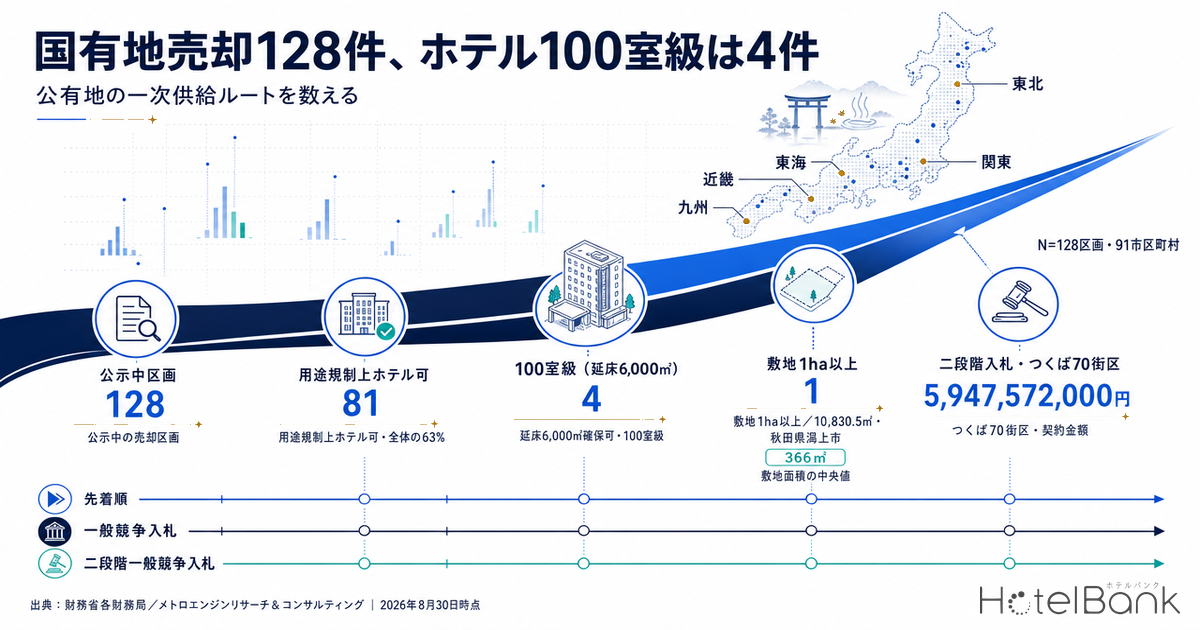
Publicly owned land comes to market in a steady trickle every year as a primary supply route for hotel sites. But the framework for “lease it and build” is a different animal from the framework for “buy it and build.” This article covers the latter — the disposal route under which freehold title passes to the private sector — the sale of national and local government land under the National Property Act and the Local Autonomy Act, and the two-stage open competitive tender that fixes development conditions up front. We count, one by one, every parcel currently advertised for sale, and quantify how many of them can actually take a hotel.
Every public-sector article we have published so far dealt with frameworks on the “lease the land, operate the facility” side: Park-PFI (installation and management permits under the Urban Parks Act), the Fishing Port Facility Utilization Program (leases of up to 30 years under the Fishing Port and Ground Improvement Act), and fixed-term business leaseholds on privately owned land. In every case the deliverable is a time-limited right of use. This article deals with freehold title itself, and both the governing statutes (the National Property Act, Article 238-5 of the Local Autonomy Act and other property-disposal provisions) and the exit design are different.
Metric Definitions Used in This Article
- ADR (Average Daily Rate): An estimated transacted rate (tax-exclusive equivalent) calculated by applying a segment-specific adjustment factor to the lowest advertised plan level each property publishes on OTAs and elsewhere (per-room rate for 2 guests per room, tax included). Cross-checked against property-level results disclosed by listed hotel REITs (91 properties, most recent 3 months), the median error is approximately 7%. These are estimates and differ from each property’s actual transacted prices and accounting figures. Area-level ADR is the median of the properties covered (the level of a typical property in that area).
- Gross floor area (GFA) capacity: An approximation original to this article: site area x designated floor area ratio. Setback (diagonal-line) restrictions, shadow regulations, building coverage ratios, district plans and the like are not taken into account, so it should be read as an upper bound on the floor area that could be built. For Category I Residential Districts, Appendix Table 2 of the Building Standards Act caps total lodging-facility floor area at 3,000 sqm, and that cap has been applied.
- Converting floor area to room count: GFA of 6,000-10,000 sqm is used as the rule of thumb for a 100-room-class hotel (60-100 sqm of GFA per room including common areas). Actual requirements vary with the segment, guest room size and common-area configuration.
- Data sources: MetroEngines Research & Consulting / Ministry of Finance regional Local Finance Bureaus, “National Property Sale Information” / MLIT Real Estate Information Library
- — Parcels currently advertised for sale total 128 parcels across 91 municipalities. The median site area is 366.3 sqm; only 4 can accommodate 6,000 sqm of GFA (the 100-room class), and none reach 10,000 sqm.
- — Use zoning permits a hotel on 81 parcels (63%). In practice the primary supply skews to “50 rooms or fewer”; anything above 100 rooms runs mainly through the two-stage open competitive tender or a municipality’s conditional public sale.
- — Of the 78 parcels whose figures we could read off the Kanto Local Finance Bureau’s opening results, 53 drew zero bidders and failed. Failed parcels roll into the first-come, first-served list, where they can be bought at the asking price with no competition.
- — At Tsukuba Block 70, 53,866.83 sqm of state-owned land contracted at ¥5,947,572,000. Only one party submitted a development proposal — for an operator able to prepare one, the competitive environment is if anything benign.
- — On the 6,495 sqm-GFA parcel in Nasushiobara (asking price ¥22 million), our modeling puts land cost at 0.3-0.9% of annual rooms revenue. Cheap land is not a reason to enter.
Only Three Routes to a Sale — the Private Sector Gets Its Turn After a Three-Month Request Window
The disposal procedure for unused state-owned land is clearly defined. Per the guidance issued by the Ministry of Finance’s regional Local Finance Bureaus, there is first a three-month window in which local governments and similar bodies may request acquisition, and “if no acquisition request is received during the window, the property will be sold by open competitive tender.” Priority for public and quasi-public use is built into the system, and a private operator only reaches state-owned land after local government has passed on it during those three months. Put the other way round: by the time a parcel appears in the public notice, the municipality has already decided it does not want it.
There are three routes by which the private sector can buy.
| Method | How the procedure works | What it means in practice |
|---|---|---|
| Open competitive tender (period tender) | Public notice, bid submission window, single opening, then award to the highest bid at or above the reserve price. In the Kanto Local Finance Bureau’s case, several months elapse between notice and opening. | Decided on price alone. The proposal is not assessed. |
| Two-stage open competitive tender | Development conditions are set in advance and bidders submit a land-use proposal. A national review committee assesses conformity with those conditions, and only those who pass the review compete on price to determine the winner. | Planning capability becomes the entry ticket. On the sale side, generally applies to sites of 1 ha or more. |
| First-come, first-served (immediately purchasable properties) | Parcels that failed to sell at tender are offered at a stated asking price and sold in order of application. An application window is set. | Can be acquired at the asking price with no competition. |
The two-stage open competitive tender rests on the Ministry of Finance circular “Handling of Open Competitive Tenders Conducted After Review of Proposals Concerning the Use of State-Owned Land” (June 26, 2008, Zairi No. 2730). The circular states its purpose as “reflecting private-sector planning capability and expertise in concrete land use, thereby realizing effects such as enhanced asset value and revitalization of the local economy,” and provides that development conditions are set in light of administrative plans, coordination with local government, and local consensus-building. The review committee includes experts in business and real estate and in urban planning and architecture, together with local government representatives. The sequence — review the proposal first, then compete on price is the essence of this method.
Local governments think the same way. MLIT materials note that while the principle for selling publicly owned land is to maximize price through open competitive tender, for land requiring “utilization from a town-planning perspective” or “use serving public welfare through public-private partnership for policy purposes,” authorities adopt conditional sales or methods that select the buyer by reviewing land-use plans. Land released with development conditions attached leaves room for operators who cannot win on price alone — and that is the starting point for viewing public land sales as a primary supply route for site acquisition.
All 128 Advertised Parcels Counted — Median 366 sqm, Not a Size That Takes a Hotel
We counted every parcel of land offered for sale on the National Property Sale Information site run by the Ministry of Finance’s regional Local Finance Bureaus, as of August 30, 2026. The set covers 128 parcels across 91 municipalities. The listings come from five bureaus — Tohoku, Kanto, Tokai, Kinki and Kyushu — split by method into 98 first-come, first-served and 30 tender. The Hokkaido, Hokuriku, Chugoku and Shikoku bureaus do not list land for sale on that site, so our population is not the complete national stock of unused state-owned land. Every figure below should be read as an aggregate “within the scope of what that site publishes.”
The first thing to grasp is size. The median site area is 366.3 sqm and the mean is 832.4 sqm. Parcels under 1,000 sqm number 101, or 79% of the total. The mainstream of state land disposal is subdivided former-housing lots and farm or miscellaneous land — one or two residential lots in size, not big enough to take a hotel building.
Next, use zoning. Under Appendix Table 2 of the Building Standards Act, hotels and ryokan may be built only in Category I Residential (floor area up to 3,000 sqm), Category II Residential, Quasi-Residential, Neighborhood Commercial, Commercial and Quasi-Industrial districts; they are prohibited in Exclusively Low-Rise Residential, Exclusively Mid/High-Rise Residential, Industrial and Exclusively Industrial districts. Of the 128 parcels, 42 sit in use districts where a hotel can be built, while 48 are in areas with no use district designated (so-called unzoned land), of which 9 are in urbanization control areas and therefore cannot in principle be built on. The remaining 39 unzoned parcels carry no use restriction and can be built on. In total, 81 parcels — 63% of the set — permit a hotel under use zoning. Conversely, the 38 parcels in exclusively low-rise/mid-to-high-rise residential and industrial districts drop out at this stage.
Only 4 Parcels Can Take a 100-Room Hotel — Primary Site Supply Skews to “50 Rooms or Fewer”
Now combine use and size. For each parcel we calculated GFA capacity as site area x designated floor area ratio, applying the 3,000 sqm lodging-facility cap in Category I Residential Districts. The result is unambiguous.
GFA of 6,000 sqm or more (100-room class)
4 of 128. Shinjo, Yamagata (Commercial District); Nasushiobara, Tochigi (Quasi-Industrial); Kagoshima City, Kagoshima (Category II Residential); Kimotsuki, Kagoshima (unzoned).
GFA of 3,000 sqm or more (50-room class)
9 of 128. In addition to the above, parcels in Yaita, Kesennuma, Hayama, Ina and Kimotsuki qualify.
GFA of 10,000 sqm or more (150-room class)
0. No parcel in the current advertised inventory can host a large hotel on its own.
In other words, the state land sale inventory offers ample supply for small and mid-sized lodging facilities of 50 rooms or fewer, while 100-room-class parcels run to only a handful a year nationwide. With primary supply of vacant land this thin, conversion of existing buildings often becomes the alternative route, and the conditions under which that pencils out are examined in Department Store Sites: 6 of 14 Go Hotel. For a development officer looking for a new business-hotel site in regional Japan this is a realistic option, but for a developer chasing more than 100 rooms in a major city, the period-tender inventory is not the main battleground. To reach the 100-room class you wait for the two-stage open competitive tender discussed below, or for a municipality’s conditional public sale.
| Location | Use district | Site area | FAR | GFA capacity | Asking price | Unit price | Method |
|---|---|---|---|---|---|---|---|
| Kimotsuki, Kagoshima | None designated (non-demarcated) | 2,483.2 sqm | 400% | 9,933 sqm | ¥11,714,000 | ¥4,717/sqm | Tender |
| Numatacho, Shinjo, Yamagata | Commercial District | 2,344.8 sqm | 400% | 9,379 sqm | ¥14,800,000 | ¥6,312/sqm | First-come |
| Shimoatsuzaki, Nasushiobara, Tochigi | Quasi-Industrial District | 3,247.4 sqm | 200% | 6,495 sqm | ¥22,000,000 | ¥6,775/sqm | First-come |
| Kamoikeshinmachi, Kagoshima City, Kagoshima | Category II Residential District | 3,214.4 sqm | 200% | 6,429 sqm | ¥428,000,000 | ¥133,150/sqm | Tender |
| Kimotsuki, Kagoshima | None designated (non-demarcated) | 1,184.4 sqm | 400% | 4,737 sqm | ¥2,730,000 | ¥2,305/sqm | Tender |
| Yaita, Tochigi | None designated (non-demarcated) | 1,630.1 sqm | 200% | 3,260 sqm | ¥6,680,000 | ¥4,098/sqm | First-come |
| Kesennuma, Miyagi | None designated (non-demarcated) | 1,553.7 sqm | 200% | 3,107 sqm | ¥7,460,000 | ¥4,801/sqm | First-come |
| Isshiki, Hayama, Kanagawa | Category I Residential District | 3,225.2 sqm | 200% | 3,000 sqm (cap) | ¥763,000,000 | ¥236,575/sqm | First-come |
| Misono, Ina, Nagano | Category I Residential District | 2,298.0 sqm | 200% | 3,000 sqm (cap) | ¥30,900,000 | ¥13,446/sqm | First-come |
The two parcels in Hayama and Ina exceed 3,000 sqm as sites, yet because they sit in Category I Residential Districts the lodging floor area is capped at 3,000 sqm. This is the textbook case of shortlisting on site size alone and then losing half the room count to use zoning. Conversely, Kimotsuki and Shinjo carry a 400% FAR, so sites of 2,300-2,500 sqm yield more than 9,000 sqm of GFA. In site search it is faster to screen on the three-part test of “site area x FAR x use zoning” than on site area alone. The land price a hotel can afford to bid when the same parcel is contested by condominium use is worked back in Hotel vs Condo Land Rivalry: ADR-Implied Feasible Land Price Map.
Failed Parcels Roll Into First-Come, First-Served — Buyable at the Asking Price With No Competition
The Local Finance Bureaus publish period-tender results in table form. Aggregating the 78 parcels whose figures we could read off the two most recent sale-result tables released by the Kanto Local Finance Bureau — FY2025 Round 2 (opened January 27, 2026, 54 parcels) and FY2026 Round 1 (opened July 22, 2026, 55 parcels) — gives 25 awards against 53 failures. What is more, all 53 failures drew zero bidders; within the range we could read, there was no parcel that attracted bids but fell short of the reserve price. Among awarded parcels the median bidder count was 2 and the maximum 15. This market, in other words, splits into two poles: “nobody bids” or “several compete.”
This is where the practical leverage sits. A parcel that fails with zero bidders subsequently moves to the “first-come, first-served (immediately purchasable)” list, where it can be bought at the asking price in order of application. That 98 of the 128 parcels we counted are first-come, and that 5 of the nine 3,000 sqm-plus GFA parcels above are first-come, can be read as the output of this cycle. Here are cases we were able to match directly.
| Parcel | Area | Bidders | Result at the January 27, 2026 opening | Current status |
|---|---|---|---|---|
| Isshiki, Hayama, Miura District, Kanagawa (property no. 0011) | 3,225.19 sqm | 0 | Failed | First-come / ¥763,000,000 |
| Misono, Ina, Nagano (property no. 0049) | 2,298.01 sqm | 0 | Failed | First-come / ¥30,900,000 |
| Shimoatsuzaki, Nasushiobara, Tochigi (property no. 0036) | 3,247.42 sqm | — | — | First-come / ¥22,000,000 |
| Yunodai, Chuo-ku, Sagamihara, Kanagawa (property no. 0009) | 9,363.61 sqm | 5 | Awarded | Contracted at ¥1,258,000,000 (February 20, 2026) |
The 9,363.61 sqm parcel at Yunodai drew five bidders and contracted at ¥1.258 billion, while in the same round not a single bidder came forward for the 3,225.19 sqm parcel at Isshiki, Hayama. Size does not summon competition. From the perspective of an operator who already has a business plan, picking up a parcel that failed with zero bidders on a first-come basis is more predictable than trading prices on opening day. In site-search practice, rather than merely following the tender notice list, tracking the parcels marked “zero bidders, failed” in the opening-result tables and waiting for them to switch to first-come may well deliver a better hit rate.
Two-Stage Open Competitive Tender — the Separate Route for 1 ha-Plus Sites, and the Hard Numbers From Tsukuba Block 70
If you want to take a 100-room-class site out of state-owned land, the method changes. Under the Ministry of Finance circular cited above, the two-stage open competitive tender applies on the sale side to “land of generally 1 ha or more located in the center of a major city or in a place where effective utilization is expected.” Of the 128 advertised parcels we counted, only one is 1 ha or larger (Katagami, Akita, 10,830.45 sqm, outside the city planning area), and land of that scale almost never appears in the ordinary period-tender inventory. Two-stage tenders are few in number, but when one appears the scale is an order of magnitude larger.
The most recent live example is 1 Azuma 2-chome and two other lots in Tsukuba, Ibaraki — known as Block 70. The figures below are taken directly from the tender result table published by the Kanto Local Finance Bureau.
| Item | Detail |
|---|---|
| Location | 1 Azuma 2-chome and two other lots, Tsukuba, Ibaraki (about 300 m from Tsukuba Station) |
| Area | State-owned land 53,866.83 sqm (39,491.11 + 6,416.25 + 7,959.47 sqm) plus Tsukuba City land 2,886.86 sqm |
| City planning / use | Urbanization promotion area / Category II Residential District / 60% building coverage, 200% FAR |
| Schedule | Notice July 22, 2025; proposal submission deadline February 2, 2026; opening May 22, 2026 |
| Stage one | One party submitted a proposal; one passed the review (average score withheld because fewer than three parties passed) |
| Stage two | Awarded. Contract date June 19, 2026; contract value ¥5,947,572,000 (about ¥110,400/sqm) |
| Counterparty | Daiwa House Industry Co., Ltd. |
| Value-depressing factors in pricing | Building demolition cost; buried objects (15,051 trees and bamboo, structures in bulk) |
| Outline of the winning proposal | (Tentative name) Super City Implementation Center; retail and convenience facilities 10,840 sqm, condominiums for sale 20,992 sqm, rental apartments 14,768 sqm, detached housing 5,538 sqm. Completion scheduled for June 2033 |
Three points stand out. First, the two-stage tender publishes the winner’s name, the contract value and the proposal outline in hard figures. The period-tender tables also carry contract values, so public land sales are far more transparent on price than private-to-private transactions. Second, only one party submitted a proposal. Given the scale — 5.4 ha and roughly ¥6 billion — and the front-end burden of building out a proposal document, there are deals where no real competitor materializes. Third, this particular proposal contains no lodging component. The two-stage tender solicits proposals aligned with the stated development conditions, so if a lodging function is not among them, no hotel will appear. If you are targeting a two-stage tender for a hotel site, moving after the notice is published is already too late; you need to be involved upstream, while the development conditions are still being set — at the stage of the regional council’s recommendation or the municipality’s town-planning policy. At Tsukuba Block 70 too, the determination that a two-stage tender was appropriate came with the National Property Regional Council recommendation in March 2024, and the notice followed one year and four months later.
Asking Prices Run 0.2-1.0x Published Land Prices — the More Urban the Site, the Closer to Market
To see where public sale prices sit relative to market levels, we matched them against the Published Land Prices and Prefectural Land Price Survey (2025) in MLIT’s Real Estate Information Library. For the five of the 3,000 sqm-plus GFA parcels above that have a standard site nearby, we set the asking price per sqm alongside the unit price of the nearest standard site.
| Sale parcel | Asking unit price | Nearest standard site (use category / distance) | Standard site unit price | Ratio |
|---|---|---|---|---|
| Isshiki, Hayama, Kanagawa | ¥236,600/sqm | Isshiki, aza Manase (residential / approx. 250 m) | ¥225,000/sqm | 1.05x |
| Kamoikeshinmachi, Kagoshima City, Kagoshima | ¥133,100/sqm | Masagocho (commercial / approx. 420 m) | ¥162,000/sqm | 0.82x |
| Misono, Ina, Nagano | ¥13,400/sqm | Nishimachi (commercial / approx. 450 m) | ¥25,800/sqm | 0.52x |
| Shimoatsuzaki, Nasushiobara, Tochigi | ¥6,800/sqm | Kamiatsuzaki, aza Ichinosawamichi (residential / approx. 1,100 m) | ¥16,300/sqm | 0.42x |
| Numatacho, Shinjo, Yamagata | ¥6,300/sqm | Odajimacho (commercial / approx. 750 m) | ¥28,800/sqm | 0.22x |
What must not be misread here is that a low ratio does not mean cheap. A standard site under the Published Land Prices is the unit price of vacant land deemed typical for the area, and it does not reflect property-specific factors such as shape, road frontage, buried objects, slope, or water and sewer connections. The asking price at a public sale, by contrast, is appraised parcel by parcel, and as the Tsukuba Block 70 table makes explicit with “building demolition cost” and “buried objects,” property-specific negatives are priced in. The further a parcel sits from a standard site, and the thinner the density of standard sites in regional areas, the more the ratio becomes a composite of property-specific factors and locational difference — and the less a simple comparison means.
The trend is still readable. The more urban the location and the stronger the residential demand, the closer the asking unit price sits to the standard site (Hayama 1.05x, Kagoshima 0.82x); in regional areas the gap widens (Shinjo 0.22x). A separate MetroEngines Research & Consulting analysis, Published Land Prices 2026 and Hotel Development Feasibility, works back the ceiling land price at which hotel development pencils out across nine areas. On winning prices: period tenders publish the contract value, and two-stage tenders likewise disclose hard figures. The reserve price itself is not published, so this article does not calculate “what percentage of the reserve price the award represented.”
Municipalities Present “Buy or Lease” Side by Side — How Iiyama Designed Its Terms
In municipal sales of publicly owned land, deals designed specifically to attract a lodging facility have actually closed. The “Iiyama Station Front City Land Lodging Facility Development Promotion Project,” put out to public solicitation by Iiyama, Nagano in April 2021, published both the conditions and the price, and is worth reading as a blueprint for the route.
The site
Three lots totaling 2,677 sqm in front of Iiyama Station (2,532 sqm of which are saleable). Neighborhood Commercial District / 80% building coverage, 200% FAR. Directly in front of Iiyama Station on the Hokuriku Shinkansen, about 100 minutes from Tokyo Station.
If you buy
Municipal property sale contract. Planned sale price ¥83,000,000 (¥32,800/sqm on 2,532 sqm)。
If you lease
Fixed-term business leasehold agreement, term of 20 years or more but under 50 years. Annual rent ¥3,642,810 (for 2,532 sqm, reviewed every three years).
Because the sale price and the ground rent are stated side by side for the same land, the ground rent divided by the sale price gives a yield of 4.4% that can be read off directly. The design lets an operator compare owning against leasing on identical terms. The business conditions are explicit — “50 rooms or more,” “open within three years of contract,” “continue operating for at least 20 years after opening” — and the city states expressly that it will not impose conditions on room size, price band or whether meals are served. Only scale and duration are locked down; product design is left to the operator — terms designed to favor operators with planning capability.
The procedure is a public proposal solicitation under Article 167-2, Paragraph 1, Item 2 of the Order for Enforcement of the Local Autonomy Act, in which a review committee selects the best proposal and identifies the counterparty (the designated operator) for a negotiated contract. According to the city’s disclosures, in August 2021 a group of Iiyama Chamber of Commerce and Industry members (represented by Fujimaki Construction Co., Ltd.) was selected as preferred negotiating party, and a basic agreement was concluded with Iiyama Hotel Co., Ltd. on October 20 of the same year. The published framework was to conclude the fixed-term business leasehold agreement by March 31, 2022, open within three years of contract, and continue for at least 20 years. That land offered as “available for sale or lease” ultimately settled on a fixed-term leasehold is itself instructive as a case where flexible terms worked in favor of the operator’s funding plan.
Sites Are Available but Room Stock Is Thin — Shinjo, Yuzawa, Tatebayashi and Ina
Finally, we match the site-side information against the lodging-market side. For the municipalities holding a parcel able to accommodate 1,500 sqm or more of GFA, we set MetroEngines Research’s estimated transacted ADR (July 2026) alongside the total room count of the lodging facilities the firm tracks.
| Municipality | Max GFA capacity | Use district | Est. transacted ADR | Properties in ADR calculation | Tracked rooms | Sale method |
|---|---|---|---|---|---|---|
| Shinjo, Yamagata | 9,379 sqm | Commercial | ¥5,960 | N=5 | 689 rooms | First-come |
| Nasushiobara, Tochigi | 6,495 sqm | Quasi-Industrial | ¥12,500 | N=69 | 4,443 rooms | First-come |
| Hayama, Kanagawa | 3,000 sqm (cap) | Cat. I Residential | ¥11,200 | N=2 | 448 rooms | First-come |
| Kagoshima City, Kagoshima | 6,429 sqm | Cat. II Residential | ¥6,380 | N=73 | 11,488 rooms | Tender |
| Ina, Nagano | 3,000 sqm (cap) | Cat. I Residential | ¥6,150 | N=14 | 1,221 rooms | First-come |
| Yuzawa, Akita | 2,124 sqm | Neighborhood Commercial | ¥11,200 | N=10 | 539 rooms | First-come |
| Tatebayashi, Gunma | 1,966 sqm | Cat. I Residential | ¥5,850 | N=6 | 497 rooms | First-come |
| Oita City, Oita | 1,723 sqm | Cat. I Residential | ¥6,440 | N=42 | 7,221 rooms | Tender |
| Izumi, Kagoshima | 1,552 sqm | Cat. I Residential | ¥5,430 | N=11 | 760 rooms | Tender |
| Kushima, Miyazaki | 1,463 sqm | Cat. I Residential | ¥7,570 | N=4 | 225 rooms | Tender |
This table can be read two ways. The first is as “markets where land is on offer but room stock is thin”. Shinjo, Yamagata has a Commercial District parcel able to take 9,379 sqm of GFA on offer at ¥14.8 million on a first-come basis, yet tracked rooms number 689 and the ADR calculation rests on just N=5 properties. Yuzawa, Akita (539 rooms, N=10), Tatebayashi, Gunma (497 rooms, N=6) and Kushima, Miyazaki (225 rooms, N=4) are similarly thin. Thin stock means either a large gap in the existing supply structure or simply a small demand base, so you cannot judge on cheap land alone; verifying the demand side is essential. Note too that in markets with single-digit sample sizes the precision of the ADR estimate itself degrades.
The second reading is as “markets where the ADR level is relatively high”. Nasushiobara stands out in this table with ADR of ¥12,500 on N=69 — thick on both demand and supply. Its 3,247.4 sqm Quasi-Industrial parcel (6,495 sqm of GFA) on offer at ¥22 million, combined with a land unit price of ¥6,800/sqm, is a combination worth working up. Yuzawa also sits high at ¥11,200, but that is a single annual cross-section that includes the seasonality of onsen and ski demand, and should be judged only after checking the monthly swing.
On methodology and population: The sale parcel data in this article aggregates land offered for sale and published as National Property Sale Information by the Ministry of Finance’s regional Local Finance Bureaus as of August 30, 2026 — N=128 parcels across 91 municipalities. The listings come from five bureaus (Tohoku, Kanto, Tokai, Kinki and Kyushu) and are not the complete national stock of unused state-owned land. GFA capacity is an approximate upper bound from site area x designated floor area ratio and does not account for setback restrictions, shadow regulations, district plans, road-frontage conditions and the like. Always confirm individual property conditions against the property particulars published by each Local Finance Bureau.
Land Cost Does Not Decide Feasibility — Three Scenarios and a Two-Axis Sensitivity on Nasushiobara’s ¥22 Million Parcel
So far we have counted the site-side inventory. Finally, we check how much that land cost actually moves the feasibility of a project, using the one parcel in this article that met both the “6,000 sqm-GFA class” and “thick ADR market” tests: Shimoatsuzaki, Nasushiobara, Tochigi (Quasi-Industrial District, 3,247.4 sqm, 200% FAR, 6,495 sqm of GFA capacity, asking price ¥22 million, first-come). This models land acquisition cost alone as the variable; construction cost, financing cost and pre-opening cost are excluded.
| Scenario | Rooms (assumed) | ADR (assumed) | Occupancy (assumed, full year) | RevPAR | Annual rooms revenue | Land cost per room | Land cost / annual rooms revenue |
|---|---|---|---|---|---|---|---|
| Pessimistic | 80 rooms | ¥10,600 | 55% | ¥5,830 | ¥170 million | ¥275,000 | 12.9% |
| Base | 100 rooms | ¥12,500 | 65% | ¥8,125 | ¥297 million | ¥220,000 | 7.4% |
| Optimistic | 120 rooms | ¥14,400 | 75% | ¥10,800 | ¥473 million | ¥183,333 | 4.7% |
In all three scenarios, the ¥22 million land cost is less than 1% of annual rooms revenue. Even in the pessimistic case (80 rooms, ADR ¥10,600, occupancy 55% — a full-year assumption corresponding to the July 2026 ADR, not an observed figure) it is 0.9%, and in the optimistic case 0.4%. In a regional deal at this level, land cost is not the main variable in the investment decision.
| ADR vs. occupancy (full year) | 55% | 60% | 65% | 70% | 75% |
|---|---|---|---|---|---|
| ¥10,600 | 10.34% | 9.48% | 8.75% | 8.12% | 7.58% |
| ¥11,600 | 9.45% | 8.66% | 7.99% | 7.42% | 6.93% |
| ¥12,500 | 8.77% | 8.04% | 7.42% | 6.89% | 6.43% |
| ¥13,400 | 8.18% | 7.50% | 6.92% | 6.43% | 6.00% |
| ¥14,400 | 7.61% | 6.98% | 6.44% | 5.98% | 5.58% |
Even varying both axes the ratio stays within a band of 0.32%-0.62%, and none of the 25 cells exceeds 1%. The main driver of the spread is neither ADR nor occupancy but the design-side call on how many rooms to extract from the floor area. Put the other way round, what governs the decision on a public land deal in this price band is not land cost but three things — construction cost, labor cost and the depth of demand — and cheap land is not a reason to enter. That is the structural reason the thin room stock of Shinjo, Yuzawa, Tatebayashi and Kushima was flagged in the previous section as a demand-side verification task.
This conclusion is, however, confined to regional deals of the 6,000 sqm-GFA class with asking prices in the tens of millions of yen. At the scale of Tsukuba Block 70 — ¥5,947,572,000 — land cost returns as the main variable, and there the design of the two-stage tender itself, in which the selection criterion is the proposal rather than the price, is what matters.
Conclusion — a Primary Supply Route Where Planning Capability Is the Entry Ticket
For a development officer, the sale of publicly owned land is a primary supply route for sites that is “small in volume but clear in logic.” Here is what our count shows.
First, the ordinary period-tender inventory skews small and mid-sized. The median site area across the 128 parcels is 366.3 sqm; four can accommodate 6,000 sqm of GFA (the 100-room class) and none reach 10,000 sqm. For an operator rolling out business hotels or small lodgings of 50 rooms or fewer in regional Japan this is a realistic source of supply, but anyone chasing more than 100 rooms needs to look at a different route.
Second, above 100 rooms the main line is the two-stage open competitive tender or a municipality’s conditional public sale. Two-stage tenders on the sale side apply to sites of generally 1 ha or more, and at Tsukuba Block 70 53,866.83 sqm of state-owned land contracted at ¥5,947,572,000. Yet only one party submitted a proposal. For an operator able to prepare a proposal, the competitive environment is if anything benign. The decisive stage is not after the notice but before it, while the development conditions are being set.
Third, parcels that fail with zero bidders roll into first-come, first-served and can be acquired at the asking price with no competition. 53 of the 78 parcels we could read failed with zero bidders, which is the background to 98 of the 128 advertised parcels being first-come. Tracking failed parcels in the opening-result tables may deliver a better hit rate than following the tender notice list alone.
Fourth, price information is highly transparent. Asking prices, contract values, winners’ names and proposal outlines are published, and matching against the Published Land Prices is possible. In our matching, asking unit prices ranged from 0.22x to 1.05x the standard site unit price — but that is the difference between an appraisal that prices in property-specific factors and a standard site, and does not translate directly into a verdict of cheap or expensive.
Fifth, municipalities are getting used to presenting conditions and price as a package. In the Iiyama case, a planned sale price of ¥83 million and an annual rent of ¥3,642,810 were stated side by side for the same site, and under conditions of 50 rooms or more, opening within three years and continuing for at least 20 years, product design was left to the operator. Unlike a tender fought on price alone, a conditional sale makes the proposal itself the entry ticket. That is, if anything, a favorable structure for operators who cannot outbid the field on capital.
Sales of publicly owned land are complementary to “lease and run” frameworks such as Park-PFI and the Fishing Port Facility Utilization Program. You get freehold title, but the parcels are small, and going after scale requires involvement from the upstream stage. There is ample reason to build this primary supply route into a site-search portfolio.
Related Reading
- Leasehold Hotel Development: 1.38x Land Price Reach Across 9 Markets
- Hotel vs Condo Land Rivalry: ADR-Implied Feasible Land Price Map
- Department Store Sites: 6 of 14 Go Hotel, ADR Needs 1.4-3.1x Market
- Policy Rate 1.00%: Break-Even ADR Across Japan’s 8 Hotel Markets
References and Sources
■ Data sources
Sale parcel data is a complete count, as of August 30, 2026, of land offered for sale and published as National Property Sale Information by the Ministry of Finance’s Tohoku, Kanto, Tokai, Kinki and Kyushu Local Finance Bureaus (N=128 parcels across 91 municipalities). Award and failure records are the 78 parcels we could read off the opening-result tables published by the Kanto Local Finance Bureau. Lodging-market estimated transacted ADR and tracked room counts are from MetroEngines Research & Consulting (July 2026; property counts shown in the N column). Land prices are standard site unit prices from MLIT’s Published Land Prices (2025).
■ Modeling assumptions
GFA capacity is an approximate upper bound from site area x designated floor area ratio. The 3,000 sqm lodging floor area cap was applied in Category I Residential Districts. The three-scenario and two-axis sensitivity models use the Shimoatsuzaki parcel in Nasushiobara (6,495 sqm of GFA, asking price ¥22 million); room counts are assumptions from dividing GFA by 54-81 sqm per room (including common areas); ADR takes the estimated transacted ADR of ¥12,500 as the base case, plus or minus 15%; occupancy of 55-75% is a full-year assumption. Annual rooms revenue is ADR x occupancy x 365 days x room count, and excludes construction cost, financing cost, operating cost and ancillary revenue.
■ Limitations and caveats
The listings come from five Local Finance Bureaus and are not the complete national stock of unused state-owned land. GFA capacity does not account for setback restrictions, shadow regulations, district plans or road-frontage conditions, so the floor area actually buildable will come in lower. The precision of estimated transacted ADR degrades in markets where N (the number of properties in the calculation) is in single digits. Tracked room counts are not limited to properties confirmed to be trading on OTAs. The ratio of asking unit price to standard site unit price reflects the difference between an appraisal that prices in property-specific factors and a standard site, and does not translate directly into a verdict of cheap or expensive. Occupancy in the sensitivity analysis is an assumption, not an observed figure. Confirm individual property conditions against the property particulars published by each Local Finance Bureau.
■ Market data
- MetroEngines Research & Consulting — estimated transacted ADR (July 2026), room counts of tracked lodging facilities
■ National property (framework, notices, tender results)
- Ministry of Finance Kanto Local Finance Bureau, “For Those Considering Purchasing State-Owned Land”
- Ministry of Finance Kanto Local Finance Bureau, “Properties Currently Advertised for Open Competitive Tender (Sale)”
- Ministry of Finance Kanto Local Finance Bureau, “Open Competitive Tender (Sale) Opening Results and Contract Status” (FY2025 Round 2, FY2026 Round 1, and the two-stage open competitive tender opened May 22, 2026)
- Ministry of Finance, “Handling of Open Competitive Tenders Conducted After Review of Proposals Concerning the Use of State-Owned Land” (June 26, 2008, Zairi No. 2730)
- Ministry of Finance, “Policy on the Management and Disposal of Unused State-Owned Land Toward Optimal Utilization” (September 20, 2019, Zairi No. 3206)
- National Property Sale Information site (the listing site for sale information from the Ministry of Finance’s regional Local Finance Bureaus)
- Ministry of Finance Kinki Local Finance Bureau, “Properties Planned for Two-Stage Open Competitive Tender”
■ Publicly owned land (municipalities)
- MLIT, “Flow of Procedures for the Sale of Publicly Owned Land”
- Tsukuba City, “On the Two-Stage Open Competitive Tender for the Former National Civil Servants’ Housing Site in Azuma 2-chome”
- Tsukuba City, “On the Successful Bidder in the Two-Stage Open Competitive Tender for the Former National Civil Servants’ Housing Site in Azuma 2-chome”
- Iiyama City, “Iiyama Station Front City Land Lodging Facility Development Promotion Project: Proposal Solicitation Guidelines” (April 2021)
- Iiyama City, “Basic Agreement Concluded for the Iiyama Station Front City Land Lodging Facility Development Promotion Project”
- Osaka Prefecture, “Sale of Prefectural Land by Tender and First-Come, First-Served”
■ Land prices and geographic information