

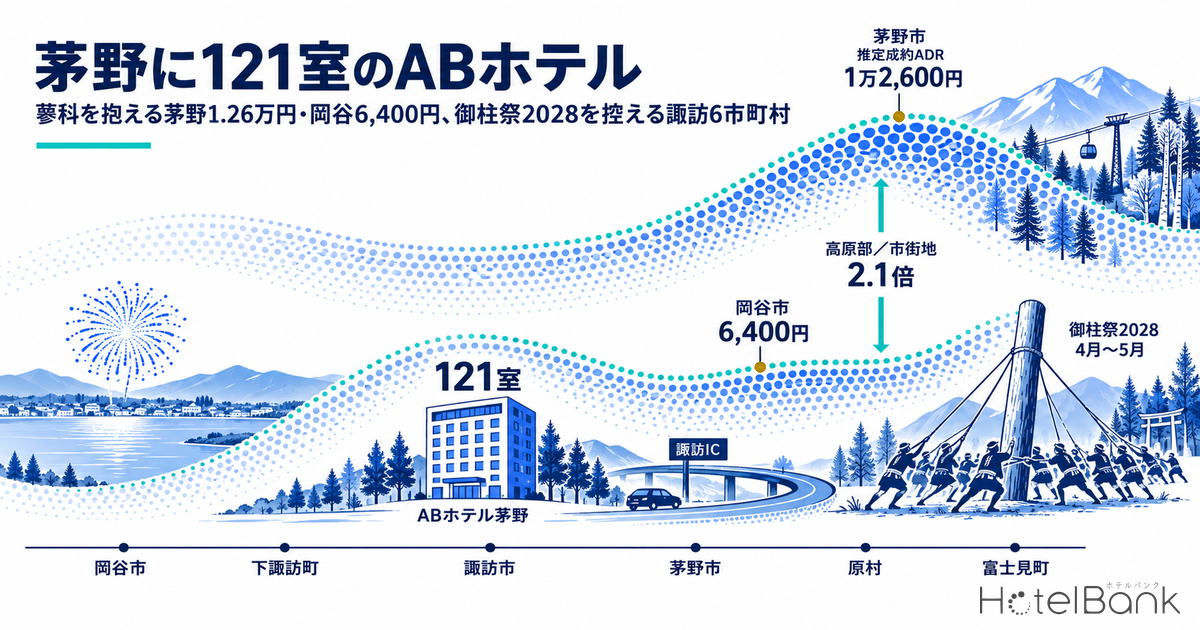
AB Hotel Co., Ltd. (TSE Standard: 6565) will hold the grand opening of AB Hotel Chino (ABホテル茅野), a six-story, 121-room property in Chino, Nagano Prefecture, on October 24, 2026. The site is about two minutes by car from the Suwa Interchange (IC) on the Chuo Expressway and about five minutes from JR Chino Station, and the company’s disclosure put the investment at roughly ¥800 million. Ranking the six Suwa-area municipalities by estimated settled ADR, Chino averages ¥12,600 over the latest 12 months, above Suwa City’s ¥11,300 — but that level is lifted by the Tateshina and Lake Shirakaba highlands, while business hotels in the urban area near the station and the IC cluster in a band around ¥7,100. This article reads the six municipalities as a single market area: room stock and price tiers, monthly peaks and troughs, where business demand is accommodated, and the Onbashira Festival in spring 2028.
Metric Definitions Used in This Article
*Metric definitions in this article: ADR (average daily rate) = estimated settled rate (tax-exclusive equivalent), calculated by applying segment-specific adjustment factors to the lowest-plan level each property publishes on OTAs (per room, two guests per room, tax included). Checked against property-level results disclosed by listed hotel REITs (91 properties, latest three months), the median error is about 7%. These are estimates and differ from each property’s actual transacted prices and accounting figures. Area-level ADR is the median of the properties covered (the level of a typical property in the area). OCC (occupancy rate) = rooms sold as a share of total rooms in the area (an estimate based on OTA sales inventory; consistency checks against REIT monthly disclosures confirm accuracy within roughly a few points). Where listed prices are mentioned, they are per-room rates for two guests per room (tax included). Booking curve = the trajectory of remaining OTA rooms toward the check-in date. LT (lead time) = days until check-in. Data source: MetroEngines Research. Coverage is the six municipalities of Suwa City, Okaya City, Chino City, Shimosuwa Town, Fujimi Town and Hara Village; the ADR aggregation period is the 12 months from September 2025 to August 2026.
- — 121 rooms, investment of roughly ¥800 million AB Hotel Chino opens on October 24, 2026. At about ¥6.6 million per room, it lifts limited-service stock between the Suwa IC and Chino Station from 740 to 909 rooms (+22.8%).
- — ¥12,588 vs ¥7,146 Chino’s citywide estimated settled ADR (12-month average, September 2025 – August 2026) is pulled up by the Tateshina and Lake Shirakaba highlands (¥14,866), 2.1 times the urban area within 5 km of the station (¥7,146).
- — 20 urban business hotels, top ADR ¥9,400 The 1,261 urban business-hotel rooms across four municipalities have a median of ¥7,315, and no urban property sits in the ¥10,000–15,000 band with 80 or more rooms.
- — GOP yield of 5.2–11.8% Even in Scenario B (120 rooms, ADR ¥8,500, 75% occupancy as a full-year average assumption), the yield more than doubles depending on whether building cost is set at the disclosed level, 2025 actuals or an inflation-adjusted level.
- — Onbashira 2028 runs April 1 – May 14 Even in the restricted 2022 festival, Shimosuwa’s April–May ADR was 1.30 times the adjacent months. The Kamisha Satobiki falls on the May 3–5 Golden Week holidays.
AB Hotel Chino at a Glance — 121 Rooms and 88 Parking Spaces, Built for Business Travelers Arriving by Car
Let us first set out the property that anchors this analysis, as far as the official website and the company’s disclosures allow. AB Hotel Chino is located in Miyagawa, Chino, in a quasi-industrial zone (floor-area ratio 200%, building coverage ratio 60%). The official website announces a grand opening on October 24, 2026; the disclosure dated October 31, 2025 gave a planned opening of September 2026, a scale of six stories and 121 rooms, and an investment of roughly ¥800 million. That works out to about ¥6.6 million per room.
| Details | |
|---|---|
| Location | 1388-5 Akada, Miyagawa, Chino, Nagano Prefecture |
| Opening | Grand opening October 24, 2026 (announced on the official website) |
| Scale | Six stories, 121 rooms in total (guest floors 1–6, all non-smoking) |
| Rooms | 8 types, from 12.9㎡ (Standard Single) to 27.2㎡ (Executive Twin) |
| Parking | 88 free surface parking spaces in total (48 on site, 19 in Lot 2, 21 in Lot 3) |
| Facilities | Large communal bath (alternating men’s/women’s hours), free breakfast, coin laundry |
| Access | About 2 minutes by car from the Suwa IC on the Chuo Expressway; about 5 minutes by car from JR Chino Station |
| Investment | Roughly ¥800 million (disclosed October 31, 2025; no breakdown given) |
A configuration of 88 free parking spaces for 121 rooms reads as a design aimed mainly at business travelers arriving by car. The combination of a large bath, free breakfast and coin laundry suits multi-night business stays, and is consistent with the official website promoting both business and leisure use. Sitting between the IC and the station, the site allows easy car access to both the workplaces on the Lake Suwa side and the tourist destinations on the Tateshina side — a position that can layer leisure demand on top of a business-demand core.
Tiers Across Six Municipalities — 235 Properties and 4,510 Rooms, from Shimosuwa’s Ryokan at ¥14,600 to Okaya’s Business Hotels at ¥6,400
Next, the overall picture. MetroEngines Research was able to observe prices at 235 lodging properties with 4,510 rooms across the six municipalities in July–September 2026 (duplicates caused by name changes are consolidated into one property). Nearly half the rooms, 2,267, are in Chino, followed by Suwa with 1,591. By type, business hotels account for 22 properties and 1,381 rooms, ryokan and resort hotels for 64 properties and 2,059 rooms, and pensions, rental villas and similar for 149 properties and 1,070 rooms.
The 12-month average estimated settled ADR was ¥14,600 in Shimosuwa, ¥12,600 in Chino, ¥11,300 in Suwa and ¥6,400 in Okaya, splitting above and below the Nagano Prefecture figure of ¥12,100. The gap between ryokan-centered Shimosuwa and Okaya, which consists of business hotels, is about 2.3 times. Year-on-year growth was +10.1% in Chino, +14.8% in Suwa, +18.2% in Shimosuwa and +11.7% in Okaya, all four outpacing Nagano Prefecture as a whole (+8.3%). Note, however, that the samples are small — N=9–11 in Shimosuwa and N=4–5 in Okaya — so moves at individual properties readily show up in the median. The price tiers of seven Chushin and Nanshin municipalities, including Matsumoto just north of the Suwa area, are laid out in Matsumoto ADR ¥13,400 vs ¥18,300 Ceiling: Absorbing 222 New Rooms.
| Properties | Rooms | Of which business | Ryokan / resort | Estimated settled ADR | YoY | ADR sample (N) | Peak month | |
|---|---|---|---|---|---|---|---|---|
| Chino | 130 | 2,267 | 10 properties / 520 rooms | 30 properties / 1,110 rooms | ¥12,588 | +10.1% | 37–41 | Aug ¥15,152 |
| Suwa | 39 | 1,591 | 7 properties / 613 rooms | 21 properties / 802 rooms | ¥11,304 | +14.8% | 25–28 | Aug ¥16,484 |
| Shimosuwa | 14 | 115 | 1 property / 19 rooms | 10 properties / 84 rooms | ¥14,587 | +18.2% | 9–11 | Aug ¥18,959 |
| Okaya | 8 | 233 | 4 properties / 229 rooms | — | ¥6,435 | +11.7% | 4–5 | Aug ¥7,848 |
| Hara | 26 | 206 | — | 2 properties / 37 rooms | ¥8,557 (reference) | — | 2 | — |
| Fujimi | 18 | 98 | — | 1 property / 26 rooms | — (not shown: N=1) | — | 1 | — |
| Six-municipality total | 235 | 4,510 | 22 properties / 1,381 rooms | 64 properties / 2,059 rooms | — | — | — | — |
Monthly Peaks and Troughs — Chino Has Twin Summer and Winter Peaks, Suwa a Single August Fireworks Peak
Followed month by month, the seasonality of the two neighboring cities takes quite different shapes. Chino recorded ¥15,200 in August 2026 (+1.6% YoY) and ¥13,900 in January 2026 (+15.1% YoY), giving it two peaks: the summer highlands and winter skiing and hot springs. The trough is March at ¥10,500, a peak-to-trough ratio of 1.44. Suwa, by contrast, spikes in August at ¥16,500 (−8.5% YoY), 1.83 times February’s ¥9,000. In 2026 the 78th Lake Suwa Fireworks Festival was held on Saturday, August 15, and the single August peak can be read as that event overlapping with summer-holiday demand.
In Suwa, October–December 2025 came in at ¥12,500–14,700, a sharp step up from ¥8,700–8,900 in the same months a year earlier. Behind this is a higher level among the ryokan and resorts of Kami-Suwa Onsen; the business-hotel median over the same period was ¥7,600–7,900, only a modest rise from ¥6,800–7,300 a year earlier. In other words, it was the onsen ryokan side that moved the citywide ADR, while rates at hotels serving business demand have stayed stable from month to month.
Chino’s twin peaks also look different once the components are separated. Splitting the city into the urban area within 5 km of Chino Station (8 properties, 400 rooms) and the highlands of Tateshina, Lake Shirakaba, Kurumayama and Oku-Tateshina (32 properties, 1,230 rooms), the 12-month average was ¥7,100 in the urban area and ¥14,900 in the highlands, a 2.1-fold gap. In August 2026 the highlands climbed to ¥19,900, while the urban area stopped at ¥9,000. The winter peak appears only in the highlands; the urban area hits its annual trough of ¥6,100 in December. The citywide figure of ¥12,600 is determined by the weight of the highlands, and the going rate in the urban area that AB Hotel Chino is joining is close to that of Okaya and the Kami-Suwa Station area.
Where Business Demand Stays — All 20 Urban Business Hotels Are Below ¥10,000
So how do rates line up on the side that takes in business demand? There are 20 business hotels with 1,261 rooms in the urban areas of the four municipalities; their 12-month average estimated settled ADR has a median of ¥7,300, and even the highest property is at ¥9,400. By zone, the Suwa IC area is a notch higher at ¥8,700, followed by the Kami-Suwa Station area at ¥7,400, urban Chino at ¥7,200 and Okaya at ¥6,700. Rates rising with proximity to the IC is a fitting result for an area where most visitors arrive by car.
| Properties | Rooms | 12-month average | Aug 2026 | Feb 2026 | |
|---|---|---|---|---|---|
| Suwa IC area (Suwa) | 3 | 340 | ¥8,671 | ¥11,135 | ¥7,913 |
| Kami-Suwa Station area (Suwa) | 4 | 273 | ¥7,442 | ¥8,956 | ¥7,250 |
| Urban Chino (within 5 km of Chino Station) | 8 | 400 | ¥7,151 | ¥9,028 | ¥6,702 |
| Okaya | 4 | 229 | ¥6,650 | ¥7,848 | ¥5,592 |
| Urban total, four municipalities | 20 | 1,261 | ¥7,315 | — | — |
Plotting positioning on two axes, room count and ADR, makes the empty band clear. Of the 80 properties covered, 45 are at ¥10,000 or above, but all of them are highland resorts or onsen ryokan in Kami-Suwa and Shimosuwa — not a single urban business hotel is among them. Two properties sit in the band of 80 or more rooms at ¥10,000–15,000, both in onsen or resort locations. Where a 100-room-class limited-service hotel with a large bath and breakfast settles on price in the urban area will be an observation point that shapes the next opening decisions in this market.
Concentration band Urban × ¥4,700–9,500
20 properties, 1,261 rooms
Limited-service hotels around the Suwa IC, Kami-Suwa Station, Chino Station and Okaya line up here. Once AB Hotel Chino’s 121 rooms open, urban limited-service stock will be about 10% thicker.
White space Urban × ¥10,000–15,000 × 80+ rooms
None
All 17 properties in the same price band are in the highlands or onsen districts. For a limited-service hotel that raises its rate with bathing facilities or larger rooms, a band with no first mover remains.
Upper band Highlands & onsen × ¥15,000 and above
28 properties, 1,039 rooms
Occupied by the ryokan and resorts of Tateshina, Lake Shirakaba and Kami-Suwa Onsen. Seasonal peaks are large, and this tier captures summer and winter rates.
Let us confirm the source of demand with employment data. According to the Economic Census, there are 527 establishments and 4,478 workers within 1 km of AB Hotel Chino, and 1,314 establishments and 12,841 workers when widened to 2 km. Office-type industries account for only 6.2% within 1 km and 7.0% within 2 km, meaning non-office industries make up more than 90% of workers. The 1 km radius around Kami-Suwa Station has 882 establishments and 7,024 workers with a relatively high office-type share of 15.8%, suggesting that within the same business demand, the Chino side sees relatively more trips to visit operating sites and the Kami-Suwa side relatively more visits to offices. Assuming travel by car and multi-night stays, a roadside format with surface parking and laundry meshes with demand on the Chino side.
| Establishments | Workers | Share of office-type industries | |
|---|---|---|---|
| AB Hotel Chino, 1 km radius | 527 | 4,478 | 6.2% |
| AB Hotel Chino, 2 km radius | 1,314 | 12,841 | 7.0% |
| Chino Station, 1 km radius | 649 | 5,487 | 9.4% |
| Kami-Suwa Station, 1 km radius | 882 | 7,024 | 15.8% |
| Okaya Station, 1 km radius | 569 | 4,502 | 7.6% |
Weekday depth is also visible on the occupancy side. Estimated occupancy (based on OTA-listed inventory; estimate) was 88.3% in July, 93.1% in August and 85.3% in September 2026 in Chino, and 89.8%, 94.2% and 90.2% in Suwa. By day of week, the September Monday–Thursday average was 84.5% in Chino and 91.0% in Suwa, against Saturday averages of 90.4% and 95.0% — a weekday–Saturday gap of only 4–6 points. This metric counts rooms not listed as already sold and therefore runs high, but a day-of-week shape in which weekdays sit close to weekends is consistent with business visits filling rooms. Because fewer than 10 properties are available for a business-hotel-only cut, the all-type figures are used here.
| Month | Monthly average | Mon–Thu | Saturday | Properties / rooms | |
|---|---|---|---|---|---|
| Chino | Jul 2026 | 88.3% | 88.4% | 91.2% | 41 properties / 1,199 rooms |
| Chino | Aug 2026 | 93.1% | 92.9% | 96.5% | 47 properties / 1,208 rooms |
| Chino | Sep 2026 | 85.3% | 84.5% | 90.4% | 46 properties / 1,272 rooms |
| Suwa | Jul 2026 | 89.8% | 89.0% | 97.7% | 18 properties / 765 rooms |
| Suwa | Aug 2026 | 94.2% | 94.7% | 98.4% | 18 properties / 791 rooms |
| Suwa | Sep 2026 | 90.2% | 91.0% | 95.0% | 15 properties / 777 rooms |
The way bookings come in also differs between the two cities. In the average curve for September 2026 stays, Chino advances gently from 62.9% at 45 days before the stay to 73.3% at 14 days and 75.7% at 7 days, reaching 85.3% the day before (coverage: average of 57 properties / 1,371 rooms, based on listings on major booking sites). Suwa builds earlier, from 65.8% at 45 days to 82.3% at 14 days and 86.1% at 7 days, and stood at 90.2% the day before (coverage: average of 19 properties / 825 rooms, same basis). Chino adds 9.6 points in the final week, which reads as a market with ample room to capture last-minute business trips and weekend trips to the highlands.
Site Assessment — Quasi-Industrial Zoning at 200% FAR, Land Prices Bottoming Out, Station Use Just Under 90% of FY2019
We check site conditions against public data. The area around AB Hotel Chino is zoned quasi-industrial, with a designated floor-area ratio of 200% and building coverage ratio of 60%. The nearest official land price point (Chino 5-3, quasi-industrial zone, about 0.8 km away) was ¥50,600 per ㎡ in 2026, down 0.4% YoY. The rate of decline has narrowed from −1.3% in 2024 and −0.8% in 2025, and the prefectural benchmark site near the Suwa IC (Suwa 5-2) turned up by +0.2% in 2026, its first rise since 2019. A level of about ¥167,000 per tsubo (approx. 3.3㎡) makes it easier to contain land cost for a roadside format with generous surface parking.
| Zoning | Quasi-industrial zone |
| FAR / building coverage | 200% / 60% |
| Nearest official land price | ¥50,600/㎡ (−0.4%) |
| 2025 estimate | 19,152 |
| 2040 projection (vs 2020) | 17,986 (−7.6%) |
| Working-age / elderly share | 62.4% / 24.9% |
Rail use is still recovering. Daily ridership at JR Chino Station fell from 7,556 in FY2019 to 5,392 in FY2020 and had returned to 6,704 in FY2023, 88.7% of FY2019. Kami-Suwa Station stood at 7,658 (87.2%) and Okaya Station at 5,524 (84.9%), so all three stations are at just under 90%. With the pool of guests arriving by rail not yet fully restored, the addition of rooms with parking right by the IC is in line with how people actually reach the area.
The resident population has entered a gradual decline. According to the 250 m mesh population projections in the National Land Numerical Information, the resident population within 2 km of AB Hotel Chino is projected to fall from 19,469 in 2020 to 19,152 in 2025 and 17,986 in 2040 (−7.6% vs 2020). The elderly share is 24.9% and the working-age share 62.4%, making this a catchment with a deep workforce for a regional city. These are resident (census-based) figures, not visitor or pass-through population, but the likely picture is that stays tied to homecomings and family ceremonies will be flat to slightly down while business visits and tourism remain the main drivers filling rooms.
On disaster risk, note that the lowland belt from the Suwa IC to Chino Station falls within the flood inundation area assumed for the maximum probable scale for Lake Suwa and the Kamikawa River. The area includes a category of inundation depth of 3.0 m to less than 5.0 m, and in landform classification terms it is lowland prone to liquefaction. Anyone considering new development in this belt should settle the placement of equipment floors — substations, boilers and the like — and insurance terms early in planning.
Supply Pipeline — Limited-Service Stock from the IC to Chino Station Grows from 740 to 909 Rooms
We lay out supply movements in chronological order. Within what MetroEngines Research tracks, five properties with 10 or more rooms, totaling 211 rooms, were confirmed to have opened in the six municipalities since 2025. Of these, the urban limited-service openings are two properties with 169 rooms: the container-type Blue quad hotel Suwa (48 rooms, March 2026) near the Suwa IC, and AB Hotel Chino (121 rooms, October 24, 2026). Business hotels in the Suwa IC area and urban Chino numbered 11 properties with 740 rooms at the start of 2026, so these two openings take stock to 909 rooms, an increase of 22.8%.
| Location | Rooms | Type | Opened | |
|---|---|---|---|---|
| GUESTHOUSE HO ALOHA 4SEASONS | Chino (highlands) | 12 | Guesthouse | Jan 2025 |
| Hotel Grand Resort Tateshina (ホテルグランリゾート蓼科) | Chino (highlands) | 18 | Resort | Apr 2025 |
| SANU 2nd Home Tateshina 1st | Chino (highlands) | 12 | Cottage | Jun 2025 |
| Blue quad hotel Suwa | Suwa (Suwa IC area) | 48 | Limited-service (container type) | Mar 2026 |
| AB Hotel Chino | Chino (urban area) | 121 | Business | Oct 24, 2026 |
Filling 169 rooms at 75% occupancy (a full-year average assumption) requires roughly 46,000 room nights a year, or 127 room nights a day. Given an employment base of 12,841 workers within 2 km alone and estimated occupancy above 80% even on weekdays in July–September, absorption looks like a matter of one to two seasons rather than several years. As for plans beyond that, information on a building-confirmation-application basis drawn from MLIT’s Building Dynamics Statistics Survey showed no lodging project of 100 or more rooms in the six municipalities at the time of our survey. *Based on building confirmation applications as of the survey date. Counts of projects and rooms are expected to rise as further applications are filed, and this should be treated as a lower bound of the confirmed pipeline at present.
Institutional capital has entered both the urban area and the highlands. Of the 300 domestic properties held by the seven listed hotel REITs — Ichigo Hotel REIT Investment Corporation (いちごホテルリート投資法人, 3463), Invincible Investment Corporation (インヴィンシブル投資法人, 8963), Nippon Hotel & Residential Investment Corporation (日本ホテル&レジデンシャル投資法人, 3472), Japan Hotel REIT Investment Corporation (ジャパン・ホテル・リート投資法人, 8985), Hoshino Resorts REIT, Inc. (星野リゾート・リート投資法人, 3287), MORI TRUST REIT, Inc. (森トラストリート投資法人, 8961) and Kasumigaseki Hotel REIT Investment Corporation (霞ヶ関ホテルリート投資法人, 401A) — three are located in the six municipalities: Tateshina Grand Hotel Takinoyu (蓼科グランドホテル滝の湯; Chino, 160 rooms) in the highlands, and Candeo Hotels Chino (カンデオホテルズ茅野; Chino, 119 rooms) and Comfort Inn Suwa Inter (コンフォートイン 諏訪インター; Suwa, 91 rooms) in the urban area (N=300 properties, domestic only; ownership master as of October 2, 2026). The two urban properties are held by Hoshino Resorts REIT, with acquisition prices of ¥793 million (about ¥6.7 million per room) and ¥658 million (about ¥7.2 million per room), close to the disclosed investment for AB Hotel Chino (about ¥6.6 million per room). Takinoyu was acquired by Invincible Investment Corporation in August 2023 for ¥8,365 million, or about ¥52.3 million per room. According to Invincible’s monthly disclosure, the property’s room occupancy was 98.3% in August 2026. Urban limited-service hotels and large highland onsen ryokan — two markets with a roughly eightfold gap in capital invested per room — sit side by side within the same city.
Onbashira Festival 2028 — April 1 to May 14, the First Regular Festival in 12 Years If Held in Full
The largest event in the area is the Onbashira Festival of Suwa Taisha Shrine, held in the years of the Tiger and the Monkey. Suwa Taisha and its council of parish representatives announced the next schedule on April 4, 2025: the Kamisha (Upper Shrine) Yamadashi on Saturday, April 1 to Monday, April 3, 2028; the Shimosha (Lower Shrine) Yamadashi on Saturday, April 8 to Monday, April 10; the Kamisha Satobiki on May 3–5; and the Shimosha Satobiki on Friday, May 12 to Sunday, May 14. In the previous festival in 2022, the pillars were moved by trailer as an infection-control measure and the Kiotoshi (log-riding descent) was canceled. The stated policy for the next festival is to return to the regular form in which parishioners haul the pillars by hand; if realized, it would be the first regular festival in 12 years, since 2016.
| Dates | Main setting | |
|---|---|---|
| Kamisha Yamadashi | Sat, Apr 1 – Mon, Apr 3, 2028 | Chino, Hara |
| Shimosha Yamadashi | Sat, Apr 8 – Mon, Apr 10, 2028 | Shimosuwa |
| Kamisha Satobiki | Wed, May 3 (holiday) – Fri, May 5 (holiday), 2028 | Chino, Suwa |
| Shimosha Satobiki | Fri, May 12 – Sun, May 14, 2028 | Shimosuwa |
For rates in past festival months, only the restricted 2022 festival can be checked in the data at hand. Lining up, year by year, the ratio of the April–May average ADR to the average of the adjacent March and June, Shimosuwa was at 1.30 in 2022, the highest of the six years from 2021 to 2026. Suwa was 1.17 and Chino 1.07, within the range of a normal Golden Week. In a year with neither the Kiotoshi nor hand-hauling, only Shimosuwa — home of the Shimosha — moved. That said, Shimosuwa’s sample is small at N=10–11, and the effect of a regular festival year cannot be measured within this article’s data period (from July 2019). As inputs for gauging 2028 rates, note that the Kamisha Satobiki coincides with three days of Golden Week, and that the Shimosha Yamadashi and Satobiki are each three-day spans that include a weekend.
| Shimosuwa | Suwa | Chino | Note | |
|---|---|---|---|---|
| 2021 | 1.19 | 1.14 | 1.12 | — |
| 2022 | 1.30 | 1.17 | 1.07 | Onbashira Festival (restricted) |
| 2023 | 1.00 | 1.00 | 1.01 | — |
| 2024 | 1.15 | 1.11 | 1.05 | — |
| 2025 | 1.10 | 1.22 | 1.08 | — |
| 2026 | 1.22 | 1.03 | 1.12 | — |
Development Scenario — A 120-Room Limited-Service Hotel: Yield Ranges from the 5% Range to 12% Depending on Construction Cost
Based on the rates above, we run a simplified pro forma for a new 120-room limited-service hotel in the zone between the Suwa IC and Chino Station. Gross floor area is about 2,500㎡ (about 754 tsubo), back-calculated from an average room size of 13.5㎡ and a guest-room share of 65%; the site is 3,000㎡, securing around 90 surface parking spaces; and land cost is set at ¥152 million using the nearest official land price of ¥50,600/㎡. We adopt a GOP margin of 40%. The GOP margin Invincible Investment Corporation discloses for its 91 MHM-operated properties was 38.9% (fiscal period ended December 2024), and assuming an operation with free breakfast and a large bath, we chose a conservative level close to that actual figure.
We set three ADR cases along the distribution of urban business hotels: A at ¥7,500, close to the median of the 20 properties; B at ¥8,500, close to the Suwa IC area median; and C at ¥9,500, the top level in the area. Occupancy is set at 70–80%. Because the estimated occupancy cited above is a metric that runs high, we assume a level one step below it.
| A. Conservative | B. Standard Base | C. Upside | |
|---|---|---|---|
| ADR assumption (tax-exclusive equivalent) | ¥7,500 | ¥8,500 | ¥9,500 |
| Occupancy assumption | 70% | 75% | 80% |
| RevPAR | ¥5,250 | ¥6,375 | ¥7,600 |
| Room revenue | ¥230 million | ¥279 million | ¥333 million |
| GOP | ¥92 million | ¥112 million | ¥133 million |
| GOP yield ① building cost at disclosed level (total project cost ¥945 million) | 9.7% | 11.8% | 14.1% |
| GOP yield ② 2025 actuals basis (total project cost ¥1.965 billion) | 4.7% | 5.7% | 6.8% |
| GOP yield ③ with construction-period inflation (total project cost ¥2.157 billion) | 4.3% | 5.2% | 6.2% |
| Simple payback period (③, GOP basis) | 23.4 years | 19.3 years | 16.2 years |
Construction cost needs to be viewed in two steps. According to MLIT’s Building Starts Statistics, the construction cost of lodging-use buildings in 2024 averaged ¥1.95 million per tsubo across all structure types, up 41% in two years from ¥1.38 million in 2022. In the 2025 secondary tabulation, steel-frame construction reached ¥2.405 million per tsubo; applying this gives a building cost of ¥1.813 billion in ②, or about ¥15.1 million per room. Factoring in a further rise of around 5% a year to the midpoint of construction for an assumed 2028 opening, ③ swells to ¥2.005 billion. The Scenario B yield is 11.8% under ①, against 5.7% under ② and 5.2% under ③ — with identical revenue assumptions, the choice of construction cost alone more than doubles the spread. For regional limited-service hotels, how far building cost per room can be held down through standardized design and construction arrangements is the variable that decides success or failure. Put the other way, rising construction cost also works to restrain later new supply, so it is a tailwind in competitive terms for properties that opened earlier.
| Base case | ADR −10% | Occupancy −5 pt | Both | |
|---|---|---|---|---|
| Room revenue | ¥279 million | ¥251 million | ¥261 million | ¥235 million |
| GOP | ¥112 million | ¥101 million | ¥104 million | ¥94 million |
| GOP yield (total project cost ¥1.965 billion) | 5.7% | 5.1% | 5.3% | 4.8% |
| GOP yield (under ① total project cost ¥945 million) | 11.8% | 10.6% | 11.0% | 9.9% |
Moving ADR and occupancy together, the GOP yield under ② (total project cost ¥1.965 billion) falls within the 4.0–6.8% range shown below. It exceeds 6% only with combinations such as ADR ¥9,000 at full-year occupancy of 75% or higher, or ¥8,500 at 80%; at ¥7,500, close to the urban business-hotel median, it stops at 5.3% even at 80% full-year occupancy. Re-reading the same table at ①’s total project cost of ¥945 million, every cell is about 2.08 times higher, giving 8.3% even at the lowest combination of ADR ¥7,500 and 60% full-year occupancy.
| 60% | 65% | 70% | 75% | 80% | |
|---|---|---|---|---|---|
| ¥7,500 | 4.0% | 4.3% | 4.7% | 5.0% | 5.3% |
| ¥8,000 | 4.3% | 4.6% | 5.0% | 5.3% | 5.7% |
| ¥8,500 | 4.5% | 4.9% | 5.3% | 5.7% | 6.1% |
| ¥9,000 | 4.8% | 5.2% | 5.6% | 6.0% | 6.4% |
| ¥9,500 | 5.1% | 5.5% | 5.9% | 6.4% | 6.8% |
| Description | What to check | |
|---|---|---|
| Demand seasonality | ADR in urban Chino is ¥6,100–6,900 in December–March, around 70% of the August level | Capturing weekday multi-night stays such as winter construction and inspection trips and training camps |
| Supply absorption | Limited-service stock from the IC to Chino Station rises +22.8% from 740 to 909 rooms during 2026 | Occupancy and rate trends in the first one to two years after opening |
| Construction cost | Building cost ranges from ¥6.6 million to ¥16.7 million per room, moving the yield from the 5% range to 12% | Design standardization, timing of orders, choice of structure |
| Population and employment | Resident population within 2 km in 2040 is −7.6% vs 2020 | Manufacturing capital-investment trends and establishment location plans |
| Flood hazard | The lowland from the IC to Chino Station includes flood inundation areas assumed for the maximum probable scale | Placement of equipment floors, flood-proofing plans, insurance terms |
| Event dependence | The Onbashira Festival is held once every seven years by the traditional count (every six calendar years); the fireworks are one day a year | A pro forma based on years and months without events |
Conclusion — Plan on the “¥7,100 Urban Area,” Not the “¥12,600 Chino”
To sum up, the six Suwa municipalities are closer in reality to two overlapping markets than to a single one. The highlands of Tateshina and Lake Shirakaba and the onsen districts of Kami-Suwa and Shimosuwa have 28 properties with 1,039 rooms in the ¥15,000-and-above tier, forming rate peaks in summer and winter, at the fireworks and over holidays. By contrast, the 20 urban business hotels with 1,261 rooms line up in a ¥4,700–9,500 band with little month-to-month swing. AB Hotel Chino’s 121 rooms join the latter zone, and the benchmark for thinking about the pro forma is not the citywide ¥12,600 but the urban area’s ¥7,100 and the Suwa IC area’s ¥8,700.
For those considering an opening, we suggest three things to watch. The first is how rates and occupancy move in the urban zone after the opening. If the +22.8% supply is absorbed in one to two seasons, that becomes a track record for gauging room for the next opening. The second is whether a limited-service hotel above ¥10,000 can work in the urban area. If a 100-room-class property with a large bath and breakfast as standard opens up this band, a new price tier will emerge in the market. The third is construction cost: since the yield moves from the 5% range to 12% on the same revenue, the first thing to pin down is how much building cost per room can be contained.
For operators of existing properties, too, spring 2028 is an opportunity worth preparing for. The Onbashira schedule was published three years ahead: the Kamisha Satobiki coincides with Golden Week, and the Shimosha events with weekends in April and May. Even in the restricted 2022 festival, rates in Shimosuwa rose to 1.30 times the adjacent months. Ahead of the next festival, set to be held in regular form, designing multi-night stay conditions and the timing of sales launch early should be effective in capturing the revenue opportunity.
About the data period: ADR in this article covers finalized months through August 2026. Months from September 2026 onward are estimates based on listed levels at the time of the survey and will change as check-in dates approach, so they are not included in the 12-month averages or year-on-year figures. This article also provides no forecast figures for rates or occupancy during the 2028 Onbashira Festival period.
Related Articles
| Japan Hotel ADR Swings Up to 4.9x by Season: 633 Municipalities Ranked |
| Matsumoto ADR ¥13,400 vs ¥18,300 Ceiling: Absorbing 222 New Rooms |
References and Sources
■ Data sources
Estimated settled ADR, room stock, estimated occupancy and booking curves are data compiled by MetroEngines Research & Consulting from listed prices and inventory on major booking sites (ADR: finalized months from September 2025 to August 2026; room stock and occupancy: July–September 2026). New openings are based on confirmed OTA listings and operators’ official information; zoning, land prices and flood inundation assumptions on the MLIT Real Estate Information Library; station ridership and 250 m mesh population projections on the National Land Numerical Information; worker counts on the Economic Census for Business Activity (2021); and REIT holdings and occupancy on each investment corporation’s disclosures.
■ Estimate assumptions
120 rooms; gross floor area of about 2,500㎡ (average room size 13.5㎡ ÷ guest-room share 65%); site of 3,000㎡; land cost ¥152 million (official land price Chino 5-3, ¥50,600/㎡). Room revenue = ADR × occupancy × 120 rooms × 365 days; GOP margin 40% (close to the 38.9% actual for Invincible Investment Corporation’s 91 MHM-operated properties). Building cost is set three ways: ① AB Hotel Chino’s disclosed investment converted at about ¥6.6 million per room; ② steel-frame construction at ¥2.405 million per tsubo × 754 tsubo; ③ ② with increases of +5.3% in 2026 and +5.0% in 2027 factored in. Occupancy of 70–80% is a full-year average assumption; FF&E, pre-opening costs, financing costs and taxes and public dues are not included.
■ Limitations and caveats
Estimated settled ADR is an estimate that applies segment-specific adjustments to listed prices and differs from actual transacted prices. Estimated occupancy (based on OTA-listed inventory; estimate) counts rooms not listed as already sold and therefore runs higher than actual occupancy. Shimosuwa (N=9–11), Okaya (N=4–5), Hara and Fujimi have few properties in the sample, so moves at individual properties readily show up in the median. GOP yield is a simplified estimate and is not NOI or IRR. The effect of a regular-form Onbashira year on rates cannot be measured within the data period (from July 2019).
■ Market data
| MetroEngines Research & Consulting — Estimated settled ADR (six municipalities, N=80 properties), room stock (N=235 properties), estimated occupancy (based on OTA-listed inventory), booking curve analysis |
■ Government statistics and public data
| MLIT Real Estate Information Library — official land prices, prefectural land price survey, zoning, flood inundation areas |
| MLIT National Land Numerical Information — future population projections by 250 m mesh, station ridership |
| Ministry of Internal Affairs and Communications / Ministry of Economy, Trade and Industry, Economic Census for Business Activity (2021) |
| MLIT, Building Starts Statistics (planned construction cost and floor area of lodging-use buildings, 2022–2024) / MLIT, Building Dynamics Statistics Survey |
■ Operators’ official information and REIT disclosures
| AB Hotel official website, “AB Hotel Chino” (grand opening date, rooms, parking, access) |
| AB Hotel Co., Ltd., “Notice of New Openings (Planned) and Deferred New Openings” (October 31, 2025) |
| Invincible Investment Corporation, portfolio list and monthly disclosures (acquisition price, room count and monthly occupancy of Tateshina Grand Hotel Takinoyu; GOP results of MHM-operated hotels) |
| archi-book, “Hotel Construction Costs and Cost per Tsubo, 2025 Edition” (secondary tabulation of the Building Starts Statistics) / Turner & Townsend construction cost escalation outlook |
■ News and event information