

On September 1, 2026 — Japan’s Disaster Prevention Day — a multilingual interpretation service for lodging facilities announced that it had added an “emergency broadcast” function. Staff call up pre-registered evacuation and guidance announcements from a tablet and play them in English, Chinese and Korean in addition to Japanese; according to press reports, the function had been offered in advance since July and has already been used in evacuation drills at hotels in the Tokyo metropolitan area. Several ways of putting foreign languages on a building’s PA system have existed since an add-on unit for emergency broadcast equipment appeared in 2017, but now that an option can be introduced as an extension of an interpretation tablet, the question of “what to tell guests who do not understand Japanese, and how, at the moment a disaster strikes” has become a realistic consideration for small and mid-sized properties as well. This article focuses on that single point. It overlays the prefectural foreign-guest ratio from the Japan Tourism Agency’s Overnight Travel Statistics Survey with the Ministry of Land, Infrastructure, Transport and Tourism’s (MLIT) flood, tsunami and landslide hazard-zone data, and puts numbers on which lodging hubs — and how many rooms — stand to gain most from preparing multilingual disaster communication.
HotelBank has previously covered location hazards themselves — flood inundation zones and land prices in Tokyo’s five eastern wards, tsunami inundation zones at Shirahama Onsen and liquefaction in central Niigata — and everyday multilingual demand through our prefecture-by-prefecture host map for stays by nationality and onsen ratings by language. This article covers neither. Its subject is the setup for getting information to foreign guests in the first few minutes after a disaster. Rather than debating hazard depth or looking for headroom in language demand, it builds a priority ranking from the overlap of foreign guest volume and hazards.
Metric Definitions Used in This Article
- Foreign-guest ratio: foreign guest nights ÷ total guest nights in the Japan Tourism Agency’s Overnight Travel Statistics Survey. Annual figures are 2025 final values; the monthly figure is July 2026 (second preliminary). From January 2026 the stratification basis changed from number of employees to number of guest rooms, so year-on-year changes may include the effect of this revision.
- Rooms in hazard zones: rooms at properties whose single representative coordinate falls within a flood inundation zone (maximum assumed scale) with depth of 0.5m or more, a tsunami inundation zone, a storm-surge inundation zone, or a landslide warning zone. Liquefaction is shown separately using the “very susceptible” and “susceptible” classes of the liquefaction tendency map based on landform classification. All zones are applied mechanically from the area data in MLIT’s Real Estate Information Library; ground elevation, flood barriers, and cases where only part of a site lies in a zone are not reflected.
- Properties covered in each hub: properties in six hotel and ryokan categories (business, city, resort, ryokan, deluxe, capsule) within a 2km radius of each hub’s center point, with sales confirmed on major booking sites in the last 12 months. Coverage is limited to the roughly 27,000 active properties tracked by MetroEngines Research and is not exhaustive.
- ADR (Average Daily Rate): an estimated transacted rate (tax-exclusive equivalent), calculated by applying category-specific adjustment factors to the lowest published plan level on OTAs (per room, two guests per room, tax included). Checked against property-level results disclosed by listed hotel REITs (91 properties, most recent three months), the median error is about 7%. It is an estimate and differs from each property’s actual transacted prices and accounting figures. Area-level ADR is the median of the covered properties.
- Data sources: MetroEngines Research (property and price data); Japan Tourism Agency, Overnight Travel Statistics Survey; MLIT Real Estate Information Library
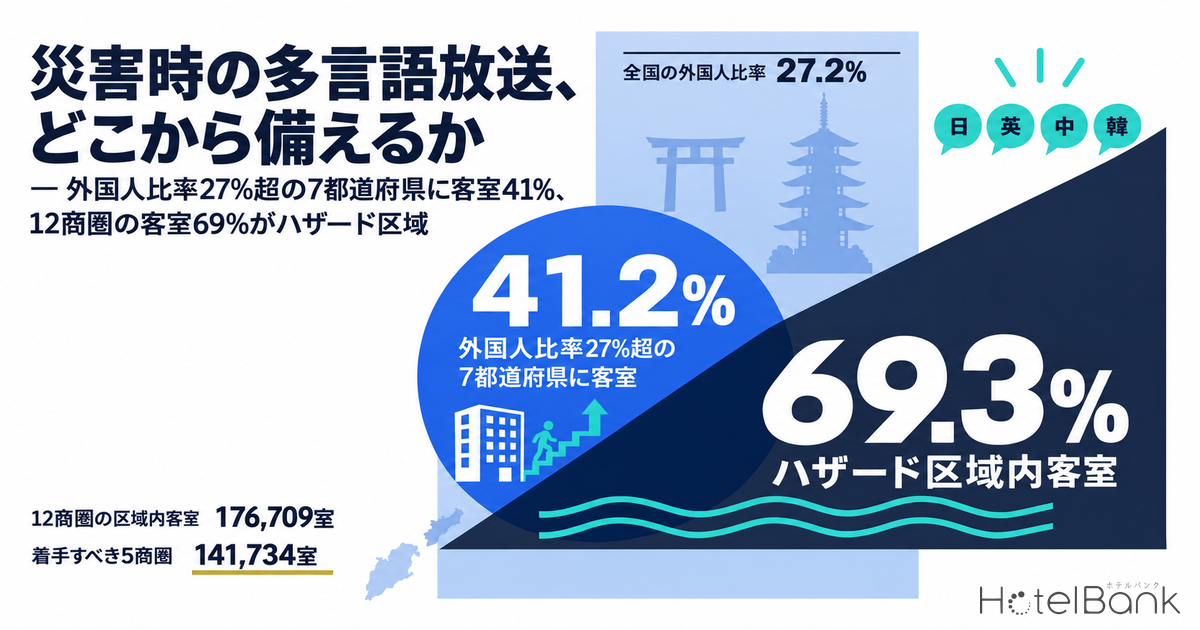
- — 75.9% of foreign guest nights are concentrated in the 7 prefectures with a foreign-guest ratio of 27.2% or more (compared to one decimal place), and 41.2% of room stock (575,133 rooms) is located there (Japan Tourism Agency, 2025 final values).
- — Of 254,947 rooms across 12 lodging hubs (N=2,016 properties), 69.3% (176,709 rooms) lie in an assumed flood (0.5m+), tsunami, storm-surge or landslide-warning zone.
- — Asakusa, Minami, Kyoto, Hakata and Naha, where both the inbound ratio and hazard exposure are high: 141,734 in-zone rooms across these 5 hubs, or 80% of the in-zone rooms across all 12 hubs.
- — Communicating disaster information and guiding evacuation are obligations under fire-safety law, but multilingual delivery is voluntary. The Fire and Disaster Management Agency’s handbook (March 2018) gives priority to Japanese and English, followed by Chinese and Korean.
- — Editorial estimate of the cost: ¥2,400–7,600 per room per year (100 rooms, tablet type) — less than one night’s estimated transacted ADR in every one of the 12 hubs.
What Happened — Three “Types” of Multilingual Disaster Broadcasting Are Now Available
The first point to establish is that the means of broadcasting multilingual disaster information inside a building is no longer a single-product story; it is now a functional category with several options. The latest announcement is an extension of an interpretation tablet, and the issuer’s press materials highlight that “it can be handled with the everyday guest-service tool, without installing a separate disaster app.” Supported languages are Japanese, English, Chinese and Korean, and audio is registered in advance for each scenario such as fire or earthquake. The press materials do not describe how it physically connects to existing PA equipment; the basic operation appears to be playback through the tablet’s speaker or a connected loudspeaker.
The type that preceded it is an add-on unit for emergency broadcast equipment. The “Multilingual Broadcast Support System” jointly announced by TOA and Mitsui Fudosan in February 2017 attaches to the emergency broadcast equipment that the Fire Service Act requires, and when an operator selects a message template suited to the situation on a PC, it broadcasts automatically in synthesized Japanese, English, Chinese and Korean speech; about 500 templates across the four languages (about 125 per language) were announced. The first unit went into a mixed-use retail and office building in Nihonbashi, and at the time of the announcement the companies aimed to expand into hotels and commercial facilities. A further type overlays an inaudible signal on broadcast audio and displays it as multilingual text on guests’ own smartphones (guidance apps based on a universal-design-for-sound standard). It has spread mainly through railways and airports, and in 2024 it was announced for use in announcements, including emergency broadcasts, at the Expo 2025 Osaka, Kansai venue.
| Type | Mechanism | Languages | Best fit | Published implementations |
|---|---|---|---|---|
| Add-on unit for emergency broadcast equipment | Adds a unit to existing emergency broadcast equipment;selecting a template triggers a building-wide synthesized-voice broadcast | Japanese, English, Chinese, Korean (about 500 templates) | Mid-sized to large hotels with emergency broadcast equipment; lodging inside mixed-use complexes | TOA × Mitsui Fudosan “Multilingual Broadcast Support System” (announced February 2017; in operation in a retail/office building) |
| Interpretation-tablet extension | Adds a function to the guest-service interpretation tablet that calls up pre-registered evacuation and guidance audio | Japanese, English, Chinese, Korean | Small and mid-sized properties where upgrading emergency broadcast equipment is difficult; properties where the front desk leads evacuation | “Emergency broadcast” function of a multilingual interpretation service (announced September 1, 2026; offered in advance from July; used in evacuation drills at hotels in the Tokyo area) |
| Broadcast-to-text / smartphone delivery | Overlays an inaudible signal on broadcast audio and shows it as multilingual text in the user’s app | Multiple (selected in the app) | Stations, airports and large venues; among lodging, properties where many guests use an in-house app | Guidance apps based on a universal-design-for-sound standard (deployed by transport operators; use for emergency broadcasts at the Expo venue announced in 2024) |
| (Complement) Public multilingual disaster app | Push notifications of Earthquake Early Warnings, tsunami warnings, emergency warnings, etc. to the user’s device | 15 languages | All properties — encourage installation at check-in | “Safety tips”, supervised by the Japan Tourism Agency (free) |
What all the types share is a design philosophy of “delivering fixed content, in fixed languages, to many people at once, without depending on staff language skills.” What is needed right after a disaster is not translation accuracy but making sure that everyone understands — in the few tens of seconds after the shaking stops — whether to stay in their room or go down the stairs, and on this point pre-registered broadcasts are better suited than interpretation. On the other hand, the individual inquiries that follow a broadcast and explanations to injured guests are the domain of interpretation; the two are not competitors but divide their roles along the timeline.
Mandatory or Voluntary? — What the Fire Service Act Requires, and Where Multilingual Delivery Fits
Next, the regulatory side needs to be pinned down precisely. Ryokan and hotels are specified fire-prevention objects under item (5)(i) of Appended Table 1 of the Order for Enforcement of the Fire Service Act, and those with a capacity of 30 or more persons are obliged under Article 8 of the Act to appoint a fire-prevention manager, prepare a fire-prevention plan, and conduct firefighting, reporting and evacuation drills. In the event of fire, the persons concerned are obliged to fight the fire, prevent its spread and rescue people until fire crews arrive (Article 25), and this applies mutatis mutandis to disasters other than water disasters, such as earthquakes (Article 36, Paragraph 8). Fire-prevention objects with even larger capacity and scale must also establish an in-house firefighting organization (Article 8-2-5). In other words, “communicating disaster information and guiding evacuation” is itself an obligation under fire-safety law, scaled to the size of the property.
By contrast, no provision directly requires that this communication be done in foreign languages. In March 2018 the Fire and Disaster Management Agency (FDMA) published a handbook for its “Guidelines on Communicating Disaster Information and Guiding Evacuation at Facilities Used by Foreign Visitors and Persons with Disabilities”; it includes ryokan and hotels of any size among the covered facilities and positions multilingual delivery as a “desirable measure.” The handbook’s language principle is clear: “as a rule, use Japanese and English.” For audio, it states that “as a rule, an English message is added after the Japanese message,” and that Chinese, Korean or other languages may be used instead of or in addition to English depending on the facility’s circumstances. The commentary says the basic approach is “to give priority first to English, then to Chinese and Korean,” and the language line-up of the products now on the market (Japanese, English, Chinese, Korean) follows this order of priority exactly. The handbook also says that facilities obliged to carry out fire-prevention management should preferably write these measures into their fire-prevention plan, so even though they are voluntary, they can be put into practice by writing them into the existing framework of the fire-prevention plan.
On the tourism side, the Japan Tourism Agency published “Guidelines for Developing Initial-Response Manuals for Foreign Visitors in the Event of Natural Disasters — for Tourism and Lodging Facilities” in October 2014, which set out templates for initial response to four types of disaster: earthquake/tsunami, storms and floods, volcanic eruptions and others. The FDMA handbook itself draws the line: it covers in-building communication and guidance “until the point at which there is no longer a risk of damage spreading,” while accepting stranded guests afterwards and guiding them to municipal evacuation shelters falls under the manuals of the Japan Tourism Agency and local governments. In practice, a property ends up connecting the two in a single fire-prevention plan and initial-response manual.
Another system with direct practical relevance is the guest register. Under the Enforcement Regulations of the Hotel Business Act, for foreign guests without an address in Japan, nationality and passport number must be recorded in addition to name, address and contact details, and in a notice dated March 7, 2025, the Ministry of Health, Labour and Welfare again called for strict compliance ahead of Expo 2025 Osaka, Kansai. Whether a property can immediately grasp “how many rooms of guests speaking which language are in the building right now” when disaster strikes depends on whether this register information is handled as language information in its property management system. The dividing line in operations is whether information already collected as an obligation can be repurposed to account for in-house guests for safety.
Prefectural Map of Foreign-Guest Ratios — 76% of Foreign Guest Nights and 41% of Rooms Concentrated in 7 Prefectures
The first axis of priority is simply where foreign guests stay. In the 2025 final values of the Japan Tourism Agency’s Overnight Travel Statistics Survey, foreign guests accounted for 179,922,130 of the 661,105,480 total guest nights nationwide, a ratio of 27.2%. By prefecture, three exceed 40% — Tokyo at 55.7%, Kyoto at 55.2% and Osaka at 41.7% — and seven prefectures, down through Fukuoka at 33.0%, Hokkaido at 28.6%, Yamanashi at 27.7% and Okinawa at 27.2%, are at or above the national average when compared to one decimal place (Okinawa is 27.20%, essentially level with the national 27.22%). These seven prefectures account for 75.9% of foreign guest nights, and 575,133 rooms — 41.2% of the 1,395,882 rooms (24,614 properties) listed on major booking sites tracked by MetroEngines Research — are located in them.
The latest monthly figures add to the picture. In July 2026 (second preliminary), foreign guest nights nationwide were 13,314,610, down 6.5% YoY, and accounted for 24.7% of the total. The August 2026 first preliminary showed 12.64 million foreign guest nights (−10.3% YoY) out of 62.68 million total (−6.7%), extending a run of months below the previous year. Yet the prefectural ranking has barely moved: July foreign-guest ratios were Tokyo 55.4%, Kyoto 51.7%, Osaka 43.8%, Fukuoka 36.5% (foreign guest nights +18.0% YoY) and Okinawa 29.6%. Prefectures with YoY increases, such as Fukuoka, Kumamoto, Hiroshima and Kagawa, stand out in regional areas; against −9.2% for the three major metropolitan areas, regional areas were at −0.9%, so even as volumes fall, inbound visitors’ choice of lodging is spreading to the regions. Multilingual disaster communication is no longer an issue only for metro areas where the ratio exceeds 50%; it is becoming relevant to regional hubs where the ratio is around 20% and rising. Which regional areas still have scarce multilingual support is mapped as language whitespace in Where Multilingual Support Is Scarce: Inbound Regional Spread and Language Whitespace.
| Prefecture | Foreign guest nights 2025 (person-nights) | Foreign-guest ratio 2025 | Foreign-guest ratio Jul 2026 | Foreign guest nights YoY (Jul) | Room stock (rooms) |
|---|---|---|---|---|---|
| 1. Tokyo | 60,115,730 | 55.7% | 55.4% | -7.0% | 184,435 |
| 2. Kyoto | 18,291,230 | 55.2% | 51.7% | -15.1% | 55,041 |
| 3. Osaka | 24,517,740 | 41.7% | 43.8% | -10.5% | 113,181 |
| 4. Fukuoka | 8,421,130 | 33.0% | 36.5% | +18.0% | 55,276 |
| 5. Hokkaido | 13,302,640 | 28.6% | 24.0% | -14.9% | 96,453 |
| 6. Yamanashi | 2,750,510 | 27.7% | 18.6% | -30.8% | 16,392 |
| 7. Okinawa | 9,211,700 | 27.2% | 29.6% | -2.2% | 54,355 |
| 8. Gifu | 2,004,510 | 24.6% | 20.0% | -12.1% | 17,837 |
| 9. Kagawa | 1,127,070 | 22.9% | 18.3% | +16.1% | 12,280 |
| 10. Ishikawa | 2,142,820 | 22.5% | 17.4% | -0.7% | 20,187 |
| 11. Aichi | 4,859,630 | 21.4% | 18.5% | -15.3% | 55,497 |
| 12. Kumamoto | 1,762,050 | 20.9% | 21.8% | +24.9% | 21,793 |
| Japan total | 179,922,130 | 27.2% | 24.7% | -6.5% | 1,395,882 |
Overlapping Hazards — 69.3% of Rooms in 12 Hubs Lie in Assumed Flood, Tsunami or Landslide Zones
The second axis is which hazards overlap the lodging clusters where foreign guests stay. We selected 12 major lodging hubs in prefectures with high foreign-guest ratios and overlaid properties in six hotel and ryokan categories within 2km of each hub’s center with MLIT Real Estate Information Library data on flood inundation (maximum assumed scale), tsunami inundation, storm-surge inundation, landslide warning zones and the liquefaction tendency map. The universe is 2,016 properties and 254,947 rooms; of these, 176,709 rooms (69.3%) have their representative coordinate inside a flood zone with depth of 0.5m or more, a tsunami inundation zone, a storm-surge inundation zone or a landslide warning zone.
The character of each hub differs widely. In Fukuoka’s Hakata–Nakasu (35,784 rooms), 99.2% are in a zone: storm surge (35,459 rooms) overlaps with floods of 0.5m+ (25,804 rooms), and 30,682 rooms also sit on landforms susceptible to liquefaction. Osaka’s Minami (43,816 rooms) has few rooms in flood zones, but the storm-surge inundation zone covers almost the entire area at 41,103 rooms, of which about 10,700 are in the 3–5m depth band. In Tokyo’s Asakusa (22,022 rooms), 19,529 rooms are in floods of 0.5m+, 4,709 in the 3–5m band, and storm surge reaches 10,608 rooms. Shinjuku, also in Tokyo but on upland terrain, is at just 3.3%, with zero rooms in liquefaction-susceptible classes. In Kyoto’s Shijo–Kyoto Station area, 77.7% of rooms are in flood zones of 0.5m+; Sapporo’s Susukino has wide zones under 0.5m but only 27.8% at 0.5m or more.
Tsunami shows yet another distribution. In Naha’s Kokusai-dori area 11,142 rooms, and in Hiroshima’s Kamiyacho–Station area 14,403 rooms, are in tsunami inundation zones; in Hiroshima a further 13,000 rooms sit in flood zones of 3m or more. In Beppu, 2,044 rooms are in tsunami zones, about 1,000 of them in the 3–4m depth band. Inland Takayama and Lake Kawaguchi have almost no inundation hazard, but landslide warning zones cover 264 and 643 rooms respectively. In other words, what “heavy hazard” means differs — storm surge and floods in metro areas, tsunami in coastal resorts, landslides in mountain resorts — and so does the evacuation action that must be communicated. The template messages to be made multilingual need to be written to match these differences.
| Hub (2km radius) | Properties | Rooms | In-zone rooms (share) | Flood 0.5m+ | of which 3m+ | Tsunami | Storm surge | Landslide warning | Liquefaction-prone landform (ref.) |
|---|---|---|---|---|---|---|---|---|---|
| Tokyo – Shinjuku (Tokyo) | 119 | 22,167 | 721 (3.3%) | 721 | 0 | 0 | 0 | 0 | 0 |
| Tokyo – Asakusa (Tokyo) | 216 | 22,022 | 19,958 (90.6%) | 19,529 | 4,709 | 0 | 10,608 | 0 | 13,233 |
| Osaka – Minami (Osaka) | 291 | 43,816 | 41,103 (93.8%) | 729 | 0 | 3,431 | 41,103 | 0 | 8,550 |
| Kyoto – Shijo to Kyoto Sta. (Kyoto) | 441 | 42,285 | 32,965 (78.0%) | 32,864 | 1,626 | 0 | 0 | 101 | 0 |
| Fukuoka – Hakata to Nakasu (Fukuoka) | 244 | 35,784 | 35,509 (99.2%) | 25,804 | 372 | 0 | 35,459 | 0 | 30,682 |
| Naha – Kokusai-dori (Okinawa) | 143 | 18,277 | 12,199 (66.7%) | 3,900 | 414 | 11,142 | 0 | 0 | 12,459 |
| Sapporo – Susukino (Hokkaido) | 170 | 31,228 | 8,694 (27.8%) | 8,694 | 0 | 0 | 0 | 0 | 0 |
| Kanazawa – Sta. to Korinbo (Ishikawa) | 109 | 13,138 | 6,555 (49.9%) | 6,551 | 635 | 0 | 0 | 4 | 4 |
| Takayama (Gifu) | 63 | 3,633 | 264 (7.3%) | 0 | 0 | 0 | 0 | 264 | 0 |
| Beppu (Oita) | 57 | 3,790 | 2,080 (54.9%) | 6 | 0 | 2,044 | 1,642 | 36 | 931 |
| Hiroshima – Kamiyacho to Sta. (Hiroshima) | 109 | 16,065 | 16,018 (99.7%) | 16,018 | 13,000 | 14,403 | —* | 0 | 16,065 |
| Lake Kawaguchi (Yamanashi) | 54 | 2,742 | 643 (23.5%) | 0 | 0 | 0 | 0 | 643 | 195 |
| 12 hubs total | 2,016 | 254,947 | 176,709 (69.3%) | 114,816 | 20,756 | 31,020 | 88,812 | 1,048 | 82,119 |
Stacking the Three Conditions — 141,734 Rooms in 5 Hubs with a High Inbound Ratio, Heavy Hazards and Deep Room Stock
Layering room depth onto the two axes so far shows the size of the population where preparation is most worthwhile. Five hubs meet both conditions at once — a prefectural foreign-guest ratio at or above the national average of 27.2%, and a hub in-zone room share of 50% or more: Tokyo – Asakusa, Osaka – Minami, Kyoto – Shijo to Kyoto Station, Fukuoka – Hakata to Nakasu, and Naha – Kokusai-dori. These five hubs cover 1,335 properties and 162,184 rooms, of which 141,734 rooms are in zones. 80% of the 176,709 in-zone rooms across the 12 hubs are concentrated in these five, so if the question is “where to start,” this is the answer.
The positioning of the remaining hubs is also clear. Shinjuku and Sapporo have high foreign-guest ratios, but only 3–28% of their rooms are in hazard zones, so in-building multilingual communication there centers on the initial response to fire and earthquakes. Lake Kawaguchi falls into the same group with Yamanashi’s 27.7% ratio, but its exposure is 643 rooms in landslide warning zones, and the evacuation action to communicate differs from metro areas. Hiroshima and Beppu are in prefectures below the national average foreign-guest ratio, yet tsunami or flood zones cover more than half their rooms; in Hiroshima (+16.7%) and Oita (+12.0%), where foreign guest nights are growing year on year, priority rises as the ratio rises. Kanazawa is on the borderline with a 49.9% in-zone share, and Takayama’s exposure is small at 264 rooms in landslide warning zones — but in a mountain resort where storms strike at night, a means of reliably reaching a small number of foreign guests is, if anything, more valuable.
| Group | Hub | Prefectural foreign-guest ratio (2025) | In-zone room share | In-zone rooms | Rooms covered |
|---|---|---|---|---|---|
| A: Both | Tokyo – Asakusa (Tokyo) | 55.7% | 90.6% | 19,958 | 22,022 |
| A: Both | Osaka – Minami (Osaka) | 41.7% | 93.8% | 41,103 | 43,816 |
| A: Both | Kyoto – Shijo to Kyoto Sta. (Kyoto) | 55.2% | 78.0% | 32,965 | 42,285 |
| A: Both | Fukuoka – Hakata to Nakasu (Fukuoka) | 33.0% | 99.2% | 35,509 | 35,784 |
| A: Both | Naha – Kokusai-dori (Okinawa) | 27.2% | 66.7% | 12,199 | 18,277 |
| B: Inbound ratio only | Tokyo – Shinjuku (Tokyo) | 55.7% | 3.3% | 721 | 22,167 |
| B: Inbound ratio only | Sapporo – Susukino (Hokkaido) | 28.6% | 27.8% | 8,694 | 31,228 |
| B: Inbound ratio only | Lake Kawaguchi (Yamanashi) | 27.7% | 23.5% | 643 | 2,742 |
| C: Hazard only | Beppu (Oita) | 18.3% | 54.9% | 2,080 | 3,790 |
| C: Hazard only | Hiroshima – Kamiyacho to Sta. (Hiroshima) | 18.2% | 99.7% | 16,018 | 16,065 |
| D: Both low | Kanazawa – Sta. to Korinbo (Ishikawa) | 22.5% | 49.9% | 6,555 | 13,138 |
| D: Both low | Takayama (Gifu) | 24.6% | 7.3% | 264 | 3,633 |
Note that this stacking applies the prefectural foreign-guest ratio to each hub. The share of foreign guests in Asakusa or Minami may be higher than the prefectural average, while onsen resorts in the same prefecture may be lower. Because public statistics do not provide foreign-guest ratios at hub level, the prefectural value is used here as a rough guide to upper and lower bounds. Also, being in a hazard zone does not mean flooding or landslides will occur; zones are designated on the premise of maximum-scale external forces. What this article shows is the population to prepare for — “how many rooms are likely to have many guests who do not understand Japanese in the building if a disaster strikes” — not a ranking of danger.
Implementation in Practice — Per Room, the Annual Cost Is Less Than One Night’s Estimated Transacted ADR
So where should a property actually begin? The practical steps that can be read from the handbook and the products now available fall into four areas. First, connection with existing PA and emergency broadcast equipment.Properties with emergency broadcast equipment can use the add-on type to set up automatic multilingual broadcasts to the entire building, but this involves an equipment upgrade.For small properties, the tablet type — using the front desk and loudspeakers on each floor — is the realistic option. Second, making evacuation route maps and in-room guidance multilingual: the handbook sets out a configuration with Japanese and English as the rule plus Chinese and Korean, and recommends using pictograms (public information symbols) alongside text. Third, staff training. By building a step — “play the foreign-language template broadcast and check whether participants playing foreign guests understood it” — into the drills held at least twice a year under the fire-prevention plan, no additional framework is needed. Fourth, mapping the nationality information in the guest register to a “language used” field in the property management system, so the number of foreign guests in the building on any given day is known by language.
On cost, prices have not been published for either the new emergency broadcast function or the add-on type. What follows is therefore presented as an editorial estimate that includes items without published prices. The premise is a 100-room hotel, with the tablet type at ¥10,000–50,000 per property per month, the add-on type at an initial cost of ¥1–3 million (depreciated over 10 years), four-language evacuation route maps and in-room guidance at ¥300,000–500,000 including translation and printing (renewed every 5 years), and additional training labor of 2 drills a year × 10 staff × 2 hours at ¥1,500 per hour.
| Item | Assumption (editorial estimate) | Annual cost (property) | Per room per year | Per room per month |
|---|---|---|---|---|
| Multilingual template broadcasts (tablet type) | ¥10,000–50,000 per property per month (no published price; estimate) | ¥120,000–600,000 | ¥1,200–6,000 | ¥100–500 |
| Multilingual template broadcasts (emergency-broadcast add-on type) | Initial ¥1–3 million depreciated over 10 years (no published price; estimate) | ¥100,000–300,000 | ¥1,000–3,000 | ¥80–250 |
| Four-language evacuation route maps and in-room guidance | Translation and printing ¥300,000–500,000, renewed every 5 years (estimate) | ¥60,000–100,000 | ¥600–1,000 | ¥50–80 |
| Incorporation into drills | 2 a year × 10 staff × 2 hours × ¥1,500 | ¥60,000 | ¥600 | ¥50 |
| Total (if the tablet type is chosen) | — | ¥240,000–760,000 | ¥2,400–7,600 | ¥200–630 |
Estimated transacted ADR across the 12 hubs (median of property averages, October 2025–October 2026, tax-exclusive equivalent) ranges from about ¥9,800 in Kanazawa to about ¥19,100 in Takayama, with Asakusa at about ¥15,500, Hakata at about ¥15,700 and Minami at about ¥11,500. The estimated cost of ¥2,400–7,600 per room per year is less than one night’s estimated transacted ADR in every hub. Put differently, it is a decision to redirect one night of revenue per room per year to the reliability of the initial response for guests who do not share a language with staff. The Japan Tourism Agency’s “Inbound Safety and Security Measures Promotion Program” has menus supporting multilingual support and strengthening shelter functions, but in the FY2024 call for applications, facility improvements related to lodging businesses were excluded from subsidy. The most recent overview, however, states that for the menu on strengthening multilingual functions only, facility improvements related to lodging businesses are also eligible (subsidy rate up to one half). Whether a subsidy is available to lodging facilities needs to be checked in each fiscal year’s application guidelines.
Inbound Guests’ Peace of Mind Shows Up in Ratings — Properties Where Reviews Mention Multilingual Support
Finally, a note on how this kind of preparation shows up in a property’s ratings. In the HotelBank Editorial Team’s semantic analysis of guest reviews (last 24 months), properties with a high rate of favorable mentions of staff multilingual support include a hotel in Osaka City with a mention rate of 9.8% (N=114 reviews), a hotel in Naha City at 5.0% (N=109) and a hotel in Shinsaibashi at 3.6% (N=81). Looking only at English support, a hotel in Shinjuku at 8.3% (N=183) and a hotel in Shinsaibashi at 4.0% (N=131) rank near the top — properties in hubs classified here as Groups A and B. Properties whose everyday multilingual support is valued find it easier to build a disaster-communication setup with the same staff and the same equipment. Inbound guests are sensitive to reassurance when choosing where to stay, and “guidance in my own language in a disaster” — though it never appears on a rate sheet — can become a reason to be chosen.
Summary
Multilingual disaster broadcasting now comes in three types — the 2017 emergency-broadcast add-on unit, broadcast-to-text delivery, and the September 2026 interpretation-tablet extension — and has reached the point where it is within reach of small and mid-sized properties too. Under the rules, communicating disaster information and guiding evacuation are obligations under fire-safety law, but multilingual delivery is a voluntary measure that the FDMA handbook calls “desirable,” with language priority given to Japanese and English, then Chinese and Korean. In Japan Tourism Agency statistics, 75.9% of foreign guest nights are concentrated in 7 prefectures, which hold 41.2% of room stock. Overlaying 12 hubs puts 69.3% of rooms in assumed flood, tsunami or landslide zones, and the five hubs where both the inbound ratio and hazards are heavy — Asakusa, Minami, Kyoto, Hakata and Naha — alone account for a population of 141,734 rooms. The estimated cost of ¥2,400–7,600 per room per year is less than one night’s estimated transacted ADR in every hub. Now that September’s disaster-prevention month and the typhoon season have passed, it is the right moment to add one line on foreign-language template broadcasts to next year’s drill plan.
Frequently Asked Questions
Q. Are multilingual in-house announcements required by law?
A. No. Communicating information and guiding evacuation during fires and earthquakes are themselves obligations under fire-safety law, but doing so in foreign languages is a voluntary measure that the FDMA handbook (March 2018) presents as “desirable.” The principle is Japanese and English, with Chinese, Korean and other languages added depending on the facility’s circumstances.
Q. What should a small property without emergency broadcast equipment do?
A. The interpretation-tablet extension type, or pointing guests to a multilingual disaster app for smartphones, is realistic. Simply recommending the free app supervised by the Japan Tourism Agency at check-in and keeping pre-registered foreign-language audio at the front desk changes how the initial response gets communicated.
Q. Does a hub with many rooms in hazard zones mean it is dangerous?
A. No. Zones are designated on the premise of maximum-scale external forces and do not indicate probability of occurrence or a ranking of danger. This article counts the population to prepare for: “how many rooms are likely to have many guests in the building who do not understand Japanese.”
Related Articles
References and Sources
■ Data sources
Foreign-guest ratios are from the Japan Tourism Agency’s Overnight Travel Statistics Survey (annual values are 2025 final; monthly values are July 2026 second preliminary). Property and room counts and estimated transacted ADR are from MetroEngines Research (12 hubs, N=2,016 properties, 254,947 rooms; six hotel and ryokan categories with sales in the last 12 months). Hazard zones are from area data in the MLIT Real Estate Information Library.
■ Calculation assumptions
Each hub is a 2km radius from its center coordinate. Hazard-zone determination uses one representative coordinate per property, and floods count as in-zone at a depth of 0.5m or more at the maximum assumed scale. The cost estimate assumes a 100-room hotel and simply divides editorial assumptions, including items without published prices, per room without regard to occupancy.
■ Limitations and caveats
Ground elevation, flood barriers and cases where only part of a site lies in a zone are not reflected. Because public statistics do not provide foreign-guest ratios at hub level, prefectural values are applied. Zone designations assume maximum-scale external forces and do not indicate probability of occurrence or a ranking of danger. In-zone rooms for storm surge cover only the prefectures included in the data used; Hiroshima is not included. The cost estimate is not a substitute for a quotation and does not assess the safety of any individual property.
■ Government statistics and public materials
- Japan Tourism Agency, “Overnight Travel Statistics Survey (August 2026 First Preliminary; July 2026 Second Preliminary)” (September 30, 2026)
- Japan Tourism Agency, Overnight Travel Statistics Survey — 2025 annual final statistical tables
- Fire and Disaster Management Agency, handbook for the “Guidelines on Communicating Disaster Information and Guiding Evacuation at Facilities Used by Foreign Visitors and Persons with Disabilities” (March 2018) [Japanese]
- Japan Tourism Agency, “Guidelines for Developing Initial-Response Manuals for Foreign Visitors in the Event of Natural Disasters — for Tourism and Lodging Facilities” (October 2014; version hosted by Oita Prefecture) [Japanese]
- MLIT Real Estate Information Library — flood inundation zones (maximum assumed scale), tsunami inundation zones, storm-surge inundation zones, landslide warning zones, liquefaction tendency map based on landform classification
- Japan Tourism Agency, “Inbound Safety and Security Measures Promotion Program” overview [Japanese]
- Kagoshima City, “Recording nationality and passport numbers in the guest register” (explanation of the Enforcement Regulations of the Hotel Business Act) [Japanese]
■ Company announcements and press reports
- Travel Voice, “‘Emergency broadcast’ function added to multilingual interpretation service” (September 1, 2026) [Japanese]
- Yakuji Nippo, report on the same announcement (September 9, 2026) [Japanese]
- TOA and Mitsui Fudosan, “Joint development of a ‘Multilingual Broadcast Support System’ linked to emergency broadcast equipment” (February 23, 2017) [Japanese]
- Yamaha news release (June 2024, use of a multilingual guidance app at Expo 2025 Osaka, Kansai) [Japanese]
■ Market data
- MetroEngines Research — property data (12 hubs, N=2,016 properties, 254,947 rooms, as of October 10, 2026), estimated transacted ADR (October 2025–October 2026), room stock by prefecture (listings on major booking sites, 24,614 properties, 1,395,882 rooms)
- HotelBank Editorial Team research — semantic analysis of guest reviews (last 24 months; mention rates for multilingual and English support)