

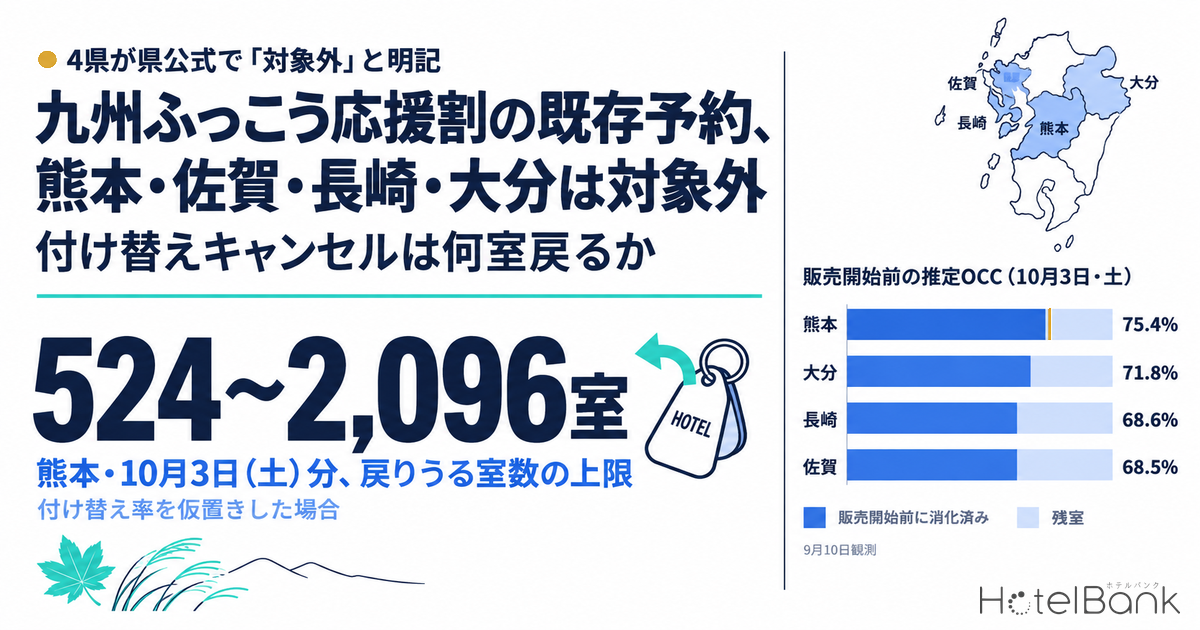
Under the Kyushu Recovery Support Discount (九州ふっこう応援割), four prefectures — Kumamoto, Saga, Nagasaki and Oita — state explicitly on their official pages that bookings made before the sale start date are “not eligible” for the discount (as of September 11, 2026). October rooms sold before the campaign goes on sale will come back once, as cancellations, whenever guests who want the discount rebook. This article measures how much October inventory has already been taken up ahead of each prefecture’s sale start date, using three Saturdays in October, and estimates the upper bound of rooms that could return by prefecture under assumed rebooking rates of 5%, 10% and 20%. It also covers how to resell the returned inventory and how to handle guest enquiries channel by channel.
Metric Definitions Used in This Article
- OCC (occupancy): the share of sold rooms against total rooms in the area (an estimate based on inventory listed for sale on OTAs). In this article it is used, for each stay date, as “the share of inventory already taken up before the sale start date.” It is aggregated over a fixed set of properties that list at least 30% of their total rooms on major booking sites; rooms not listed are counted on the sold side, so the figure runs higher than a property’s actual occupancy.
- Booking curve: the movement of OTA rooms remaining (or estimated OCC) toward the check-in date. LT (lead time) = days until check-in. This article uses only the LT45–LT1 range.
- Rooms taken up: the total rooms of the target properties minus OTA rooms remaining as of the observation date. This is not the same as the number of bookings; it also includes stop-sales and inventory withdrawals.
- Data source: MetroEngines Research (latest observation date: September 10, 2026)
- — Four prefectures state that existing bookings are “not eligible” on their official pages (Kumamoto, Saga, Nagasaki and Oita, as of September 11, 2026). The cut-off is not the prefecture’s start date but the sale start date of each individual product; Fukuoka, Miyazaki and Kagoshima have not announced theirs.
- — For stays on Saturday, October 3, 50.0–81.5% of inventory had already been taken up as of the September 10 observation, before sales opened (estimate; 2,148 properties / 88,850 rooms across seven prefectures).
- — Assuming rebooking rates of 5%, 10% and 20%, the upper bound of rooms that could return is 524–2,096 rooms in Kumamoto for October 3 alone, and roughly 34,000–135,000 room-nights across the four prefectures for stays from October 1 to 25.
- — The return under the 5% scenario equals 2.5–4.1% of total rooms, above the largest single-day swing seen before sales opened (0.15–1.25%). If cancellations cluster over a short window, they are likely to be observable as inventory coming back.
- — Three things hotels should prepare: a single consistent guest-facing script, early release of discount-eligible plans, and relisting of returned inventory. Kumamoto opens at 10:00 on September 15, with operators going on sale in turn as they get ready.
Four prefectures officially exclude existing bookings; three have not announced
First, the programme rules as set out in the prefectures’ own primary sources. The Japan Tourism Agency page for the Kyushu Recovery Support Discount (updated September 11, 2026) covers stays from Thursday, October 1 onward, with a discount rate of 60% in Kumamoto and Kagoshima and 50% in the other five prefectures. The cap is ¥20,000 per person per night (¥30,000 for trips of two nights or more that include transport, and ¥35,000 for multi-prefecture itineraries covering two or more prefectures). Booking start dates are published by prefecture in a table, but as of the same date Fukuoka, Miyazaki and Kagoshima are still shown as “—”. How much October inventory remains in those three prefectures that have yet to announce a start date is therefore still an open question at the time of writing.
The treatment of existing bookings is not stated on the Japan Tourism Agency page; each prefecture gives its own guidance. Kumamoto says, “Travel products already booked are not eligible; we appreciate your understanding” (updated September 11), and Oita uses the same wording (updated September 3). Nagasaki says, “Bookings made on or after the sale start date of an eligible travel product qualify for the discount. Bookings made before that date are not eligible” (updated September 8), and Saga states, “Applications submitted before the booking start date are not eligible for the discount” (announced September 11). In short, none of the four prefectures has a mechanism to apply the discount retroactively.
The operational dividing line is that the cut-off is set at the sale start date of the individual product, not the prefecture’s start date. Kumamoto opens at 10:00 on Tuesday, September 15, with “operators going on sale in turn as they get ready,” while Saga has different start dates by channel: Thursday, September 24 for online booking sites and Friday, October 2 for travel agencies. Even within the same prefecture, the boundary against existing bookings shifts from property to property depending on when — and through which channel — its own discounted product goes on sale.
| Prefecture | Discount rate | Booking / sale start (as of 9/11) | Existing bookings (as stated officially) |
|---|---|---|---|
| Kumamoto | 60% | From 10:00 on Tuesday, September 15; operators go on sale in turn as they get ready | Not eligible (updated 9/11) |
| Saga | 50% | Online booking sites Thursday, September 24 / travel agencies Friday, October 2 | Applications before the booking start date are not eligible (announced 9/11) |
| Nagasaki | 50% | Targeting the third week of September (some online booking sites earlier) | Bookings on or after the sale start date qualify; earlier bookings are not eligible (updated 9/8) |
| Oita | 50% | Planned for late September | Not eligible (updated 9/3) |
| Fukuoka | 50% | Not announced | Not announced |
| Miyazaki | 50% | Not announced | Not announced |
| Kagoshima | 60% | Not announced | Not announced |
Source: Japan Tourism Agency, “Kyushu Recovery Support Discount” (updated 9/11), and the official pages of Kumamoto, Saga, Nagasaki and Oita prefectures; compiled by the HotelBank Editorial Team. The eligible period in all four prefectures covers stays from October 1 to December 25 (Saga through check-out on December 26), ending once the budget is exhausted.
October Saturdays were already 50–80% taken up before sales opened
So how much inventory has already sold by the time sales open? Lining up the estimated OCC for Saturday, October 3, Saturday, October 10 (the first day of a three-day weekend) and Saturday, October 17 as observed on September 10 in MetroEngines Research data, October 3 stood at 81.5% in Fukuoka, 75.4% in Kumamoto, 71.8% in Oita, 68.6% in Nagasaki, 68.5% in Saga, 56.5% in Miyazaki and 50.0% in Kagoshima. For October 10, the first day of the long weekend, Oita at 83.5%, Saga at 82.2% and Fukuoka at 80.2% all cleared 80%, and six prefectures excluding Kagoshima clustered in the 76–84% band.
These figures are close to a floor for how much was taken up before sales opened. Kumamoto’s October 3 stay date has been rising 0.71 points per day over the past seven days; if that pace held over the five days to the September 15 sale start, it would reach around 79%. Saga has 14 days until its online booking sites open on September 24, and extending the same pace puts October 3 in the mid-74% range. Both are rough guides from mechanically extending the recent pace, not forecasts.
Scope for 10/3: Fukuoka 430 properties / 29,881 rooms; Saga 132 / 4,167; Nagasaki 248 / 11,384; Kumamoto 360 / 13,899; Oita 453 / 10,870; Miyazaki 153 / 6,667; Kagoshima 372 / 11,982 (based on listings on major booking sites; 10/10 and 10/17 are of similar scale at 131–452 properties per prefecture). Observed September 10, 2026 (10/3 = LT23, 10/10 = LT30, 10/17 = LT37).
Source: MetroEngines Research; compiled by the HotelBank Editorial Team
That said, estimated OCC is not the same as the number of bookings. The take-up rate of OTA inventory also reflects stop-sales and inventory withdrawals by properties. In fact, Kagoshima’s October 3 stay date rose 7.8 points in a single day on August 28, when the programme details were announced — alongside additional bookings, that may include inventory being re-released as properties prepared their discounted products. And even when the set is narrowed to properties listing at least 30% of their total rooms, unlisted rooms are counted on the taken-up side. That is why the estimates below serve as an upper bound.
Booking curve for stays on Saturday, October 3 (estimated OCC; LT45 to LT23 observed, LT22 onward not yet observed). Saga’s online booking site start (9/24) corresponds to LT9 for that stay date. Scope is the same seven prefectures as the table above: 2,148 properties / 88,850 rooms (based on listings on major booking sites).
Source: MetroEngines Research; compiled by the HotelBank Editorial Team
Rooms that could return at rebooking rates of 5%, 10% and 20%
Next, we multiply the rooms already taken up by assumed rebooking rates to estimate an upper bound for rooms that could come back as cancellations. The rebooking rate is not an evidence-based estimate; it is an assumption used to get a sense of scale. Rather than a single forecast, we lay out three scenarios: 5%, 10% and 20%.
For Saturday, October 3 alone, Kumamoto’s 10,481 rooms taken up translate into 524 rooms at 5%, 1,048 at 10% and 2,096 at 20%. Per property, the 10% scenario works out to roughly 2.9 rooms in Kumamoto, 3.1 in Nagasaki, 2.2 in Saga and 1.7 in Oita. By contrast, the take-up that actually accumulated over the roughly three weeks since LT45 (August 19) was only 2,071 rooms in Kumamoto, which at the same rates gives 104–414 rooms. Since rebooking can also apply to reservations made early, the reality is likely to fall between these two ranges.
| Prefecture | Properties / rooms | Est. OCC | Rooms taken up | of which since LT45 | 5% | 10% | 20% | Rooms remaining now |
|---|---|---|---|---|---|---|---|---|
| Kumamoto | 360/13,899 | 75.4% | 10,481 | 2,071 | 524 | 1,048 | 2,096 | 3,418 |
| Saga | 132/4,167 | 68.5% | 2,856 | 333 | 143 | 286 | 571 | 1,311 |
| Nagasaki | 248/11,384 | 68.6% | 7,811 | 539 | 391 | 781 | 1,562 | 3,573 |
| Oita | 453/10,870 | 71.8% | 7,809 | 939 | 390 | 781 | 1,562 | 3,061 |
| Fukuoka (not announced) | 430/29,881 | 81.5% | 24,354 | 3,482 | 1,218 | 2,435 | 4,871 | 5,527 |
| Miyazaki (not announced) | 153/6,667 | 56.5% | 3,767 | 457 | 188 | 377 | 753 | 2,900 |
| Kagoshima (not announced) | 372/11,982 | 50.0% | 5,989 | 2,097 | 299 | 599 | 1,198 | 5,993 |
Stays on Saturday, October 3, observed September 10, 2026 (LT23). The 5%, 10% and 20% columns are assumed rebooking rates applied to rooms taken up, giving an “upper bound of rooms that could return.” “Of which since LT45” is the increase in rooms taken up between August 19 (LT45) and September 10. Fukuoka, Miyazaki and Kagoshima are shown for reference because their treatment of existing bookings has not been announced.
Source: MetroEngines Research; compiled by the HotelBank Editorial Team
Upper bound of rooms that could return for stays on Saturday, October 3, by rebooking scenario. Scope: 2,148 properties / 88,850 rooms across seven prefectures (based on listings on major booking sites), observed September 10, 2026.
Source: MetroEngines Research; compiled by the HotelBank Editorial Team
The comparison against rooms remaining is another useful operational signal. For Kumamoto’s October 3 stay date, the 1,048 rooms in the 10% scenario equal roughly 30% of the 3,418 rooms currently remaining. Returned inventory does not merely mean “more empty rooms”; it temporarily thickens the sellable pool for that same date. Properties that can shift inventory into the price band where the discount bites are the ones best placed to catch the rebooking demand.
Widening the view to the first half of the eligible period — the 25 nights from October 1 to 25 — the scale grows further. Summing stay dates through October 25, which are observable within LT45, rooms taken up across the four prefectures that have announced existing bookings as ineligible total 676,093 room-nights, giving roughly 34,000 room-nights at 5%, 68,000 at 10% and 135,000 at 20%. This is an upper bound that includes unlisted rooms, and is best treated as a rough guide to the volume of cases to be processed.
| Prefecture | Properties in scope | Taken up (room-nights) | 5% | 10% | 20% |
|---|---|---|---|---|---|
| Kumamoto | 356–362 | 236,180 | 11,809 | 23,618 | 47,236 |
| Nagasaki | 248–252 | 198,509 | 9,925 | 19,851 | 39,702 |
| Oita | 449–454 | 174,557 | 8,728 | 17,456 | 34,911 |
| Saga | 130–133 | 66,847 | 3,342 | 6,685 | 13,369 |
| Four-prefecture total | — | 676,093 | 33,805 | 67,609 | 135,219 |
Aggregate of stays from October 1 to 25 (25 nights), observed September 10, 2026 (LT21–LT45 for each stay date). Eligible rooms across the four prefectures total 1,010,697 room-nights (based on listings on major booking sites). Rebooking rates are assumptions.
Source: MetroEngines Research; compiled by the HotelBank Editorial Team
How to spot inventory coming back — use the daily swing before sales opened as a yardstick
Whether rebooking actually happens can be tracked by watching for days on which rooms remaining temporarily rise just after sales open. Rooms remaining can, however, rise on some days even before sales open. Counting day-on-day increases in the booking curves for stays from October 1 to 25 (within LT45, using only days where the property set matched the previous day), the share of days on which rooms remaining rose was 2.1% in Fukuoka, 12.0% in Kumamoto and 19.0% in Miyazaki, and the largest single-day return ranged from 0.15% of total rooms (Fukuoka) to 1.25% (Miyazaki).
Using that pre-launch swing as a yardstick shows how detectable rebooking would be. For October 3, the 5% rebooking scenario equals 2.5–4.1% of total rooms, above each prefecture’s largest swing. If cancellations cluster over a short window, they are likely to be observable as inventory coming back. On the other hand, if guests secure the new booking first and cancel the old booking at the same property afterwards, inventory barely moves. It is worth remembering that an absence of observed returns does not mean rebooking is not happening. For a case where inventory that had already sold was measured coming back at the last minute for a different reason, see Typhoon Stays: 48.3% of Okinawa Hotels Get Inventory Back, 3.1x Normal.
Grey: the largest single-day return of rooms remaining observed for stays from October 1 to 25 (as a share of total rooms at the properties in scope). Blue: rooms that could return for stays on October 3 under a 5% rebooking rate (same basis). Scope: 2,148 properties / 88,850 rooms across seven prefectures (10/3, based on listings on major booking sites).
Source: MetroEngines Research; compiled by the HotelBank Editorial Team
Kumamoto opens sales at 10:00 on Tuesday, September 15, and as of the time of writing (September 11) there are no observations from after that point. From September 16 onward we will track whether a temporary rise in rooms remaining appears for October stay dates (not yet observed). Saga’s online booking site start (September 24) and travel agency start (October 2) can be compared the same way.
What hotels should prepare — scripts, reselling and channel-by-channel contact points
Even if the scale of rebooking stays within the range of these scenarios, hotels face a period of handling enquiries and re-releasing inventory at the same time. Getting ready in the few days before sales open makes it easier to capture the rebooking demand as bookings at your own property.
1. Prepare your cancellation-policy script in advance. The prefectures’ official pages say nothing about how cancellation fees should be handled when guests rebook (none of the four addressed it as of the time of writing). Cancellation fees are governed by the property’s terms and the conditions of the booked plan, so decide your own policy — apply the standard terms, or treat rebooking cases differently — and make sure the same wording is used on your website, in booking confirmation emails and over the phone. One example: “Guests who have already booked are not eligible for the discount under the prefecture’s guidance. If you would like the discount, please make a new booking on a discount-eligible plan and then cancel your existing reservation. Cancellation may incur a fee under our standard terms.”
2. Resell the returned inventory on discount-eligible plans. The basic move is to re-release returned inventory for the same date as a product the discount applies to. In prefectures like Kumamoto, where operators go on sale “in turn as they get ready,” the sooner you release your discounted products, the sooner you secure a place to catch rebooking demand. The cap is ¥20,000 per person per night (in Kumamoto and Kagoshima at 60% off, that means up to roughly ¥67,000 per room for two guests sharing falls within the full-benefit range; in the five prefectures at 50%, up to roughly ¥80,000), so it pays to design the price band of the returned inventory against that cap. Where the cap starts to bite is estimated alongside actual prevailing rates by prefecture in Kyushu Recovery Subsidy Set: 60%/50% Split, ¥20,000 Cap Hits Top 10%.
3. Check for returning inventory daily. By the yardstick above, any day where the return exceeds 1% of total rooms can be treated as movement beyond the pre-launch swing. Deciding in advance to review inventory and pricing starting from the stay dates with the largest returns speeds up decision-making.
4. Align contact points and start dates by channel. The channel that took the original booking may differ from the one handling the rebooking. In a prefecture like Saga, where travel agencies open on October 2, the rebooking window for existing agency bookings opens later than it does for online booking sites.
| Channel | Main contact point for cancellation / rebooking | What the hotel needs to decide |
|---|---|---|
| Direct (phone, official website) | Front desk / reservations team | Cancellation fee policy, the order in which the same room is secured when rebooking (new booking first, then cancel the old one), guest-facing script |
| Online booking sites | Guests complete the process on the booking site | Release date for discount-eligible plans, display of cancellation conditions on existing plans, relisting of returned inventory |
| Travel agencies | The travel agency’s own desk | Each prefecture’s start date for travel agencies (Saga: 10/2), procedures for returning and reallocating allotment inventory |
Source: compiled by the HotelBank Editorial Team from the sales-method descriptions on each prefecture’s official page
Enquiry FAQ (for the front desk)
| Common question | Key points of the answer |
|---|---|
| Can the discount be added later to an October stay I have already booked? | Kumamoto, Saga, Nagasaki and Oita officially exclude existing bookings. Fukuoka, Miyazaki and Kagoshima had not announced as of 9/11. |
| Will I be charged a cancellation fee if I rebook? | It depends on our terms and the conditions of the booked plan (answer with your own policy). |
| When can I book with the discount? | It varies by prefecture, channel and property. Kumamoto opens from 10:00 on 9/15 with operators going on sale in turn as they get ready; Saga opens on 9/24 for online booking sites and 10/2 for travel agencies. State your own property’s start date clearly. |
| Can I switch while keeping the same room? | Advise guests to make the new booking on a discount-eligible plan first and cancel the existing reservation once it is secured, so they do not lose the room. |
| How long does the discount run? | Stays from 10/1 to 12/25, ending once the budget is exhausted. |
Conclusion
Under the Kyushu Recovery Support Discount, Kumamoto, Saga, Nagasaki and Oita have all officially stated that existing bookings are not eligible, with the cut-off set at the sale start date of each product. For stays on Saturday, October 3, inventory was already taken up at 75.4% in Kumamoto, 71.8% in Oita, 68.6% in Nagasaki and 68.5% in Saga as of September 10. Assuming rebooking rates of 5%, 10% and 20%, between 524 and 2,096 rooms in Kumamoto on that date alone — and roughly 34,000 to 135,000 room-nights across the four prefectures for stays from October 1 to 25 — could become subject to rebooking. All of these are upper-bound guides that include unlisted rooms and stop-sales.
If rebooking clusters over a short window, it is likely to be observable as a return exceeding the daily swing seen before sales opened (up to 0.15–1.25% of total rooms). Movement after Kumamoto’s sale start will be tracked from September 16. For hotels, the fastest route to capturing rebooking demand at their own property is to get three things in place first: a consistent guest-facing script, early release of discount-eligible plans, and relisting of returned inventory.
A note on data for future dates: the estimated OCC in this article is an interim reading based on the take-up of inventory listed on major booking sites as of September 10, 2026, and will move as the check-in date approaches. The take-up rate of OTA inventory also includes stop-sales and inventory withdrawals, and is not the same as the number of bookings. Rebooking rates are assumptions and do not forecast the actual number of rebookings. The programme details for each prefecture are as published at the time of writing (September 11) and may be updated.
References and Sources
- Japan Tourism Agency, “Kyushu Recovery Support Discount” (updated September 11, 2026)
- Kumamoto Prefecture, “About the Kumamoto Recovery Support Discount” (updated September 11, 2026)
- Saga Prefecture, “50% off travel and accommodation: launching the Kyushu Recovery Support Discount Saga Campaign” (September 11, 2026)
- Nagasaki Prefecture, “About the Kyushu Recovery Support Discount” (updated September 8, 2026)
- Oita Prefecture, “Kyushu Recovery Support Discount” (updated September 3, 2026)
- Travel Watch, “Kumamoto Prefecture: Kyushu Recovery Support Discount bookings open at 10:00 on September 15” (September 11, 2026)
- Travel Watch, “Saga Prefecture travel support: Kyushu Recovery Support Discount Saga Campaign bookings start September 24” (September 11, 2026)
- MetroEngines Research — booking curves and estimated OCC for the seven Kyushu prefectures (stays from October 1 to 25, observed September 10, 2026, within LT45)