

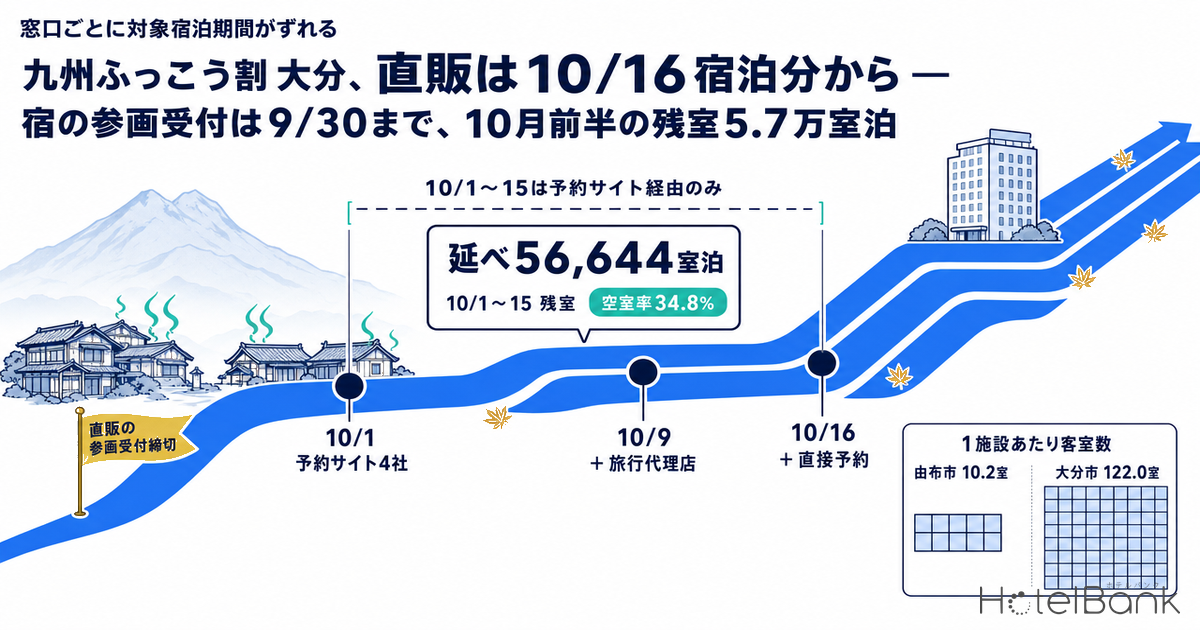
Oita Prefecture’s share of the Kyushu Fukko Ouenwari (Kyushu Recovery Support Discount) goes on sale through online booking sites (OTAs) at 12:00 on Friday, September 25, 2026. Oita’s scheme design, however, has a feature not seen in the prefectures that launched earlier: it is not only the sales start date that differs by sales channel, but the eligible stay period itself. The discount applies to OTA bookings for stays from October 1, to travel-agency bookings for stays from October 9, and to direct bookings sold by the properties themselves only for stays from October 16.
This 15-day gap does not affect every property equally. According to MetroEngines Research data on October inventory at 459 properties with 10,846 rooms in Oita (based on listings on major booking sites), 56,644 room-nights remain unsold for October 1–15. The smaller the average property, the more it will have to fight these first 15 days through OTAs alone — above all in Yufu City and Kokonoe Town, where properties average only 10-odd rooms. This article first sets out the differences in channel design using materials published by Oita Prefecture and the Japan Tourism Agency, then examines how much October inventory remains on which dates, by property type and by municipality.
Metric Definitions Used in This Article
- Occupancy (OCC): the share of rooms sold out of total rooms in the area (an estimate based on OTA sales inventory). It is estimated from how inventory sold on major booking sites is being taken up, and is defined differently from a property’s actual overall occupancy.
- LT (lead time): the number of days before check-in. All inventory snapshots in this article were observed on September 16, 2026; stays on October 1 are at LT15 and stays on October 31 at LT45. Observations beyond a 45-day lead time are not used, because they include periods before listed allocations have been loaded.
- Unsold rooms (room-nights): the number of unsold rooms on each stay date, summed over the days in the period.
- ADR (average daily rate): an estimated settled rate (tax-excluded equivalent) derived by applying property-type adjustment factors to the lowest published plan rate each property lists on booking sites (two guests per room, per-room rate, tax included). Cross-checked against property-level results disclosed by listed hotel REITs (91 properties, most recent three months), the median error is about 7%. It is an estimate and differs from each property’s actual transacted rates or accounting figures. Used for settled months only.
- Listed price: the all-plan average per-room rate (room-only through meal-inclusive plans; two guests per room, tax included). Used for future months.
- Data source: MetroEngines Research
- — Eligible stay periods differ by channel: in Oita, the four OTAs cover stays from 10/1, travel agencies from 10/9, and direct bookings from 10/16. For the 15 nights of 10/1–15, the discount can be sold only through OTAs.
- — 56,644 room-nights: unsold inventory for 10/1–15 across 459 properties and 10,846 rooms in Oita (vacancy rate 34.8%, observed September 16, 2026) — the same order of magnitude as the roughly 50,000 nights of funding reported in the press.
- — Direct-sales opt-in closes September 30: discounted direct bookings start with stays from 10/16, but the registration window closes five days after OTA sales begin (9/25).
- — +3.7pt on launch day: in Nagasaki, estimated occupancy for October 10, 2026 stays jumped from 79.1% to 82.8% on the single day of 9/15 — about 12 times the average daily pace of the preceding 13 days.
- — 10.2 rooms per property in Yufu City and 11.5 in Kokonoe Town: the smaller the properties, the more the first half of October depends on OTAs alone. Oita City averages 122.0 rooms, a 12-fold gap within the prefecture.
In Oita, “the eligible stay period differs by channel” — how the design differs from Nagasaki
Set the list published by Oita Prefecture (updated September 3, 2026) alongside that of Nagasaki Prefecture, which launched sales earlier (Japan Tourism Agency page, updated September 15), and the difference in design philosophy between the two prefectures becomes clear.
In Nagasaki, all three channels cover stays from October 1; only the sales start dates differ (two OTAs on September 15, direct bookings on September 28, travel agencies and other sites on September 30). The channels that start selling earlier have an advantage, but the product they can sell is the same.
In Oita, by contrast, the stay dates each channel can sell are themselves different. The four OTAs cover October 1 – December 25, travel agencies October 9 – December 25, and properties’ direct bookings October 16 – December 25. In other words, the 15 nights from October 1 to 15 can structurally be sold at the discount in Oita only through OTAs. For the eight nights from October 1 to 8, the four OTAs are the only channel at all.
| Prefecture | Channel | Booking start | Eligible stay period | Property registration window |
|---|---|---|---|---|
| Oita | Four OTAs | Fri, Sep 25, 12:00 | Oct 1 – Dec 25 | — |
| Travel agencies (with a branch in the prefecture) | Fri, Oct 9 | Oct 9 – Dec 25 | Sep 18 – Sep 25 | |
| Properties (direct booking) | Fri, Oct 16 | Oct 16 – Dec 25 | Sep 18 – Sep 30 | |
| Nagasaki | Two OTAs | Tue, Sep 15 | Oct 1 – Nov 30 (December to follow) | — |
| Properties (direct booking) | Mon, Sep 28 | Oct 1 – Dec 25 | — | |
| Travel agencies and other sites | Wed, Sep 30 | Oct 1 – Dec 25 | — |
Source: compiled by HotelBank Editorial Team from Oita Prefecture, “Kyushu Fukko Ouenwari” (updated September 3, 2026) and Japan Tourism Agency, “Kyushu Fukko Ouenwari” (updated September 15, 2026)
Source: compiled by HotelBank Editorial Team from materials published by Oita Prefecture and the Japan Tourism Agency
The subsidy rate is 50% of the travel or accommodation price (60% for multi-prefecture itinerary products spanning Oita and Kumamoto or Kagoshima). The discount cap is ¥20,000 per night for accommodation only, ¥20,000 for a one-night transport-inclusive stay, ¥30,000 for transport-inclusive stays of two nights or more, and ¥35,000 for multi-prefecture itineraries. How the subsidy rates and caps were aligned across the seven prefectures is set out, as of when the scheme was confirmed, in Kyushu Recovery Subsidy Set: 60%/50% Split, ¥20,000 Cap Hits Top 10%.
Whether this cap actually binds at prevailing prices is worth checking. Oita’s listed price for October 2026 (all-plan average, two guests per room, tax included) is ¥35,528 per room, or about ¥17,800 per person. Even at 50%, the discount comes to only about ¥8,900 — well short of the ¥20,000 cap. Even in Yufu City, the prefecture’s highest-priced area, the listed price is ¥48,053 per room (about ¥24,000 per person), for a discount of about ¥12,000. At Oita’s typical price levels, the full 50% passes through without being held down by the cap. Rather than adjusting prices to work around the cap, the more straightforward design is to put into the plan what guests will find worthwhile once the 50% applies.
The deadline to join direct sales is September 30 — five days after OTA sales begin
Alongside the differences in eligible periods by channel, the operational deadline to keep in mind is the registration window for properties. According to Oita Prefecture’s published materials, registration for travel agencies runs from September 18 to 25, and for properties (direct booking) from September 18 to 30. Properties are subject to the condition that they be “limited to those from whom a written pledge and other documents can be collected in person.” The dedicated website and call centre (Kyushu Fukko Ouenwari Oita Campaign Secretariat) opened on September 18.
This creates a mismatch in timing. Direct bookings can carry the discount only for stays from October 16, but the procedure to get into that allocation closes on September 30. Since sales through the four OTAs start on September 25, properties have effectively only five days to observe “how fast rooms sell on OTAs.” Put the other way round, there is little room to revisit the decision on direct sales later, so for undecided properties an easy approach is to complete the registration first and decide later whether to use it from October 16.
The scale of the funding is also relevant to the decision. Oita’s discount budget is reported at about ¥1bn, and Governor Sato said at a September 1 press conference that it would cover about 50,000 nights (TOS TV Oita, September 1, 2026; Nikkei, September 15, 2026). Oita Prefecture’s official page does not state the budget amount or the treatment of existing bookings (as checked on September 17, 2026), so these amounts are figures from press reports.
Setting this against inventory shows how scarce the funding is. MetroEngines Research data on inventory at 459 properties and 10,846 rooms in Oita (based on listings on major booking sites) show 56,644 unsold room-nights for the 15 nights of October 1–15 alone (a vacancy rate of 34.8% against 162,652 room-nights of capacity). The 16 nights of October 16–31 still have 58,469 unsold room-nights (33.9%). The roughly 50,000 nights of funding reported in the press is of about the same order as the open allocation in the first half of October, and is not on a scale that covers the entire period to December 25. Given that Nagasaki’s advance sale, which opened at 10:00 on September 15, sold out in about 20 minutes (Nagasaki International Television, September 15, 2026), building the October inventory allocation on the assumption that funds will be used up early makes it less likely to miss the opportunity. Note also that the scheme lapses, for now, on December 25, so the rise in guests’ effective cost for stays from December 26 onward is a separate point to plan for.
October inventory splits into three bands — 10/1–8, 10/9–15 and 10/16 onward
Mapping the channel design onto stay dates splits Oita’s October into three bands. From October 1 to 8 only the four OTAs are available; from October 9 to 15 there are two channels, OTAs plus travel agencies; and from October 16 all three channels, including direct booking, are in place. The next chart shows the inventory position for each band as observed on September 16.
Coverage: 459 properties / 10,846 rooms (based on listings on major booking sites; ryokan: 235 properties / 3,692 rooms). Observed September 16, 2026, LT15–45. Source: MetroEngines Research; compiled by HotelBank Editorial Team
By day, Oita’s October demand is concentrated on Saturdays and the three-day weekend. Saturday, October 10 has reached 85.6% for all properties and 90.1% for ryokan, and Sunday, October 11 — the middle day of the three-day weekend that includes Sports Day on Monday, October 12 — stands at 75.7% for all properties and 80.0% for ryokan, well above a normal Sunday (60–67%). Saturday, October 17 is at 79.9% for all properties and 82.4% for ryokan, Saturday, October 24 at 76.1% and 77.8%, and Saturday, October 31 at 75.8% and 78.1%.
Weekday inventory, by contrast, is nearly level across the bands. The weekday average for all properties is 61.2% for October 1–8, 60.9% for October 9–15 and 61.8% for October 16–31. For ryokan the figures are 66.0%, 68.4% and 68.6%. There is almost no difference in weekday demand between the three bands; the only difference is “how many channels can sell the discount”.
Coverage: all properties 459 / 10,846 rooms; ryokan 235 / 3,692 rooms; business hotels 39 / 3,651 rooms; resort hotels 31 / 1,486 rooms (based on listings on major booking sites). City hotels (9 properties / 1,229 rooms) are excluded because their inventory time series lack complete observation points. Observed September 16, 2026, LT15–45. Source: MetroEngines Research; compiled by HotelBank Editorial Team
| Property type | Properties | Rooms | Rooms per property | 10/1–15 unsold | 10/1–15 vacancy rate | 10/16–31 unsold |
|---|---|---|---|---|---|---|
| Ryokan | 235 | 3,692 | 15.7 | 16,188 room-nights | 29.2% | 16,426 room-nights |
| Business hotels | 39 | 3,651 | 93.6 | 20,062 room-nights | 36.6% | 21,447 room-nights |
| Resort hotels | 31 | 1,486 | 47.9 | 8,199 room-nights | 36.9% | 7,804 room-nights |
| All properties | 459 | 10,846 | 23.6 | 56,644 room-nights | 34.8% | 58,469 room-nights |
“All properties” includes, besides the three types above, holiday rentals, cottages, guesthouses, minshuku and others. Observed September 16, 2026, LT15–45. Source: MetroEngines Research; compiled by HotelBank Editorial Team
The closer to 10 rooms per property, as in Yufu and Kokonoe, the more the first half of October rests on OTAs alone
Where the effect of the channel design falls is easiest to see from the size mix of properties. The 235 ryokan have 3,692 rooms in total, or 15.7 rooms per property. The 39 business hotels have 3,651 rooms, or 93.6 per property, so roughly the same number of rooms is shared among properties one-sixth the size. At the municipal level the gap widens further.
Coverage: Beppu City 142 properties / 4,066 rooms; Yufu City 164 / 1,681 rooms; Kokonoe Town 33 / 381 rooms; Oita City 16 / 1,952 rooms; Hita City 30 / 651 rooms (based on listings on major booking sites). Observed September 16, 2026, LT15–45. Source: MetroEngines Research; compiled by HotelBank Editorial Team
| Municipality | Properties | Rooms | Rooms per property | 10/1–15 occupancy | 10/16–31 occupancy | 10/1–15 unsold |
|---|---|---|---|---|---|---|
| Yufu City | 164 | 1,681 | 10.2 | 70.6% | 67.1% | 7,420 room-nights |
| Kokonoe Town | 33 | 381 | 11.5 | 70.9% | 71.9% | 1,661 room-nights |
| Hita City | 30 | 651 | 21.7 | 66.8% | 70.4% | 3,244 room-nights |
| Beppu City | 142 | 4,066 | 28.6 | 69.9% | 71.5% | 18,356 room-nights |
| Oita City | 16 | 1,952 | 122.0 | 58.8% | 60.0% | 12,060 room-nights |
Based on listings on major booking sites. Observed September 16, 2026, LT15–45. Source: MetroEngines Research; compiled by HotelBank Editorial Team
Yufu City has 164 properties with 1,681 rooms, or 10.2 rooms per property. Kokonoe Town has 33 properties with 381 rooms, or 11.5 per property. Oita City, by contrast, has 16 properties with 1,952 rooms, or 122.0 per property. Even within the same prefecture, property size differs 12-fold.
This size mix translates directly into the number of channels in play. Inns of around 10 rooms inevitably have limited staff to devote to in-person paperwork and sales management. For the 15 nights of October 1–15, Oita’s scheme design offers no option to sell the discount through direct booking at all, so for this period the inventory allocated to the four OTAs is, in effect, the ceiling on discounted sales. Yufu City has 7,420 unsold room-nights for October 1–15 and Kokonoe Town 1,661; this is the room for growth in the first half.
Note that the data in this article aggregate inventory listed on major booking sites and do not show each property’s direct-booking share as such. For properties with small listed allocations, several explanations are possible — channel operations centred on direct booking, inventory control that releases rooms to booking sites a little at a time, or contractually small allotments — and public data alone cannot distinguish between them.
What happened on Nagasaki’s launch day — +3.7pt in a single day
As a guide to how inventory will move when OTA sales start on September 25, the movement in Nagasaki, which launched earlier on September 15, is instructive. We compared the occupancy trajectory for stays on Saturday, October 10 across 258 properties and 11,449 rooms in Nagasaki and 459 properties and 10,846 rooms in Oita.
Coverage: Nagasaki 258 properties / 11,449 rooms; Oita 459 properties / 10,846 rooms (based on listings on major booking sites). Stays on Saturday, October 10, 2026, LT24–38. Source: MetroEngines Research; compiled by HotelBank Editorial Team
In Nagasaki, occupancy rose from 75.1% to 79.1% over the 13 days from September 2 to 14, a pace of about 0.3pt per day. Then, on launch day, September 15, it moved from 79.1% to 82.8% — +3.7pt in a single day, about 12 times the average pace of the preceding 13 days. On the same day Oita moved from 84.6% to 84.9% (+0.3pt), its normal pace. The same pattern appears for other dates in Nagasaki: stays on Saturday, October 3 went from 69.0% on September 14 to 72.0% on September 15 (+3.0pt), and stays on Saturday, October 17 from 75.6% to 78.6% (+3.0pt).
Taken together with Nagasaki’s advance sale selling out in about 20 minutes, it is closer to reality to expect launch-day inventory take-up to happen not “gradually over several days” but “as a single jump on the day”. It is worth assuming the same behaviour for Oita at 12:00 on September 25 and locking in launch-day inventory and pricing in advance.
What small ryokan can do in the first half of October
Here we rearrange the figures so far in the order of practical steps. As a starting point, the vacancy rate for Oita’s 235 ryokan over October 1–15 is 29.2%, lower than business hotels (36.6%) and resort hotels (36.9%) over the same period. Ryokan are already the property type with the tightest inventory; the question is how to use the 15 days in which sales are narrowed to a single channel.
1. Allocate more inventory to the four OTAs on weekdays from October 1 to 15. Weekday occupancy for all properties is 61.2% for October 1–8 and 60.9% for October 9–15, and 66.0% and 68.4% for ryokan. The gap to weekends (Friday–Sunday) is up to 25pt, which is the most straightforward room for growth. During these 15 days, the channels that can carry the discount are limited to booking sites (only the four OTAs for the first eight days, with travel agencies joining from the 9th), which makes it easier to decide to shift allocations held on other channels to OTAs for this period only.
2. Look at the three-day weekend in terms of length of stay rather than allocation. Saturday, October 10 has reached 90.1% for ryokan and Sunday, October 11 is at 80.0%, while Monday, October 12 — Sports Day — is at 68.0%, the same level as a weekday. Creating demand for the night before the last day of the long weekend is where the remaining headroom lies over these three days. A two-night plan covering October 10–12 also fits the ¥30,000 cap for transport-inclusive stays of two nights or more.
3. Complete the direct-booking registration by September 30. Direct sales at the discount can actually start only with stays from October 16, but registration closes on September 30. Because collecting a written pledge and other documents in person is a stated condition, allow a few days for the paperwork. The final decision on whether to use it can be deferred, but once the deadline passes, the option of a direct-sales allocation for October 16 – December 25 is no longer available at all.
4. Prepare guidance for guests already booked direct for October 16 onward. Oita Prefecture’s official page says nothing about the treatment of existing bookings, and in other Kyushu prefectures there are confirmed cases in which existing bookings are excluded. Enquiries from guests who want to use the direct-sales discount for stays from October 16 can be expected to increase, so summarising on a single page from when, through which channel and for what the discount applies makes it easier for calls and replies from October 16 onward to convert straight into bookings.
5. Rather than worrying about the ¥20,000 cap, build content that makes the 50% count. As noted above, at Oita’s listed price level (¥35,528 per room, about ¥17,800 per person) the discount does not reach the cap, so there is little need to adjust prices to the cap. The estimated settled ADR for October 2025 was ¥14,610 (N=446 properties, settled month), so actual transacted rates are lower still. Because this is a range where the full 50% applies, every increase in rate also increases the value guests feel they are getting.
For properties: plan-name hints for this theme
Most common selling points in autumn and recovery-related plan names published by ryokan in Oita (N=91) ——
Open-air hot spring 55%Points / coupons 52%Wagyu / branded beef 30%Kaiseki course 27%Two meals included 20%Pets 10%
Examples of actual names (anonymised, translated from Japanese):
- [Autumn only! Hot spring × scenic views ◯◯ coupon] <Standard | private-room dining | limited to 2 groups per day> Kaiseki course with a Bungo beef steak main
- ★Oita Wagyu, autumn leaves, hot springs!★ Great value! Autumn-foliage tour plan!! One night with two meals! Free 5kg of rice to take home!
* These are tendencies based on a tally of published plan names; they do not show that naming causes sales.
Summary
Compared with other Kyushu prefectures, the defining design feature of Oita’s Kyushu Fukko Ouenwari is that the eligible stay period itself differs by channel. Whereas in Nagasaki all three channels cover stays from October 1 and only the sales start dates differ, in Oita the four OTAs cover stays from October 1, travel agencies from October 9 and properties’ direct bookings from October 16. The 15 nights of October 1–15 can be sold at the discount only through OTAs, and for October 1–8 the four OTAs are the only channel.
The allocation remaining for these 15 days is 56,644 room-nights across 459 properties and 10,846 rooms in Oita (based on listings on major booking sites). That is the same order as the funding reported in the press (about ¥1bn, about 50,000 nights), and given that Nagasaki’s advance sale sold out in about 20 minutes, assuming funds will be used up early makes it less likely to miss the opportunity.
The impact is greatest for properties with few rooms. Yufu City has 164 properties averaging 10.2 rooms and Kokonoe Town 33 properties averaging 11.5, while Oita City has 16 properties averaging 122.0 — a 12-fold gap within the prefecture. For a 10-room inn, discounted sales in the first half of October are capped by the inventory allocated to OTAs, so the core of the practical work is how to build up weekdays in these 15 days (ryokan at 66.0–68.4%). In addition, the registration window that keeps the direct-sales option open for October 16 onward closes on September 30 — a date worth putting on the same calendar as the September 25 sales launch.
⚠ Note on data for future dates: the occupancy rates, unsold room counts and listed prices for October stays in this article are estimates based on inventory and selling prices listed on major booking sites as of September 16, 2026, and will change as check-in dates approach. Inventory movement may accelerate in particular after sales begin on September 25. The scheme’s details, registration deadlines and eligible properties may also be changed by announcements from each prefecture and the campaign secretariat, so always check Oita Prefecture’s official page and the campaign secretariat’s guidance before making operational decisions.
Related Reading
- Kyushu Recovery Subsidy Set: 60%/50% Split, ¥20,000 Cap Hits Top 10%
- Kyushu Subsidy: Kumamoto & Kagoshima Hold 34.9% of Oct Unsold Rooms
- Nagasaki Early Sep Booking Curves: 9/12 OCC 82.7%, Ryokan 24.2pt Gap
References and Sources
■ Primary sources (local government and ministries)
- Oita Prefecture, “Kyushu Fukko Ouenwari” (Tourism Policy Division, Commerce, Industry, Tourism and Labor Department; updated September 3, 2026) — booking start dates and eligible stay periods by channel, registration periods, subsidy rate and discount caps, secretariat details (in Japanese)
- Japan Tourism Agency, “Kyushu Fukko Ouenwari” (updated September 15, 2026) — list of sales start dates and eligible stay periods by prefecture (in Japanese)
■ News reports
- Travel Watch, “Kyushu Fukko Ouenwari: Oita bookings open at 12:00 on September 25” (September 15, 2026, in Japanese)
- Travel Watch, “Oita’s Kyushu Fukko Ouenwari eligible period runs to the end of December” (September 3, 2026, in Japanese)
- Nikkei, “Kyushu Fukko Ouenwari: Oita bookings from the 25th; partly sold out in Kumamoto and Nagasaki” (September 15, 2026, in Japanese) — discount budget of about ¥1bn for Oita
- Nagasaki International Television, “Nagasaki’s Kyushu Fukko Ouenwari advance sale sells out in about 20 minutes” (September 15, 2026, in Japanese)
- TOS TV Oita, “Kyushu Fukko Ouenwari: ¥1bn of discounts in Oita” (September 1, 2026, in Japanese) — Governor Sato’s press conference, about 50,000 nights
■ Market data
- MetroEngines Research — inventory listed on major booking sites for 459 properties / 10,846 rooms in Oita and 258 properties / 11,449 rooms in Nagasaki (observed September 16, 2026, LT15–45); rooms and estimated occupancy by municipality and property type; listed prices and estimated settled ADR