

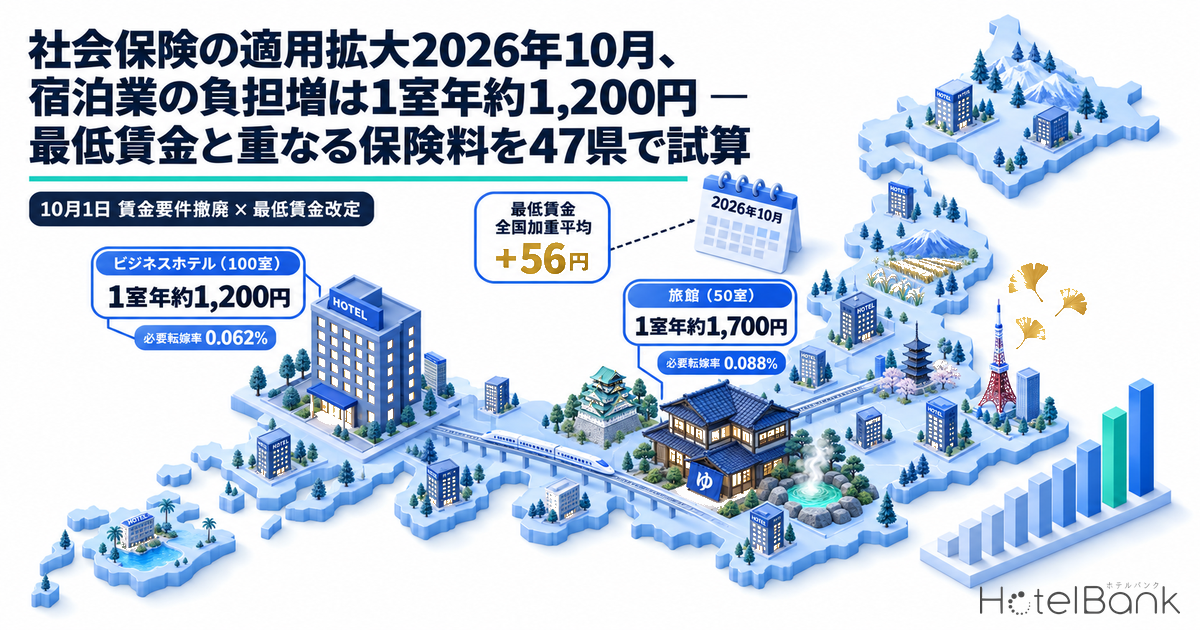
On October 1, 2026, Japan removes the “monthly wage of ¥88,000 or more” requirement that has applied to part-time workers joining Employees’ Health Insurance and the Employees’ Pension, the threshold widely known as the “¥1.06 million wall.” The Cabinet Order setting the effective date (Cabinet Order No. 275 of 2026) was promulgated on September 11. The FY2026 regional minimum wages also take effect, prefecture by prefecture, from the same October. This article estimates how much statutory welfare costs actually move for accommodation operators when these two changes coincide. Using a 100-room business hotel model and a 50-room ryokan model, we convert the change into cost per room and per room-night, and express it as the ADR pass-through needed against the estimated settled ADR in each of the 47 prefectures.
Metric Definitions Used in This Article
- ADR (average daily rate): an estimated settled rate (tax-exclusive equivalent), calculated by applying segment-specific adjustment factors to the lowest-priced plan level each property publishes on OTAs (per room, two guests, tax-inclusive). Checked against property-level results disclosed by listed hotel REITs (91 properties, most recent 3 months), the median error is about 7%. These are estimates and differ from each property’s actual settled prices and accounting figures. Area-level ADR is the median of the properties covered (the level of a typical property in the area). This article uses the 12-month average from September 2025 to August 2026.
- Occupancy: rooms sold in the model are based on room occupancy by property type from the Japan Tourism Agency’s Overnight Travel Statistics Survey, 2025 annual figures (final): 75.3% for business hotels and 38.2% for ryokan.
- Employer contribution rate: the sum of the employer half of health insurance (Japan Health Insurance Association, prefecture-specific rates) and the child and child-rearing support levy, the employer share of Employees’ Pension (9.15%), and the child and child-rearing contribution (0.36%, paid entirely by the employer). Rates are for employees under 40 and exclude long-term care insurance.
- Required pass-through rate: the increase in employer contributions per room-night ÷ estimated settled ADR.
- Data sources: MetroEngines Research; Ministry of Health, Labour and Welfare, Japan Pension Service, Japan Health Insurance Association; Statistics Bureau of Japan (Ministry of Internal Affairs and Communications); Japan Tourism Agency
- — Removing the wage requirement on October 1 brings almost no new part-time workers in the accommodation industry into coverage under our model. Even at the lowest pre-revision minimum wage (¥1,023), 20 hours a week already came to ¥88,660 a month, above the ¥88,000 line.
- — What actually moves in October is the premiums of employees who are already enrolled, which rise with the minimum wage increase (national weighted average +¥56). About ¥1,200 per room per year (¥4.4 per night) for a 100-room business hotel, and about ¥1,700 per room per year (¥12.3 per night) for a 50-room ryokan.
- — The median required pass-through is 0.062% for business hotels and 0.088% for ryokan, comfortably within the growth in estimated settled ADR over the last 12 months (medians of +3.8% and +5.8%).
- — The minimum wage increase on its own moves the standard monthly remuneration by only one grade, so in most cases it does not trigger an interim revision. Premiums will mainly reflect it from the September 2027 contribution month, through the regular annual determination, which coincides with the lowering of the company-size requirement in October 2027.
What changes on October 1, and what does not
Until now, part-time workers joined Employees’ Health Insurance and the Employees’ Pension if they met four requirements (20 or more contracted hours a week, a monthly wage of ¥88,000 or more, expected employment of more than two months, and not being a student) and their employer met a size requirement (51 or more Employees’ Pension insured persons). The pension reform act promulgated in June 2025 (Act No. 74 of 2025) provided that the wage requirement would be removed “within three years of promulgation, once the national minimum wage is confirmed to be ¥1,016 or more.” On September 11, 2026, a Cabinet Order set the effective date at October 1, 2026.
The key point is that only the wage requirement goes away on October 1. The three requirements of 20 hours a week, more than two months, and the student exclusion remain, and the current company-size requirement of 51 or more stays in place until September 2027. The October change therefore reaches only specified applicable offices (companies with 51 or more Employees’ Pension insured persons) and voluntarily applicable offices that have opted in by labor-management agreement.
The figure of “about 2 million people” often cited in the media also needs care. It is a Ministry of Health, Labour and Welfare estimate presented to the Pension Subcommittee of the Social Security Council in July 2024, and it describes the expansion if the company-size requirement were abolished and the non-covered industries for sole-proprietor offices were eliminated, on top of removing the wage requirement. It does not mean that removing the wage requirement on October 1 alone will add 2 million new enrollees.
| Timing | Change | Impact on accommodation operators |
|---|---|---|
| October 1, 2026 | Wage requirement for part-time workers (¥88,000 or more a month) removed (Cabinet Order No. 275 of 2026). The premium adjustment scheme also starts | Applies to specified applicable offices. Given minimum wage levels, almost everyone working 20+ hours a week already meets the wage requirement |
| October 1 – December 2, 2026 | FY2026 regional minimum wages take effect in stages (national weighted average ¥1,177, +¥56) | Pay of existing insured employees rises, and so does the basis for calculating premiums |
| From the September 2027 contribution month | Standard monthly remuneration revised through the regular annual determination (April–June pay) | Main period in which the minimum wage increase shows up in premiums |
| October 1, 2027 | Company-size requirement lowered to 36 or more Employees’ Pension insured persons | New enrollment begins at operators with 36–50 insured persons |
| October 2029 – October 2035 | Company-size requirement lowered to 21 or more (2029) and 11 or more (2032), then abolished (2035). Sole-proprietor offices with 5 or more regular employees established from October 2029 are covered regardless of industry | Coverage extends step by step to small and mid-sized ryokan and hotels |
Source: Compiled from Ministry of Health, Labour and Welfare, “Expansion of Social Insurance Coverage”; Japan Pension Service, “Expansion of Health Insurance and Employees’ Pension Coverage to Part-Time Workers”; Ministry of Health, Labour and Welfare, “FY2026 Regional Minimum Wage Recommendations” (as of September 25, 2026)
The wage requirement was already “not binding”: monthly pay for 20 hours a week at the minimum wage
Why removing the wage requirement produces almost no new enrollment can be checked with arithmetic. Twenty hours a week works out to about 86.7 hours a month (20 hours × 52 weeks ÷ 12 months). Even at the lowest pre-revision minimum wage of ¥1,023 (Kochi, Miyazaki, Okinawa), monthly pay comes to ¥88,660, just above ¥88,000. After the revision it is ¥94,033 at Miyazaki’s ¥1,085, the lowest, and ¥110,933 at Tokyo’s ¥1,280.
In other words, anyone paid at least the minimum wage with 20 or more contracted hours a week already met the wage requirement in all 47 prefectures. This is exactly why the Ministry of Health, Labour and Welfare set “a minimum wage of ¥1,016” as the benchmark for removal. For accommodation operators, the October 1 removal is closer to an administrative clean-up than a new cost: the check on “monthly pay” drops out of the eligibility test, which can now be decided on contracted hours alone.
Source: Prepared by MetroEngines Research and HotelBank Editorial Team from Ministry of Health, Labour and Welfare, “FY2026 Regional Minimum Wage Recommendations” (converted at 20 hours × 52 weeks ÷ 12 months)
How many hours do part-time workers in accommodation work?
Next, we look at working hours to see which groups in the accommodation industry are affected. According to the Statistics Bureau’s 2022 Employment Status Survey, the accommodation industry has 496,700 employees, of whom 253,300 (51.0%) are non-regular staff and 203,700 (41.0%) are part-timers. Compared with a part-timer share of 24.2% across all industries, accommodation is clearly an industry supported by short-hours workers.
Among those part-timers who work on a regular schedule, 30.4% work under 20 hours a week, 33.4% work 20–29 hours, and 36.1% work 30 hours or more. Those working 30 hours or more are often already insured regardless of company size, under the standard of “at least three-quarters of a regular worker’s hours.” It is the 20–29 hour group whose enrollment depends on the company-size requirement, and about 48,500 people in accommodation fall into it. Even this group, however, will be brought into coverage by the lowering of the company-size requirement from October 2027 onward, not by the October wage requirement removal.
Source: Prepared by MetroEngines Research and HotelBank Editorial Team from Statistics Bureau of Japan, 2022 Employment Status Survey (population by sex, industry, annual working days, regularity of work, weekly working hours, and employment status/type). Shares are for part-timers who work on a regular schedule, set to 100%
Model estimate: October moves the premiums of existing insured employees
Based on the above, we estimated the change in employer contributions at the October milestone for two models. The assumptions are as follows. Staffing varies widely from property to property, so treat these figures as a standard case that illustrates the approach.
| Item | A. 100-room business hotel | B. 50-room ryokan |
|---|---|---|
| Size of operating company | 51+ Employees’ Pension insured persons (specified applicable office) | Single entity, 50 or fewer |
| Part-timers at the property | 14 | 17 |
| Of whom insured (as of October) | 9.7 (4.7 at 20–29 hours + 5.1 at 30+ hours) | 6.1 (30+ hours) |
| New enrollees from wage requirement removal | 0 | 0 (outside the company-size requirement) |
| Representative weekly hours | 25 hours / 32 hours | 32 hours |
| Hourly wage increase | Each prefecture’s minimum wage increase (+¥54–65) | |
| Employer contribution rate | By prefecture (14.23%–14.90%) | |
| Annual rooms sold | 27,485 room-nights (occupancy 75.3%, calendar 2025) | 6,972 room-nights (occupancy 38.2%, calendar 2025) |
| Increase in employer contributions (annual, median) | About ¥121,000 | About ¥85,000 |
| Per room per year (median) | About ¥1,200 | About ¥1,700 |
| Per room-night (median) | ¥4.4 | ¥12.3 |
| Required pass-through rate (median) | 0.062% | 0.088% |
Source: Prepared by MetroEngines Research and HotelBank Editorial Team (model estimate). Staffing mix applies the weekly working-hour distribution for accommodation from the Ministry of Internal Affairs and Communications’ 2022 Employment Status Survey. Rates are the FY2026 rates of the Japan Health Insurance Association and Japan Pension Service. Medians are across 47 prefectures (46 for ryokan, excluding Okinawa, where fewer than 30 properties are covered by the estimated settled ADR)
A (the 100-room business hotel) is a specified applicable office, so part-time workers working 20 hours or more are already enrolled. All that happens in October is that pay rises with the minimum wage, and the basis for calculating premiums rises with it. The wage increase for 9.7 insured employees is about ¥830,000 a year; the employer contribution on it is about ¥121,000 a year at the 47-prefecture median, or about ¥1,200 per room per year.
B (the 50-room ryokan) is outside the company-size requirement, so its 5.7 employees working 20–29 hours do not become eligible after October either. The cost that moves is for the 6.1 employees at 30+ hours who are already enrolled: about ¥85,000 a year, or about ¥1,700 per room per year. Because the ryokan sells fewer room-nights, the per-night figure is ¥12.3, about 2.8 times the business hotel’s. The pattern in which occupancy, more than the amount itself, determines how heavily labor costs weigh is the same one we found in our earlier analysis of the 2026 minimum wage increase, which put the added labor cost at ¥9,600 per room per year.
We also show the combined effect with the minimum wage. Counting only insured part-time workers, A’s October increase, wages plus employer contributions, is about ¥950,000 a year, or about ¥9,500 per room per year. The employer’s social insurance contribution equals roughly 14.6% of the wage increase. An estimate of the total wage bill including non-insured part-timers and full-time staff is beyond the scope of this model.
Premiums reflect it from the September 2027 contribution month — checking standard monthly remuneration grades
Beyond the “size” of the cost, financial planning also needs to know “when it hits the invoice.” Social insurance premiums are set by the grade of standard monthly remuneration, not by actual pay. An interim revision, which changes the grade mid-year after a pay rise, requires not only a change in fixed wages but also “a difference of two or more grades on a three-month average” (Japan Pension Service).
Take someone working 25 hours a week at the minimum wage. In Tokyo, monthly pay rises from about ¥132,800 to about ¥138,700, and standard monthly remuneration moves up one grade, from ¥134,000 to ¥142,000. The employer contribution rises by about ¥1,200 a month, but a one-grade change does not meet the interim revision requirement. Checking all 47 prefectures for two working patterns, 25 and 32 hours a week, we found no case in which the minimum wage increase alone moved the grade by two or more. At 25 hours a week, the grade does not change at all in 11 prefectures: Tochigi, Gunma, Saitama, Chiba, Toyama, Ishikawa, Fukui, Nagano, Gifu, Aichi and Fukuoka.
As a result, most of the minimum wage increase will be reflected in premiums from the September 2027 contribution month (paid in October), through the regular annual determination based on April–June 2027 pay. The model’s annual figures are best read as an expected value averaged over employees with varied working hours. In September–October 2027, this regular determination coincides with the lowering of the company-size requirement to 36 or more. HotelBank estimates the latter as a separate step of roughly ¥20,000–¥39,000 per room per year, and placing both in the same period of the FY2027 budget makes the outlook easier to read.
| Effective date | Prefectures | Main prefectures |
|---|---|---|
| October 1 | 15 | Hokkaido, Miyagi, Saitama, Chiba, Tokyo, Kanagawa, Aichi, Osaka, Hyogo and others |
| October 2–31 | 22 | Shizuoka (15th), Hiroshima (11th), Fukuoka (4th), Kagoshima (25th) and others |
| November | 7 | Yamanashi, Tokushima, Ehime, Oita (1st), Nagasaki (2nd), Saga (15th), Kyoto (16th) |
| December | 3 | Iwate, Kumamoto (1st), Okinawa (2nd) |
Source: Compiled from Ministry of Health, Labour and Welfare, “FY2026 Regional Minimum Wage Recommendations” (based on recommendations; finalized after the objection procedure)
Note that minimum wage effective dates are not all October 1. Fifteen prefectures take effect on October 1, while Kyoto takes effect on November 16 and Okinawa on December 2. The wage requirement removal and the minimum wage revision fall on the same day only in those 15 prefectures; elsewhere there is a gap of several weeks to two months between them. For the full list of effective dates and what they mean for room-rate design, see Japan Minimum Wage 2026: Chiba & Aichi ¥1,195, Oct 1-15 Rollout.
Required pass-through in 47 prefectures — 0.03–0.08% for business hotels
Applying each prefecture’s minimum wage increase and health insurance rate, we divided the per-night cost increase for a business hotel (100-room model) by the estimated settled ADR. The lowest required pass-through is Tokyo at 0.029%, followed by Kyoto at 0.032%, Fukuoka at 0.040% and Osaka at 0.042%. The higher a city’s rate level, the smaller the pass-through for the same cost. At the top are Kagoshima at 0.081%, Ehime, Tokushima and Saga at 0.077% each, and Tottori at 0.076%, all regions with large minimum wage increases and room rates around ¥6,000.
Source: Prepared by MetroEngines Research and HotelBank Editorial Team. Estimated settled ADR for business hotels (September 2025 – August 2026 average, N=32–914 properties per prefecture). Cost increase is employer contributions in the 100-room model (under-40 rates)
For ryokan (50-room model), Kyoto at 0.051% and Hyogo and Kanagawa at 0.054% are the lowest, while Miyazaki at 0.171%, Ibaraki at 0.162% and Tokushima at 0.160% are the highest. The ryokan pass-through is about 1.4 times the business hotel figure (median ratio), yet no prefecture exceeds 0.2%.
Source: Prepared by MetroEngines Research and HotelBank Editorial Team. Estimated settled ADR for ryokan (September 2025 – August 2026 average, 46 prefectures with 30 or more covered properties, N=38–503 properties per prefecture). Cost increase is employer contributions in the 50-room model (under-40 rates)
Source: Prepared by MetroEngines Research and HotelBank Editorial Team. Circle shade shows the required pass-through rate for the 100-room business hotel model.
| Prefecture | Minimum wage (revised) | Increase | Effective date | Employer contribution rate | Business hotel per room/year | Business hotel ADR | Business hotel pass-through | Ryokan ADR | Ryokan pass-through |
|---|---|---|---|---|---|---|---|---|---|
| Hokkaido | ¥1,131 | +¥56 | Oct 1 | 14.77% | ¥1,198 | ¥8,881 (N=430) | 0.049% | ¥9,671 | 0.125% |
| Aomori | ¥1,090 | +¥61 | Oct 29 | 14.55% | ¥1,286 | ¥7,150 (N=87) | 0.065% | ¥10,655 | 0.122% |
| Iwate | ¥1,090 | +¥59 | Dec 1 | 14.38% | ¥1,229 | ¥6,384 (N=85) | 0.070% | ¥9,044 | 0.137% |
| Miyagi | ¥1,098 | +¥60 | Oct 1 | 14.68% | ¥1,276 | ¥7,568 (N=140) | 0.061% | ¥13,584 | 0.095% |
| Akita | ¥1,090 | +¥59 | Oct 14 | 14.63% | ¥1,251 | ¥7,400 (N=59) | 0.061% | ¥9,101 | 0.139% |
| Yamagata | ¥1,092 | +¥60 | Oct 30 | 14.50% | ¥1,261 | ¥6,877 (N=76) | 0.067% | ¥13,382 | 0.095% |
| Fukushima | ¥1,094 | +¥61 | Oct 16 | 14.38% | ¥1,270 | ¥6,177 (N=156) | 0.075% | ¥11,014 | 0.117% |
| Ibaraki | ¥1,136 | +¥62 | Oct 18 | 14.38% | ¥1,292 | ¥6,711 (N=184) | 0.070% | ¥8,068 | 0.162% |
| Tochigi | ¥1,125 | +¥57 | Oct 1 | 14.54% | ¥1,200 | ¥6,562 (N=137) | 0.067% | ¥16,992 | 0.071% |
| Gunma | ¥1,120 | +¥57 | Oct 3 | 14.46% | ¥1,195 | ¥6,500 (N=102) | 0.067% | ¥15,909 | 0.076% |
| Saitama | ¥1,196 | +¥55 | Oct 1 | 14.46% | ¥1,152 | ¥7,664 (N=147) | 0.055% | ¥13,929 | 0.084% |
| Chiba | ¥1,195 | +¥55 | Oct 1 | 14.49% | ¥1,155 | ¥8,082 (N=163) | 0.052% | ¥13,895 | 0.084% |
| Tokyo | ¥1,280 | +¥54 | Oct 1 | 14.55% | ¥1,138 | ¥14,178 (N=914) | 0.029% | ¥11,094 | 0.104% |
| Kanagawa | ¥1,279 | +¥54 | Oct 1 | 14.59% | ¥1,141 | ¥9,221 (N=210) | 0.045% | ¥21,403 | 0.054% |
| Niigata | ¥1,108 | +¥58 | Oct 1 | 14.23% | ¥1,196 | ¥6,761 (N=127) | 0.064% | ¥13,834 | 0.087% |
| Toyama | ¥1,119 | +¥57 | Oct 1 | 14.42% | ¥1,191 | ¥6,473 (N=69) | 0.067% | ¥13,310 | 0.090% |
| Ishikawa | ¥1,113 | +¥59 | Oct 3 | 14.47% | ¥1,237 | ¥7,827 (N=109) | 0.058% | ¥18,326 | 0.068% |
| Fukui | ¥1,112 | +¥59 | Oct 4 | 14.48% | ¥1,238 | ¥7,465 (N=45) | 0.060% | ¥15,222 | 0.082% |
| Yamanashi | ¥1,113 | +¥61 | Nov 1 | 14.40% | ¥1,273 | ¥7,945 (N=73) | 0.058% | ¥12,951 | 0.099% |
| Nagano | ¥1,117 | +¥56 | Oct 2 | 14.44% | ¥1,172 | ¥7,779 (N=167) | 0.055% | ¥13,453 | 0.088% |
| Gifu | ¥1,121 | +¥56 | Oct 1 | 14.53% | ¥1,179 | ¥7,362 (N=120) | 0.058% | ¥15,022 | 0.079% |
| Shizuoka | ¥1,154 | +¥57 | Oct 15 | 14.43% | ¥1,192 | ¥7,048 (N=220) | 0.062% | ¥18,823 | 0.064% |
| Aichi | ¥1,195 | +¥55 | Oct 1 | 14.59% | ¥1,163 | ¥7,820 (N=325) | 0.054% | ¥14,597 | 0.081% |
| Mie | ¥1,143 | +¥56 | Oct 1 | 14.51% | ¥1,177 | ¥6,857 (N=95) | 0.062% | ¥16,905 | 0.070% |
| Shiga | ¥1,136 | +¥56 | Oct 3 | 14.56% | ¥1,182 | ¥7,479 (N=83) | 0.057% | ¥14,390 | 0.083% |
| Kyoto | ¥1,180 | +¥58 | Nov 16 | 14.57% | ¥1,224 | ¥13,892 (N=321) | 0.032% | ¥24,378 | 0.051% |
| Osaka | ¥1,231 | +¥54 | Oct 1 | 14.69% | ¥1,149 | ¥10,016 (N=497) | 0.042% | ¥11,470 | 0.101% |
| Hyogo | ¥1,172 | +¥56 | Oct 1 | 14.69% | ¥1,191 | ¥7,674 (N=167) | 0.056% | ¥22,192 | 0.054% |
| Nara | ¥1,107 | +¥56 | Oct 4 | 14.58% | ¥1,183 | ¥8,690 (N=32) | 0.050% | ¥16,822 | 0.071% |
| Wakayama | ¥1,101 | +¥56 | Oct 3 | 14.65% | ¥1,189 | ¥6,260 (N=71) | 0.069% | ¥13,826 | 0.087% |
| Tottori | ¥1,090 | +¥60 | Oct 3 | 14.55% | ¥1,265 | ¥6,053 (N=52) | 0.076% | ¥13,310 | 0.096% |
| Shimane | ¥1,092 | +¥59 | Oct 10 | 14.60% | ¥1,248 | ¥7,353 (N=54) | 0.062% | ¥15,953 | 0.079% |
| Okayama | ¥1,104 | +¥57 | Oct 2 | 14.65% | ¥1,210 | ¥7,182 (N=96) | 0.061% | ¥13,057 | 0.094% |
| Hiroshima | ¥1,141 | +¥56 | Oct 11 | 14.52% | ¥1,178 | ¥7,700 (N=186) | 0.056% | ¥16,916 | 0.070% |
| Yamaguchi | ¥1,101 | +¥58 | Oct 8 | 14.70% | ¥1,235 | ¥6,256 (N=97) | 0.072% | ¥15,400 | 0.081% |
| Tokushima | ¥1,103 | +¥57 | Nov 1 | 14.74% | ¥1,218 | ¥5,778 (N=74) | 0.077% | ¥7,692 | 0.160% |
| Kagawa | ¥1,092 | +¥56 | Oct 1 | 14.63% | ¥1,187 | ¥7,339 (N=90) | 0.059% | ¥12,068 | 0.099% |
| Ehime | ¥1,093 | +¥60 | Nov 1 | 14.62% | ¥1,271 | ¥5,991 (N=101) | 0.077% | ¥10,793 | 0.119% |
| Kochi | ¥1,086 | +¥63 | Oct 29 | 14.65% | ¥1,337 | ¥7,443 (N=68) | 0.065% | ¥9,815 | 0.138% |
| Fukuoka | ¥1,114 | +¥57 | Oct 4 | 14.68% | ¥1,212 | ¥10,900 (N=338) | 0.040% | ¥13,570 | 0.090% |
| Saga | ¥1,095 | +¥65 | Nov 15 | 14.90% | ¥1,403 | ¥6,597 (N=49) | 0.077% | ¥20,417 | 0.069% |
| Nagasaki | ¥1,087 | +¥56 | Nov 2 | 14.65% | ¥1,189 | ¥6,708 (N=126) | 0.064% | ¥10,342 | 0.116% |
| Kumamoto | ¥1,092 | +¥58 | Dec 1 | 14.66% | ¥1,232 | ¥6,948 (N=118) | 0.065% | ¥16,958 | 0.073% |
| Oita | ¥1,096 | +¥61 | Nov 1 | 14.66% | ¥1,296 | ¥6,424 (N=92) | 0.073% | ¥18,370 | 0.071% |
| Miyazaki | ¥1,085 | +¥62 | Oct 24 | 14.51% | ¥1,303 | ¥6,303 (N=86) | 0.075% | ¥7,695 | 0.171% |
| Kagoshima | ¥1,090 | +¥64 | Oct 25 | 14.69% | ¥1,362 | ¥6,104 (N=159) | 0.081% | ¥10,396 | 0.132% |
| Okinawa | ¥1,086 | +¥63 | Dec 2 | 14.35% | ¥1,309 | ¥8,865 (N=194) | 0.054% | — | — |
Source: Prepared by HotelBank Editorial Team from Ministry of Health, Labour and Welfare (minimum wages, based on recommendations), Japan Health Insurance Association (FY2026 rates), and MetroEngines Research (estimated settled ADR, September 2025 – August 2026 average; figures in parentheses are the number of business hotels covered). Ryokan ADR is shown as “—” for prefectures with fewer than 30 covered properties
Where is the room to pass costs through? Opportunities by ADR growth and price band
Set against recent ADR movements, the required pass-through turns out to be within what pricing can absorb. Estimated settled ADR for September 2025 – August 2026 rose year on year by a median of +3.8% for business hotels and +5.8% for ryokan. ADR growth exceeded this required pass-through in 43 of 47 prefectures for business hotels and 41 of 46 for ryokan.
By price band, the per-night cost increase is about ¥4.4 for business hotels and about ¥12.3 for ryokan. That is 0.07% for a business hotel with a ¥6,000 ADR and 0.04% at ¥10,000, and 0.08% for a ryokan with a ¥15,000 ADR and 0.06% at ¥20,000. The higher the rate, the less visible the pass-through; the lower the rate, the easier it is to absorb by slightly refining price differences by season and day of week. For example, adjusting selling prices on peak days by a few tens of yen generates more than the annual increase. This is a scale that can be handled as an extension of normal revenue management, matching prices to high-demand days, rather than as a price hike.
| ADR (estimated settled) | Business hotel (¥4.4 per night) | Ryokan (¥12.3 per night) |
|---|---|---|
| ¥6,000 | 0.073% | 0.205% |
| ¥8,000 | 0.055% | 0.154% |
| ¥10,000 | 0.044% | 0.123% |
| ¥15,000 | 0.029% | 0.082% |
| ¥20,000 | 0.022% | 0.062% |
Source: Prepared by MetroEngines Research and HotelBank Editorial Team (sensitivity using the model’s median estimates)
Options that assume enrollment, and designing contracted hours
From October, employers also gain one more tool. The premium adjustment scheme lets an employer pay part of the employee’s share of premiums for part-time workers newly enrolled through the expansion (standard monthly remuneration of ¥126,000 or less), for up to three years in total. The additional premiums the employer pays are refunded by deduction from later premiums, so according to the Japan Pension Service the premiums the employer ultimately pays do not increase. The employee’s future pension is not reduced either. On the other hand, once use begins it cannot be stopped midway. The scheme is worth considering as a way to ease hours restriction driven by lower take-home pay and to secure staff for peak seasons.
Even offices outside the company-size requirement can enroll part-time workers as voluntarily applicable offices if labor and management agree. Presenting enrollment as an employee benefit may help secure staff who can work year-round. For a discussion from the shift-design perspective, see Japan Ends the ¥1.06M Wage Threshold Oct 2026: Hotel Shift Design.
Another option is to design contracted hours below 20 a week. About 30% of part-timers in accommodation already work under 20 hours a week, and there is real demand for this as a way of working that suits the individual. With the wage requirement gone, however, eligibility is decided by contracted hours alone. Adjustments that hold down monthly pay no longer affect eligibility, so in practice it is essential to confirm hours design together with the employee’s wishes. Which choice is right depends on each property’s staffing mix and hiring environment.
Summary
Compared with the impression of the headline “the ¥1.06 million wall disappears,” removing the wage requirement on October 1, 2026 barely moves accommodation operators’ costs, because minimum wage levels were already above the requirement. What actually moves in October is the premiums of existing insured employees, tied to the minimum wage increase: about ¥1,200 per room per year for a 100-room business hotel and about ¥1,700 for a 50-room ryokan, with median required pass-through of just 0.062% and 0.088%. That sits comfortably within recent ADR growth.
The planning point is rather the timing. The minimum wage increase reaches premiums from the September 2027 contribution month through the regular annual determination, and the following month the company-size requirement drops to 36 or more. Placing these two side by side in the FY2027 budget and pricing plan turns the step-up into an opportunity to adjust rates ahead of it.
Frequently Asked Questions
Q. How do social insurance eligibility rules change from October 1, 2026?
A. The wage requirement of “a monthly wage of ¥88,000 or more” for part-time workers is removed. The three requirements of 20 or more hours a week, expected employment of more than two months, and not being a student remain, and the company-size requirement (51 or more Employees’ Pension insured persons) continues until September 2027.
Q. Will more hotel and ryokan employees be newly enrolled?
A. Removing the wage requirement alone is expected to add very few. Even at the lowest pre-revision minimum wage of ¥1,023, 20 hours a week came to ¥88,660 a month, above ¥88,000. New enrollment will pick up in earnest from October 2027, when the company-size requirement drops to 36 or more.
Q. When will the minimum wage increase show up in social insurance premiums?
A. The minimum wage increase alone changes standard monthly remuneration by only about one grade, so in most cases it does not qualify for an interim revision (which requires a difference of two or more grades). In that case it is reflected from the September 2027 contribution month (paid in October), after the regular annual determination based on April–June 2027 pay.
Q. How much will it affect hotel and ryokan room rates?
A. In this article’s model, the increase in employer contributions per night is ¥4.4 for a 100-room business hotel and ¥12.3 for a 50-room ryokan. The median required pass-through against estimated settled ADR across the 47 prefectures is 0.062% and 0.088%, within the growth in estimated settled ADR over the last 12 months (medians of +3.8% and +5.8%).
Q. How does the premium adjustment scheme work?
A. For part-time workers newly enrolled through the expansion (standard monthly remuneration of ¥126,000 or less), the employer can pay part of the employee’s share of premiums, for up to three years in total. The additional amount is refunded by deduction from later premiums, so according to the Japan Pension Service the premiums the employer ultimately pays do not increase. Note that once use begins it cannot be stopped midway.
Notes on the estimates: The rules described in this article are based on information published as of the research date, September 25, 2026. Minimum wages are recommended amounts and are finalized after the objection procedure. The model’s staffing mix and working hours are assumptions set as a standard case; actual costs vary with each property’s staffing, age mix (employees aged 40–64 add half of the 1.62% long-term care insurance rate), and whether bonuses and allowances are paid. Estimated settled ADR is an estimate and differs from each property’s actual settled prices.
Related Articles
- Japan Ends the ¥1.06M Wage Threshold Oct 2026: Hotel Shift Design
- Japan Minimum Wage 2026: Chiba & Aichi ¥1,195, Oct 1-15 Rollout
References and Sources
■ Data sources
Estimated settled ADR is MetroEngines Research’s prefecture-level estimated settled ADR (business hotels and ryokan, 12-month average from September 2025 to August 2026; year-on-year comparison against September 2024 – August 2025; business hotels N=32–914 properties per prefecture, ryokan covering the 46 prefectures with 30 or more properties, N=38–503 per prefecture). Rules and rates are from the Ministry of Health, Labour and Welfare, Japan Pension Service and Japan Health Insurance Association (FY2026 rates); minimum wages are the FY2026 regional minimum wage recommendations; the working-hour distribution is from the Statistics Bureau’s 2022 Employment Status Survey; and room occupancy is from the Japan Tourism Agency’s Overnight Travel Statistics Survey, 2025 annual figures (final).
■ Model assumptions
Two models: a 100-room business hotel (specified applicable office, 14 part-timers, of whom 9.7 insured) and a 50-room ryokan (single entity with 50 or fewer, 17 part-timers, of whom 6.1 insured). Representative weekly hours are 25 / 32; hourly wages rise by each prefecture’s minimum wage increase (+¥54–65); employer contribution rates are 14.23%–14.90% by prefecture (under 40, excluding long-term care insurance). Annual rooms sold are calculated from room occupancy of 75.3% (business hotels) and 38.2% (ryokan), both for calendar 2025. Required pass-through rate = increase in employer contributions per room-night ÷ estimated settled ADR.
■ Limitations
Minimum wages are recommended amounts, finalized after the objection procedure. Staffing and working hours are assumptions set as a standard case and exclude full-time staff, age mix (long-term care premiums for ages 40–64), and bonuses and allowances. Estimated settled ADR is an estimate and differs from each property’s actual settled prices. Ryokan figures exclude Okinawa, which has fewer than 30 covered properties. When premiums reflect the change depends on grade movements in each employee’s standard monthly remuneration and differs by property.
- Ministry of Health, Labour and Welfare, “Expansion of Social Insurance Coverage” (Japanese)
- Japan Pension Service, “Expansion of Health Insurance and Employees’ Pension Coverage to Part-Time Workers” (Japanese)
- Effective date for “removal of the wage requirement” set at October 1, 2026 (Cabinet Order No. 275 of 2026, promulgated September 11, 2026) — PSR Network of Certified Social Insurance and Labor Consultants (Japanese)
- Ministry of Health, Labour and Welfare, 16th Pension Subcommittee of the Social Security Council, Document 1 (July 3, 2024) — estimates of coverage expansion (Japanese)
- Japan Pension Service, “What Is the Premium Adjustment Scheme?” (Japanese)
- Japan Pension Service, “Interim Revision (Notification of Change in Monthly Remuneration)” (Japanese)
- Ministry of Health, Labour and Welfare, “Revised Regional Minimum Wages Recommended in All Prefectures” (September 3, 2026) (Japanese)
- Japan Health Insurance Association, “FY2026 Kyokai Kenpo Premium Rates” (Japanese)
- Statistics Bureau of Japan, 2022 Employment Status Survey (table ID 0004008135)
- Japan Tourism Agency, Overnight Travel Statistics Survey, 2025 annual figures (final) (Japanese)
- MetroEngines Research — estimated settled ADR (business hotels and ryokan, by prefecture, September 2024 – August 2026)