

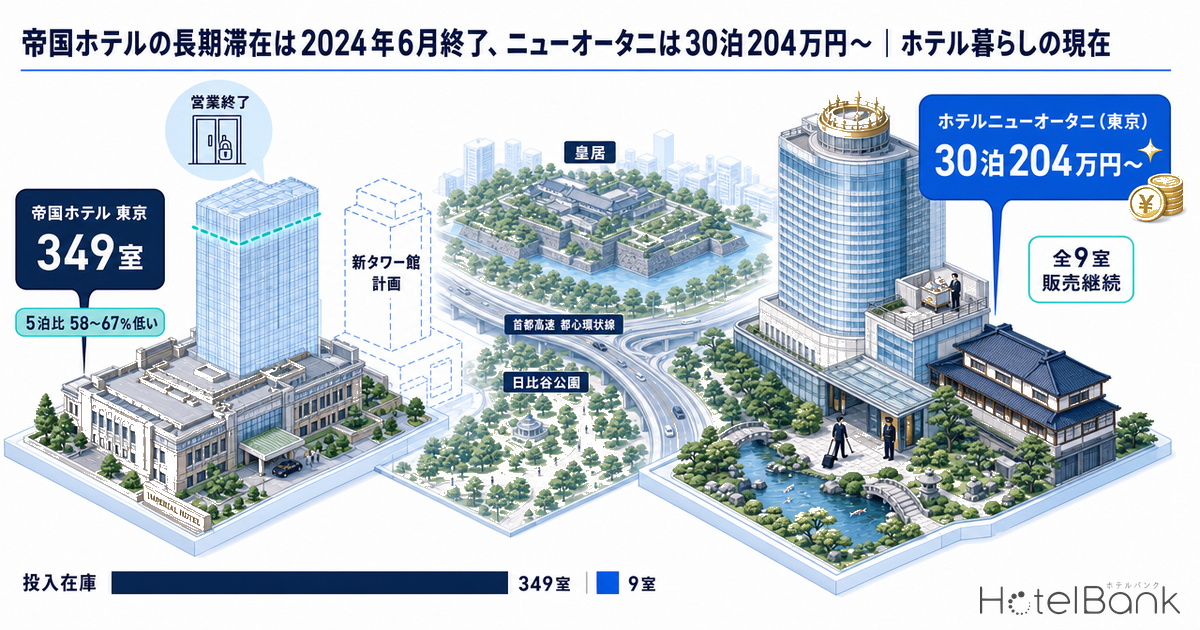
The “living in a hotel” serviced apartment business that Imperial Hotel Tokyo (帝国ホテル 東京) launched in 2021 reached a turning point when its Tower Wing closed on June 30, 2024. Hotel New Otani Tokyo (ホテルニューオータニ), meanwhile, started its own serviced apartment offer as “Home in Hotel” in April 2022 and was still selling it as of September 2026. This article treats the rate cards both properties have published as primary sources, converts their 30-night rates into per-night and per-square-meter figures, and cross-checks them against listed-price data from MetroEngines Research. The aim is to read what it actually means, commercially, for a luxury hotel to run a long-stay product — along two axes: rate architecture, and how much room inventory gets committed.
Metric Definitions Used in This Article
- Published rate: amounts quoted verbatim from rate cards and press releases officially released by Imperial Hotel and Hotel New Otani. All are inclusive of service charge and consumption tax, and exclusive of accommodation tax. The period each rate applies to is stated in the heading of each table.
- Listed price (all-plan average, tax incl.): the average across all plans a property publishes on OTAs and elsewhere. Per-room rate for double occupancy (tax incl.), covering everything from room-only to meal-inclusive plans. It differs from actual transacted prices.
- ADR (average daily rate): an estimated transacted rate derived by applying a segment-specific correction factor to the lowest published plan level each property lists on OTAs (double occupancy, per room, tax incl.), expressed on a tax-excluded basis. Cross-checked against property-level results disclosed by listed hotel REITs (91 properties, most recent 3 months), the median error is roughly 7%. These are estimates and differ from each property’s actual transacted prices and accounting figures. Area-level ADR is the median of the properties covered (the level of a typical property in that area).
- Data sources: official disclosures from Imperial Hotel, Ltd. and New Otani Co., Ltd., and MetroEngines Research
- — Imperial Hotel Tokyo’s serviced apartments reached a turning point with the June 30, 2024 closure of the Tower Wing. The new Tower Wing, due for completion in fiscal 2030, is publicly planned to relaunch the offer with rental housing added
- — Hotel New Otani Tokyo is still running as of September 2026, selling nine rooms in total, mostly suites, from ¥2.04 million for 30 nights
- — The rate designs are opposites. Imperial Hotel used tiered discounting at 58–67% below its five-night per-night rate; New Otani holds the same per-night rate for 30 nights and for each extra night, stacking value through inclusions instead
- — Normalized to one square meter per night, both land in the ¥600–1,500 band. That is roughly two to three times the entry products at launch (¥400–444 per sqm), showing where the center of gravity has moved
- — Committed inventory differs by an order of magnitude: 349 rooms versus nine. Monetizing a wing already slated for closure, or underpinning the top end of a large portfolio — the difference in intent shows up directly in the room count
Imperial Hotel’s long-stay offer paused in June 2024; next comes the fiscal 2030 Tower Wing
First, the facts. Imperial Hotel Tokyo’s serviced apartments occupied floors 20 through 31 of the Tower Wing. According to the company’s news release of January 18, 2024, the Tower Wing opened in 1983 as “Japan’s first mixed-use building combining a hotel, offices, retail and restaurants” — a 31-story, 130-meter structure with retail on floors 1 to 4, offices on floors 5 to 18, and “hotel guest rooms and serviced apartments” on floors 20 to 31. The Tower Wing ceased operations on June 30, 2024, and Imperial Hotel Tokyo moved to operating the Main Building alone.
As of September 2026, therefore, Imperial Hotel Tokyo is not selling a dedicated long-stay product. What matters, though, is that this is not a withdrawal. The company’s March 25, 2022 disclosure, “Plan for Continued Operations During the Redevelopment of the Imperial Hotel Tokyo Site,” states explicitly that the new Tower Wing in the north district, due for completion in fiscal 2030, will offer “rental offices and serviced apartments, plus newly added rental housing.” The plan also names “entry into the rental housing business as a new venture” as one of its pillars, sets the redevelopment period at fiscal 2024 through fiscal 2036 (planned), and puts completion of the new Main Building in fiscal 2036. In other words, what the company learned over three years and three months of operation is slated to be expanded in the next building into a form that includes a residential business.
| Date | Imperial Hotel Tokyo | Hotel New Otani Tokyo |
|---|---|---|
| February 2021 | Serviced apartment business announced (reservations from Feb 1, move-in from Mar 15). 99 rooms across three Tower Wing floors. Studio of approx. 30 sqm at ¥360,000 per month (30 nights) | — |
| December 2021 | Expansion to 12 floors (20F–31F) of the Tower Wing announced. 184 rooms added to the existing 165, for 349 in total. 18 new suites of 72.4–105 sqm | — |
| April 2022 | — | Move-ins begin under “Home in Hotel.” Garden Tower Standard Room (from 27 sqm) from ¥150,000 for 6 nights / ¥360,000 for 30 nights; Shin-Edo Residence Premium Room (from 77 sqm) from ¥2,807,100 for 30 nights |
| June 2024 | Rate card publication ends with the 5th term (departures through June 29). Tower Wing closes June 30 | Sales continue |
| September 2026 | Main Building only. No dedicated long-stay product published | Nine rooms in total, mostly suites, sold as “Serviced Apartment Premium.” From ¥2.04 million for 30 nights |
| Fiscal 2030 (planned) | New Tower Wing completed. Plan to offer rental offices and serviced apartments, plus newly added rental housing | — |
Source: compiled by the HotelBank Editorial Team from official disclosures by Imperial Hotel, Ltd. and New Otani Co., Ltd.
New Otani’s launch announcement and Imperial Hotel’s subsequent expansion were both covered at the time; this article narrows the focus to what the rates have actually looked like since, and how they compare with market levels.
Convert 30-night rates to a nightly basis and the two rate designs look nothing alike
Here is the heart of it. Translate both properties’ published rates into per-night terms and you find that, despite sharing the product name “serviced apartment,” the two build their pricing in opposite ways.
The final rate card Imperial Hotel published (4th and 5th terms, departures through June 29, 2024) listed both a five-night rate and a 30-night rate for five suite types. Converted to a per-night basis, the 30-night figure sits 58–67% below the five-night one. The Penthouse Suite (105 sqm), for example, was ¥1,100,000 for five nights — ¥220,000 a night — against ¥2,424,000 for 30 nights, or ¥80,800 a night. Clearly, a tiered discount was designed in as the consideration for a long stay.
Source: compiled by the HotelBank Editorial Team from Imperial Hotel, “Imperial Hotel Serviced Apartment Rate Card (4th and 5th terms)”
| Room type | Size | 5 nights | 30 nights | Per night (5) | Per night (30) | Gap |
|---|---|---|---|---|---|---|
| Ginza View Corner Suite | 72.4 sqm | ¥630,000 | ¥1,575,000 | ¥126,000 | ¥52,500 | -58.3% |
| Two-Bedroom Suite | 99 sqm | ¥868,000 | ¥1,740,000 | ¥173,600 | ¥58,000 | -66.6% |
| Penthouse Suite | 105 sqm | ¥1,100,000 | ¥2,424,000 | ¥220,000 | ¥80,800 | -63.3% |
| Residential Suite | 66.2 sqm | ¥630,000 | ¥1,575,000 | ¥126,000 | ¥52,500 | -58.3% |
| Residential Suite | 70.1 sqm | ¥945,000 | ¥1,890,000 | ¥189,000 | ¥63,000 | -66.7% |
Source: Imperial Hotel, “Imperial Hotel Serviced Apartment Rate Card (4th and 5th terms)”
Hotel New Otani’s current rate card is built on an entirely different logic. As published in September 2026, 30-night rates for “Serviced Apartment Premium” start at ¥2,040,000 for the Garden Tower Suite (74.7 sqm) and run to ¥2,730,000 for the Shin-Edo Residence Suite (77.0 sqm), across six types. The revealing column is “additional night.” The Garden Tower Suite is ¥2,040,000 for 30 nights — ¥68,000 a night — and each extra night is also ¥68,000. Across all six types, the per-night equivalent of the 30-night rate matches the additional-night rate exactly. Rather than discounting the nightly rate for a long stay, the hotel holds the rate flat and builds the value of the stay out of a thick bundle of inclusions: complimentary restaurant breakfast, use of the members-only sports club Golden Spa New Otani, one free parking space, a workout room, a business center and laundry privileges.
The same thinking runs through “2 Week Stay,” accepted for stays from July 4 through September 30, 2026. This July-to-September special makes a product normally offered from 30 nights available from 14 — yet the Garden Tower Suite’s 14 nights costs ¥952,000, or ¥68,000 a night, identical to the 30-night per-night rate. The call was to widen the entry point by relaxing the minimum stay, not by cutting price. As a lever for the low season, moving only the length-of-stay condition while protecting the rate is a coherent choice.
| Room type | Size | 30 nights | Per night (30) | Additional night | 14 nights (Jul–Sep only) |
|---|---|---|---|---|---|
| Garden Tower Suite | 74.7 sqm | from ¥2,040,000 | ¥68,000 | from ¥68,000 | from ¥952,000 |
| Garden Tower Count Suite | 88.4 sqm | ¥2,100,000 | ¥70,000 | ¥70,000 | ¥980,000 |
| Garden Tower Queen Suite | 88.4 sqm | ¥2,280,000 | ¥76,000 | ¥76,000 | ¥1,064,000 |
| Garden Tower Count Suite (Japanese Garden side) | 88.4 sqm | ¥2,280,000 | ¥76,000 | ¥76,000 | ¥1,064,000 |
| Shin-Edo Residence Deluxe | 55.0 sqm | ¥2,430,000 | ¥81,000 | ¥81,000 | ¥1,134,000 |
| Shin-Edo Residence Suite | 77.0 sqm | ¥2,730,000 | ¥91,000 | ¥91,000 | ¥1,274,000 |
Source: Hotel New Otani Tokyo official website, “Hotel New Otani Serviced Apartment” (surveyed September 2026)
Per square meter, today’s levels sit about twice as high as the launch entry products
Comparing per-night rates across rooms of different sizes tells you little. So normalize the 30-night rates to “per square meter, per night.” Imperial Hotel’s suite types (published 2024) fall between ¥586 and ¥899; New Otani’s six Premium types (published September 2026) between ¥792 and ¥1,473. The two ranges overlap, which tells us that central Tokyo luxury hotels place the consideration for a long stay at roughly ¥600 to ¥1,500 per square meter.
The contrast is with the entry products at launch. The studio (approx. 30 sqm) Imperial Hotel introduced in February 2021 was ¥360,000 per month for 30 nights — ¥12,000 a night, or ¥400 per square meter. The Garden Tower Standard Room (from 27 sqm) that New Otani introduced in April 2022 was likewise from ¥360,000 for 30 nights: the same ¥12,000 a night, ¥444 per square meter. By coincidence, both properties’ entry prices landed on ¥360,000 for 30 nights. Current published levels sit roughly two to three times higher on a per-square-meter basis. The numbers show that both properties have shifted the center of gravity of their long-stay products toward larger, more fully equipped upper-tier rooms.
Source: compiled by the HotelBank Editorial Team from published rates of Imperial Hotel and Hotel New Otani (Imperial Hotel: 4th and 5th terms as published in 2024; New Otani: as published in September 2026)
| Category | Product | Size | 30 nights | Per night | Per sqm, per night |
|---|---|---|---|---|---|
| Imperial, Feb 2021 | Studio | approx. 30 sqm | ¥360,000 | ¥12,000 | ¥400 |
| Imperial, Feb 2021 | Premier Studio | approx. 50 sqm | ¥600,000 | ¥20,000 | ¥400 |
| New Otani, Apr 2022 | Garden Tower Standard Room | from 27 sqm | from ¥360,000 | ¥12,000 | ¥444 |
| Imperial, published 2024 | Five suite types | 66.2–105 sqm | ¥1,575,000–¥2,424,000 | ¥52,500–¥80,800 | ¥586–899 |
| New Otani, Sep 2026 | Six Premium types | 55.0–88.4 sqm | ¥2,040,000–¥2,730,000 | ¥68,000–¥91,000 | ¥792–1,473 |
Source: compiled by the HotelBank Editorial Team from official disclosures by Imperial Hotel and Hotel New Otani
Short-stay prices swing 1.5× within a year — the window where long-stay inventory pays
So why does a luxury hotel keep a long-stay allocation at all? MetroEngines Research listed-price data supplies part of the answer, in the form of seasonality. Imperial Hotel Tokyo’s listed price (all-plan average, tax incl.) over the most recent 12 months (September 2025 to August 2026) peaked at roughly ¥137,300 in October 2025 and bottomed at roughly ¥89,300 in January 2026 — a ratio of 1.54×. Hotel New Otani Tokyo over the same span peaked at roughly ¥103,400 in October 2025 and bottomed at roughly ¥69,900 in January 2026, a ratio of 1.48×. Across Chiyoda Ward as a whole, where both properties sit, estimated transacted ADR moved across a 1.61× span, from roughly ¥12,600 in August 2026 to roughly ¥20,300 in April 2026 (N=80 properties).
Source: MetroEngines Research; compiled by the HotelBank Editorial Team (Chiyoda Ward / N=78–84 properties)
A single 30-night contract works to flatten those peaks and troughs. Instead of cutting the nightly rate in a slow month to chase short-stay bookings, the hotel places a fixed-rate stay in the calendar ahead of time. Fill inventory in a low month without discounting and it becomes easier to defend the price position in peak months. The familiar claim that long-stay products “smooth occupancy” is inseparable from this defense of price position.
Source: MetroEngines Research; compiled by the HotelBank Editorial Team
What is striking is that within New Otani itself, Executive House Zen — 87 rooms by our count — shows listed-price variation across the year of only 1.23× (a high of roughly ¥199,200 in March 2026, a low of roughly ¥162,300 in September 2025). Where the absolute volume of guests is limited to begin with and the quality of demand is stable, prices move less. What a long-stay product is reaching for is exactly this: manufacturing that “demand that does not move” in-house.
Committed inventory: 349 rooms versus nine — an order of magnitude apart under one product name
Alongside rate design, the other decisive difference is how many rooms get turned over to long stays. In the expansion announced in December 2021, Imperial Hotel added 184 rooms to the existing 165 for a total of 349, spread across 12 floors from the 20th to the 31st of the Tower Wing. That means nearly the entire hotel-room portion of a wing already earmarked for closure was committed to long stays. For the time remaining before closure, an asset that cannot easily justify major new investment gets filled with a product carrying long contract terms. A heavily depreciated asset plus a fixed end date: when those two line up, a long-stay product works hardest.
Hotel New Otani Tokyo, by contrast, currently offers nine rooms in total under “Serviced Apartment Premium,” mostly suites, according to its official website. Against the property’s room count as we record it (1,479), that is under 1%. A sliver of a portfolio exceeding 1,000 rooms is locked to long stays and the rest turns on ordinary short-stay selling. Pinning part of the upper-tier inventory to long stays puts a firm floor under the segment that carries the highest rate and whose day-to-day occupancy is hardest to forecast: suite inventory.
This is not a question of which approach is better. Imperial Hotel used a long-stay product to “extract maximum value from the room inventory of a wing scheduled to close”; New Otani uses one to “put a stable floor under the upper tier of a large portfolio.” Different goals produce different inventory commitments and different rate designs.
Evidence that inventory is deliberately rationed survives in Imperial Hotel’s final published rate card. It carried a note for the Studio, Premier Studio and Connecting Studio types reading, “30-night plans for the above room types have reached their limited allocation and are no longer on sale,” and availability for the suite types was shown alongside in symbols. In other words, the 30-night plans had a sales cap, and intake closed once it was reached. Managing the number of rooms routed to long stays, then selling, is visible right there in the operation.
Three questions to settle before launching a long-stay product
Let me pull the above together into three questions, from the standpoint of someone weighing a long-stay product as a business. All three are propositions, not matters with a single correct answer.
First, decide the volume of inventory before anything else. The gap between 349 rooms and nine is not a matter of pricing skill; it is a difference in what problem is being solved. A closure, a major renovation or a wing-level off-season leaves room to commit heavily; under normal operations, starting with a handful of upper-tier rooms is also a legitimate choice. As Imperial Hotel’s rate card showed, setting a sales cap and closing intake once it is hit is an effective design for protecting short-stay inventory.
Second, state explicitly whether the rate architecture is long-stay-discount or flat-rate. Imperial Hotel set a 30-night per-night rate 58–67% below its five-night rate — tiered discounting. New Otani holds the same rate for 30 nights and for each extra night, stacking long-stay value through breakfast, the sports club and parking. The former secures volume more easily when vacancy risk is high; the latter protects the brand’s price band. Which to choose is the flip side of the inventory decision above. On tiered length-of-stay pricing itself, our article Japan Hotel Long-Stay Discounts: 15% at 7 Nights, 20% at 30 Nights examines market-wide levels. The per-tsubo economics of treating serviced apartments as an investment asset is a separate question that we have looked at elsewhere.
Third, treat the minimum stay as a variable independent of price. New Otani’s “2 Week Stay” widens the July-to-September entry point by relaxing the minimum from 30 nights to 14 while leaving the nightly rate untouched. As a way to broaden the base of demand without reaching for a discount, it is a design worth studying.
For hoteliers: plan-name cues that work on this theme
Appeals that appear most often in published plan names for Tokyo × long stay (N=889) —
Consecutive-night discount 80% Room only 41% Breakfast included 37% Long stay / living here 32% Discount 17% Kitchen appliances 10%
Examples of actual names (anonymized):
- [5-Night Plan] — Suite & Deluxe — 15% OFF! Lounge access included (no meals)
- [7-Night Plan] — Suite & Deluxe — 20% OFF! Lounge access included (no meals)
- [3-Night Plan] — Suite & Deluxe — Lounge access included. Perfect as a base for your trip! (no meals)
* A tendency observed in aggregated published plan names; it does not demonstrate that naming causes sales. For a deeper look at market × naming, see our naming benchmark and event articles.
Conclusion
Imperial Hotel Tokyo’s serviced apartments reached a turning point in June 2024 with the closure of the Tower Wing. Yet the company’s redevelopment plan states explicitly that the new Tower Wing, due for completion in fiscal 2030, will offer serviced apartments — with rental housing added on top. What three years and three months of operation taught the company is set to return in the next building as a larger business.
Hotel New Otani Tokyo continues with a deliberately narrow configuration of nine rooms, mostly suites. Its level of ¥2.04 million and up for 30 nights sits in a different band from the entry product at launch, but the design — holding the nightly rate and stacking value through inclusions — and the operating move of relaxing the minimum stay to 14 nights from July to September are consistent as ways to widen the base of demand while protecting the brand’s price position.
For a central Tokyo luxury hotel, a long-stay product is not “a way to sell leftover rooms cheaply.” Published levels of ¥600 to ¥1,500 per square meter represent pricing for a distinct category of product that bundles space, facilities and privileges. And the inventory committed can be 349 rooms or nine, depending on the goal. What anyone weighing this should settle first is not the rate but a single question: which inventory, how much of it, and for how long, gets entrusted to this product.
⚠ A note on prices for future dates: listed prices and estimated transacted ADR for October 2026 onward included in this article’s charts are estimates based on selling prices published on OTAs at the time of the survey, and will shift as the check-in date approaches. Prices set high at present may fall in last-minute adjustments. The published rates of both properties are those in effect at the point noted in each table heading; please confirm the latest applicable rates with each hotel’s reservations desk.
Related reading
- Japan Hotel Long-Stay Discounts: 15% at 7 Nights, 20% at 30 Nights
- Monthly Hotels in Japan: No Lease, 20% Off at 30 Nights (Aug 2026)
References and Sources
■ Imperial Hotel official disclosures
- Imperial Hotel, “A New Value Proposition, Living in a Hotel: Launch of the Serviced Apartment Business, Imperial Hotel Serviced Apartment” (February 1, 2021)
- Imperial Hotel, “Imperial Hotel Serviced Apartment Rate Card (4th and 5th terms)” (departures through June 29, 2024)
- Imperial Hotel, “Imperial Hotel Serviced Apartment Rate Card (March 31, 2024 – June 29, 2024)”
- Imperial Hotel, “Imperial Hotel Tokyo Tower Wing, Opened as Japan’s First Mixed-Use Building, to Close on Sunday, June 30, 2024 as the Hotel Moves to Main Building-Only Operation” (January 18, 2024)
- Imperial Hotel, “Plan for Continued Operations During the Redevelopment of the Imperial Hotel Tokyo Site” (March 25, 2022)
■ Hotel New Otani official disclosures
- Hotel New Otani Tokyo, “Hotel New Otani Serviced Apartment” official page (surveyed September 2026)
- Hotel New Otani Tokyo, “Move-ins Begin April 1! Comfortable Kioicho Living with ‘Home in Hotel’ and Its Dedicated Lounge” (March 31, 2022)
■ Media coverage
■ Price data
- MetroEngines Research — listed price (all-plan average, tax incl.), estimated transacted ADR (Chiyoda Ward, N=78–84 properties), property data