

Selling a hotel room not as “a place to stay” but as “a place to live for a while” is taking hold in Japan as a mainstream option on the supply side. In 2026 alone, Mitsubishi Estate Hotels & Resorts opened the first property of its new brand WAYPOINT in Tsukiji, Tokyo, and the apartment-hotel brand MIMARU reached 1,500 rooms in total with the opening of its 28th property. Yet the segment is described with a tangle of overlapping labels — “extended-stay hotel”, “apartment hotel”, “serviced apartment”, “monthly apartment” — and products with different contract structures and different revenue recognition are lumped together under the same words.
Written for B2B readers (investors, operators and corporate travel managers), this article first draws the boundaries of the market by contract type, then measures the prevailing 30-night price range in three cities — Tokyo, Osaka and Fukuoka — using MetroEngines Research OTA listed-price data. The universe is 163 properties (Tokyo 105, Osaka 23, Fukuoka 35) identified by property name as belonging to brands publicly positioned as extended-stay or apartment-type. Price aggregates are limited to the properties with listed-price observations in the latest three months.
Metric Definitions Used in This Article
- Listed price (lowest-plan level): the monthly average of the cheapest plan each property publishes on OTAs and similar channels, per room for two guests sharing (tax included). The “30-night equivalent” in this article is this level multiplied by 30 — a reference value that differs from actual long-stay or corporate contract rates.
- Listed price (all-plan average): the average of all published plans, from room-only to meal-inclusive, likewise per room for two guests sharing (tax included).
- ADR (average daily rate): an estimated settled rate (tax-exclusive equivalent) calculated by applying a segment-specific adjustment factor to the lowest published OTA plan level. Checked against property-level results disclosed by listed hotel REITs (91 properties, latest three months), the median error is about 7%. It is an estimate and differs from each property’s actual settled prices and accounting figures. Area-level ADR is the median of the properties covered.
- OCC (occupancy rate): the share of rooms sold relative to total rooms in the area (an estimate based on OTA sales inventory). Because it is based on how OTA-listed inventory sells through, it differs from a property’s actual overall occupancy.
- Data source: MetroEngines Research
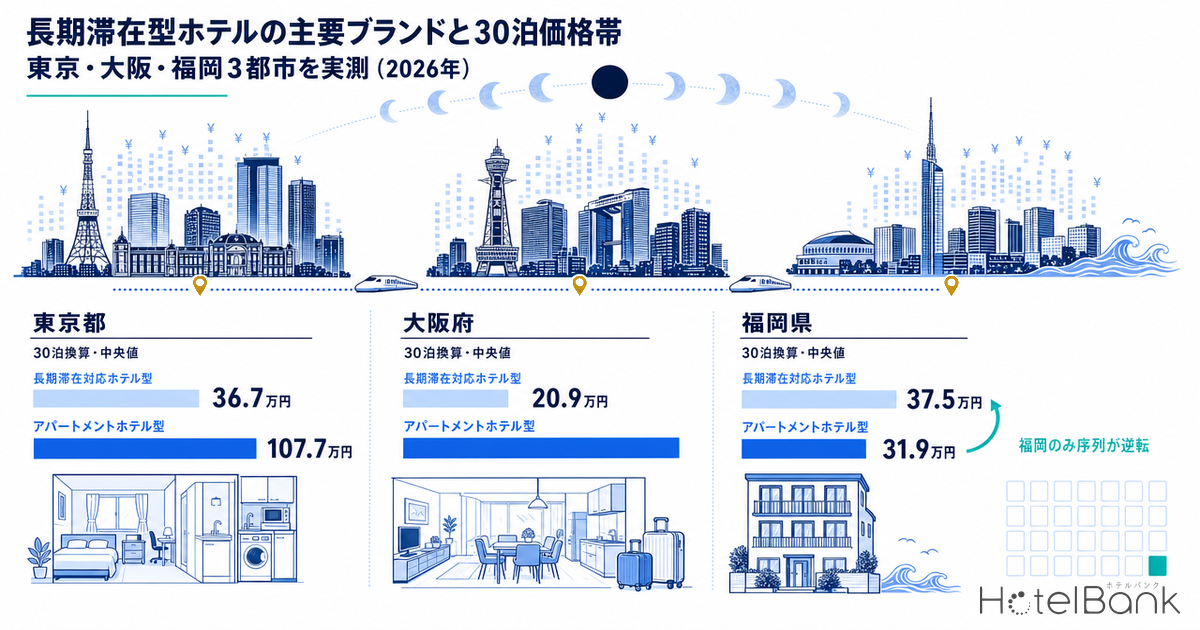
- — In Tokyo, the median 30-night equivalent runs from about ¥370,000 to about ¥1.08 million. Even within “extended stay”, the per-room price of an apartment hotel is roughly three times that of a long-stay-ready hotel.
- — The market boundary is drawn by contract type, not by facilities. Accommodation contracts under the Hotel Business Act allow day-by-day pricing; fixed-term leases lock in the price for the period and are booked as rental income.
- — Only in Fukuoka is the order of the two formats reversed. Apartment hotels (about ¥320,000) come in below long-stay-ready hotels (about ¥380,000), reflecting a supply structure dominated by independents with a median of 19.5 rooms.
- — Inventory sell-through is high in all three cities (estimated occupancy as of August 2026: Tokyo 88.2%, Osaka 80.8%, Fukuoka 89.6%). A product that ties up a room for 30 days carries an opportunity-cost decision.
- — International extended-stay brands are absent from Japan. Hilton’s four extended-stay brands, 1,481 hotels in total, show no hotels operating in Japan in the company’s own fact sheet.
The Market Boundary Is Drawn by Contract Type, Not Facilities
When comparing extended-stay products, attention tends to go to specifications such as whether there is a kitchen or a washer-dryer. From the operator’s point of view, however, the fundamental difference lies in the underlying legal framework and contract type. Change that, and revenue recognition (lodging revenue or rental income), the tools for controlling inventory, and the licences required all change with it.
To summarise: extended-stay hotels, apartment hotels and serviced apartments are all provided under accommodation contracts based on the Hotel Business Act (旅館業法). Because prices can move day by day, they are subject to revenue management. Monthly apartments, by contrast, use fixed-term lease contracts or temporary-use building leases and fall within real-estate leasing, premised on continuous residence of one month or more. Weekly apartments sit in between; depending on how they are operated, they may be classified as a lodging business.
| Format | Legal basis / contract type | Price flexibility | Deposit, key money, guarantor | Revenue recognition |
|---|---|---|---|---|
| Long-stay-ready hotel | Hotel Business Act (accommodation contract) | Variable by day | Not required | Lodging revenue |
| Apartment hotel | Hotel Business Act (accommodation contract) | Variable by day | Not required | Lodging revenue |
| Serviced apartment | Hotel Business Act (accommodation contract); long stays also use individual quotes and monthly pricing | Variable by day (long stays mainly fixed quotes) | Not required | Lodging revenue |
| Weekly apartment | Fixed-term lease etc.; may count as a lodging business depending on how it is operated | Fixed per period | Generally not required (varies by operator) | Rental income |
| Monthly apartment | Fixed-term lease / temporary-use building lease; assumes residence of one month or more | Fixed per period | Generally not required (varies by operator) | Rental income |
Source: Compiled by the HotelBank Editorial Team from the Ministry of Health, Labour and Welfare’s “Overview of the Hotel Business” and published explanations of each contract type
Where this line matters in practice is clear. If a company is securing housing for an employee on a solo posting, a monthly apartment on a rental basis will come in cheaper. For project-type stays where the length of the assignment is not fixed, or where people rotate every few days, accommodation contracts that can be cancelled or extended by the day have the edge. The former is typically paid from general-affairs or HR budgets, the latter from the business unit’s travel budget — so even for the same “30 nights”, the internal decision-making process is entirely different.
Domestic Supply Falls into Three Formats — From Company Disclosures
The three accommodation-contract formats differ in both property size and the length of stay they are designed around. This article classifies them as follows. Within the scope tracked by MetroEngines Research across Tokyo, Osaka and Fukuoka, the median number of rooms per property is 160 for serviced apartments (Tokyo), 39.5 (Tokyo) and 19.5 (Fukuoka) for apartment hotels, and 146.5 for long-stay-ready hotels (Tokyo). Only the apartment hotel is clearly a small-scale format.
| Format | Main brands (listed by format; order does not indicate scale) | Publicly disclosed information |
|---|---|---|
| Serviced apartment Multi-month stays by expatriates and executives | Ascott / Somerset / Citadines / Oakwood / lyf Fraser Suites | Ascott Japan operates five brands and 21 properties in Japan across Tokyo, Yokohama, Osaka, Kyoto and Fukuoka. Citadines North Shinjuku Tokyo is scheduled to open on October 28, 2026 (company announcement). Fraser Suites Akasaka Tokyo opened on August 7, 2020, developed by Frasers Hospitality and Sekisui House (company release). |
| Apartment hotel Multi-night stays by families and groups; large rooms with kitchens | MIMARU MONday Apart WAYPOINT | On September 1, 2026, MIMARU opened its 28th property, MIMARU Osaka Shinsaibashi CENTRAL (66 rooms), bringing its total to 1,500 rooms, with a target of 3,000 rooms by 2030 (Daiwa House Industry release). Rooms start at about 40㎡ with a kitchen and dining area. The hotel MONday group has 24 properties in Tokyo, 5 in Kyoto and 1 in Osaka (JHAT announcement). WAYPOINT opened WAYPOINT TSUKIJI TOKYO on April 1, 2026 (52 rooms; Deluxe 37.28㎡ / Suite 68.28㎡, up to 6 guests, mini-kitchen and washer-dryer in some rooms) and targets 10 properties by 2030 (Mitsubishi Estate Hotels & Resorts release). |
| Long-stay-ready hotel Solo mid-length business trips and training; central station-front locations | Tokyu Stay Villa Fontaine Hotel MyStays and others | Tokyu Stay rooms are equipped with a washer-dryer, mini-kitchen and microwave, with an average room size of about 20㎡. The brand officially offers mid- to long-stay plans of up to 31 nights and flat-rate long-stay plans (company website). Villa Fontaine operates large properties in central Tokyo and at Haneda Airport and, together with Hotel MyStays, provides deep supply in central business locations. |
Source: Company disclosures and official websites (cited individually in the text); property size from MetroEngines Research
Looked at globally, this segment is organised as a brand portfolio. According to Hilton’s “Company Overview” (updated August 25, 2026), its all-suites line-up includes brands explicitly positioned for extended stays: Homewood Suites by Hilton with 562 hotels (5 countries), Home2 Suites by Hilton with 913 hotels (4 countries), LivSmart Studios by Hilton — designed for stays of 20 nights or more — with 3 hotels (1 country), and the newly created Apartment Collection, which handles furnished apartments, with 3 hotels (1 country). In the “Japan” column of the same document, all four brands show “—”, meaning none are counted among hotels operated in Japan. A group of extended-stay brands numbering 1,481 hotels worldwide remains undeployed in Japan.
In Tokyo, Listed Prices Move Differently by Format
We first tracked the monthly median of the lowest listed plan level for the three formats in Tokyo from January 2025 to August 2026. Plotted against the same month of the previous year, the three formats clearly move to different rhythms within the same market.
Source: MetroEngines Research; compiled by the HotelBank Editorial Team (Tokyo; pools of 7 serviced apartments, 38 apartment hotels and 60 long-stay-ready hotels. Monthly medians; months with fewer than 3 observed properties are not shown)
Long-stay-ready hotels fell to ¥11,200 a night in August 2026, down from ¥12,700 in the same month a year earlier — a straightforward reflection of the summer demand trough in central business locations. Serviced apartments, by contrast, reached ¥59,600 in August 2026, their highest level in these 20 months. Tied to expatriate arrival schedules and corporate personnel-rotation cycles, this format moves on an axis separate from leisure seasonality. Apartment hotels peaked at ¥57,500 in March 2026 and eased gradually into the summer, mirroring the seasonality of inbound family demand.
The key point in reading the chart is not to treat the three lines as a ranking from expensive to cheap. Serviced apartments include units of nearly 100㎡, apartment hotels are mainly large rooms for 4–6 guests, and long-stay-ready hotels centre on single-occupancy rooms of about 20㎡. Because all listed prices are per room for two guests sharing, the order changes once converted to a per-person or per-㎡ basis.
Prevailing 30-Night Price Ranges — Tokyo, Osaka and Fukuoka
We averaged each property’s lowest listed plan level over the latest three complete months (June–August 2026), multiplied it by 30 as the “30-night equivalent”, and aggregated by format and city. Alongside the median, we show the first quartile (P25) and third quartile (P75) to indicate how wide the price range is within the same format.
Source: MetroEngines Research; compiled by the HotelBank Editorial Team (property-level average of the lowest listed plan level, June–August 2026, × 30 nights; median. Serviced apartments in Osaka and Fukuoka are not charted because N=2 and N=1)
| City | Format | Properties | Rooms | 30-night P25 | 30-night median | 30-night P75 | Estimated settled ADR (per night, median) |
|---|---|---|---|---|---|---|---|
| Tokyo | Serviced apartment | 6 | 1,014 | ¥758k | ¥1,287k | ¥1,897k | ¥57,300 |
| Apartment hotel | 34 | 1,521 | ¥751k | ¥1,077k | ¥1,482k | — | |
| Long-stay-ready hotel | 60 | 11,328 | ¥299k | ¥367k | ¥478k | ¥15,100 | |
| Osaka | Serviced apartment *N=2 | 2 | 427 | ¥601k | ¥649k | ¥698k | ¥24,300 |
| Apartment hotel | 7 | 339 | ¥1,000k | ¥1,147k | ¥1,257k | — | |
| Long-stay-ready hotel | 9 | 1,707 | ¥168k | ¥209k | ¥317k | ¥10,200 | |
| Fukuoka | Serviced apartment *N=1 | 1 | 130 | — | ¥485k | — | ¥19,900 |
| Apartment hotel | 11 | 304 | ¥313k | ¥319k | ¥367k | — | |
| Long-stay-ready hotel | 4 | 862 | ¥338k | ¥375k | ¥451k | ¥15,900 |
Source: MetroEngines Research; compiled by the HotelBank Editorial Team (June–August 2026). The 30-night equivalent is 30 × the lowest listed plan level (two guests per room, per room, tax included). Estimated settled ADR is calculated only for properties in validated categories (N=59 for Tokyo long-stay-ready hotels, N=1–9 elsewhere); cells with no eligible properties show “—”. Cells with N=1–2 are for reference only.
Setting the three cities side by side reveals differences in market structure. In Tokyo, the 30-night figure is about ¥370,000 for long-stay-ready hotels and about ¥1.08 million for apartment hotels — a gap of roughly threefold. Much of that, however, reflects room size and capacity: an apartment-hotel room shared by four comes to about ¥270,000 per person, while a long-stay-ready hotel room shared by two comes to about ¥180,000, so the roughly threefold gap per room narrows to about 1.5 times per person. For corporate travel buyers, the assumed number of occupants drives the price judgement.
Osaka is the opposite case. The 30-night equivalent for long-stay-ready hotels is about ¥210,000, the lowest of the three cities, while apartment hotels come to about ¥1.15 million, higher than Tokyo. Osaka’s overall estimated settled ADR for June–August 2026 was about ¥8,600, below Tokyo’s (about ¥12,200). Within a market whose overall level is lower, only the large rooms aimed at inbound families form a separate price band.
In Fukuoka, the apartment-hotel segment is made up differently from Tokyo and Osaka. The 30 qualifying properties in the prefecture have a median of 19.5 rooms, clearly smaller than 39.5 in Tokyo and 40 in Osaka. Supply is led not by national brands but by small independent residence-style hotels. As a result, the 30-night equivalent is about ¥320,000, below Fukuoka’s own long-stay-ready hotels (about ¥380,000). It is the only one of the three cities where the order of these two formats is reversed.
Supply Clusters Along a Few Central Corridors
Placing the 105 properties covered in Tokyo (14,017 rooms in total) on a map makes the concentration of supply visible. Circle size indicates room count and colour indicates format.
Source: MetroEngines Research. 105 properties with 14,017 rooms in Tokyo (as of September 2026)
Long-stay-ready hotels line up in the business districts along the Yamanote Line — Shinjuku, Shibuya, Gotanda and Hamamatsucho — and on the eastern side of the centre around Tokyo Station, Nihonbashi and Kayabacho. Given that the demand is for solo mid-length business trips, proximity to the workplace is the location criterion. Apartment hotels, on the other hand, are concentrated in the old downtown (shitamachi) and along tourist routes — Ueno, Asakusa, Kinshicho and Hatchobori. Even under the same “extended stay” label, the target customers separate clearly on the map.
Supply and Demand — Sell-Through Remains High in All Three Cities
To add a supply-and-demand perspective to the price discussion: estimated occupancy based on OTA-listed inventory as of August 2026 was 88.2% in Tokyo (792 properties, 103,904 rooms), 80.8% in Osaka (409 properties, 58,700 rooms) and 89.6% in Fukuoka (381 properties, 28,550 rooms).
Source: MetroEngines Research; compiled by the HotelBank Editorial Team (August 2026; estimated occupancy based on OTA-listed inventory)
Limited to business hotels in the same month, estimated occupancy (as of August 2026, based on OTA-listed inventory) was 90.6% in Fukuoka (173 properties) and 88.8% in Tokyo (529 properties), showing that urban lodging demand remains at a high level. An extended-stay product “ties up one room for 30 days” against this tight urban inventory, so from the operator’s standpoint it involves an opportunity-cost decision. The more a location attracts high-rate short-stay demand on peak days, the more the quoted long-stay rate is set at a level that prices in the expected short-stay revenue. The fact that Tokyo’s serviced apartments hit their highest level in August 2026 can be read as a reflection of this structure.
Implications for Corporate Demand and Investors
On the demand side, visitors with longer stays are receiving institutional support. According to a tally based on Ministry of Foreign Affairs statistics, Japan’s digital nomad visa (Designated Activities) was issued 646 times in 2025, 2.51 times the 257 issued in the previous period (the nine months from March 31, 2024). The average length of stay is 22 days, more than twice the 9.5-night average for all international visitors to Japan. The base is still small, but in terms of total nights per person this group consumes more than twice as much as a typical inbound visitor, so each booking is worth more to suppliers.
For corporate travel managers, the figures in this article can be used as follows. First, the median 30-night equivalent is a starting point for negotiation, not the end point. Listed prices are day-by-day sales prices, and direct monthly contracts typically come in below this level. Second, the spread between P25 and P75 indicates the room for negotiation. For apartment hotels in Tokyo, P75 is about twice P25, so the total cost varies widely by property choice even within the same format and area. Third, decide the contract type before the price. For a project where people rotate every few days, an accommodation contract fits; for a solo posting with a fixed assignment period, a rental contract fits — different premises change the very basis of comparison.
From the investor and operator perspective, there are three points. The first is the choice of room format. The median apartment hotel in Tokyo has just 39.5 rooms, which makes the format workable for conversions of existing buildings and on small sites. In central Tokyo, where competition for land is fierce, this divisibility is itself an advantage.
The second is the seasonal diversification of rates. In August 2026, Tokyo’s long-stay-ready hotels dropped to ¥11,200 a night while serviced apartments hit their high of ¥59,600 in the same month. Formats whose demand originates in corporate personnel cycles rather than tourism move out of phase with the troughs of the leisure market. Built into a portfolio, they can be expected to smooth out the seasonal swings of urban hotels.
The third is the brand gap. As Hilton’s “Company Overview” (updated August 25, 2026) shows, the company’s four extended-stay brands, with 1,481 hotels worldwide, are not counted among its hotels operating in Japan. Domestic players are establishing the format first — WAYPOINT from Mitsubishi Estate Hotels & Resorts targets 10 properties by 2030, and MIMARU aims for 3,000 rooms by 2030. As international brands move in earnest, management contracts and brand affiliation become realistic options for existing independent and small-scale operators. In areas such as Fukuoka, where small independent residence-style properties dominate supply, the room for this kind of conversion is relatively large.
Summary
Under the label “extended-stay hotel” sit three formats that differ in contract type, room format and customer base. Because they are all accommodation contracts, they share the ability to move prices day by day, but their demand comes from different sources — tourism, corporate personnel moves and project stays — and they differ in both seasonal phase and location criteria.
Based on OTA listed prices, the prevailing 30-night ranges in Tokyo are about ¥300,000–¥480,000 for long-stay-ready hotels, about ¥750,000–¥1.48 million for apartment hotels, and about ¥760,000–¥1.90 million for serviced apartments. Osaka’s long-stay-ready hotels are the cheapest at about ¥170,000–¥320,000, while in Fukuoka apartment hotels (about ¥310,000–¥370,000) come in below long-stay-ready hotels (about ¥340,000–¥450,000). This reversal stems not from a difference in demand but from supply structure: Fukuoka’s apartment hotels are led by independents with a median of 19.5 rooms.
When comparing figures, the first step is to align three premises: per room or per person, listed price or contract rate, and accommodation contract or rental contract. Rates lined up without aligning these premises will lead decisions astray.
Related Articles
- Long-Stay Hotels Take Off in Tokyo: Mitsubishi Estate WAYPOINT and Hilton Enter the Market
- Business Hotels for Long Stays: 6 Checks and ¥16,722 a Night in Tokyo
- 30 Nights of Hotel Living in Japan: ¥494,700 Tokyo, ¥209,300 Nagoya
References and Sources
■ Data Source
OTA listed-price data collected by MetroEngines Research. The universe is 163 properties (Tokyo 105, Osaka 23, Fukuoka 35) identified by property name as belonging to brands publicly positioned as extended-stay or apartment-type; price aggregates are limited to properties with listed-price observations in the latest three months. Estimated occupancy is based on OTA-listed inventory for August 2026 (Tokyo 792 properties / 103,904 rooms, Osaka 409 properties / 58,700 rooms, Fukuoka 381 properties / 28,550 rooms).
■ Calculation Assumptions
The “30-night equivalent” is a reference value equal to 30 × each property’s monthly average lowest listed plan level (two guests per room, per room, tax included) for June–August 2026, reported by format and city as a median with P25 / P75. Estimated settled ADR is an estimate (tax-exclusive equivalent) obtained by applying a segment-specific adjustment factor to the lowest plan level, covering only properties in validated categories. Area-level ADR is the median of the properties covered.
■ Limitations
Listed prices are day-by-day sales prices and differ from actual monthly direct-contract or corporate-contract rates. Cells with N=1–2 are for reference only, and months with fewer than 3 observed properties are not charted. Estimated occupancy is based on how OTA-listed inventory sells through and differs from actual overall occupancy. The format classification is the editorial team’s, based on property names and company disclosures, and may not match each company’s own definitions.
■ Market Data
- MetroEngines Research — OTA listed-price data (163 properties), estimated settled ADR, estimated occupancy based on OTA-listed inventory
■ Brand and Company Disclosures
- Daiwa House Industry, “Apartment hotel MIMARU restarts new openings toward 3,000 rooms by 2030” (August 26, 2026, Japanese)
- Cosmos Initia, “APARTMENT HOTEL MIMARU” (Japanese)
- Mitsubishi Estate Hotels & Resorts, “Full-scale entry into the apartment hotel business / first WAYPOINT property opens April 1, 2026 in Tsukiji, Tokyo” (Japanese)
- Mitsubishi Estate, “Full-scale entry into the apartment hotel business” (February 2, 2026, Japanese)
- Monthly Hoteres, “The Ascott Limited announces its sales strategy” (Japanese)
- Ascott Japan, “Citadines North Shinjuku Tokyo, a new base in Shinjuku, opens October 28, 2026” (company release, Japanese)
- Frasers Hospitality / Sekisui House, Fraser Suites Akasaka Tokyo opening release (Japanese)
- hotel MONday, “Weekly and monthly plans” (Japanese)
- Tokyu Stay, “About Tokyu Stay” / “Mid- to long-stay plans (up to 31 nights)” (Japanese)
- Hilton, “Company Overview” (updated August 25, 2026)
■ Government Statistics and Public Data
- Ministry of Health, Labour and Welfare, “Overview of the Hotel Business” (Japanese)
- Kanko Keizai Shimbun, “Japan’s digital nomad visa: 646 issued in 2025, 2.5 times the previous year” (tally based on Ministry of Foreign Affairs statistics, Japanese)
- Japan Digital Nomad Association, “[MOFA statistics] Japan’s digital nomad visa: 646 issued in 2025, 2.5 times the previous year” (Japanese)
■ Legal Framework and Contract Types
Source: Hilton, “Company Overview” (updated August 25, 2026)