

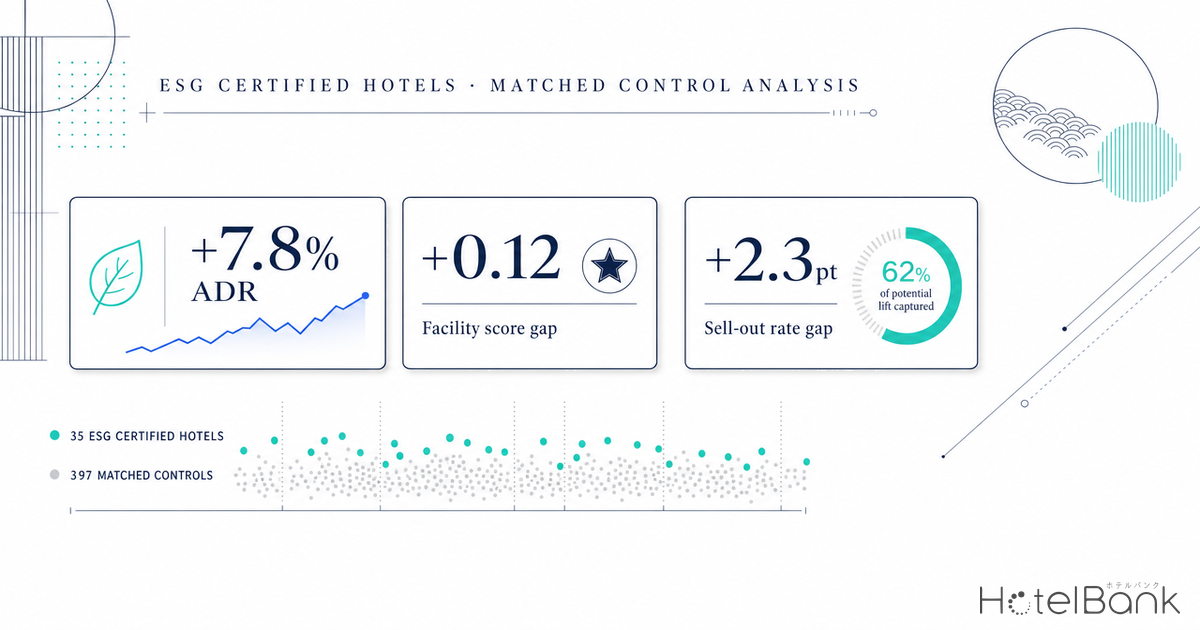
ESG certifications such as Sakura Quality Green, Green Key, and GRESB are evolving from mere “proof of environmental commitment” into a core element of hotel branding strategy. A 2023 global online travel survey covering more than 33,000 respondents across 35 countries found that 76% of global travelers want to “travel more sustainably,” indicating clear demand for certified properties. Yet quantitative evidence of whether obtaining a certification actually translates into higher review scores or ADR (average daily rate) premiums remains scarce. This article uses approximately 560,000 guest reviews aggregated by MetroEngines Research (メトロエンジンリサーチ) and a matched comparison of 35 ESG-certified hotels against 397 control properties to verify the managerial returns of certification with real-world data.
Metric Definitions Used in This Article
- ADR (Average Daily Rate): average of publicly listed prices on OTAs. This may differ from actual transaction prices. Per-room rate (tax included) for two guests in one room, averaged across all plans (room-only through meal-inclusive).
- Sold-out Rate: share of plans on OTAs that had stopped accepting reservations at the time of the survey. This differs from a property’s overall room occupancy rate.
- Matched Control: for each ESG-certified hotel, up to 15 non-certified properties from the same prefecture, the same hotel grade (hotel_grade_id), and with at least 500 reviews are pair-matched and compared on a weighted-average basis.
- Data Sources: MetroEngines Research (OTA published prices and review data). Identification of certified properties is based on each company’s press releases and the official Sakura Quality website.
ESG Certification Is Expanding Rapidly: A Three-Layer Structure of Sakura Quality, Green Key, and GRESB
The number of ESG-certified hotels in Japan has grown rapidly in recent years. The leading frameworks form a three-layer structure: the Japan-originated, GSTC-recognized “Sakura Quality An ESG Practice” (commonly known as Sakura Quality Green); Denmark-based FEE’s “Green Key”; and “GRESB,” the real estate ESG assessment for listed REITs.
Sakura Quality Green is structured around 172 items based on the 17 SDGs and is rated on a five-tier scale (1–5 Gyoiko Sakura). After Imperial Hotel (帝国ホテル) earned the top “5 Gyoiko Sakura” rating across three properties in 2023, group-wide acquisitions accelerated: Okura Nikko Hotels obtained certification in bulk for 30 domestic properties starting in 2024, followed by all six Karaksa Hotels, the three Cross Hotels (Sapporo, Kyoto, Osaka), and in February 2026, five Metropolitan Hotels operated by Nippon Hotel Co. (Ikebukuro, Kawasaki, Kamakura, Saitama-Shintoshin, and Takasaki) earned “4 Gyoiko Sakura.” We covered the announcement and Nippon Hotel’s overall progress in detail in Five Metropolitan Hotels Earn “4 Gyoiko Sakura” Sakura Quality Green Certification.
For Green Key, 29 properties in Japan had earned certification as of February 25, 2026. Aloft Tokyo Ginza (February 2025), Aloft Osaka Dojima (June 2025), The Ritz-Carlton Osaka, Westin Hotel Tokyo / Osaka / Yokohama, and JW Marriott Hotel Nara stand out — Marriott-affiliated foreign luxury brands dominate the list. On the GRESB side, Japan Hotel REIT Investment Corporation (8985) has earned “Green Star” status for eight consecutive years and was named Asia Hotel Sector Leader, demonstrating that sustainability assessment matters at the listed REIT level as well.
Source: HotelBank Editorial Team, compiled from individual press releases
35 Properties × 397 Matched Controls: Certified Hotels Show a Clear +0.07–0.11 Premium in “Cleanliness, Facilities, Service”
This article analyzes review data from approximately 560,000 guest reviews compiled by MetroEngines Research for 35 properties whose Sakura Quality Green or Green Key certification could be verified through public information. For each of these certified properties, we set up matched controls drawn from 397 non-certified properties in the same prefecture and same grade band (luxury through economy), comparing them on a weighted-average basis.
The results are intriguing. On the overall score, ESG-certified properties average 4.38 versus 4.43 for the controls — 0.06 points lower on the certified side. This reflects the fact that certified properties include many large city hotels and resorts where guest assessments of room age and banquet operations are mixed in. Once the score is decomposed by category, however, the picture changes dramatically.
Source: MetroEngines Research, compiled by HotelBank Editorial Team (35 ESG-certified properties / 397 control properties / approx. 560,000 reviews)
“Cleanliness” is 4.58 for certified versus 4.48 for controls (+0.10 pt); “Facilities & Amenities” is 4.45 versus 4.33 (+0.12 pt); “Service” is +0.07 pt; and “Rooms” is +0.07 pt. Across the categories that lie at the heart of ESG operations, the certified side consistently shows positive gaps. Meanwhile, “Food” and “Location” show differences of only about +0.01. This suggests that certification surfaces not as a “given attribute like location” but as visible “day-to-day operational quality.”
+7.8% ADR Premium and +2.3 pt Sold-out Rate Gap — Pricing Power Is Real
Does the review premium translate into pricing power? Using OTA published price data from March 2026, we compared the 35 certified properties against same-area, same-grade matched controls.
The result is clear-cut. Certified properties’ ADR averages ¥54,500 versus ¥50,600 for matched controls — a +7.8% (+¥3,900) premium for the ESG-certified side. The sold-out rate is also higher: 15.3% versus 13.0%, a +2.3 pt gap. In other words, certified properties have managed to “raise prices while still maintaining occupancy.” This is not merely a function of the strong demand environment in March 2026. In the same month a year earlier (March 2025), the ESG cohort’s ADR was ¥54,400 versus ¥37,100 for controls — a clear absolute gap that has persisted, indicating that certified properties’ positioning is stable throughout the year.
Source: MetroEngines Research, compiled by HotelBank Editorial Team (March 2026, N=35 pairs)
That said, the distribution of individual premiums across the 35 properties is wide. The largest are concentrated in the luxury tier: The Thousand Kyoto (ザ・サウザンド京都) at +150%, Imperial Hotel Osaka (帝国ホテル大阪) at +100%, and The Ritz-Carlton Osaka at +93%. For these, certification serves as “additional proof of brand value,” reinforcing high room rates. On the other hand, eight properties show negative premiums of −20% to −40%; these are mainly large resorts and regional city hotels. Such areas tend to contain few high-rate competitors, so sub-category differences within the same grade are amplified.
Top ADR Premium Hotels — All Top 10 Show Double-Digit ADR Premiums
The top 10 properties by ADR premium versus matched controls are all hotels where certification and brand positioning are highly aligned. Luxury-to-deluxe urban hotels dominate the upper ranks: The Thousand Kyoto, Imperial Hotel Osaka, The Ritz-Carlton Osaka, Westin Hotel Osaka, and Westin Hotel Tokyo.
| Hotel | Area | ESG ADR | Control ADR | Premium |
|---|---|---|---|---|
| The Thousand Kyoto (ザ・サウザンド京都) | Kyoto | ¥148,900 | ¥59,600 | +150% |
| Imperial Hotel Osaka (帝国ホテル大阪) | Osaka | ¥67,000 | ¥33,500 | +100% |
| Karaksa Hotel Osaka Namba (からくさホテル大阪なんば) | Osaka | ¥39,400 | ¥19,900 | +98% |
| The Ritz-Carlton Osaka | Osaka | ¥110,100 | ¥57,100 | +93% |
| Cross Hotel Osaka (クロスホテル大阪) | Osaka | ¥52,900 | ¥29,700 | +78% |
| Grand Prince Hotel Hiroshima (グランドプリンスホテル広島) | Hiroshima | ¥42,500 | ¥24,800 | +72% |
| JW Marriott Hotel Nara | Nara | ¥81,200 | ¥55,700 | +46% |
| Westin Hotel Osaka | Osaka | ¥77,300 | ¥57,100 | +35% |
| Westin Hotel Tokyo | Tokyo | ¥135,300 | ¥103,500 | +31% |
Source: MetroEngines Research, compiled by HotelBank Editorial Team (March 2026; prices for 1 room / 2 guests, tax included)
What is striking is that mid-tier properties such as Karaksa Hotel Osaka Namba (+98%) and Cross Hotel Osaka (+78%) — not just luxury — also show large premiums. All six Karaksa Hotels carry Sakura Quality Green at the 3 to 4 Gyoiko Sakura level, and the brand’s positioning, well aligned with repeat inbound visitors and corporate business demand, is reflected in pricing power.
Top Review Score Premiums — Mid-tier Properties in Kawasaki and Osaka Achieve +0.4 pt Gaps
Looking at the top 10 properties by overall review score premium versus same-area, same-grade matched controls, large gaps appear not only in luxury but also in mid-to-upper tier properties of relatively small scale. Hotel Metropolitan Kawasaki ranks first (4.72 vs 4.34 for controls, +0.38 pt), Cross Hotel Osaka second (4.64 vs 4.28, +0.36 pt), and Imperial Hotel Osaka third (4.63 vs 4.36, +0.27 pt).
Source: MetroEngines Research, compiled by HotelBank Editorial Team
What these properties share is that they opened relatively recently and show little wear in rooms or facilities. The frameworks of ESG operations — energy efficiency, waste reduction, use of local ingredients, employee training — appear to align well with the operational profiles of new and mid-life properties, translating into stronger review scores. By contrast, large resorts and existing large-scale properties such as Grand Nikko Awaji and Sapporo Prince Hotel scored below their controls despite holding certification. This shows that certification is not a panacea: the assessment must be combined with property scale, age, and operating model.
ADR Premium vs Sold-out Rate Gap — Roughly 30% of Properties Achieve “Both”
Plotting ADR premium (vs control, %) against sold-out rate gap (vs control, points) for each property creates a four-quadrant scatter. The upper-right quadrant — “both ADR premium and sold-out rate premium positive” — contains 11 properties, or 31% of the 35. Representative examples include Cross Hotel Osaka, Grand Prince Hotel Hiroshima, Karaksa Hotel Osaka Namba, and JW Marriott Hotel Nara.
Source: MetroEngines Research, compiled by HotelBank Editorial Team (March 2026, N=35 pairs)
The lower-right quadrant — “price advantage, occupancy disadvantage” (ADR+/sold-out−) — contains luxury properties such as The Ritz-Carlton Osaka, Imperial Hotel Osaka, and Westin Hotel Tokyo, suggesting a strategy of holding premium prices while accepting somewhat lower occupancy. The upper-left quadrant — “price disadvantage, occupancy advantage” (ADR−/sold-out+) — includes Hotel Metropolitan Takasaki, Sapporo Park Hotel, and hotel around TAKAYAMA, where certification combined with stable pricing is used to capture occupancy.
ESG Certification Is a “Long-term Branding Investment” — and the ROI Is Visible
Summarizing the analysis, ESG certification generates managerial returns in four respects:
- By review category, “Cleanliness +0.10 pt,” “Facilities +0.12 pt,” and “Service +0.07 pt” — consistent premiums in operations-quality categories.
- ADR +7.8% (vs matched controls) and sold-out rate +2.3 pt — on average, both pricing and occupancy advantages are realized.
- At the property level, 19 of 35 properties (51%) outscored their controls on the overall review score, and 31% earned premiums on both ADR and sold-out rate axes.
- The certification effect is most pronounced for new-to-mid-life properties in the mid-to-luxury bands; for large existing resorts, certification alone has limited impact.
The 2024 edition of the same global travel survey found that 59% of global travelers and 35% of Japanese travelers want to “filter their next booking by certified accommodations.” For more on sustainable-travel sentiment trends in Asia, see Agoda Survey: Sustainable Travel Interest Expanding, Over Half of Japanese Travelers Now Prioritize Sustainability. As inbound share continues to rise, certification marks — particularly GSTC-recognized schemes — are becoming an important decision filter for travelers from Europe, Australia, and the Nordic countries. Sakura Quality Green’s standards received GSTC recognition in March 2022, laying the foundation for international recognition of Japan’s certification logo.
In short, ESG certification is not a “cost” but rather a long-term branding investment that pays back through three channels: improvements in review quality, capture of price premiums, and appeal to inbound travelers. Certification is not, however, a guarantee of automatic results. Its impact materializes in combination with property scale, age, guest mix, and category-level quality improvement — factors that management must keep firmly in view. Through 2026 and 2027, group-wide certification by hotel operators, ESG disclosure at the IR level, and integrations with sustainable-booking platforms targeting inbound travelers are expected to accelerate. The investment decisions required to avoid being left behind by this trend will be tested.
Notes on the analysis: The certified properties in this article are limited to the 35 hotels for which certification could be confirmed via press releases or official websites as of April 2026, with at least 500 reviews and price data in our database. The actual number of Sakura Quality–certified properties in Japan is presumed to be substantially larger. The matched-control comparison uses averages within the same prefecture and same grade; the influence of property-specific characteristics (age, renovation history, guest mix) cannot be fully eliminated.
Related Articles
- Aloft Tokyo Ginza Earns “Green Key” International Eco-Label for Second Consecutive Year, Driving 100% Renewable Energy and Food-Loss Reduction
- Hotel Metropolitan Saitama-Shintoshin Earns “4 Gyoiko Sakura” Sakura Quality An ESG Practice Certification — A First for Saitama Prefecture
- Five Metropolitan Hotels Earn “4 Gyoiko Sakura” Sakura Quality Green Certification: Nippon Hotel Co. Reaches 11 Properties Total
- Hotel Nikko Niigata Earns Niigata Prefecture’s First “3 Gyoiko Sakura” Sakura Quality An ESG Practice Certification
- Kawasaki King Skyfront Tokyu REI Hotel Earns “4 Gyoiko Sakura” ESG Certification
- Japan Tourism Agency Holds 3rd “Sustainable Travel Award” Ceremony — 10 Organizations Recognized, with Mizu to Takumi (Toyama) Taking Top Honors
- hotel around TAKAYAMA Earns “4 Gyoiko Sakura” International ESG Sakura Quality Certification (Greens Co., Ltd.)
- Sustainability Through the Five Senses: Royal Park Hotel Hosts a Free Experience Event
References & Sources
- Sakura Quality Official Site (List of Certified Properties)
- GSTC Recognition of Sakura Quality An ESG Practice Standards (March 22, 2022)
- GSTC (Global Sustainable Tourism Council) Official
- Japan Tourism Agency: “Japan Sustainable Tourism Standard for Destinations (JSTS-D)”
- Cross Hotel Sapporo / Kyoto / Osaka — “4 Gyoiko Sakura” Sakura Quality Green Certification (ORIX Real Estate / PR TIMES)
- Nippon Hotel Co. — Five Metropolitan Hotels Earn Sakura Quality Green (February 2026)
- hotel around TAKAYAMA Earns “4 Gyoiko Sakura” (Greens Co., Ltd.)
- Imperial Hotel — “5 Gyoiko Sakura” Press Release (March 22, 2023)
- Karaksa Hotels — All Six Properties Earn Sakura Quality Green
- Japan Green Key (Japan Environment Association)
- Japan Hotel REIT Investment Corporation — Sustainability / GRESB Information
- “Sustainable Travel” International Research Findings (2024 edition, table source)
- MetroEngines Research — OTA published-price and guest review data aggregation (N=35 ESG-certified properties / 397 controls / approx. 560,000 reviews / March 2026 sales price data)