

The shift at the entry point — guests asking AI where to stay — has already been covered in our earlier work. This article looks at the next stage: since summer 2026, a path where the booking itself is completed inside a conversation with AI has actually started to operate, albeit on a limited basis. On August 27, 2026, Google began offering US users a feature in Search’s AI Mode that lets them compare rooms, check cancellation policies and pay, all on a single screen. Around the same time, a major short-term rental platform began testing lower fees for guests that hosts bring in themselves, and on September 2, Radisson Hotel Group announced its hotel search app on ChatGPT in a Japanese-language press release. This article is neither about content readiness (see our earlier piece, Google UCP & ChatGPT: 3 Data Fixes Hotels Should Make Now) nor about cutting commissions on existing channels (our earlier analysis “Look at inventory allocation before going OTA-free”). It focuses narrowly on what operators and headquarters should decide when one more sales channel is added. The conclusion first: at this point, few mechanisms apply directly to Japanese properties, and the right move is not “deciding whether to sign up” but “getting ready to be able to sign up.”
Metric Definitions Used in This Article
- ADR (Average Daily Rate): An estimated settled rate (tax-excluded equivalent), calculated by applying property-type correction factors to the lowest-plan price level each property publishes on OTAs and similar sites (two guests per room, per-room price, tax-included). Checked against property-level results disclosed by listed hotel REITs (91 properties, most recent 3 months), the median error is about 7%. These are estimates and differ from each property’s actual settled prices and accounting figures. Property-type ADRs in this article are the same as in our earlier estimates: the 12-month average from August 2025 to July 2026 of monthly medians across 47 prefectures, weighted by the number of properties (business ¥8,900, city ¥13,800, resort ¥16,900, ryokan ¥15,200).
- Actual occupancy: Room occupancy by property type from the Japan Tourism Agency’s Overnight Travel Statistics Survey, 2025 annual figures (final): business 75.3%, city 74.1%, resort 56.9%, ryokan 38.2%. These are not our estimates.
- Annual revenue per room = ADR × actual occupancy × 365 days. Rooms revenue only; F&B, banquets and other departments are excluded.
- Commission rate: In this article, an assumed range based on levels generally cited in public information, not any specific contract terms. It does not represent actual contract terms.
- New openings: Properties tracked by MetroEngines Research that are confirmed as listed on major booking sites and whose room count is known, tallied by opening year based on listing confirmation. May include re-listings due to renaming or rebranding.
- Data sources: MetroEngines Research / Japan Tourism Agency, Overnight Travel Statistics Survey / company press releases
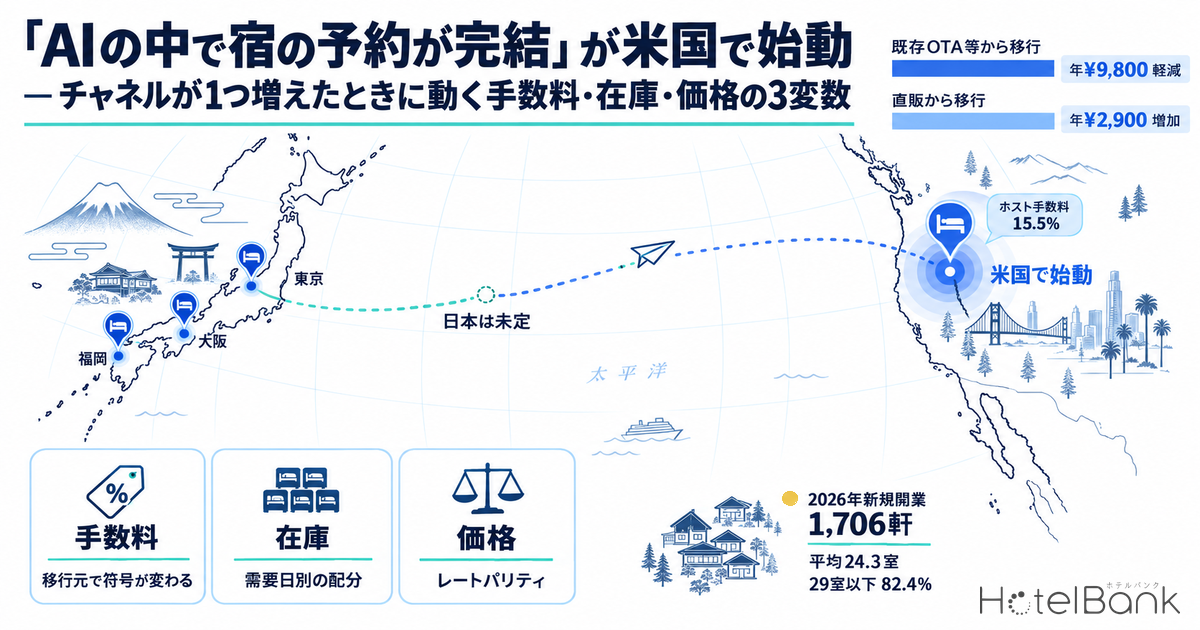
- — A path where the booking is completed inside AI started in the US on August 27, 2026. In Google’s AI Mode, comparison, policy review and payment are all completed on one screen. However, it is limited to US users, and the merchant of record remains the hotel or the OTA.
- — The hotel search app on ChatGPT stops at “discovery”. In Radisson’s case, availability and rates are shown, then the user is sent to the hotel’s own website to complete the booking; in-chat booking is described as a “planned future extension.” There has been no announcement that properties in Japan are included.
- — A major short-term rental platform’s “lower fees for host-referred guests” does not change where the booking is made. The standard 15.5% host fee is reported to be reduced only for bookings made through links the hosts share themselves, but booking, payment and terms stay on the platform, and the eligible regions have not been disclosed.
- — The P&L of adding a channel is determined not by the commission rate but by “where the bookings moved from”. Assuming 10% of a business hotel room’s annual revenue moves to a new channel, a 6% rate saves ¥9,800 a year if the bookings come from existing OTAs and similar sites (assumed 10% rate), but the same 6% adds ¥2,900 a year if they come from direct sales.
- — New supply is centered on size bands that struggle to maintain their own sales channels. The 1,706 properties opening in 2026 (with known room counts) average 24.3 rooms, and properties with 29 rooms or fewer account for 82.4% of the count, while the 137 properties with 100+ rooms account for 64.9% of rooms. Who is most affected by an added channel flips depending on whether you count properties or rooms.
What Was Announced — Three Facts, and How Far They Matter for Japanese Properties
Let us first lay out the facts briefly. The moves reported since summer 2026 tend to be lumped together as “bookings completed inside AI,” but they fall into three groups. The first is Google’s feature that completes payment within Search’s AI Mode — the only path that literally qualifies as “the booking is made inside AI.” The second is hotel chains’ apps on ChatGPT that show availability and rates, which keep the place where the booking is made on the hotel’s own website. The third is a short-term rental platform’s fee reduction; it is not directly related to AI, but it bears heavily on channel design in that “how fees are set changes with the referral route.”
| Date | Company | What it is | Where the booking is made | Relevance to Japanese properties |
|---|---|---|---|---|
| August 27, 2026 | In Search’s AI Mode, users compare rooms, check cancellation policies and pay with Google Pay, all on a single screen. The user selects the room, reviews the terms and approves payment; the AI does not book on its own | Within the AI Mode screen. However, the merchant of record is the hotel or OTA, which also handles billing, confirmations and changes | Launched for US users. Participants at launch were major hotel chains (Marriott, Hilton, IHG, Wyndham, Choice) and several major OTAs. No announcement on timing in Japan or inclusion of Japanese properties | |
| July 28, 2026 (Japanese release on September 2) | Radisson Hotel Group / Accenture | Users call up “@RadissonHotels” in ChatGPT, which suggests matching options from 1,000+ properties in over 100 countries, showing availability, rates, maps and amenities | The hotel’s own website. “Once you choose a hotel, you go straight to the Radisson Hotels website and complete the booking.” In-chat booking is a planned future extension | Usable by Japanese travelers searching for properties overseas. The group only set up a representative office in Tokyo and appointed a head of development for Japan in March 2026; there is no announcement that Japanese properties are included in the app |
| Late August 2026 | Major short-term rental platform | Invited some hosts to a test that lowers the standard 15.5% host fee only for bookings through a dedicated link issued from the listing editor. The reduced rate is reported at 6–10% | On the platform. The platform’s booking, payment, protection and terms apply unchanged. The link leads to the platform’s listing page, not the host’s own website | Eligible regions and host conditions have not been disclosed. The size of the reduction is as reported by industry media and could not be confirmed in an official rate table from the platform |
| March 6, 2026 | OpenAI | Scaled back plans to integrate direct booking within ChatGPT. Checkout for travel products moved to the connected companies’ apps | Each company’s app or website | The premise that “ChatGPT completes the booking” does not hold at present |
Source: Compiled by HotelBank Editorial Team from company press releases, Skift (August 27 and 29, 2026), Travel Voice (March 6 and September 2, 2026) and PR TIMES (September 2, 2026)
The table makes one thing clear. The only path that can be called “the booking is made inside AI” is Google AI Mode in the US, and even there the merchant of record stays the hotel or the OTA. In other words, even when AI completes a booking, which channel the revenue is booked under in the hotel’s accounts depends on which business sits behind the AI. Radisson’s case is a “discovery path” that hands off to the hotel’s own website, an extension of the trend we described for the first half of 2026 (discovery moves first, booking returns to each company’s own path). The short-term rental platform’s test changes pricing within a channel, altering the rate when the referral originates with the host. No mechanism that applies directly to Japanese properties can be confirmed at this point, but the fact that all three moves point the same way — “the combination of fee and booking location changes depending on who brought the guest” — is enough to set preparation priorities.
Looking at Japan, similar moves can be seen at two levels. One is a major domestic OTA, which on April 30, 2026 added booking to its own AI agent: after comparing options in conversation with the AI, the booking is completed in the company’s app via a booking button. The other is AI guest-service products for lodging operators. “talkappi ChatAgent,” launched by Activalues Inc. on August 10, 2026, is designed to integrate with PMSs and booking engines and complete everything from inquiries to availability checks and booking within the chat (some functions are described as under development). In the former, the entry point becomes AI but the booking is still made at the OTA; in the latter, the booking is made on the property’s own side. That distinction is the subject of the next section.
“More Entry Points” and “More Places Where Bookings Are Made” Are Two Different Things
Placing these cases on a single grid sharpens the issue. With “the entry point where guests first learn about a property” on the horizontal axis and “where booking and payment are completed” on the vertical axis, the 2026 moves scatter across four quadrants — and it is the vertical axis that affects the design of commission, inventory and pricing.
Search, OTAs, official website, phone
ChatGPT, AI Mode, own chat
Source: Compiled by HotelBank Editorial Team from company press releases
In the upper-right quadrant — AI entry point, booking made at the OTA — nothing changes in the property’s P&L. Commission and inventory distribution follow existing contracts; the only change is which screen the guest saw the options on. The lower-right quadrant, by contrast, is an extension of direct sales, but whether “some form of compensation goes to the AI side” has not yet been determined. Industry commentary also notes that, for bookings executed by AI agents, “nothing confirmed and verifiable exists yet” regarding commission structures, and both Google and OpenAI keep each company as the merchant of record while holding the conversation side themselves. One more channel becomes real only at the moment a new commission rate is written into the lower-right quadrant. What we see now is the step before that: “more entry points” and “reshuffled rates within existing channels.”
Three Variables That Move When a Channel Is Added — Commission, Inventory Distribution and Price Consistency
So when a rate is written into the lower-right quadrant, what should operators and headquarters calculate? Following the same structure we used in our earlier analysis of inventory allocation before going OTA-free — “annual revenue per room × channel share × commission rate” — we set out how the annual cost per room changes when the new channel’s rate is 0% (referral only, booked on own website), 6%, 10% or 15%. Rates are the estimated settled ADR; occupancy is the Japan Tourism Agency’s 2025 final figure.
| Property type | Estimated settled ADR | Actual occupancy | Annual revenue per room | 10% via new channel, 6% rate | Same, 10% rate | Same, 15% rate |
|---|---|---|---|---|---|---|
| Business hotel | ¥8,900 | 75.3% | ¥2,446,000 | ¥14,700 | ¥24,500 | ¥36,700 |
| City hotel | ¥13,800 | 74.1% | ¥3,732,000 | ¥22,400 | ¥37,300 | ¥56,000 |
| Resort hotel | ¥16,900 | 56.9% | ¥3,510,000 | ¥21,100 | ¥35,100 | ¥52,600 |
| Ryokan | ¥15,200 | 38.2% | ¥2,119,000 | ¥12,700 | ¥21,200 | ¥31,800 |
Annual revenue per room = estimated settled ADR × actual occupancy × 365 days (rooms revenue only). Estimated settled ADR is the 12-month average from August 2025 to July 2026 of monthly medians across 47 prefectures, weighted by number of properties (N = business 7,368 / city 1,096 / resort 1,550 / ryokan 6,684 properties). The 10% new-channel share and the commission rates are assumptions, not actual contract terms.
Source: Compiled by HotelBank Editorial Team from MetroEngines Research / Japan Tourism Agency, Overnight Travel Statistics Survey, 2025 annual figures (final)
Taken alone, this table leads to the obvious conclusion that “the lower the new channel’s rate, the better,” but that leads to the wrong decision. What really matters when a channel is added is where those bookings moved from. Assuming 10% of annual revenue moves to the new channel, we set the prior channel two ways — “existing OTAs and similar sites (assumed 10% rate)” and “direct sales on the own website (online payment 3.6% + booking engine usage fee 1.22% = about 4.8%, based on the fee stack in our earlier analysis of a ¥13,600 hotel night netting ¥10,000)” — and the chart below shows the difference in annual cost for one business hotel room.
Source: Compiled by HotelBank Editorial Team from MetroEngines Research / Japan Tourism Agency, Overnight Travel Statistics Survey, 2025 annual figures (final) (estimates for one business hotel room, annual revenue ¥2,446,000, 10% via new channel)
If the bookings moved from existing OTAs and similar sites, a new channel at a 6% rate saves ¥9,800 a year, and referral only with booking on the own website saves ¥12,700 a year. But at the same 6%, bookings that moved from direct sales turn into an extra ¥2,900 a year. At a 15% rate, a shift from direct sales costs an extra ¥24,900 a year. Scaled to 100 rooms, the same decision — “add one channel at a 6% rate” — can mean either ¥980,000 a year in savings or ¥290,000 a year in extra cost. The economics of a new channel are determined not by how high or low its rate is but by what it cannibalizes. Our earlier work framed “the value of 1pt of direct sales as annual revenue per room × 1% × commission rate”; with an added channel, note that the sign of that formula flips depending on where the bookings came from.
The second variable is how inventory is distributed. Google AI Mode inserts a step in which the user reviews the room and terms and approves payment, while billing and booking confirmation are handled by the hotel or OTA acting as merchant. This means it is a prerequisite that the booking engine or channel manager connected to the AI can supply inventory and rates as fresh as those on existing OTAs. If inventory on the new channel is treated as “released only when left over,” the AI will show no availability at the moment it presents the property, defeating the purpose of adding an entry point. Conversely, opening all inventory unconditionally just because the channel books on the property’s own side will break alignment with existing channels on high-demand dates. As shown in our earlier work, public allotments sell out faster on stronger-demand dates, so it is realistic to give the new channel a demand-date allocation policy from the outset. The share of rooms listed on booking sites itself has been covered in a separate analysis and is outside the scope of this article (for the distribution of allocation rates by property type, region and size, see also Median 39.2% of Rooms Online — Allocation Across 12,941 Hotels).
The third is price consistency, so-called rate parity. In an environment where AI collects and lines up the prices of the same room from multiple merchants, the effort of switching screens to compare drops to zero. In our earlier measurement of 9,030 like-for-like pairs, the share where prices on two sites did not differ by even ¥1 was 71.0%, and price differences were the result of design rather than chance. In front of AI, designed and undesigned price differences alike are fully exposed. It is telling that the short-term rental platform’s test is reported to let “hosts choose whether to pass part of the reduction on to guests”: if rates differ by channel, it becomes one step harder to design prices so that the official channel is not at a disadvantage under identical conditions. Before adding channels, you need to decide which condition’s price will serve as the baseline and what you will differentiate on through added value.
Implications by Size — New Supply Averages 24.3 Rooms, While 100+ Room Properties Hold 65% of Rooms
To consider who is most affected by an added channel, we need to look at Japan’s supply structure. Among properties tracked by MetroEngines Research that are confirmed as listed on major booking sites with known room counts, new openings in 2026 totaled 1,706 properties and 41,396 rooms, averaging 24.3 rooms, as of October 10, 2026. Compared with 1,985 properties in 2024 (average 19.7 rooms) and 1,772 in 2025 (average 23.4 rooms), the number of properties is declining slightly while the size per property is gradually increasing. Note, however, that because this is based on listing confirmation, openings from October 2026 onward will increase as they get listed.
Source: MetroEngines Research & Consulting (based on OTA listing confirmation; 2026 openings with known room counts, N=1,706 properties / 41,396 rooms, as of October 10, 2026)
Split by size band, the picture becomes twofold. Properties with 29 rooms or fewer number 1,406 and make up 82.4% of properties, but only 5,786 rooms, or 14.0% of rooms. Conversely, properties with 100+ rooms account for 137 properties (8.0%) but 26,861 rooms (64.9%). Measured by “the number of businesses that must respond,” the main actors in channel addition are small properties; measured by “the number of rooms that move,” they are large properties. This duality tends to cause headquarters and on-site teams to talk past each other.
Source: MetroEngines Research & Consulting (based on OTA listing confirmation; properties with known room counts in each year. 2024 N=1,985 / 2025 N=1,772 / 2026 N=1,706. 2026 is as of October 10, and the most recent months onward may increase as more listings appear)
| Property type (2026 openings, top 9) | Properties | Average rooms | Typical sales channels |
|---|---|---|---|
| Vacation rental | 823 | 1.7 | Heavily platform-dependent; many have no booking engine of their own |
| Business hotel | 210 | 98.9 | Many have a chain HQ booking platform and loyalty program |
| Hostel | 125 | 18.6 | Mix of overseas OTAs and own website |
| Resort hotel | 100 | 76.4 | Three pillars: OTAs, travel agencies and own channels |
| Guesthouse | 91 | 4.3 | Heavily platform-dependent |
| Cottage | 79 | 8.7 | Heavily platform-dependent |
| Machiya townhouse | 61 | 1.7 | Heavily platform-dependent |
| Ryokan | 59 | 14.5 | Mix of OTAs, phone and travel agencies |
| City hotel | 51 | 112.3 | HQ booking platform, corporate contracts and banquet departments |
Property counts and average rooms are both based on properties with known room counts (1,599 of the 1,706 total in the top 9 types). “Typical sales channels” is the editorial team’s summary of general tendencies by type and does not describe individual properties.
Source: MetroEngines Research & Consulting (based on OTA listing confirmation, as of October 10, 2026)
By type, the largest group of new supply in 2026 is vacation rentals, at 823 properties averaging 1.7 rooms; together with guesthouses, cottages and machiya, small accommodation-only types total 1,054 properties, more than 60% of the total. Many of these have no booking engine or loyalty program of their own, and the platform listing page effectively serves as the “official website.” It is no coincidence that the short-term rental platform’s fee-reduction test is designed precisely for this segment. The less able a segment is to maintain its own sales channels, the more directly its economics are shaken by pricing changes — “which platform applies what rate to host-originated referrals”. On the other hand, many of the 210 business hotels (average 98.9 rooms) and 51 city hotels (average 112.3 rooms) have HQ booking platforms, and just as the hotel participants in Google AI Mode were all major chains that connected their own booking platforms as merchants, connecting to AI can be handled as a question of HQ technology investment. For the former, AI channels are something to “wait for the platform to connect”; for the latter, something to “decide whether to connect themselves.” The same news calls for actions with different subjects.
What You Can Prepare Now — Structured Property Data, Centralized Rate and Inventory Management, and Written Cancellation Policies
Since the timing in Japan is uncertain, what to invest in now is not signing up for a specific service but a state in which you can connect by the same procedure whichever channel arrives. Google AI Mode’s specification shows a flow in which, before AI completes a booking, the user checks three things: “room details,” “cancellation policy” and “payment amount.” Properties where these three are not structured are less likely to remain among the options even when the entry point opens. To the three stages covered in our earlier piece on data readiness — static content, ARI (availability, rates and inventory) and review consistency — this article adds the following from the perspective of channel addition.
| Preparation item | Concrete steps | Main owner | Timeframe |
|---|---|---|---|
| 1. Structured property data | Split capacity, floor area, bed configuration, smoking/non-smoking and accessibility into separate fields for each room type, and align the vocabulary registered on the official website and each booking site. The “conditions” AI cites are extracted from fields, not free text | Marketing, front desk | 1–2 months |
| 2. Centralized rate and inventory management | Using the channel manager or booking engine as the hub, confirm that inventory and rates for all channels are reflected by a single update. If any inventory is entered manually per channel, make it the first target for centralization. Document a demand-date allocation policy (keep allotments for direct and repeat guests on strong dates; widen public allotments on weak dates) | Revenue management, reservations | 1–3 months |
| 3. Written cancellation policies | List “X% from X days before” rules by plan, room type and channel, and express exceptions (multi-night, groups, peak seasons) as fields rather than in body text. Because AI summarizes and presents terms, vague wording can cause a property to drop out of the options | Reservations, management | 1 month |
| 4. Measuring the source of shifted bookings | Record booking share by channel monthly, split by “new vs. repeat guests” and “origin of the booking path (search, social media, referral, existing OTAs).” This lays the groundwork to determine after the fact where bookings moved from when a new channel is added | Revenue management, HQ | Ongoing |
Source: Compiled by HotelBank Editorial Team
What the four items have in common is that none is a new investment; all are about organizing existing information, and none will be wasted regardless of whether a specific AI service launches in Japan. Item 4 in particular is easily overlooked, but as the estimates in the previous section showed, the sign of a new channel’s P&L flips with the source of the shifted bookings. A property that cannot measure where bookings moved from cannot tell, after adding a channel, whether it gained or lost. For properties in the 24.3-room average size band, adding one “origin” column to the monthly booking ledger is enough.
When to Act — Closing with Decision Criteria
The numbers in the area covered here are not settled. Google’s feature is US-only with no published commission structure, the ChatGPT app stops at discovery, and the short-term rental platform’s fee reduction is a reported figure. It would not be appropriate at this stage to declare “sign up” or “wait and see.” Instead, we set out criteria: once which facts are confirmed, which decision to move to.
| Fact to confirm | Decision to move to once confirmed | As of October 10, 2026 |
|---|---|---|
| The AI side offers lodging booking completion to users in Japan | Check whether your booking engine and channel manager are among the connection targets, and review the centralized management path in item 2 | Not confirmed (US only) |
| For paths where the AI side is the merchant, compensation from properties (rate, flat fee or free) is published | Recalculate the previous section’s “difference by source” with your own figures; sign up if shifts from existing OTAs and similar sites dominate, and revisit price and inventory terms if shifts from direct sales dominate | Not confirmed (merchant is the hotel or OTA) |
| An existing booking site formally announces in Japan a scheme that changes rates for property-originated referrals | Use the measurements from item 4 to decide whether it is worth routing your social media, email and repeat-guest outreach to the scheme’s eligible links | Not confirmed (only the short-term rental platform’s test, regions not disclosed) |
| Visits originating from AI can be measured monthly among your bookings | Look at the relationship between the readiness of items 1 and 3 and visit numbers to set priorities for structuring | Identifiable as a referral source in some booking engines and analytics tools |
Source: Compiled by HotelBank Editorial Team
To sum up, three facts were confirmed in summer 2026: “a path where the booking is completed inside AI has started in the US,” “apps on ChatGPT handle discovery and send bookings back to the hotel’s own website” and “even within platforms, rates have started to vary with the origin of the referral.” None of these forces Japanese properties into an immediate sign-up decision. However, since all three point the same way — the combination of fee and booking location is determined by who brought the guest — there is real value in building, now, the ability to calculate the P&L of an added channel by “source of shifted bookings” rather than by “commission rate”. The same preparation works differently for each: for the small properties that make up 60% of new supply, it is a hedge against platform pricing changes; for large properties with HQ booking platforms, it is the input for deciding whether to connect themselves.
⚠ On estimates and reported figures: All per-room commission costs in this article are estimates calculated from the estimated settled ADR, the Japan Tourism Agency’s actual occupancy, and assumed commission rates and channel shares. The estimated settled ADR has a median error of about 7% when checked against listed hotel REITs’ disclosed results, and differs from each property’s actual settled prices and accounting figures. Commission rates are ranges based on levels generally cited in public information and do not represent actual contract terms. The short-term rental platform’s reduced rate (6–10%) is a figure reported by industry media and was not confirmed in an official rate table from the company. Service regions and eligible properties are based on information published as of October 10, 2026 and may change.
Frequently Asked Questions
Q. Can properties in Japan already use a system where the booking is completed within a conversation with AI?
As of October 10, 2026, the only confirmed system that completes payment within the AI screen is Google’s AI Mode (for US users), and neither the timing in Japan nor the inclusion of Japanese properties has been announced. The hotel search app on ChatGPT handles presenting options, and booking is completed on each company’s website. In Japan, OTAs’ own AI agents and AI guest-service products for lodging operators are beginning to offer booking functions, but in the former the booking is made at the OTA and in the latter on the property’s own website, so no new channel has actually been added.
Q. If a new channel with a low commission rate appears, is it better to sign up?
The rate alone cannot tell you. In our estimate, if 10% of a business hotel room’s annual revenue moves to a new channel at a 6% rate, the shift saves ¥9,800 a year if it comes from existing OTAs and similar sites (assumed 10% rate), but adds ¥2,900 a year if it comes from direct sales. We recommend first building the ability to measure where the new channel’s bookings moved from, and then recalculating with your own figures.
Q. Where should a small property start preparing?
The starting point is to organize room information and cancellation policies as fields rather than free text, and to confirm a path where inventory and rates for all channels are reflected by a single update. Neither requires new investment, and neither will be wasted regardless of whether a specific AI service launches in Japan. Adding one “booking origin” column to your booking ledger at the same time will also help you judge the P&L if you add a channel in the future.
Related Reading
- Google UCP & ChatGPT: 3 Data Fixes Hotels Should Make Now
- Median 39.2% of Rooms Online — Allocation Across 12,941 Hotels
References and Sources
■ Data sources
Property and rate data continuously collected by MetroEngines Research from public information on major booking sites (the population for monthly ADR aggregation is about 20,300 properties as of 2026), the Japan Tourism Agency’s Overnight Travel Statistics Survey 2025 annual figures (final), and company press releases and primary reports published between March and September 2026. New openings are based on listing confirmation and include only properties with known room counts (2024 N=1,985 / 2025 N=1,772 / 2026 N=1,706, as of October 10, 2026).
■ Estimation assumptions
Annual revenue per room is rooms revenue calculated by multiplying the estimated settled ADR (12-month average from August 2025 to July 2026) by the Japan Tourism Agency’s 2025 annual actual occupancy and 365 days. Bookings moving to the new channel are set at 10% of annual revenue; the new channel’s rate is set four ways — 0% (referral only, booked on own website), 6%, 10% and 15%; and the prior channel’s rate is set at 10% for existing OTAs and similar sites and about 4.8% for direct sales on the own website (online payment 3.6% + booking engine usage fee 1.22%). All are assumptions for comparison.
■ Limitations and caveats
The estimated settled ADR is an estimate and differs from each property’s actual settled prices and accounting figures. Commission rates are ranges based on levels generally cited in public information, not actual contract terms. The short-term rental platform’s reduced rate is a reported figure. The feature that completes payment within the AI screen is for US users, and its timing in Japan has not been announced. Because new openings are based on listing confirmation, 2026 figures may increase, and they may include re-listings due to renaming or rebranding.
■ Primary sources and reports
- Skift, “Google’s Agentic Hotel Booking Tool Comes to AI Mode” (August 27, 2026)
- Skift, on a major short-term rental platform testing lower fees for hosts who bring their own guests (August 29, 2026)
- Radisson Hotel Group / Accenture, launch of hotel search across 1,000+ hotels in 100 countries on ChatGPT (PR TIMES, September 2, 2026; Japanese)
- Travel Voice, “Radisson launches hotel search app on ChatGPT showing latest rates at 1,000+ hotels” (September 2, 2026; Japanese)
- Travel Voice, “Radisson Hotel Group opens Tokyo representative office, appoints head of development for Japan” (March 4, 2026; Japanese)
- OpenAI, “Radisson Hotel Group brings hotel discovery into ChatGPT”
- Web Tantousha Forum, “Booking function added to a domestic OTA’s AI agent” (May 1, 2026, announced April 30; Japanese)
- Activalues Inc., launch of AI agent for lodging operators “talkappi ChatAgent” (PR TIMES, August 10, 2026; Japanese)
- Hospitality Net, “The Agentic Booking Question No One Has Answered: Who Gets the Commission?” (August 3, 2026, updated September 7)
- TNW, “Two hotel groups moved into ChatGPT this week. Neither will let you pay there”
■ Government statistics and public data
■ Market data
- MetroEngines Research & Consulting — new openings (based on OTA listing confirmation, 2024–2026, properties with known room counts N=1,985 / 1,772 / 1,706); estimated settled ADR by property type (47 prefectures, August 2025 to July 2026, same as earlier estimates)
- MetroEngines Research — population for monthly ADR aggregation is about 20,300 properties as of 2026 (based on listings on major booking sites)