

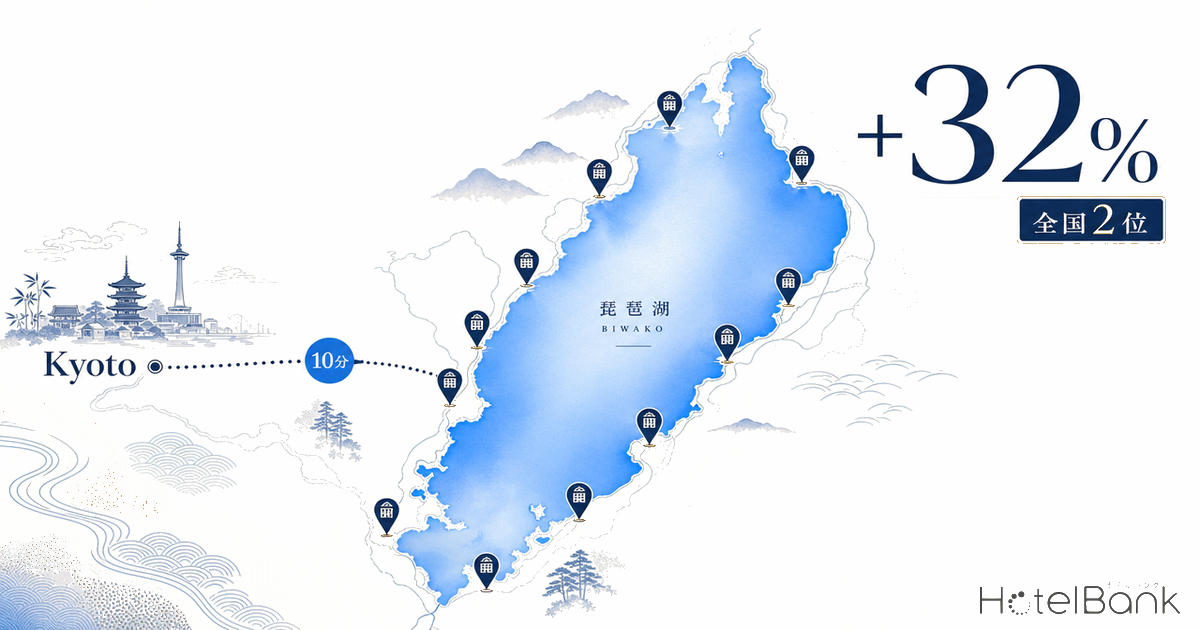
A major OTA’s summer travel trend survey, released on May 22, 2026, identified the prefecture with the second-fastest year-on-year growth in search volume. Second only to Tokyo (+48% YoY), it was Shiga Prefecture (+32%). Regional hotel-market analysis has long centered on Tokyo, Osaka, Kyoto, Okinawa and Hokkaido, leaving Shiga — home to Lake Biwa — rarely treated head-on as anything more than a “backup” market. Yet as Kyoto’s average room rate continues to surge under over-tourism, a clear demand-supply opportunity is emerging along Shiga’s lakeshore as a spillover destination. This article aligns the monthly ADRs of Otsu, Hikone and Nagahama — the principal lakeside areas — with central Kyoto, quantifies the “10-minute-neighbor discount,” and unpacks Shiga’s distinctive lake-view assets together with the new supply now coming online.
Metric Definitions Used in This Article
- ADR (Average Daily Rate): Mean of selling prices published on OTAs and other channels. Differs from actual transaction prices (cross-checks against REIT disclosure data show OTA-published ADR running approximately +25–30% above realized ADR, structurally because unsold higher-priced plans remain visible on OTAs, biasing the published average upward). Per-room rate for double occupancy (tax-included), averaged across all plan types (room-only through meal-inclusive).
- Central Kyoto ADR: Weighted average — by observation count — of selling-price data across the 11 wards of Kyoto City (Shimogyo, Nakagyo, Higashiyama, Minami and others).
- 10-minute-neighbor discount: Discount of Otsu City ADR against central Kyoto ADR = (Central Kyoto ADR − Otsu ADR) ÷ Central Kyoto ADR.
- Data source: MetroEngines Research
- — Shiga ranked #2 nationwide for search-volume growth (+32%) in a major OTA’s Summer 2026 trend survey, second only to Tokyo (+48%) and emerging as a backup-market dark horse.
- — Otsu City’s published ADR runs about 27% below central Kyoto on average, widening to a maximum 43% discount during the cherry-blossom season. The “10-minute-neighbor discount” — roughly a JR Special Rapid ride from Kyoto — is now structural.
- — Shiga’s overall published ADR rose +27.3% YoY (from approximately ¥29,500 to approximately ¥37,600), showing search heat passing through into realized pricing.
- — Supply remains concentrated in the south of the lake (Otsu), with the eastern and northern shores still thin. Established Omi inns offering lake views and open-air baths function as a differentiation asset.
- — Roadside-format new supply is now opening in Nagahama and Hino. Shiga is at an inflection point from “Kyoto’s backup” to “a lakeside chosen on its own merits.”
#2 in National Search Growth — Why “Japan’s Largest Lake” Has Surfaced
In the major OTA’s Summer 2026 trend survey, the top-five prefectures by search-volume growth were Tokyo (+48%), Shiga (+32%), Fukuoka and Gunma (tied at +22%), and Nara (+21%). Shiga was singled out for “the nature surrounding Japan’s largest lake, Lake Biwa, combined with historic streetscapes.” Sitting next door to powerhouse tourist destinations like Kyoto and Osaka — yet holding a natural asset on the scale of Lake Biwa — Shiga clearly resonates with travelers actively seeking to avoid crowding.
That search heat is showing up in selling prices. According to MetroEngines Research, Shiga’s overall published ADR rose from approximately ¥29,500 in June 2025 to approximately ¥37,600 in June 2026 — a +27.3% YoY increase. Search growth (+32%) and ADR growth (+27%) are tracking almost in lockstep, suggesting rising interest is now materializing as accommodation demand. Why has Shiga surfaced at this particular moment? The answer lies in the pricing structure of neighboring Kyoto. The wider Kansai foot-traffic spillover beyond the region itself has also been documented in our analysis of Osaka-Kansai Expo visitor mobility.
Source: Major OTA “Summer 2026 Travel Trends” (released May 22, 2026); chart by HotelBank Editorial Team
The “10-Minute-Neighbor Discount” — Kyoto-Spillover Pricing Advantage
From Otsu Station, the JR Tokaido Main Line’s Special Rapid service reaches Kyoto Station in roughly 9–10 minutes. Despite straddling the prefectural border, Otsu functionally sits inside Kyoto’s commuting and tourism zone. Even so, a wide gap separates the two cities’ room rates. As of June 2026, central Kyoto’s published ADR (weighted across the 11 wards) stands at approximately ¥49,700, while Otsu’s sits at approximately ¥34,400 — a difference of roughly ¥15,300, or a 31% discount.
This “10-minute-neighbor discount” tends to widen during Kyoto’s high-rate peak seasons. In April 2026, the cherry-blossom peak, central Kyoto climbed to approximately ¥63,800 while Otsu stayed at approximately ¥36,400 — pushing the discount to a maximum 43%. Even on a trailing-12-month average, Otsu’s discount versus central Kyoto runs about 27%, with the average gap at roughly ¥13,400. Put another way: a traveler who had planned to stay in Kyoto can save more than ¥10,000 per night simply by switching to Otsu, and that arithmetic now holds almost continuously.
Source: MetroEngines Research; chart by HotelBank Editorial Team (central Kyoto N≈430 properties / Otsu N≈13 properties)
What is striking is that Otsu’s ADR is not “stuck at cheap levels.” Otsu’s ADR has climbed from approximately ¥27,300 in June 2025 to approximately ¥40,600 in May 2026, and during peak periods it is moving up steadily in tandem with Kyoto. The roughly 30% gap persists because Kyoto’s pace of price escalation is even faster. So long as Kyoto’s prices keep testing the ceiling, the lakeshore areas — Otsu chief among them — should retain meaningful spillover capacity on price. Kyoto’s continued unit-price climb has been driven in large part by policy and inbound dynamics whose recent quarter we have separately tracked in our reporting on Kyoto’s lodging-tax pass-through.
Distinct Profiles by Area — Otsu, Hikone and Nagahama Price Levels
“Lake Biwa shoreline” is a single phrase covering markedly different price bands and characters. Otsu, the southern gateway, anchors around ¥34,000 on the strength of its Kyoto-commuter convenience, with a deep stack of accommodation from the Ogoto Onsen ryokan cluster through business and city hotels. To the east, Hikone — built around Hikone Castle — climbed to the area’s highest band of ¥45,000–¥61,000 from autumn 2025 onward. Northward, Nagahama, anchored by historic streetscapes such as Kurokabe Square, has held a stable ¥37,000–¥43,000. Taga Town is a reference point only — just one observed property — sitting in budget territory at ¥23,000–¥27,000.
Source: MetroEngines Research; chart by HotelBank Editorial Team
The table below summarizes published ADR by area for June 2025 versus June 2026. Hikone’s growth stands out, driven both by the inclusion of high-ADR resort properties in the observation set and by tourist demand at Hikone Castle and Genkyu-en. Every area outpaced its prior-year month, confirming that demand uplift is reaching the entire Lake Biwa shoreline.
| Area | 2025/06 ADR | 2026/06 ADR | YoY | N (properties) |
|---|---|---|---|---|
| Otsu City (south lake) | ¥27,300 | ¥34,400 | +25.9% | 13 |
| Hikone City (east lake) | ¥25,800 | ¥56,400 | +118.9% | 11 |
| Nagahama City (north lake) | ¥35,400 | ¥37,700 | +6.5% | 12 |
| Taga Town (reference, N=1) | ¥16,800 | ¥27,200 | +61.7% | 1 |
| Shiga Prefecture (total) | ¥29,500 | ¥37,600 | +27.3% | ~180 |
Note: Hikone’s growth is amplified by the inclusion of high-ADR resort properties in the observation set. Taga Town reflects only one observed property and is shown for reference.
Lake Views and Open-Air Baths — Differentiation Assets of Omi’s Premier Inns
A pricing advantage as Kyoto’s backup is unlikely, on its own, to anchor demand over the long run. What Shiga can offer uniquely is the experiential value of lake-view rooms and lakeside open-air baths. When the HotelBank Editorial Team aggregated guest reviews and pulled out the properties most often mentioning “open-air bath” (rotenburo), lakeside inns and hotels dominated the top of the list.
Top by raw mentions was Biwako Ryokusuitei (大津市・69 rooms, 122 mentions) in Ogoto Onsen. Following were Toyodayu Happu no Yu in Higashi-Omi (99 mentions, 45.6% mention rate) and Biwako Hotel in Otsu (175 rooms, 61 mentions). On view-related mentions, Hikone Castle Resort & Spa and lake-side Hotel Piazza Biwako placed near the top, showing how Shiga’s distinctive landscape — lake plus castle town — underpins property evaluation. On total review scores, small-scale ryokan in Ogoto Onsen — Biwako Hanakaido (4.55) and Dantokan Kikunoya (4.67) — also earn high marks.
Source: Guest review data, HotelBank Editorial Team (trailing 24-month window, 206 Shiga properties)
What these properties share is that they are “chosen on experience, not price.” The lakeside sunset and the openness of an open-air bath are simply not available at a standard Kyoto city hotel — and they can sustain a steady room rate while generating repeat stays. Even within a backup market, an inn with lake-view as a differentiation axis can draw demand that goes beyond simply being “the cheap Kyoto alternative.”
Distribution Around the Lake — South-Lake Concentration, East- and North-Lake White Space
The map below plots major inns and hotels around Lake Biwa. Circle size reflects room-count scale. At a glance, large hotels and onsen ryokan are heavily concentrated in Otsu (south lake), while eastern Hikone and northern Nagahama remain comparatively thin both in property count and in scale. Convenience to Kyoto has driven that south-lake concentration — but the flip side is genuine supply headroom in Hikone and Nagahama, both of which have anchor tourism cores.
Source: MetroEngines Research / chart by HotelBank Editorial Team
New Supply on the Ground — Roadside Formats Arrive in Nagahama and Hino
Supply is moving in response to the demand pickup. Within MetroEngines Research’s observed perimeter, the principal new properties confirmed on OTAs in Shiga during 2025–2026 cluster in Nagahama City and Hino Town, where roadside-format hotel openings stand out. “HOTEL R9 The Yard Nagahama Inter” (44 rooms), opened in April 2026, and “HOTEL R9 The Yard Gamo Hino” (47 rooms), opened in January 2026, are both container-format business hotels sited near expressway interchanges — clearly positioned to capture car-borne touring travelers and business demand. In July 2025, “Super Hotel Shiga Nagahama Natural Hot Spring” (144 rooms) opened, adding mid-scale supply with a natural-hot-spring bath to Nagahama, the northern lake’s hub city.
In Hikone, “Trail Inn Hikone” (30 rooms, August 2024) and the small-scale machiya-style “HATAGO HIKONE” series have appeared in succession, deepening the castle-town stay experience. In Nagahama, very small, high-value-add formats — one-party-per-day kominka inns — are also emerging, with our coverage of one such example available in our opening report on Tsunaguyado Kihe. Collectively, these moves show two-axis expansion: roadside / value-tier formats absorbing the “Kyoto-is-too-expensive” overflow, and machiya and onsen inns marketing experiences unique to Shiga.
| Property | Location | Rooms | OTA-listed |
|---|---|---|---|
| HOTEL R9 The Yard Nagahama Inter | Nagahama City | 44 | April 2026 |
| HOTEL R9 The Yard Gamo Hino | Hino Town | 47 | January 2026 |
| Super Hotel Shiga Nagahama Natural Hot Spring | Nagahama City | 144 | July 2025 |
| Trail Inn Hikone | Hikone City | 30 | August 2024 |
| HATAGO HIKONE (main / annex) | Hikone City | 15 / 7 | July 2025 |
Source: MetroEngines Research & Consulting (OTA-listing basis). Listings typically appear several months before opening; coverage may expand for more recent dates.
Bottom Line — From “Kyoto’s Backup” to “A Lakeside Chosen on Its Own Merits”
Shiga and Lake Biwa’s demand-supply opportunity rests on three structural pillars. First, demand is taking off with both interest and pricing in sync: #2 search-volume growth nationwide (+32%) and ADR up +27% YoY. Second, there is a structural pricing advantage — a “10-minute-neighbor discount” of 20–40% versus central Kyoto that is essentially permanent. Third, there is a non-price differentiation asset: lake views and lakeside open-air baths.
The implications for regional hotel investors and Kansai-area OTA managers are clear. So long as Kyoto’s room rates keep testing the ceiling, the convenience of the south lake (Otsu) and the tourism cores plus supply headroom in the east lake (Hikone) and north lake (Nagahama) can all function as spillover capacity for Kyoto-bound demand. Whether each market settles for being merely “a cheaper alternative” or rises to become “a lakeside chosen on its own merits” depends on each property’s playbook. Building on existing strengths — lake views, onsen — and combining them with stepwise peak-period pricing leaves substantial room to convert the Kyoto-linked rate rise into incremental revenue opportunity. Shiga is no longer an “untouched dark horse”; it is becoming an area that deserves formal inclusion on the Kansai lodging map.
⚠ Note on forward-dated ADR: The ADRs in this article are averages of selling prices published on OTAs at the time of observation; they shift as the check-in date approaches. Prices currently set at high levels may decline through near-date markdowns.
Related Reading
- Kyoto’s New Lodging Tax — One Month In: Kyoto ADR +18.6% YoY, Price Mix Shifts to Higher Class
- Osaka-Kansai Expo Visitor Mobility — Confirming Spillover Foot Traffic Beyond the Kinki Region
- [Field Report] One-Party-Per-Day Kominka Inn “Tsunaguyado Kihe” Opens in Nagahama, Shiga
References & Sources
■ Data Sources
Published ADR is sourced from MetroEngines Research’s OTA-published-price dataset (monthly, municipality-level, Shiga and Kyoto prefectures, June 2025 – June 2026). Search trend data is from a major OTA’s “Summer 2026 Travel Trends” (released May 22, 2026). Review-based evaluation reflects 206 Shiga properties aggregated over a trailing 24-month window.
■ Calculation Methodology
Central Kyoto ADR is the weighted average across the 11 wards. Discount rate = (Central Kyoto ADR − Otsu ADR) ÷ Central Kyoto ADR. Gaps and discount rates are computed from each month’s published ADR; peak references April 2026, and “average” uses the simple mean of the trailing 12 months.
■ Limitations & Caveats
ADR is on an OTA-published-price basis and may differ from actual selling results (realized ADR). New-supply coverage is OTA-listing-based and is not exhaustive. Search-growth figures are from a single OTA’s survey. Occupancy (OCC) is outside the scope of this analysis.
■ Market Data
- MetroEngines Research — OTA-published-price dataset (municipality-level monthly ADR, Shiga and Kyoto Prefectures); new-opening data (OTA-listing-confirmed basis)
- HotelBank Editorial Team — Guest review dataset (206 Shiga properties, 24-month window)
■ News & Press Releases