

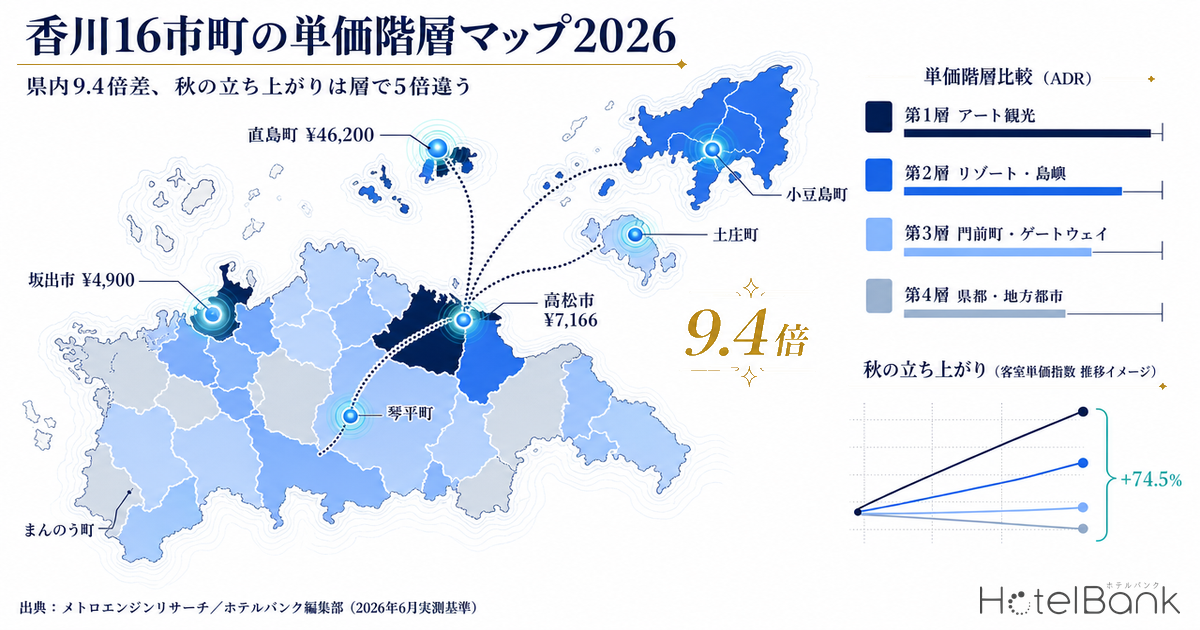
Hotel rates in Kagawa Prefecture cannot be captured by a single prefecture-wide average. Breaking MetroEngines Research data down to the municipal level, the estimated settled ADR for June 2026 (actual basis) ranges from roughly ¥46,200 in Naoshima at the top to roughly ¥4,900 in Sakaide at the bottom — a gap of about 9.4x within one prefecture. And these tiers do not all lift uniformly heading into autumn; each rises at a distinctly different angle. This article organizes Kagawa’s 16 municipalities into four price tiers and overlays last autumn’s actuals with this autumn’s outlook to read where the remaining upside sits, tier by tier.
Metric Definitions Used in This Article
- ADR (average daily rate) = an estimated settled rate (tax-exclusive equivalent) calculated by applying category-specific correction coefficients to the lowest published plan level each property lists on OTAs and similar channels (2 guests per room, per-room price, tax-inclusive). Cross-checked against property-level results disclosed by listed hotel REITs (91 properties, most recent 3 months), the median error is approximately 7%. These are estimates and differ from each property’s actual transacted prices or accounting figures. Area-level ADR is the median of the target properties (the level of a typical property in that area).
- Published price = the average of all plans each property lists on OTAs and similar channels (2 guests per room, per-room price, tax-inclusive, spanning room-only through meal-inclusive plans). Because the calculation basis differs from the ADR above, this article distinguishes the two explicitly.
- Number of properties in scope (n) = the number of properties used to calculate estimated settled ADR. This is a different figure from the number of properties aggregated for published prices; this article reports both.
- Data source: MetroEngines Research
- — A 9.4x gap within one prefecture — June 2026 actual estimated settled ADR is roughly ¥46,200 in Naoshima (3 properties in scope) versus roughly ¥4,900 in Sakaide (10 properties). The prefecture-wide single figure of roughly ¥7,100 hides this structure entirely.
- — Four price tiers — separated by three steps: roughly ¥22,500 between Naoshima and Manno, roughly ¥6,500 between Shodoshima and Kotohira, and roughly ¥1,900 between Tonosho and Takamatsu. The levers that move rates are concentrated in five municipalities — the islands and the shrine town.
- — Autumn slopes differ by about 5x across tiers — on last year’s actuals, Tiers 2–3 rose +45% to +75% versus June, while Tier 4 (the prefectural capital and regional cities) rose only +8% to +15%. Tier 4’s narrow swing indicates that event-period upside remains untapped.
- — Peak months are offset — across the two autumn months, Kotohira and Tonosho run higher in October (Kotohira-gu Grand Festival, Oct 9–11), while Shodoshima peaks clearly in November (Kankakei autumn foliage season). The peaks in the data align with the event calendar month for month.
- — The white space is “mid-scale × above ¥12,000” — no municipality combines an average of 25+ rooms per property with estimated settled ADR above ¥12,000. Several municipalities reach around ¥15,000 at the autumn peak, so the largest opportunity lies in product design that sustains that level year-round.
Kagawa’s 16 municipalities split into four price tiers
Lining up the June 2026 estimated settled ADR (actual basis) by municipality, the values are not distributed continuously — they cluster into four groups separated by clear steps. The largest step sits between Naoshima (roughly ¥46,200) and Manno (roughly ¥23,700), a difference of about ¥22,500. Next comes a step of about ¥6,500 between Shodoshima (roughly ¥16,600) and Kotohira (roughly ¥10,100), followed by a step of about ¥1,900 between Tonosho (roughly ¥9,100) and Takamatsu (roughly ¥7,200). Cutting on those three steps, Kagawa’s accommodation rate structure organizes into the following four tiers.
| Tier | Municipalities | Estimated settled ADR band | Character |
|---|---|---|---|
| Tier 1 | Naoshima | Above ¥40,000 | The art-tourism outlier. On an island where small lodgings dominate, a handful of high-rate properties make up the calculation scope |
| Tier 2 | Manno (reference), Shodoshima | ¥15,000–¥25,000 | Upper-tier resorts and islands. Clear purpose of stay, capturing multi-night demand |
| Tier 3 | Kotohira, Tonosho | ¥9,000–¥15,000 | Shrine town and island gateway. Nodes for pilgrimage and island crossings, with high elasticity during event periods |
| Tier 4 | Takamatsu and 10 other municipalities | ¥4,900–¥7,200 | Prefectural capital and regional cities. Built on business and wide-area travel demand, with small year-round variation |
Source: Compiled by the HotelBank Editorial Team from MetroEngines Research (June 2026 actual basis)
Source: Compiled by the HotelBank Editorial Team from MetroEngines Research (June 2026, estimated settled ADR; figures in parentheses are the number of properties in scope, n)
Within Tier 4, 11 municipalities cluster in a band from ¥4,900 to ¥7,200, with almost no difference between them. Structurally, the rate spread inside the prefecture is generated almost entirely by the five municipalities in Tiers 1 through 3. Put differently, the levers that move rates in Kagawa are concentrated in the islands and the shrine town. Such intra-prefecture gaps are not unique to Kagawa — comparable range differences are observed across every prefecture in Japan. We covered that nationwide spread in Japan Intra-Prefecture ADR Gaps Reach 5.2x: 368 Municipalities Ranked.
“Number of properties” has a dual structure — Naoshima’s 37 listed properties versus 3 in scope
There is one premise that cannot be skipped when reading this tier map: municipal aggregates contain two different property counts side by side. The number of properties aggregated for published prices is not the same as the number in scope for estimated settled ADR. Estimated settled ADR is calculated only for verified categories to which category-specific correction coefficients can be applied (business, city, resort, ryokan, capsule), so in areas with many pensions, minshuku and guesthouses, the calculation scope narrows sharply.
That divergence is most extreme in Naoshima. As of June 2026, 37 properties are aggregated for published prices, while only 3 fall within the estimated settled ADR scope. Moreover, the published-price average is roughly ¥20,600 while estimated settled ADR is roughly ¥46,200 — a large divergence in the opposite direction from the usual pattern. This stems from the difference in population mix: the small lodgings that make up most of the island’s 37 properties are included on the published-price side but not in the estimated settled ADR calculation. In fact, the 47 properties and 258 rooms we track in Naoshima average just 5.5 rooms per property, confirming that the island’s accommodation supply is centered on small lodgings.
Naoshima’s figure of roughly ¥46,200 therefore needs to be read as “the level of the 3 properties in scope,” not as “the typical accommodation rate across the island.” For a sense of the island average, the published-price basis of roughly ¥20,600 (37 properties aggregated) is closer to reality.
Source: Compiled by the HotelBank Editorial Team from MetroEngines Research
A further caution: Naoshima’s calculation scope shrinks from 3 properties in June 2026 to just 1 property in October and November. The October outlook of roughly ¥24,000 for Naoshima is likewise the value of a single property in scope and cannot be compared directly with the June figure drawn from 3 properties. This decline does not indicate weakening demand; it is better understood as an apparent movement caused by turnover in the calculation scope. For reference, estimated settled ADR was not calculated at all for Naoshima in October and November 2025, so this island’s rates are an area where stable comparison across seasons is difficult.
For the same reason, Manno also requires careful handling. Its published-price aggregation covers 2–3 properties, and its estimated settled ADR scope is a single property across the entire period. The June figure of roughly ¥23,700 is the level of one specific property and cannot be called “the Manno average.” Throughout this article, Naoshima and Manno are treated as reference values and excluded from definitive municipality-to-municipality comparison. Tadotsu (1 property in scope), Zentsuji (1), Miki (2), Higashikagawa (2), Sanuki (3) and Utazu (3) are treated as reference values as well.
Municipal data table — actuals, outlook and supply scale
| Municipality | Jun 2026 est. settled ADR | Scope n | Jun 2026 published price | Oct 2026 outlook | Nov 2026 outlook | Properties | Rooms | Avg rooms per property |
|---|---|---|---|---|---|---|---|---|
| Naoshima reference | ¥46,235 | 3 | ¥20,630 | ¥24,010 | ¥21,240 | 47 | 258 | 5.5 |
| Manno reference | ¥23,701 | 1 | ¥39,161 | ¥35,213 | ¥34,914 | 5 | 81 | 16.2 |
| Shodoshima | ¥16,622 | 9 | ¥29,197 | ¥19,463 | ¥30,252 | 45 | 592 | 13.2 |
| Kotohira | ¥10,062 | 16 | ¥25,258 | ¥14,709 | ¥15,046 | 33 | 862 | 26.1 |
| Tonosho | ¥9,051 | 9 | ¥27,852 | ¥17,712 | ¥18,674 | 59 | 1,020 | 17.3 |
| Takamatsu | ¥7,166 | 72 | ¥17,739 | ¥11,335 | ¥10,629 | 163 | 7,714 | 47.3 |
| Higashikagawa reference | ¥6,784 | 2 | ¥21,345 | ¥10,813 | ¥13,694 | 14 | 350 | 25.0 |
| Kanonji | ¥6,279 | 13 | ¥15,625 | ¥8,914 | ¥9,219 | 23 | 818 | 35.6 |
| Tadotsu reference | ¥6,176 | 1 | ¥27,167 | — | — | 5 | 37 | 7.4 |
| Marugame | ¥6,105 | 12 | ¥14,759 | ¥9,022 | ¥9,157 | 27 | 1,624 | 60.1 |
| Utazu reference | ¥5,788 | 3 | ¥16,097 | ¥8,993 | ¥9,219 | 11 | 323 | 29.4 |
| Mitoyo | ¥5,626 | 5 | ¥31,139 | ¥7,829 | ¥7,829 | 43 | 200 | 4.7 |
| Miki reference | ¥5,498 | 2 | ¥26,732 | ¥8,924 | ¥8,924 | 3 | 201 | 67.0 |
| Sanuki reference | ¥5,309 | 3 | ¥45,935 | ¥7,923 | ¥7,855 | 28 | 179 | 6.4 |
| Zentsuji reference | ¥5,172 | 1 | ¥9,738 | ¥6,060 | ¥5,989 | 11 | 206 | 18.7 |
| Sakaide | ¥4,892 | 10 | ¥14,003 | ¥9,027 | ¥9,038 | 30 | 968 | 32.3 |
Note: “reference” marks municipalities where the estimated settled ADR scope is 3 properties or fewer, or where population bias is large enough to warrant caution in reading the figure as a municipal average. October and November are outlooks based on listed levels at the time of the survey, not actuals. Property and room counts are aggregated across properties with registered room counts within the scope MetroEngines Research tracks. Ayagawa is excluded from the table because it has no properties in the estimated settled ADR scope.
Source: Compiled by the HotelBank Editorial Team from MetroEngines Research
Autumn lift-off differs completely by tier — last year’s actuals show a roughly 5x slope gap
This is the core of the article. Rates across Kagawa’s municipalities do not rise in unison heading into autumn. The angle of lift-off differs clearly from tier to tier.
First, a note on aligning the basis of comparison. Estimated settled ADR has two bases: actual, once a month has closed and the figure switches to a verified basis, and outlook, calculated from listed levels at the time of the survey. June 2026 is an actual; July onward is an outlook, so comparisons that cross this boundary carry a basis difference. Indeed, for Kagawa as a whole, 2025 moved from roughly ¥7,200 in June to roughly ¥7,700 in October, a rise of +7.5% (both on an actual basis), whereas 2026 moves from roughly ¥7,100 in June to roughly ¥10,900 in October, +54.4% (actual to outlook) — an apparently order-of-magnitude larger increase. A substantial part of that difference is likely attributable to the basis difference and to the composition of inventory still remaining at the time of the survey. To read the shape of the season itself, the reliable approach is to look at last year’s trajectory, where actuals can be compared with actuals.
We therefore indexed estimated settled ADR from June to December, setting June 2025 = 100 (all on an actual basis). The result was unambiguous.
Source: Compiled by the HotelBank Editorial Team from MetroEngines Research (2025, estimated settled ADR all on an actual basis, June 2025 = 100)
| Municipality (tier) | Jun 2025 | Oct 2025 | Nov 2025 | vs Jun (higher of Oct/Nov) | Scope n |
|---|---|---|---|---|---|
| Shodoshima (Tier 2) | ¥14,700 | ¥20,800 | ¥25,700 | +74.5% (Nov) | 7–8 |
| Tonosho (Tier 3) | ¥7,300 | ¥10,800 | ¥10,700 | +47.8% (Oct) | 10 |
| Kotohira (Tier 3) | ¥9,700 | ¥14,400 | ¥14,100 | +47.4% (Oct) | 14–15 |
| Sakaide (Tier 4) | ¥4,300 | ¥5,700 | ¥6,500 | +53.8% (Nov) | 8–12 |
| Takamatsu (Tier 4) | ¥7,700 | ¥8,000 | ¥8,800 | +14.7% (Nov) | 67–72 |
| Kanonji (Tier 4) | ¥6,400 | ¥6,800 | ¥7,200 | +13.4% (Nov) | 9–10 |
| Marugame (Tier 4) | ¥6,200 | ¥6,200 | ¥6,700 | +8.1% (Nov) | 11–12 |
Source: Compiled by the HotelBank Editorial Team from MetroEngines Research (2025, estimated settled ADR on an actual basis)
Tiers 2 and 3, driven primarily by leisure demand, lift into autumn at an angle of +45% to +75% versus June. Tier 4 — the prefectural capital and regional cities — stays within +8% to +15%: Takamatsu +14.7%, Kanonji +13.4%, Marugame +8.1%. Within the same prefecture, autumn elasticity differs by roughly 5x. Tier 4 is structured to capture business and wide-area travel demand steadily throughout the year, and the smaller seasonal swing can equally be read as room to raise rates during event periods that has simply been left on the table. This split between leisure destinations and the prefectural capital is common to other prefectures as well; we verified it under the same four-tier framework in Gunma Hotel Market 2026: Four ADR Tiers and a ¥5,700 Upper-Mid Gap.
Another point of interest is that peak months shift by tier. Across the two autumn months, Kotohira and Tonosho run higher in October, while Shodoshima peaks clearly in November. This one-month offset aligns almost exactly with the autumn event calendar discussed below. One caveat: Sakaide belongs to Tier 4 yet shows a relatively large +53.8% rise, but its calculation scope narrows to 8 properties in October, so the figure may include the effect of turnover in the underlying population.
Autumn 2026 outlook — Tier 3 moves into the ¥15,000–¥18,000 band
The chart below plots estimated settled ADR in absolute yen for the same municipalities, from June 2026 (actual) through December (outlook). July onward is an outlook based on listed levels at the time of the survey and rests on a different basis from the actuals, so the step up from June cannot be read directly as demand growth. What deserves attention here is the relative positioning between municipalities.
Source: Compiled by the HotelBank Editorial Team from MetroEngines Research (June 2026 is an actual; July onward is an outlook based on listed levels at the time of the survey)
On an outlook basis, October brings Tonosho to roughly ¥17,700 (8 properties in scope) and Kotohira to roughly ¥14,700 (14 properties) — both well above the Tier 3 band. In November, Shodoshima reaches roughly ¥30,300 (7 properties), close to double its June level of roughly ¥16,600. Takamatsu, the prefectural capital, also steps up from roughly ¥7,200 in June to roughly ¥11,300 in October (69 properties) and roughly ¥10,600 in November (65 properties). With a scope as deep as 69 and 65 properties, Takamatsu’s outlook ranks among the most reliable in the prefecture.
The pattern last year’s actuals revealed — Tier 3 holding high through autumn, Tier 2 peaking in November — carries through into the 2026 outlook. Kotohira sits at nearly the same level in October and November (roughly ¥14,700 and roughly ¥15,000), while Shodoshima stands out in November. The difference in peak month by tier is best treated as a recurring structure rather than a one-year coincidence.
Geographic distribution of supply — price tier and room scale are inversely correlated
To understand the price tiers one level deeper, we mapped the distribution of supply. Circle size represents each property’s room count (square-root scale) and color indicates its price tier. The map plots the 554 properties in Kagawa with registered room counts within the scope we track.
Source: Compiled by the HotelBank Editorial Team from MetroEngines Research (N=554 properties)
What the map shows is an inverse correlation: the higher a municipality’s rates, the smaller its circles. Takamatsu has 163 properties and 7,714 rooms, averaging 47.3 rooms per property, and Marugame has 27 properties and 1,624 rooms, averaging 60.1 — the prefecture’s room stock is concentrated in the urban areas along the Seto Inland Sea. By contrast, top-rate Naoshima has 47 properties and 258 rooms, averaging 5.5 rooms, and Shodoshima has 45 properties and 592 rooms, averaging 13.2: few rooms relative to the number of properties.
In other words, in Kagawa the areas that hold room scale and the areas that command rates are almost entirely separated. That separation is precisely what creates the price-band gap examined next.
White space in scale × rate — the gap above ¥12,000 at mid scale
Plotting average rooms per property on the horizontal axis, June 2026 estimated settled ADR on the vertical axis, and property count as circle size, Kagawa’s municipalities fall into a clear L-shape.
Source: Compiled by the HotelBank Editorial Team from MetroEngines Research (June 2026, estimated settled ADR; circle size = number of properties)
Two gaps stand out in this chart.
Gap 1: mid-scale × above ¥12,000
No municipality combines an average of 25+ rooms with estimated settled ADR above ¥12,000. The closest is Kotohira (26.1 rooms on average, roughly ¥10,100), and above that point there is nothing. The range where economies of scale and rate strength coexist is entirely vacant.
Gap 2: the ¥25,000–¥40,000 band
A fault line of about ¥22,500 separates Tier 1 (roughly ¥46,200) from Tier 2 (roughly ¥16,600–¥23,700), with no municipality in between. The islands lack depth in the upper price band.
For Gap 1, the autumn outlook offers a clue. In October and November, Tonosho reaches roughly ¥17,700–¥18,700, Kotohira roughly ¥14,700–¥15,000, and Shodoshima roughly ¥30,300 in November — several municipalities climb to around ¥15,000 and above. That means demand accepts this price band at the seasonal peak, and there is upside in product design that can sustain the level year-round. Kotohira, with 26.1 rooms on average across 33 properties and 862 rooms, holds comparatively consolidated room stock for a leisure area in the prefecture — an advantage as a starting point for filling this gap.
Gap 2 points to room for products that raise the value of a stay in the islands. In Naoshima, small lodgings account for most of the supply, and within that 5.5-room average structure a handful of properties achieve levels above ¥40,000. If depth were to emerge in the band between, it would be an opportunity to widen the range of visitors the island as a whole can host. On that front, the opening of edit x seven Setouchi Shodoshima — the first new hotel on Shodoshima in 34 years — is an instructive example of a property capable of carrying a new price band in the islands.
Autumn 2026 demand calendar — three axes that explain the offset peaks
The offset in peak months by tier corresponds precisely to Kagawa’s autumn event calendar. All of the following was confirmed against primary sources.
| Timing | Details | Municipalities primarily affected |
|---|---|---|
| October 9–11, 2026 | Kotohira-gu Grand Festival (Oct 9: eve festival / Oct 10: main rite, sacred procession and portable-shrine departure / Oct 11: temporary-shrine morning rite and return procession) | Kotohira (Tier 3) |
| November 10, 2026 | Kotohira-gu Autumn Foliage Festival | Kotohira (Tier 3) |
| Early November – early December | Peak autumn foliage at Kankakei Gorge (one of Japan’s three great gorge landscapes, viewed from the ropeway) | Shodoshima and Tonosho (Tiers 2–3) |
| FY2026 onward (year-round) | Start of regular public openings for the Setouchi Triennale’s indoor artworks. Shodoshima, Megijima and Ogijima: second Saturday and Sunday of each month, May–November; Teshima: every Saturday, Sunday, Monday and public holiday; Awashima: every Saturday; Hiketa: every Sunday; Oshima: second Saturday and Sunday, April–November | Shodoshima, Tonosho and Higashikagawa |
| Opened May 31, 2025 | Naoshima New Museum of Art (designed by Tadao Ando; the tenth facility he has designed for Benesse Art Site Naoshima) | Naoshima (Tier 1) |
Source: Compiled by the HotelBank Editorial Team from Kotohira-gu “Annual Events at Kotohira-gu, Reiwa 8 (2026)”, information published by Shodoshima Town and Kankakei Ropeway, information published by the Setouchi Triennale, and information published by Benesse Art Site Naoshima
One important clarification. The Setouchi Triennale is held once every three years; the most recent main edition was in 2025, and 2026 is not a main edition year. Autumn 2026 demand in the islands will therefore be supported not by the festival itself, but by year-round art facilities and natural scenery. On that point, the regular public openings of indoor artworks beginning in FY2026 deserve attention. Until now, opportunities to view indoor exhibits outside the festival period were limited to long holidays such as Golden Week and Obon; with regular openings, viewing becomes possible on the second Saturday and Sunday of each month from May to November on Shodoshima, Megijima and Ogijima, and every Saturday, Sunday, Monday and public holiday on Teshima. In addition, the Setouchi Asia Gallery on Shodoshima has announced a “Special Exhibition 2026,” which may create a fresh reason to visit the islands in a non-festival year.
Kotohira’s October peak matches the Grand Festival (October 9–11); Tonosho’s elevated level through October and November matches its role as the gateway for island crossings; and Shodoshima’s November peak matches the Kankakei foliage season — each aligning month for month. That the peaks in the data line up this closely with the event calendar shows that Kagawa’s autumn accommodation demand has clear anchors.
Conclusion — four tiers the prefectural average hides, and different plays for each
Kagawa’s prefecture-wide estimated settled ADR stood at roughly ¥7,100 in June 2026 (162 properties in scope), essentially flat against roughly ¥7,200 the same month a year earlier. Yet inside that single figure sit four tiers separated by a 9.4x rate gap between municipalities and by autumn slopes that differ about 5x. Watch the prefectural average alone and this structure is invisible.
Organized by tier, the direction of play diverges as follows. Tiers 2 and 3 showed autumn elasticity of +45% to +75% versus June on last year’s actuals, so product design aimed at the peak months (October–November for Kotohira, November for Shodoshima) works readily. Tier 4 swings only +8% to +15% across the year; that stability means the room to capture event-period demand remains fully intact as upside. Takamatsu carries the prefecture’s deepest population at 69 properties in scope, and with its October outlook of roughly ¥11,300 stepping up from a June actual of roughly ¥7,200, the groundwork is there to translate autumn demand into rate.
Across the prefecture as a whole, the range that combines scale and rate — an average of 25+ rooms with ADR above ¥12,000 — is entirely vacant. At the autumn peak, several municipalities reach around ¥15,000 and above, so demand willing to accept that band demonstrably exists. A product that can sustain it year-round is the single largest remaining opportunity in Kagawa’s accommodation market.
⚠ Note on ADR for future dates: Estimated settled ADR for July 2026 onward in this article is an outlook based on prices published on OTAs and similar channels as of the survey date (July 31, 2026), and will change as the check-in date approaches. Because the calculation basis also differs from the actual basis (for months that have closed), the step up from the June actual cannot be interpreted directly as demand growth. For municipalities where the number of properties in scope (n) is fewer than 10, please also note that turnover in the underlying population can produce wide swings.
Related reading
- Japan Intra-Prefecture ADR Gaps Reach 5.2x: 368 Municipalities Ranked
- Mandarin Oriental Setouchi — ¥298M/Room Investment Yield Analysis
- Supply Absorption Capacity in 8 Regional Core Cities — GW2026 Sellout Rate × New Openings Map
- Gunma Hotel Market 2026: Four ADR Tiers and a ¥5,700 Upper-Mid Gap
- Golf Town Hotels: ¥5,200–¥21,300 Autumn ADR Across 15 Municipalities
References and Sources
■ Data source
MetroEngines Research monthly aggregates for Kagawa’s 16 municipalities (June 2025 – December 2026, retrieved July 31, 2026). Estimated settled ADR, published price and number of properties in scope (n) were obtained at the municipal level; on the supply side, the property count, room count and coordinates of 554 properties in the prefecture with registered room counts were used. The demand calendar was confirmed against information published by Kotohira-gu, Shodoshima Town, Kankakei Ropeway, the Setouchi Triennale and Benesse Art Site Naoshima (primary sources).
■ Calculation assumptions
Estimated settled ADR is an estimate (tax-exclusive equivalent) derived by applying category-specific correction coefficients to each property’s lowest published plan level (2 guests per room, per-room price, tax-inclusive); area values are the median of the properties in scope. Through June 2026 the figures use the actual basis (for months that have closed); from July onward they use an outlook basis derived from listed levels as of the survey date (July 31, 2026). The four tiers were cut mechanically on the three steps visible in the distribution of June actuals (about ¥22,500 / about ¥6,500 / about ¥1,900). To avoid mixing bases, the autumn slope comparison uses the June–December 2025 series, where every figure is on an actual basis.
■ Limitations and caveats
Naoshima, Manno, Tadotsu, Zentsuji, Miki and Higashikagawa have 3 or fewer properties in scope and are reference values; they cannot be compared definitively as municipal averages. Because the actual and outlook bases are calculated differently, the step between June and July onward cannot be read directly as an increase or decrease in demand. The number of properties in scope changes month to month, so in municipalities where n is fewer than 10, shifts in the underlying population affect the values (Sakaide falls to 8 properties in October). Estimated settled ADR is an estimate and differs from each property’s actual transacted prices or accounting figures. Published prices and estimated settled ADR use different calculation bases and cannot be compared directly.
■ Market data
- MetroEngines Research — estimated settled ADR, published price and property counts for Kagawa’s 16 municipalities (June 2025 – December 2026, retrieved July 31, 2026); property distribution and room counts (N=554 properties)
■ Events and tourism information (primary sources)
- Kotohira-gu, “Annual Events at Kotohira-gu, Reiwa 8 (2026)”
- Kankakei Ropeway official website
- Shodoshima Town, “Kankakei Ropeway Latest Information 2026”
- Setouchi Triennale, “Announcement of the Setouchi Asia Gallery Special Exhibition 2026”
- Setouchi Triennale, “Artwork Opening Schedule”
- KCT Town, “[2026] Setouchi Triennale Indoor Artworks Open Regularly for the First Time”
- Benesse Art Site Naoshima, “Naoshima New Museum of Art to Open on Saturday, May 31, 2025”
- Benesse Art Site Naoshima, “Naoshima New Museum of Art”