

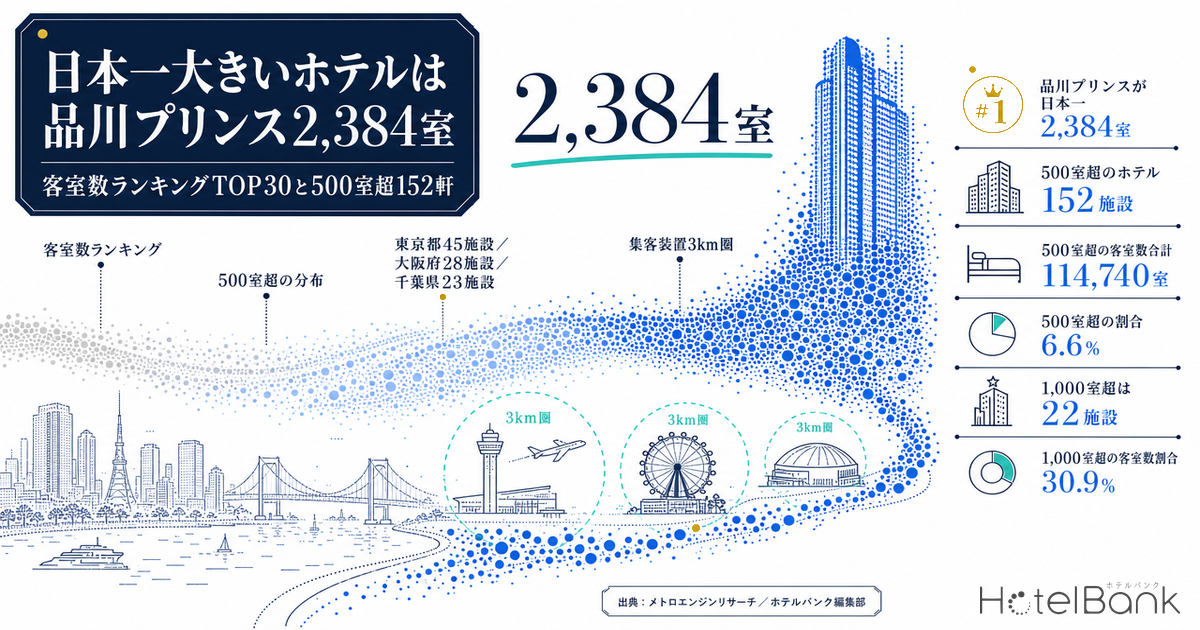
Which is the largest hotel in Japan? Ranking every lodging property MetroEngines Research tracks by room count puts Shinagawa Prince Hotel (品川プリンスホテル) first with 2,384 rooms, followed by APA Hotel & Resort Yokohama Bay Tower at 2,311 rooms and APA Hotel & Resort Osaka Namba-Ekimae Tower at 2,055 rooms. This article presents the named Top 30 by room count, then uses maps and numbers to explain where Japan’s 152 large-scale properties of 500-plus rooms are concentrated — and why.
Metric Definitions Used in This Article
- Room count: the registered number of rooms for each property. Where a tower wing or annex is registered as a separate property, it is counted separately. Figures may differ from an operator’s published count by a few rooms depending on when extensions are reflected and how the registration unit is defined.
- Coverage: lodging properties located in Japan’s 47 prefectures with a registered room count, limited to hotel and ryokan formats (city hotel / business hotel / resort hotel / deluxe hotel / ryokan / capsule hotel). Training facilities, group lodging houses and campsites are excluded. The base population is 29,781 properties and 1,750,857 rooms.
- “Above 500 rooms”: properties with 500 or more rooms. That group numbers 152 properties and 114,740 rooms.
- Data source: MetroEngines Research. Coverage is limited to properties whose operation can be confirmed through online distribution listings, and is not a complete census.
- — 2,384 rooms — Shinagawa Prince Hotel is Japan’s largest. Adding the separately listed East Tower (919 rooms) takes the single site past 3,300 rooms.
- — 152 properties, 0.51% — that is the entire 500-plus-room universe. Yet it holds 114,740 rooms, 6.6% of all supply, or one room in every 15.
- — Tokyo 45, Osaka 28, Chiba 23 — the top three prefectures hold 96 properties and 76,044 rooms, 66.3% of all 500-plus-room inventory. Twenty-five prefectures have none at all.
- — One in three — 47 properties and 38,743 rooms sit within 3 km of an airport, theme park or MICE venue. Distribution is set by demand generators, not by population.
- — 27 properties in the 2020s — 3.9 per year, ahead of the 2.9 per year of the 1980s. Large-format hotels are a current supply pattern, not a legacy one.
Top 30 by room count — only 22 properties exceed 1,000 rooms
Start with the overall picture. Of the 29,781 properties covered, just 22 (0.07%) have 1,000 rooms or more, and only 152 (0.51%) reach 500. Yet those 152 properties hold 114,740 rooms, 6.6% of the 1,750,857-room total. A group that accounts for half a percent of properties supplies one room in every 15. Japan’s lodging supply is overwhelmingly an aggregation of small properties, and a handful of large-format hotels absorb the peaks of demand.
The table below lists the 30 largest properties by room count. Shinagawa Prince Hotel, the leader, is a complex made up of several towers; in our data “Shinagawa Prince Hotel” (2,384 rooms) and “Shinagawa Prince Hotel East Tower” (919 rooms) are registered as separate listings. Combined, they exceed 3,300 rooms, making it far and away the largest single site in Japan.
| Rank | Property | Rooms | Location | Format |
|---|---|---|---|---|
| 1 | Shinagawa Prince Hotel | 2,384 | Minato, Tokyo | City hotel |
| 2 | APA Hotel & Resort Yokohama Bay Tower | 2,311 | Naka-ku, Yokohama, Kanagawa | Resort hotel |
| 3 | APA Hotel & Resort Osaka Namba-Ekimae Tower | 2,055 | Naniwa-ku, Osaka | Business hotel |
| 4 | APA Hotel & Resort Tokyo Bay Makuhari | 2,007 | Mihama-ku, Chiba City, Chiba | City hotel |
| 5 | APA Hotel & Resort Osaka Umeda-Eki Tower | 1,704 | Kita-ku, Osaka | Business hotel |
| 6 | Villa Fontaine Grand Haneda Airport | 1,557 | Ota, Tokyo | City hotel |
| 7 | Hotel New Otani Tokyo | 1,479 | Chiyoda, Tokyo | City hotel |
| 8 | Keio Plaza Hotel | 1,438 | Shinjuku, Tokyo | Deluxe hotel |
| 9 | Ours Inn Hankyu | 1,388 | Shinagawa, Tokyo | Business hotel |
| 10 | Toyoko Inn Chubu International Airport No.2 | 1,287 | Tokoname, Aichi | Business hotel |
| 11 | Shinjuku Washington Hotel Main Building | 1,280 | Shinjuku, Tokyo | Business hotel |
| 12 | Naeba Prince Hotel | 1,216 | Yuzawa, Niigata | Resort hotel |
| 13 | APA Hotel & Resort Ryogoku-Eki Tower | 1,111 | Sumida, Tokyo | Business hotel |
| 14 | Sunshine City Prince Hotel | 1,085 | Toshima, Tokyo | City hotel |
| 15 | Hilton Fukuoka Sea Hawk | 1,053 | Chuo-ku, Fukuoka City, Fukuoka | City hotel |
| 16 | Hotel Hankyu Respire Osaka | 1,030 | Kita-ku, Osaka | Business hotel |
| 17 | Sheraton Grande Tokyo Bay Hotel | 1,016 | Urayasu, Chiba | Resort hotel |
| 18 | Tokyo Dome Hotel | 1,006 | Bunkyo, Tokyo | City hotel |
| 19 | Rihga Royal Hotel Osaka, Vignette Collection | 1,001 | Kita-ku, Osaka | Deluxe hotel |
| 20 | Toyoko Inn Chubu International Airport No.1 | 1,001 | Tokoname, Aichi | Business hotel |
| 21 | APA Hotel Roppongi SIX | 1,001 | Minato, Tokyo | Business hotel |
| 22 | APA Hotel & Resort Niigata-Ekimae Odori | 1,001 | Chuo-ku, Niigata City, Niigata | Business hotel |
| 23 | Miyako Hotel Kyoto Hachijo | 988 | Minami-ku, Kyoto | City hotel |
| 24 | Hotel Gracery Shinjuku | 970 | Shinjuku, Tokyo | Business hotel |
| 25 | Osaka Shin-Hankyu Hotel | 961 | Kita-ku, Osaka | City hotel |
| 26 | Keikyu EX Hotel Shinagawa | 935 | Minato, Tokyo | Business hotel |
| 27 | Shinagawa Prince Hotel East Tower | 919 | Minato, Tokyo | City hotel |
| 28 | APA Hotel & Resort Midosuji-Honmachi-Eki Tower | 913 | Chuo-ku, Osaka | Business hotel |
| 29 | Sotetsu Grand Fresa Tokyo-Bay Ariake | 912 | Koto, Tokyo | City hotel |
| 30 | Grand Prince Hotel Shin Takanawa | 908 | Minato, Tokyo | City hotel |
Source: compiled by the HotelBank Editorial Team from MetroEngines Research (Japan’s 47 prefectures, top 30 of N=29,781 properties)
Source: compiled by the HotelBank Editorial Team from MetroEngines Research
Recutting those 30 properties by region and format shows that scale is built differently in different parts of the country.
| Region | City | Business | Resort | Deluxe | Total |
|---|---|---|---|---|---|
| Greater Tokyo | 9 12,257 rooms | 6 6,685 rooms | 2 3,327 rooms | 1 1,438 rooms | 18 23,707 rooms |
| Kansai | 2 1,949 rooms | 4 5,702 rooms | — | 1 1,001 rooms | 7 8,652 rooms |
| Rest of Japan | 1 1,053 rooms | 3 3,289 rooms | 1 1,216 rooms | — | 5 5,558 rooms |
| Total | 12 15,259 rooms | 13 15,676 rooms | 3 4,543 rooms | 2 2,439 rooms | 30 37,917 rooms |
Source: compiled by the HotelBank Editorial Team from MetroEngines Research (re-aggregated from the top 30 above. Greater Tokyo = Tokyo, Kanagawa, Chiba and Saitama; Kansai = Osaka, Kyoto, Hyogo and neighbouring prefectures)
Greater Tokyo accounts for 18 of the top 30 — more than half — and spreads across all four formats. Only Greater Tokyo has demand deep enough for banquet-driven city hotels and rooms-focused business hotels to coexist at this scale. Kansai, by contrast, has four business hotels among its seven properties, clustered in the station-front towers of Umeda, Namba and Honmachi. The five properties elsewhere are confined to an airport island (two properties at Chubu International Airport), a ski resort (Naeba) and regional hub cities (Fukuoka and Niigata); there is almost no case of a large-format hotel standing on ordinary urban lodging demand alone.
By format, the top 30 splits almost evenly: 13 business hotels and 12 city hotels. The old assumption that a large hotel means a city hotel combining banquet halls with guest rooms has been rewritten by the arrival of rooms-focused tower hotels. APA Hotels alone accounts for 8 of the top 30, showing how the group’s urban tower development has driven large-scale supply in Japan. Its Osaka Namba-Ekimae Tower, opened in December 2024 with 2,055 rooms in a 40-storey building, is the largest hotel in western Japan by room count.
Airport locations are just as visible. Villa Fontaine Grand Haneda Airport (1,557 rooms), ranked sixth, sits inside Haneda Airport. Toyoko Inn Chubu International Airport No.2 (1,287 rooms) and No.1 (1,001 rooms), at 10th and 20th, are adjacent buildings that together exceed 2,000 rooms — one of the largest room stocks in Japan concentrated on a single airport island.
Where the 152 properties above 500 rooms are — Tokyo 45, Osaka 28, Chiba 23
Widening the lens, here is how the 152 properties of 500-plus rooms break down by prefecture. Tokyo has 45 properties (38,173 rooms), Osaka 28 (21,106 rooms) and Chiba 23 (16,765 rooms). Those three alone hold 96 properties and 76,044 rooms, 66.3% of all 500-plus-room inventory nationwide. Hokkaido follows with 10, then Fukuoka with 8, Aichi with 7 and Kanagawa with 5. In 25 prefectures, not a single property above 500 rooms can be confirmed.
Source: compiled by the HotelBank Editorial Team from MetroEngines Research (N=152 properties)
Plotted on a map, the skew is starker still. The map below shows the locations of all 152 properties above 500 rooms, with circle size scaled to room count. Along Tokyo Bay, large properties string together through Urayasu, Makuhari, Ariake, Haneda and Yokohama Minato Mirai; in Osaka they concentrate along the Midosuji axis from Umeda down to Namba. Elsewhere they appear only sporadically, at airports, resorts and the station fronts of prefectural capitals.
Source: compiled by the HotelBank Editorial Team from MetroEngines Research (N=152 properties)
Why Chiba ranks third nationwide — 22 of its 23 properties are in Urayasu and Narita
Chiba is not a top-three prefecture by population or by gross prefectural product, yet it ranks third in the number of properties above 500 rooms. Break the locations down and the reason is immediate. Of the 23 properties in the prefecture, 16 are in Urayasu and 6 in Narita — 22 of 23 between those two cities. The remaining one is APA Hotel & Resort Tokyo Bay Makuhari (2,007 rooms) in the Makuhari New City district. Chiba’s large-format supply is, in other words, almost entirely tied to three demand generators: a theme park, an international airport and a major exhibition complex.
| Property | Rooms | Location | Cluster |
|---|---|---|---|
| APA Hotel & Resort Tokyo Bay Makuhari | 2,007 | Mihama-ku, Chiba City | Makuhari New City |
| Sheraton Grande Tokyo Bay Hotel | 1,016 | Urayasu | Maihama |
| Toyoko Inn Narita Airport Main Building | 844 | Narita | Narita Airport |
| Hilton Tokyo Bay | 828 | Urayasu | Maihama |
| Marroad International Hotel Narita | 801 | Narita | Narita Airport |
| The Royal Park Hotel Maihama Resort Tokyo Bay | 750 | Urayasu | Maihama |
| Hotel MyStays Premier Narita | 711 | Narita | Narita Airport |
| Grand Nikko Tokyo Bay Maihama | 707 | Urayasu | Maihama |
| Tokyo Disneyland Hotel | 706 | Urayasu | Maihama |
| Tokyo Bay Maihama Hotel Club Resort | 703 | Urayasu | Maihama |
| Tokyo Disney Celebration Hotel | 702 | Urayasu | Maihama |
| Tokyo Bay Maihama Hotel First Resort | 696 | Urayasu | Maihama |
| Hotel Nikko Narita | 685 | Narita | Narita Airport |
| 1955 Tokyo Bay by Hoshino Resorts | 638 | Urayasu | Maihama |
| Tokyo Bay Tokyu Hotel | 638 | Urayasu | Maihama |
| Tokyo Disney Resort Toy Story Hotel | 595 | Urayasu | Maihama |
| Hotel Emion Tokyo Bay | 583 | Urayasu | Maihama |
| Mitsui Garden Hotel Prana Tokyo Bay | 550 | Urayasu | Maihama |
| Hilton Narita | 548 | Narita | Narita Airport |
| Toyoko Inn Narita Airport New Building | 540 | Narita | Narita Airport |
| Oriental Hotel Tokyo Bay | 511 | Urayasu | Maihama |
| Disney Ambassador Hotel | 504 | Urayasu | Maihama |
| Tokyo DisneySea Hotel MiraCosta | 502 | Urayasu | Maihama |
Source: compiled by the HotelBank Editorial Team from MetroEngines Research (Chiba properties above 500 rooms, N=23 properties)
Urayasu’s 16 properties total 10,629 rooms. Park-operated hotels and partner hotels have been layered into the same area, and the average property runs to 664 rooms. Leisure demand that does not end after one night — multi-night stays, multi-guest bookings — varies between weekdays and weekends but is readable in volume year-round. The demand conditions that make a large-format property viable are all present.
Narita’s 6 properties total 4,129 rooms. Here the base is time-bound demand: connecting passengers, early-morning departures and delay recovery. Stays are short, but daily volume is predictable and seasonality is milder than for leisure. The economics favour turnover over rate, which is why business hotels dominate the upper ranks. Even within the same “large-format prefecture,” Urayasu and Narita build revenue in fundamentally different ways.
The demand large hotels serve — 30% sit within 3 km of an airport, theme park or MICE venue
Does the pattern visible in Chiba hold nationally? We matched the coordinates of all 152 properties above 500 rooms against 7 major airports, the Maihama theme park district, and 8 major MICE venues, domes and arenas, then tested whether each falls within 3 km of any of them. The result: 47 properties and 38,743 rooms qualify — 30.9% by property count and 33.8% by rooms. One large-format hotel in three stands not on ordinary urban lodging demand but on a specific, very large demand generator.
Source: compiled by the HotelBank Editorial Team from MetroEngines Research (152 properties above 500 rooms, classified by straight-line distance within 3 km of each anchor)
The MICE, dome and arena catchment is the largest of the three, at 25 properties and 22,310 rooms. The main clusters are 2,007 rooms around Makuhari Messe, 5 properties and 3,955 rooms around Tokyo Big Sight, 10 properties and 7,927 rooms around Kyocera Dome Osaka, and 4 properties and 4,061 rooms around Pacifico Yokohama — all positioned to absorb simultaneous demand of thousands to tens of thousands of people at very short range. Some carry that load in a single building: Hilton Fukuoka Sea Hawk (1,053 rooms) adjoins Fukuoka PayPay Dome, and Shin Yokohama Prince Hotel (875 rooms) sits close to Yokohama Arena.
Airport catchments account for 12 properties and 9,426 rooms; the Maihama theme park catchment for 10 properties and 7,007 rooms. The three demand types follow different patterns. MICE and arena demand spikes hard on event days, airport demand is level day to day, and theme park demand peaks at weekends and during long holidays. That is why several large properties can sit side by side in one area without cannibalising each other — each is sharing demand that fills on a different calendar. The corollary is that a closure at a major venue, or a thinner slate of events and concerts, is a swing factor for which nearby large-format hotels have few substitutes. On how inventory at different property sizes sells down, see our separate analysis, Do Big Hotels Fill Last? 200+ Rooms Lead by 25.8pt at LT90.
When were they built? The 2020s already account for 27
Broken down by opening decade, the 1980s produced the most of the 152 properties above 500 rooms, at 29, followed by the 2000s and the 2020s at 27 each. The point to note is that the 2020s are only seven years old. On an annual basis that is 3.9 properties per year against 2.9 in the 1980s — the fastest rate on record. Large-format hotels are not a relic; they are a supply pattern still being produced.
Source: compiled by the HotelBank Editorial Team from MetroEngines Research (based on confirmed online distribution listings, N=152 properties). Registration for a decade may be updated on rebranding or major renovation, so it does not indicate new-build years alone.
The 27 properties and 21,289 rooms added in the 2020s are led by 1,000-room-class towers: APA Hotel & Resort Osaka Namba-Ekimae Tower (2,055 rooms, December 2024), APA Hotel & Resort Osaka Umeda-Eki Tower (1,704 rooms, February 2023), Villa Fontaine Grand Haneda Airport (1,557 rooms, December 2022), APA Hotel & Resort Ryogoku-Eki Tower (1,111 rooms, August 2020) and APA Hotel & Resort Niigata-Ekimae Odori (1,001 rooms, February 2022). APA in particular has brought several 1,000-plus-room properties online in a short span, giving it supply capacity unmatched by any other single group in Japan.
Major openings in 2026 and the pipeline ahead
Recent activity has also skewed large. On 13 February 2026, The Royal Park Hotel Maihama Resort Tokyo Bay (750 rooms) opened in Chidori, Urayasu. It is the largest property in the Mitsubishi Estate Hotels & Resorts group, with a dedicated shuttle bus linking Maihama Station and both parks, and parking for roughly 400 vehicles. That is another 750 rooms added to the Urayasu cluster described above.
On 6 August 2026, APA Hotel & Resort Okayama-Eki Shinkansen-guchi (600 rooms) opened — the first “APA Hotel & Resort” branded property in the Chugoku-Shikoku region and among the largest in Okayama Prefecture. It includes resort-grade shared facilities such as a large public bath, an open-air bath and a top-floor observation pool. The arrival of a genuine large-format property in Chugoku-Shikoku, a region that had almost no properties above 500 rooms, matters: it shows that large-scale properties can be viable as demand catchments even in regional hub cities.
Later this year, Solaria Nishitetsu Hotel Osaka Honmachi (202 rooms) is scheduled to open in Chuo-ku, Osaka on 18 December 2026. It is the first Osaka property for the Nishitetsu Hotel Group’s SOLARIA brand, sited close to Honmachi Station where the Osaka Metro Midosuji, Yotsubashi and Chuo lines intersect. With rooms designed for medium- and long-stay use, including mini-kitchens and washing machines, it differentiates on quality of stay rather than scale. In Okinawa, the current DoubleTree by Hilton Naha Shuri Castle is scheduled to reopen on 1 January 2027 as The Grand Castle Naha Shurijo by Hewitt Resort (333 rooms). That is an operator change plus renovation rather than a new build, positioned ahead of the completion of the Shuri Castle main hall reconstruction.
Further out, a mixed-use project of roughly 1,000 rooms in a 23-storey building has been confirmed for Hibino, Mihama-ku, Chiba City. The scheme includes a cinema, restaurants and bathing facilities alongside the hotel, with completion scheduled for December 2027. If realised, Makuhari New City would host a 2,000-room-class and a 1,000-room-class property side by side. (For a detailed look at this project, see Kaihin-Makuhari 1,000-Room ¥30bn Mixed-Use: Breakeven ADR.) Note that these planned-project counts are based on building confirmation applications and are expected to rise as further applications are filed. The pipeline visible today is best read as a floor, not a final figure.
Conclusion
The largest property in Japan by room count is Shinagawa Prince Hotel at 2,384 rooms; only 22 properties exceed 1,000 rooms and only 152 exceed 500. Those 152 nonetheless hold 6.6% of all guest rooms. Large-format hotels are numerically exceptional, yet they carry a concentrated share of the task of absorbing peak demand.
What determines their distribution is not population but demand generators. Setting aside the two great metropolitan areas of Tokyo and Osaka, Chiba’s third-place ranking comes down entirely to a theme park, an international airport and a major exhibition complex. Nationwide, just over 30% of large-format properties sit within 3 km of an airport, theme park or MICE venue — evidence that siting decisions for large properties have been made on how many people gather at a single point in a day, not on how big the city is.
And large-format hotels are not a product of the past. The 2020s have already added 27 properties, running at close to the fastest annual pace on record. In 2026, 750 rooms were added in Urayasu and 600 in Okayama, with a 1,000-room-class project pending in Makuhari. Large-scale supply tied to demand generators looks set to keep shaping the structure of Japan’s lodging market.
Related reading
- Do Big Hotels Fill Last? 200+ Rooms Lead by 25.8pt at LT90
- Kaihin-Makuhari 1,000-Room ¥30bn Mixed-Use: Breakeven ADR
- 43% of Chiba’s 75,065 Rooms Sit in 25 Disaster-Relief Municipalities
- 1,002 New Japan Openings H1 2026: ADR 1.14x, Ryokan Lag
- Median 39.2% of Rooms Online — Allocation Across 12,941 Hotels
References and Sources
- MetroEngines Research — room-count and location data for lodging properties in Japan (N=29,781 properties)
- Compiled by MetroEngines Research from the Ministry of Land, Infrastructure, Transport and Tourism “Statistical Survey on Building Construction Starts” — planned hotels on a building-confirmation-application basis
- Mitsubishi Estate Hotels & Resorts, “The Royal Park Hotel Maihama Resort Tokyo Bay: opening date confirmed and reservations now open” (1 July 2025, in Japanese)
- APA Hotel Co., Ltd., “Okayama’s largest class, all 600 rooms: APA Hotel & Resort Okayama-Eki Shinkansen-guchi opens today” (6 August 2026, in Japanese)
- Nishi-Nippon Railroad Co., Ltd., “Solaria Nishitetsu Hotel Osaka Honmachi to open on 18 December 2026” (17 April 2026, in Japanese)
- Core Global Management Co., Ltd., “New hotel brand in Shuri, Okinawa: The Grand Castle Naha Shurijo by Hewitt Resort to rebrand and open on 1 January 2027” (in Japanese)
- APA Hotel Co., Ltd., “Six APA Hotels on Roppongi-dori: APA Hotel Roppongi SIX opens today” (in Japanese)
- APA Hotel Co., Ltd., “Niigata City’s largest mega-hotel with 1,001 rooms: APA Hotel & Resort Niigata-Ekimae Odori opens today” (in Japanese)
- Shinagawa Prince Hotel official site, “Guest rooms” (in Japanese)
- Hyatt Japan K.K., “Press materials, April 2026” (cross-check of room counts for the Hyatt properties listed)
■ Data sources
Room-count and location data for lodging properties in Japan held by MetroEngines Research (Japan’s 47 prefectures, hotel and ryokan formats, N=29,781 properties and 1,750,857 rooms). Opening decades come from property attributes in the same dataset; planned projects are compiled by MetroEngines Research from the Ministry of Land, Infrastructure, Transport and Tourism “Statistical Survey on Building Construction Starts.” Room counts, opening dates and scheduled opening dates for individual properties are cross-checked against each operator’s official releases and websites.
■ Calculation assumptions
“Above 500 rooms” is defined as a registered room count of 500 or more. Where a tower wing or annex is registered as a separate property, the two are counted separately rather than combined (which is why Shinagawa Prince Hotel and its East Tower appear as separate listings). Location categories are assigned by straight-line distance within 3 km between each property’s coordinates and 7 major airports, the Maihama theme park district, and 8 major MICE venues, domes and arenas; properties matching more than one anchor are not double-counted. Annual rates treat the 2020s as the seven years from 2020 to 2026.
■ Limitations
Coverage is limited to properties whose operation can be confirmed through online distribution listings, and is not a complete census. Room counts are registered values and may differ from an operator’s published figure by a few rooms depending on when extensions are reflected and how the registration unit is defined. Opening decades may be updated on rebranding or major renovation and do not necessarily match the year of construction. The pipeline is on a building-confirmation-application basis and represents a floor rather than a final figure. This article is an aggregation of the supply side only; it does not cover demand-side metrics such as occupancy or average daily rate, and is not an assessment of the demand-absorption capacity of large-format hotels themselves.