

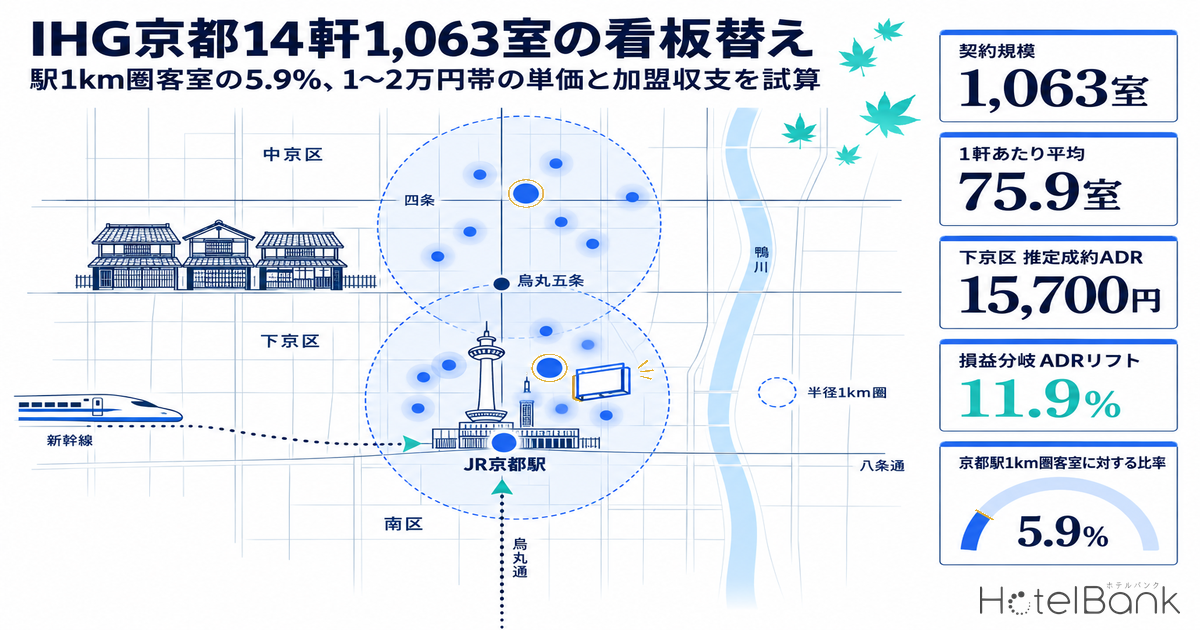
The portfolio agreement IHG Hotels & Resorts announced on August 24, 2026 with GCP Hospitality (the hospitality arm of Gaw Capital Group), covering 14 hotels and 1,063 rooms in Kyoto City, puts international brand flags across the city’s midscale segment in one stroke without building a single new property. The split is 12 Garner hotels, one Holiday Inn Express and one with the brand still to be decided; every property will be fully renovated and reopened in phases over the next 12 months. The average of 75.9 rooms per hotel is about the same scale as the small independent hotels packed around Kyoto Station, Shijo and Gojo, which makes the deal a yardstick for owners of similar buildings in the same locations: “which price band is my building in, and what would change if I switched the flag?” This article first sets out the facts of the deal from primary sources, then lines up the estimated transacted ADR of Shimogyo, Nakagyo and Minami wards, the room stock within a 1km radius of Kyoto Station and of Karasuma-Gojo, and how quickly each price band sells out, and finally sketches — with every assumption stated — the economics of a small independent hotel joining an international brand.
Metric Definitions Used in This Article
- ADR (average daily rate): an estimated transacted rate (tax-exclusive equivalent) calculated by applying a category-specific adjustment factor to the lowest-plan rate each property publishes on OTAs and other channels (per room, two guests per room, tax-inclusive). Checked against the property-level results disclosed by listed hotel REITs (91 properties, most recent three months), the median error is about 7%. These are estimates and differ from each property’s actual transacted prices and accounting figures. Area-level ADR is the median of the properties covered (the level of a typical property in the area); the ward ADRs in this article use the 12-month average from October 2025 to September 2026. Where listed prices are mentioned, they are per-room rates for two guests (tax-inclusive).
- OCC (occupancy rate): rooms sold as a share of total rooms in the area (an estimate based on OTA sales inventory). This article shows only ward-level monthly averages and does not calculate OCC for individual properties.
- LT (lead time): the number of days before the check-in date. Early sell-out LT = the lead time at which remaining inventory first reached 0 rooms (a larger value means an earlier sell-out). Only observations within 45 days of the stay date are used; properties already sold out more than 45 days ahead are capped at 45 as “sold out from 45+ days out”.
- Catchment stock: an inventory, property by property, of facilities within a 1km radius of JR Kyoto Station (34.9858°N, 135.7588°E) and of the Karasuma-Gojo intersection area (34.9960°N, 135.7596°E), counting properties open at each year-end after excluding closed properties and duplicate listings (based on listings on major booking sites). The price-band distribution is limited to properties with 10 or more rooms for which an estimated transacted ADR can be calculated.
- Data sources: MetroEngines Research & Consulting (analysing about 27,000 properties and about 1.26 million rooms in Japan whose operation can be confirmed on major booking sites), the IHG official release (August 24, 2026), MLIT Real Estate Information Library, and the Japan Tourism Agency’s Overnight Travel Statistics Survey
- — The IHG–GCP Hospitality deal covers 14 hotels and 1,063 rooms in Kyoto City (Garner 12 / Holiday Inn Express 1 / undecided 1). It is a reflagging of existing rooms, to be fully renovated and reopened in phases over the next 12 months — not new supply.
- — The 1,063 rooms equal 5.9% of the 18,137 rooms in the 208 properties with 10+ rooms within 1km of Kyoto Station. Rooms in that radius grew 2.26-fold in the 14 years from end-2012, and 2.43-fold within 1km of Karasuma-Gojo (based on listings on major booking sites).
- — The 12-month average estimated transacted ADR (October 2025–September 2026) is ¥15,700 in Shimogyo, ¥17,000 in Nakagyo and ¥14,000 in Minami Ward. The ¥10k–20k band holds 59.3% of rooms within 1km of Kyoto Station and 65.9% within 1km of Karasuma-Gojo.
- — In a regular weekday week, ¥10k–20k properties mostly reached zero remaining rooms on the day of arrival to 2 days before, while the ¥30k–50k band in Shimogyo did so 33.5 days out. The midscale segment is a market that does not fill until the last minute, and pulling bookings forward is where the revenue opportunity lies.
- — In a 76-room model, the break-even ADR lift that covers 8% ongoing fees through rate alone is 11.9%. With ADR +15% and occupancy +3pt, payback is 7.6 years at ¥1.5M/room of renovation, or 3–5 years if only the brand-standard premium is counted (all assumptions).
The Facts of the Deal — Bringing 1,063 Rooms Under International Brands Without Building
Start by pinning down the facts as far as the primary sources go. According to IHG’s official release (Tokyo, August 24, 2026), the agreement is described as “one of the largest conversion portfolio deals in Japan in recent years”, and Erwann Mahé, CEO of GCP Hospitality, said the company “will lead the operations team across the full portfolio of 14 hotels”. On the IHG side, Abhijay Sandilya (Managing Director, Japan & Micronesia, IHG, and CEO of IHG ANA Hotels Group Japan) noted that owner demand for rebranding has grown in the roughly 18 months since Garner entered Japan, and that the Japanese business-hotel market has ample room for international brands to grow their share. The individual hotel names, the contract structure (franchise or management contract) and the deal value have not been disclosed, so this article does not estimate them either.
| Item | Details | Source |
|---|---|---|
| Announced | August 24, 2026 | IHG official release |
| Parties | IHG Hotels & Resorts / GCP Hospitality (hospitality arm of Gaw Capital Group) | Same as above |
| Size | 14 hotels, 1,063 rooms in total in Kyoto City (average 75.9 rooms per hotel) | Same as above (average calculated by us) |
| Brand split | Garner 12 / Holiday Inn Express 1 (third in Japan, after Osaka and Sapporo) / brand undecided 1 | Same as above |
| Locations | Main areas of the city, including Kyoto Station, Shijo and Gojo | Same as above; Travel Voice, August 24, 2026 |
| Schedule | Full renovation, then phased reopening over the next 12 months (opening dates per property to be announced separately) | IHG official release; TTG Asia, August 28, 2026 |
| Operations | GCP Hospitality leads the operations team for all 14 hotels | IHG official release (Mahé’s comment) |
| Undisclosed | Individual hotel names, contract structure (franchise / management contract), deal value | — |
Garner is IHG’s midscale conversion-only brand, launched in August 2023, and had reached 100 open hotels worldwide at the time of the release. In Japan it began in 2025 with three hotels in Osaka, and Kyoto already has Garner Hotel Kyoto Shijo Karasuma (103 rooms, opened November 2025), so the 12 new hotels amount to a citywide roll-out of the brand in Kyoto. The 75.9-room average closely matches the group of properties with 50–99 rooms within 1km of Kyoto Station discussed below (15 properties, 1,107 rooms, for which an estimated transacted ADR can be calculated). In other words, the deal can be read as bundling the thickest supply layer of the station area — the mid-sized tier — under a midscale brand through renovation and reflagging.
Estimated Transacted ADR in Three Kyoto Wards — 12-Month Averages of ¥14k–17k, 1.5x in November
Next, check by ward the price band the 1,063 rooms are entering. Averaging MetroEngines Research’s estimated transacted ADR over the 12 months from October 2025 to September 2026 gives ¥15,700 for Shimogyo Ward (N=157–170 properties), ¥17,000 for Nakagyo Ward (N=103–112) and ¥14,000 for Minami Ward (N=54–56). Against ¥16,500 for Kyoto Prefecture as a whole (N=576–607), Nakagyo sits above and Minami below. The highest month of the year in all three wards was November 2025 — ¥23,900 in Shimogyo, ¥25,800 in Nakagyo and ¥21,900 in Minami — each more than 1.5 times the 12-month average. By contrast, June–September stayed at ¥11,100–13,900 in Shimogyo and ¥10,000–11,300 in Minami: Kyoto’s midscale segment has a clear seasonality of “earning in autumn and spring, with rates sinking in summer”.
Comparing finalised months year on year, September 2026 was above the prior year in Shimogyo (+4.2%) and Nakagyo (+6.2%) heading into autumn, while July and August were 10–16% below the prior year in all three wards. Summer 2025 was lifted by Kansai-wide demand during the Expo period, so summer 2026 can be read as that rebound effect compounded by added supply. Limited to business hotels, the 12-month averages are ¥14,700 in Shimogyo (N=111–118), ¥15,800 in Nakagyo (N=77–82) and ¥13,800 in Minami (N=50–52) — about 6–7% below the all-category figures in Shimogyo and Nakagyo, and about 1% below in Minami. This is the band Garner targets, and the calculations below use the Shimogyo business-hotel figure of ¥14,700 as the provisional “pre-conversion rate”.
| Ward | Est. transacted ADR, 12-month avg. | Of which business hotels | November 2025 (peak) | June–September 2026 avg. | Est. OCC, September 2026 | Properties / rooms covered |
|---|---|---|---|---|---|---|
| Shimogyo (Kyoto Station, Shijo, Gojo) | ¥15,652 | ¥14,701 | ¥23,885 | ¥12,103 | 85.4% | 156 properties / 11,923 rooms |
| Nakagyo (Shijo, Karasuma-Oike) | ¥17,016 | ¥15,830 | ¥25,768 | ¥12,811 | 82.2% | 96 properties / 6,626 rooms |
| Minami (south of Kyoto Station, Hachijo-guchi) | ¥13,963 | ¥13,769 | ¥21,903 | ¥10,326 | 84.8% | 49 properties / 5,133 rooms |
| Kyoto Prefecture overall | ¥16,482 | — | ¥24,800 | ¥12,698 | — | 576–607 properties |
Within 1km of Kyoto Station and Karasuma-Gojo — Rooms Up 2.3–2.4x in 14 Years; 1,063 Rooms Are 5.9% of the Station Area
From the supply side, the market the 1,063 rooms are entering is already one of the densest hotel clusters in Japan. Within a 1km radius of Kyoto Station, 590 properties with 18,954 rooms were open as of October 2026, up 2.26-fold in rooms from 216 properties and 8,394 rooms at end-2012. Within 1km of Karasuma-Gojo there are 753 properties and 17,288 rooms, 2.43 times the 319 properties and 7,107 rooms at end-2012. Growth was concentrated in 2018–2021: the Kyoto Station area added 1,674 rooms in 2018 and 2,984 in 2019 in single steps, and the Karasuma-Gojo area added 2,400 rooms in 2018 and 1,754 in 2021. Since 2022 both areas have settled into gradual additions of 100–600 rooms a year, with growth in property count driven by machiya and guesthouse-type properties with fewer than 10 rooms.
Set against this stock, the 1,063 rooms equal 5.9% of the 18,137 rooms in the 208 properties with 10+ rooms within 1km of Kyoto Station, or 5.6% of all 590 properties including machiya. The point to stress, however, is that these 1,063 rooms are not new supply. All 14 hotels are existing buildings; they drop out of the market temporarily while being renovated, and the same rooms come back under a different brand once they reopen. The station area’s total room count therefore does not increase because of this deal. What changes is that “the flag and sales channels of about 6% of the 18,137 rooms switch at once”, so the implication for competitors lies not in supply volume but in shifts in price positioning and in how guests are acquired.
| Catchment (1km radius) | End-2012 | End-2019 | 2026 (as of October) | 14-year multiple (rooms) | Of which 10+ rooms | 1,063 rooms’ share |
|---|---|---|---|---|---|---|
| JR Kyoto Station | 216 properties, 8,394 rooms | 466 properties, 15,295 rooms | 590 properties, 18,954 rooms | 2.26x | 208 properties, 18,137 rooms | 5.9% |
| Karasuma-Gojo | 319 properties, 7,107 rooms | 598 properties, 13,351 rooms | 753 properties, 17,288 rooms | 2.43x | 260 properties, 16,221 rooms | 6.6% |
Price-Band Distribution — The ¥10k–20k Band Holds 59% of Station-Area Rooms, 66% Around Karasuma-Gojo
To see where a midscale brand fits, properties with 10+ rooms for which an estimated transacted ADR can be calculated were split into price bands by 12-month average. Among the 104 properties and 14,945 rooms within 1km of Kyoto Station, the ¥10k–15k band has 32 properties and 4,650 rooms and the ¥15k–20k band 24 properties and 4,208 rooms; together, the ¥10k–20k band holds 59.3% of rooms. Among the 119 properties and 12,170 rooms within 1km of Karasuma-Gojo, the same band has 66 properties and 8,022 rooms, or 65.9%, while ¥30k and above accounts for only 5–8% of rooms in both areas. Measured by rooms, central Kyoto’s hotel market is overwhelmingly a midscale market.
By size tier, in the Kyoto Station area the 25 properties with 200+ rooms (8,676 rooms) have a median of ¥19,800 and the 34 properties with 10–49 rooms (718 rooms) ¥18,000, whereas the 15 properties with 50–99 rooms (1,107 rooms) are at ¥11,200 and the 30 with 100–199 rooms (4,444 rooms) at ¥13,200 — mid-sized properties have the lowest rates. In the Karasuma-Gojo area, too, the 50–99-room median of ¥13,700 is well below the ¥21,300 of 10–49-room properties. The deal’s 75.9-room average falls squarely in this “tier with the most rooms and the most rate upside”. Large properties earn their rates through on-site facilities and name recognition, and small ones through design and scarcity, while the mid-sized tier sits in between with no obvious axis of differentiation — bringing an international brand’s loyalty base and distribution into that tier appears to be the logic of this deal.
Rate × Early Sell-Out — The ¥10k–20k Band Fills at the Last Minute; Above ¥30k Fills Three Weeks Out
How quickly rooms fill in each price band was aggregated by ward × price band, without naming individual properties. The periods are the five weekdays from Monday, September 7 to Friday, September 11, 2026 and the five days of Silver Week from Saturday, September 19 to Wednesday, September 23, covering properties with 10+ rooms for which an estimated transacted ADR can be calculated and whose public allocation on major booking sites is at least 30% of total rooms (weekday week: Shimogyo 31 properties/3,768 rooms, Nakagyo 31/2,958, Minami 32/4,463; Silver Week: 32, 30 and 27 properties). The vertical axis is the median early sell-out LT of each price band, capped at 45 days.
In the weekday week, most ¥10k–20k properties reached zero remaining rooms between the day of check-in and 2 days before: the ¥10k–15k band in Shimogyo (11 properties, 1,541 rooms) had a median of 0.8 days, and the ¥15k–20k band in Nakagyo and Minami 0–0.1 days. The ¥30k–50k band, by contrast, sold out 33.5 days out in Shimogyo and 19.8 days out in Nakagyo — the higher the band, the earlier it fills (though these are only 2–3 properties each, so read this as a tendency). In Silver Week, the ¥10k–20k band also filled 6–22 days out; in strong-demand weeks the gap between bands narrows. The takeaway is that Kyoto’s midscale segment is not a market that “doesn’t fill” but one that “doesn’t fill until the last minute”. Selling that relies on last-minute demand struggles to hold pricing power and tends to finish the year with rate upside in peak periods left on the table. International brands with a high share of member bookings have a revenue opportunity in this band to pull bookings forward and lift the rate floor at the same time — which is likely why GCP and IHG concentrated 12 hotels in the same band.
Location — Commercial Land Prices Up 12–14% Year on Year, Floor-Area Ratios of 300–700%
The land side tells the same story. In the 2026 official land price survey (MLIT Real Estate Information Library), the median of the 10 commercial-land points within 1km of Kyoto Station was ¥1.339M/m², with a median year-on-year change of +13.5%. For the 14 commercial points within 1km of Karasuma-Gojo, the median was ¥1.44M/m² (+12.3% median YoY), and the highest point was “Kyoto Shimogyo 5-15”, directly in front of the Karasuma exit of Kyoto Station (Karasuma-dori, south of Shichijo), at ¥8.87M/m² (+15.2%). Floor-area ratios at these points range from 300% to 700%; the higher-priced points in front of the station and along arterial roads lie in commercial zones of 600–700%, and under Kyoto City’s height controls (31m or less across much of the urban area) existing mid-sized hotels are built out to their full floor area. Where land prices keep rising by double digits, renovating and reflagging existing buildings becomes relatively more economical than building new supply from bare land. That is the backdrop to this deal’s form: “1,063 rooms without building”.
Commercial land within 1km of Kyoto Station (N=10 points)
Median ¥1.339M/m²
Median YoY +13.5%
Floor-area ratio 300–600%
Commercial land within 1km of Karasuma-Gojo (N=14 points)
Median ¥1.44M/m²
Median YoY +12.3%
Floor-area ratio 300–700%
Highest point in the catchments (Kyoto Shimogyo 5-15)
¥8.87M/m²
YoY +15.2%
Floor-area ratio 600%
In addition, Kyoto City’s accommodation tax was revised from March 1, 2026, which also bears on price-band design. The tiers are ¥200 per person per night for rates under ¥6,000, ¥400 for ¥6,000 to under ¥20,000, ¥1,000 for ¥20,000 to under ¥50,000, ¥4,000 for ¥50,000 to under ¥100,000, and ¥10,000 for ¥100,000 and above. Midscale rates of ¥15k–20k for two guests in one room (¥7,500–10,000 per person) fall in the ¥400 tier. Properties that move above ¥20,000 per person after renovation see the tax rise to ¥1,000, so when raising rates through branding, the top of the price band needs to be set with the tax-inclusive price in view as well.
Economics of a Small Independent Hotel Joining an International Brand
From here, we estimate — with all assumptions stated — the economics of a 76-room independent business hotel joining a conversion brand. Even the IHG–GCP contract terms have not been disclosed, so every figure below is our own assumption and does not represent any specific contract. The pre-conversion rate is set at ¥14,700, the 12-month average for Shimogyo business hotels, and occupancy at 77.4%, the Japan Tourism Agency’s Overnight Travel Statistics Survey finalised 2025 figure for Kyoto Prefecture business hotels, giving rooms revenue of ¥315.6M a year (¥4.15M per room). For the ongoing fees, the base case is 8% of rooms revenue (5% royalty + 3% marketing contribution) — around the middle of the published range for hotel franchise royalties, which run at 4–11% of rooms revenue — with sensitivities at 6% and 10%. The initial fee at signing is set at ¥7.5M, with reference to Garner’s terms published in the US (US$500 per room, minimum US$50,000; third-party compilation). Renovation costs are tested at three levels — ¥1.5M, ¥3M and ¥5M per room — and the contribution margin on incremental revenue is 75%.
| Assumption | Value | Basis / notes |
|---|---|---|
| Rooms | 76 rooms | Rounded from the deal’s average of 75.9 rooms per hotel |
| Pre-conversion ADR | ¥14,701 | 12-month average estimated transacted ADR for Shimogyo business hotels (N=111–118) |
| Occupancy | 77.4% | Japan Tourism Agency Overnight Travel Statistics Survey, finalised 2025, Kyoto Prefecture business hotels |
| Pre-conversion rooms revenue | ¥315.6M | 76 rooms × ¥14,701 × 77.4% × 365 days |
| Ongoing fee rate | 8% (sensitivity 6–10%) | Assumes 5% royalty + 3% marketing. Reservation and loyalty-related charges are excluded on the assumption that they offset existing distribution commissions |
| Initial franchise fee | ¥7.5M | Reference value converting the published US terms (US$500 per room, minimum US$50,000) at ¥150 per US dollar |
| Renovation cost | ¥1.5M / ¥3M / ¥5M per room | Three levels: light refresh / standard renovation / full renovation including building-systems replacement (assumption) |
| Contribution margin on incremental revenue | 75% | Set high because variable costs on rate increases are small |
The first thing to establish is the ADR lift needed to absorb the ongoing fees through rate increases alone. Holding occupancy constant, the break-even lift is 8.7% at a 6% fee rate, 11.9% at 8% and 15.4% at 10%. Applied to the Shimogyo business-hotel rate of ¥14,700, covering an 8% fee takes roughly ¥1,750; measured against the ward average for September 2026, it means lifting ¥13,900 to around ¥15,600. Given that Kyoto’s midscale segment is a market that “fills at the last minute”, a design that pursues not only rate but also extra occupancy from earlier bookings is what determines whether joining a brand pays off.
| Scenario | Post-conversion rooms revenue | Revenue uplift | Ongoing fees | Incremental GOP | Payback, renovation ¥1.5M/room | Same, ¥3M/room | Same, ¥5M/room |
|---|---|---|---|---|---|---|---|
| ADR +15%, occupancy unchanged | ¥363.0M | ¥47.3M | ¥29.0M | ¥6.5M | 18.8 yrs | 36.4 yrs | 59.9 yrs |
| ADR +15%, occupancy +3pt | ¥377.1M | ¥61.4M | ¥30.2M | ¥15.9M | 7.6 yrs | 14.8 yrs | 24.4 yrs |
| ADR +20%, occupancy unchanged | ¥378.8M | ¥63.1M | ¥30.3M | ¥17.0M | 7.1 yrs | 13.8 yrs | 22.7 yrs |
| ADR +20%, occupancy +3pt | ¥393.5M | ¥77.8M | ¥31.5M | ¥26.9M | 4.5 yrs | 8.8 yrs | 14.4 yrs |
Laying out how much rate and occupancy each matter on two axes, with standard renovation (¥3M per room) and 8% ongoing fees, gives the following. In the occupancy-unchanged column, incremental GOP does not turn positive until the ADR lift exceeds the 11.9% break-even. Adding occupancy shortens payback sharply: even at ADR +15%, occupancy +5pt brings it to 10.6 years, and ADR +20% with occupancy +3pt to 8.8 years.
| ADR lift \ occupancy gain | Occupancy unchanged | +1.5pt | +3pt | +5pt |
|---|---|---|---|---|
| ADR+10% | — | Over 50 yrs | 47.9 yrs | 21.6 yrs |
| ADR+12.5% | Over 50 yrs | 40.6 yrs | 22.6 yrs | 14.2 yrs |
| ADR+15% | 36.4 yrs | 21.1 yrs | 14.8 yrs | 10.6 yrs |
| ADR+20% | 13.8 yrs | 10.7 yrs | 8.8 yrs | 7.0 yrs |
| ADR+25% | 8.5 yrs | 7.2 yrs | 6.2 yrs | 5.3 yrs |
What the calculation shows is that if the whole renovation cost is treated as an investment in joining the brand, keeping payback within 10 years requires both ADR +15% and occupancy +3pt, or an ADR lift on the order of +20%. The perspective worth shifting here is that a large part of the renovation cost is replacement capex that arises whether or not the hotel joins a brand. Ageing mid-sized hotels are reaching the replacement cycle for HVAC, plumbing and guest-room interiors, so the real decision is a comparison between doing that renewal “as an independent” and doing it “to brand standards while switching distribution at the same time”. If the investment attributed to joining is limited to the brand-standard premium (say ¥0.5M–1M per room), payback on the ¥15.9M incremental GOP from ADR +15% and occupancy +3pt shrinks to 3–5 years. How much rate lift actually materialises after a brand change can be gauged from a separate HotelBank analysis that tracked the estimated transacted ADR of 33 properties in Japan whose operating brand switched. For lenders, an international brand’s loyalty base that pulls bookings forward and reduces dependence on last-minute demand translates into more predictable cash flow, which can feed into the credit assessment. Note that this is a simplified calculation; an actual investment decision requires property-specific due diligence and a feasibility study.
Renovation-Led Moves in the Same Wards — The Full Renewal of sequence KYOTO GOJO and Others
IHG’s 14 hotels are only one of the “raise value without building” moves under way in central Kyoto. In Shimogyo Ward, Mitsui Fudosan and Mitsui Fudosan Hotel Management are fully renewing sequence KYOTO GOJO on Karasuma-dori, which will open as Mitsui Garden Hotel Kyoto Gojo on Saturday, March 20, 2027 (reservations opened on September 24, 2026). Its location, about a 3-minute walk from Exit 2 of Gojo subway station, is the same “Gojo” market named in the IHG deal, and it is notable that even a relatively new building, opened in 2020, is taking the option of switching brands and starting over. On the Hachijo side of Kyoto Station, Courtyard by Marriott Kyoto Station (270 rooms), rebuilt on the former site of Hotel Centnorm Kyoto, opens on Monday, November 16, 2026; we cover it in detail in “Courtyard Kyoto Station Opens Nov 16: 270 Rooms Join 17,400 Within 1km”.
| Project | Ward | Type | Timing | Size | Source |
|---|---|---|---|---|---|
| IHG × GCP Hospitality, 14 hotels | Shimogyo, Nakagyo and others (Kyoto Station, Shijo, Gojo) | Renovation + rebrand (Garner 12 / HIE 1 / TBD 1) | Announced August 2026; phased reopening over the next 12 months | 1,063 rooms | IHG official release |
| sequence KYOTO GOJO → Mitsui Garden Hotel Kyoto Gojo (三井ガーデンホテル京都五条) | Shimogyo (Gojo-Karasuma) | Full renewal + brand change | Opens March 20, 2027 | Room count not stated in the announcement | Mitsui Fudosan Hotel Management release, September 24, 2026 |
| Garner Hotel Kyoto Shijo Karasuma (ガーナーホテル京都四条烏丸) | Shimogyo (Shijo-Karasuma) | Garner’s first hotel in Kyoto | Opened November 2025 | 103 rooms | MetroEngines Research & Consulting |
| Courtyard by Marriott Kyoto Station (コートヤード・バイ・マリオット京都駅) | Minami (Hachijo east exit) | Rebuild (redevelopment of a former hotel site) | Opens November 16, 2026 | 270 rooms | JR Central Real Estate announcement; HotelBank coverage |
Put side by side, these show central Kyoto’s centre of gravity shifting from “adding supply through new builds” to “switching the flags and specifications of existing stock”. In a market where rooms within a 1km radius grew 2.3–2.4-fold in 14 years, land prices are rising 12–14% a year and height controls rule out adding floor area, the investment-recovery math is easier to make work for renovation-led projects. GCP’s approach of bundling 14 hotels at once uses portfolio scale to secure brand terms and renovation procurement volumes that would be hard to obtain one hotel at a time, and it could become a replicable model for owners and private funds holding several small hotels in the same market.
Summary — Three Things Independents Should Check as the Reflagging Wave Arrives
Based on the above, owners and operators of mid-sized hotels around Kyoto Station, Shijo and Gojo should check three things. First, where their estimated transacted ADR sits relative to the ward business-hotel average (Shimogyo ¥14,700, Nakagyo ¥15,800, Minami ¥13,800). The median for the mid-sized tier in the station area is ¥11,200, below the ward averages, and the further down a property sits, the greater its rate upside. Second, whether the point at which remaining inventory hits zero is skewed toward the day of arrival to 2 days before. The heavier the dependence on last-minute demand, the more room a brand’s loyalty-backed distribution has to pull occupancy forward. Third, the timing of the next replacement capex. If a renovation is coming anyway, putting the option of doing it to brand standards on the same table allows the investment attributed to joining a brand to be estimated smaller. Reflagging 1,063 rooms adds not a single room to the station area, but it may change how midscale rooms are priced and how bookings come in, and the reopening schedule through autumn 2027 will be a valuable observation window for measuring that change.
Frequently Asked Questions
| Question | Answer |
|---|---|
| Where are IHG’s 14 Kyoto hotels? | IHG’s official release only says “main areas of the city, including Kyoto Station, Shijo and Gojo”; the individual hotel names and addresses have not been disclosed. Opening dates for each property will be announced in turn. |
| Is the deal a franchise or a management contract? | It has not been disclosed. GCP Hospitality said it will “lead the operations team across the 14 hotels”, so GCP handles operations, but the contract structure with IHG is not stated in the materials. |
| Do the 1,063 rooms add to Kyoto’s supply? | No. All 14 hotels are existing buildings, and the same rooms reopen under a different brand after renovation. The 5.9% share of the 18,137 rooms in properties with 10+ rooms within 1km of Kyoto Station is “the share of rooms changing flags”, not new supply. |
| What ADR increase is needed to break even on joining a brand? | Under this article’s assumptions (8% ongoing fees, 75% contribution margin on incremental revenue, occupancy unchanged), about 11.9%. At a 6% fee rate it is 8.7%, and at 10% it is 15.4%. If occupancy rises 3pt, the required rate increase is lower. |
| Is Mitsui Garden Hotel Kyoto Gojo a new build? | It is a renovation project: sequence KYOTO GOJO is being fully renewed and will open on March 20, 2027. The room count is not stated in the announcement. |
⚠ Note on ADR for future dates: Estimated transacted ADR from October 2026 onward mentioned in the text (¥25,600 for Shimogyo in November 2026, N=165) is an estimate based on selling prices published on major booking sites at the time of research and will change as check-in dates approach. Because the basis differs from finalised months (through September 2026), these figures are not used in year-on-year comparisons.
Related Reading
- Courtyard Kyoto Station Opens Nov 16: 270 Rooms Join 17,400 Within 1km
- Hotel Leasing Explained: Lease, MC, and Franchise in 52 REIT Hotels
- 31m Height Limit = 10 Hotel Floors: Kyoto Site Need 672→448 sqm
- Pre-Renovation Asbestos Surveys: 1975/2006 Cut-offs, ¥10k–¥570k/Room
- Japan-Debut Hotel Brands 2026: 5 Brands, 6 Hotels, 857 Rooms
- Noted Collection Shinjuku: 207 Rooms, Only 4 Rivals Above ¥40,000 ADR
References and Sources
■ Data sources
Compiled by MetroEngines Research & Consulting from public information on major booking sites: estimated transacted ADR (12 months from October 2025 to September 2026; Shimogyo N=157–170 properties, Nakagyo N=103–112, Minami N=54–56), property and room stock within a 1km radius of JR Kyoto Station and of Karasuma-Gojo (at each year-end, 2012–2026), early sell-out lead time by price band (the September 2026 weekday week and Silver Week, within 45 days of the stay date), and estimated OCC by ward (September 2026 monthly average). Facts of the deal are from IHG’s official release (August 24, 2026), land prices from the 2026 official land prices in the MLIT Real Estate Information Library, and the occupancy assumption in the calculations from the Japan Tourism Agency’s Overnight Travel Statistics Survey, finalised 2025 figures.
■ Calculation assumptions
76 rooms; pre-conversion ADR ¥14,701 (12-month average estimated transacted ADR for Shimogyo business hotels); full-year occupancy 77.4% (finalised 2025, Kyoto Prefecture business hotels); ongoing fees 8% of rooms revenue (sensitivity 6–10%); initial franchise fee ¥7.5M (reference value at ¥150 per US dollar); renovation cost at three levels of ¥1.5M / ¥3M / ¥5M per room; contribution margin on incremental revenue 75%. Incremental GOP = revenue uplift × 75% − ongoing fees; payback years = (renovation cost + initial franchise fee) ÷ incremental GOP. Contract terms are undisclosed, so all of these are our assumptions.
■ Limitations
Estimated transacted ADR is an estimate based on published prices and differs from actual transacted rates and accounting figures. Estimated OCC and sell-out observations are based on inventory sold on major booking sites and do not match properties’ actual overall occupancy. Catchment stock is based on listings on major booking sites and excludes unlisted properties. Because the 14 hotels’ names, contract structure and value have not been disclosed, the catchment and price-band figures in this article are not the results of those 14 hotels themselves. Sell-out days for the ¥30k–50k band rest on observations of only 2–3 properties. The calculations are simple single-year, pre-tax estimates and do not reflect closure during renovation, financing costs or property-specific conditions.
■ Primary sources and press releases
- IHG Hotels & Resorts, “IHG signs landmark 14-hotel portfolio deal in Japan” (August 24, 2026)
- Travel Voice, “IHG signs a 14-hotel, 1,063-room portfolio deal in Kyoto” (August 24, 2026; in Japanese)
- TTG Asia, “IHG expands Japan footprint with 14-hotel conversion deal in Kyoto” (August 28, 2026)
- Hospitality Net, “IHG Hotels & Resorts signs landmark 14-hotel portfolio deal in Japan” (August 2026)
- Mitsui Fudosan Hotel Management, opening release for Mitsui Garden Hotel Kyoto Gojo (September 24, 2026; in Japanese)
- Central Japan Railway, JR Central Real Estate, JR Central Hotels and Marriott International, “Courtyard by Marriott Kyoto Station” to open November 16, 2026 (August 6, 2026; in Japanese)
- Third-party compilation of US franchise disclosure documents (reference values for Garner’s initial fees and royalty levels)
■ Government statistics and public data
- MLIT Real Estate Information Library — 2026 official land prices (commercial land, floor-area ratios)
- Japan Tourism Agency, Overnight Travel Statistics Survey, 2025 finalised figures — guest-room occupancy by prefecture × facility type (in Japanese)
- Kyoto City Tourism Association, “Notice of the revision of Kyoto City’s accommodation tax” (February 27, 2026; in Japanese)
■ Market data
- MetroEngines Research & Consulting — estimated transacted ADR (by ward and category), room stock within a 1km radius, remaining-inventory trends by price band, estimated OCC