

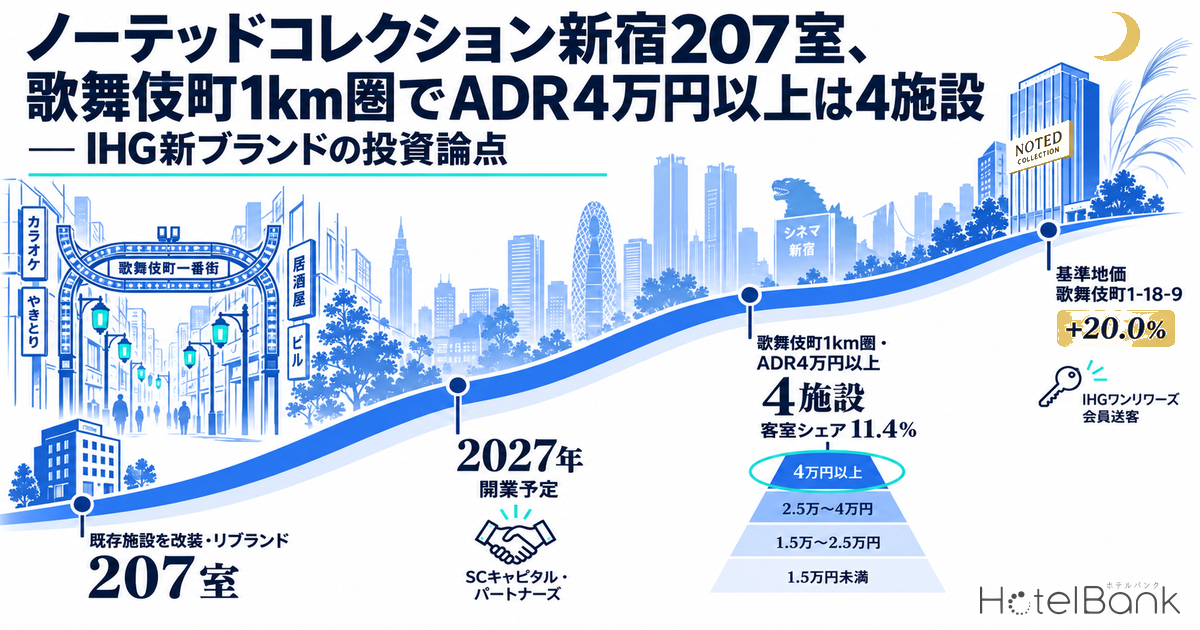
On September 28, 2026, IHG Hotels & Resorts announced that Noted Collection (ノーテッドコレクション), its 21st brand launched in February of the same year, will make its debut in Japan. The first property is a 207-room rebrand of an existing hotel in Kabukicho, Shinjuku, which will be renovated and is scheduled to open in 2027 in partnership with SC Capital Partners. The second is a newly built 81-room hotel in Ginza 8-chome, scheduled to open in 2029.
This article focuses on the 207 rooms in Kabukicho and quantifies the lodging market within a 1 km radius of the district’s center from four angles: price tiers, supply and demand, land prices, and employment. The conclusion first: of the 72 properties and 12,679 rooms within 1 km for which an estimated settled ADR can be calculated, only 4 properties, or 11.4% of rooms, have an ADR of ¥40,000 or more. Among mid-sized properties with 100–299 rooms, there is just one. If a 207-room collection-brand hotel positions itself in the upper tier, it will enter a band with few competitors.
Scope of this article: HotelBank has previously covered the flow of foreign capital into Japanese hotels, the ADR changes measured after brand conversions, and the conversion of 14 former Unizo hotels to Four Points Flex. This article narrows the focus to three points — the Shinjuku/Kabukicho location, IHG’s new brand, and SC Capital Partners as the owner — and reads the positioning of the rebrand from the price-tier structure of the 1 km radius.
Metric Definitions Used in This Article
- ADR (Average Daily Rate) = an estimated settled rate (tax-exclusive equivalent) calculated by applying a correction factor for each hotel type to the lowest plan level each property publishes on OTAs (two guests per room, price per room, tax included). When checked against the property-level results disclosed by listed hotel REITs (91 properties, most recent three months), the median error is about 7%. These are estimates and differ from each property’s actual settled prices and accounting figures. Area-level ADR is the median of the properties covered (the level of a typical property in the area).
- OCC (Occupancy Rate) = rooms sold as a share of total rooms in the area (an estimate based on inventory sold through OTAs). It is an estimate based on how inventory sold on OTAs is being absorbed and differs from the actual occupancy of the whole property.
- LT (Lead Time) = the number of days until the check-in date. LT0 = the day of arrival. The booking curves in this article use only LT45 to LT1.
- Early sell-out LT = the lead time at which remaining rooms first reached zero (the larger the value, the earlier the sell-out).
- Data source: MetroEngines Research & Consulting
- — The upper tier is thin: within 1 km of central Kabukicho, 4 properties with 1,445 rooms have an ADR of ¥40,000 or more. Among mid-sized properties with 100–299 rooms, there is only one.
- — Rates in Shinjuku Ward have been rising: estimated settled ADR exceeded the same month a year earlier in all nine months from September 2025 to May 2026, with growth of +5.9% to +23.8%.
- — The upper tier holds inventory until the last minute: over the four days of Silver Week, no property with an ADR of ¥40,000 or more sold out 45 or more days before the stay date. Remaining rooms reached zero by the day before in 5 of 20 property-days.
- — Land prices keep rising: the five official and benchmark land price points in Kabukicho rose +5.7% to +20.0% YoY in 2026.
- — An extra ¥1,000 of ADR is worth about ¥1.03 billion in asset value: with 207 rooms and OCC of 80% (model assumption, full year), room revenue rises by about ¥60 million a year. This is a simple estimate that treats 70% as profit and capitalizes it at an expected yield of 4.1%.
The Announcement — Two Projects: a Renovation Rebrand and a New Build
The table below summarizes the two projects announced. Shinjuku is a “rebrand through renovation of an existing property,” while Ginza is a “new build” — the development approach is entirely different even under the same brand. The name of the existing Shinjuku property is not disclosed in the release. This article likewise does not name the property and proceeds using only location and scale information.
| Item | Shinjuku (Kabukicho) | Ginza (Ginza 8-chome) |
|---|---|---|
| Development approach | Renovation and rebrand of an existing property | New build |
| Rooms | 207 rooms | 81 rooms |
| Scheduled opening | 2027 | 2029 |
| Partner / owner | SC Capital Partners | An Consulting Co., Ltd. (株式会社アンコンサルティング) |
| Main features (as announced) | An open lobby connected to a restaurant and café; design inspired by Shinjuku’s culture | Suites for family stays, restaurant & bar, fitness facility |
According to Kyodo News, the Shinjuku project is a renovation of an existing hotel near Shinjuku Golden Gai, and an executive of IHG’s Japan business has also expressed interest in expanding beyond Tokyo. According to the announcement by IHG’s UK headquarters (February 17, 2026), Noted Collection is a collection brand aimed primarily at converting existing independent hotels in the upscale to upper-upscale range, and expects more than 150 hotels worldwide over the next 10 years. In price terms it sits in the premium segment alongside Crowne Plaza, voco, and Ruby, complementing Hotel Indigo and Vignette Collection in the luxury & lifestyle segment.
How a Collection Brand Works — Keep the Name and Character, Gain Demand and a Sales Platform
The essence of the collection model (soft brand) is that a hotel keeps its own name, design, and operating style while connecting to the brand’s reservation and sales platform and its membership base. IHG’s release describes it as an option that lets each hotel retain its individuality while drawing on IHG’s global network, platforms, and the IHG One Rewards loyalty program (160 million members). Access to revenue management and distribution technology is also cited as a benefit for owners.
For owners, the significance comes down to three points. First, compared with converting to a standard brand with uniform specifications, the scope of renovation can be designed around the property’s character. Second, demand delivered through the membership base thickens booking channels other than OTAs and similar intermediaries. Third, a global brand name widens the pool of buyers at a future sale. When overseas institutional investors are the buyers, brand recognition makes it easier to align the assumptions behind a valuation.
As a recent precedent, KKR’s former Unizo properties moved to Four Points Flex, Marriott’s conversion brand. In addition, in the 27-property portfolio that SC Capital Partners and its co-investors acquired from Daiwa House Industry in 2023, 23 hotels were converted all at once in spring 2024 to Accor’s Grand Mercure (12 hotels) and Mercure (11 hotels). The current project can be read as an example of the same owner’s use of international brands broadening in form, from a simultaneous conversion of resorts to a single urban building joining a collection.
Estimated Settled ADR in Shinjuku Ward — Above the Prior Year for Nine Straight Months
The estimated settled ADR for Shinjuku Ward (median of the properties covered) exceeded the same month a year earlier in all nine months from September 2025 to May 2026. Growth ranged from a low of +5.9% in February to a high of +23.8% in January, and the peak was ¥20,700 in April 2026 (+16.3% YoY). Inbound demand during the cherry blossom season appears to have pushed rates up.
The levels from June 2026 onward (¥12,400–¥13,300), on the other hand, are values recorded after the base of properties included in the aggregation widened from 187 in May to 239 in June. Because these figures reflect a changed composition, this article does not compare those three months with the prior year as a single series, and the chart also shows them as a separate series. The number of properties for which estimated settled ADR is calculated has ranged from 84 to 100 per month.
| Month | Same month, prior year | Current month | YoY |
|---|---|---|---|
| September 2025 | ¥13,354 | ¥14,962 | +12.0% |
| October 2025 | ¥14,568 | ¥17,049 | +17.0% |
| November 2025 | ¥15,892 | ¥18,828 | +18.5% |
| December 2025 | ¥15,390 | ¥17,502 | +13.7% |
| January 2026 | ¥12,546 | ¥15,536 | +23.8% |
| February 2026 | ¥14,496 | ¥15,345 | +5.9% |
| March 2026 | ¥16,112 | ¥17,212 | +6.8% |
| April 2026 | ¥17,774 | ¥20,671 | +16.3% |
| May 2026 | ¥15,314 | ¥16,734 | +9.3% |
The Location: 1 km Around Kabukicho — 261,000 Workers, Rooms Nearly Doubled Since 2012
The reference point for the analysis is central Kabukicho (35.6950°N, 139.7020°E), not the location of the property. According to the Economic Census, 12,125 establishments and 261,015 workers are concentrated within the 1 km radius. Of these, 84,313 (32.3%) work in office-type industries, and the remaining roughly 70% are in food service, retail, services, and similar sectors. This is not a district driven by business demand alone; the concentration of nighttime entertainment and dining underpins lodging demand. Note that “workers” here refers to the number of people who work there during the day, not to the resident population or the number of visitors.
Lodging supply is also deep. As far as MetroEngines Research can identify, lodging facilities within the same 1 km radius grew from 74 properties and 9,226 rooms at the end of 2012 to 177 properties and 18,100 rooms as of September 2026 — roughly double on a room basis. However, the bulk of that growth came by 2019 (141 properties, 16,090 rooms), and room growth over the seven years since has been limited to +12.5%. The 207 rooms are equivalent to 1.1% of the rooms currently within the radius. Because this is a conversion of an existing property, the total number of rooms does not increase.
Land Prices — Kabukicho’s Five Points Rose +5.7% to +20.0% in 2026
Checking three official land price points (chika-koji) and two prefectural land price survey points (benchmark sites) in Kabukicho in the Real Estate Information Library of the Ministry of Land, Infrastructure, Transport and Tourism (MLIT), the 2026 rate of change was positive at all of them, at +5.7% to +20.0% YoY. Kabukicho 1-18-9 (benchmark site, floor-area ratio 900%) stands at ¥11.5 million/㎡, marking a second straight year of growth in the +20% range. The three official land price points fell by around 10% in 2021 and were flat in 2022. Since then, growth has accelerated at all five points through 2024–2025.
| Point (type) | 2026 price | YoY | vs. 2021 | Zoning / floor-area ratio |
|---|---|---|---|---|
| Kabukicho 1-18-9 (benchmark site) | ¥11.5M/㎡ | +20.0% | +65.0% | Commercial district / 900% |
| Kabukicho 1-1-16 (official land price) | ¥9.88M/㎡ | +5.7% | +18.0% | Commercial district / 900% |
| Kabukicho 2-19-13 (benchmark site) | ¥3.28M/㎡ | +16.7% | +56.2% | Commercial district / 600% |
| Kabukicho 2-10-7 (official land price) | ¥3.15M/㎡ | +17.5% | +56.7% | Commercial district / 600% |
| Kabukicho 2-21-6 (official land price) | ¥1.98M/㎡ | +15.1% | +58.4% | Commercial district / 600% |
Rising land prices push up the land cost of a new build. A rebrand that makes use of an existing building is an approach that adds brand value while avoiding costs that keep rising for both land acquisition and construction. Compared with the new-build Ginza project, the Shinjuku project has an advantage on this point in both time and cost.
Price-Tier Positioning — Only One Mid-Sized Property at ¥40,000 or More
Within the 1 km radius, 72 hotels, ryokan, and capsule hotels (10 rooms or more) with 12,679 rooms had an estimated settled ADR available for six or more months between September 2025 and August 2026, and their median ADR was ¥15,000. Divided by price tier and room count, 35.0% of rooms fall below ¥15,000, 27.3% in ¥15,000–¥25,000, and 26.3% in ¥25,000–¥40,000, while ¥40,000 or more accounts for 11.4% (4 properties, 1,445 rooms).
| Estimated settled ADR \ Room count | Under 100 rooms | 100–299 rooms | 300 rooms or more | Tier median |
|---|---|---|---|---|
| ¥40,000 or more | 1 property / 97 rooms | 1 property / 239 rooms | 2 properties / 1,109 rooms | ¥47,600 |
| ¥25,000–¥40,000 | 4 properties / 187 rooms | 7 properties / 1,179 rooms | 3 properties / 1,969 rooms | ¥34,700 |
| ¥15,000–¥25,000 | 7 properties / 369 rooms | 6 properties / 964 rooms | 5 properties / 2,127 rooms | ¥17,400 |
| Under ¥15,000 | 21 properties / 733 rooms | 12 properties / 2,173 rooms | 3 properties / 1,533 rooms | ¥11,900 |
Looking at the 100–299 room column where 207 rooms falls, the largest number of properties is in the under-¥15,000 tier (12 properties), with 7 in ¥25,000–¥40,000 and only 1 at ¥40,000 or more. Noted Collection is a brand aimed at the upscale to upper-upscale range, and whichever of the top two tiers its post-opening rate lands in, there are not many competitors of the same size.
Crowded band
Under ¥15,000 × fewer than 100 to 299 rooms
33 properties, 2,906 rooms. A band dense with limited-service hotels and small properties, where differentiation on something other than price is required.
White space 1
¥40,000 or more × 100–299 rooms
1 property, 239 rooms. If the 207-room collection-brand hotel positions itself in the upper tier, it enters this band almost alone.
White space 2
¥25,000–¥40,000 × 100–299 rooms
7 properties, 1,179 rooms. Even just below the upper tier, competitors remain in the single digits, making this a landing zone for raising rates in stages.
Supply and Demand — Shinjuku Ward Is Nearly Full on Peak Dates, and the Upper Tier Holds Inventory Until the Last Minute
Looking at the booking curve for Shinjuku Ward as a whole, for the night of Saturday, September 19 — the first day of Silver Week — estimated OCC was 69.4% at LT45, 86.8% at LT14, and reached 98.0% the day before (LT1). The night of Wednesday, September 16, a weekday in the same month, also filled to 92.1% by the day before. Demand in the ward is at a high level, not only on peak dates. The night of Saturday, October 10 (the first day of a three-day weekend) was still in progress at LT14 at the time of writing, with estimated OCC at 83.7%.
Next, we grouped the properties in the ward whose property-level inventory can be tracked by price tier, and compared when remaining rooms reached zero over the four days of Silver Week (nights of September 19–22). The sample is 58 properties with 8,670 rooms (based on listings on major booking sites) whose OTA-published allotment is 30% or more of total rooms and for which an estimated settled ADR can be calculated. In the under-¥15,000 tier, 43.3% of 104 property-days were already sold out 45 or more days before the stay date. In the ¥40,000-or-more tier, by contrast, there were no cases of selling out 45 or more days before the stay date, and remaining rooms reached zero by the day before in 5 of 20 property-days (25.0%).
The low-price tier fills early, while the upper tier keeps inventory until the last minute and then sells through. Upper-tier properties can be read as holding inventory for individual and inbound travelers who book close to arrival, and selling it while maintaining their rates. For a 207-room upper-tier hotel, how high a rate it can capture from last-minute demand will drive profitability. This is the phase in which demand delivered through the membership base and access to global RM tools make a difference.
Value-Add and Exit for a PE-Owned Asset — What an Extra ¥1,000 of ADR Means
SC Capital Partners is a Singapore-based real estate investment manager, and Japan accounts for about 75% of its roughly ¥1.4 trillion of assets under management in Asia-Pacific (as of September 2025). In January 2026 it announced that it had raised up to ¥112.8 billion from investors including the Canada Pension Plan Investment Board (CPP Investments) to expand its Japan hotel fund. It has set out a policy of handling acquisition, operation, and value-add end to end, and it also holds an operating subsidiary and a majority stake in Japan Hotel REIT Advisors (ジャパン・ホテル・リート・アドバイザーズ), the asset manager of Japan Hotel REIT Investment Corporation (ジャパン・ホテル・リート投資法人, 8985).
To measure the effect of the rebrand from the owner’s perspective, we ran a simple estimate using a 207-room model. Estimated settled ADR is set at two levels — ¥34,700, the median of the ¥25,000–¥40,000 tier within the 1 km radius, and ¥47,600, the median of the ¥40,000-or-more tier — and OCC at 75–85%. ADR and occupancy are assumptions and do not represent the property’s actual results or plans.
| Annual room revenue (207-room model) | OCC 75% | OCC 80% | OCC 85% |
|---|---|---|---|
| ADR ¥34,700 (median of the ¥25,000–¥40,000 tier) | ¥1.97B | ¥2.10B | ¥2.23B |
| ADR ¥47,600 (median of the ¥40,000-or-more tier) | ¥2.70B | ¥2.88B | ¥3.06B |
| Difference | +¥730M | +¥780M | +¥830M |
If ADR is raised by ¥1,000, annual room revenue increases by about ¥60 million at OCC of 80% (model assumption, full year). Assuming 70% of the increase remains as profit, and capitalizing it at 4.1% — the expected yield for limited-service hotels in Tokyo in the Japan Real Estate Institute’s Japanese Real Estate Investor Survey (April 2026) — the impact on asset value comes to about ¥1.03 billion. Applying a limited-service yield to a hotel aiming for the upper tier is a simplification, but the picture does not change: a small improvement in rate has a large effect on valuation.
Varying the assumptions for the rate increase and occupancy, the impact on asset value spans the range shown in the table below. The assumptions are the same as in the text (207 rooms, 365 days, 70% of incremental revenue as profit, expected yield of 4.1%), and the figure in bold is the mid case in the text (+¥1,000, OCC 80%). If the expected yield is set 0.5 points higher at 4.6%, each value becomes about 11% smaller.
| ADR increase \ Occupancy (full-year assumption) | 70% | 75% | 80% | 85% | 90% |
|---|---|---|---|---|---|
| +¥500 | ¥450M | ¥480M | ¥520M | ¥550M | ¥580M |
| +¥1,000 | ¥900M | ¥970M | ¥1.03B | ¥1.10B | ¥1.16B |
| +¥2,000 | ¥1.81B | ¥1.93B | ¥2.06B | ¥2.19B | ¥2.32B |
| +¥3,000 | ¥2.71B | ¥2.90B | ¥3.10B | ¥3.29B | ¥3.48B |
| +¥5,000 | ¥4.51B | ¥4.84B | ¥5.16B | ¥5.48B | ¥5.80B |
As a reference point for transaction prices, Japan Hotel REIT Investment Corporation (ジャパン・ホテル・リート投資法人) acquired Hotel Amanek Shinjuku Kabukicho (ホテル アマネク新宿歌舞伎町, 169 rooms) in March 2023 for ¥8.845 billion, or about ¥52.3 million per room (per the REIT’s disclosure materials). In Kabukicho, where land prices continue to rise, layering the added value of a brand onto an existing building is an option that can realize value faster than a new build.
Note: The 81 Rooms in Ginza 8-chome (2029)
The second Noted Collection property, in Ginza, is a newly built 81-room hotel in Ginza 8-chome, owned by An Consulting Co., Ltd. (株式会社アンコンサルティング) and scheduled to open in 2029. It has been announced that it will feature suites for family stays. Compared with the 207-room renovation project, it is a little under 40% of the size, and the time to opening is two years longer. Ginza’s development pipeline, including land price levels and construction costs for the location, will be covered in a separate article.
Conclusion
The 207 rooms in Kabukicho, Noted Collection’s first property in Japan, are a rebrand that connects to IHG’s membership base and sales platform through the renovation of an existing building. Within 1 km of the center, properties with an estimated settled ADR of ¥40,000 or more are limited to 4 properties and 11.4% of rooms, and there is only one with 100–299 rooms. Shinjuku Ward’s estimated settled ADR exceeded the same month a year earlier for nine straight months from September 2025 to May 2026, and on peak dates the ward-wide estimated OCC reaches 98.0% the day before. Upper-tier properties sell through while holding inventory until the last minute, and the ability to capture last-minute demand at a high rate will determine the value of this rebrand. In Kabukicho, where land prices are rising +5.7% to +20.0%, a PE fund layering a global brand onto an existing asset is a design that aims at both post-acquisition value-add and a wider field of future buyers.
Note on data for future dates: The booking curve for the night of October 10 is in progress as of the survey date (September 28, 2026) and will change as the check-in date approaches. The estimates in this article are simple estimates based on assumptions and do not represent the results or plans of any individual property or constitute an investment judgment.
References and Sources
■ Data sources
Estimated settled ADR, estimated OCC, property-level inventory, and lodging stock trends based on OTA-published prices and inventory (MetroEngines Research & Consulting); MLIT Real Estate Information Library (official land prices and prefectural land price survey); Economic Census for Business Activity (2021), Ministry of Internal Affairs and Communications and Ministry of Economy, Trade and Industry; disclosure materials of IHG, SC Capital Partners, and Japan Hotel REIT Investment Corporation.
■ Estimate assumptions
Annual room revenue = 207 rooms × 365 days × OCC × ADR (tax-exclusive equivalent). ADR uses the price-tier medians within 1 km of central Kabukicho (¥34,700 for the ¥25,000–¥40,000 tier and ¥47,600 for the ¥40,000-or-more tier), and OCC is 75–85% (full-year assumption). The asset value impact treats 70% of incremental revenue as profit and capitalizes it at 4.1%, the expected yield for limited-service hotels in Tokyo in the Japan Real Estate Institute’s 54th Japanese Real Estate Investor Survey (April 2026).
■ Limitations and caveats
Estimated settled ADR is an estimate obtained by multiplying the lowest plan level on OTAs by a factor for each hotel type, and differs from actual settled prices and accounting figures (the median error against property-level results of listed hotel REITs is about 7%). The monthly ADR for Shinjuku Ward saw its aggregation base widen from 187 to 239 properties in June 2026, so the periods before and after cannot be compared as a single series. The reference point for the 1 km radius is central Kabukicho, not the location of the property being rebranded. The property-level inventory analysis is limited to properties whose OTA-published allotment is 30% or more of total rooms. The estimates do not represent the results or plans of any individual property or constitute an investment judgment.
■ Market data
- MetroEngines Research & Consulting — estimated settled ADR (Shinjuku Ward; 72 properties within 1 km), estimated OCC and booking curves (69 properties in Shinjuku Ward), property-level inventory (58 properties), lodging stock trends
■ Government statistics and public data
- MLIT Real Estate Information Library — official land prices (January 1, 2026) and prefectural land price survey (July 1, 2026)
- Economic Census for Business Activity (2021), Ministry of Internal Affairs and Communications and Ministry of Economy, Trade and Industry
■ REIT and industry reports
- Japan Hotel REIT Investment Corporation, “Portfolio List”
- Japan Real Estate Institute, “The 54th Japanese Real Estate Investor Survey (as of April 2026)”
- IHG PLC, “IHG Hotels & Resorts unveils new premium collection brand, Noted Collection” (February 17, 2026)
■ News and press releases
- Noted Collection, the newest brand of IHG Hotels & Resorts, makes its Japan debut (PR TIMES, September 28, 2026; in Japanese)
- IHG’s newest premium brand debuts in Japan: Noted Collection to open in Shinjuku in 2027 and Ginza in 2029 (Travel Voice, September 28, 2026; in Japanese)
- UK’s IHG to open upscale hotels in Tokyo: Kabukicho and Ginza, with further expansion possible (Kyodo News, September 28, 2026; in Japanese)
- SC Capital Partners secures up to ¥112.8 billion from Canadian pension fund and others (estie, January 2026; in Japanese)
- Accor × Daiwa Resort rebrand 23 hotels as Grand Mercure and Mercure (Travel Watch, September 15, 2023; in Japanese)