

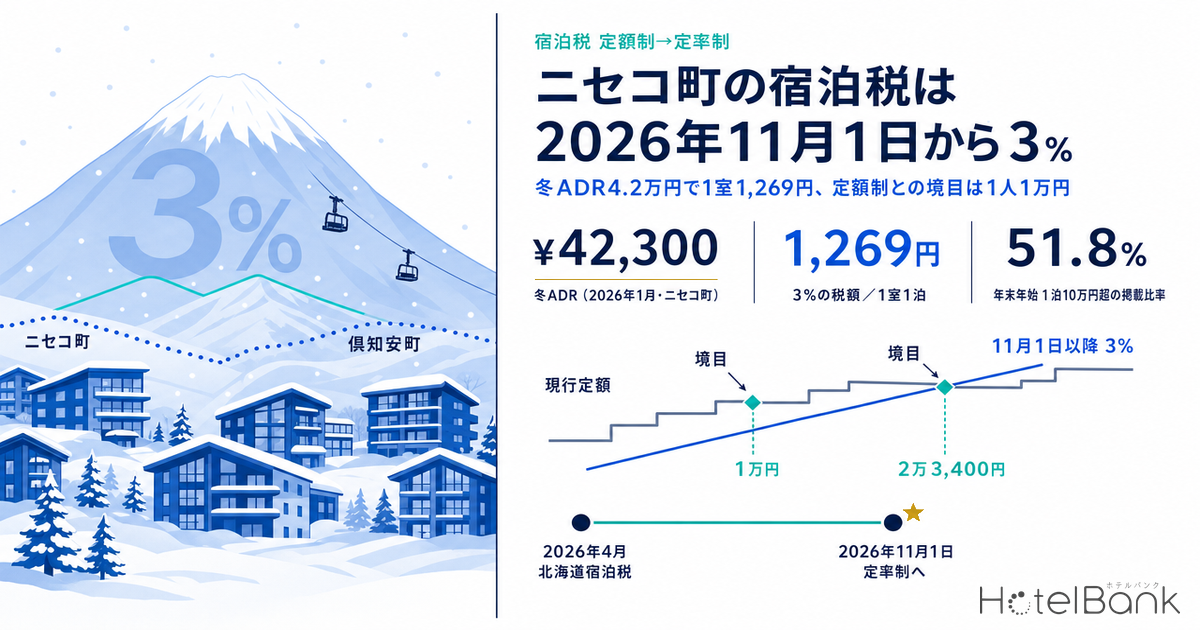
According to a press release issued by the Town of Niseko on March 27, 2026, the town’s accommodation tax will switch from a five-tier flat-amount system of ¥100-¥2,000 per person per night (the town portion; combined with the prefectural tax, the amount currently collected is ¥200-¥2,500) to a flat-rate system charging 3% of the accommodation charge, effective for stays on or after November 1, 2026. The 3% rate absorbs the Hokkaido Accommodation Tax (¥100-¥500 per person per night) introduced in April 2026, and the town portion becomes “3% minus the Hokkaido portion.” Neighboring Kutchan Town has already operated the same “3%, Hokkaido tax included” scheme since April, so from November the two main towns of the Niseko area will share the same rate and the same calculation method. This article first confirms the system against official town and prefectural documents, then uses estimated settled ADR for both towns and the listed-price distribution for New Year and summer to show how much tax a night actually generates at real-world rates, where the break-even points against the flat-amount system lie, and what lodging operators should have in place by November 1.
Metric Definitions Used in This Article
- ADR (Average Daily Rate): An estimated settled rate (excluding tax) calculated by applying segment-specific adjustment factors to the lowest-priced plan each property publishes on OTAs (per room, two guests per room, tax included). Checked against property-level results disclosed by listed hotel REITs (91 properties, most recent 3 months), the median error is about 7%. These are estimates and differ from each property’s actual transaction prices and accounting figures. Area-level ADR is the median of the properties covered (the level of a typical property in the area).
- Listed price: The per-room price of the lowest-priced plan published on OTAs and other channels as of October 13, 2026 (two guests per room, tax included). Price-band tallies count these listed prices per property x stay date.
- Tax estimates: Listed prices are divided by 1.1 to remove consumption tax; estimated settled ADR is treated as already excluding tax. In both cases the amount is rounded down to the nearest ¥100 and multiplied by 3%. For plans that include meals, the meal portion is excluded from the tax base, so the actual tax can be lower than estimated.
- Data sources: MetroEngines Research (prices and ADR); official documents from the Towns of Niseko and Kutchan and from Hokkaido (tax system)
- — 3% for stays from November 1, 2026: Niseko’s accommodation tax moves from tiered flat amounts to 3% of the room-only rate (excluding tax, rounded down to the nearest ¥100). The ¥100-¥500 Hokkaido Accommodation Tax is included in the 3%, and there is no tax-free threshold.
- — Break-even points at ¥10,000 and ¥23,400 per person per night: Below ¥10,000 and between ¥20,000 and ¥23,300 the flat rate is lower; above ¥50,000 the flat rate is always higher.
- — ¥1,269 per room at a winter ADR of ¥42,300: 3% of the January 2026 estimated settled ADR (N=10 properties). In summer, August ADR of ¥15,900 yields ¥477, below the current flat ¥600 for two guests.
- — Over the New Year, 51.8% of listings exceed ¥100,000 a night: At this band’s median of ¥220,000, the tax is ¥6,000 per room, above the current flat-amount ceiling (¥5,000 for two guests) (listed prices as of October 13, 2026, N=168).
- — Rate and tax base now match Kutchan: The remaining differences are the grant/incentive rates and the collection ledger attachment. For operators, the key tasks are switching tax settings and filing October stays during November.
What Changes and When — “3% of the Room-Only Rate” for Stays from November 1
Let us first confirm the framework from official documents. Niseko introduced its accommodation tax on November 1, 2024, and from April 1, 2026 it has been levied alongside the Hokkaido Accommodation Tax. Currently (stays from April 1 to October 31, 2026), the tax is a tiered flat amount per person per night: ¥200 (town ¥100 + Hokkaido ¥100) if the accommodation charge is under ¥5,001; ¥300 from ¥5,001 to under ¥20,000; ¥700 from ¥20,000 to under ¥50,000; ¥1,500 from ¥50,000 to under ¥100,000; and ¥2,500 at ¥100,000 or more. From stays on November 1 this is unified into “3% of the accommodation charge.” Within that amount, the Hokkaido Accommodation Tax (¥100 under ¥20,000, ¥200 from ¥20,000 to under ¥50,000, ¥500 at ¥50,000 or more) is allocated first, and the remainder is the Niseko town tax.
The scope of the “accommodation charge” that forms the tax base is also clearly defined. The town’s flyer for guests states that “the accommodation charge means the so-called room-only rate and any service charges associated with it, and does not include meal charges, consumption tax and the like,” while the operator document “Changes in Calculation Methods under the Flat-Rate System” specifies that “the accommodation charge to which 3% is applied is the amount excluding consumption tax, meals and the like, rounded down to the nearest ¥100” and that “the tax is paid in units of ¥1.” Hokkaido’s Q&A uses the same definition: cleaning fees, bedding fees, bathing fees, service charges and gratuity charges are included in the accommodation charge, while food and drink, entertainment, meeting-room use, taxes such as consumption tax, bathing tax and accommodation tax, advances paid on the guest’s behalf, and voluntary tips are not. On a tax-free threshold, Hokkaido’s Q&A explicitly states that “no tax-free threshold is set, so that the burden is shared broadly,” and Niseko’s published documents make no mention of one either. This is where the design differs from Tokyo’s 2027 revision, which uses the same 3% flat rate but exempts stays under ¥13,000 per person per night. Tax exemptions are limited to school events such as school trips and, added from April 2026, childcare-facility events (children aged 3 and over and their chaperones).
| Item | Stays April 1-October 31, 2026 | Stays from November 1, 2026 |
|---|---|---|
| Taxing authority | Town of Niseko + Hokkaido (filing and payment consolidated by the town) | Same as left |
| Calculation method | Tiered flat amount (per person per night) | Flat rate: 3% of the accommodation charge (including the Hokkaido portion) |
| Tax amount | Five tiers: ¥200 / ¥300 / ¥700 / ¥1,500 / ¥2,500 | (1) Accommodation charge x 3%; (2) of which Hokkaido tax ¥100 / ¥200 / ¥500; (3) town tax = (1) – (2) |
| Tax base | Accommodation charge per person per night (excluding meals, consumption tax, etc.) | Accommodation charge under the same definition. 3% applied after rounding down to the nearest ¥100; tax in units of ¥1 |
| Calculation unit | Per person per night | Per person, per room or per building depending on the business (Hokkaido portion allocated on a per-person-per-night basis) |
| Tax-free threshold | None | None (not mentioned in official documents; Hokkaido’s Q&A states that none is set) |
| Exemptions | School events such as school trips; childcare-facility events | Same as left |
| Filing attachments | Tax return | Tax return + collection ledger showing the charge, number of guests and tax per stay unit (for allocating the Hokkaido portion) |
Source: Compiled by the HotelBank Editorial Team from Town of Niseko, “Changes to the Accommodation Tax System” (press release, March 27, 2026), “Changes in Calculation Methods under the Flat-Rate System,” the accommodation tax revision flyer, and Hokkaido, “Accommodation Tax Q&A (March 2026)”
The town has also published its reasons for the revision. Its December 2025 briefing for operators described it as “a revision to return to the flat-rate system originally intended,” citing clarity for guests, a lighter administrative burden for operators, a constant burden ratio relative to price, and the large benefit of unifying the system across the Niseko area including Kutchan. On revenue, estimates based on FY2025 put the flat-amount system at about ¥170 million versus about ¥330 million under the flat-rate system including the Hokkaido portion, of which about ¥250 million is the town portion, meaning the town expects about ¥80 million (roughly 50%) more in town tax revenue.
Break-Even Against the Flat-Amount System — The Lines Cross at ¥10,000 and ¥23,400 per Person
Comparing the flat-amount and flat-rate taxes by the accommodation charge per person per night (excluding tax, room only) shows in which price bands the tax rises and where it falls. The ¥5,001-under-¥20,000 tier is currently ¥300, but 3% equals exactly ¥300 at ¥10,000, and above ¥10,000 the flat rate is higher. In the ¥20,000-under-¥50,000 tier the current amount is ¥700, while 3% of exactly ¥20,000 is ¥600, so the flat rate is lower; the two meet at ¥23,400 and above that the flat rate is higher. The ¥50,000-under-¥100,000 tier matches at ¥1,500 at ¥50,000, after which the flat rate is higher. At ¥100,000 or more the current amount is ¥2,500 while the flat rate is at least ¥3,000, so the flat rate is always higher.
Conversely, the flat rate is lower in two bands: below ¥10,000 and from ¥20,000 to ¥23,300. When the charge falls below ¥3,400, 3% does not reach the Hokkaido minimum of ¥100, but the town’s worked example states that “the town makes up the shortfall when 3% does not reach the ¥100 Hokkaido tax, and the town portion is ¥0,” so operators do not need to collect more than 3% from guests. For a ¥3,500 (tax included) room-only stay, ¥3,182 excluding tax is rounded down to ¥3,100, and 3% gives an accommodation tax of ¥93, broken down as Hokkaido ¥100 (with the town covering the ¥7 difference) and town ¥0.
Source: Compiled by the HotelBank Editorial Team from official Town of Niseko and Hokkaido documents (per person per night, based on room-only rate excluding tax, 3% applied after rounding down to the nearest ¥100)
| Charge per person per night (excl. tax) | Current flat amount (town + Hokkaido) | 3% from Nov 1 | of which Hokkaido | of which town | Difference |
|---|---|---|---|---|---|
| ¥3,000 | ¥200 | ¥90 | ¥100 (town covers the ¥10 gap) | ¥0 | -¥110 |
| ¥8,000 | ¥300 | ¥240 | ¥100 | ¥140 | -¥60 |
| ¥10,000 | ¥300 | ¥300 | ¥100 | ¥200 | 0 |
| ¥15,000 | ¥300 | ¥450 | ¥100 | ¥350 | +¥150 |
| ¥20,000 | ¥700 | ¥600 | ¥200 | ¥400 | -¥100 |
| ¥30,000 | ¥700 | ¥900 | ¥200 | ¥700 | +¥200 |
| ¥50,000 | ¥1,500 | ¥1,500 | ¥500 | ¥1,000 | 0 |
| ¥80,000 | ¥1,500 | ¥2,400 | ¥500 | ¥1,900 | +¥900 |
| ¥100,000 | ¥2,500 | ¥3,000 | ¥500 | ¥2,500 | +¥500 |
| ¥200,000 | ¥2,500 | ¥6,000 | ¥500 | ¥5,500 | +¥3,500 |
Source: Compiled by the HotelBank Editorial Team from Town of Niseko, “Changes to the Accommodation Tax System” and “Changes in Calculation Methods under the Flat-Rate System,” and Hokkaido, “Accommodation Tax Rate List (as of March 1, 2026)”
Tax per Night at Real-World Rates — ¥1,269 per Room at a Winter ADR of ¥42,300
So how much tax do Niseko’s lodging properties generate at their actual rates? MetroEngines Research’s estimated settled ADR (two guests per room, excluding tax, area median) for the Town of Niseko is concentrated in the winter peak: ¥42,300 in January 2026 (N=10 properties, +16.4% YoY), ¥39,400 in February (+17.5% YoY) and ¥34,200 in December 2025. Summer stays at just under 40% of the winter level: ¥14,600 in July 2026 (+2.9% YoY) and ¥15,900 in August (-3.5% YoY). Applying 3% gives a tax per room per night of ¥1,269 in January, ¥1,179 in February, ¥1,026 in December, ¥435 in July and ¥477 in August. With two guests, that works out to roughly ¥500-¥630 per person in winter and ¥220-¥240 in summer.
The comparison with the current flat amount is revealing. Dividing the median ADR by two guests gives a per-person rate of only about ¥21,200 even in January 2026, which currently means ¥700 per person (town ¥500 + Hokkaido ¥200), or ¥1,400 per room. Under 3% it is ¥1,269, so as long as “a median property is occupied by two guests,” the tax does not necessarily rise even at the winter peak. February, on the other hand (¥19,700 per person, currently ¥300 or ¥600 per room), rises to ¥1,179, and December rises from ¥600 to ¥1,026. In summer, at ¥7,300-¥8,000 per person, 3% gives ¥435-¥477 versus the current ¥600, so the tax actually falls. In other words, the roughly 50% revenue increase the town expects comes not from the median but from the top of the price distribution discussed below, namely condominiums and whole-building rentals priced at several hundred thousand yen a night.
Source: Compiled by the HotelBank Editorial Team from MetroEngines Research (estimated settled ADR, area median. Niseko N=7-10 properties, Kutchan N=17-24 properties. October 2026-January 2027 are estimates based on listed price levels at the time of the survey)
| Month | Niseko ADR | N | 3% / room | Current flat amount / room (2 guests) | Kutchan ADR | N | 3% / room |
|---|---|---|---|---|---|---|---|
| Dec 2025 | ¥34,240 | 10 | ¥1,026 | ¥600 | ¥36,116 | 24 | ¥1,083 |
| Jan 2026 | ¥42,306 | 10 | ¥1,269 | ¥1,400 | ¥61,574 | 20 | ¥1,845 |
| Feb 2026 | ¥39,369 | 10 | ¥1,179 | ¥600 | ¥63,522 | 21 | ¥1,905 |
| Jul 2026 | ¥14,574 | 10 | ¥435 | ¥600 | ¥17,468 | 22 | ¥522 |
| Aug 2026 | ¥15,941 | 10 | ¥477 | ¥600 | ¥19,916 | 22 | ¥597 |
| Dec 2026 (est.) | ¥30,222 | 9 | ¥906 | — | ¥35,734 | 20 | ¥1,071 |
| Jan 2027 (est.) | ¥36,998 | 8 | ¥1,107 | — | ¥49,393 | 17 | ¥1,479 |
Source: Compiled by the HotelBank Editorial Team from MetroEngines Research (ADR is estimated settled ADR, excluding tax. 3% calculated after rounding down to the nearest ¥100. Current flat-amount tier determined from the per-person rate, ADR divided by two guests. Kutchan has applied 3% since April 2026, so no flat-amount column. December 2026 onward are estimates based on listed price levels at the time of the survey)
In Kutchan, winter rates sit a full step higher. January 2026 ADR was ¥61,600 (N=20 properties, +28.4% YoY) and February ¥63,500 (+19.1% YoY); at 3% that is ¥1,845-¥1,905 per room, or ¥920-¥950 per person. Because Kutchan has already been operating its “town and Hokkaido accommodation tax of 3%” since April 1, 2026, this is also the level that will actually be charged at a winter peak for the first time in the 2026-27 season. In summer, July ADR of ¥17,500 and August ADR of ¥19,900 put the tax at ¥520-¥600 per room, roughly the same range as Niseko.
Tax Ranges by Price Band — Over the New Year, Half of Listings Exceed ¥100,000 a Night
Because medians alone do not show the depth of the distribution, we counted listed prices as of October 13, 2026 (lowest-priced plan, two guests per room, tax included) per property x stay date for December 28-January 3 and August 8-15, and set out tax ranges by price band. Note that the New Year period is still more than 45 days out, too early to read booking progress as a booking curve, so it is treated here as a snapshot of listed price levels. For Niseko over the New Year (N=168 property-nights, 27 properties), 0% are under ¥10,000, 5.4% are ¥10,000-¥30,000, 42.9% are ¥30,000-¥100,000 and 51.8% exceed ¥100,000, meaning more than half of listings are above ¥100,000 a night. In summer (N=273, 47 properties), 47.3% are ¥10,000-¥30,000, 44.7% are ¥30,000-¥100,000 and 8.1% exceed ¥100,000, so the center of the distribution drops a level. In Kutchan, 35.2% of New Year listings (N=213, 33 properties) exceed ¥100,000, and even in summer (N=843, 142 properties) the share is 33.5%, indicating a deep high-price segment year-round.
Source: Compiled by the HotelBank Editorial Team from MetroEngines Research (listed prices as of October 13, 2026, lowest-priced plan, two guests per room, tax included. Shares of property x stay date)
| Price band (per room, tax incl.) | Niseko New Year share | Band median | 3% / room (range within band) | Current flat amount / room (2 guests) | Kutchan New Year share | 3% / room (median) |
|---|---|---|---|---|---|---|
| Under ¥10,000 | 0.0% | — | — | ¥400 | 0.0% | — |
| ¥10,000-¥30,000 | 5.4% | ¥19,000 | ¥516 (¥435-¥762) | ¥600 | 18.8% | ¥681 |
| ¥30,000-¥100,000 | 42.9% | ¥57,700 | ¥1,572 (¥816-¥2,529) | ¥600-¥1,400 | 46.0% | ¥1,470 |
| Over ¥100,000 | 51.8% | ¥220,000 | ¥6,000 (¥3,051-¥19,773) | ¥3,000-¥5,000 | 35.2% | ¥5,460 |
Source: Compiled by the HotelBank Editorial Team from MetroEngines Research (December 28-January 3, listed prices as of October 13, 2026. Tax = tax-inclusive price divided by 1.1, rounded down to the nearest ¥100, x 3%. Current flat-amount tier determined from the per-person rate = price excluding tax / 2. For whole-building rentals used by three or more guests, the 3% total does not change, but the Hokkaido allocation and the per-person count under the current flat amount do)
What this table shows is that whether the tax goes up or down is determined almost entirely by price band. In the ¥10,000-¥30,000 band, 3% is ¥435-¥762 per room, not much different from the current ¥600. In the ¥30,000-¥100,000 band the median is ¥1,572, only slightly above the current ¥1,400, though near the top of the band it reaches ¥2,500. The gap opens up in the over-¥100,000 band: at the band median of ¥220,000 the tax is ¥6,000 per room, and at the very top, in the ¥720,000 range, it is about ¥20,000, an order of magnitude beyond the current flat-amount ceiling (¥2,500 per person). Since 51.8% of Niseko’s New Year listings fall in this band, the town’s revenue projection can be read as resting on it. How the properties and rooms behind this high-price segment are distributed within the area is examined from the supply side in Niseko’s Top Tier: Just 2 Hotels, 75 Rooms — Where Fairmont’s 165 Fit. In summer, only 8.1% of listings exceed ¥100,000, and the tax centers on ¥471 in the ¥10,000-¥30,000 band (current ¥600) and ¥1,698 in the ¥30,000-¥100,000 band (current ¥600-¥1,400).
Taxes Across the Town Line — Rates Now Match Kutchan; Grants and Filing Formats Still Differ
In the Niseko area, Kutchan Town on the Hirafu/Hanazono side and Niseko Town on the Niseko Village/Annupuri side have used different tax calculation methods on either side of the same mountain from April through October 2026. Kutchan introduced a 2% flat rate in November 2019 and, from April 1, 2026, raised the rate to 3% as a “town and Hokkaido accommodation tax,” with the town tax being the remainder after deducting the Hokkaido portion (¥100 under ¥20,000, ¥200 from ¥20,000 to under ¥50,000, ¥500 at ¥50,000 or more). From November 1, Niseko adopts the same structure, so the main elements match in both towns: a 3% rate, Hokkaido tax included, the same tax-base definition (room-only rate excluding meals, consumption tax and the like) and rounding down to the nearest ¥100. Kutchan’s “Accommodation Tax Guide” specifies the tax base as “the accommodation charge, whether the charge is calculated per person, per room or per building, with fractions under ¥100 rounded down,” and Niseko’s worked examples apply the same treatment.
Some differences remain in the details, however. Kutchan has raised its collection incentive for special collection agents from 2.5% to 3.5%, covering filings from April 2026 through March 2031. Niseko’s guidebook sets the special-collection administrative grant at 5% of the amount filed and paid on time for the town portion (rounded down to the nearest ¥1) and 3.5% for the Hokkaido portion (rounded down to the nearest ¥100; 2.5% from FY2032). On filing, Niseko is distinctive in requiring a collection ledger showing the charge, number of guests and tax per stay unit, because the town allocates the Hokkaido portion itself, whereas Kutchan states that “there are no new procedures other than changing the rate from 2% to 3%.” Note that within the same Niseko area, Rusutsu Village keeps a flat amount of ¥200-¥1,000 including the Hokkaido tax, and Akaigawa Village keeps a flat amount from ¥100 under ¥8,000 to ¥1,000 at ¥50,000 or more, so crossing a village line still changes the calculation method.
| Item | Niseko (from November 1, 2026) | Kutchan (from April 1, 2026) |
|---|---|---|
| Rate | 3% of the accommodation charge (including the Hokkaido portion) | 3% of the accommodation charge (including the Hokkaido portion) |
| History | Introduced as flat amounts in November 2024, switching to a flat rate in November 2026 | Introduced at a 2% flat rate in November 2019, raised to 3% in April 2026 |
| Rounding | Tax base rounded down to the nearest ¥100; tax in units of ¥1 | Tax base rounded down to the nearest ¥100 |
| When 3% is below the Hokkaido minimum | Town covers the gap; town portion ¥0 (town worked example) | Not specified in official documents |
| Grant / incentive for special collection | 5% of town portion; 3.5% of Hokkaido portion (2.5% from FY2032) | 3.5% (filings April 2026-March 2031) |
| Filing attachments | Collection ledger (any format accepted) | Consolidated filing breakdown when filing jointly |
| Filing and payment deadline | Monthly (once every 3 months with special approval) | End of the following month (4 times a year under the special provision) |
| Support for system upgrades | Town subsidy: up to ¥1.5 million per property, 100% subsidy rate (for the revision) | Refers operators to Hokkaido’s “Accommodation Tax System Development Subsidy” |
Source: Compiled by the HotelBank Editorial Team from Town of Niseko, “Special Collection Guidebook (from November 1, 2026)” and “Niseko Accommodation Tax Utilization Subsidy,” and Town of Kutchan, “About Kutchan’s Accommodation Tax” and “Accommodation Tax Guide (from April 2026)”
How the Hokkaido Tax Fits In — ¥100-¥500 Is Contained Within the 3%
The Hokkaido Accommodation Tax was introduced across the whole prefecture on April 1, 2026, charging ¥100 per person per night if the accommodation charge is under ¥20,000, ¥200 from ¥20,000 to under ¥50,000, and ¥500 at ¥50,000 or more. Hokkaido’s rate list (as of March 1, 2026) lists both Niseko and Kutchan as “3%, including the Hokkaido portion,” so the total burden on guests is complete at 3%. In other words, it is not “3% plus the Hokkaido tax” but “3%, of which the Hokkaido tax,” and a single line suffices for guest-facing display: “Accommodation tax (Hokkaido Accommodation Tax + Niseko Accommodation Tax): 3% of the accommodation charge.”
What operators need to watch is that the Hokkaido portion is allocated per person per night. In the town’s Worked Example 3, four guests stay seven nights in one building for a total of ¥565,000 including consumption tax and accommodation tax; the tax base of ¥500,000 x 3% gives an accommodation tax of ¥15,000. The Hokkaido portion is ¥500,000 / 4 guests / 7 nights = ¥17,857 per person per night, so ¥100 x 28 person-nights = ¥2,800, and the town portion is the remaining ¥12,200. Because the amount collected is fixed by the 3%, operators do not need to calculate the allocation themselves, but they are required to record the accommodation charge, number of guests and number of nights in the collection ledger so the allocation can be made. Hokkaido’s Q&A likewise states that even when rates are set per room, operators should determine the actual number of guests from the guest register, and if the per-person charge is unknown, the total divided by the number of guests is treated as the per-person accommodation charge.
Operator Checklist — Displayed Prices, OTA Tax Settings, Stays Spanning November 1, and Refunds
Finally, here are the practical items to settle by November 1, organized according to the official documents. Under a flat rate the tax moves with the price, so the crux across price display, reservation systems and accounting is whether the tax base can be isolated as the room-only rate excluding tax.
| Issue | What official documents say | How to set it up |
|---|---|---|
| Designing displayed prices | The tax base is the room-only rate excluding meals, consumption tax, etc. Service charges, cleaning fees, bedding fees and bathing fees are included. If a free meal is included, the meal is not separated and the full amount is the accommodation charge. For tax-inclusive pricing, the amount after deducting the tax portion | Hold accommodation and meal charges as separate line items for meal-inclusive plans. Show “accommodation tax” by name and amount on receipts, separately from the accommodation charge (Hokkaido’s Q&A warns it may otherwise be subject to consumption tax) |
| Tax settings on OTAs, etc. | Hokkaido’s Q&A notes that the tax “may be included in payments to booking sites or travel agencies” and asks that travel-agency packages including the tax state so explicitly. For third-party discounts such as booking-site points, the pre-discount amount is the accommodation charge; for the property’s own discounts, the post-discount amount | Switch OTA tax settings from a flat amount to “3% of the accommodation charge,” and standardize whether it is paid on site or included, from stays on November 1. Configure settings so tax can be calculated on the pre-discount amount for point discounts |
| Reservations spanning November 1 | The town’s press release says “applies to stays from November 1, 2026.” The stay date, not the booking date, is the basis. When the Hokkaido tax was introduced in April, it was likewise treated as “taxable if the stay date is April 1 or later, even if booked before the effective date” | Calculate night by night: the night of October 31 at the flat amount and the night of November 1 at 3%. For the tax breakdown of a multi-night stay such as October 31-November 2, the official documents give no specific example, so confirm with the town Tax Division (0136-56-8838) |
| Refunds and changes | Cancellation fees treated contractually as a “penalty” are not taxable; those treated as an “accommodation charge” are. For cancellations already settled through an OTA with tax included, the property or site operator refunds the tax portion (per the agreement between them). Additional charges for upgrades are included in the accommodation charge | Clarify in the terms and conditions whether cancellation fees are a penalty or an accommodation charge. Confirm the refund route for the tax portion with OTAs |
| Switching filings | On eLTAX, filings under the flat-amount system (stays through October) cannot be made after December 1, 2026. September and October stays are filed in November, November stays in December. The flat-rate system requires a collection ledger attachment | Complete the filing for October stays within November. Prepare the collection ledger per stay unit using the town’s simplified form or any format |
| System upgrade costs | Town accommodation tax utilization subsidy (for the revision): initial costs of building new systems or modifying existing ones are covered up to ¥1.5 million per property at a 100% subsidy rate; if there are no initial costs, usage fees up to ¥500,000. Application period July 1, 2026-February 28, 2027 | Upgrades started on or after April 1, 2026 may qualify even if begun before the application period, so consult the Commerce and Tourism Division (0136-56-8843) in advance |
Source: Compiled by the HotelBank Editorial Team from Town of Niseko, “Changes under the Flat-Rate System (Filing Notes, etc.),” “Special Collection Guidebook” and “Niseko Accommodation Tax Utilization Subsidy”; Town of Kutchan, “Accommodation Tax Guide”; and Hokkaido, “Accommodation Tax Q&A (March 2026)”
When designing displayed prices, it helps to see the flat rate as a mechanism that gives more pricing freedom. Under the flat-amount system, crossing the ¥20,000 or ¥50,000 tier boundary per person per night made the tax jump in steps; at 3%, price and tax move proportionally, so peak-season increases and multi-night discounts can be designed without worrying about tax steps. On multi-night discounts, Kutchan’s guide states that “if the discount rate is clear for each night, the discount is calculated night by night; if it is applied to the whole period, the post-discount total” is the accommodation charge, and the same tax-base approach applies in Niseko. Payments in foreign currency are converted to yen at the telegraphic transfer middle rate (TTM) on the stay date.
⚠ Note on prices for future dates: The ADR for October 2026-January 2027 and the price-band distribution for December 28-January 3 in this article are estimates and tallies based on selling prices published on OTAs and other channels as of October 13, 2026, and will change as check-in approaches due to new plans and price adjustments. The New Year period is more than 45 days out and not yet at a stage that indicates booking progress. Tax estimates apply the mechanics of the system to prices; each property’s actual tax will vary with its rate structure, meal inclusion and number of guests.
Summary
From stays on November 1, 2026, Niseko’s accommodation tax replaces its flat amounts of ¥100-¥2,000 per person per night (town portion) with a flat rate of 3% of the room-only rate (excluding tax, rounded down to the nearest ¥100). The 3% includes the Hokkaido Accommodation Tax (¥100-¥500), the town tax is the difference, there is no tax-free threshold, and exemptions are limited to school and childcare-facility events. The break-even points against the flat-amount system are ¥10,000 and ¥23,400 per person per night; below them the tax falls, and in bands above ¥50,000 it always rises. Applied to real-world rates, Niseko’s winter ADR of ¥42,300 (January 2026, N=10 properties) yields ¥1,269 per room and the summer ADR of ¥15,900 (August) yields ¥477, so as long as a median property hosts two guests the tax is not very different from the current ¥600-¥1,400. The gap opens in the over-¥100,000 band, which accounts for 51.8% of New Year listings: at that band’s median of ¥220,000 the tax is ¥6,000 per room, exceeding the current ceiling of ¥5,000. Kutchan has operated the same 3%, Hokkaido-tax-included scheme since April, so from November the two towns share the same rate and calculation method. For operators, the key transition points are a rate design that isolates the room-only rate excluding tax, switching OTA tax settings, handling stays that span November 1 on a per-night basis, clarifying the nature of cancellation fees, and completing the filing for October stays within November.
Frequently Asked Questions
Q. How much will Niseko’s accommodation tax be from November 1?
A. 3% of the accommodation charge (the room-only rate excluding meals, consumption tax and the like). The Hokkaido Accommodation Tax (¥100-¥500 per person per night) is included in this 3% and is not added separately.
Q. How much is the tax on a ¥10,000 room-only stay?
A. If the accommodation charge per person per night excluding tax is ¥10,000, the tax is ¥300 (Hokkaido ¥100 + town ¥200), the same as under the current flat-amount system. Above ¥10,000 the flat rate is higher; below it, lower.
Q. Does the 3% apply to a November stay booked in October?
A. The town’s press release says it “applies to stays from November 1,” so the stay date, not the booking date, determines it. The night of October 31 falls under the flat-amount system and the night of November 1 under the flat-rate system.
Q. How does it differ from Kutchan?
A. The 3% rate, inclusion of the Hokkaido tax, the tax-base definition and rounding down to the nearest ¥100 are common to both. They differ in the grant/incentive rates for special collection, the collection ledger attachment, and how the special filing schedules are divided.
Related Reading
- Japan Onsen Bathing + Lodging Tax: 7.2% of ADR at Inns Under ¥10,000
- Niseko’s Top Tier: Just 2 Hotels, 75 Rooms — Where Fairmont’s 165 Fit
- Okinawa 2% Lodging Tax from Feb 1, 2027: ¥100–¥320 a Night, ¥2,000 Cap
- Tokyo Accommodation Tax: ¥100 or ¥200 a Night, 3% From April 2027
- November Hotel Occupancy: Hokkaido -9.0pt, Gunma -1.2pt vs October
References and Sources
■ Data sources
Estimated settled ADR based on public prices on OTAs and other channels collected by MetroEngines Research (Niseko and Kutchan, January 2025-January 2027, area median; Niseko N=7-10 properties, Kutchan N=17-24 properties), and listed prices as of October 13, 2026 (lowest-priced plan for December 28-January 3 and August 8-15, two guests per room, tax included; per property x stay date, Niseko N=168 and 273, Kutchan N=213 and 843). Tax system details are from official documents of the Towns of Niseko and Kutchan and Hokkaido.
■ Estimation assumptions
Tax = tax base (rounded down to the nearest ¥100) x 3%. Estimated settled ADR was used as-is as an amount excluding tax; for listed prices (tax included), the amount divided by 1.1 was used as the tax base. Comparisons with the current flat amount assume two guests per room, with the tier determined from the per-person rate (room rate divided by two). All prices are treated as room-only equivalents, with no deduction for meals.
■ Limitations
ADR is an estimate and differs from each property’s actual transaction prices and accounting figures. Months from October 2026 onward and the New Year price-band distribution are based on listed price levels at the time of the survey and will change with future price adjustments. For meal-inclusive plans, stays by three or more guests, and per-building pricing, the tax base and the Hokkaido allocation change, so individual tax amounts will not match these estimates. For system details such as the breakdown for multi-night stays, check the latest official documents and contact points of each town.
- Town of Niseko, “Accommodation Tax” (Tax Division) (Japanese)
- Town of Niseko, “Accommodation Tax Changing to a Flat Rate” (March 27, 2026) (Japanese)
- Town of Niseko, press release “Changes to the Accommodation Tax System” (March 27, 2026, PDF, Japanese)
- Town of Niseko Tax Division, “Revision of the Accommodation Tax System” (December 2025, PDF, Japanese)
- Town of Niseko, “Accommodation Tax Revision (Flat Rate) Flyer” (PDF, Japanese)
- Town of Niseko, “Accommodation Tax Overview (System from April 1, 2026)” (PDF, Japanese)
- Town of Niseko, “Accommodation Tax for Lodging Operators” (calculation changes under the flat rate, filing changes, special collection guidebook) (Japanese)
- Town of Niseko, “Niseko Accommodation Tax Utilization Subsidy” (Japanese)
- Town of Kutchan, “About Kutchan’s Accommodation Tax” (including the Accommodation Tax Guide from April 2026) (Japanese)
- Hokkaido, “Hokkaido Accommodation Tax” (Tourism Promotion Division, Tourism Bureau, Department of Economic Affairs) (Japanese)
- Hokkaido, “Rate List for the Hokkaido Accommodation Tax and Municipal Accommodation Taxes” (as of March 1, 2026, PDF, Japanese)
- Hokkaido, “Accommodation Tax Q&A (March 2026)” (PDF, Japanese)
- MetroEngines Research — Estimated settled ADR for Niseko and Kutchan (January 2025-January 2027); listed prices as of October 13, 2026 (December 28-January 3, August 8-15)