

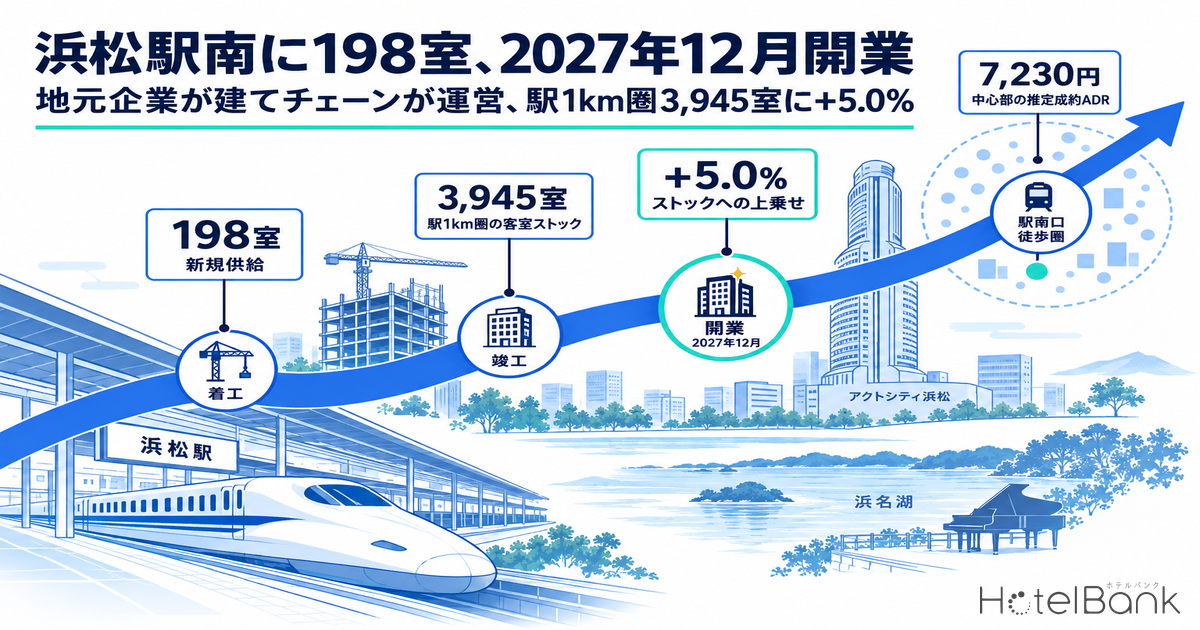
According to plans announced by Vessel Hotel Development (ベッセルホテル開発) on May 14, 2026, REF Hamamatsu by VESSEL HOTELS (レフ浜松 by ベッセルホテルズ), a 10-story steel-frame hotel with 198 rooms, will open in December 2027 in Sunayama-cho, Chuo Ward, Hamamatsu, a four-minute walk from the south exit of JR Hamamatsu Station. The building will be constructed by Asahi Corporation (アサヒコーポレーション), which is headquartered in Hamamatsu, and Vessel Hotel Development will operate it after completion. It will be the company’s first property in Shizuoka Prefecture. Starting from this structure, in which a local landholding company builds and a chain operates, this article overlays the room stock within 1 km of the station, the estimated achieved ADR of the city center, and booking pace by day of week to work out which price band the 198 rooms will enter and where the room for absorption lies.
Metric Definitions Used in This Article
*Metric definitions used in this article: ADR (average daily rate) = estimated achieved rate (tax-exclusive equivalent), calculated by applying a correction factor for each hotel type to the lowest-plan price level each property publishes on OTAs (per room, two guests per room, tax included). In a comparison with the property-level ADR disclosed by a listed hotel REIT (Invincible Investment Corporation; 184 property-months, April–May 2026), the median error was 7.5% (6.0% for business and city hotels). These are estimates and differ from each property’s actual achieved rates and accounting figures. Area-level ADR is the median of the properties covered (the level of a typical property in the area). OCC (occupancy) = rooms sold as a share of total rooms in the area (an estimate based on inventory sold through OTAs; consistency checks against monthly REIT disclosures indicate accuracy of roughly a few percentage points). Where listed prices are mentioned, they are per-room rates for two guests per room (tax included).
Booking curve = the change in remaining OTA room inventory as the check-in date approaches. LT (lead time) = the number of days until check-in. Occupancy (estimated, based on OTA-listed inventory) is an estimate based on how inventory sold on OTAs is taken up and differs from a property’s actual overall occupancy. Data source: MetroEngines Research & Consulting. Figures are as compiled on October 5, 2026.
- — 198 rooms, opening planned for December 2027: REF Hamamatsu by VESSEL HOTELS will stand in Sunayama-cho, a four-minute walk from the south exit of Hamamatsu Station. Local company Asahi Corporation builds it and Vessel Hotel Development operates it.
- — +5.0% on the 3,945 rooms within 1 km of the station: Together with Toyoko Inn Hamamatsu-eki Minami-guchi (東横INN浜松駅南口, 284 rooms), which opened in April 2026, the uplift is +13.2% against the 3,661 rooms in place at the end of 2025.
- — Estimated achieved ADR averaged ¥7,230 over 12 months (central Hamamatsu, all hotel types, September 2025–August 2026, N=33–35 properties). The four properties opened since 2018 line up at ¥8,100–8,700.
- — Tue–Thu occupancy (estimated) is 91.7% (city-center business hotels, July–September 2026). Wednesday bookings build by 24.0 pt in the final two weeks and overtake Saturday by the day before arrival.
- — The reference estimate puts room revenue at ¥410–550 million a year: The central case is ¥480 million, at an assumed ADR of ¥8,300 and an assumed full-year occupancy of 80%. This is not the project’s actual figure but a guide built from statistical values.
Project Overview — Built by a Local Company, Operated by a Chain
First, what can be confirmed from the published materials. Vessel Hotel Development’s release names Asahi Corporation Co., Ltd. (head office: Kaji-machi, Chuo Ward, Hamamatsu) as the project owner and Vessel Hotel Development Co., Ltd. as the operator, and explains that “Asahi Corporation will construct the hotel and Vessel Hotels will operate it after completion.” The groundbreaking safety ceremony was held on May 13, 2026, and construction started the same month. Completion is planned for late September 2027 and opening for December 2027.
| Item | Details |
|---|---|
| Name | REF Hamamatsu by VESSEL HOTELS (レフ浜松 by ベッセルホテルズ) |
| Location | 1055 Sunayama-cho and adjoining lots (lot number), Chuo Ward, Hamamatsu, Shizuoka Prefecture |
| Access | Four-minute walk from the south exit of JR Hamamatsu Station |
| Project owner (constructs the building) | Asahi Corporation Co., Ltd. (株式会社アサヒコーポレーション; Chuo Ward, Hamamatsu) |
| Operator | Vessel Hotel Development Co., Ltd. (株式会社ベッセルホテル開発; Fukuyama, Hiroshima Prefecture) |
| Design / construction | Toshi Kenchiku Kenkyusho Co., Ltd. (株式会社都市・建築研究所) / Asahi House Industry Co., Ltd. (アサヒハウス工業株式会社) |
| Structure and scale | Steel frame, 10 stories |
| Site area / gross floor area | 1,068.70 m² / 5,280.00 m² |
| Number of rooms | 198 in total (planned), all non-smoking |
| Schedule | Construction start May 2026 → completion late September 2027 (planned) → opening December 2027 (planned) |
| Main features | Large communal bath with sauna, shoes-off design from the guest room entrance, free co-sleeping for guests aged 18 and under |
Source: Compiled by MetroEngines Research & Consulting from Vessel Hotel Development’s published materials (May 14, 2026)
Two figures can be read from this table. One is 26.7 m² per room, the gross floor area divided by the number of rooms; even including shared areas such as the large bath and the breakfast venue, this sits within the standard density for a limited-service hotel. The other is a ratio of about 494%, the gross floor area divided by the site area. As shown later, Sunayama-cho on the south side of the station is a commercial zone with a floor-area ratio of 500–600%, so on a simple calculation the project is sized to use almost all of the designated floor-area ratio (gross floor area and the floor area counted toward the floor-area ratio are not the same, so this is only a guide).
On the other hand, it has not been disclosed whether the contract between the two companies is a building lease or a management contract, or how the rent and term were set. This article therefore does not go into contract terms and takes as its premise only the fact that a division of roles was established: land and building by a local company, brand and operation by a national chain. For operating companies and landowners holding land in regional core cities, a concrete example has now appeared in Hamamatsu of an option to monetize station-front land as a hotel without having operating know-how in-house.
Room Stock Within 1 km of the Station — 29 Properties, 3,945 Rooms, 928 Added Since 2018
Next, the size of the market the 198 rooms will enter. Of the properties tracked by MetroEngines Research, 29 properties with 3,945 rooms within a 1 km radius of Hamamatsu Station were confirmed on sale in September 2026 (properties that changed brand were counted as one property, as the same building). The 198 rooms amount to +5.0% of this stock.
Station-front supply is already moving, however. Toyoko Inn Hamamatsu-eki Minami-guchi (284 rooms) opened on April 25, 2026, a three-minute walk from the south exit; together with REF Hamamatsu, that makes 482 rooms in a little under two years, an uplift of +13.2% against the 3,661 rooms in place at the end of 2025. Arranging the existing properties by opening period, buildings operating since 2017 or earlier account for 24 properties and 3,017 rooms, openings in 2018–2021 for 4 properties and 644 rooms, and 2026 for 1 property and 284 rooms. Openings since 2018 total 928 rooms, or 23.5% of the current stock.
Source: MetroEngines Research & Consulting (based on confirmed OTA listings, N=29 properties, 3,945 rooms). The 2027 figure is as announced by Vessel Hotel Development
*Properties confirmed on sale in September 2026 are stacked by opening period; properties that ceased operating in the meantime are not included. Opening period is classified by the year the current building began operating as lodging, and brand changes (such as Centurion Hotel Hamamatsu in April 2024 and ANA Crowne Plaza Hotel Hamamatsu in July 2026) are not counted as new supply. This is a tally of what MetroEngines Research has identified and is not a complete census. Projects planned for 2027 or later that are unannounced or not yet listed on OTAs are not included, so the count may rise with future announcements and listings.
| Period | Properties | Rooms | Main contents |
|---|---|---|---|
| Operating since 2017 or earlier | 24 | 3,017 | City hotels at the north exit, limited-service hotels at the south exit, and others |
| Opened 2018–2021 | 4 | 644 | Kuretake Inn Hamamatsu-eki Minamiguchi Premium (くれたけイン浜松駅南口プレミアム, 160 rooms), Kita no Niwa THE KURETAKESO (北の庭 THE KURETAKESO, 250 rooms), and others |
| Opened April 2026 | 1 | 284 | Toyoko Inn Hamamatsu-eki Minami-guchi (東横INN浜松駅南口) |
| Total as of October 2026 | 29 | 3,945 | |
| Opening planned for December 2027 | 1 | 198 | REF Hamamatsu by VESSEL HOTELS (4,143 rooms in total, +5.0%) |
Source: MetroEngines Research & Consulting (based on confirmed OTA listings); company announcements
The map below shows the locations of the 29 properties as circles proportional to room count. On the north side of the station, city hotels around Act City and limited-service hotels in the 200-room class line up, while on the south exit side, properties of around 100 rooms are clustered within a three-minute walk. The REF Hamamatsu site is in Sunayama-cho, a four-minute walk from the south exit, so the 198 rooms will be added just outside this south-exit cluster.
Source: MetroEngines Research & Consulting (N=29 properties; circle size = number of rooms; dashed line = 1 km radius from Hamamatsu Station)
Estimated Achieved ADR in the City Center — 12-Month Average of ¥7,230, Peaks in November and May
So at what rates is this stock selling? The estimated achieved ADR of the city center including Hamamatsu Station (the former Naka Ward in the tabulation) averaged ¥7,200 for all hotel types (¥7,230, N=33–35 properties) over the 12 months from September 2025 to August 2026, and ¥7,000 for business hotels alone (¥6,995, N=28–29 properties). By month, November at ¥7,900 and May at ¥7,900 are the peaks and February at ¥6,500 is the trough. The gap between peak and trough is about ¥1,500, or 23%, so the seasonal swing is not large.
Source: MetroEngines Research & Consulting (central Hamamatsu, all hotel types, N=33–35 properties, finalized months only)
Year on year, 2026 was almost flat from January to April at −5.1% to +0.5%, while May (−18.1%) and August (−14.8%) reflected the prior year’s spikes dropping out. As a result, the 12-month average settled at −4.9% against ¥7,600 (¥7,602) in the same period a year earlier. Meanwhile, September 2026, after the 284 rooms had been added, recovered to ¥8,000 (¥7,989, N=35 properties), up 11.4% year on year; it is worth noting that rates held even immediately after supply rose by 7.8%. Cases in which rates do not collapse right after a supply increase have also been observed in other markets, such as Kure.
A comparison with the prefectural capital is also useful. For Aoi Ward in Shizuoka City, which includes Shizuoka Station, the same 12-month average was ¥8,300 for all hotel types (¥8,293, N=36–38 properties) and ¥7,400 for business hotels (¥7,362, N=22 properties); central Hamamatsu is 12.8% lower for all hotel types and 5.0% lower for business hotels. The large gap for all hotel types and the small gap for business hotels reflect the fact that central Hamamatsu’s mix leans toward limited-service hotels; comparing like with like, the two cities’ levels are close.
| Area | All hotel types (12-month average) | Business hotels (12-month average) | September 2026, all hotel types |
|---|---|---|---|
| Central Hamamatsu (former Naka Ward) | ¥7,230 (N=33–35) | ¥6,995 (N=28–29) | ¥7,989 (+11.4% YoY) |
| Aoi Ward, Shizuoka City | ¥8,293 (N=36–38) | ¥7,362 (N=22) | ¥8,486 (+11.0% YoY) |
| Gap (Hamamatsu / Shizuoka) | −12.8% | −5.0% | −5.9% |
Source: MetroEngines Research & Consulting (estimated achieved ADR, average of finalized months, September 2025–August 2026)
Estimated Occupancy by Day of Week — 91.7% Tue–Thu, Peaking on Thursday
After rates, the next question is on which days of the week demand is thickest. For city-center business hotels (20–21 properties / 2,517–2,589 rooms covered, based on listings on major booking sites), averaging the 92 nights of July–September 2026 by day of week puts Thursday highest at 93.0%, followed by Wednesday at 91.8% and Tuesday at 90.4%. The Tue–Thu average is 91.7%, slightly above Saturday’s 90.0%. Sunday is 75.7% and Monday 83.3%, so the weekly trough falls on Sunday. For September 2026 alone, occupancy (estimated) was 90.5% (21 properties / 2,589 rooms covered), 5.0 pt higher than the 85.5% for business hotels across Shizuoka Prefecture (117 properties / 12,460 rooms covered).
Source: MetroEngines Inc.; compiled by the HotelBank Editorial Team (business hotels in central Hamamatsu, 20–21 properties / 2,517–2,589 rooms covered, based on listings on major booking sites, July–September 2026)
Even where weekday and Saturday occupancy levels are close, the way rooms fill is very different. The next chart averages booking pace from 45 days before the stay date to the day before, for the four Wednesdays and four Saturdays of September 2026 (20–22 properties / 2,517–2,873 rooms covered). Saturdays are already 60.4% full 45 days out, whereas Wednesdays stand at only 50.1%. Yet Wednesdays build by 24.0 pt in the final two weeks, from 70.3% to 94.3%, overtaking Saturday’s 92.0% by the day before. This can be read as short-lead-time demand, characteristic of business travel, pushing up the middle of the week.
Source: MetroEngines Inc.; compiled by the HotelBank Editorial Team (business hotels in central Hamamatsu, 20–22 properties / 2,517–2,873 rooms covered, based on listings on major booking sites, average of the four Wednesdays and four Saturdays of September 2026, LT45→1)
Behind this is most likely the concentration of employment around the station. According to the Economic Census by the Ministry of Internal Affairs and Communications and the Ministry of Economy, Trade and Industry, 3,646 establishments and 44,030 employees are concentrated within a 1 km radius of Hamamatsu Station, of which office-type employees account for 19.8%. The resident population of the same area is 21,961 (2020), meaning there are roughly twice as many people working there as living there. When 198 rooms are added to a market where occupancy exceeds 90% from Tuesday to Thursday, the room for weekday absorption comes mainly from business demand in the final two weeks, and the occupancy easiest to grow after opening is that of Sundays and Mondays.
The Price Band the 198 Rooms Will Enter — Four Post-2018 Properties Sit at ¥8,100–8,700
From here, the properties within 1 km are lined up one by one by rate to find where the 198 rooms fit. Dividing the 27 properties and 3,785 rooms for which estimated achieved ADR can be calculated into five bands by 12-month average rate, 9 properties with 1,014 rooms fall in the ¥6,500–7,500 band and 7 properties with 1,023 rooms in the ¥7,500–8,500 band; these two bands account for 54% of rooms. The ¥8,500–10,000 band has 4 properties with 706 rooms and ¥10,000 and above has 2 properties with 533 rooms, so rooms thin out toward the top.
Source: MetroEngines Research & Consulting (within 1 km of Hamamatsu Station, N=27 properties and 3,785 rooms for which estimated achieved ADR can be calculated, average for September 2025–August 2026. For the one property opened in April 2026, the average of the five months after opening)
What deserves attention is where the new buildings sit. The estimated achieved ADR of the four properties (800 rooms in total) opened since 2018 for which rates can be calculated falls within ¥8,100–8,700, 19–29% above the ¥6,800 median (¥6,771) of the 21 business hotels (2,471 rooms) operating since 2017 or earlier. Building age translates directly into steps on the rate ladder, and it is highly likely that this ¥8,000-range band is also the first against which the 198 rooms opening in 2027 will be compared.
What about the large communal bath? In guest reviews from the most recent 24 months tallied by the HotelBank Editorial Team, four business hotels within 1 km have mentions of a large bath in more than 20% of their reviews (2,749 reviews in total), and the median of their estimated achieved ADR was ¥7,400 (¥7,449). The difference from the ¥6,900 median (¥6,927) of the other 20 properties is +7.5%. With only N=4, and with the effect overlapping that of newness, the figure needs to be read with a margin, but the specification of a new build with a sauna-equipped large bath as standard meets the conditions for lining up on the higher-rate side of the existing stock.
Finally, the relationship between rate and early sell-out. The scatter plot below takes 22 business hotels within 1 km, with estimated achieved ADR on the horizontal axis and, on the vertical axis, the number of days out of the 28 nights of September 1–28, 2026 on which remaining rooms reached zero three or more days before the stay date (only properties whose OTA-published allotment is 30% or more of total rooms are included). The 11 properties below ¥7,000 average 9.1 days and the 7 properties at ¥8,000 or above average 6.1 days; the correlation coefficient is weak at −0.14. The tendency suggested is that allotments fill earlier in lower rate bands, while properties in the ¥8,000 range hold inventory until close to arrival and then sell through.
Source: MetroEngines Inc.; compiled by the HotelBank Editorial Team (N=22 business hotels within 1 km of Hamamatsu Station. Inventory drawn from 28 properties, being the 38 with observation data among the 101 covered properties in central Hamamatsu, less those with an OTA-published allotment below 30%; stay dates September 1–28, 2026)
*Remaining rooms are the number left within the allotment published on OTAs and do not mean the property as a whole is full. For properties with a small OTA-published allotment, several possibilities exist: channel management centered on direct sales and corporate contracts, a practice of adding inventory as the stay date approaches, or a contractually small allocation to OTAs.
Site Assessment — Sunayama-cho Is a Commercial Zone With a 500–600% Floor-Area Ratio; Official Land Prices Rose by More Than 4% in 2026
The site conditions can be pinned down with public data. According to the Real Estate Information Library of the Ministry of Land, Infrastructure, Transport and Tourism (MLIT), the Sunayama-cho area at the south exit of Hamamatsu Station is a commercial zone (building coverage ratio 80%), and the designated floor-area ratio at the official land price points in the district is 500–600%. The ratio of gross floor area to site area seen earlier (about 494%) is close to this designated ratio.
| Official land price point (Sunayama-cho) | 2022 | 2023 | 2024 | 2025 | 2026 | 2026 YoY |
|---|---|---|---|---|---|---|
| Hamamatsu Chuo 5-13 (floor-area ratio 500%) | 242,000 | 242,000 | 246,000 | 251,000 | 261,000 | +4.0% |
| Hamamatsu Chuo 5-18 (floor-area ratio 600%) | 421,000 | 424,000 | 432,000 | 441,000 | 460,000 | +4.3% |
Source: Compiled by MetroEngines Research & Consulting from the MLIT Real Estate Information Library (official land prices, ¥/m²)
The official prices at the two points were flat through 2023, turned upward from 2024, and accelerated to +4.0% and +4.3% in 2026. The increases over four years are 7.9% and 9.3%. Station use has also recovered. Average daily passengers at JR Hamamatsu Station (boarding and alighting, including the Tokaido Shinkansen) fell from 74,051 in fiscal 2019 to 44,992 in fiscal 2020, then recovered to 67,370 in fiscal 2023, 91% of the fiscal 2019 level.
Disaster risk should also be checked. The reference point in Sunayama-cho (near the south exit) falls, in the flood inundation zones assumed for the maximum-scale event, in the 0.5 m to under 3 m class for the Tenryu River and the under 0.5 m class for the Magome River, and its landform classification is alluvial fan, rated “somewhat prone to liquefaction.” Existing hotels around the station operate under the same conditions, so this is not specific to this site, but the floors on which machine rooms and electrical equipment are placed and the business continuity plan in the event of flooding are items the party owning the building will want to build in at the design stage. Assumptions for an individual location need to be checked on the municipality’s hazard map.
The distribution of resident population is shown in the next map. The resident population within a 1 km radius is projected to fall from 21,961 in 2020 to 19,377 in 2040 (−11.8%), and the share aged 65 and over is 27.6% as of 2025. Because demand for a station-front hotel is supported by visitors and workers rather than residents, the population projection is better read as an operational premise, namely securing staff for the breakfast venue and the large bath.
Source: MLIT National Land Numerical Information (future population projections by 250 m mesh, 2024 estimates by the National Spatial Planning and Regional Policy Bureau) (resident population, not daytime or pass-through population)
Reference Estimate for a Same-Size Building at Statistical Unit Costs — Room Revenue of ¥410–550 Million
Using the figures so far, a rough estimate can be made of the revenue a 198-room property generates. Because the project’s cost, rent and financials have not been disclosed, the following are reference values for a building of the same size using general statistical values and do not represent the project’s actual figures.
| Assumed ADR \ assumed full-year occupancy | 75% | 80% | 85% |
|---|---|---|---|
| ¥7,500 | ¥407 million | ¥434 million | ¥461 million |
| ¥8,300 (center of the four properties opened since 2018) | ¥450 million | ¥480 million | ¥510 million |
| ¥9,000 | ¥488 million | ¥520 million | ¥553 million |
Source: Estimate by MetroEngines Research & Consulting (198 rooms × 365 days × assumed ADR × assumed occupancy. Annual room revenue, tax-exclusive equivalent)
The central case is ¥480 million a year, at ¥8,300, the same as the four newer properties within 1 km, and a full-year occupancy of 80%. The occupancy assumption was lowered from the 87.2% estimated occupancy of July–September 2026 to allow for the winter trough and the ramp-up in the first year after opening. If ADR falls 10%, the figure becomes ¥430 million; if occupancy falls 5 pt, ¥450 million; and even where both coincide, ¥400 million serves as the guide.
The scale of the building investment is viewed in two steps. The 5,280 m² of gross floor area is about 1,597 tsubo; applying the 2025 national average for steel-frame hotels based on MLIT’s Building Starts Statistics (¥2.405 million per tsubo) gives about ¥3.84 billion, or about ¥19.4 million per room. Factoring in a 5% annual rise in construction costs up to the midpoint of the construction period from start to completion (early 2027) raises this to about ¥4.13 billion, or about ¥20.9 million per room. For the level of operating profit, taking as a reference the 38.9% GOP margin (gross operating profit as a share of revenue; fiscal period ended December 2024) of the 91 domestic hotels disclosed by Invincible Investment Corporation (インヴィンシブル投資法人), the figure is about ¥190 million on room revenue of ¥480 million, a ratio of 4.5–4.9% to the building investment. Because a new build incurs ramp-up costs in its first year, this ratio is best read as a guide for the period after operations stabilize. As for the time it takes after opening for ADR to catch up with the surrounding level, a separate HotelBank measurement of 182 new hotel openings found a median of two months.
*This is a simplified estimate; actual investment decisions require a detailed feasibility study. Land cost is not included, on the premise that the project owner holds the land. The statistical unit cost is a national average and varies up or down by region, specification and timing of the order. Rising construction costs also work to restrain new supply, and so are a factor stabilizing the competitive environment for existing properties and for projects that broke ground earlier.
Implications for Landholding Companies and Nearby Hotels — Weekdays Are Decided in the Final Two Weeks, Weekends 45 Days Out
To sum up so far, the Hamamatsu station-front area is a market that “fills to more than 90% from Tuesday to Thursday, with rates of around ¥7,000 and new buildings in the ¥8,000 range.” From this premise, three implications follow, one for each standpoint.
First, for operating companies and landowners holding land, the yardsticks for gauging the viability of a build-and-lease (or build-and-entrust-operation) model are now in place. The sense of scale, namely 198 rooms on a site of about 1,070 m² with a designated floor-area ratio of 500% and central-case room revenue of ¥480 million a year, can serve as a reference point when companies holding similar underused station-front land begin their own studies. At the stage of selecting an operator, it is worth confirming that the specification (new build, large bath, family-friendly) is sufficient to place the assumed ADR in the ¥8,000 range.
Second, for regional financial institutions considering lending, the fact that weekday occupancy is underpinned by business demand becomes the axis of assessment. Because Wednesday bookings build by 24.0 pt in the final two weeks, looking only at monthly bookings on the books tends to make performance appear weaker than it is. For monitoring, tracking pace at three points, 45 days out, 14 days out and the day before, is an effective approach.
Third, for operators of nearby hotels, the opening of the 198 rooms is an occasion to review price bands. With the new build entering the ¥8,000 range, properties in the ¥6,500–7,500 band can keep their current strength as “the price that fills early” while having room to raise ceiling rates on days when occupancy reaches the high 90s, such as Thursdays and holiday weekends. Sundays and Mondays, where estimated occupancy is in the 70–80% range, are the days on which to aim for a lift through consecutive-night and long-stay plans.
Conclusion — Weekday Business Demand at 90% Absorbs a +5.0% Supply Increase
REF Hamamatsu by VESSEL HOTELS is a 198-room property built by local company Asahi Corporation and operated by Vessel Hotel Development, with opening planned for December 2027. The uplift against the 3,945 rooms within 1 km of the station is +5.0%, and +13.2% even when combined with the 284 rooms opened in April 2026; given the business demand of the city center, where estimated Tue–Thu occupancy reaches 91.7%, there is ample room for absorption. On rates, the four properties opened since 2018 line up at ¥8,100–8,700, and the specification of a new build with a sauna-equipped large bath has what it takes to enter this band. That estimated achieved ADR in September 2026 was up 11.4% year on year even after the 284 rooms opened is evidence that this market can hold rates while absorbing supply. Over the year and more until opening, how last-minute weekday booking pace and the depth of the ¥8,000-range band move will be the points to watch for anyone considering the next project.
Frequently Asked Questions
Q. When and where will REF Hamamatsu by VESSEL HOTELS open?
A. It is scheduled to open in December 2027 in Sunayama-cho, Chuo Ward, Hamamatsu, a four-minute walk from the south exit of JR Hamamatsu Station. It is a 10-story steel-frame building with 198 rooms, and completion is planned for late September 2027.
Q. Who is constructing the building?
A. The project owner is Asahi Corporation Co., Ltd., headquartered in Hamamatsu, and Vessel Hotel Development Co., Ltd. will operate the hotel after completion. The contract structure and rent have not been disclosed.
Q. What are hotel rates like around Hamamatsu Station?
A. The estimated achieved ADR of central Hamamatsu averaged ¥7,230 for all hotel types (N=33–35 properties) and ¥6,995 for business hotels (N=28–29 properties) over the 12 months from September 2025 to August 2026. These are estimates and differ from each property’s actual achieved rates.
⚠ Note on ADR for future dates: The estimated achieved ADR used for comparison in this article covers finalized months through September 2026. Months from October 2026 onward are only estimates based on listed levels at the time of the survey and change as check-in dates approach, so they are not compared on the same footing as finalized months. The planned opening date and number of rooms are plans as of the announcement and may change.
Related Reading
References and Sources
■ Data sources
Estimated achieved ADR, occupancy (estimated), booking curves and the room stock within 1 km of the station are values compiled by MetroEngines Research & Consulting from OTA listing information (as of October 5, 2026). The project overview is based on Vessel Hotel Development’s published materials (May 14, 2026); official land prices, zoning, flood inundation zones and station passenger numbers on the MLIT Real Estate Information Library; future population projections on National Land Numerical Information; numbers of establishments and employees on the Economic Census for Business Activity (2021); and construction unit costs on the Building Starts Statistics.
■ Estimate assumptions
Annual room revenue = 198 rooms × 365 days × assumed ADR × assumed occupancy (tax-exclusive equivalent). The central case uses an assumed ADR of ¥8,300 (the level of the four properties opened since 2018) and an assumed full-year occupancy of 80%; nine combinations of assumed ADR of ¥7,500–9,000 and assumed occupancy of 75–85% are shown. The scale of the building investment applies the 2025 national average unit cost for steel-frame hotels (¥2.405 million per tsubo) to the 5,280 m² of gross floor area (about 1,597 tsubo), and is shown in two steps together with the case adding a 5% annual rise in construction costs. A GOP margin of 38.9% is used as a reference value for the level of operating profit, and land cost is not included.
■ Limitations and caveats
The project’s cost, contract structure, rent and financials have not been disclosed; the estimate is a reference value for a building of the same size using statistical values and does not represent the project’s actual figures. Estimated achieved ADR and occupancy (estimated) are estimates based on OTA listing information and differ from each property’s actual results and accounting figures. The room stock is a tally of what could be identified and is not a complete census. The rate difference for large baths rests on only N=4 properties and overlaps with the effect of building newness. The opening date and number of rooms are plans as of the announcement and may change.
■ Market data
MetroEngines Research & Consulting — estimated achieved ADR (central Hamamatsu N=33–35 properties, Aoi Ward in Shizuoka City N=36–38 properties), occupancy (estimated), booking curves, room stock within 1 km of the station (N=29 properties, 3,945 rooms)
HotelBank Editorial Team research — tally of guest reviews (most recent 24 months; four properties with frequent mentions of a large bath, 2,749 reviews in total)
■ Government statistics and public data
MLIT Real Estate Information Library — official land prices, zoning, flood inundation zones, station passenger numbers
MLIT National Land Numerical Information (future population projections by 250 m mesh)
Ministry of Internal Affairs and Communications / Ministry of Economy, Trade and Industry, Economic Census for Business Activity (2021)
MLIT Building Starts Statistics
■ REIT and industry reports
Invincible Investment Corporation (8963) hotel operating results (reference value for GOP margin)
■ News and press releases
Vessel Hotel Development, notice on the opening of REF Hamamatsu by VESSEL HOTELS (May 14, 2026)
Toyoko Inn, press release on the opening of Toyoko Inn Hamamatsu-eki Minami-guchi (opened April 25, 2026; 284 rooms)
Travel Watch, article on the opening of Toyoko Inn Hamamatsu-eki Minami-guchi
Press release on the opening (rebranding) of ANA Crowne Plaza Hotel Hamamatsu on July 1, 2026