

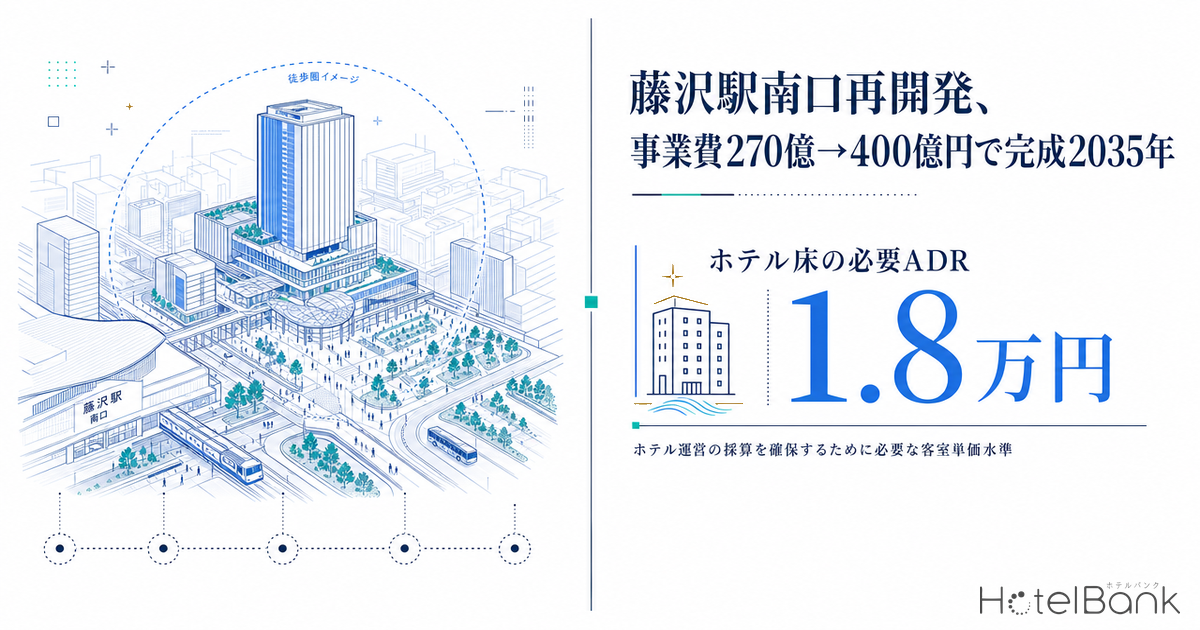
In July 2026, the preparatory association behind the Fujisawa Station South Exit 391 District Urban Redevelopment Project — a plan to replace three commercial buildings at the station’s south exit with a single tower — announced a review of its project plan. The estimated total project cost has swollen roughly 1.5-fold, from about ¥27.0bn to about ¥40.0bn, and completion of the redevelopment building slips three years, from 2032 to 2035 at the earliest. Meanwhile, the official land price standard site on the same block rose 11.5% in a single year, while hotel rates in Fujisawa City rose only 2.1% YoY on a 12-month average. This article focuses on the hotel floors planned for the upper storeys and uses sensitivity tables to show how far the cost overrun pushes up the required ADR, both when the floor is acquired and when it is leased.
Metric Definitions Used in This Article
Note on metric definitions in this article: ADR (average daily rate) = an estimated settled rate (tax-exclusive equivalent) calculated by applying a category-specific adjustment factor to the lowest-plan level each property publishes on OTAs (per-room rate for two guests in one room, tax included). When checked against the property-level results disclosed by listed hotel REITs (91 properties, most recent three months), the median error is about 7%. These are estimates and differ from each property’s actual settled prices and accounting figures. Area-level ADR is the median of the properties covered (the level of a typical property in the area). OCC (occupancy rate) = rooms sold as a share of total rooms in the area (an estimate based on OTA sales inventory; consistency checks against monthly REIT disclosures confirm accuracy of roughly a few points). Where listed prices are mentioned, they are per-room rates for two guests in one room (tax included). Months from September 2026 onward are estimates based on listed levels at the time of the survey and are therefore not used for the YoY comparisons in this article. Data source: MetroEngines Research & Consulting.
- — Total project cost up from about ¥27.0bn to about ¥40.0bn (+48.1%); completion of the redevelopment building pushed back three years, from 2032 to 2035 at the earliest (Kanagawa Shimbun, July 14, 2026).
- — The five commercial land price sites within 1 km of the station rose +9.4% to +13.4% YoY. The standard site on the same block, “Fujisawa 5-3”, stands at ¥2.13M/m², up 11.5% (2026 official land prices).
- — Fujisawa City’s estimated settled ADR averaged ¥9,700 over 12 months, +2.1% YoY (Sep 2025 – Aug 2026, N=21–23 properties), below the +6.0% for Kanagawa Prefecture as a whole.
- — Required ADR for the hotel floors is ¥18,300 if acquired and ¥22,200 if leased (estimate: project cost of about ¥40.0bn, 40 m² per room, 5.0% yield). At 30 m² per room it falls to ¥13,700; if construction costs rise 5% a year it reaches ¥25,800.
- — There are 18 properties with 1,318 rooms within 1 km of the station, flat over the past six years. The nine limited-service hotels cluster in the ¥8,000–¥11,100 band, and the ¥15,000–¥20,000 band at 100+ rooms is vacant.
Cost Up About 1.5x, Completion in 2035 at the Earliest — What the Review Changed
We begin by establishing where the plan stands, using primary documents and press reports. The 391 District is the block facing the south exit station plaza where three buildings stand side by side — the Fujisawa Meiten Building, the Diamond Building and the CD Building — and Fujisawa City adopted a city planning decision designating it a Type 1 Urban Redevelopment Project in June 2023. According to city council materials, the facility plan calls for a 17-storey building with a total floor area of about 35,200 m², for commercial, office, lodging and other uses, with a multipurpose hall inside the hotel that would serve as a temporary shelter for stranded commuters. Kentsu Shimbun reports that the structure is reinforced concrete with two basement levels and 17 storeys above ground, that Fujita Corporation is the project partner, and that basic design is by Fujita and Akihisa Hirata Architecture Office.
The review affects both cost and timing. According to Kanagawa Shimbun (July 14, 2026), rising material prices and labour costs pushed the total project cost from the initial estimate of about ¥27.0bn to about ¥40.0bn, and it became clear in October 2025 that the project balance would be about ¥8.0bn in the red. In response, the preparatory association postponed the closure of the three buildings from March 2028 to 2031, and completion moves from 2032 to 2035. The Townnews Fujisawa edition reports that design changes such as cutting the number of elevators were also attempted, and that because the existing buildings fill the entire site, the block is structurally ill-suited to securing new floor area that can be sold after rebuilding (reserved floor).
Note, however, that the figures rest on different assumptions depending on the source. Materials Fujisawa City presented to a special committee in November 2024 put the total project cost at about ¥32.1bn (of which about ¥12.5bn is national, prefectural and city subsidies) and the plan period at FY2026–FY2032, so the base date or scope may differ from the “initial about ¥27.0bn” in press reports. The size of the district also varies: the city materials and Kanagawa Shimbun give “about 0.5 ha (about 5,000 m²)”, whereas Kentsu Shimbun writes “site of about 3,180 m²”. The former can be read as the project area including roads and the plaza and the latter as the building site, but this article simply presents both by source. For the hotel floors, too, some reports say “13th–17th floors” and others “12th–17th floors”, and the number of rooms has not been disclosed.
| Timing | Details | Source |
|---|---|---|
| 2017 | Seismic assessment rates two of the buildings as “at high risk of collapse in an earthquake of seismic intensity 6 or higher”. Rights holders establish a preparatory association | Townnews / Fujisawa City materials |
| June 2023 | Fujisawa City adopts city planning decisions for a Type 1 Urban Redevelopment Project, a high-level use district and a district plan (area of about 0.5 ha) | Fujisawa City Planning Council materials |
| November 2024 | City materials: total project cost about ¥32.1bn (subsidies about ¥12.5bn), plan period FY2026–FY2032, total floor area about 35,200 m², 17 storeys | Fujisawa City Council materials |
| October 2025 | Total project cost found to have swollen from about ¥27.0bn to about ¥40.0bn, with the project balance expected to be about ¥8.0bn in the red | Kanagawa Shimbun |
| July 2026 | Preparatory association announces a review of the project plan and postponement of the full closure of the buildings (March 2028 to 2031) | Kanagawa Shimbun / Townnews |
| FY2027 | Project plan to be revised (design re-examined; method of disposing of reserved floor re-examined) | Kentsu Shimbun |
| 2029–2030 | Aim to establish the formal association (2029) and obtain approval of the rights conversion plan (2030) | Kentsu Shimbun |
| 2031 onward | Existing three buildings close; construction starts | Kanagawa Shimbun / Kentsu Shimbun |
| 2035 | Redevelopment building completed (at the earliest) | Kanagawa Shimbun / Townnews |
The Growth Gap — Project Cost +48%, Land Prices +13%, Hotel Rates +2.1%
Viewed from the standpoint of the hotel floors, the issue is the gap between how fast costs and revenues are growing. Total project cost rose 48.1%, from about ¥27.0bn to about ¥40.0bn, and the median commercial land price within 1 km of the station rose 13.4%, from ¥478,000/m² in 2025 to ¥542,000/m² in 2026. By contrast, Fujisawa City’s estimated settled ADR rose 2.1%, from a 12-month average of ¥9,500 for September 2024 – August 2025 to ¥9,700 for September 2025 – August 2026 (N=21–23 properties). Over the same period ADR for Kanagawa Prefecture as a whole rose 6.0%, from ¥13,300 to ¥14,100 (N=542–600 properties), so Fujisawa’s increase was more gradual than the prefectural average.
Month by month, though, the picture is somewhat different. The chart below overlays Fujisawa City’s ADR by year: August 2026 came in at ¥12,100, 9.4% above the ¥11,100 of the same month a year earlier. Rates tend to rise in summer, when leisure demand for Enoshima and the Shonan coast is added, and conversely fall to ¥8,500–¥8,800 in February and June. The annual average of just under ¥10,000 can be read as the result of smoothing the gap between the summer peak and the slack months.
On occupancy, recent sell-through is at a high level. Estimated OCC for Fujisawa City’s business hotel category (12–13 properties / 1,041–1,080 rooms, based on listings on major booking sites) was 88.4% in July 2026, 91.9% in August and 87.2% in September. In September, the Monday–Thursday average was 89.2% and Saturday 87.5%, showing that weekday business demand fills rooms to about the same degree as weekends. Note that this figure is an estimate based on the sell-through of inventory sold on booking sites and differs from the actual occupancy rate of each property as a whole.
Location Fundamentals — Standard Site on the Same Block at ¥2.13M/m², +35.7% in Four Years
Turning to the location, land prices are moving in the same direction as project costs. In MLIT’s official land prices (2026) there are five commercial standard sites within 1 km of Fujisawa Station, and all five rose more than 9% YoY, by +9.4% to +13.4%. The highest-priced site, “Fujisawa 5-3”, is located at Minami-Fujisawa 2-1, the same address as the redevelopment district; it is zoned commercial with a 600% floor-area ratio and stands at ¥2.13M/m², up 11.5% YoY. Compared with ¥1.57M/m² in 2022, that is +35.7% in four years, and the median of the five sites also rose 29.7%, from ¥418,000/m² to ¥542,000/m².
Rising land prices feed into the redevelopment’s economics through two channels. One is that the appraised value of the pre-existing assets rises, which works to thicken the floor area that rights holders receive (rights floor). The other is that it pushes up the unit price of the reserved floor sold to recover project costs. Given the “hard to secure reserved floor” structure the press describes, the way an operator comes in is also likely to differ depending on whether the hotel floors are disposed of as reserved floor or held by rights holders and leased out.
The foundation of demand is the concentration of employment around the station. According to the Economic Census (2021) by the Ministry of Internal Affairs and Communications and the Ministry of Economy, Trade and Industry, 2,830 establishments and 37,599 workers are concentrated within a 1 km radius of Fujisawa Station, of whom 24.5% are office workers. The station is a node where three lines meet — the JR Tokaido Line, the Odakyu Enoshima Line and the Enoshima Electric Railway — and the location layers two kinds of demand: business on weekdays, and Shonan and Enoshima leisure in summer and on weekends.
Competitive Landscape — 18 Properties and 1,318 Rooms Within 1 km, Led by Nine Limited-Service Hotels
Next, we check the depth of the market the hotel floors would enter. As far as MetroEngines Research can identify, lodging properties within a 1 km radius of Fujisawa Station increased from 14 properties with 980 rooms at the end of 2017 to 18 properties with 1,339 rooms at the end of 2020, and stand at 18 properties with 1,318 rooms as of 2026 (rebrands of the same building and duplicate registrations that have since been merged are counted as one property). After four properties and 359 rooms were added in the three years 2018–2020, supply has been flat for the past six years.
Of these, the business hotel category with 60 or more rooms comprises nine properties with 1,105 rooms in total, accounting for about 84% of the rooms in the catchment. All are within about 600 m of the station centre, and the largest has 206 rooms.
| Property | Rooms | Distance from station centre |
|---|---|---|
| Toyoko Inn Shonan Kamakura Fujisawa Station North Exit | 206 | approx. 380 m |
| Hotel Hokke Club Shonan Fujisawa | 160 | approx. 390 m |
| Smile Hotel Shonan Fujisawa | 147 | approx. 300 m |
| Kipp Hotel Shonan Fujisawa | 142 | approx. 110 m |
| 8hotel Shonan Fujisawa | 109 | approx. 180 m |
| Super Hotel Shonan Fujisawa Station South Exit | 105 | approx. 160 m |
| Almont Inn Shonan Fujisawa | 96 | approx. 170 m |
| KOKO STAY Shonan Fujisawa | 80 | approx. 200 m |
| EN HOTEL Fujisawa | 60 | approx. 590 m |
The next chart shows the distribution of price bands. For ten properties — the nine above plus one city hotel category property of about 30 rooms — it plots estimated settled ADR for September 2025 – August 2026 (12-month average) against room count. The nine limited-service hotels fall within a range of ¥8,000–¥11,100, and the median of the ten properties is ¥9,400. Only the single 30-room property sits in the band around ¥18,000, and no property in the catchment commands this price band at a scale of more than 100 rooms.
Estimating Required ADR — ¥18,000 to Acquire, ¥22,000 to Lease
This is the core of the analysis. Because neither the price nor the rent of the hotel floors has been disclosed, we back-calculated the required ADR under the simplified assumption that “the floor is disposed of at the average unit price obtained by dividing total project cost by the total floor area of 35,200 m²”. At a project cost of about ¥40.0bn the average unit price is ¥1.136M/m² (about ¥3.76M per tsubo); at the initial ¥27.0bn it is ¥767,000/m² (about ¥2.54M per tsubo). Because this unit price also includes demolition, compensation, design and public facility works, it differs from pure building construction cost. For reference, based on MLIT’s Building Starts Statistics, the 2025 construction cost of lodging-use buildings was ¥2.405M per tsubo for steel-frame structures and ¥2.026M for reinforced concrete.
The assumptions of the estimate are as follows. Total floor area per room is set at 40 m², including an allocation of common areas and the multipurpose hall, and estimated OCC at 85%, more conservative than the recent 87–92%. For the acquisition case we assume an expected NOI (net operating income) yield of 5.0% and an NOI margin of 40% of room revenue (an assumed value for the level after deducting property tax, insurance and replacement reserves from GOP). For the lease case, the floor owner is assumed to earn the same 5.0% yield through rent, and the rent an operator can bear is set at 33% of room revenue.
| Total project cost scenario | Average floor unit price | Per room (40 m²) | Required ADR (acquisition) | Required ADR (lease) |
|---|---|---|---|---|
| About ¥27.0bn (initial, press reports) | ¥767,000/m² | ¥30.68M | ¥12,400 | ¥15,000 |
| About ¥32.1bn (November 2024, city materials) | ¥912,000/m² | ¥36.48M | ¥14,700 | ¥17,800 |
| About ¥40.0bn (July 2026, press reports) | ¥1.136M/m² | ¥45.45M | ¥18,300 | ¥22,200 |
| About ¥49.2bn (rising 3% a year through 2033) | ¥1.398M/m² | ¥55.90M | ¥22,500 | ¥27,300 |
| About ¥56.3bn (rising 5% a year through 2033) | ¥1.599M/m² | ¥63.96M | ¥25,800 | ¥31,200 |
To summarise the results, when the project cost was about ¥27.0bn the required ADR for acquisition was ¥12,400, roughly on a par with the actual ¥12,100 of August 2026. At about ¥40.0bn it becomes ¥18,300, about 1.9 times Fujisawa City’s 12-month average of ¥9,700. In the lease case it is higher by the amount needed to secure the operator’s share, at ¥22,200. Conversely, the floor unit price that the current 12-month average ADR can support works out to ¥602,000/m², equivalent to a project cost of about ¥21.2bn when applied to the entire floor area. Even assuming August’s rate level persisted all year, it would be equivalent to only about ¥26.5bn.
The outlook for construction costs should be viewed as a range. If construction starts in 2031 or later and completion is in 2035, the midpoint of the works falls around 2033. Starting from the current about ¥40.0bn, a 3% annual rise would bring the cost to about ¥49.2bn and a 5% annual rise to about ¥56.3bn, lifting the required ADR for acquisition to ¥22,500–¥25,800. The design review the preparatory association is pursuing works to absorb this increase, and because rising construction costs also restrain new supply nearby, there is an accompanying upside in that competition with the existing market would ease.
The other point to note in the estimate is its sensitivity to floor area per room and to yield. Keeping the project cost at about ¥40.0bn but holding each room to 30 m² lowers the required ADR for acquisition to ¥13,700, bringing it close to actual summer levels. Conversely, making the rooms a more spacious 50 m² would require ¥22,900.
| Expected yield \ Total floor area per room | 30 m² | 40 m² | 50 m² |
|---|---|---|---|
| 4.5% | ¥12,400 | ¥16,500 | ¥20,600 |
| 5.0% | ¥13,700 | ¥18,300 | ¥22,900 |
| 5.5% | ¥15,100 | ¥20,100 | ¥25,200 |
The treatment of subsidies also moves the conclusion substantially. If the roughly ¥12.5bn in subsidies shown in the city’s November 2024 materials is assumed to remain the same after the review, the project cost borne by the floors becomes about ¥27.5bn, and the required ADR for acquisition falls to around ¥12,600. Because the post-review funding plan has not been disclosed, this figure is no more than one illustrative assumption. The estimates in this article are simplified, and actual investment decisions require a detailed feasibility study.
Scale of the Hotel Floors — 132–220 Rooms at 15–25% of Total Floor Area (Estimate)
The number of rooms has not been disclosed, but having a rough sense of scale makes it easier to think about the impact on supply. If the hotel floors account for 15–25% of the total floor area (5,280–8,800 m²) at 40 m² per room, the room count comes to 132–220. This is not a planned figure but an estimate from floor area, and it will move up or down with the number of hotel storeys and the size of the multipurpose hall. Opening within this range would represent an increase of +10.0% to +16.7% on the 1,318 rooms within 1 km of the station, and the acquisition cost of the floors would be on the order of ¥6.0bn–¥10.0bn on an average unit price basis.
The existing core band
¥8,000–¥11,100 × 60–206 rooms
Nine limited-service hotels with 1,105 rooms cluster here. They capture weekday business demand and summer leisure demand, and estimated OCC has been running at 87–92%.
The vacant band
¥15,000–¥20,000 × 100+ rooms
Only one property of about 30 rooms sits in this price band within the catchment. Direct station access, upper floors and an attached multipurpose hall leave room to create a product that fits this band.
Time horizon
Opening in 2035 at the earliest
The three existing buildings will stay open until 2031. Supply in the catchment has been flat for the past six years, and for the time being the current 18 properties are expected to continue absorbing demand.
Implications for Operators, Rights Holders and Lenders
Pulling this together, a project cost of about ¥40.0bn does not balance as an extension of Fujisawa’s current standard rate band (just under ¥10,000); it balances only on the premise of a product in the ¥15,000–¥20,000 band. Behind this is the growth gap: rates moved only 2% while costs rose nearly 50%. That said, rates have actually reached the ¥12,000 range in summer, and given that there is no large property in the same price band within the catchment, it is also within reach depending on product design.
For operators, it would be useful to compare forms of participation early. When acquiring the floor, compressing floor area per room lowers the required ADR the most, so it is worth considering a configuration centred on rooms of around 30 m² while reflecting upper-floor views and direct station access in the rate. When leasing, combining fixed rent with revenue-linked variable rent could hold down the burden in the early years after opening while sharing summer upside with the owner. With completion in 2035, there should be several opportunities to re-measure construction costs and rates at the point when contract terms are set.
From the standpoint of rights holders and lenders, hotel floors are an option both as a destination for disposing of reserved floor and as a use for rights floor. The economics of placing a hotel on the upper floors of a redevelopment building, and the choice between continuing to hold rights floor and cashing out, both turn on the same variables examined here. In Fujisawa’s case, the block-level condition of thin reserved floor overlaps with the market condition of gradual rate growth, so the next point to watch is how the positioning of the hotel floors is sorted out in the FY2027 revision of the project plan.
Finally, a word on how to read the time horizon. Planned completion is nine years away; in the meantime the three existing buildings will stay open until 2031, and the conversion of the station to an elevated concourse and the redevelopment of the south exit station plaza will proceed first. As far as MetroEngines Research can identify, this redevelopment is the only new-build hotel plan under way within 1 km of the station (based on building confirmation applications as of the survey date; the number of projects and rooms is expected to increase as further applications are filed, so this should be read as the lower bound of the confirmed pipeline at present). For existing properties, this can also be read as time to work on lifting their rate band a notch while supply is flat.
Conclusion
The Fujisawa Station South Exit 391 District redevelopment has been revised, with total project cost up from about ¥27.0bn to about ¥40.0bn and completion moved from 2032 to 2035 at the earliest. The standard site on the same block stands at ¥2.13M/m², up 11.5% YoY, and all five commercial sites within 1 km of the station rose more than 9%, while Fujisawa City’s ADR averaged ¥9,700 over 12 months, up only 2.1% YoY. The required ADR for the hotel floors, estimated from the average floor unit price, is ¥18,300 for acquisition and ¥22,200 for lease, which presupposes a different product design from the ¥8,000–¥11,100 band where the catchment’s nine limited-service hotels sit. Floor area per room, subsidies and rent structure are the three main variables that move the required ADR, and the project plan revision scheduled for FY2027 will be the first milestone for re-measuring these assumptions.
Related Articles
| Kanagawa Hotel Market 2026: Four Tiers and a ¥15,400 Autumn ADR Gap |
| Department Store Sites: 6 of 14 Go Hotel, ADR Needs 1.4-3.1x Market |
References and Sources
■ Data Sources
Estimated settled ADR for Fujisawa City and Kanagawa Prefecture (monthly, September 2024 – August 2026), the number of properties and rooms within 1 km of Fujisawa Station (as of each year-end), and estimated OCC for Fujisawa City’s business hotel category (July–September 2026) are compiled by MetroEngines Research & Consulting. Land prices are from MLIT’s official land prices (2022–2026, five commercial sites within 1 km of Fujisawa Station), employment concentration from the Economic Census for Business Activity (2021), construction costs from the Building Starts Statistics (2025), and project cost and schedule from Fujisawa City materials and press reports (Kanagawa Shimbun, Kentsu Shimbun, Townnews).
■ Estimate Assumptions
Simplified so that the hotel floors are disposed of at the average unit price obtained by dividing total project cost by the total floor area of about 35,200 m². Total floor area of 40 m² per room (including an allocation of common areas and the multipurpose hall), estimated OCC 85% (an assumed full-year value for the estimate), expected NOI yield 5.0%, NOI margin of 40% of room revenue, and rent burden ratio of 33% when leasing. Required ADR (acquisition) = floor price per room × yield ÷ NOI margin ÷ (365 days × OCC). NOI (net operating income) refers to income after deducting operating expenses, property tax, insurance and replacement reserves from revenue. The construction cost escalation scenarios compound at 3% / 5% a year through 2033 from a starting point of about ¥40.0bn.
■ Limitations and Caveats
The floor price, rent, number of rooms and area of the hotel floors have not been disclosed, and the required ADR is a guide back-calculated from the average floor unit price. The average unit price includes demolition, compensation, design and public facility works costs, and the post-review treatment of subsidies (about ¥12.5bn in the city’s November 2024 materials) is also undisclosed, so it may diverge from the actual floor price. ADR and OCC are estimates based on OTA listing information and differ from each property’s accounting results. Total project cost differs in base date and scope by source (about ¥27.0bn / about ¥32.1bn / about ¥40.0bn).
■ Market Data
| MetroEngines Research & Consulting — Estimated settled ADR for Fujisawa City (N=21–23 properties); number of properties and rooms within 1 km of Fujisawa Station (based on confirmed OTA listings, N=18 properties); estimated OCC for Fujisawa City’s business hotel category (12–13 properties / 1,041–1,080 rooms, based on listings on major booking sites) |
■ Government Statistics and Public Documents
■ News