

Toyoko Inn lists “Toyoko Inn Kyoto Nagaokakyo (東横INN京都長岡京)” on the new-openings page of its official website with a scheduled opening in January 2027, and in Fukuchiyama, Super Hotel is reported to be targeting a spring 2027 opening along National Route 9. Together, 326 limited-service rooms are set to enter two business cities in Kyoto Prefecture whose demand differs in character from tourism-driven Kyoto City. The depth of the markets receiving them, however, is very different: over the latest three months, we confirmed just 1 property with 16 rooms on sale in Nagaokakyo, against 12 properties with 698 rooms in Fukuchiyama. This article reads the new supply in the two cities through three yardsticks: the ratio to existing stock, the working population, and estimated settled ADR.
The scope here is deliberately narrow. The tourism and business markets of Kyotango, Miyazu and Maizuru, and individual openings inside Kyoto City, are separate subjects; this article covers only the new limited-service supply entering Nagaokakyo and Fukuchiyama, two business cities outside Kyoto City.
Metric Definitions Used in This Article
- ADR (average daily rate): An estimated settled rate (tax-exclusive equivalent) calculated by applying a segment-specific adjustment factor to the lowest plan level each property publishes on OTAs (two guests per room, per-room rate, tax included). Checked against property-level results disclosed by listed hotel REITs (91 properties, latest three months), the median error is about 7%. These are estimates and differ from each property’s actual settled prices and accounting figures. Area-level ADR is the median of the properties covered (the level of a typical property in the area). This article uses only finalized months (September 2025 to August 2026).
- OCC (occupancy rate): The share of rooms sold out of total rooms in the area (an estimate based on OTA sales inventory). It is an estimate based on how inventory sold on OTAs is taken up, and differs from the actual occupancy of a whole property. This article uses only values as of the day before the stay (lead time of 1 day) and states the number of properties and rooms covered (based on listings on major booking sites).
- Room stock: The number of rooms at lodging properties that MetroEngines Research confirmed as listed for sale on major booking sites in July–September 2026, within the scope it tracks. Leisure hotels are excluded, and a property that changed its name is counted as one property. Ryokan and simple lodgings not listed on booking sites are not included.
- Employees and resident population: Employees and establishments are small-area tabulations of the Economic Census for Business Activity (2021) by the Ministry of Internal Affairs and Communications and the Ministry of Economy, Trade and Industry, summed by radius. Resident population is from the Ministry of Land, Infrastructure, Transport and Tourism’s National Land Numerical Information (future population estimates by 250m mesh); it is not visitor or pass-through population.
- Listed price index by day of week: The lowest listed price for two guests in one room (tax included), indexed for each property with the Monday–Thursday average = 100 and then averaged simply across properties (stay dates June 1–28, 2026). These are listed prices, not ADR.
- Data source: MetroEngines Research & Consulting
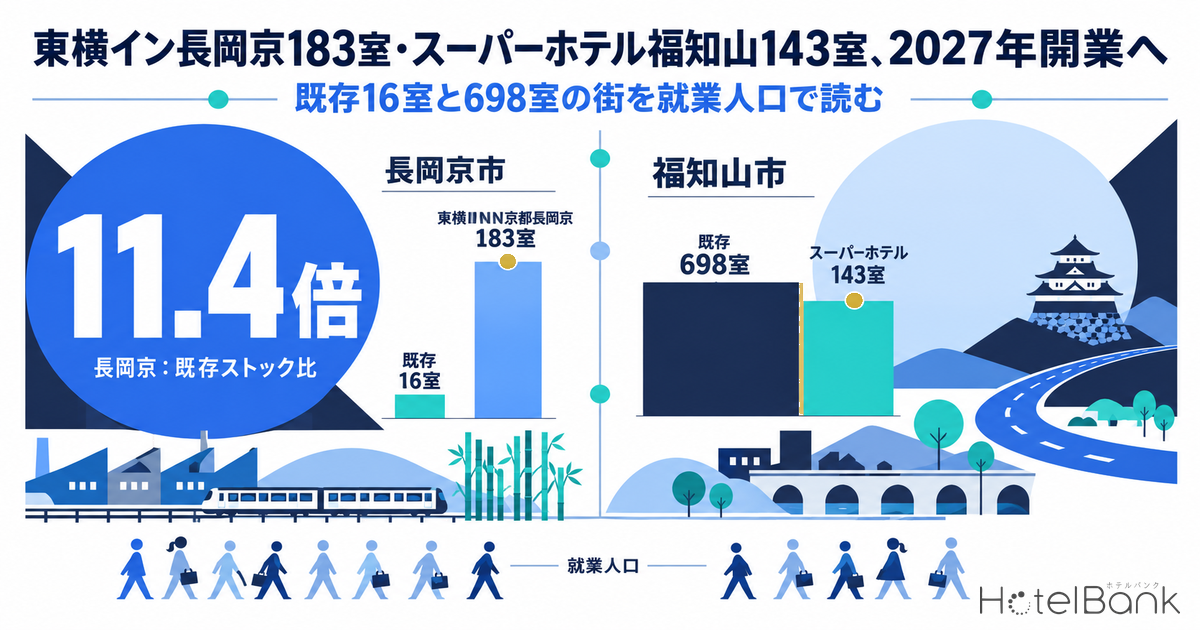
- — 16 rooms → 199 rooms: Rooms confirmed on sale in Nagaokakyo total 1 property with 16 rooms. Adding Toyoko Inn Kyoto Nagaokakyo (183 rooms, scheduled to open in January 2027) brings capacity 11.4 times the size of the existing stock.
- — 8.0 → 100.0 rooms per 10,000 employees: The 1km radius of JR Nagaokakyo Station, with 19,905 employees, will sit between Ibaraki Station (84.4 rooms) and Takatsuki Station (135.0 rooms) after the opening.
- — 143 rooms on top of Fukuchiyama’s 698 (+20.5%): Super Hotel is going not in front of the station but in Hazemiyamachi along National Route 9. Rooms per 10,000 employees within 2km of the site thicken from 186.6 to 328.5.
- — Estimated settled ADR of about ¥5,700 with a 1.14x swing: Fukuchiyama’s 12-month average (September 2025 to August 2026, N=8–11 properties). A business market in contrast to Shimogyo Ward’s roughly ¥15,600 and 2.18x.
- — Annual room revenue of about ¥170–260 million: An estimate for a 143-room property using the observed range of estimated settled ADR and assumed occupancy of 60–80%. The occupancy assumption matters more than the rate, so capturing weekday demand is the axis of project viability.
326 Rooms Weigh Differently in Each City — 11.4x Existing Stock in Nagaokakyo, +20.5% in Fukuchiyama
First, the overall picture. Three projects are in motion across the two cities: two are new builds and one is a brand conversion of an existing hotel. Organized with the sources for opening dates and room counts, they look as follows.
| Project | Location | Rooms | Opening (source) | Effect on stock |
|---|---|---|---|---|
| Toyoko Inn Kyoto Nagaokakyo (東横INN京都長岡京) (new build) | Kaiden 2-chome, Nagaokakyo. About a 6-minute walk from the east exit of Hankyu Nagaoka-Tenjin Station and about 9 minutes from the west exit of JR Nagaokakyo Station | 183 rooms (planned figure in MetroEngines Research’s new-openings data) | Scheduled to open January 2027 (Toyoko Inn official “New Hotel Openings” page, checked October 5, 2026) | 16 rooms in the city → 199 rooms |
| Super Hotel Fukuchiyama (スーパーホテル 福知山) (new build) | Hazemiyamachi 2-chome, Fukuchiyama, along National Route 9. About 2.4km from Fukuchiyama Station in a straight line | 143 rooms (planned figure, same source) | Spring 2027 (Kyoto Shimbun, September 13, 2025) | 698 rooms in the city → 841 rooms (+20.5%) |
| APA Hotel Kyoto Fukuchiyama Ekimae (アパホテル〈京都福知山駅前〉) (brand conversion) | Ekinan-cho 3-chome, Fukuchiyama. A 1-minute walk from the south exit of JR Fukuchiyama Station | 91 rooms | Opened May 1, 2026 (APA Group announcement) | Conversion of 91 existing rooms; room count unchanged |
Set side by side, the three projects mean different things for supply. Toyoko Inn Kyoto Nagaokakyo is a new build that gives a city with few rooms its first sizeable block of capacity, while Super Hotel in Fukuchiyama rises along National Route 9, away from the existing stock clustered in front of the station. As of January 2026, local media reported Toyoko Inn Kyoto Nagaokakyo’s opening as February 2027, but the official website currently shows January 2027.
APA Hotel Kyoto Fukuchiyama Ekimae, meanwhile, opened in May 2026 after the local company R-INN Co., Ltd. (株式会社R・INN) signed a franchise agreement and converted its own 91 rooms. A national brand’s sign and booking platform were added to a site a 1-minute walk from the station’s south exit, so a local operator now runs a national-chain outpost in its own building. Because the room count is unchanged, this article’s stock tally counts it as 1 property with 91 rooms and treats Fukuchiyama’s new supply as 143 rooms.
Nagaokakyo — 16 Rooms Beside 20,000 Jobs; 183 More Bring It to Takatsuki–Ibaraki Levels
Nagaokakyo is a manufacturing city located between Kyoto City and northern Osaka Prefecture, and headquarters and plants in electronic components and electrical machinery cluster around JR Nagaokakyo Station. Aggregating the Economic Census by radius, the station’s 1km area has 19,905 employees and 1,388 establishments, with office-type industries accounting for 10.2%. Most workers appear to commute to factory and R&D sites, so the base of business demand, such as business trips and visits for construction and maintenance, is thick.
Against that, the rooms we confirmed on sale at its doorstep came to 1 property with 16 rooms. That converts to 8.0 rooms per 10,000 employees, an order of magnitude below the 84.4 rooms within 1km of JR Ibaraki Station and the 135.0 rooms within 1km of JR Takatsuki Station, both business cities on the same Kyoto–Osaka corridor. Relative to the scale of employment, this is a city where lodging capacity is only now starting to be put in place.
Adding the 183 rooms of Toyoko Inn Kyoto Nagaokakyo lifts the stock within 1km of the station to 199 rooms, or 100.0 rooms per 10,000 employees. That level falls between Ibaraki and Takatsuki, and contrary to the impression given by “11.4 times the existing stock,” it can be read as a scale that brings capacity in line with neighboring business cities.
| 1km radius of station | Employees | Establishments | Office-type share | Room stock | Rooms per 10,000 employees |
|---|---|---|---|---|---|
| Nagaokakyo Station (current) | 19,905 | 1,388 | 10.2% | 16 rooms (1 property) | 8.0 |
| Nagaokakyo Station (after Toyoko Inn Kyoto Nagaokakyo opens) | 19,905 | 1,388 | 10.2% | 199 rooms (2 properties) | 100.0 |
| JR Ibaraki Station (Osaka) | 21,564 | 1,989 | 16.9% | 182 rooms (2 properties) | 84.4 |
| JR Takatsuki Station (Osaka) | 29,855 | 2,508 | 12.1% | 403 rooms (6 properties) | 135.0 |
| Kusatsu Station (Shiga) | 19,791 | 1,517 | 17.6% | 738 rooms (8 properties) | 372.9 |
| Fukuchiyama Station | 11,303 | 1,334 | 11.6% | 485 rooms (8 properties) | 429.1 |
| Kyoto Station (reference) | 50,103 | 2,860 | 11.3% | 17,075 rooms (225 properties) | 3,408 |
In terms of resident population too, 60,735 people lived within 1.5km of the construction site as of 2025. The 2040 estimate is 56,749, a 7.7% decline from 2020, but the working-age share was 59.7% as of 2025, a solid base of people of working age. Resident-driven stays, such as visits home, weddings and funerals, and accompanying family members to hospital, have until now most likely been absorbed outside the city.
The market’s view of the location also shows in land prices. The official land price (chika koji) for Kaiden 1-chome, Nagaokakyo (neighborhood commercial zone, floor-area ratio 300%), near the construction site, rose 7.9% year on year in 2026 to ¥395,000 per square meter. The prefectural benchmark land price for the same point (as of July 1) was ¥407,000, up 7.1%, so competition to acquire sizeable sites within walking distance of the station is intensifying. Whether a single building can secure the room count at which a limited-service hotel works is likely to be the dividing line for developers.
About 10 Minutes to Kyoto Station — Overflow Capacity When Kyoto City Fills Up Thursday to Saturday
Nagaokakyo’s other face is its closeness to Kyoto City. JR Nagaokakyo Station is about 10 minutes from Kyoto Station, and Hankyu Nagaoka-Tenjin Station gives direct access to Karasuma and Kyoto-Kawaramachi without a transfer. Inside Kyoto City, rooms tend to fill in the second half of the week even in June–August, the off-season for tourism. Looking at business hotels in Shimogyo Ward by day of week, occupancy (estimated, based on listed inventory) rose to 88.0% on Thursdays (56 days from June 10 to August 7, 2026; N=67–70 properties / 7,891–8,119 rooms, based on listings on major booking sites), 87.2% on Fridays and 87.1% on Saturdays. That is a gap of around 13 points from 74.3% on Mondays and 74.4% on Sundays. The way Thursday climbs to a level on par with Friday is also seen across business hotels in Kyoto Prefecture as a whole (May–July 2026, N=272–293 properties), as analyzed in detail in Kyoto Day-of-Week OCC: Thursday Edges Friday.
The seasonal gap in rates is also large. Shimogyo Ward’s estimated settled ADR rose to about ¥23,900 in November 2025, the autumn foliage season (N=157 properties, +9.3% YoY), and about ¥22,300 in April 2026, cherry blossom season (N=167 properties, +1.4% YoY), more than double the roughly ¥10,900 of February 2026 (N=160 properties). On top of that, the lowest listed price on Saturdays reaches 1.47 times the weekday level (77 business hotels, June 2026). For travelers who struggle to find a room in Kyoto City at tourism peaks and on weekends, a limited-service hotel about 10 minutes away by train is a realistic option.
Note that Nagaokakyo has very few properties with listed prices, so a city-level rate would simply be the figure for a specific property; this article therefore does not present one. The location is best summarized as one that can stand on two pillars: local business demand on weekdays, and inflow from Kyoto City in the second half of the week and at tourism peaks.
Fukuchiyama — A Business Market in the High-¥5,000s Year-Round With Little Day-of-Week Variation
Turning to Fukuchiyama, the market looks like the opposite of Nagaokakyo. We confirmed 12 properties with 698 rooms on sale in the city, of which 8 properties with 485 rooms were within 1km of Fukuchiyama Station and 10 properties with 627 rooms within 2km. As the transport hub of northern Kinki, the station front already has several business hotels of around 100 rooms each.
| Property (nearest to the station first) | Type | Rooms | Straight-line distance from Fukuchiyama Station |
|---|---|---|---|
| Business Hotel Matsushiroya (ビジネスホテル松代屋) | Ryokan | 15 | About 120m |
| APA Hotel Kyoto Fukuchiyama Ekimae (アパホテル〈京都福知山駅前〉) | Business | 91 | About 160m |
| North Front Hostel (ノースフロントホステル) | Hostel | 14 | About 260m |
| Hotel Sunroute Fukuchiyama (ホテルサンルート福知山) | Business | 102 | About 300m |
| Fukuchiyama Ark Hotel (福知山アークホテル) | Business | 107 | About 320m |
| Niko Niko Capsule Hotel (ニコニコカプセルホテル) | Capsule | 36 | About 480m |
| Fukuchiyama Business Hotel Seiwa Hotel (福知山ビジネスホテル セイワホテル) | Business | 32 | About 560m |
| Hotel Tsukasa Fukuchiyama (ホテルつかさ 福知山) | Business | 88 | About 730m |
| Asahi Ryokan (旭旅館) | Ryokan | 24 | About 1.9km |
| Fukuchiyama Sun Hotel (福知山サンホテル) | Business | 118 | About 2.0km |
| Hotel Royal Hill Fukuchiyama & Spa (ホテルロイヤルヒル福知山&スパ) | City | 70 | About 3.1km |
| 1 other property | Vacation rental, etc. | 1 | About 7km |
| Total (12 properties) | 698 rooms | 485 rooms within 1km of the station / 627 within 2km |
Rates barely move through the year. Fukuchiyama’s estimated settled ADR averaged about ¥5,700 over the 12 months from September 2025 to August 2026 (N=8–11 properties), up 1.4% from the same period a year earlier. The monthly high was about ¥6,200 in August 2026 and the low about ¥5,500 in September 2025, keeping the swing to 1.14x. Shimogyo Ward over the same period, by contrast, came to about ¥15,600 (N=157–168 properties, +5.5% year on year), roughly 2.7 times Fukuchiyama, and its monthly swing widened to 2.18x.
The same pattern appears by day of week. Indexing the lowest listed prices for June 2026 with Monday–Thursday = 100, Fukuchiyama (8 properties) was almost flat at 98.7 on Saturdays and 99.5 on Fridays. The shape is clearly different from the 147.3 on Saturdays for business hotels in Shimogyo Ward (77 properties) and the 106.2 on Saturdays in Maizuru (14 properties). Rather than a market where tourists are layered on at weekends, it reads as a market supported throughout the week by business demand such as business trips, construction and maintenance. Because only 5 properties in Fukuchiyama can be observed continuously, too few for a stable estimate, standalone occupancy (estimated) for the city is not shown; the shape of demand is checked here with listed prices by day of week instead.
143 Rooms on National Route 9 — Capacity for an East Side With as Many Jobs as the Station Front
The Super Hotel entering this market is located not in front of the station but in Hazemiyamachi, along National Route 9. Its position in our data is about 2.4km east of Fukuchiyama Station in a straight line, and beyond it lies the Osadano Industrial Park (長田野工業団地). According to a Fukuchiyama City planning document, total employment in the park reaches 6,310 (fiscal 2016), and the Kyoto Shimbun also reported the move as aimed at capturing business-trip demand.
Measuring the distribution of employment by radius, there are 11,303 employees within 1km of Fukuchiyama Station, while 10,077 also work within 2km of the construction site. Room stock, however, stood at 485 rooms within 1km of the station against 2 properties with 188 rooms within 2km of the construction site. Per 10,000 employees, that is 429.1 rooms versus 186.6 rooms, putting the east side at just over 40% of the station-front density. With 143 rooms added, the 2km radius of the construction site reaches 331 rooms, or 328.5 rooms per 10,000 employees, approaching about 77% of the station front.
For the city as a whole, the new supply represents a 20.5% increase on the existing 698 rooms. Although the construction site lies outside that radius, the scale is also equivalent to 22.8% of the 627 rooms within 2km of the station. Even so, the positioning does not overlap head-on with the existing stock at the station front. The site is placed to capture demand that moves along different lines from the station front, namely business travelers getting around by car and visitors to the industrial park, and can be seen as supply that broadens the capacity of the market as a whole.
Land prices also step down from the station front to the outskirts. The 2026 official land price for Suehiro-cho 1-chome (commercial zone), about 220m from Fukuchiyama Station, was ¥98,000 per square meter (−0.3% YoY), and for Maeda-shinmachi (quasi-residential zone), about 800m from the construction site, ¥53,500 (0.0% YoY), a gap of 4 to 7 times from the ¥395,000 of Kaiden 1-chome in Nagaokakyo. Even in a market where rates are in the high-¥5,000s, one view is that a limited-service project is easier to put together along the national route, where land costs can be held down.
Rate Tiers in Northern Kinki — Fukuchiyama, Ayabe and Maizuru Sit in a ¥5,700–6,300 Band
Let us place Fukuchiyama’s rate level among the cities of northern Kinki and the Kyoto–Osaka corridor. The 12-month average estimated settled ADR was about ¥5,700 in Fukuchiyama, about ¥5,800 in Ayabe (N=4 properties, reference value) and about ¥6,300 in Maizuru (N=17–18 properties, −0.5% year on year), with the three cities lined up in a narrow ¥5,700–6,300 band. Takatsuki on the Kyoto–Osaka corridor was about ¥10,700 (N=7 properties, +8.4%) and Minami Ward in Kyoto City about ¥14,100 (N=54–56 properties, +5.4%), so the business cities of northern Kinki sit at 50–60% of Takatsuki and around 40% of Shimogyo Ward.
| City / ward | Estimated settled ADR (12-month average) | YoY (same period) | Monthly swing (high ÷ low) | Properties covered |
|---|---|---|---|---|
| Fukuchiyama | ¥5,697 | +1.4% | 1.14x | N=8–11 |
| Ayabe (reference value) | ¥5,778 | 0.0% | 1.07x | N=4 |
| Maizuru | ¥6,251 | −0.5% | 1.23x | N=17–18 |
| Takatsuki (Osaka) | ¥10,688 | +8.4% | 1.22x | N=7 |
| Ibaraki (Osaka, reference value) | ¥11,024 | +5.1% | 1.39x | N=3 |
| Minami Ward, Kyoto City | ¥14,099 | +5.4% | 2.20x | N=54–56 |
| Shimogyo Ward, Kyoto City | ¥15,606 | +5.5% | 2.18x | N=157–168 |
What these tiers suggest is that in northern Kinki, because there is little room to push rates up by season or day of week, the depth of weekday demand that stabilizes occupancy becomes the axis of the business. A limited-service format that holds down land and operating costs is a good fit for this rate band. As Maizuru shows, where Saturday listed prices rise to 106.2 against weekdays, cities with a port or tourism element also see some weekend uplift.
The Business Scale of 143 Rooms — The Range of Annual Room Revenue by Rate Band and Occupancy Assumption
To gauge how much room revenue a 143-room limited-service hotel would generate in this rate band, we combine the observed range of Fukuchiyama’s estimated settled ADR with occupancy assumptions. Annual available rooms are 143 rooms × 365 days = 52,195 room nights; taking the 12-month average of ¥5,697 and an assumed occupancy of 70% as the mid case, annual room revenue comes to about ¥208 million. Combining the monthly low ADR (¥5,460) with an assumed occupancy of 60% gives about ¥171 million, and the monthly high (¥6,208) with 80% gives about ¥259 million, so the range from bottom to top is kept to about ¥90 million.
| Scenario | Estimated settled ADR | Occupancy (assumption) | Revenue per available room | Annual room revenue |
|---|---|---|---|---|
| Cautious | ¥5,460 (monthly low) | 60% | ¥3,276 | ¥171 million |
| Mid | ¥5,697 (12-month average) | 70% | ¥3,988 | ¥208 million |
| Bullish | ¥6,208 (monthly high) | 80% | ¥4,966 | ¥259 million |
Viewed on two axes, a 10-point move in the occupancy assumption has a larger effect than rates moving within the monthly swing (1.14x). At the mid-case ¥5,697, moving the occupancy assumption from 60% to 80% opens a ¥60 million gap, from about ¥178 million to about ¥238 million, whereas moving the rate from the monthly low to the monthly high at a 70% occupancy assumption makes a difference of only about ¥27 million. This is consistent with this article’s view that, in a market where rates are hard to raise by day of week or season, project viability hinges on how steadily weekday business demand can be captured.
| Estimated settled ADR \ Occupancy (assumption) | 60% | 65% | 70% | 75% | 80% |
|---|---|---|---|---|---|
| ¥5,460 (monthly low, September 2025) | ¥171 million | ¥185 million | ¥199 million | ¥214 million | ¥228 million |
| ¥5,600 | ¥175 million | ¥190 million | ¥205 million | ¥219 million | ¥234 million |
| ¥5,697 (12-month average) | ¥178 million | ¥193 million | ¥208 million | ¥223 million | ¥238 million |
| ¥5,900 | ¥185 million | ¥200 million | ¥216 million | ¥231 million | ¥246 million |
| ¥6,208 (monthly high, August 2026) | ¥194 million | ¥211 million | ¥227 million | ¥243 million | ¥259 million |
The Two Cities Compared — Both “Business Cities,” but the Investment Reading Is Reversed
To sum up so far, Nagaokakyo can be positioned as “a city thin on rooms relative to employment and to Kyoto City demand,” and Fukuchiyama as “a city well stocked with rooms where rates are stable year-round.” The yardstick for assessing new supply should likewise be the degree to which demand is met in the former, and differentiation from the existing stock in the latter.
| Item | Nagaokakyo | Fukuchiyama |
|---|---|---|
| Character of demand | Manufacturing-related business demand, plus overflow from Kyoto City in the second half of the week and at tourism peaks | Weekday-led business demand (Saturday listed price index 98.7) |
| Existing room stock | 1 property, 16 rooms | 12 properties, 698 rooms (485 within 1km of the station) |
| New supply | 183 rooms (Toyoko Inn Kyoto Nagaokakyo, scheduled to open January 2027) | 143 rooms (Super Hotel, reported for spring 2027). Separately, 91 rooms at the station front converted brands |
| New supply ratio | 11.4x existing stock | +20.5% vs existing stock |
| Employees | 19,905 within 1km of the station | 11,303 within 1km of the station / 10,077 within 2km of the construction site |
| Rooms per 10,000 employees | 8.0 → 100.0 | 429.1 within 1km of the station / 186.6 → 328.5 within 2km of the construction site |
| Rate guide (estimated settled ADR) | No city figure shown (very few listed properties). Reference: Takatsuki about ¥10,700, Shimogyo Ward about ¥15,600 | About ¥5,700 (monthly swing 1.14x) |
| Location type | Walking distance from stations (Hankyu about 6 minutes, JR about 9 minutes) | Along National Route 9 (about 2.4km from the station in a straight line) |
| Land price (official, 2026) | ¥395,000/㎡ (+7.9% YoY) | Station front ¥98,000/㎡ (−0.3% YoY); national-route side ¥53,500/㎡ (0.0% YoY) |
| Resident population, 2040 estimate (vs 2020) | −7.7% within 1.5km of the construction site | −5.1% within 2km of the station |
Implications by Stakeholder — Rooms per Employee as a Common Yardstick
The two cities offer a yardstick for comparing projects to anyone considering limited-service hotels in Kyoto Prefecture or northern Kinki. For each stakeholder, we set out possible directions as suggestions.
Developers and landowners (build-to-lease)
A station front that is thin on rooms relative to employment, like Nagaokakyo, leaves room for a single building to shape the market even while land prices are rising. In a city already well stocked, like Fukuchiyama, it makes sense to exploit low land costs and choose a site near an employment cluster whose traffic does not overlap with the station front. Rooms per 10,000 employees within a radius is a useful measure for comparing candidate sites.Regional financial institutions
Looking only at the ratio to existing stock, Nagaokakyo’s 11.4x looks large and Fukuchiyama’s +20.5% looks small. Converted to density per employee, however, Nagaokakyo is still at 100.0 rooms after the opening, on par with neighboring cities, while the east side of Fukuchiyama approaches about 77% of the station front. Checking both indicators side by side in credit review makes a project’s positioning easier to grasp.Operators considering a franchise
APA Hotel Kyoto Fukuchiyama Ekimae is a case of a local owner converting its 91 existing rooms to a national brand. It is an option that widens sales channels and recognition without adding rooms, and a useful reference for lifting the occupancy floor in a business market with stable rates.Owners of existing hotels
A national chain’s opening increases the occasions on which the city itself is searched and compared as a place to stay. Revenue opportunities can be expected in multi-night and long-stay products and weekend offers in Fukuchiyama, where day-of-week differences are small, and in pricing matched to Kyoto City’s peak days in Nagaokakyo.Summary
The limited-service hotels entering Nagaokakyo and Fukuchiyama share a combined scale of 326 rooms, yet they mean entirely different things to each city. In Nagaokakyo, capacity at a station front with 19,905 employees goes from 16 rooms to 199, drawing level with Takatsuki and Ibaraki. In Fukuchiyama, 143 rooms aimed at an employment cluster separate from the station front join a stable business market with 698 existing rooms and an estimated settled ADR of about ¥5,700.
What the two plans have in common is that both rest on business demand that does not depend on Kyoto City’s rates or occupancy. When reading supply in Kyoto Prefecture, it helps to check, one by one, the ratio of employment clusters to room stock outside the city, and not only Kyoto City’s tourism demand. After the openings, the next points to verify will be how much inflow Nagaokakyo sees on Kyoto City’s peak days, and how much occupancy weekday demand on Fukuchiyama’s east side translates into.
Note on opening plans: Opening dates and room counts in this article are based on company websites, announcements, press reports and our new-openings data as of the survey date (October 5, 2026). Plans may change, and room counts for properties not yet open are not final. This is a simplified comparison; actual investment decisions require a detailed feasibility study.
Related Articles
- Kyoto Day-of-Week OCC: Thursday 90.4% Edges Friday, May–Jul 2026
- Shiga Hotel Development: 1.5% New Supply, ¥11-16k Whitespace, 8.0% NOI
References and Sources
■ Data sources
Room stock covers properties that MetroEngines Research & Consulting confirmed as listed for sale on major booking sites in July–September 2026 (leisure hotels excluded; a property that changed its name is counted as one). Estimated settled ADR uses finalized months by city and ward (September 2025 to August 2026), and occupancy is the estimate as of the day before the stay for business hotels in Shimogyo Ward, Kyoto City. Employees and establishments are from the Economic Census for Business Activity (2021), resident population from National Land Numerical Information, and land prices from the Real Estate Information Library. Room counts for new openings are planned figures in our new-openings data, and opening dates are from company websites, announcements and press reports.
■ Assumptions
Rooms per 10,000 employees = room stock within a 1km or 2km radius of the station (or construction site) ÷ employees within the same radius × 10,000. Post-opening values simply add planned rooms to the existing stock and do not factor in exits of existing properties or changes in room counts. Annual room revenue is 143 rooms × 365 days × estimated settled ADR × occupancy (assumption), with occupancy assumed at 60–80%. Ancillary revenue, operating costs and construction costs are not included.
■ Limitations and caveats
Room stock is limited to properties listed on booking sites and does not include unlisted ryokan and simple lodgings. Employees (2021) and room stock (2026) have different reference dates. No rate is shown for Nagaokakyo because very few properties have listed prices, and no occupancy estimate is shown for Fukuchiyama because few properties can be observed continuously. Room counts and opening dates for properties not yet open are planned figures and may change. The revenue estimates are a guide to business scale and do not represent the plans of any specific property or an investment recommendation.
■ Market data
- MetroEngines Research & Consulting — Estimated settled ADR (by city and ward, finalized months), room stock (based on listings confirmed in July–September 2026), listed price index by day of week, occupancy (estimated, based on listed inventory), new-openings data
■ Government statistics and public data
- Ministry of Internal Affairs and Communications / Ministry of Economy, Trade and Industry, Economic Census for Business Activity (2021, e-Stat)
- Ministry of Land, Infrastructure, Transport and Tourism, National Land Numerical Information (future population estimates by 250m mesh)
- Ministry of Land, Infrastructure, Transport and Tourism, Real Estate Information Library — official land prices, prefectural land price survey, zoning
- Fukuchiyama City, Osadano Industrial Park Utilization Enhancement Plan (June 2018)
■ Company websites and press releases
- Toyoko Inn official website, “New Hotel Openings” (checked October 5, 2026)
- APA Group release on the franchise agreement for APA Hotel Fukuchiyama Ekimae (PR TIMES, February 3, 2026)
- APA Group, opening ceremony held for APA Hotel Kyoto Fukuchiyama Ekimae (PR TIMES, May 13, 2026)
■ News