

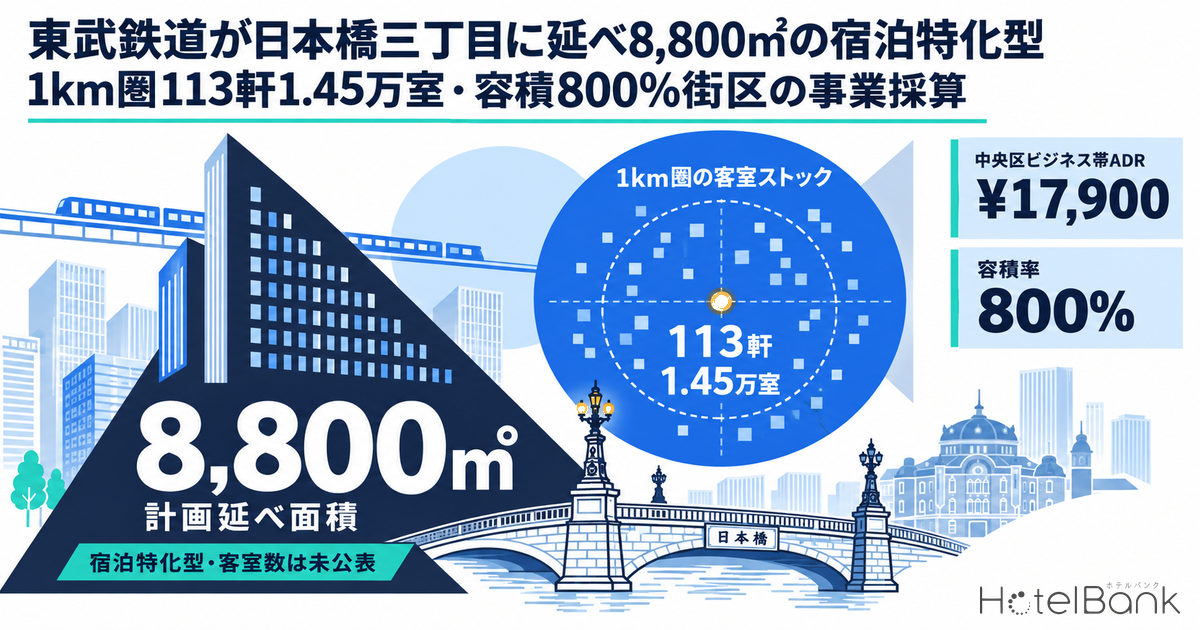
Tobu Railway (東武鉄道) is planning a limited-service hotel with a gross floor area of 8,800㎡ in Nihonbashi 3-chome, Chuo Ward, Tokyo. Kentsu Shimbun (June 2, 2026) reported that Nikken Sekkei is the designer and that a contractor is being selected with a view to breaking ground in mid-November; Nikkei Real Estate Market Report (September 10, 2026) followed with a piece headlined “8,800㎡ limited-service hotel near Tokyo Station.” The room count, brand and operator remain undisclosed as of the time of writing (October 2, 2026). This article reads the block the site belongs to through geospatial data from the Ministry of Land, Infrastructure, Transport and Tourism (MLIT) and the Economic Census, sets the 113 properties and 14,520 rooms of supply built up within 1km against the estimated settled ADR of Chuo Ward business hotels (12-month average ¥17,900, N=127–129 properties), and examines the project economics of three room-count cases back-solved from the 8,800㎡ gross floor area, along with what it means for a railway company to hold a limited-service hotel in the city centre, away from its own lines.
Metric Definitions Used in This Article
- ADR (average daily rate): An estimated settled rate (tax-exclusive equivalent) derived by applying category-specific adjustment factors to the lowest published plan rate each property posts on OTAs (double occupancy, per-room rate, tax-inclusive). Cross-checked against property-level results disclosed by listed hotel REITs (91 properties, most recent three months), the median error is roughly 7%. These are estimates and differ from each property’s actual transacted rates and accounting figures. Area-level ADR is the median across the properties covered (the level of a typical property in the area).
- OCC (occupancy rate): Rooms sold as a share of total rooms in the area (an estimate based on inventory sold through OTAs; consistency checks against monthly REIT disclosures confirm accuracy to within a few percentage points). This article labels it “occupancy (OTA-listed inventory basis, estimated).” It is an estimate based on how inventory sold on OTAs is being absorbed and differs from a property’s actual whole-house occupancy.
- Booking curve: The path of remaining OTA inventory toward the check-in date. LT (lead time) = days until check-in. This article uses only observation points from LT45 to LT1.
- Where the article refers to a listed rate, it means the per-room rate for double occupancy (tax-inclusive).
- Data source: MetroEngines Research & Consulting (tracks roughly 168,000 properties in Japan, of which roughly 27,000 properties and about 1.26 million rooms with confirmed activity on OTAs are analysed). Geographic, population and employment data come from the MLIT Real Estate Information Library, MLIT National Land Numerical Information, and the Economic Census of the Ministry of Internal Affairs and Communications and the Ministry of Economy, Trade and Industry.
- — 8,800㎡ gross floor area, 14 floors above ground and 2 below, on a 729.05㎡ site, with construction scheduled to start in November 2026. Room count, brand and operator are undisclosed (as of October 2, 2026)
- — Room stock within 1km stands at 113 properties and 14,520 rooms (2026, confirmed-operating basis), up 4,360 rooms (+42.9%) from 2017; about 70% of rooms are in business hotels
- — The estimated settled ADR of Chuo Ward business hotels averaged ¥17,900 over 12 months (+9.8% YoY, N=127–129 properties). Estimated occupancy on an OTA-listed inventory basis exceeded 90% in September 2026
- — The break-even ADR is ¥15,800 at 293 rooms (30㎡ per room) and ¥21,100 at 220 rooms (40㎡ per room) — a simplified estimate assuming total project cost of ¥12.4–15.6 billion, an expected yield of 4.1% and an NOI margin of 40%
- — Chuo Ward’s Intensive Land Use District grants hotels on sites of 300㎡ or more a floor area ratio (FAR) bonus of up to 400%, and the 8,800㎡ gross floor area almost exactly matches site area × 1,200% (8,749㎡)
The Conclusion First — 8,800㎡ Is a Scale That “Works at Prevailing Business-Hotel Rates at Around 290 Rooms”
To state the conclusion up front: dividing the 8,800㎡ gross floor area by the gross-area-per-room ratios typical of limited-service hotels puts the room count in a range of 220–382 rooms. Against a total project cost of ¥12.4–15.6 billion, built up from official land prices and 2025 construction cost data, the break-even ADR that satisfies the 4.1% expected yield the Japan Real Estate Institute reports for limited-service hotels in Tokyo back-solves to ¥15,800 at 293 rooms (30㎡ per room). The estimated settled ADR of Chuo Ward business hotels averaged ¥17,900 over the latest 12 months (+9.8% YoY), about 13% above that break-even level. If the room count is cut to 220 rooms (the equivalent of 40㎡ per room), however, the break-even ADR jumps to ¥21,100, which means the hotel would have to earn year-round a rate close to the peak month of April 2026 (¥22,600). In other words, the economics of this project are decided almost entirely by where the room count is set; the demand of the block itself (560,000 workers, estimated occupancy of around 90%) is amply deep. The evidence follows in order.
What Has Been Disclosed — The Site Notice Confirms Scale and Schedule; the Room Count Is Undisclosed
First, we separate the facts that can be confirmed from public information from the items that cannot. In their publicly readable portions, the two press reports give only the gross floor area (8,800㎡ / “9,000㎡ class”), the designer and the construction start. In addition, a secondary-source website that transcribes building plan notice signs (updated April 30, 2026) lists the lot numbers, number of floors, height, site area and construction period. This article treats those as “figures transcribed from the site notice” and notes explicitly that they are not an official announcement by Tobu Railway.
| Item | Details | Source |
|---|---|---|
| Developer | Tobu Railway Co., Ltd. (東武鉄道株式会社) | Kentsu Shimbun (June 2, 2026) / site notice transcription |
| Designer | Nikken Sekkei Ltd (株式会社日建設計) | Kentsu Shimbun (June 2, 2026) / site notice transcription |
| Location | Nihonbashi 3-chome 4, Chuo Ward, Tokyo (lots 4-2, 4-3 and others, 12 parcels in total) | Site notice transcription (secondary-source website) |
| Use | Hotel, car parking garage | Site notice transcription (secondary-source website) |
| Scale | 14 floors above ground, 2 below; height 56.00m (67.00m including rooftop structures) | Site notice transcription (secondary-source website) |
| Site area / building area / gross floor area | 729.05㎡ / 600.00㎡ / 8,800.00㎡ | Site notice transcription (secondary-source website). Gross floor area matches the 8,800㎡ in Nikkei Real Estate Market Report |
| Scheduled construction start | November 15, 2026 (Kentsu Shimbun: “selecting a contractor with a view to starting in mid-November”) | Kentsu Shimbun / site notice transcription |
| Scheduled completion of works | March 31, 2031 (as stated on the site notice; no opening date has been announced) | Site notice transcription (secondary-source website) |
| Room count, brand, operator | Undisclosed | No relevant statement in Tobu Railway news releases or in the company profile of Tobu Hotel Management (as of October 2, 2026) |
A gross floor area of 8,800㎡ on a 729.05㎡ site works out to roughly 1,207% on a simple division. The designated FAR for this block is 800% (discussed below), so it should be noted that gross floor area — which includes the basement garage and common areas excluded from the FAR calculation — is not the same as FAR-countable floor area. As a reference, though, 729.05㎡ × 800% is 5,832㎡, and adding the 400% maximum bonus that Chuo Ward’s Intensive Land Use District grants to hotels gives 1,200%, or 8,749㎡ — almost identical to the 8,800㎡ gross floor area. It is a tenable reading that the project is planned at a scale that uses the maximum bonus available under the scheme (this is not confirmed information).
Location Assessment — Commercial Zone, 800% FAR, Fire Prevention District; Land Prices Rising 7–9% a Year
Nihonbashi 3-chome, where the site is located, lies between the Yaesu exit of Tokyo Station and Nihombashi Station. Querying the MLIT Real Estate Information Library at the representative point of the chome (35.6809°N, 139.7735°E; the site is at lot 4 of the same chome, and the catchment tallies in this article are centred on this representative point) shows a commercial zone, a designated FAR of 800% (700% on the adjacent block, with tiles of 600–1,300% mixed in the surroundings), a fire prevention district, and a location inside both the Nihonbashi–Tokyo Station Front District Plan and an Intensive Land Use District. The 2026 official land prices are ¥7.23 million/㎡ at “Nihonbashi 3-chome 2-3 and others” (+9.0% YoY) and ¥9.79 million/㎡ at “Nihonbashi 3-chome 11-1” (+7.3% YoY) — a gap of more than 30% between streets within the same chome.
| Use district | Commercial zone |
| Designated FAR | 800% (adjacent 700%) |
| Fire designation | Fire prevention district |
| District plan, etc. | Nihonbashi–Tokyo Station Front District / Intensive Land Use District |
| Establishments | 17,316 |
| Workers | 560,437 |
| Office-type share | 39.2% |
| Resident population, 2025 → 2040 | 20,674 → 22,412 |
The depth of employment is the core of demand at this location. Within a 1km radius (about 3.1km²) there are 17,316 establishments and 560,437 workers, 39.2% of them in office-type industries. Worker density reaches roughly 180,000 per km², putting the source of weekday lodging demand from business trips, meetings and training within walking distance. That said, the resident population is thin at 20,674 in 2025 and is projected at only 22,412 in 2040 (+16.9% vs 2020). This is a district of commuters rather than residents, and weekend demand structurally depends on Tokyo Station as a transport hub and on shopping and sightseeing foot traffic through Ginza and Nihonbashi.
Chuo Ward’s Rules — How the 2019 Reform Scrapped the Housing FAR Bonus and Made Hotels Eligible Instead
Essential to reading this project is the restructuring of district plans that Chuo Ward carried out on July 1, 2019. Since 1993 the ward had operated “use-specific FAR district plans” that added FAR for residential use in order to restore its resident population. Once that population passed 160,000 in 2018, the ward abolished in principle the FAR bonus for securing housing and introduced a new “intensive-use district plan (function-renewal-type Intensive Land Use District)” (Chuo Ward, “Past District Plans and Function-Renewal-Type Intensive Land Use Districts”; Jutaku Shimpo, July 30, 2019). The ward set out three directions: (1) abolishing the housing bonus in principle; (2) bonuses for daily-convenience and public-interest facilities such as shops, nurseries, clinics and plazas; and (3) bonuses for “good-quality hotel plans that provide guest rooms of at least a certain size and facilities that bring vitality to the neighbourhood.”
The specific figures are set out in the ward’s published “Operating Standards for Intensive Land Use Districts” (effective July 1, 2019; revised November 1, 2023). They apply to the function-renewal-type Intensive Land Use Districts of the Nihonbashi–Tokyo Station Front area and the Ginza area, and to receive the hotel-share bonus hotel use (hotels or ryokan) must account for at least one half of the building. The maximum FAR bonus by site size is 100% for sites under 300㎡ and 400% for sites of 300㎡ or more. In addition, in the Nihonbashi–Tokyo Station Front area, for buildings in which guest rooms of 30㎡ or more account for at least one quarter of total guest room floor area and which provide at least 50% in FAR of hotel-related facilities open to the general public on a daily basis — lounges, meeting rooms, halls and the like — the FAR of that portion is relaxed by up to a further 100% on top of the hotel-share bonus. The facilities listed as open to the general public are lounges (excluding the portion used as restaurants and the like), common rooms, meeting rooms, event halls, large communal baths provided separately from guest room bathrooms, and facilities that contribute to local vitality; the standards state explicitly that “temporary use for breakfast is not precluded.”
| Item in the operating standards (Nihonbashi–Tokyo Station Front area) | Figure / requirement |
|---|---|
| Hotel share | At least 1/2 (hotel or ryokan use) |
| Maximum FAR bonus by site area | Under 300㎡: 100% / 300㎡ or more: 400% |
| Sites fronting a section of an “A road” with no sidewalk | Maximum bonus of 400% where a sidewalk-style open space at least 2m wide is provided to secure pedestrian safety |
| Additional bonus for hotels meeting the room-size requirement | Guest rooms of 30㎡ or more account for at least 1/4 of total guest room floor area, and hotel-related facilities open to the general public are provided at 50% or more → that portion relaxed by up to a further 100% |
| Effective / revised | Effective July 1, 2019; revised November 1, 2023 |
With a 729.05㎡ site, this project falls in the “300㎡ or more” bracket and can use the 400% maximum bonus as long as hotel use is at least one half. As noted above, the 8,800㎡ gross floor area almost exactly matches site area × 1,200%; even a limited-service hotel reaches the requirements for the additional bonus if it secures at least one quarter of its rooms at 30㎡ or more and places a lounge open to the neighbourhood around the ground-floor lobby. Chuo Ward’s scheme is designed to hand FAR to hotels that “make rooms larger and open the ground floor to the street,” which shows that the district itself is asking for a different product from the conventional limited-service hotel that stacks up small rooms.
Competitive Landscape — 4,360 Rooms Added Within 1km in Nine Years; 70% of Rooms Are Business Hotels
Next, supply. To the extent tracked by MetroEngines Research & Consulting, room stock on a confirmed-operating basis within a 1km radius of the representative point stands at 113 properties and 14,520 rooms as of 2026. It grew 2.5-fold in eight years, from 47 properties and 5,681 rooms in 2012 to 106 properties and 14,447 rooms in 2020, dipped temporarily in 2021, and has been flat at 110–113 properties and 14,500–14,700 rooms since 2023. Compared with 2017 (74 properties, 10,160 rooms), that is +39 properties and +4,360 rooms (+42.9%): the expansion of supply on the east side of Tokyo Station had largely run its course before the pandemic.
By category, of the 120 properties and 15,377 rooms identifiable on an OTA-listed basis (including planned openings, simple lodgings and the like), business hotels account for 71 properties and 10,716 rooms, or 70% of rooms. They are followed by capsule hotels (7 properties, 1,047 rooms), deluxe/luxury hotels (10 properties, 1,311 rooms) and city hotels (8 properties, 1,357 rooms); there are only 3 ryokan. By room-count band, 100–199 rooms is the thickest with 43 properties, while properties of 200 rooms or more number 25, with 6,468 rooms.
| Category | Properties | Rooms | Room share |
|---|---|---|---|
| Business hotel | 71 | 10,716 | 69.7% |
| City hotel | 8 | 1,357 | 8.8% |
| Deluxe / luxury | 10 | 1,311 | 8.5% |
| Capsule hotel | 7 | 1,047 | 6.8% |
| Hostel / apartment-type | 13 | 594 | 3.9% |
| Ryokan | 3 | 103 | 0.7% |
| Other (guesthouses, serviced apartments, etc.) | 8 | 249 | 1.6% |
| Room-count band | Properties | Rooms | Room share |
|---|---|---|---|
| Up to 49 rooms | 26 | 608 | 4.0% |
| 50–99 rooms | 26 | 2,031 | 13.2% |
| 100–149 rooms | 23 | 2,936 | 19.1% |
| 150–199 rooms | 20 | 3,334 | 21.7% |
| 200–249 rooms | 13 | 2,879 | 18.7% |
| 250 rooms or more | 12 | 3,589 | 23.3% |
What stands out is that this catchment already has 11 railway-affiliated hotels with 2,606 rooms (17% of rooms in the catchment). Moreover, most belong to companies that do not have Nihonbashi on their own lines: Nishi-Nippon Railroad, Keio Corporation, Sotetsu, Hankyu Hanshin, JR West and Keikyu Corporation. For railway companies the east side of Tokyo Station is the archetypal “city centre off our own lines,” and Tobu Railway’s entry is not an outlier but a move that joins an existing current.
| Opened | Property | Railway group | Rooms | Estimated settled ADR (12-month average) |
|---|---|---|---|---|
| 2003 | Nishitetsu Inn Nihonbashi (西鉄イン日本橋) | Nishi-Nippon Railroad | 261 | ¥14,687 |
| 2005 | Keio Presso Inn Otemachi (京王プレッソイン大手町) | Keio Corporation | 386 | ¥16,918 |
| 2007 | Hotel Metropolitan Tokyo Marunouchi (ホテルメトロポリタン丸の内) | JR East | 337 | ¥41,587 |
| 2011 | Sotetsu Fresa Inn Tokyo-Kyobashi (相鉄フレッサイン 東京京橋) | Sotetsu Holdings | 160 | ¥19,222 |
| 2013 | Sotetsu Fresa Inn Nihombashi-Ningyocho (相鉄フレッサイン 日本橋人形町) | Sotetsu Holdings | 128 | ¥15,712 |
| 2013 | Sotetsu Fresa Inn Nihombashi-Kayabacho (相鉄フレッサイン 日本橋茅場町) | Sotetsu Holdings | 196 | ¥16,450 |
| 2017 | Keio Presso Inn Tokyo Station Yaesu (京王プレッソイン東京駅八重洲) | Keio Corporation | 248 | ¥24,084 |
| 2018 | Keio Presso Inn Nihombashi Kayabacho (京王プレッソイン日本橋茅場町) | Keio Corporation | 236 | ¥14,854 |
| 2019 | remm Tokyo Kyobashi (レム東京京橋) | Hankyu Hanshin Holdings | 272 | ¥23,852 |
| 2019 | Via Inn Prime Nihonbashi Ningyocho (ヴィアインプライム日本橋人形町) | JR West | 240 | ¥15,444 |
| 2020 | Keikyu EX Inn Tokyo Nihombashi (京急EXイン 東京・日本橋) | Keikyu Corporation | 142 | ¥14,983 |
Supply Pipeline — Projects Identified in the Catchment for 2027 Onward Are Mostly High-End
We now sort recent openings and upcoming projects. Aside from a 195-room lifestyle hotel in Kabutocho, properties opened in the catchment since 2025 have mostly been small, at 14–45 rooms; large-scale supply in the business-hotel tier has stopped since three properties in Kayabacho and Hatchobori (492 rooms in total) opened in 2023.
| Opening | Property | Category | Rooms |
|---|---|---|---|
| April 2025 | GRAND MONday Ginza (GRAND MONday銀座) | Hostel / apartment-type | 45 |
| September 2025 | SOIL Nihonbashi Hotel | City hotel | 14 |
| October 2025 | Caption by Hyatt Kabutocho Tokyo (キャプション by Hyatt 兜町 東京) | Business hotel (lifestyle) | 195 |
| December 2025 | FUFU Tokyo Ginza (ふふ 東京 銀座) | Resort hotel (small luxury) | 34 |
| December 2026 (planned) | VAYS Tokyo STATION EAST (VAYS 東京 STATION EAST) | Deluxe hotel | 16 |
Cross-referencing building confirmation applications in MLIT’s “Survey on Building Dynamics Statistics” with each company’s published materials, the projects identified in the same catchment for 2027 onward are as follows. All are high-end hotels occupying the upper floors of supertall mixed-use developments; this project is the only standalone limited-service building.
| Project (location) | Developer | Lodging component | Rooms | Timing |
|---|---|---|---|---|
| Tokyo Midtown Nihonbashi (Nihonbashi 1-chome Central District, Nihonbashi 1-chome) | Nihonbashi 1-chome Central District Urban Redevelopment Association (project partners: Mitsui Fudosan, Nomura Real Estate Development) | Waldorf Astoria Tokyo Nihonbashi (ウォルドーフ・アストリア東京日本橋; floors 39–47) | 197 | Opening planned for 2027 (completion per confirmation application: October 2027) |
| Torch Tower (Tokiwabashi; Otemachi 2-chome / Yaesu 1-chome) | Mitsubishi Estate | Dorchester Collection Tokyo (ドーチェスター・コレクション 東京; tentative name, floors 53–58) | approx. 110 | Opening planned for 2028 (completion per confirmation application: December 2027) |
| YAESU CORE (Yaesu 2-chome Central District, Yaesu 2-chome) | Yaesu 2-chome Central District Urban Redevelopment Association (participating members: Kajima, Sumitomo Realty & Development and others) | Serviced apartments (floors 40–43, stays from one night) | Undisclosed | Completion planned for January 2029 |
| (Tentative) Nihonbashi 3-chome Project (this project) | Tobu Railway | Limited-service hotel and car parking garage (14 floors above ground) | Undisclosed (220–382 in this article’s estimate) | Construction start planned for November 2026; completion of works per site notice March 2031 |
Where Supply and Demand Stand — Chuo Ward Business Hotels at 90% Occupancy, ADR Up 10% on a 12-Month Average
We check the demand side with Chuo Ward data. The estimated settled ADR of Chuo Ward business hotels (N=127–129 properties) averaged ¥17,900 over the 12 months from September 2025 to August 2026, up 9.8% from the same period a year earlier (¥16,300). By month, April 2026 was the highest at ¥22,600 (+9.8% YoY), while the summer fell below the prior year at ¥14,600 in June (-6.7% YoY) and ¥13,600 in August (-11.9% YoY). The gap between the spring/autumn peaks and the summer trough reaches roughly 1.7x, so full-year rates need to be designed with seasonal swings as a given.
Occupancy (OTA-listed inventory basis, estimated) reached 92.1% for Chuo Ward business hotels in September 2026 (86 properties, 13,293 rooms) and 91.9% across all categories (113 properties, 15,739 rooms). August also held in the 90s at 90.5% and 90.6% respectively: even in the summer, when rates fell, inventory was almost fully absorbed. On the booking curve, business hotels in September 2026 stood at 60.7% occupancy at LT45, 68.3% at LT30, 79.4% at LT14, 84.3% at LT7 and 92.1% at LT1 — a short-lead curve that adds roughly 13 points in the final two weeks. This is the booking behaviour of business travel itself and is consistent with a location of 560,000 workers.
Disclosed results provide corroboration. Courtyard by Marriott Tokyo Station (コートヤード・バイ・マリオット 東京ステーション; 150 rooms, opened 2014), located in Kyobashi within the catchment, is owned by MORI TRUST REIT, Inc. (森トラストリート投資法人; 8961) (acquisition price ¥17,017 million, variable rent). The REIT’s monthly disclosure for July 2026 shows room occupancy of 73.0%, ADR of ¥45,416 and RevPAR of ¥33,149. As a single upscale property it is not a direct comparison for a limited-service hotel, but the fact that an achieved ADR in the ¥40,000s has been disclosed on the east side of Tokyo Station indicates the price potential of the location.
Positioning — 18 Properties at 100–199 Rooms × ¥15–25k; 8 at 200+ Rooms × ¥25k and Above
Plotting the 66 properties in the catchment with at least 12 months of estimated settled ADR on a room count × ADR plane, the crowded zone is 100–199 rooms × ¥15,000–25,000 (18 properties). The median for the 56 business hotels is ¥17,700. There are 19 properties with 200 rooms or more, overlapping this project’s room-count range (220–382 rooms), of which only 8 have an ADR of ¥25,000 or higher.
Crowded Occupied territory
¥15k–25k × 100–199 rooms
18 properties. The standard limited-service format is concentrated here and differentiation on price is difficult. If this project enters at the 382-room level (23㎡ per room), it faces the most competitors.
WS① Large × upper-midscale
¥25k–40k × 250–400 rooms
Only 2 properties. A design meeting Chuo Ward’s room-size requirement (at least 1/4 at 30㎡ or more) sits naturally in this band. There is headroom against the Case B break-even ADR of ¥15,800 at 293 rooms.
WS② Mid-size × upscale
¥40k–60k × 150–300 rooms
3 properties. The Case A break-even ADR of ¥21,100 at 220 rooms (40㎡ per room) does not reach the lower end of this band; it is viable only where brand and food and beverage can add to the rate.
Back-Solving the Economics — Total Project Cost and Break-Even ADR for Three Room-Count Cases
We divide the 8,800㎡ gross floor area by gross-area-per-room ratios for limited-service hotels. Gross floor area per room in a limited-service hotel — guest room area plus corridors, plant, lobby and back-of-house — is generally distributed across 23–40㎡ per room, so we set three cases. Case A (40㎡ per room) assumes larger rooms with Chuo Ward’s room-size requirement in mind; Case B (30㎡ per room) is the standard for city-centre upper-midscale; Case C (23㎡ per room) is the ratio of a conventional business hotel. Because a car parking garage occupies the two basement floors, the actual room count is likely to be closer to Cases B to A.
| Item | A. 40㎡/room | B. 30㎡/room Base | C. 23㎡/room |
|---|---|---|---|
| Assumed room count | 220 | 293 | 382 |
| Land (729.05㎡ × official land price of ¥7.23–9.79m/㎡) | ¥5.3–7.1bn | ¥5.3–7.1bn | ¥5.3–7.1bn |
| Construction (2,662 tsubo × ¥2.026m (RC) to ¥2.405m (steel) per tsubo, 2025 actuals) | ¥5.4–6.4bn | ¥5.4–6.4bn | ¥5.4–6.4bn |
| Construction (with inflation during the build, 5% a year × 3 years = +15.8%) | ¥6.2–7.4bn | ¥6.2–7.4bn | ¥6.2–7.4bn |
| Design, FF&E and other costs (15% of construction) | ¥0.9–1.1bn | ¥0.9–1.1bn | ¥0.9–1.1bn |
| Total project cost (midpoint) | ¥12.4–15.6bn (¥14.0bn) | ¥12.4–15.6bn (¥14.0bn) | ¥12.4–15.6bn (¥14.0bn) |
| Total project cost per room (midpoint) | ¥64m | ¥48m | ¥37m |
| Required NOI (4.1% expected yield) | ¥576m | ¥576m | ¥576m |
| Break-even ADR (85% full-year occupancy, 40% NOI margin) | ¥21,100 | ¥15,800 | ¥12,100 |
| Chuo Ward business-hotel ADR (12-month average) as a ratio of break-even | 85% | 113% | 148% |
The basis for the assumptions is as follows. For construction cost, 2025 hotel construction costs based on MLIT Building Starts Statistics were ¥2.026 million per tsubo for reinforced concrete and ¥2.405 million per tsubo for steel (the all-structure average rose 41% in three years, from ¥1.38 million in 2022 to ¥1.95 million in 2025); on that basis we assumed increases of 5% a year continuing to the midpoint between the November 2026 start and the March 2031 completion shown on the site notice. This is a conservative figure, below the annual rate of the past three years. The 40% NOI margin is this article’s assumption. Limited-service hotels are regarded as a format centred on room revenue in which GOP margins tend to be relatively high (Relo Hotel Solutions), and we set the margin as the level after deducting fixed asset tax, insurance and FF&E reserves from that GOP. Because it is not drawn directly from published statistics, a sensitivity varying the NOI margin from 35% to 45% is shown below. The 4.1% expected yield is the level for limited-service hotels in Tokyo in the Japan Real Estate Institute’s 54th Japanese Real Estate Investor Survey (as of April 2026), down 0.1 point from the previous survey, and refers to the NOI yield investors require at acquisition. Since the internal hurdle of a railway company that develops and holds for the long term may differ from this, sensitivity tables are attached.
| Case B (293 rooms) break-even ADR | Total project cost ¥12.4bn | Total project cost ¥14.0bn | Total project cost ¥15.6bn |
|---|---|---|---|
| Occupancy 80% (full year) | ¥14,900 | ¥16,800 | ¥18,700 |
| Occupancy 85% (full year) | ¥14,000 | ¥15,800 | ¥17,600 |
| Occupancy 90% (full year) | ¥13,200 | ¥15,000 | ¥16,700 |
| Case B (293 rooms) break-even ADR | NOI margin 35% | NOI margin 40% | NOI margin 45% |
|---|---|---|---|
| Expected yield 3.6% | ¥15,900 | ¥13,900 | ¥12,400 |
| Expected yield 4.1% | ¥18,100 | ¥15,800 | ¥14,100 |
| Expected yield 4.6% | ¥20,300 | ¥17,800 | ¥15,800 |
| Expected yield 5.1% | ¥22,500 | ¥19,700 | ¥17,500 |
We also check what happens when the required yield and NOI margin move. With the NOI margin unchanged at 40%, a rise in the expected yield to 4.6% puts the break-even ADR at ¥17,800, roughly level with the ¥17,900 12-month average for Chuo Ward business hotels. The combination of a 5.1% expected yield and a 35% NOI margin requires ¥22,500 — the level of the April 2026 peak month (¥22,600) — on a full-year basis; conversely, 3.6% and 45% brings it down to ¥12,400. Case B’s headroom can be read as extending to a deterioration of about 0.5 points in required yield or about 5 points in NOI margin.
What the sensitivity tables show is that at Case B’s 293 rooms, even if total project cost swings to the ¥15.6 billion upper bound and occupancy falls to 80%, the break-even ADR stays at ¥18,700, about 4% above the ¥17,900 12-month average for Chuo Ward business hotels. In Case A at 220 rooms, by contrast, even the base scenario requires ¥21,100, and only 28 properties in the catchment, upper-midscale and above, achieve that rate on a 12-month average. A design that makes rooms larger in order to capture the FAR bonus is at the same time a design that raises the ADR target by a notch. Rising construction costs also work to restrain new supply, so we note as an upside factor that competition with existing properties may ease.
What It Means for Railway Companies to Hold Limited-Service Hotels in City Centres Off Their Own Lines — Reading the Disclosed Cases Side by Side
Tobu Railway’s hotel business is run through Tobu Hotel Management (established 1990, wholly owned by Tobu Railway), which operates 10 hotels in Tokyo, Chiba, Saitama and Tochigi along with a restaurant on the Tokyo Skytree Tembo Deck. In Chuo Ward it has two hotels in Ginza 6-chome: Courtyard by Marriott Tokyo Ginza Hotel (コートヤード・マリオット銀座東武ホテル) and AC Hotel by Marriott Tokyo Ginza (ACホテル・バイ・マリオット東京銀座) (company profile). Asakusa Tobu Hotel (浅草東武ホテル; 253 rooms) opened in front of Asakusa Station on October 8, 2020, and this project lies on the extension of a move to thicken a “city-centre base” that links Asakusa and Skytree, the origin of its lines, with Ginza and Nihonbashi off those lines.
Other companies have announced the same kind of move. They are shown side by side (not ranked by scale).
| Railway group | Property / location | Opening | How published materials position it |
|---|---|---|---|
| JR East (Nippon Hotel) | JR-East Hotel Mets Sapporo (JR東日本ホテルメッツ 札幌; 206 rooms, Sapporo Station north exit) | February 1, 2019 | “First opening outside the eastern Japan area” (PR TIMES, 2019) |
| Keio Corporation | Keio Prelia Hotel Kyoto Karasuma-Gojo (京王プレリアホテル京都烏丸五条; Shimogyo Ward, Kyoto) | November 2018 | First property of a new limited-service upper-midscale brand, launched in Kyoto off its own lines (Keio Corporation announcement) |
| Hankyu Hanshin Holdings | remm plus Ginza (レムプラス銀座; Ginza, Chuo Ward) | December 24, 2019 | First property of the upper-tier brand of “remm,” opened in Ginza, Tokyo (Hankyu Hanshin Hotels announcement) |
| Nagoya Railroad (Meitetsu) | Meitetsu Inn Shin-Osaka Station East Exit (名鉄イン新大阪駅東口; Yodogawa Ward, Osaka) | June 21, 2020 | “Meitetsu Inn’s first entry into Kansai” (Meitetsu Inn announcement) |
| Sotetsu Holdings | Sotetsu Fresa Inn Kitakami-Ekimae (相鉄フレッサイン 北上駅前; Kitakami, Iwate) | October 1, 2026 | Into a regional city off its own lines, with the first large communal bath at a directly operated property (Sotetsu Hotel Management announcement) |
| Tobu Railway | (Tentative) Nihonbashi 3-chome Project (Nihonbashi, Chuo Ward) | Construction start planned for November 2026 | Limited-service, 8,800㎡ gross floor area (subject of this article) |
What these have in common is that, for railway companies, hotels are shifting in position from “an add-on to the value of the line” to “an independent earnings pillar of the real estate business.” Sites in front of stations on a company’s own lines are limited, and the lodging demand of its passengers is not contained within those lines. Holding a limited-service hotel in a block such as the east side of Tokyo Station — 560,000 workers, around 90% occupancy — secures stable NOI that does not depend on the company’s lines and also lets the group’s hotel operating company build a track record in brand operation. The operator of this project is undisclosed, but the fact that Tobu Hotel Management operates two Marriott-family brands in Ginza shows that the options for the operating structure (own brand, international-brand franchise, third-party management) are already available in-house.
Risks and Implications — Four Points Developers Need to Pin Down
| Issue | What the data show | Implication for developers |
|---|---|---|
| Seasonality | Chuo Ward business-hotel ADR differs by about 1.7x between April (¥22,600) and August (¥13,600). Summer months were down YoY | Assess the full-year break-even ADR against the average. Cutting the room count on the premise of peak-month rates removes resilience to the downside |
| Qualitative change in supply | The catchment pipeline from 2027 consists of ultra-high-end hotels of 197 and approx. 110 rooms plus serviced apartments. No large-scale business-hotel supply since 2023 | Competitors are unlikely to increase in the upper-midscale band (WS①). If anything, the clustering of ultra-high-end hotels works to push up the district’s price ceiling |
| Construction cost | +41% from 2022 to 2025; still elevated in 2025 at ¥2.405 million per tsubo for steel. More than four years from the start to the completion shown on the site notice | Build escalation during the construction period into total project cost. At the same time, it works as a barrier to entry that protects existing stock |
| Regulatory fit | The hotel bonus in the Intensive Land Use District is up to +400% plus +100%, subject to “hotel use of 1/2 or more,” “rooms of 30㎡ or more at 1/4 or more” and “open facilities of 50% or more” | The harder the bonus is pursued, the larger and fewer the rooms and the higher the break-even ADR. Decide the trade-off between FAR and rate at the design stage |
Frequently Asked Questions
Q. How many rooms will Tobu Railway’s Nihonbashi 3-chome hotel have?
A. As of October 2, 2026, Tobu Railway has made no announcement. This article presents 220–382 rooms as an estimated range, obtained by dividing the 8,800㎡ gross floor area by the gross-area-per-room ratios of limited-service hotels (23–40㎡ per room).
Q. How large is the room stock within 1km?
A. To the extent tracked by MetroEngines Research & Consulting, there are 113 properties and 14,520 rooms (2026) on a confirmed-operating basis within a 1km radius of the Nihonbashi 3-chome representative point, up 43% from 74 properties and 10,160 rooms in 2017.
Q. What are the requirements for Chuo Ward’s hotel FAR bonus?
A. The ward’s “Operating Standards for Intensive Land Use Districts” provide for a hotel-use share of at least 1/2; a maximum bonus of 400% for sites of 300㎡ or more; and, where guest rooms of 30㎡ or more account for at least 1/4 of total guest room floor area and hotel-related facilities open to the general public are provided at 50% or more, an additional relaxation of that portion of up to 100%.
Summary
As far as disclosed facts go, only the skeleton of Tobu Railway’s Nihonbashi 3-chome project is visible: 8,800㎡ gross floor area, 14 floors above ground and 2 below, a 729.05㎡ site and a November 2026 start. Even so, the conditions of the location can be drawn clearly from data. Within a 1km radius there are 560,000 workers and a room stock of 14,520 rooms; estimated occupancy is around 90%; and business-hotel ADR averages ¥17,900 over 12 months, up 9.8% YoY. Chuo Ward’s scheme, which in 2019 redirected its FAR incentive from housing to good-quality hotels, grants hotels on sites of 300㎡ or more a bonus of up to 400%, and the 8,800㎡ gross floor area almost exactly matches that ceiling. Set the room count at 293 rooms (the equivalent of 30㎡ per room) and the break-even ADR is ¥15,800, inside prevailing rates; at 220 rooms (40㎡ per room) it requires ¥21,100, and upper-midscale rate design becomes the premise. JR East, Keio, Hankyu Hanshin, Meitetsu and Sotetsu have already announced moves to hold limited-service hotels in city centres off their own lines, and Tobu’s entry joins the row of 11 railway-affiliated hotels already on the east side of Tokyo Station. We intend to re-examine where the project lands among this article’s three cases once the room count and brand are announced.
⚠ Note on ADR for future dates: ADR figures in this article for September 2026 onward are estimates based on selling rates published on OTAs at the time of the survey and will change as check-in dates approach. Please bear in mind that rates currently set high may fall through last-minute discounting. The project economics are a simplified estimate; actual investment decisions require a detailed feasibility study.
Related Articles
| Hotel Acquisition Costs 7.1%: A 6.5% Gross Yield Becomes 4.65% Net |
| Tokyo Station Supertall Luxury Hotel Pipeline: Tokyo-Shinagawa-Nagoya Tri-Pole (2027-2028) |
References and Sources
■ Data sources
Room stock, category mix, estimated settled ADR, occupancy (OTA-listed inventory basis, estimated) and booking curves are compiled by MetroEngines Research & Consulting (the 1km catchment is a 1km radius from the Nihonbashi 3-chome representative point; Chuo Ward figures cover the whole ward). The project outline comes from two press reports and a transcription of the building plan notice sign; the regulatory framework from Chuo Ward’s published materials; land prices and urban planning from the MLIT Real Estate Information Library; and employment and population from the Economic Census and National Land Numerical Information.
■ Estimate assumptions
The room count takes three cases — 220, 293 and 382 rooms — obtained by dividing the 8,800㎡ gross floor area by gross floor area per room of 40㎡, 30㎡ and 23㎡. Total project cost is ¥12.4–15.6 billion, the sum of land (729.05㎡ site × official land price of ¥7.23–9.79 million/㎡), construction (2025 actual cost per tsubo with increases of 5% a year × 3 years built in) and design, FF&E and other costs (15% of construction); the break-even ADR is back-solved from the ¥14.0 billion midpoint, a 4.1% expected yield, 85% full-year occupancy and a 40% NOI margin. Sensitivities are shown in two tables: total project cost × occupancy, and expected yield × NOI margin.
■ Limitations and caveats
The room count, brand, operator and opening date are undisclosed, and the three cases are this article’s assumptions. Gross floor area includes the basement garage and other space excluded from the FAR calculation, so the floor area available for guest rooms may be smaller. The land figure is a reference value applying official land prices and differs from the actual acquisition timing and price. The 40% NOI margin is an assumption and varies with the operating structure (direct operation, lease, management contract). ADR and occupancy are estimates based on information published on OTAs, not each property’s actual results.
■ Market data
- MetroEngines Research & Consulting — room stock within 1km (confirmed-operating basis, N=113 properties), estimated settled ADR of Chuo Ward business hotels (N=127–129 properties), occupancy (OTA-listed inventory basis, estimated), booking curve (LT45–1), property-level estimated settled ADR (N=66 properties)
■ Government statistics and public data
- MLIT Real Estate Information Library — official land prices (2026), use districts, district plans, fire prevention districts
- MLIT National Land Numerical Information — future population estimates by 250m mesh (FY2024 National Spatial Planning and Regional Policy Bureau estimates)
- Ministry of Internal Affairs and Communications / Ministry of Economy, Trade and Industry, “Economic Census for Business Activity” (2021) — establishments and workers by small area
- MLIT, “Survey on Building Dynamics Statistics” — lodging facility projects on a building confirmation application basis
- MLIT Building Starts Statistics (archi-book 2025 compilation) — hotel construction cost per tsubo
- Chuo Ward Urban Development Department, “Operating Standards for Intensive Land Use Districts” (revised November 1, 2023)
- Chuo Ward, “Overview of District Plans and Function-Renewal-Type Intensive Land Use Districts” / “Past District Plans and Function-Renewal-Type Intensive Land Use Districts”
- Japan Real Estate Institute, “54th Japanese Real Estate Investor Survey” (as of April 2026) — expected yield for limited-service hotels (Tokyo 4.1%)
■ REIT and industry reports
- MORI TRUST REIT, Inc. — portfolio list and monthly hotel operating results — Courtyard by Marriott Tokyo Station (July 2026). Ownership cross-checked as of October 2, 2026
- Relo Hotel Solutions — definition of GOP and cost structure by hotel type
■ News and press releases
- Kentsu Shimbun Digital, “Tobu Railway: 9,000㎡-Class Hotel in Nihonbashi 3-chome, Construction to Start in November” (June 2, 2026)
- Nikkei Real Estate Market Report, “[Development] 8,800㎡ Limited-Service Hotel near Tokyo Station, Tobu Railway” (September 10, 2026)
- (Tentative) Nihonbashi 3-chome Project — transcription of the building plan notice sign (updated April 30, 2026)
- Tobu Hotel Management Co., Ltd. — company profile / Travel Watch, opening of Asakusa Tobu Hotel (2020)
- Jutaku Shimpo, “Chuo Ward, Tokyo Abolishes FAR Bonus: From Steering Housing to Enhancing the Living Environment” (July 30, 2019)
- Mitsui Fudosan, construction start of the “Yaesu 2-chome Central District Category 1 Urban Redevelopment Project” (August 26, 2024) / Fashion Press, “Tokyo Midtown Nihonbashi” to open in autumn 2027 / Travel Voice, “Dorchester Collection” to open in Tokyo in 2028 (November 8, 2022)
- JR East Hotels, opening of “JR-East Hotel Mets Sapporo” (PR TIMES, 2019) / Keio Prelia Hotel official site / Hankyu Hanshin Hotels, opening of “remm plus Ginza” (PR TIMES, 2019) / Opening of Meitetsu Inn Shin-Osaka Station East Exit (2020) / Sotetsu Hotel Management, opening of “Sotetsu Fresa Inn Kitakami-Ekimae” (2026)
Source: Hyatt Japan, “Press Materials, April 2026”
Source: Hilton, “Company Overview” (updated August 25, 2026)