

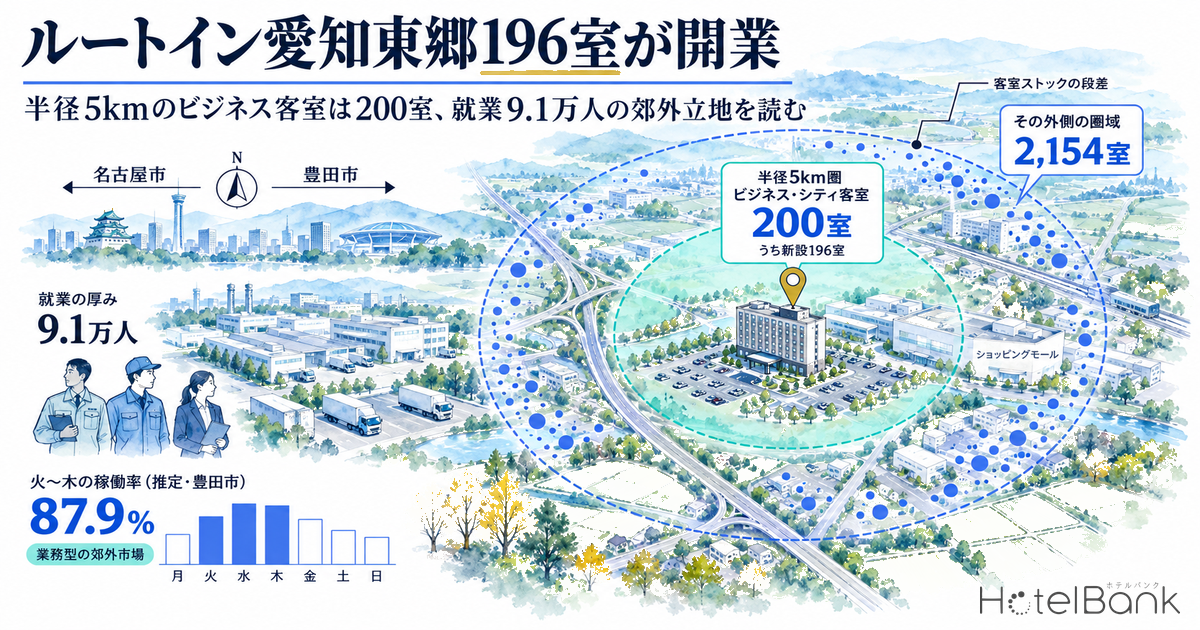
On September 16, 2026, Route Inn Japan opened Hotel Route Inn Aichi Togo (ホテルルートイン愛知東郷, 196 rooms) in Togo Town, Aichi. The official website introduces the property as “the first business hotel in Togo Town,” and a survey of its surroundings bears that out: within a 5km radius, business and city hotel rooms confirmed on sale total just 200 across 2 properties, including this hotel, against 2,154 rooms across 22 properties in the 5–10km ring — a clear step between the two. This article reads this suburban site, located midway between Nagoya and Toyota City, in the following order: room stock, ADR in the surrounding cities, day-of-week occupancy structure, the residential and employment catchment, and the contract structures used with landowners.
| 1 | Business and city hotel rooms within a 5km radius total 200 across 2 properties, of which 196 are the new opening. The 5–10km ring holds 2,154 rooms across 22 properties, and all 6 existing properties with 150 rooms or more sit at least 6.7km away. |
| 2 | The median ADR of the 22 properties in the 5–10km ring is about ¥7,400 (finalized 12-month average). Toyota City as a whole stands at about ¥7,600, up 2.4% YoY (N=29–30), a gradual upward trend. |
| 3 | Occupancy at Toyota City business hotels (estimated, based on OTA-listed inventory) is 87.9% Tue–Thu, 86.6% on Saturday, 77.9% on Friday and 76.8% on Sunday. The Saturday premium in listed prices is +8.0%, a different curve shape from the +52.7% in Naka Ward, Nagoya. |
| 4 | There are 91,082 workers within a 5km radius, with an office-type share of 6.0%. Business and city hotel rooms per 1,000 workers come to 2.2, well short of the 15.0 within 5km of Toyotashi Station. |
| 5 | Suburban hotel development can be sorted into three structures: operator-owned, fixed-term business land lease, and build-to-suit lease. Rent and other terms are set in individual contracts, and public materials reveal only the mechanisms. |
Business & city hotel rooms
Business & city hotel rooms
Median ADR
Workers
(estimated, Toyota City)
Metric Definitions Used in This Article
*Metric definitions used in this article: ADR (average daily rate) = an estimated settled rate (tax-exclusive equivalent) calculated by applying a correction factor by hotel type to the lowest-plan price level each property publishes on OTAs (per room, two guests per room, tax included). When checked against property-level results disclosed by listed hotel REITs (91 properties, most recent three months), the median error is about 7%. These are estimates and differ from each property’s actual settled prices and accounting figures. Area-level ADR is the median of the properties covered (the level of a typical property in the area). OCC (occupancy) = rooms sold as a share of total rooms in the area (an estimate based on OTA sales inventory; consistency checks against monthly REIT disclosures confirm accuracy to within roughly a few points). Where listed prices are mentioned, they are per-room rates for two guests per room (tax included).
Booking curve = the trend in remaining OTA rooms toward the check-in date. Lead Time (LT) = the number of days until check-in. The curves in this article run from LT45 to LT1. Occupancy (estimated, based on OTA-listed inventory) is an estimate based on the sell-through of inventory sold on OTAs and differs from a property’s actual overall occupancy.
Room stock counts the rooms of “properties whose sales prices could be confirmed in the most recent three months (July–September 2026).” ADR covers the period through August 2026, the latest finalized month, and “finalized 12 months” refers to September 2025–August 2026. Data source: MetroEngines Research.
Opening Overview — “The First Business Hotel in Togo Town,” Built on Land Readjustment Ground
We start with the published facts. According to the official Route Inn Hotels website, Hotel Route Inn Aichi Togo opened on Wednesday, September 16, 2026, with a total of 196 rooms. It stands on Block 36 of the Togo Chuo Land Readjustment Project in Togo Town, a 6–7 minute walk from the bus stop of LaLaport Aichi Togo (ららぽーと愛知東郷), a large shopping center that opened in September 2020. The official website introduces the hotel as “the first business hotel in Togo Town” and puts its location midway between Nagoya and Toyota City front and center.
The access guidance centers on driving. The hotel is described as about 15 minutes from the Tomei-Miyoshi IC on the Tomei Expressway and about 20 minutes from the Kariya Smart IC on the Isewangan Expressway; by rail, it is about a 30-minute walk from Nisshin Station on the Meitetsu Toyota Line. Parking is free, with 78 surface spaces and 55 spaces in a self-park multi-level structure for a total of 133, which works out to 0.68 spaces per room. The facility mix — a large public bath, free breakfast, a dinner restaurant and a coin laundry — is well suited to business travelers staying multiple nights.
| Item | Details | Source |
|---|---|---|
| Opening date | Wednesday, September 16, 2026 | Route Inn Hotels official website |
| Total rooms | 196 rooms | Same as above |
| Location | Block 36, Togo Chuo Land Readjustment Project, Togo Town, Aichi District, Aichi | Same as above |
| Parking | 133 spaces in total (78 surface, 55 self-park multi-level; free, first come, first served) | Same as above |
| Access by car | About 15 minutes from Tomei-Miyoshi IC / about 20 minutes from Kariya Smart IC | Same as above |
| Access by rail | About a 30-minute walk from Nisshin Station on the Meitetsu Toyota Line (by bus, a 6–7 minute walk from the “LaLaport Aichi Togo” stop) | Same as above |
| Gross floor area | 5,851㎡ (about 29.9㎡ per room) | MetroEngines Research & Consulting (based on building plans) |
| Zoning | Category 2 Residential District (floor area ratio 200%, building coverage ratio 60%) | MLIT Real Estate Information Library |
Site Analysis — Category 2 Residential, 200% Floor Area Ratio, a Site Built Around Car Use
The hotel’s site is zoned Category 2 Residential District, with a designated floor area ratio of 200% and a building coverage ratio of 60%. Category 2 Residential is a zoning class in which hotels and ryokan can be built with no size restriction, and working backward from the gross floor area of 5,851㎡ implies a site in the 2,900㎡ range or larger. Rather than a development that uses up a high floor area ratio, as in a station-front commercial district, this reads as a suburban configuration that places a mid-rise building and parking on a relatively large site.
Land prices continue to rise gradually. The official land price survey reference point “Aichi Togo 5-1” (Neighborhood Commercial District), about 1.7km from the hotel, rose from ¥126,000/㎡ in 2024 to ¥132,000/㎡ in 2026. The reference point “Aichi Togo-6” (residential), in the block adjacent to the hotel, stood at ¥151,000/㎡ in 2026, up 2.0% YoY. Rail usage, by contrast, is not large: the nearest station, Nisshin, recorded 8,658 passengers per day in fiscal 2023, only 83% of the 10,422 per day in fiscal 2019. This is a location whose catchment is most realistically drawn on the assumption that guests arrive by car.
| Category 2 Residential District | FAR 200% / coverage 60% |
| Surrounding designations | Neighborhood commercial, quasi-residential, mid/high-rise exclusive residential |
2 Properties and 200 Rooms Within 5km, 22 Properties and 2,154 Rooms at 5–10km — Rooms Cluster Toward Toyotashi and Chiryu Stations
Counting room stock by distance band brings out what is distinctive about this site. Business and city hotels whose sales prices could be confirmed in the most recent three months (July–September 2026) number 24 properties with 2,354 rooms within a 10km radius. Narrowed to a 5km radius, however, there are only 2 properties with 200 rooms — the 196 rooms of Hotel Route Inn Aichi Togo plus a small 4-room property — meaning the area was close to a blank before the opening. The 5–8km band holds 4 properties with 363 rooms and the 8–10km band 18 properties with 1,791 rooms: the farther out, the thicker the room stock.
The same tendency shows up by size. There are 7 properties with 150 rooms or more within 10km including Aichi Togo, but all 6 existing ones sit at least 6.7km away, most of them around Toyotashi, Chiryu and Fujigaoka stations in the 9km range. In other words, the belt spanning Togo Town, Nisshin City and Miyoshi City had remained thinly served by business hotels with a meaningful number of rooms. Separately, other property types such as leisure hotels and glamping sites account for 12 properties with 303 rooms within 10km (of which 5 properties with 169 rooms are within 5km), but because they play a different role from accommodation for business travel, they are kept out of this article’s tallies.
| Distance band | Properties | Rooms | 150+ rooms | Median ADR (finalized 12-month average) | Main locations |
|---|---|---|---|---|---|
| 0–5km | 2 | 200 | 1 (new) | — (not shown; only 1 property has finalized months) | Togo Town, Nisshin City |
| 5–8km | 4 | 363 | 1 | ¥7,201 (N=4) | Toyoake City, western Toyota City |
| 8–10km | 18 | 1,791 | 5 | ¥7,492 (N=18) | Around Toyotashi Station, Chiryu City, eastern Nagoya |
| 5–10km total | 22 | 2,154 | 6 | ¥7,357 (N=22) | — |
To add an investor’s perspective: within the scope of a cross-check against the J-REIT ownership data we maintain (as of September 28, 2026; 300 properties in Japan), no J-REIT-owned property could be confirmed among the 24 properties within the 10km radius. The check covered seven REITs: Ichigo Hotel REIT Investment Corporation (いちごホテルリート投資法人, 3463), Invincible Investment Corporation (インヴィンシブル投資法人, 8963), Nippon Hotel & Residential Investment Corporation (日本ホテル&レジデンシャル投資法人, 3472), Japan Hotel REIT Investment Corporation (ジャパン・ホテル・リート投資法人, 8985), Hoshino Resorts REIT (星野リゾート・リート投資法人, 3287), MORI TRUST REIT (森トラストリート投資法人, 8961) and Kasumigaseki Hotel REIT Investment Corporation (霞ヶ関ホテルリート投資法人, 401A). Their holdings in Aichi are located in separate catchments such as central Nagoya and Tokoname City, and this belt reads as a market that has been carried by operating companies and by individual and corporate landowners.
ADR in Surrounding Cities Runs ¥6,100–¥7,600 — Toyota City Up 2.4% YoY Over the Finalized 12 Months
Next we check the rate level. In the four municipalities of Togo Town, Nisshin City, Miyoshi City and Nagakute City, the properties for which ADR can be calculated are limited to one in Togo Town and one in Nisshin City, and no business or city hotel listings could be confirmed on major booking sites for Miyoshi City or Nagakute City (this does not mean no accommodation exists there). Because a single property’s figure cannot be treated as an area level, we use the figures of neighboring cities where rooms are concentrated as the yardstick here.
Average ADR over the finalized 12 months (September 2025–August 2026) was about ¥7,600 in Toyota City (N=29–30), up 2.4% from about ¥7,400 a year earlier, and about ¥6,100 in Kariya City (N=8), up 2.7%. By contrast, Anjo City came in at about ¥6,800 (N=13), down 4.5%, and Chiryu City at about ¥6,600 (N=6), down 5.6%, so direction diverges by city. The business cities of Nishi-Mikawa sit in a subdued rate band even within the prefecture, and the price a newly built hotel aims for in this belt starts from the existing level of around ¥7,000.
| City | Finalized 12-month average ADR | Year-earlier period | YoY | Properties covered | Listed price, September 2026 (YoY) |
|---|---|---|---|---|---|
| Toyota City | ¥7,562 | ¥7,388 | +2.4% | N=29–30 | ¥22,627 (+33.8%) |
| Kariya City | ¥6,147 | ¥5,986 | +2.7% | N=8 | ¥15,855 (+44.8%) |
| Anjo City | ¥6,774 | ¥7,090 | −4.5% | N=13 | ¥14,831 (+10.6%) |
| Chiryu City | ¥6,552 | ¥6,939 | −5.6% | N=6 | ¥16,936 (+28.9%) |
Overlaying Toyota City’s monthly figures by year shows November as the annual peak in both 2024 and 2025. November is the month in which Rally Japan, a round of the World Rally Championship, is held with Toyota Stadium as its base; in 2025 it ran from November 6 to 9. Outside November and May, the figures move within a narrow band of ¥6,600–¥7,800, and this small seasonal swing is also characteristic of a business-oriented city.
September 2026, however, is treated separately. The month is not yet finalized and also overlaps with the 20th Asian Games (September 19–October 4, Aichi-Nagoya), so this article does not include it in the finalized 12-month average. For reference, comparing listed prices (all-plan average, tax included) with the same month a year earlier, Toyota City rose 33.8% from about ¥16,900 to about ¥22,600 and Kariya City rose 44.8%; the upswing during the Games needs to be read separately from normal levels.
Positioning — All 6 Properties With 150+ Rooms Sit 6.7km or Farther Out; Large Hotels Within 5km Were a Blank
Lining up the 22 properties in the 5–10km ring by room count and ADR splits the market into two broad clusters. One is the 13 properties with 130 rooms or fewer and ADR under ¥9,000 — a dense zone centered on independent business hotels around Toyotashi Station. The other is the 6 large properties with 150 rooms or more, whose ADR is spread across ¥7,200–¥10,400. ADR exceeds ¥9,000 at 4 properties (99–230 rooms), a band occupied by station-front city hotels and recently built large properties.
DenseOccupied zone
130 rooms or fewer × under ¥9,000
13 properties cluster here, centered on existing business hotels around Toyotashi Station, with little difference in price band.
WS①Large hotels within 5km
150+ rooms × within 5km
All 6 existing properties sit 6.7km or farther out. In the Togo–Nisshin–Miyoshi belt, Aichi Togo’s 196 rooms are the first such building.
WS②The band above ¥9,000
ADR of ¥9,000 or more
Only 4 properties qualify. It is a band with room for a property that combines a large public bath, parking and new construction.
Because Aichi Togo has just opened and has no finalized months, its ADR position is yet to be established, but its launch pricing is a useful reference. Comparing listed prices (all-plan average, two guests per room, tax included) as of the survey date (October 1, 2026) for weekdays (Mon–Thu, excluding holiday periods) from October 5 to 31, Aichi Togo stood at about ¥22,500, 30.4% above the roughly ¥17,200 median of the 22 properties in the 5–10km ring. On Saturdays it was about ¥25,500 against a ring median of about ¥20,100 (N=21). Although plan composition differs, including the free breakfast service, the fact that a newly built 196-room hotel is launching in the upper band of the ring reads as a stance aimed at capturing the WS② band.
Day-of-Week Structure — Occupancy Concentrates on Tue–Thu, and the Saturday Price Premium Is Only +8.0%
A suburban market centered on business demand shows its character in how each day of the week fills. For business hotels in Toyota City (10–11 properties / 1,029–1,144 rooms covered, based on listings on major booking sites), we averaged by day of week the 72 nights from June 10 to August 31, 2026, excluding Obon (August 8–16) and the Marine Day long weekend. Occupancy (estimated, based on OTA-listed inventory) as of the day before the stay (LT1) was 87.9% for Tue–Thu, 86.6% for Saturday and 83.7% for Monday, falling to 77.9% on Friday and 76.8% on Sunday. The shape has a peak mid-week and troughs on Friday and Sunday.
The contrast with a city-center market is striking. In Naka Ward, Nagoya (all hotel types, 52–56 properties / 10,136–10,382 rooms covered), occupancy rises toward the weekend, at 87.8% on Friday and 88.6% on Saturday, and the listed price at LT1 is 52.7% higher on Saturday, at about ¥21,900, than the roughly ¥14,300 for Tue–Thu. Toyota City business hotels, by contrast, are at about ¥12,500 for Tue–Thu and about ¥13,500 on Saturday, a premium of only 8.0%. This is not the city-center model that earns on weekend pricing but one that steadily stacks up weekday occupancy.
The way the curve builds also reflects the character of a business city. Toyota City’s Tue–Thu nights had already built to 56.3% at 45 days before the stay, 9.1pt above the 47.2% in Naka Ward, Nagoya, at the same point. Conversely, the gain over the final 7 days was +8.3pt in Toyota City (79.6%→87.9%) versus +13.9pt in Naka Ward (73.1%→87.0%): Toyota City fills early and adds little at the last minute. This suggests a thick layer of demand whose dates are fixed in advance, such as regular business trips and training, and the prefecture-wide tendency seen among Aichi business hotels appears here in a stronger form.
| Metric | Toyota City (business hotels) | Naka Ward, Nagoya (all types) |
|---|---|---|
| Tue–Thu occupancy (LT1, estimated) | 87.9% | 87.0% |
| Friday occupancy (LT1, estimated) | 77.9% | 87.8% |
| Saturday occupancy (LT1, estimated) | 86.6% | 88.6% |
| Sunday occupancy (LT1, estimated) | 76.8% | 70.8% |
| Tue–Thu occupancy (LT45, estimated) | 56.3% | 47.2% |
| Listed price (LT1), Tue–Thu | ¥12,510 | ¥14,309 |
| Listed price (LT1), Saturday | ¥13,506 (+8.0%) | ¥21,853 (+52.7%) |
Opening Week Coincided With the Asian Games — Occupancy (Estimated) Averaged 98.1% for September 16–30
The opening fell at the very time the surrounding market was at its fullest. Occupancy (estimated) at LT1 for Toyota City business hotels (10–11 properties / 1,029–1,144 rooms covered, based on listings on major booking sites) averaged 88.2% for September 1–13, whereas over the 15 days from September 16, when Aichi Togo opened, through September 30 it averaged 98.1%, with even the lowest day at 94.8%. This appears to be the result of the Asian Games period (September 19–October 4), with venues across the prefecture including Toyota Stadium, overlapping with the five-day holiday of September 19–23.
Levels in this period are a tailwind for a new hotel’s launch but are no yardstick for normal times. Monthly averages for June–August were 83.0–85.2%, and the day-of-week shape seen in the previous section is what normal operation looks like. Note also that the occupancy (estimated) data has been accumulated only since spring 2026, so comparison with the same month a year earlier is not yet possible.
Catchment — 82,000 Residents and 91,000 Workers, With an Office-Type Share of 6.0%
We check the catchment that underpins demand from both the residential and the employment side. The resident population within a 3km radius of the hotel was 81,587 in 2020, is estimated at 82,168 for 2025, and is projected at 80,692 for 2040 (−1.1% versus 2020), an essentially flat outlook. The working-age share is 63.8% and the senior share 22.4%, a young profile typical of the eastern Nagoya suburbs, where land readjustment continues to supply housing. The map below shows resident population by 250m mesh: densely populated cells are more common north of the hotel, toward Nisshin City, and just over 60% of the population within the 3km radius is distributed in the northern half.
The employment side is larger still. According to the Economic Census, workers number 9,167 within a 1km radius (772 establishments), 34,519 within 3km (2,733 establishments) and 91,082 within 5km (6,266 establishments). The office-type share — the proportion accounted for by clerical industries — is low at 2.0% within 1km, 5.6% within 3km and 6.0% within 5km, so this reads as an area where non-office employment such as manufacturing, logistics, retail and services predominates. Miyoshi City, immediately to the east, is home to Toyota Motor’s Miyoshi, Myochi and Shimoyama plants, and business travelers visiting plants and logistics bases, along with stays for training and temporary support assignments, can be expected to form the main demand segment.
The table below compares how many rooms exist relative to this scale of employment with the 5km ring centered on Toyotashi Station. The Toyotashi Station 5km ring has 21 business and city hotels with 2,150 rooms against 143,355 workers, or 15.0 rooms per 1,000 workers. The Aichi Togo 5km ring, by contrast, has 200 rooms against 91,082 workers, or 2.2 rooms. With rooms this thin relative to the depth of employment, stays have presumably flowed until now to the areas around Toyotashi and Chiryu stations, and the new 196 rooms are positioned to intercept part of that flow closer in.
| Center point (5km radius) | Establishments | Workers | Office-type share | Business & city hotel rooms | Rooms per 1,000 workers |
|---|---|---|---|---|---|
| Hotel Route Inn Aichi Togo | 6,266 | 91,082 | 6.0% | 200 rooms (2 properties) | 2.2 |
| Toyotashi Station | 7,583 | 143,355 | 8.3% | 2,150 rooms (21 properties) | 15.0 |
On the tourism side, demand comes from Ghibli Park in Expo 2005 Aichi Commemorative Park (愛・地球博記念公園) in Nagakute City. According to materials published by Aichi Prefecture, the park’s visitor count (estimate) reached 2.9405 million in fiscal 2024, about 2.1 times the 1.4230 million of fiscal 2019. The prefecture’s survey found that 55.0% of domestic visitors came by private car and that 64.5% of domestic visitors from outside the prefecture stayed overnight within it. However, 82.3% of domestic visitors who stayed did so in the city of Nagoya. Aichi Togo’s conditions — about 9km in a straight line to the park and 133 free parking spaces — could make it an option for families traveling by car, but since stays are currently concentrated in Nagoya, it is reasonable to regard tourism demand as a weekend top-up that supplements weekday business demand.
Development Structures — Operator-Owned, Fixed-Term Business Land Lease, and Build-to-Suit Lease
For landowners and operators considering a hotel site in the suburbs, who holds the land and the building is a premise of the financials. Development structures can generally be sorted into three: operator-owned, where the operating company holds both land and building; the fixed-term business land lease, where the operating company leases only the land and constructs the building; and the build-to-suit lease, where the landowner constructs the building and leases it whole to the operating company.
| Structure | Land | Building | Key points of the mechanism |
|---|---|---|---|
| Operator-owned | Operating company | Operating company | The operating company bears both acquisition and construction. The landowner’s involvement ends with the sale. |
| Fixed-term business land lease | Landowner | Operating company | Based on Article 23 of the Act on Land and Building Leases. It applies to buildings used exclusively for business, the term is at least 10 years and less than 50 years, and the contract must be executed as a notarial deed. It can be set up with no contract renewal and no right to demand purchase of the building. |
| Build-to-suit lease (leaseback) | Landowner | Landowner | The landowner constructs the building and leases it as a whole. In some cases a construction cooperation deposit is used, under which construction costs are borrowed from the tenant; this method is also called the leaseback method. |
Published materials show that the choice of structure differs by chain. Toyoko Inn (東横イン) states in its corporate brochure that it adopts a “long-term whole-building master lease method,” explaining the arrangement — it rents a building constructed by the landowner at a fixed rent and carries out repairs and maintenance at its own expense — as a model that benefits all three parties: the owner, the guest and the operating company. For a landowner, the strength lies in earning long-term rental income without giving up the land.
The Route Inn Group (ルートイングループ), for its part, traces its origins to a construction company established in 1975 and discloses a setup in which Route Inn Kaihatsu, a group company, handles store planning and development as well as the design, construction and supervision of buildings and facilities. As of July 1, 2026, the group has 368 hotels with a total of 65,534 rooms in operation, and its ability to complete everything from planning to construction in-house is likely one factor that makes suburban openings easier to pursue. The rights relating to Aichi Togo’s land and building and its rent terms cannot be confirmed from published materials, so this article does not address them.
How Far Can Room Revenue for 196 Rooms Swing With ADR and Occupancy? — Three Scenarios and a Two-Axis Sensitivity (Estimate)
Here we translate the market data so far into a range of annual room revenue for 196 rooms. These are not the new hotel’s actual results but an estimate that applies the surrounding market’s ADR and occupancy (estimated) directly to 196 rooms × 365 days = 71,540 room nights. ADR is the estimated settled ADR (tax-exclusive equivalent), and September 2026, which overlapped with the Asian Games, is not included.
| Scenario | ADR | Occupancy | RevPAR | Annual room revenue | Basis for assumptions (figures measured in this article) |
|---|---|---|---|---|---|
| Downside | ¥6,600 | 77% | ¥5,082 | ¥364 million | The level of Anjo City and Chiryu City, where rates are low for the area (¥6,552–¥6,774), and the Friday and Sunday occupancy (estimated) of Toyota City business hotels, 77.9% and 76.8% |
| Base | ¥7,357 | 84% | ¥6,180 | ¥442 million | The median ADR of the 22 properties in the 5–10km ring, and 84.1%, the one-week weighted average of day-of-week occupancy (estimated) at Toyota City business hotels (consistent with the monthly averages of 83.0–85.2% for June–August 2026) |
| Upside | ¥9,000 | 88% | ¥7,920 | ¥567 million | The lower bound of the above-¥9,000 band labeled WS② in the positioning, and the Tue–Thu occupancy (estimated) of 87.9% |
Annual room revenue in the base scenario is about ¥442 million, and the gap between the downside and the upside is about ¥203 million. The table below views, on a 5×5 grid, the two variables that determine where within this range the result settles.
| ADR \ Full-year occupancy | 76% | 80% | 84% | 88% | 92% |
|---|---|---|---|---|---|
| ADR ¥6,600 | 359 | 378 | 397 | 416 | 434 |
| ADR ¥7,200 | 391 | 412 | 433 | 453 | 474 |
| ADR ¥7,800 | 424 | 446 | 469 | 491 | 513 |
| ADR ¥8,400 | 457 | 481 | 505 | 529 | 553 |
| ADR ¥9,000 | 489 | 515 | 541 | 567 | 592 |
The sensitivities that can be read from the grid are as follows. At full-year occupancy of 84%, a ¥1,000 move in ADR moves annual room revenue by about ¥60 million, and at an ADR of ¥7,357, a 1pt move in occupancy moves it by about ¥5.3 million. In other words, a ¥1,000 difference in ADR is equivalent to roughly 11pt of occupancy. Whether the upper-band launch pricing seen in the positioning section remains as an ADR uplift in the finalized months after opening will be the most important point to check when assessing the financials. Note that the occupancy used here is the surrounding market average and does not factor in the time a newly opened hotel takes to reach the same level.
Checklist for Assessing Suburban Hotel Sites
We want to organize the material so far from the perspective of developers looking for sites, landowners considering how to use their land, and financial institutions considering lending. What the Aichi Togo case shows is that the depth of the workforce and the distance to existing rooms, rather than rail station passenger counts, become the axes for evaluating a location.
| Check item | Measured at Aichi Togo | How to read it |
|---|---|---|
| Existing rooms within 5km | 4 business and city hotel rooms (before opening) | The farther away the existing large properties are — 6–7km or more — the easier it is to capture demand closer in. |
| Ratio of workers to rooms | 2.2 rooms per 1,000 workers (after opening) | The gap with the central city of the same living area (15.0 rooms in the Toyotashi Station ring) serves as a gauge of room for new openings. |
| Composition of employment | Office-type share of 6.0% (within 5km) | If manufacturing and logistics predominate, build the financials on a day-of-week structure in which occupancy concentrates on Tue–Thu. |
| Rate level in surrounding cities | Median ADR of ¥7,357 (5–10km ring) | Aichi Togo is launching in the upper band of the ring, but it is prudent to set the normal-time baseline at the existing level. |
| Zoning and site | Category 2 Residential District, floor area ratio 200% | Whether the site can be used horizontally, parking included, matters in a car-based catchment. |
| Supplementary weekend demand | 2.9405 million park visitors (fiscal 2024); retail facility within walking distance | As material for filling the Friday and Sunday troughs, tourism and retail footfall should be evaluated together. |
For those building the financials, it is important not to be pulled along by the figures from the Games period. The yardstick for normal times is the day-of-week occupancy of 87.9% for Tue–Thu and 77.9% for Friday, together with ADR in the ¥7,000 range. On that basis, an effective approach is to verify in the finalized months after opening how much uplift over the existing level the product strengths of new construction, a large public bath and free parking can deliver.
Summary
The 196 rooms of Hotel Route Inn Aichi Togo entered a belt that had only 4 business and city hotel rooms within a 5km radius. The surrounding workforce is deep, at 91,082 within 5km, and rooms per 1,000 workers are just 2.2 even after the opening, far below the 15.0 of the Toyotashi Station ring. With existing large properties lined up 6.7km or farther out, the hotel is positioned to intercept demand closer in.
The market is business-driven in character. At Toyota City business hotels, occupancy concentrates on Tue–Thu, and the Saturday price premium is small at 8.0%. ADR is about ¥7,400 at the median of the 22 surrounding properties, and Toyota City as a whole shows only a gradual rise of 2.4% YoY. In the opening week, the Asian Games and a holiday period coincided and occupancy (estimated) averaged 98.1%, but it would be appropriate to wait for finalized months to accumulate before evaluating normal times. We will continue to follow developments as one example of reading a site in the manufacturing suburbs of the Nagoya metropolitan area from the depth of employment and the distance to existing rooms.
⚠ Note on prices for future dates: The listed prices shown in this article for stay dates in October 2026 are averages of sales prices published as of the survey date (October 1, 2026) and will fluctuate as the check-in date approaches. Please note that prices currently set may be revised in line with subsequent sales conditions. ADR for September 2026 is not yet finalized and is therefore not included in this article’s tallies.
Related Articles
| Japan’s 50 Smart Interchanges: Median 1,130 Hotel Rooms Within 10km |
References and Sources
■ Data Sources
Room stock, ADR, listed prices and occupancy (estimated) are tallies by MetroEngines Research & Consulting (continuous observation of published prices and sales inventory on major booking sites). Room stock covers business and city hotels whose sales prices could be confirmed in July–September 2026 (N=24 properties within a 10km radius); ADR is the finalized 12-month average of estimated settled ADR (tax-exclusive equivalent) for September 2025–August 2026; day-of-week occupancy is as of LT1 for 10–11 Toyota City business hotels from June 10 to August 31, 2026 (72 nights). The catchment draws on the Economic Census for Business Activity (2021) and the National Land Numerical Information 250m-mesh future population projections; site conditions on the Real Estate Information Library; and the opening overview and development structures on materials published by the Route Inn Group and the Toyoko Inn Group.
■ Estimate Assumptions
The room revenue estimate multiplies 196 rooms × 365 days = 71,540 room nights by ADR (¥6,600–¥9,000) and occupancy (76–92%). The base case uses ¥7,357, the median ADR of the 22 properties in the 5–10km ring, and 84%, rounded from 84.1%, the weekly weighted average of day-of-week occupancy (estimated) at Toyota City business hotels. These are assumed values that apply surrounding market averages to a newly built hotel; they are not the actual results or planned figures of Hotel Route Inn Aichi Togo. Ancillary income, operating costs, rent and the first-year ramp-up are not included.
■ Limitations and Caveats
Occupancy is an estimate based on OTA-listed inventory and differs from a property’s actual overall occupancy. Because the data has been accumulated only since spring 2026, comparison with the same month a year earlier is not possible. In Togo Town and Nisshin City, within the 5km radius, ADR can be calculated for only one property each, and these are not treated as area levels. September 2026 was excluded from averages because it is a not-yet-finalized figure affected by the Asian Games (September 19–October 4). October listed prices are sales prices as of the survey date (October 1, 2026) and will change. The rights relating to the land and building and the rent terms are undisclosed and are not addressed.
■ Market Data
| MetroEngines Research & Consulting — Estimated settled ADR (Toyota City N=29–33 properties, among others), listed prices, occupancy (estimated, based on OTA-listed inventory), booking curves, room stock within a 10km radius (N=24 properties), J-REIT ownership data (as of September 28, 2026; 300 properties in Japan) |
■ Government Statistics and Public Data
■ Corporate Disclosures