

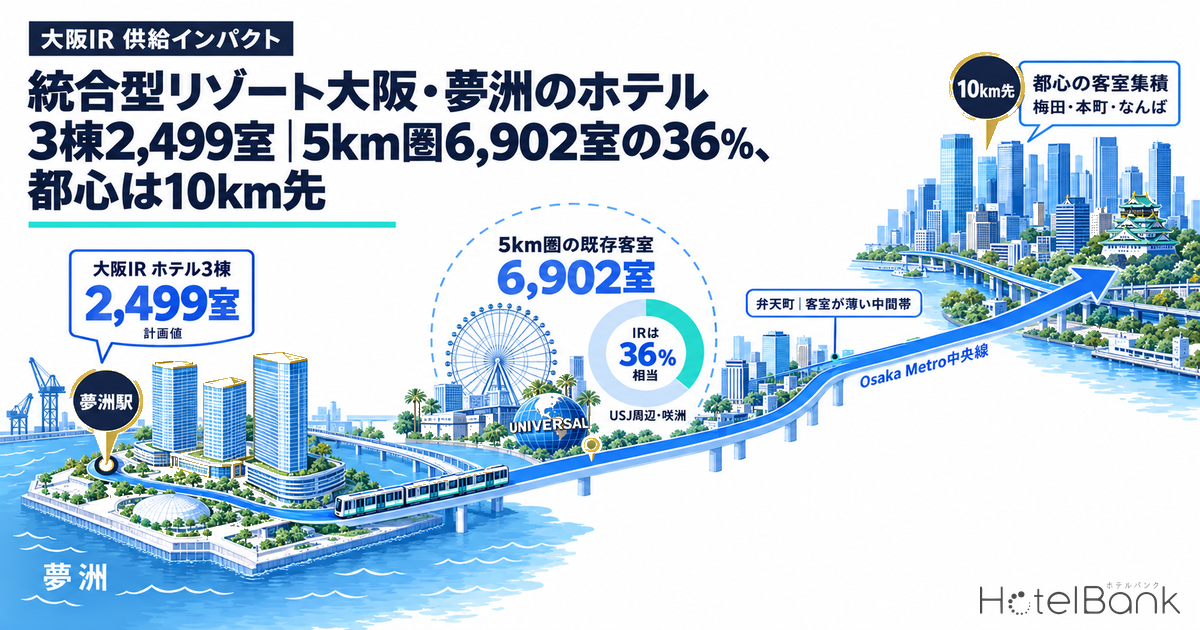
According to the area development plan submitted by Osaka Prefecture and Osaka City on July 31, 2026, the integrated resort (IR) on Yumeshima in Osaka will include three hotels with a combined 2,499 rooms. Construction began on April 24, 2025, with completion targeted for around summer 2030 and opening around autumn of the same year. Measured against the registered room counts tracked by MetroEngines Research, those 2,499 rooms amount to only about 1.9% of Osaka City as a whole, yet they equal 36.2% of the 6,902 existing rooms within a 5km radius of Yumeshima Station. This article quantifies the IR’s rooms as a “supply impact by distance band” and overlays rail access and station ridership to map the bayside lodging catchment heading into 2030.
Metric Definitions Used in This Article
*Metric definitions used in this article: ADR (average daily rate) = an estimated settled rate (tax-excluded equivalent), calculated by applying property-type adjustment factors to the lowest-plan level each property publishes on OTAs (two guests per room, per-room price, tax-inclusive). Checked against property-level results disclosed by listed hotel REITs (91 properties, most recent 3 months), the median error is about 7%. These are estimates and differ from each property’s actual settled prices and accounting figures. Area-level ADR is the median of covered properties (the level of a typical property in the area). Room and property counts = registered counts within the scope tracked by MetroEngines Research (as of the October 1, 2026 survey, properties with 1+ rooms, aggregated by building); this is not a complete census. Distances are straight-line distances from Yumeshima Station. Data source: MetroEngines Research & Consulting.
- — 3 hotels, 2,499 rooms: The Osaka IR’s hotels are MGM Osaka (1,829 rooms), the Villas (10 rooms) and MUSUBI Hotel (660 rooms), scheduled to open around autumn 2030. The plan itself notes a possible delay of roughly one to two years.
- — 1.9% vs. 36.2%: Against Osaka City’s 132,364 rooms the IR adds about 1.9%, but against the 6,902 rooms within 5km of Yumeshima Station it is 36.2%, and 28.8% of the 8,683 rooms in the three bayside wards. Depending on the denominator, the ratio ranges from 1.8% to 173.5%.
- — Only 1,315 rooms at 5–7.5km: Existing rooms split between the 2.5–5km band (11 properties with 300+ rooms hold 5,371 rooms) and the 10–12.5km band (97,045 rooms); the middle band that includes Bentencho is the thinnest.
- — Konohana Ward approx. ¥18,600: Its estimated settled ADR for June–August 2026 ranks first among six wards (N=13 properties). YoY is −29% to −39% in every ward, but the comparison period fell during the Expo; against the same period of 2024, Suminoe, Kita and Minato are roughly flat.
- — Approx. 2,980 rooms/night outside the IR: In the mid scenario (visitors as planned, 20% staying overnight), lodging demand the IR cannot absorb equals 43% of the 5km-radius room stock (editorial estimate based on assumed values).
The IR’s Room Plan — 3 Hotels, 2,499 Rooms, Large Rooms Averaging 60–75㎡
First, let us confirm the planned figures from published documents. According to Osaka Prefecture’s “Progress of the Osaka Yumeshima Integrated Resort Area Development,” IR construction began on April 24, 2025, and is scheduled to run until around summer 2030. The area development plan (version submitted July 31, 2026) sets the opening for around autumn 2030 and describes the lodging facilities as “approximately 2,500 rooms in total.” Note, however, that the plan positions this schedule as the fastest-case scenario and states that, depending on circumstances, it could slip by roughly one to two years.
By hotel, the flagship MGM Osaka has 1,829 rooms, the VIP-oriented MGM Osaka Villas have 10 rooms, and MUSUBI Hotel, billed as a multi-generational aqua resort, has 660 rooms, for a total of 2,499. Their grades are positioned as luxury, super-luxury and upper-upscale respectively. The average room size across all hotels is about 60–75㎡, and suites make up 20% or more of all rooms. The lodging facilities have a total floor area of about 267,000㎡, roughly one-third of the entire IR (about 780,000㎡).
| Hotel | Grade (as positioned in the plan) | Total rooms | Total room floor area | Average room floor area |
|---|---|---|---|---|
| MGM Osaka | Luxury | 1,829 rooms | 133,471㎡ | Approx. 65–85㎡ |
| MGM Osaka Villas | Super-luxury | 10 rooms | 5,347㎡ | Approx. 440–545㎡ |
| MUSUBI Hotel | Upper-upscale | 660 rooms | 26,527㎡ | Approx. 35–50㎡ |
| Total | — | 2,499 rooms | 165,345㎡ | Approx. 60–75㎡ |
A useful yardstick for scale is the visitor projection in the same plan. The IR area is expected to draw about 20 million visitors a year (about 14 million domestic and 6 million international), or roughly 55,000 a day when simply divided by 365. Even if all 2,499 rooms were filled with two guests each, they could accommodate only about 5,000 people — less than 10% of daily visitors. This is only a simple editorial calculation, but if visitation meets the plan, most visitors will either make day trips or stay outside the IR. In other words, the IR’s room supply is not self-contained within the resort area; it is a theme continuous with the lodging market of the surrounding area.
Supply Impact Depends on the Denominator — 1.9% of Osaka City, 28.8% of the 3 Bayside Wards
How large, then, are 2,499 rooms relative to existing stock? Within the scope tracked by MetroEngines Research, the 24 wards of Osaka City contain 1,813 lodging properties with 132,364 rooms (registered basis). With that as the denominator, the IR’s rooms equal about 1.9%. Seen across the whole city, it is a modest supply increment.
Narrow the denominator to the bay, however, and the picture changes completely. Konohana Ward, which includes Yumeshima, has 77 properties with 5,109 rooms; Suminoe Ward, home to Sakishima across the water, has 19 properties with 2,134 rooms; and Minato Ward, where Tempozan is located, has 38 properties with 1,440 rooms. Together, the three wards hold 134 properties and 8,683 rooms — just 6.6% of the city total. Against these three bayside wards, the IR’s 2,499 rooms equal 28.8%; by ward, the ratios are 48.9% for Konohana, 117.1% for Suminoe and 173.5% for Minato. By contrast, the three central wards of Chuo, Kita and Naniwa hold 927 properties and 87,099 rooms, 65.8% of the city total. Osaka’s room stock is clearly skewed — thick in the city center, thin along the bay.
| Comparison base (existing stock) | Properties | Rooms | Share of Osaka City | IR 2,499 rooms as % |
|---|---|---|---|---|
| Osaka City, 24 wards | 1,813 | 132,364 | 100.0% | 1.9% |
| 3 central wards (Chuo, Kita, Naniwa) | 927 | 87,099 | 65.8% | 2.9% |
| 3 bayside wards (Konohana, Minato, Suminoe) | 134 | 8,683 | 6.6% | 28.8% |
| Konohana Ward | 77 | 5,109 | 3.9% | 48.9% |
| Suminoe Ward | 19 | 2,134 | 1.6% | 117.1% |
| Minato Ward | 38 | 1,440 | 1.1% | 173.5% |
| Within 5km of Yumeshima Station | 44 | 6,902 | — | 36.2% |
| Within 10km of Yumeshima Station | 532 | 25,806 | — | 9.7% |
| Within 15km of Yumeshima Station | 1,937 | 140,418 | — | 1.8% |
The key point here is that the answer to “how much does supply increase?” swings from 1.8% to 173.5% depending solely on the denominator. When investors and operators estimate the IR’s impact, they first need to determine which distance band and which ward their property belongs to, and then read the ratio against that denominator. Widening the base to four bayside wards yields a ratio of roughly one-quarter, and examining which price bands are currently thin is a natural next step for that analysis.
Current Stock Within 5km and 10km of Yumeshima — Rooms Cluster at 2.5–5km and Beyond 10km
Next, we look at existing stock by distance band from Yumeshima Station. Within a 2.5km radius there are only 4 properties with 248 rooms, on Maishima and the northern tip of Sakishima; there are almost no rooms at the IR’s doorstep. The next band, 2.5–5km, holds 40 properties with 6,654 rooms, made up of two clusters: the area around Universal Studios Japan (USJ) and the Cosmo Square district of Sakishima. Of the 44 properties within 5km, 11 are large properties with 300+ rooms, and these 11 alone account for 5,371 rooms, or 77.8% of the rooms in the radius.
In the 5–7.5km band, however, stock thins to 60 properties and 1,315 rooms. This band, just short of Bentencho and Nishikujo, is dominated by small properties, with only one property of 300+ rooms. Stock thickens again to 428 properties and 17,589 rooms at 7.5–10km, then jumps to 1,103 properties and 97,045 rooms at 10–12.5km. The central clusters of Umeda, Hommachi and Namba stand like a wall just over 10km from Yumeshima Station.
| Distance band | Properties | Rooms | Of which 300+ rooms | Main areas |
|---|---|---|---|---|
| 0–2.5km | 4 | 248 | 0 | Maishima, northern tip of Sakishima |
| 2.5–5km | 40 | 6,654 | 11 | Around USJ, Sakishima, Tempozan |
| 5–7.5km | 60 | 1,315 | 1 | Just short of Bentencho and Nishikujo |
| 7.5–10km | 428 | 17,589 | 7 | Nishi Ward, Fukushima Ward, western Naniwa Ward, Amagasaki |
| 10–12.5km | 1,103 | 97,045 | 69 | Umeda, Hommachi, Shinsaibashi, Namba |
| 12.5–15km | 302 | 17,567 | 13 | Toward Shin-Osaka, Tennoji, Kyobashi |
The map below plots existing properties within 10km of Yumeshima Station as circles sized by room count. The inner dashed line marks 5km and the outer one 10km. Large circles line up around USJ and on Sakishima, while to the east only small circles are scattered, and density rises sharply near the edge facing the city center.
| Property | Ward | Rooms | Distance from Yumeshima Sta. |
|---|---|---|---|
| Liber Hotel Osaka (リーベルホテル大阪) | Konohana | 760 | 4.0km |
| Hotel Keihan Universal Tower (ホテル京阪 ユニバーサル・タワー) | Konohana | 641 | 4.6km |
| Hotel Universal Port (ホテルユニバーサルポート) | Konohana | 600 | 4.6km |
| The Park Front Hotel at Universal Studios Japan (ザ パーク フロント ホテル アット ユニバーサル・スタジオ・ジャパン) | Konohana | 598 | 4.5km |
| Grand Prince Hotel Osaka Bay (グランドプリンスホテル大阪ベイ) | Suminoe | 480 | 2.9km |
| Hotel Kintetsu Universal City (ホテル近鉄ユニバーサル・シティ) | Konohana | 456 | 4.8km |
| Hotel Universal Port Vita (ホテルユニバーサルポートヴィータ) | Konohana | 428 | 5.0km |
| The Singulari Hotel & Skyspa at Universal Studios Japan (ザ シンギュラリ ホテル & スカイスパ アット ユニバーサル・スタジオ・ジャパン) | Konohana | 390 | 4.8km |
| Osaka Academia (大阪アカデミア) | Suminoe | 368 | 3.6km |
| Oriental Hotel Universal City (オリエンタルホテル ユニバーサル・シティ) | Konohana | 330 | 4.7km |
| Hotel Fukuracia Osaka Bay (ホテルフクラシア大阪ベイ) | Suminoe | 320 | 3.4km |
As Table 4 shows, even the largest property within 5km has 760 rooms, so MGM Osaka, with 1,829 rooms on its own, will far exceed any existing property in the radius. Moreover, the existing large properties grew up relying mainly on theme-park demand and training/meeting demand, and their room design philosophy differs from the planned average of 60–75㎡ with 20%+ suites. In terms of both scale and price band, the IR can be framed as supply that stacks a new tier “next to” the existing stock.
Rate Levels on the Bay and in the Center — Konohana’s Estimated Settled ADR of Approx. ¥18,600 Tops Six Wards
After supply volume, let us check where prices stand today. The estimated settled ADR for June–August 2026 (3-month average of monthly medians) was about ¥18,600 in Konohana Ward (N=13 properties), the highest of the six wards and roughly 1.9 times Chuo Ward’s approx. ¥9,800 (N=193–194 properties) and Kita Ward’s approx. ¥9,500 (N=72–74 properties). Suminoe Ward at approx. ¥10,600 (N=7 properties) and Minato Ward at approx. ¥10,200 (N=10–11 properties) sit in roughly the same band as the city center. This suggests that destination-driven demand around USJ has created a distinct price band for Konohana even within the bay area.
| Ward | Estimated settled ADR | Properties (N) | YoY | vs. same period 2024 |
|---|---|---|---|---|
| Konohana | ¥18,556 | 13 | −35.3% | −18.7% |
| Suminoe | ¥10,640 | 7 | −29.3% | +3.2% |
| Minato | ¥10,224 | 10–11 | −35.7% | −2.0% |
| Chuo | ¥9,791 | 193–194 | −34.9% | −7.2% |
| Kita | ¥9,507 | 72–74 | −30.4% | −1.5% |
| Nishi | ¥8,572 | 27–28 | −39.1% | −10.8% |
YoY moved sharply in every ward, from −29% to −39%, but the comparison period of June–August 2025 coincided with Expo 2025 Osaka, Kansai, when special demand from the Expo, held on Yumeshima, was pushing rates up. Compared with the same period of 2024, before the Expo, Suminoe was +3.2%, Kita −1.5% and Minato −2.0% — roughly flat — so for these wards it is natural to read current levels as a “return to pre-Expo normal.” On the other hand, Konohana (−18.7%), Nishi (−10.8%) and Chuo (−7.2%) are also below the same period of 2024, and it is worth noting that their adjustment cannot be explained by the fading of Expo demand alone. For the post-Expo year, reading YoY together with the comparison against two years earlier gives a more accurate picture. The chart below overlays Konohana’s monthly trend by year: about ¥35,200 in August 2025 marks the peak of Expo demand, and about ¥23,100 in August 2026 shows where rates stand now.
That said, the rates shown here are levels for existing properties. The IR’s hotels, positioned as luxury or above in the plan, are likely to enter a tier separate from the bay area’s current price band. For existing properties, therefore, the issue is likely to shift away from direct price competition toward how to capture the share of IR visitors who stay outside the resort area.
Access and Catchment — 30 Minutes to the Center on the Chuo Line, Line Stations Handle 20,000–70,000 Passengers a Day
Rail access to Yumeshima is provided by Yumeshima Station on the Osaka Metro Chuo Line, opened as an extension on January 19, 2025. The area development plan states that the IR can be reached within 30 minutes from major stations such as Osaka, Tennoji and Namba, and in about 40 minutes from Shin-Osaka. In straight-line distance from Yumeshima Station, Umeda is about 11.1km, Hommachi about 10.4km, Namba about 10.2km and Nakanoshima about 9.8km — almost exactly overlapping the “room cluster in the 10–12.5km band” seen earlier. In other words, the center’s 90,000+ rooms lie within a 30-minute rail ride.
| Origin | Straight-line distance from Yumeshima Sta. | Access stated in the area development plan |
|---|---|---|
| Umeda (Osaka Station) | Approx. 11.1km | Within 30 minutes by rail |
| Namba (Namba Station) | Approx. 10.2km | Within 30 minutes by rail |
| Tennoji Station | Approx. 11.3km | Within 30 minutes by rail |
| Nakanoshima | Approx. 9.8km | Not specifically stated (connects with other lines at Hommachi and Awaza on the Chuo Line) |
| Shin-Osaka Station | Approx. 13.5km | Approx. 40 minutes by rail |
| Kansai International Airport | — | Approx. 40 minutes by car / approx. 70 minutes by rail |
| Osaka International Airport (Itami) | — | Approx. 40 minutes by car / approx. 70 minutes by rail |
| Kobe Airport | — | Approx. 40 minutes by car / approx. 80 minutes by rail |
How much passenger flow do stations along the Chuo Line carry? According to the Ministry of Land, Infrastructure, Transport and Tourism’s (MLIT) station ridership data (FY2023), Cosmo Square Station, one stop before Yumeshima, handles 23,773 passengers a day (including the Nanko Port Town Line), Osakako Station 23,579, and Bentencho Station — a transfer point with the JR Osaka Loop Line — 39,541 on the Chuo Line and 67,088 on JR. For comparison, JR Universal City Station, the gateway to USJ, handles 70,542, 17.6% above pre-pandemic FY2019 (59,992). Yumeshima Station opened in January 2025 and is not yet included in this data.
| Station (line) | FY2019 | FY2023 | Change |
|---|---|---|---|
| Cosmo Square (Chuo Line, Nanko Port Town Line) | 26,650 | 23,773 | −10.8% |
| Osakako (Chuo Line) | 21,960 | 23,579 | +7.4% |
| Bentencho (Chuo Line) | 40,144 | 39,541 | −1.5% |
| Bentencho (JR Osaka Loop Line) | 68,978 | 67,088 | −2.7% |
| Universal City (JR Sakurajima Line) | 59,992 | 70,542 | +17.6% |
| Sakurajima (JR Sakurajima Line) | 27,788 | 30,736 | +10.6% |
The IR’s projected 55,000 visitors a day approaches the ridership of Universal City Station. Not every visitor will travel by rail, but the passenger flow through Cosmo Square and Osakako stations, currently in the 20,000s, could change character significantly after opening. Bentencho Station in particular, where the Chuo Line meets the JR Osaka Loop Line, lies about 6.7km from Yumeshima Station in the 5–7.5km band. It is notable that a transfer hub sits in the distance band with the thinnest room stock, just 1,315 rooms. The plan also states that a future northern rail route will be considered in line with the phased land use of Yumeshima.
Land Prices — Bayside Industrial Land Up 13–14% YoY
As a supplementary lens for location assessment, we also look at the 2026 official land price publication. The standard site closest to Yumeshima Station is on the Maishima side at Hokko-Shiratsu 1-chome, Konohana Ward (industrial), at ¥148,000 per ㎡, up 13.8% YoY. Nanko-Naka 1-chome, Suminoe Ward on Sakishima (industrial), was ¥198,000, up 14.5%; bayside logistics land continues to rise at double-digit rates. Among commercial sites, Benten 4-chome in Minato Ward was ¥531,000 (+8.6%) and Sanzaki 1-chome in the same ward ¥418,000 (+7.2%), with the Bentencho area standing out.
| Standard site | Location | Use | Price (¥/㎡) | YoY | Distance from Yumeshima Sta. |
|---|---|---|---|---|---|
| Osaka Konohana 9-1 | Hokko-Shiratsu 1-chome, Konohana Ward | Industrial | 148,000 | +13.8% | 1.7km |
| Osaka Minato-8 | Chikko 2-chome, Minato Ward | Residential | 194,000 | +3.2% | 3.9km |
| Osaka Suminoe 9-2 | Nanko-Naka 1-chome, Suminoe Ward | Industrial | 198,000 | +14.5% | 4.6km |
| Osaka Minato 5-3 | Yahataya 1-chome, Minato Ward | Commercial | 213,000 | +1.4% | 5.0km |
| Osaka Minato 5-4 | Sanzaki 1-chome, Minato Ward | Commercial | 418,000 | +7.2% | 5.9km |
| Osaka Minato 5-1 | Benten 4-chome, Minato Ward | Commercial | 531,000 | +8.6% | 6.5km |
Lodging Demand Outside the IR — Sensitivity Estimates by Visitor Volume and Overnight Ratio
We now express the simple calculation from the opening (about 55,000 visitors a day versus an IR lodging capacity of about 5,000) as a range by varying two assumptions. The first is visitor volume, at four levels: 70%, 85%, 100% and 115% of the planned figure (about 20 million a year). The second is the share of that day’s visitors who stay overnight, at five levels from 5% to 40%. Assuming two guests per room and that all 2,499 IR rooms are filled by IR visitors, the remainder is calculated as “rooms needed outside the resort area (per night).” Because the IR’s rooms will not necessarily be filled only by IR visitors, the outside-area demand here is a conservative estimate. Since the plan assumes about 30% of visitors (about 6 million a year) will come from overseas — a group for whom day trips are difficult — we set the overnight ratio at 20% for the mid scenario and 30% for the optimistic one. All are editorial assumptions, not demand forecasts.
| Scenario | Visitors (vs. plan) | Visitors/day | Overnight ratio | Rooms needed | Of which outside IR | vs. 6,902 rooms within 5km | vs. 8,683 rooms in 3 bayside wards |
|---|---|---|---|---|---|---|---|
| Pessimistic | 70% | 38,356 | 10% | 1,918 rooms | 0 rooms | 0.0% | 0.0% |
| Mid | 100% | 54,795 | 20% | 5,479 rooms | 2,980 rooms | 43.2% | 34.3% |
| Optimistic | 115% | 63,014 | 30% | 9,452 rooms | 6,953 rooms | 100.7% | 80.1% |
| Overnight ratio \ Visitors (vs. plan) | 70% | 85% | 100% | 115% |
|---|---|---|---|---|
| Overnight ratio 5% | 0 | 0 | 0 | 0 |
| Overnight ratio 10% | 0 | 0 | 241 | 652 |
| Overnight ratio 20% | 1,337 | 2,159 | 2,980 | 3,802 |
| Overnight ratio 30% | 3,254 | 4,487 | 5,720 | 6,953 |
| Overnight ratio 40% | 5,172 | 6,816 | 8,460 | 10,104 |
What Table 10 shows is that lodging demand outside the resort area depends heavily on the overnight ratio. At an overnight ratio of 10% or less, even with visitation as planned, only about 241 rooms are needed outside the area, and the IR’s own rooms absorb almost all demand. At 20%, the figure is 2,980 rooms, or 43% of the 6,902 existing rooms within 5km; at 30%, it reaches 5,720 rooms, or 83% of the 5km-radius stock, and if visitors exceed the plan by 15%, it becomes 6,953 rooms — more than the existing rooms within 5km. Even if visitors reach only 70% of the plan, an overnight ratio of 30% still leaves 3,254 rooms of outside-area demand. As noted earlier, rooms within 5km are concentrated in 11 large properties, and the 5–7.5km band is thin at 1,315 rooms, so the more outside-area demand swells, the more its overflow is likely to spread to the city center beyond 10km and to the Chuo Line corridor.
Implications Toward 2030 — Three Opportunities for Investors and Operators
To summarize: Osaka’s integrated resort is supply with a dual character — “about 1.9% citywide, 30–40% along the bay” — and in the 5km radius at its feet, about 80% of rooms are concentrated in 11 large properties. From this structure, three opportunities toward 2030 can be identified.
The first is filling out the 5–7.5km band. Currently holding only 1,315 rooms, this band lies midway along the Chuo Line route connecting Yumeshima and the city center, and includes the transfer hub of Bentencho. Given the earlier estimate that many IR visitors will stay outside the resort area, properties with mid-sized room inventories along the Chuo Line have room to grow. For investors considering development, this band — the gap left between the central cluster and the large bayside properties — merits a place on the shortlist.
The second is upside for existing large properties around USJ and on Sakishima. These properties already offer 300–700-room capacity and the drawing power built on theme-park and meeting demand. On days when large events are held at the IR’s international conference center (largest hall seating 6,000+) or exhibition facility (20,000㎡), lodging demand that 2,499 rooms cannot hold may spill over into the surrounding area. Preparing sales plans tied to the event calendar early would be effective.
The third is for operators in the city center to reconfirm their positioning. Umeda, Hommachi and Namba are within 30 minutes of Yumeshima by rail and will be natural lodging choices for IR visitors. In terms of supply ratio, the IR’s rooms are only 2.9% of the three central wards, so the impact on volume is limited. Rather, by building convenient access to the Chuo Line into their messaging, these properties have the potential to capture new visit purposes.
At the same time, the timeline should be held with some latitude. The plan itself mentions a possible delay of roughly one to two years, so the opening date is not fixed. Current rates are in a phase where Expo demand has fallen away (Konohana, Nishi and Chuo are also below the same period of 2024), making it difficult to project 2030 demand levels directly from today’s numbers. What this article presents is the distribution of stock and the structure of access observable at this point; it should be used on the premise that it will be revisited as plans change and surrounding development progresses.
Summary
The hotels planned for the integrated resort on Yumeshima, Osaka, comprise three properties with 2,499 rooms, anchored by MGM Osaka’s 1,829 rooms. They equal about 1.9% of Osaka City’s 132,364 rooms, but 36.2% of the 6,902 rooms within 5km of Yumeshima Station and 28.8% of the 8,683 rooms in the three bayside wards; the apparent impact varies greatly with distance band and choice of denominator. Existing rooms are polarized between the USJ area and Sakishima in the 2.5–5km band and the city center beyond 10km, with only 1,315 rooms in the 5–7.5km band in between. Viewed together with a single Chuo Line ride that puts the center within 30 minutes, multiple growth opportunities remain in the bayside and line-side lodging markets ahead of the opening around autumn 2030.
Related Reading
- Station Premium Ends at an 8-Minute Walk: 8 Stations, 1,012 Hotels
- Naniwasuji & Haneda Access Lines 2031: Hotel Investment Timelines
*Related articles differ in tally date and scope (distance origin, wards covered, aggregation unit), so property and room counts may not match.
References & Sources
■ Data Sources
Room and property counts are from MetroEngines Research & Consulting lodging data (registered basis, as of the October 1, 2026 survey, properties with 1+ rooms, aggregated by building). Estimated settled ADR is the company’s ward-level monthly median (June 2024–August 2026). IR planned figures are from the Osaka Prefecture/Osaka City area development plan (July 31, 2026 submission); land prices and station ridership are from the MLIT Real Estate Information Library (2026 official land prices; National Land Numerical Information station ridership, FY2019 and FY2023).
■ Calculation Assumptions
Distances are straight-line from Yumeshima Station. IR ratios = 2,499 rooms ÷ existing rooms in each denominator. Daily visitors = approx. 20 million a year ÷ 365 days. Outside-area lodging demand in Tables 9 and 10 is an editorial estimate assuming two guests per room and all 2,499 IR rooms filled by IR visitors, varying visitor volume (70–115% of plan) and overnight ratio (5–40%) as assumed values.
■ Limitations
Registered room counts are not a complete census and may differ from other tallies, including related articles, due to differences in tally date and scope. Estimated settled ADR is an estimate; Konohana, Suminoe and Minato have small N and are for reference. IR planned figures are provisional, and the opening may be delayed. The outside-area lodging demand estimate is a sensitivity analysis that simplifies length of stay, party size and choice of lodging, and is not a demand forecast. Yumeshima Station opened in January 2025 and is not yet included in the ridership data.
■ Market Data
MetroEngines Research & Consulting — Registered room counts of lodging properties (1,813 properties in Osaka City and 1,937 within 15km of Yumeshima Station, as of the October 1, 2026 survey); estimated settled ADR (6 wards of Osaka City, June 2024–August 2026)
■ Government Statistics & Public Data
Osaka Prefecture, “Progress of the Osaka Yumeshima Integrated Resort Area Development” (updated July 31, 2026) (Japanese)
Osaka Prefecture and Osaka City, “Plan for the Development of the Osaka Yumeshima Integrated Resort Area” and summary (July 31, 2026 submission) (Japanese)
Osaka Prefecture and Osaka City IR Promotion Bureau, “About the Osaka IR Construction Work” (July 2026) (Japanese, PDF)
MLIT Real Estate Information Library — Official Land Prices (2026) and Station Ridership (Japanese)
MLIT National Land Numerical Information, “Station Ridership Data” (Japanese)
■ News & Press Releases
Osaka Metro, “Chuo Line Yumeshima Station Has Opened” (January 19, 2025) (Japanese)