

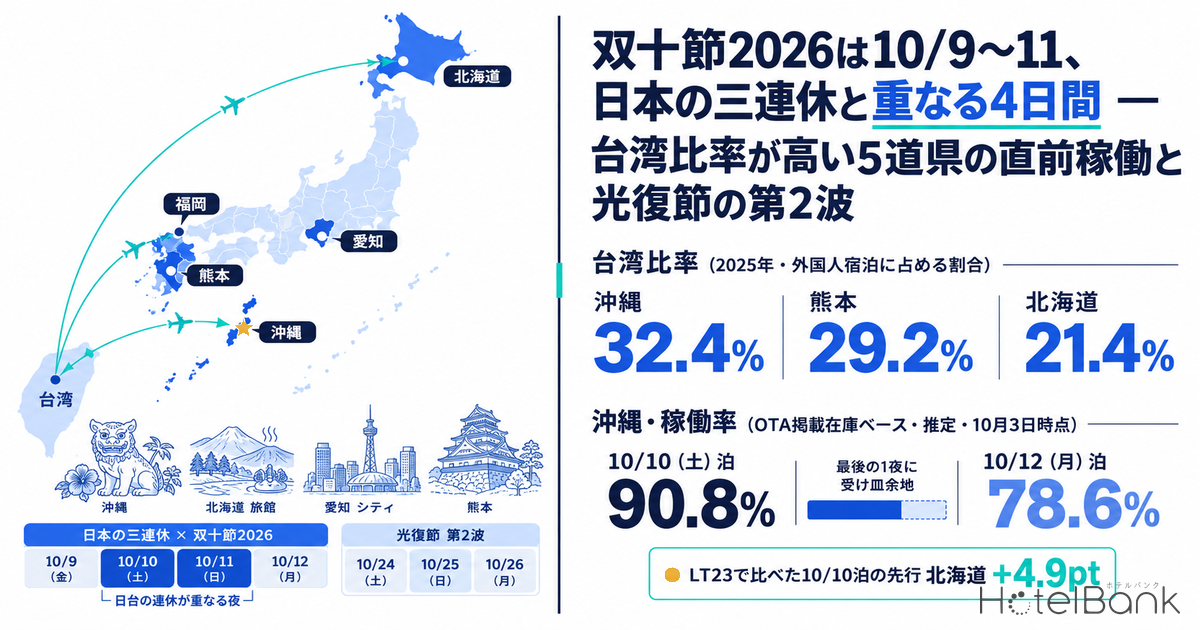
Taiwan’s 2026 holiday calendar moves the National Day (Double Ten) holiday on Saturday, October 10 to the preceding Friday, October 9, creating a three-day weekend from Oct 9 to Oct 11, and moves Retrocession Day on Sunday, October 25 to Monday, October 26, creating another three-day weekend from Oct 24 to Oct 26. In Japan, Monday, October 12 is Sports Day, making Oct 10-12 a three-day weekend. As a result, the four nights from Friday, October 9 through Monday, October 12 become an “overlapping four days” in which the Taiwanese and Japanese long weekends coincide, offset by one day. This article uses the 2025 annual figures from the Japan Tourism Agency’s Overnight Travel Statistics Survey to identify the prefectures where Taiwanese guest nights are concentrated. For five of them — Okinawa, Hokkaido, Fukuoka, Aichi and Kumamoto (with Tokyo and Osaka as references) — it then breaks down by property type how the four nights of Oct 9-12 differ from other October weekends, as observed on October 3. The second half checks the Oct 24-26 Retrocession Day weekend as a “second wave” using the same metrics, and also reports estimated settled ADR for October.
Metric Definitions Used in This Article
- ADR (Average Daily Rate): An estimated settled rate (tax-exclusive equivalent) calculated by applying a correction factor for each property type to the lowest-plan price level that each property publishes on OTAs (per room, two guests per room, tax included). When checked against property-level results disclosed by listed hotel REITs (91 properties, most recent three months), the median error is about 7%. These are estimates and differ from each property’s actual transacted rates and accounting figures. Area-level ADR is the median of the properties covered (the level of a typical property in the area).
- OCC (Occupancy): The share of rooms sold out of total rooms in the area (an estimate based on OTA sales inventory). In this article it is written as “occupancy (OTA-listed inventory basis, estimated)”. It is an estimate based on how inventory sold on OTAs is being consumed and differs from the actual occupancy of the whole property.
- Booking curve / LT: The trend in OTA rooms remaining toward the check-in date. LT (lead time) = days until check-in. The curves in this article use only observations within LT45, and when nights with different stay dates are compared they are aligned at the same LT (23 days before the stay date = LT23).
- Listed price: The per-room rate for two guests per room (tax included), averaged across all plans. A separate metric from ADR.
- Taiwan share: The share of Taiwan in foreign guest nights by nationality (place of origin) in the Japan Tourism Agency’s Overnight Travel Statistics Survey (establishments with 10 or more employees; for July 2026, establishments with 20 or more rooms).
- Data sources: MetroEngines Research, Japan Tourism Agency, Japan National Tourism Organization (JNTO)
- — Taiwanese visitors accounted for 19,971,870 guest nights nationwide in 2025, or 12.9% of all foreign guest nights. The Taiwan share of foreign guest nights within each prefecture was 32.4% in Okinawa, 29.2% in Kumamoto, 21.4% in Hokkaido, 19.2% in Aichi and 18.2% in Fukuoka, far above Tokyo (7.4%) and Osaka (9.0%).
- — As of October 3, occupancy (OTA-listed inventory basis, estimated) in Okinawa had reached 89.5% for the night of Oct 9 (Fri) and 90.8% for Oct 10 (Sat), while Oct 12 (Mon), the last day of the Japanese long weekend, stood at only 78.6%. All five prefectures share this pattern of spare capacity on the last of the four nights.
- — Aligned at 23 days before the stay date, the night of Oct 10 (Sat) ran ahead of a regular Saturday (Oct 17) by +4.9pt in Hokkaido and +3.0pt in Okinawa. By property type, ryokan in Hokkaido (+8.6pt), city hotels in Aichi (+6.0pt) and business hotels in Okinawa (+4.3pt) are filling first.
- — For the Retrocession Day weekend (Oct 24-26), the night of Oct 24 (Sat) is ahead of a regular Saturday at the same LT by +2.5pt in Hokkaido and +1.3pt in Kumamoto, but Oct 25 (Sun) and Oct 26 (Mon) are level with or below a regular Sunday, leaving ample capacity for the second wave.
Holiday Calendars in Taiwan and Japan — The “Overlapping Four Days” of Oct 9-12 and the Retrocession Day Second Wave
First, the dates. Under the 2026 (ROC Year 115) office calendar for government agencies published by the Directorate-General of Personnel Administration of Taiwan’s Executive Yuan, National Day on October 10 falls on a Saturday, so the preceding Friday, October 9 becomes a compensatory holiday and October 9-11 is a three-day weekend. In addition, Retrocession Day (October 25), which was reinstated as a public holiday in 2025, falls on a Sunday in 2026, so Monday, October 26 becomes a substitute holiday and October 24-26 is also a three-day weekend. This is a year in which Taiwan has two three-day weekends in October.
In Japan, as set out in the Cabinet Office’s “About National Holidays”, Monday, October 12 is Sports Day, making October 10 (Sat) to 12 (Mon) a three-day weekend. Sorted by stay date, the night of Oct 9 (Fri) is one when only Taiwan is on holiday; the nights of Oct 10 (Sat) and Oct 11 (Sun) are ones when both Taiwan and Japan are on holiday; and the night of Oct 12 (Mon) is one when only Japan is on holiday, which for Taiwanese travelers is the return day (most fly home the day before, on Oct 11). The night of Oct 9 is the right cut for seeing the pure uplift from Taiwanese demand, Oct 10 for seeing the overlap of demand, and Oct 12 for seeing remaining capacity.
| Stay date | Taiwan | Japan | How to read this night |
|---|---|---|---|
| Oct 3 (Sat) / Oct 4 (Sun) | Regular weekend | Regular weekend | Comparison weekend whose results were just finalized |
| Oct 9 (Fri) | Substitute holiday for National Day (first day of the long weekend) | Weekday | Only Taiwan is on holiday |
| Oct 10 (Sat) | National Day (Double Ten) | First day of the three-day weekend | Taiwanese and Japanese holidays overlap |
| Oct 11 (Sun) | Last day of the long weekend | Middle day of the three-day weekend | Eve of departure for Taiwanese guests; middle day for domestic guests |
| Oct 12 (Mon) | Weekday | Sports Day (last day of the three-day weekend) | Only Japan is on holiday; Taiwanese guests have gone home |
| Oct 16 (Fri) – Oct 18 (Sun) | Regular weekend | Regular weekend | Regular weekend for comparison |
| Oct 24 (Sat) – Oct 26 (Mon) | Retrocession Day three-day weekend (Oct 26 substitute holiday) | Regular weekend (Oct 26 is a weekday) | Taiwan’s second wave; on the night of Oct 26 only Taiwan is on holiday |
Source: Compiled by the HotelBank Editorial Team from the Directorate-General of Personnel Administration, Executive Yuan, “2026 (ROC Year 115) Office Calendar for Government Agencies” and the Cabinet Office of Japan, “About National Holidays”
Where Taiwanese Guests Stay — 19,971,870 Guest Nights in 2025, With In-Prefecture Shares of 32.4% in Okinawa and 29.2% in Kumamoto
We start with the size of the demand source. According to the 2025 annual figures of the Japan Tourism Agency’s Overnight Travel Statistics Survey (final figures, establishments with 10 or more employees), foreign guest nights by guests whose nationality (place of origin) is Taiwan totaled 19,971,870 nationwide, 12.9% of the 154,254,100 foreign guest nights overall. The Japan National Tourism Organization (JNTO) estimates that visitor arrivals from Taiwan reached a record 6,763,400 in 2025, and Taiwan’s own statistics (Tourism Administration, Ministry of Transportation and Communications) show that 35.6% of the 18.94 million Taiwanese outbound travelers in 2025 visited Japan. Most recently, Taiwanese arrivals hit a single-month record of 760,000 in July 2026, and August, at 666,000 (+7.3% YoY), was also a record for that month. With total arrivals to Japan down 9.6% YoY in August (3,098,900), Taiwan is one of the few markets still growing.
Taiwanese guests are not, however, spread evenly across the country. Table 2 lists the prefectures with the most Taiwanese guest nights in 2025, together with the Taiwan share of foreign guest nights within each prefecture. In absolute volume the order is Tokyo, Hokkaido, Osaka, Okinawa and Fukuoka, but by in-prefecture share the structure is different: about 30% in Okinawa and Kumamoto and around 20% in Hokkaido, Aichi and Fukuoka, against less than 10% in Tokyo, Osaka and Kyoto. The more Taiwanese guests a prefecture hosts, the more directly a Taiwanese long weekend feeds through to its lodging demand.
| Property location | Taiwan guest nights (2025) | Taiwan share within prefecture | Share of all Taiwan guest nights in Japan | Taiwan share, Oct 2025 | Taiwan share, Jul 2026 |
|---|---|---|---|---|---|
| Tokyo | 3,805,690 | 7.4% | 19.1% | 6.4% | 11.5% |
| Hokkaido | 2,403,820 | 21.4% | 12.0% | 25.1% | 22.5% |
| Osaka | 2,079,630 | 9.0% | 10.4% | 8.4% | 14.4% |
| Okinawa | 2,017,950 | 32.4% | 10.1% | 29.2% | 37.8% |
| Fukuoka | 1,422,250 | 18.2% | 7.1% | 17.3% | 25.7% |
| Kyoto | 1,116,250 | 7.2% | 5.6% | 5.0% | 11.2% |
| Aichi | 869,450 | 19.2% | 4.4% | 18.5% | 32.7% |
| Kumamoto | 456,610 | 29.2% | 2.3% | 25.9% | 31.6% |
| Chiba | 455,280 | 10.5% | 2.3% | 8.6% | 16.5% |
| Miyagi | 439,570 | 45.3% | 2.2% | 44.7% | 50.5% |
| Nagano | 376,230 | 20.4% | 1.9% | 20.3% | 25.2% |
| Hyogo | 339,980 | 17.9% | 1.7% | 13.2% | 35.9% |
| Japan total | 19,971,870 | 12.9% | 100% | 11.9% | 18.2% |
Source: Compiled by the HotelBank Editorial Team from the Japan Tourism Agency’s Overnight Travel Statistics Survey: 2025 annual figures (final, establishments with 10 or more employees), October 2025 (same basis) and July 2026 (second preliminary, establishments with 20 or more rooms). Because the establishment criteria differ for July 2026, it should be read as a guide to composition rather than a direct comparison of levels
Seasonality and recent changes are also worth a look. The Taiwan share in October 2025 was 11.9% nationwide, almost the same as for the full year, and the share held up in October in the prefectures where it is high: 29.2% in Okinawa, 25.1% in Hokkaido and 25.9% in Kumamoto. In July 2026 (establishments with 20 or more rooms) the national Taiwan share rose to 18.2%, with increases to 37.8% in Okinawa, 32.7% in Aichi, 31.6% in Kumamoto and 25.7% in Fukuoka. With guest nights from mainland China falling, the weight of Taiwan in the foreign guest mix has grown further in 2026. This is why the article focuses on the five prefectures of Okinawa, Hokkaido, Fukuoka, Aichi and Kumamoto and uses Tokyo and Osaka as references.
Source: Compiled by the HotelBank Editorial Team from the Japan Tourism Agency’s Overnight Travel Statistics Survey, 2025 annual figures
Booking Pace as of October 3 — Okinawa at 89.5% for Oct 9 and 90.8% for Oct 10, but 78.6% for the Final Night of Oct 12
We now turn to MetroEngines Research’s inventory observations. Table 3 shows occupancy estimated from OTA-listed inventory in each prefecture for the four nights of Oct 9-12, as observed on October 3 (covering a fixed set of properties in each prefecture confirmed as listed on OTAs; room counts as shown in the table). Because this is a snapshot taken 6 to 9 days before the stay dates, it should be read as work in progress, with room still to be added through last-minute bookings.
| Prefecture | Properties | Rooms | Oct 9 (Fri) | Oct 10 (Sat) | Oct 11 (Sun) | Oct 12 (Mon) | Rooms left, Oct 12 | Ref: Oct 3 (Sat), final |
|---|---|---|---|---|---|---|---|---|
| Okinawa | 876 | 36,059 | 89.5% | 90.8% | 85.4% | 78.6% | 7,707 rooms | 93.4% |
| Hokkaido | 752 | 55,723 | 81.3% | 90.9% | 81.4% | 70.2% | 16,615 rooms | 90.0% |
| Fukuoka | 424 | 29,327 | 87.4% | 93.5% | 84.5% | 72.6% | 8,027 rooms | 93.1% |
| Aichi | 345 | 33,433 | 79.3% | 89.0% | 81.3% | 70.2% | 9,912 rooms | 95.8% |
| Kumamoto | 320 | 13,018 | 77.4% | 91.9% | 84.7% | 68.4% | 4,111 rooms | 90.8% |
| Tokyo | 846 | 103,944 | 86.6% | 92.4% | 87.4% | 79.9% | 20,883 rooms | 95.7% |
| Osaka | 447 | 62,802 | 77.5% | 86.8% | 78.4% | 66.0% | 21,338 rooms | 88.8% |
Source: Compiled by MetroEngines Research and the HotelBank Editorial Team. Occupancy (OTA-listed inventory basis, estimated), observed on October 3, 2026 (the night of Oct 9 is at LT6 and Oct 12 at LT9). The night of Oct 3 is the value as of the day before the stay. Property and room counts are for the night of Oct 10; the count varies by a few properties depending on the stay date
In all five prefectures the night of Oct 10 (Sat) is the highest, and Okinawa at 90.8%, Fukuoka at 93.5%, Kumamoto at 91.9% and Hokkaido at 90.9% are already at around 90% a week before the stay date. By contrast, the night of Oct 12 (Mon) is at 78.6% in Okinawa, 68.4% in Kumamoto, 72.6% in Fukuoka, 70.2% in Hokkaido and 70.2% in Aichi, more than 10pt lower within the same long weekend. Oct 12 is the last night of the Japanese three-day weekend, when domestic guests are heading home, and Taiwanese travelers have already returned, so demand from both markets thins out at the same time. In terms of rooms remaining, 7,707 rooms in Okinawa, 16,615 in Hokkaido and 8,027 in Fukuoka were still on sale as of October 3, making this the largest pocket of spare capacity in the four days.
For the night of Oct 9 (Fri), Okinawa at 89.5% and Fukuoka at 87.4% are high, followed by Hokkaido at 81.3%, Kumamoto at 77.4% and Aichi at 79.3%. However, the Friday night is the closest to its stay date, at 6 days out, with the fewest observation days remaining, so comparing its level with the Saturday and Monday nights within the same table is not appropriate. The next section therefore compares the nights at the same distance from the stay date.
Source: Compiled by MetroEngines Research and the HotelBank Editorial Team (observed on October 3, 2026)
Aligned at 23 Days Before the Stay — Oct 10 (Sat) Is +4.9pt in Hokkaido and +3.0pt in Okinawa; Oct 9 (Fri) Is in Line With a Regular Friday
To compare nights with different stay dates fairly, the observation point has to be aligned by the number of days before the stay date (LT). This article uses LT23 (23 days before the stay date) as the common cut — the smallest LT for which an observation also exists for Oct 26, the last night of the Retrocession Day weekend — and lines up each night of the Double Ten weekend (Oct 9-12), the regular weekend (Oct 16-18) and the Retrocession Day weekend (Oct 24-26, plus the preceding Oct 23 for comparison) at that same LT23 value. Table 4 shows the result.
| Prefecture | Oct 9 (Fri) | Oct 16 (Fri) | Diff | Oct 10 (Sat) | Oct 17 (Sat) | Diff | Oct 11 (Sun) | Oct 18 (Sun) | Diff | Oct 12 (Mon) | vs Oct 18 (Sun) |
|---|---|---|---|---|---|---|---|---|---|---|---|
| Okinawa | 83.7% | 83.5% | +0.2pt | 86.1% | 83.1% | +3.0pt | 80.2% | 78.4% | +1.8pt | 74.3% | -4.1pt |
| Hokkaido | 75.5% | 77.3% | -1.8pt | 86.1% | 81.2% | +4.9pt | 75.6% | 73.7% | +1.9pt | 65.9% | -7.8pt |
| Fukuoka | 76.2% | 78.4% | -2.2pt | 83.8% | 83.2% | +0.6pt | 73.8% | 74.6% | -0.8pt | 63.4% | -11.2pt |
| Aichi | 70.5% | 80.9% | -10.4pt | 80.3% | 84.0% | -3.7pt | 73.1% | 77.3% | -4.2pt | 64.2% | -13.1pt |
| Kumamoto | 73.8% | 79.6% | -5.8pt | 89.3% | 87.9% | +1.4pt | 84.2% | 79.0% | +5.2pt | 68.3% | -10.7pt |
| Tokyo | 75.4% | 78.8% | -3.4pt | 83.2% | 79.8% | +3.4pt | 79.4% | 75.0% | +4.4pt | 72.2% | -2.8pt |
| Osaka | 67.1% | 70.3% | -3.2pt | 75.4% | 77.4% | -2.0pt | 68.1% | 67.1% | +1.0pt | 59.8% | -7.3pt |
Source: Compiled by MetroEngines Research and the HotelBank Editorial Team. Occupancy (OTA-listed inventory basis, estimated) as of 23 days before each stay date (LT23). Oct 9-12 were observed on Sep 16-19 respectively, and Oct 16-18 on Sep 23-25
At the same LT, the night of Oct 10 (Sat) in Hokkaido stood at 86.1%, +4.9pt above a regular Saturday (Oct 17, 81.2%), followed by Okinawa at +3.0pt, Tokyo at +3.4pt, Kumamoto at +1.4pt and Fukuoka at +0.6pt. This uplift includes the domestic factor of it being the first day of the Japanese three-day weekend and cannot be explained by Taiwanese demand alone, but the fact that it is largest in Hokkaido and Okinawa, where the Taiwan share is high, is consistent with the guest mix. Aichi at -3.7pt and Osaka at -2.0pt, on the other hand, show Oct 17 running ahead. In Aichi, bookings for the night of Oct 17 (Sat) built up earlier, which suggests capacity still remains on the Double Ten night.
What about the night of Oct 9 (Fri), when only Taiwan is on holiday? At LT23, Okinawa stood at 83.7% against 83.5% for a regular Friday (Oct 16), a gap of only +0.2pt, while Hokkaido at -1.8pt, Fukuoka at -2.2pt and Kumamoto at -5.8pt were below a regular Friday. A snapshot taken 30 days before the stay date had shown the Friday night in Okinawa and Fukuoka running about +2pt ahead of the adjacent weeks, but at 23 days out bookings for the regular weekend had caught up and the gap had narrowed. The extent to which Taiwanese holiday demand lands “early” on the Friday night is limited, and the natural reading is that capacity remains for last-minute demand.
Comparing the night of Oct 12 (Mon) with a regular Sunday (Oct 18), Okinawa is at -4.1pt, Hokkaido -7.8pt, Fukuoka -11.2pt, Aichi -13.1pt and Kumamoto -10.7pt: the final night of the long weekend starts from a level below a regular Sunday. It is also the lowest night in the October 3 figures of the previous section, and the higher the Taiwan share, the larger the drop on “the last night of the domestic long weekend, after the Taiwanese guests have left”. Of the four Double Ten days, this is the night with the most room to take in domestic guests, foreign residents and short-haul independent travelers while holding rates.
Source: Compiled by MetroEngines Research and the HotelBank Editorial Team. Booking curves for Okinawa (876 to 879 properties and about 36,100 rooms depending on the stay date), from LT45 to the latest observation (October 3)
Which Property Types Fill First — Ryokan in Hokkaido +8.6pt, City Hotels in Aichi +6.0pt, Business Hotels in Okinawa +4.3pt
In prefectures with many Taiwanese guests, which property types fill first? Table 5 compares occupancy at LT23 for the night of Oct 10 (Sat) and a regular Saturday (Oct 17) by property type. The types follow MetroEngines Research’s property classification (business, city, resort and ryokan), and categories with fewer than 10 properties are not shown.
| Prefecture | Property type | Properties | Rooms | Oct 10 (Sat) LT23 | Oct 17 (Sat) LT23 | Diff | Oct 9 (Fri) LT23 | Oct 16 (Fri) LT23 | Diff |
|---|---|---|---|---|---|---|---|---|---|
| Okinawa | Business | 137 | 12,770 | 88.3% | 84.0% | +4.3pt | 85.2% | 87.1% | -1.9pt |
| Resort | 189 | 15,960 | 87.8% | 86.1% | +1.7pt | 87.2% | 85.3% | +1.9pt | |
| Hokkaido | Business | 218 | 26,749 | 85.8% | 81.3% | +4.5pt | 75.6% | 77.1% | -1.5pt |
| City | 35 | 8,713 | 89.1% | 84.8% | +4.3pt | 80.7% | 87.2% | -6.5pt | |
| Resort | 92 | 10,369 | 86.5% | 84.1% | +2.4pt | 74.2% | 76.9% | -2.7pt | |
| Ryokan | 154 | 6,923 | 88.3% | 79.7% | +8.6pt | 77.2% | 75.2% | +2.0pt | |
| Fukuoka | Business | 176 | 22,751 | 84.1% | 83.7% | +0.4pt | 77.5% | 80.0% | -2.5pt |
| City | 25 | 3,354 | 86.5% | 87.0% | -0.5pt | 81.4% | 79.6% | +1.8pt | |
| Resort | 13 | 742 | 89.2% | 91.5% | -2.3pt | 68.5% | 82.6% | -14.1pt | |
| Ryokan | 49 | 903 | 83.2% | 79.0% | +4.2pt | 62.2% | 58.8% | +3.4pt | |
| Aichi | Business | 166 | 25,358 | 77.8% | 84.4% | -6.6pt | 69.6% | 82.0% | -12.4pt |
| City | 23 | 3,674 | 92.4% | 86.4% | +6.0pt | 80.0% | 82.9% | -2.9pt | |
| Ryokan | 85 | 1,814 | 78.4% | 70.4% | +8.0pt | 55.5% | 64.1% | -8.6pt | |
| Kumamoto | Business | 56 | 7,035 | 86.4% | 85.4% | +1.0pt | 72.8% | 82.0% | -9.2pt |
| City | 11 | 1,255 | 97.1% | 92.9% | +4.2pt | 83.6% | 87.5% | -3.9pt | |
| Resort | 19 | 1,093 | 96.2% | 93.6% | +2.6pt | 86.2% | 84.2% | +2.0pt | |
| Ryokan | 142 | 2,667 | 95.1% | 95.1% | +0.0pt | 80.4% | 81.6% | -1.2pt |
Source: Compiled by MetroEngines Research and the HotelBank Editorial Team. Occupancy (OTA-listed inventory basis, estimated) as of 23 days before each stay date. City and ryokan in Okinawa and some categories in Fukuoka, Aichi and Kumamoto are not shown because they have fewer than 10 properties
In Hokkaido the night of Oct 10 is ahead across every property type — ryokan +8.6pt, business +4.5pt, city +4.3pt and resort +2.4pt — with the uplift for ryokan particularly large. Mid-October is the season of autumn foliage and hot springs in Hokkaido, a time when both domestic and Taiwanese guests readily choose ryokan, which is likely part of the background. In Okinawa, business hotels are at +4.3pt against +1.7pt for resorts, meaning the business hotels concentrated in Naha are filling first. This is consistent with direct flights from Taiwan being concentrated on Naha and with many itineraries spending the first and last days of the stay in the city.
In Aichi, city hotels (+6.0pt) and ryokan (+8.0pt) are ahead, while business hotels are at -6.6pt, higher on the regular Saturday; the overall gap looked small because of the weight of business hotels, which have the most rooms. In Kumamoto, city hotels (+4.2pt) and resorts (+2.6pt) are ahead, and ryokan are at +0.0pt, already filled to the same level on the regular Saturday, which shows that ryokan demand on autumn weekends is strong regardless of the long weekend. In Fukuoka, ryokan are at +4.2pt and business hotels at +0.4pt, so business hotels, with their large room count, are at almost the same pace as a regular Saturday. Even among prefectures with a high Taiwan share, the order in which rooms fill takes a common shape: limited-service hotels in city centers and ryokan first, large resorts and suburban business hotels later.
Source: Compiled by MetroEngines Research and the HotelBank Editorial Team (gap between the nights of Oct 10 and Oct 17 at LT23; categories with 10 or more properties only)
The Second Wave: Retrocession Day Three-Day Weekend (Oct 24-26) — Oct 24 (Sat) Is +2.5pt in Hokkaido, With Capacity Left on Oct 26 (Mon)
Taiwan has a second three-day weekend in October. For the Retrocession Day weekend of Oct 24 (Sat) to Oct 26 (Mon) there is no public holiday on the Japanese side, so the night of Oct 26 (Mon), like the night of Oct 9 (Fri) for Double Ten, is one when only Taiwan is on holiday. Table 6 compares the three nights of the Retrocession Day weekend with the regular weekend at the same LT23 cut.
| Prefecture | Oct 24 (Sat) | Oct 17 (Sat) | Diff | Oct 25 (Sun) | Oct 18 (Sun) | Diff | Oct 26 (Mon) | Oct 23 (Fri) | Oct 26 latest (as of Oct 3) |
|---|---|---|---|---|---|---|---|---|---|
| Okinawa | 83.3% | 83.1% | +0.2pt | 78.4% | 78.4% | +0.0pt | 75.9% | 83.3% | 75.9% |
| Hokkaido | 83.7% | 81.2% | +2.5pt | 71.7% | 73.7% | -2.0pt | 71.4% | 78.2% | 71.4% |
| Fukuoka | 94.5% | 83.2% | +11.3pt | 75.3% | 74.6% | +0.7pt | 71.6% | 81.4% | 71.6% |
| Aichi | 83.1% | 84.0% | -0.9pt | 67.9% | 77.3% | -9.4pt | 66.9% | 83.7% | 66.9% |
| Kumamoto | 89.2% | 87.9% | +1.3pt | 75.5% | 79.0% | -3.5pt | 70.9% | 79.7% | 70.9% |
| Tokyo | 83.6% | 79.8% | +3.8pt | 79.4% | 75.0% | +4.4pt | 79.6% | 78.9% | 79.6% |
| Osaka | 85.1% | 77.4% | +7.7pt | 70.9% | 67.1% | +3.8pt | 65.1% | 74.4% | 65.1% |
Source: Compiled by MetroEngines Research and the HotelBank Editorial Team. Occupancy (OTA-listed inventory basis, estimated) as of 23 days before each stay date. For the night of Oct 26, LT23 coincides with the latest observation (October 3)
The night of Oct 24 (Sat) is slightly above a regular Saturday in Hokkaido (+2.5pt), Kumamoto (+1.3pt) and Tokyo (+3.8pt), and at the same level in Okinawa (+0.2pt). Fukuoka’s 94.5% stands out at +11.3pt above a regular Saturday, but with business hotels filled to 96.1%, domestic factors other than Taiwanese demand may be at work, so this article treats it separately from the Taiwanese second wave.
The nights of Oct 25 (Sun) and Oct 26 (Mon), meanwhile, are tracking level with or below a regular Sunday (Oct 18) in all five prefectures. The latest values for the night of Oct 26 (Mon) (as of October 3, LT23) are 75.9% in Okinawa, 71.4% in Hokkaido, 70.9% in Kumamoto, 71.6% in Fukuoka and 66.9% in Aichi; this night, when only Taiwan is on holiday, enters its three-week selling window with even more room than the night of Oct 9 (Fri) for Double Ten. Retrocession Day is in only its second year since being reinstated as a holiday in 2025, and travel demand around it as a long weekend is still taking hold. To capture the second wave, the rational design is not to sell around Oct 24 (Sat) alone but to have three-night stays that include Oct 25 (Sun) and Oct 26 (Mon) ready for the Taiwanese market.
Estimated Settled ADR for October — The Five High-Taiwan-Share Prefectures Are Selling Above the Same Month Last Year
On price, we compared each prefecture’s estimated settled ADR (as defined at the top of the article: an estimate applying a property-type correction to the lowest OTA plan level, tax-exclusive equivalent, area median) between October 2025, a month with actual results, and a snapshot of October 2026 taken at the time of the survey. The October 2026 values are estimates based on selling prices listed on OTAs as of October 4 and will move as the stay dates approach.
| Prefecture | Oct 2025 estimated settled ADR | Properties covered | Oct 2026 estimated settled ADR (at time of survey) | Properties covered | YoY | Ref: Oct 2026 listed price (all-plan average, tax incl.) |
|---|---|---|---|---|---|---|
| Okinawa | ¥10,852 | 492 | ¥12,731 | 507 | +17.3% | ¥27,512 (2,206 properties) |
| Hokkaido | ¥9,708 | 901 | ¥12,370 | 898 | +27.4% | ¥26,966 (2,154 properties) |
| Fukuoka | ¥11,229 | 466 | ¥14,670 | 470 | +30.6% | ¥27,193 (944 properties) |
| Aichi | ¥8,738 | 497 | ¥12,837 | 489 | +46.9% | ¥23,886 (752 properties) |
| Kumamoto | ¥10,428 | 374 | ¥14,298 | 398 | +37.1% | ¥26,459 (714 properties) |
| Tokyo | ¥15,625 | 1,103 | ¥19,048 | 1,104 | +21.9% | ¥29,963 (2,383 properties) |
| Osaka | ¥13,392 | 641 | ¥11,135 | 643 | -16.9% | ¥18,250 (1,231 properties) |
Source: Compiled by MetroEngines Research and the HotelBank Editorial Team. Estimated settled ADR is the tax-exclusive equivalent area median; October 2026 is an estimate based on listed levels as of October 4. Listed price is the per-room rate for two guests per room (tax included) averaged across all plans, a separate metric from ADR
Estimated settled ADR for October 2026 in the five prefectures is about ¥12,700 in Okinawa (+17.3% YoY), about ¥12,400 in Hokkaido (+27.4%), about ¥14,700 in Fukuoka (+30.6%), about ¥14,300 in Kumamoto (+37.1%) and about ¥12,800 in Aichi (+46.9%), all selling above the actual results of the same month last year. October 2026 is a snapshot at the time of the survey and will move up or down with last-minute demand, so the point to take away is less the growth rates themselves than the fact that October selling has started from a position above last year’s results. The -16.9% for Osaka, included as a reference, reflects a high base: October 2025 was the closing month of Expo 2025 Osaka, Kansai (October 13).
Note that the listed price (all-plan average, tax included) shown at the right of the table is roughly twice the estimated settled ADR. The listed price is an average of published prices that includes unsold high-priced plans and plans with meals; it is not a transacted rate. Estimated settled ADR should be used when discussing price levels, and listed price when discussing how a property appears alongside competitors on OTAs.
Implications for Lodging Operators and DMOs — Do Not Sell the Four Days as One Long Weekend
Translating these observations into sales design, the first point is that Oct 9-12 should not be sold as “one three-day weekend” with uniform rates and restrictions. On the night of Oct 10 (Sat), Taiwanese and Japanese demand overlap and prefectures with a high Taiwan share were at around 90% a week out, so this is a night on which to sell the remaining rooms through to the end while holding rate. The night of Oct 12 (Mon), by contrast, is one when Taiwanese guests have returned home and domestic guests are also heading back, and it starts from a level below a regular Sunday. Measures such as multi-night offers targeting the second night of an Oct 11 (Sun) – Oct 12 (Mon) stay, or lifting minimum-stay restrictions on the night of Oct 12, offer room to increase rooms sold across the four days as a whole.
Seen as capacity for the Taiwanese market, the fact that the nights of Oct 9 (Fri) and of Oct 26 (Mon) for Retrocession Day — the nights when only Taiwan is on holiday — are tracking level with or below a regular Friday and Sunday at the same LT means there is still room to capture last-minute Taiwanese demand. Taiwan is a short-haul market with direct flights to Naha, Fukuoka, New Chitose and Chubu airports, so even a short trip is easy to make. The basics — property information and plan names in Traditional Chinese, three-night stays set to match the Taiwanese holiday dates, and access information from Naha, New Chitose, Fukuoka and Chubu airports — are likely to be especially effective on these two nights.
The order by property type can also be used in the design. Ryokan in Hokkaido, business hotels in Naha in Okinawa and city hotels in Aichi and Kumamoto fill first, with large resorts and suburban business hotels following later. The types that fill first have room to lift rates on the peak night, while those that fill later have room to build up the shoulder nights of the long weekends (Oct 9, Oct 12 and Oct 26). For DMOs, the faster the guest mix is changing — as in Okinawa and Kumamoto, where the Taiwan share is around 30%, or Aichi and Hyogo, where it rose into the 30% range in July 2026 — the greater the value of tracking pace by property type for each long weekend and timing communications accordingly.
Summary
In October 2026 Taiwan has two three-day weekends, Double Ten (Oct 9-11) and Retrocession Day (Oct 24-26), and the former overlaps with the Japanese three-day weekend (Oct 10-12) to create the four nights of Oct 9-12. In Okinawa (32.4%), Kumamoto (29.2%), Hokkaido (21.4%), Aichi (19.2%) and Fukuoka (18.2%), where the Taiwan share is high in the Japan Tourism Agency’s 2025 annual figures, the night of Oct 10 (Sat) had reached around 90% as of October 3, and the gap against a regular Saturday at the same LT was +4.9pt in Hokkaido and +3.0pt in Okinawa. By property type, ryokan in Hokkaido, business hotels in Okinawa and city hotels in Aichi and Kumamoto fill first. Meanwhile, the night of Oct 9 (Fri), when only Taiwan is on holiday, and the night of Oct 12 (Mon), when only Japan is on holiday, are tracking level with or below the same day of the week in a regular period, and on Oct 12, the final night of the long weekend, 7,707 rooms in Okinawa and 16,615 rooms in Hokkaido remain available. For the Retrocession Day weekend too, the lead for the night of Oct 24 (Sat) is small, and Oct 25 and 26 enter their three-week selling window with capacity to spare. Estimated settled ADR shows October selling starting above the same month last year in all five prefectures, and designing each night individually rather than selling the four days uniformly is a practical way to widen capacity for the Taiwanese market.
Frequently Asked Questions
Q. When is the Double Ten long weekend in 2026?
Because National Day (Double Ten) on October 10 falls on a Saturday, the preceding Friday, October 9 becomes a substitute holiday, making a three-day weekend from Friday, October 9 to Sunday, October 11. Combined with the Japanese three-day weekend that includes Sports Day (October 12), the four nights from October 9 to October 12 are where the Taiwanese and Japanese holidays overlap.
Q. When is the Retrocession Day long weekend in 2026?
Because Retrocession Day on October 25 falls on a Sunday, Monday, October 26 becomes a substitute holiday, making a three-day weekend from Saturday, October 24 to Monday, October 26. There is no public holiday on the Japanese side, so the night of October 26 is one when only Taiwan is on holiday.
Q. Which Japanese prefectures have the most guest nights from Taiwan?
According to the 2025 annual figures of the Japan Tourism Agency’s Overnight Travel Statistics Survey, Taiwanese guest nights are highest in Tokyo, Hokkaido, Osaka, Okinawa and Fukuoka, in that order, while the Taiwan share of foreign guest nights within the prefecture is high in Okinawa (32.4%), Kumamoto (29.2%), Hokkaido (21.4%), Aichi (19.2%) and Fukuoka (18.2%). Some prefectures, such as Miyagi (45.3%) and Kagawa (34.5%), have a high share even though the absolute volume is small.
Related Articles
- China National Day 2026: 21pt Weekday OCC Gap Across 26 Prefectures
- Double Ten x Sports Day: Japan’s Oct 9-12 Capacity at 76 Days Out
⚠ Note on figures for future dates: The occupancy figures (OTA-listed inventory basis, estimated) for Oct 9 onward in this article are as observed on October 3, 2026, and the estimated settled ADR for October 2026 is an estimate based on selling prices published on OTAs as of October 4; both will change as check-in dates approach. Please note that last-minute bookings, cancellations and price adjustments may move them up or down from the values shown here.
References and Sources
■ Data sources
The Taiwan share and guest nights are from Reference Table 1 of the Japan Tourism Agency’s Overnight Travel Statistics Survey (2025 annual figures and October 2025 are final figures for establishments with 10 or more employees; July 2026 is the second preliminary release for establishments with 20 or more rooms). Occupancy (OTA-listed inventory basis, estimated) and booking curves are from MetroEngines Research’s inventory observations (as of October 3, 2026; 4,010 properties in total across seven prefectures for the night of Oct 10), and estimated settled ADR and listed price are from its aggregation as of October 4, 2026.
■ Assumptions
Nights with different stay dates are compared using values as of 23 days before the stay date (LT23), with gaps shown as percentage-point differences. The regular weekend is Oct 16-18, and the comparison nights for the Retrocession Day weekend are Oct 17 (Sat), Oct 18 (Sun) and Oct 23 (Fri). By property type, only categories with 10 or more properties are shown. The YoY change in estimated settled ADR compares October 2025 (a month with actual results) with October 2026 (an estimate based on listed levels at the time of the survey).
■ Limitations and caveats
Occupancy is an estimate based on how inventory sold on OTAs is being consumed and is defined differently from the actual occupancy of the whole property. Because the nationality of bookers cannot be observed, gaps against the regular weekend include non-Taiwanese factors such as the Japanese three-day weekend. Values for Oct 9 onward are work in progress and will change with last-minute bookings, cancellations and price adjustments. The 2025 and July 2026 Taiwan-share figures use different establishment criteria and are not suited to a direct comparison of levels.
- Japan Tourism Agency, Overnight Travel Statistics Survey, 2025 annual figures (final) and July 2026 second preliminary release — Reference Table 1: Foreign guest nights by property location and nationality (place of origin)
- Japan National Tourism Organization (JNTO), “Visitor Arrivals to Japan (August 2026 estimates)” (September 16, 2026)
- Travel Voice, “Visitor arrivals to Japan at 3.1 million in August 2026 as the decline widens to 10%, while 14 markets set record highs” (September 16, 2026)
- Honichi Lab, “Visitor arrivals to Japan at 3.442 million in July; Taiwan at a record 760,000” (August 19, 2026)
- Yamatogokoro, “Visitor arrivals to Japan reach a record 42.68 million in 2025, up 15.8% YoY” (market breakdown of JNTO 2025 annual estimates)
- Yamatogokoro, “2025 Taiwan tourism statistics: outbound travelers at a record 18.94 million, visits to Japan up to 6.73 million” (2025 final figures from the Tourism Administration, Taiwan Ministry of Transportation and Communications)
- Business Today (Taiwan), “2026 (ROC Year 115) calendar: How many days off for the National Day holiday? Is Retrocession Day a day off?” (long-weekend dates based on the Executive Yuan Directorate-General of Personnel Administration office calendar for ROC Year 115)
- Cabinet Office of Japan, “About National Holidays” (Sports Day in 2026 is October 12)
- MetroEngines Research — Occupancy (estimated) and booking curves based on OTA-listed inventory (as observed on October 3, 2026; 4,010 properties in total across seven prefectures for the night of Oct 10), and estimated settled ADR (as of October 4, 2026)