

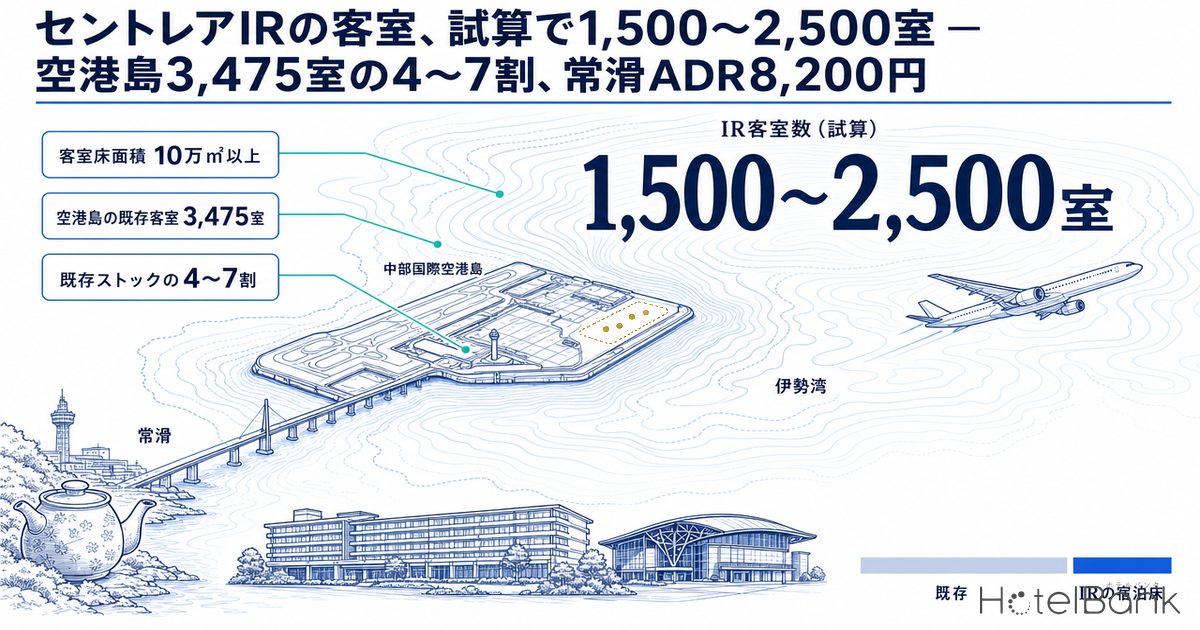
Since April 1, 2026, Aichi Prefecture has been soliciting proposals from prospective operators of an integrated resort (IR) on roughly 50ha of prefecture-owned and other land on the Chubu Centrair International Airport island. The deadline for submitting expressions of interest was extended from the original July 31 to September 30. The prefecture’s request for proposals (RFP) does not set a room count for the accommodation facility; instead it requires that “the total floor area of all guest rooms be approximately 100,000㎡ or more.” This article converts that floor-area requirement into room counts and estimates at what scale, and in which price band, the IR’s accommodation floor space could sit relative to the existing lodging stock on the airport island and the price levels of the Tokoname and Chita area.
How this differs from our earlier coverage: our analysis of investment headroom for airport-adjacent hotels across five airports (Kansai, Fukuoka, Naha, New Chitose and Chubu) and Hotels Within 3km of 4 Airports: 148 Properties, 14,827 Rooms approached airport-adjacent hotels from the aviation-demand side (pre- and post-flight stays). Our analysis of the Yumeshima IR’s 2,500 rooms, equal to 26% of the 9,559 rooms in Osaka’s four bay wards, covers the Osaka IR. This article starts from the IR solicitation as an institutional event and looks at the scale of new accommodation floor space that would be added to the airport island. The Osaka IR plan figures are used only as reference values for the conversion.
Metric Definitions Used in This Article
- ADR (average daily rate): An estimated settled rate (tax-exclusive equivalent) calculated by applying a segment-specific adjustment factor to the lowest-priced plan level each property publishes on OTAs and similar channels (two guests per room, price per room, tax included). When checked against the property-level results disclosed by listed hotel REITs (91 properties, most recent three months), the median error is about 7%. These are estimates and differ from each property’s actual settled prices and accounting figures. Area-level ADR is the median of the properties covered (the level of a typical property in the area).
- OCC (occupancy rate): The share of rooms sold relative to total rooms in the area (an estimate based on inventory sold through OTAs; a consistency check against monthly figures published by REITs confirmed accuracy within roughly a few percentage points). It is an estimate based on the sell-through of inventory offered on OTAs and differs from the actual occupancy of a whole property.
- Guest room floor area: “The total floor area of all guest rooms” as referred to in Aichi Prefecture’s RFP. This is a different figure from the gross floor area of the accommodation facility, which includes lobbies, food and beverage outlets, banquet space and so on.
- Data source: MetroEngines Research & Consulting
- — The prefecture’s requirement is not a room count but 100,000㎡ or more of guest room floor area. At an average room size of 40㎡ that is 2,500 rooms, at 50㎡ it is 2,000 rooms, and at the Osaka IR plan’s average of 66.8㎡ it is about 1,500 rooms.
- — The existing stock on the airport island is 6 properties and 3,475 rooms. Even with floor area exactly at the requirement, the IR’s accommodation floor space would be equivalent to 43–72% of the existing stock.
- — About two-thirds of the rooms on the island are limited-service hotels with an estimated settled ADR in the ¥7,000s, and the ¥20,000+ band holds only 319 rooms (9.2%). IR hotels, which are required to be internationally competitive, are likely to be stacked in an upper band separate from the existing pre- and post-flight demand.
- — Tokoname City’s estimated settled ADR averaged ¥8,154 over the latest 12 months (−0.6% YoY). It has been running slightly below Aichi Prefecture as a whole (¥8,777, +5.6% YoY).
- — The project term is 35 years from plan certification. Operator selection is set for autumn 2026–spring 2027 (if a suitable proposal is received), and the period for applying to the national government for certification of the area development plan is May 6–November 5, 2027.
Key Points of the IR Solicitation — 50ha, Exhibition Center Included, 35 Years, Deadline September 30
According to the implementation policy and RFP that Aichi Prefecture adopted in March 2026, the planned IR area covers approximately 50ha in Centrair 4-chome and 5-chome, Tokoname City, and includes the Aichi International Exhibition Center (Aichi Sky Expo; gross floor area approx. 90,000㎡, exhibition area 60,000㎡). The prefecture plans to sell the exhibition center to the IR operator and to lease or sell the land. The stated vision is “an international tourism city with MICE at its core,” and the facility mix consists of six types: international conference and exhibition facilities, attraction-enhancement facilities, tourism gateway facilities, accommodation facilities, facilities contributing to visitation and stays, and a casino facility. The gaming area is capped at 3% of the total floor area of the IR facilities.
The schedule was revised on June 17, 2026. The deadline for expressions of interest is now Wednesday, September 30; competitive dialogue runs until around winter of fiscal 2026; and the deadline for proposal documents is around winter of fiscal 2026. Selection of the preferred operator is described as “autumn 2026–spring 2027 (if a suitable proposal is received).” At the national level, the Japan Tourism Agency amended the cabinet order under the Act on Development of Specified Integrated Resort Districts, setting the application period for certification of area development plans as May 6 to November 5, 2027. The nationwide cap is three certified areas, of which one, Yumeshima in Osaka, has been certified.
| Item | Details (Aichi Prefecture RFP as revised June 17, 2026, and other sources) |
|---|---|
| Planned IR area | Centrair 4-chome and 5-chome, Tokoname City; approx. 50ha of prefecture-owned and other land |
| Zoning / floor area ratio | Quasi-industrial district (FAR 300%) / commercial district (FAR 500%); 45m height limit (Civil Aeronautics Act) |
| Existing building in the area | Aichi International Exhibition Center (gross floor area approx. 90,000㎡, exhibition area 60,000㎡) |
| Accommodation requirement | Total floor area of all guest rooms of approximately 100,000㎡ or more. No room count specified |
| Project term | 35 years from plan certification (extension may be requested) |
| Deadline for expressions of interest | September 30, 2026 (originally July 31) |
| Deadline for proposal documents | Around winter of fiscal 2026 (originally around autumn 2026) |
| Selection of preferred operator | Autumn 2026–spring 2027 (if a suitable proposal is received) |
| Application period for national certification | May 6–November 5, 2027 |
Source: Compiled by the HotelBank Editorial Team from Aichi Prefecture, “Implementation Policy for Development of the Specified Integrated Resort District on the Chubu Centrair International Airport Island” and “Request for Proposals for the IR Establishment and Operation Project (revised June 17, 2026),” and Japan Tourism Agency materials
The point to note here is the 45m height limit. Because the site adjoins the airport, the accommodation buildings will have to be designed as low- to mid-rise structures spread horizontally rather than as high-rise towers. The building volume needed to fit 100,000㎡ of guest room floor area is checked in the estimates later in this article.
Existing Rooms on the Airport Island: 6 Properties, 3,475 Rooms — Last Major Supply Was in 2019
As far as MetroEngines Research has identified, there are 6 accommodation properties with 3,475 rooms on the airport island, all of which were confirmed to be on sale through OTAs and similar channels in the latest 12 months. Widening the scope to a 3km radius from the center of the airport island, which takes in Rinku-cho on the opposite shore, adds J Hotel Rinku (Jホテルりんくう; 180 rooms), for a total of 7 properties and 3,655 rooms. One annex for group guests is also registered within the same radius, but it was excluded from the count because no sales through OTAs or similar channels could be confirmed.
| Property | Location | Opened | Rooms |
|---|---|---|---|
| Centrair Hotel (中部国際空港セントレアホテル) | Centrair 1-chome (directly connected to the passenger terminal) | 2005 | 381 |
| Comfort Hotel Central International Airport (コンフォートホテル中部国際空港) | Centrair 4-chome | 2005 | 350 |
| Toyoko Inn Chubu International Airport 1 (東横INN中部国際空港1) | Centrair 4-chome | 2007 | 1,001 |
| TUBE Sq (capsule) | Centrair 1-chome (passenger terminal, 1F) | 2017 | 138 |
| Four Points by Sheraton Nagoya, Chubu International Airport (フォーポイントバイシェラトン名古屋 中部国際空港) | Centrair 4-chome | 2018 | 319 |
| Toyoko Inn Chubu International Airport 2 (東横INN中部国際空港2) | Centrair 4-chome | 2019 | 1,286 |
| Airport island total | 3,475 | ||
| (Reference) J Hotel Rinku (Jホテルりんくう) | Rinku-cho, Tokoname City | 2006 | 180 |
Source: MetroEngines Research & Consulting (based on confirmed OTA listings, N=7 properties). Room counts cross-checked against figures published by each company (property information from Ichigo Hotel REIT Investment Corporation (いちごホテルリート投資法人), Kankokeizai News and others)
Lining up the opening years, two properties opened in 2005 when the airport opened, one large property followed in 2007, and two more were added in 2018–2019 around the opening of the Aichi International Exhibition Center (August 2019). The two Toyoko Inn Chubu International Airport buildings (1 and 2) account for 2,287 rooms, about two-thirds of the island’s total, and absorb large volumes of pre- and post-flight stays for early-morning and late-night flights as well as demand from trade show exhibitors. On the basis of building confirmation applications in the Ministry of Land, Infrastructure, Transport and Tourism’s Building Starts Statistics, no new large hotel project can be confirmed in Tokoname City at this point (because confirmation applications are filed one to two years before opening, this should be read as a lower bound).
Source: MetroEngines Research & Consulting (N=7 properties); Aichi Prefecture RFP (location of the planned IR area). Circle size = room count; dashed line = 3km radius from the center of the airport island
Tokoname Price Levels — Estimated Settled ADR of ¥8,154, with the Island Centered on the ¥7,000s
Tokoname City’s estimated settled ADR averaged ¥8,154 over the 12 months from September 2025 to August 2026 (N=12–13 properties). Compared with ¥8,201 in the same period a year earlier (September 2024–August 2025), that is −0.6%, or essentially flat. Aichi Prefecture as a whole stood at ¥8,777 for the same period, up 5.6% from ¥8,309 a year earlier. On a monthly basis, Tokoname City fell 15.4% and 15.3% YoY in June and July 2026 respectively, while August recovered to ¥7,991, narrowing the decline to −5.8% YoY.
Source: Compiled by the HotelBank Editorial Team from MetroEngines Research (Tokoname City N=12–13 properties, Aichi Prefecture N=495–520 properties)
Sorting the six on-island properties into price bands by their 12-month average estimated settled ADR makes the structure clear. The ¥7,000s band holds 2,287 rooms (65.8%), the ¥10,000–14,000s band holds 731 rooms, and the ¥20,000+ band holds 319 rooms (9.2%). The room-weighted average is about ¥9,200, close to the Tokoname City median. In other words, today’s airport island is a market that absorbs aviation and exhibition demand through a large supply of limited-service rooms, and its upper price tier is thin.
Source: Compiled by the HotelBank Editorial Team from MetroEngines Research (6 properties and 3,475 rooms on the airport island, classified by average estimated settled ADR for September 2025–August 2026)
Comparison with neighboring municipalities shows where Tokoname sits. Minamichita Town in the southern Chita Peninsula (¥16,830, N=53–56 properties) and Gamagori City on Mikawa Bay (¥15,314, N=22–23 properties) have a high share of ryokan and resort properties and correspondingly high rates. Set alongside the downtown business locations of Nagoya’s Nakamura Ward (¥10,441) and Naka Ward (¥9,587) and the Aichi Prefecture city-hotel median (¥12,675, N=30–31 properties), Tokoname also sits in a price band dominated by limited-service hotels. Note, however, that differences in estimated settled ADR between municipalities reflect not only differences in price itself but also differences in property mix, such as ryokan, resort and business hotels.
Source: Compiled by the HotelBank Editorial Team from MetroEngines Research (average estimated settled ADR for September 2025–August 2026; figures in parentheses are the range of properties covered each month)
Supply and Demand in the Prefecture — Estimated OCC of 82.5% in August 2026
Because Tokoname City alone does not have enough properties (a large enough cohort) to calculate estimated OCC, supply and demand are checked for Aichi Prefecture as a whole. Estimated OCC in August 2026 was 82.5% (337 properties and 33,846 rooms covered, based on listings on major booking sites), rising step by step from 79.6% in June and 81.7% in July. Business hotels stood at 82.5% and city hotels at 80.1%, so the gap between segments is small.
| Segment | Properties covered | Rooms covered | June 2026 | July 2026 | August 2026 |
|---|---|---|---|---|---|
| All properties | 337 | 33,846 | 79.6% | 81.7% | 82.5% |
| Business | 171 | 25,703 | 80.1% | 81.8% | 82.5% |
| City | 22 | 3,565 | 77.8% | 80.9% | 80.1% |
| Ryokan | 82 | 1,738 | 75.1% | 77.2% | 80.9% |
Source: Compiled by the HotelBank Editorial Team from MetroEngines Research. Properties and rooms covered are the August 2026 cohort (properties listing 30% or more of their total rooms on major booking sites; based on listings on major booking sites). The June and July cohorts differ slightly in size
As the foundation on the demand side, Chubu Centrair International Airport handled 11,589,759 air passengers in fiscal 2025 (April 2025–March 2026), up 5% from the previous fiscal year, of which international passengers numbered 5,361,237, up 9% (Central Japan International Airport Co., Ltd., final figures).
Scale Scenarios for IR Accommodation Floor Space — How Many Rooms Is 100,000㎡?
Because the prefecture’s requirement is expressed as total guest room floor area, the room count depends on what “average room size” is assumed. As a reference, the Osaka IR, whose area development plan has already been certified, has 2,500 rooms across three buildings with total guest room floor area of 167,018㎡, an average of about 66.8㎡. The breakdown is the luxury MGM Osaka (1,830 rooms), top-end villas (10 rooms) and the upper-upscale MUSUBI Hotel (660 rooms); the minimum floor area of a standard room is approximately 30㎡ or more, and suites account for roughly 20% or more of the total.
On that basis, room counts were converted for combinations of three floor-area levels and three average room sizes. At exactly the required 100,000㎡, the result is 2,500 rooms at an average of 40㎡, 2,000 rooms at 50㎡, and about 1,500 rooms at the Osaka IR’s 66.8㎡.
| Total guest room floor area | Average 40㎡ | Average 50㎡ | Average 66.8㎡ (in line with the Osaka IR plan) |
|---|---|---|---|
| 100,000㎡ (requirement level) | 2,500 rooms | 2,000 rooms | 1,497 rooms |
| 130,000㎡ | 3,250 rooms | 2,600 rooms | 1,946 rooms |
| 167,018㎡ (same volume as the Osaka IR plan) | 4,175 rooms | 3,340 rooms | 2,500 rooms |
Source: HotelBank Editorial Team estimates based on the Aichi Prefecture RFP and Osaka Prefecture, Osaka City and Osaka IR KK, “Area Development Plan for the Specified Integrated Resort District in the Osaka Yumeshima Area”
Laying the three requirement-level scenarios over the existing 3,475 rooms on the airport island, the island’s room count becomes 4,972 (+43%) with an addition of about 1,500 rooms (1,497), 5,475 (+58%) with 2,000 rooms, and 5,975 (+72%) with 2,500 rooms. In every scenario, the accommodation floor space of a single IR is equivalent to 40–70% of the island’s existing stock and is of the same order of magnitude as Toyoko Inn Chubu International Airport 1 and 2 combined (2,287 rooms).
Source: HotelBank Editorial Team estimates based on MetroEngines Research & Consulting (existing stock, N=6 properties) and the Aichi Prefecture RFP
The building volume is also worth checking. In the Osaka IR plan, guest room area as a share of the accommodation facility’s gross floor area (the rentable ratio) is put at about 52–64% for MGM Osaka and about 50–61% for the MUSUBI Hotel. Applying the MGM Osaka ratio, the gross floor area of an accommodation facility containing 100,000㎡ of guest room floor area comes to about 156,000–192,000㎡, equivalent to 1.7–2.1 times the Aichi International Exhibition Center (gross floor area approx. 90,000㎡). Placing this under the 45m height limit would require allocating a substantial portion of the roughly 50ha area to accommodation buildings.
A rough guide on the operating side is also given. Running the IR’s accommodation floor space at an estimated annual occupancy of 70–80% would require demand of 511,000–584,000 room nights a year for 2,000 rooms and 639,000–730,000 room nights for 2,500 rooms. This assumes the rooms are filled by new demand generated by the IR’s own MICE and entertainment offering; it is not a calculation that has the IR competing for the existing pre- and post-flight demand.
Segmentation by Price Band — Existing Stock for Pre- and Post-Flight Stays, IR for the Upper Band Plus MICE
The RFP stipulates that the accommodation facility must be “internationally competitive in grade, room size, equipment, facility composition, service and other respects in comparison with accommodation facilities at IRs in other countries.” Given that the Osaka IR’s hotels are composed of luxury and upper-upscale products, Aichi’s IR hotels are also likely to be built around the upper band. The existing rooms on the airport island, by contrast, are mainly limited-service rooms in the ¥7,000s, with only 319 rooms at ¥20,000 or above. As far as price bands go, the IR’s accommodation floor space is likely to add a new tier on top of the existing core band rather than overlap with it head-on.
Existing core band
Estimated settled ADR in the ¥7,000s, 2,287 rooms
The band that absorbs large-volume demand from pre- and post-flight stays for early-morning and late-night flights and from trade show exhibitors. After the IR opens, it could also take on a role in housing IR employees on training and business trips, and price-sensitive IR visitors.
Existing upper band
Estimated settled ADR of ¥10,000 to over ¥20,000, 1,050 rooms
The full-service band directly connected to the terminal and adjacent to the exhibition center. It sits closest to the IR’s MICE demand and is the band best placed to cooperate through sharing of meetings and banquets and guest referrals.
Band the IR would add (assumed)
Upper band required to be internationally competitive, 1,500–2,500 rooms (estimate)
Rooms operated as one with the international conference hall (largest meeting room for 3,000 or more people). The airport island currently has no upper-band stock of this scale, so it would be added as a new tier.
The 35-Year Project Term and Investment Opportunities for Existing Hotels
The IR’s project term is long, at 35 years from plan certification. For existing hotels, the inputs to investment decisions include not only the moment the IR opens but also the changes in demand mix over the decades that follow. Broadly, three opportunities can be identified.
The first is repositioning of guest rooms. The IR’s MICE business includes international conferences and corporate incentive travel, which opens room for existing limited-service hotels to raise their share of twin and higher-category rooms as a base for group blocks. The second is consideration of extensions or additional buildings. Existing hotels are clustered in Centrair 4-chome, and phased expansion that takes advantage of a location next to the IR area is an option that can be decided after confirming how demand ramps up. The third is cooperation with an eye on the transition period for exhibition center operations. The RFP states that the preferred operator and Aichi International Convention & Exhibition Center Inc. will consult on the operation of the Aichi International Exhibition Center through the end of March 2035.
As a guide to acquisition prices, stock on the airport island exists as a REIT transaction record. Ichigo Hotel REIT Investment Corporation (3463) acquired Comfort Hotel Central International Airport (350 rooms) in August 2016 for ¥5,308 million, or about ¥15.17 million per room. That is above the median acquisition price per room across the REIT’s 29 properties (about ¥13.75 million), and can be regarded as one piece of evidence that limited-service stock located on the airport island has been valued (Ichigo Hotel REIT Investment Corporation disclosures, as of September 14, 2026).
■ Estimation assumptions
- Room count = total guest room floor area ÷ average room size. Three levels of average room size: 40㎡, 50㎡ and 66.8㎡ (the Osaka IR plan’s 167,018㎡ ÷ 2,500 rooms).
- Gross floor area of the accommodation facility = guest room floor area ÷ rentable ratio. The rentable ratio applied is the approx. 52–64% of MGM Osaka in the Osaka IR plan (the MUSUBI Hotel is approx. 50–61%. 100,000㎡ ÷ 0.64 ≈ 156,000㎡; 100,000㎡ ÷ 0.52 ≈ 192,000㎡).
- Required room nights = room count × 365 days × annual occupancy rate (two levels: 70% and 80%).
- Existing stock is the 6 properties and 3,475 rooms on the airport island (as of September 2026, based on confirmed sales through OTAs and similar channels). These estimates are simplified calculations intended to give a sense of scale; the prefecture has not assumed or announced any room count. Actual investment decisions require a detailed feasibility study.
Summary
Aichi Prefecture’s IR solicitation requires of the accommodation facility not a room count but 100,000㎡ or more of guest room floor area. Depending on the average room size assumed, the room count ranges from about 1,500 to 2,500, an addition of 40–70% relative to the existing 6 properties and 3,475 rooms on the airport island. About two-thirds of the existing stock consists of limited-service hotels with an estimated settled ADR in the ¥7,000s, and the ¥20,000+ band is thin at 319 rooms. IR hotels, which are required to be internationally competitive, are likely to be positioned as a new price tier stacked on top of this, and for existing hotels the questions of repositioning and expansion will remain live throughout the 35-year project term. Once the September 30 deadline for expressions of interest has passed and the content of operators’ proposals becomes clear, the assumptions on room count and price band should be revisited.
Frequently Asked Questions
Q. Has the number of hotel rooms for the Aichi IR been decided?
A. No. The RFP sets the requirement in terms of floor area, “the total floor area of all guest rooms be approximately 100,000㎡ or more,” and leaves the room count to operators’ proposals.
Q. How many rooms does 100,000㎡ of guest room floor area correspond to?
A. It depends on the average room size. In this article’s estimates, it is 2,500 rooms at 40㎡, 2,000 rooms at 50㎡, and about 1,500 rooms at the Osaka IR plan’s average of 66.8㎡.
Q. How many hotel rooms are there on the airport island now?
A. As far as MetroEngines Research has identified, 6 properties and 3,475 rooms (including 138 capsule hotel units). Within a 3km radius that includes Rinku-cho on the opposite shore, the figure is 7 properties and 3,655 rooms.
Q. What is the schedule from here?
A. The deadline for expressions of interest is September 30, 2026; the deadline for proposal documents is around winter of fiscal 2026; and selection of the preferred operator is set for autumn 2026–spring 2027 (if a suitable proposal is received). The period for applying to the national government for certification of the area development plan is May 6–November 5, 2027.
Related Articles
References and Sources
■ Data sources
Lodging stock and estimated settled ADR for the airport island and Tokoname, and estimated OCC for Aichi Prefecture, are compiled by MetroEngines Research & Consulting (ADR is monthly for September 2025–August 2026, Tokoname City N=12–13 properties and Aichi Prefecture N=495–520 properties; OCC is for June–August 2026, Aichi Prefecture N=337 properties / 33,846 rooms). IR requirements and schedule are from the Aichi Prefecture RFP and Japan Tourism Agency materials; the Osaka IR’s guest room floor area and rentable ratios are from the Osaka Prefecture and Osaka City area development plan.
■ Limitations and caveats
Room counts are conversions obtained by dividing guest room floor area by average room size; the prefecture has not assumed or announced any room count. Estimated settled ADR is an estimate that applies a segment-specific adjustment to the lowest published plan level, and estimated OCC is an estimate based on inventory sold through OTAs; both differ from properties’ actual results. Estimated OCC for Tokoname City alone is not calculated because too few properties are covered. Because building confirmation applications in the Building Starts Statistics are filed one to two years before opening, the presence or absence of new hotel projects should be read as a lower bound. The assumptions will be reviewed once the content of operators’ proposals is published.
■ Market data
- MetroEngines Research & Consulting — lodging stock on the airport island and in Tokoname (N=7 properties), estimated settled ADR (Tokoname City N=12–13 properties, Aichi Prefecture N=495–520 properties), estimated OCC (Aichi Prefecture N=337 properties, 33,846 rooms)
■ Public documents
- Aichi Prefecture, “Solicitation of Proposals for the IR Establishment and Operation Project on the Chubu Centrair International Airport Island” (March 31, 2026)
- Aichi Prefecture, “Schedule for the Solicitation of Proposals” (June 17, 2026)
- Aichi Prefecture, “Request for Proposals for the IR Establishment and Operation Project on the Chubu Centrair International Airport Island” (revised June 17, 2026)
- Aichi Prefecture, “Implementation Policy for Development of the Specified Integrated Resort District on the Chubu Centrair International Airport Island: Summary” (March 2026)
- Japan Tourism Agency, “Specified Integrated Resorts (IR)”
- Japan Tourism Agency, public comment on the “Draft Cabinet Order Partially Amending the Cabinet Order Specifying the Period under Article 9, Paragraph 10 of the Act on Development of Specified Integrated Resort Districts”
- Osaka Prefecture, Osaka City and Osaka IR KK, “Area Development Plan for the Specified Integrated Resort District in the Osaka Yumeshima Area” (April 19, 2024)
- Compiled by MetroEngines Research & Consulting from the Ministry of Land, Infrastructure, Transport and Tourism, “Building Starts Statistics”
■ Airport, REIT and media
- Central Japan International Airport Co., Ltd., “Chubu Centrair International Airport Traffic Results [Fiscal 2025]”
- Ichigo Hotel REIT Investment Corporation, “Portfolio”
- Kankokeizai News, “Toyoko Inn to Open the 1,286-Room Toyoko Inn Chubu International Airport II on the 29th”
- R9 Hotels Group, TUBE Sq official website
- Centrair Hotel official website
- Travel Vision, “New Application Period Set for IR Development: May–November 2027”