

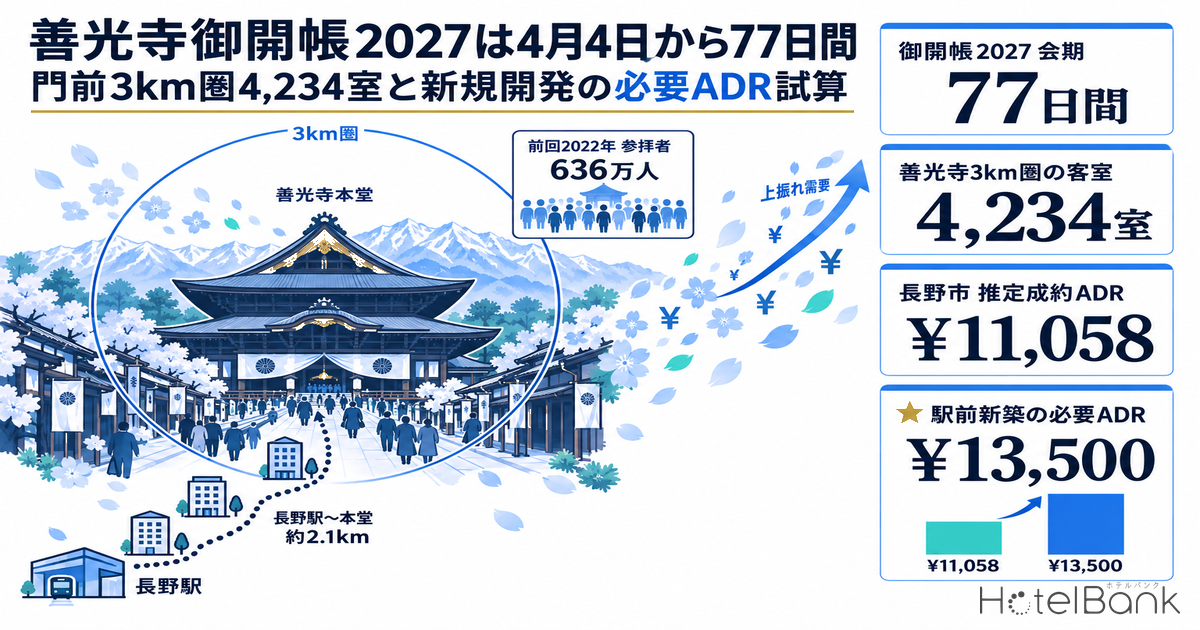
The unveiling of Zenkoji Temple’s Maedate Honzon (the Gokaicho) will run for 77 days, from the opening on April 4, 2027 to the closing on June 19. The previous edition in 2022 was held over an extended period as a COVID-19 measure; it drew 6.36 million visitors and its economic impact was reported at ¥109.5bn or more. In this article we estimate, in room-nights, how much of the extra demand over those 77 days can be absorbed by existing rooms within a 3km radius of Zenkoji, and use land prices around Nagano Station and the temple town to calculate the year-round estimated settled ADR that new development would require. The Gokaicho is highly predictable demand that comes round every six years, but what should anchor a development decision is the rate achievable over the remaining 288 days.
Metric Definitions Used in This Article
- ADR (average daily rate): an estimated settled rate (tax-excluded equivalent), calculated by applying a property-type correction factor to the lowest-priced plan each property publishes on OTAs (two guests per room, per-room rate, tax included). Checked against property-level results disclosed by listed hotel REITs (91 properties, most recent 3 months), the median error is about 7%. These are estimates and differ from each property’s actual settled rates and accounting figures. Area-level ADR is the median of the properties covered (the level of a typical property in the area).
- OCC (occupancy rate): the share of sold rooms in the total rooms of the area (an estimate based on OTA inventory). Because it is based on how OTA-listed inventory is being sold down, it differs from a property’s actual overall occupancy.
- Booking curve / LT: booking curve = the change in OTA remaining rooms leading up to the check-in date. LT (lead time) = days until check-in. This article uses LT45 to LT1 only.
- Room-nights: rooms × nights. One room for one night is one room-night.
- Data sources: MetroEngines Research & Consulting (estimated settled ADR, estimated OCC, property master); the MLIT Real Estate Information Library (Land Price Publication, Prefectural Land Price Survey, zoning)
The conclusion first. Rooms within 3km of Zenkoji have been almost flat, from 4,188 in 2019 to 4,234 in 2026, and depending on the stay rate assumed, the extra Gokaicho demand may exceed the spare capacity of existing rooms (about 82,000 room-nights, assuming 75% annual OCC). For an existing hotel room, on the other hand, the extra revenue the Gokaicho brings is 4.6–12.1% of annual room revenue, which spread over six years is only 0.8–2.0% a year. A new limited-service hotel in front of Nagano Station would need an ADR of about ¥13,500 (7% GOP yield), around 20% above the Nagano City median of ¥11,058. New development should be judged not on the Gokaicho alone but on a product that can earn this rate band year-round.
- — 77 days: Gokaicho 2027 runs Apr 4 – Jun 19. The previous edition (2022) ran 88 days with 6.36 million visitors, about 72,000 a day
- — 4,234 rooms: 83 properties within 3km of Zenkoji (2026). Rooms are almost flat, +1.1% from 4,188 in 2019, and no planned projects in Nagano City can be confirmed
- — ~60,000 room-nights: if 4% of visitors stay within 3km, extra demand that exceeds the spare capacity of existing rooms (about 130,000 room-nights at 6%)
- — 4.6–12.1%: Gokaicho revenue uplift per existing hotel room, as a share of annual room revenue. Averaged over six years it is only 0.8–2.0% a year
- — ¥13,500: estimated settled ADR needed for a new limited-service hotel by Nagano Station (7% yield, 75% annual OCC assumed). 9 of the 37 existing properties within 3km already achieve it
Gokaicho 2027 runs 77 days; 6.36 million visited last time
Zenkoji’s Gokaicho is the public unveiling of the Maedate Honzon, the stand-in for the temple’s hidden main Buddha image. It is held once every seven years by traditional count (in practice every six years), in the years of the Ox and the Sheep. The last one, originally scheduled for 2021, was postponed by a year because of COVID-19 and held from April 3 to June 29, 2022, over a longer-than-usual 88 days to avoid crowding. 2027 (a Sheep year) marks the return to the usual cycle, with a 77-day period from April 4 to June 19. The 2015 edition ran 57 days, so this one is 20 days longer than the one before last.
Visitors in 2022 were announced at 6.36 million, about 90% of the 7.07 million in 2015. According to press reports, the economic impact was estimated at ¥109.5bn or more. Per day, 2022 drew about 72,000 people, and with a shorter period in 2027, daily crowds may be heavier than last time. Note that this article does not compare rates during the 2022 Gokaicho period; it uses normal-year 2026 rates as the baseline.
| Edition | Period | Days | Visitors |
|---|---|---|---|
| 2015 (Sheep year) | Apr 5 – May 31 | 57 days | 7.07M |
| 2022 (postponed a year by COVID-19) | Apr 3 – Jun 29 | 88 days | 6.36M |
| 2027 (Sheep year) | Apr 4 – Jun 19 | 77 days | — |
Nagano City’s estimated settled ADR is ¥11,058, with double-digit YoY gains in April and May
On MetroEngines Research’s estimated settled ADR, Nagano City’s 12-month average for September 2025 to August 2026 was ¥11,058 (70–78 properties). By month, January 2026 was the highest at ¥12,209 and June the lowest at ¥9,207. In April–June 2026, with no Gokaicho, rates were ¥11,030 in April, ¥11,774 in May and ¥9,207 in June — the normal-year baseline for the months the Gokaicho will cover. Year on year, April was +13.8%, May +20.7% and June +2.9%, so spring rates are already on an upward trend.
Compared with other cities in the prefecture, Nagano City’s rate sits between Matsumoto (¥13,252, 91–108 properties) and Ueda (¥9,171, 40–54 properties). Within Nagano City, business hotels are at ¥8,466 (29–31 properties) and ryokan at ¥13,264 (33–39 properties), so ryokan rates are about 1.6 times those of business hotels. A distinctive feature of Nagano City, where temple lodgings (shukubo) and long-established ryokan line the approach to Zenkoji, is that its ryokan and upper-tier hotels already achieve a level on a par with the Matsumoto average. The price tiers on the Matsumoto side are examined in Matsumoto ADR ¥13,400 vs ¥18,300 Ceiling.
| Area / type | 12-month avg | Properties (per month) |
|---|---|---|
| Matsumoto (all types) | ¥13,252 | 91–108 |
| Nagano City (all types) | ¥11,058 | 70–78 |
| Nagano City: ryokan | ¥13,264 | 33–39 |
| Nagano City: business hotels | ¥8,466 | 29–31 |
| Ueda (all types) | ¥9,171 | 40–54 |
83 properties and 4,234 rooms within 3km of Zenkoji; rooms up 1% since 2019
A 3km radius centred on Zenkoji’s Main Hall takes in all of Nagano Station (about 2.1km from the Main Hall) and its surroundings. Counting properties open at each year-end in MetroEngines Research’s property data, there were 83 properties with 4,234 rooms in 2026. In 2019 there were 72 properties with 4,188 rooms, and in 2022, the year of the last Gokaicho, 76 properties with 4,151 rooms: the number of properties has risen, but rooms are almost flat at +1.1% on 2019. Three properties (405 rooms in total) opened in 2023, but closures and renovation shutdowns overlapped in the same period, so the room total has moved within a 4,100–4,400 range.
Next, the pipeline. In our planned-project data, based on building confirmation applications in MLIT’s Building Dynamics Statistics, no planned projects in Nagano City could be confirmed as of September 24, 2026, and across the whole of Nagano Prefecture there was just one, 159 rooms in Otari Village, Kitaazumi District. Confirmation applications are usually filed one to two years before opening, so rooms within 3km are unlikely to rise significantly before the Gokaicho in April 2027. *Based on confirmation applications as of the survey date. The count is expected to grow as further applications are filed; it is used here as the lower bound of the confirmed pipeline at this point.
BusinessCity / resortRyokanOtherLand-price points
| Nagano Station Zenkoji Exit | Commercial zone, FAR 400% / BCR 80% |
| Chuo-dori (around Daimon-cho) | Commercial zone, FAR 400% / BCR 80% |
| Around the Zenkoji Main Hall | Category 1 residential zone, FAR 200% / BCR 60% |
Pre-holiday nights are nearly full by the day before; weekdays still have room
We check how much room existing properties have from the pace of bookings this summer and over the September holidays. On Nagano City’s booking curve (LT45 to LT1), Saturday July 18, in the Marine Day three-day weekend, reached an estimated OCC of 100.0% at LT1 (40 properties / 2,384 rooms, based on major booking-site listings). Saturday September 19 in Silver Week also hit 99.2% at LT1 (43 properties / 2,409 rooms): pre-holiday inventory is almost fully taken by the day before. By contrast, the weekday of Wednesday July 15 stood at 48.3% at LT45 and 91.6% at LT1 (37 properties / 2,305 rooms), so the gap by day of week is wide even within the same week.
As monthly averages, estimated OCC was 88.2% in July (34 properties / 2,308 rooms) and 93.2% in August (36 properties / 2,318 rooms). Because rooms not listed on OTAs are counted on the sold side, this metric runs higher than actual occupancy. Even so, the pattern that existing rooms fill up on pre-holiday nights in peak season is clear. The 77-day Gokaicho period includes Golden Week and 11 Saturdays; demand on those days cannot all be met by existing rooms and is likely to spill over to surrounding cities or day trips. On weekdays, by contrast, existing rooms have capacity to spare. Nagano City’s pattern, in which the gap between weekdays and the first night of a holiday does not narrow even close to arrival, is analysed in detail in Nagano September: Wed 58.7% vs Holiday Sat 93.0%.
Estimating the 77 days of extra demand in room-nights: at a 4% stay rate, about 60,000 room-nights spill outside the radius
Over the 77 days, existing rooms within 3km can provide 4,234 rooms × 77 days = 326,018 room-nights. If normal demand is set at 75% annual OCC (assumption), normal demand fills 244,514 room-nights, leaving 81,504 room-nights of spare capacity for the extra Gokaicho demand. On top of this, we set 2027 visitors at 6.36 million, the same as last time, assumed three cases for the share staying within 3km — 2%, 4% and 6% — and estimated the extra demand at 1.8 people per room for one night.
| Case | Guests within 3km | Extra demand | vs spare capacity | Additional rooms needed |
|---|---|---|---|---|
| Stay rate 2% | 127,200 | 70,667 room-nights | Within capacity (10,838 room-nights to spare) | — |
| Stay rate 4% | 254,400 | 141,333 room-nights | 59,829 room-nights over | ~863 rooms |
| Stay rate 6% | 381,600 | 212,000 room-nights | 130,496 room-nights over | ~1,883 rooms |
At a 2% stay rate existing rooms can absorb the demand, but at 4% about 60,000 room-nights, and at 6% about 130,000 room-nights, would spill outside the 3km radius. Absorbing that within the 77 days alone would require about 863–1,883 additional rooms, but those rooms could expect only normal demand for the remaining 288 days. In practice, part of the demand concentrated on pre-holiday nights is likely to be shared by Ueda, Matsumoto and nearby onsen towns, so adding temple-town rooms to match the Gokaicho peak makes little sense. The right way to capture the upside is through pricing of existing rooms and spreading demand onto weekdays.
Gokaicho effect on existing hotels: 4.6–12.1% of annual revenue, under 2% a year averaged over six years
We estimate the Gokaicho revenue uplift per existing hotel room. With normal-year annual OCC of 75% and ADR of ¥11,058 (Nagano City’s 12-month average), annual room revenue per room is about ¥3.027M. For the 77-day Gokaicho period we set OCC rising to 92% and three cases in which ADR rises 0%, 15% and 30% above the April–June baseline (¥10,670).
| ADR uplift during the Gokaicho | Uplift per room | Share of annual room revenue | Six-year average (per year) |
|---|---|---|---|
| 0% (OCC rise only) | ~¥140k | +4.6% | +0.8% |
| +15% | ~¥253k | +8.4% | +1.4% |
| +30% | ~¥366k | +12.1% | +2.0% |
For existing hotels, a Gokaicho year is a chance to add up to just over 10% to annual room revenue. Since this is a market where pre-holiday nights fill almost completely by the day before, there is ample room to approach the upside cases by combining tiered pricing for Golden Week and the Saturdays in the period. Spread over the six-year cycle, however, the effect is only 1–2% a year, not large enough to sway the investment decision for a new building.
Land prices: ¥385k/m² by the station, ¥98k/m² on Chuo-dori in the temple town
Using the Land Price Publication and Prefectural Land Price Survey in the MLIT Real Estate Information Library, we lined up the points from Nagano Station to the Zenkoji temple town. In the 2026 Land Price Publication, the station-front point at Nagano Station’s Zenkoji Exit is the highest at ¥385,000 per m² (+3.5% YoY, commercial zone, FAR 600%). Prices fall with distance from the station: Gocho on Chuo-dori was ¥98,000 (2025 Land Price Survey, +1.0%, commercial zone, FAR 400%), and the residential area west of Zenkoji ¥73,000 (+0.6%, Category 1 residential zone, FAR 200%).
| Point | Type | Price (¥/m²) | YoY | Zoning / FAR | From Main Hall | Land per room |
|---|---|---|---|---|---|---|
| Nagano Sta. Zenkoji Exit, station front | Land Price Pub. 2026 | 385,000 | +3.5% | Commercial, 600% | 2.0km | ~¥1.93M |
| Ishido-cho | Land Price Pub. 2026 | 218,000 | +3.3% | Commercial, 600% | 1.8km | ~¥1.09M |
| Minami-Chitose 1-chome | Land Price Pub. 2026 | 184,000 | +2.2% | Commercial, 500% | 1.9km | ~¥1.10M |
| Gondo | Land Price Pub. 2026 | 136,000 | +1.5% | Commercial, 400% | 1.1km | ~¥1.02M |
| Chuo-dori / Gocho | Land Price Survey 2025 | 98,000 | +1.0% | Commercial, 400% | 0.9km | ~¥740k |
| Zenkoji West / Kaminagano | Land Price Pub. 2026 | 73,000 | +0.6% | Cat. 1 residential, 200% | 0.5km | ~¥1.10M |
| Zenkoji North / Hakoshimizu 2-chome | Land Price Pub. 2026 | 63,800 | +0.9% | Cat. 1 residential, 200% | 0.4km | ~¥960k |
Converted into land cost per room, the station front is about ¥1.93M and Gocho on Chuo-dori about ¥0.74M, so commercial land nearer the temple costs under 40% of the station front. Interestingly, the residential land right beside Zenkoji has the lowest land price, yet because its FAR is a small 200%, it costs about ¥0.96M–¥1.10M per room, more than Gocho. In a Category 1 residential zone, hotel and ryokan floor area is limited to 3,000 m² or less, so the area around the Main Hall suits small-scale lodgings.
Required ADR for new development: ¥13,500 for limited-service by the station, ¥24k for upscale in the temple town
We worked back from land and construction costs to the year-round estimated settled ADR required. Scenario A is a limited-service hotel in front of Nagano Station (30 m² of floor area per room, steel frame); Scenario B is an upscale property on Chuo-dori in the temple town (45 m² per room, reinforced concrete, a small hotel with breakfast, a lounge and so on). For construction cost we used 2025 per-tsubo unit costs based on MLIT’s Statistics on Building Construction Starts (¥2.405M for steel frame, ¥2.026M for reinforced concrete; 1 tsubo = 3.306 m²), and also show a case that factors in construction-cost inflation up to opening (2026 +5.3% and 2027 +5.0% from Turner & Townsend’s forecast, 2028 +4.5% an editorial assumption; about 1.155x cumulative). Required ADR is calculated as the rate at which room revenue × GOP margin ÷ total investment equals the target yield.
| Item | A. Station front, limited-service | B. Temple town, upscale |
|---|---|---|
| Location / land price | Nagano Station front ¥385,000/m² | Chuo-dori / Gocho ¥98,000/m² |
| Floor area per room / structure | 30 m², steel frame | 45 m², RC |
| Construction cost per room (2025) | ~¥21.83M | ~¥27.58M |
| Land per room | ~¥1.93M | ~¥1.10M |
| Total investment per room (2025) | ~¥23.75M | ~¥28.68M |
| GOP margin (assumption) | 45% | 30% |
| Required ADR at 6% / 7% / 8% yield | ¥11,600 / ¥13,500 / ¥15,400 | ¥21,000 / ¥24,400 / ¥27,900 |
| Total investment per room after inflation | ~¥27.14M | ~¥32.97M |
| Required ADR after inflation, 6% / 7% / 8% | ¥13,200 / ¥15,400 / ¥17,600 | ¥24,100 / ¥28,100 / ¥32,100 |
| Comparison: Nagano City est. settled ADR | Business ¥8,466 | Ryokan ¥13,264 |
We checked how far Scenario A’s required ADR moves with the occupancy assumption, on two axes: annual OCC and target yield (2025 construction-cost basis). If annual OCC can be lifted from 75% to 85%, the required ADR at a 7% yield falls to ¥11,900. Conversely, at 65% annual OCC it is ¥15,600, above the ¥15,400 level that only 8 of the 37 existing properties achieve.
| Target yield \ Annual OCC | 65% | 70% | 75% | 80% | 85% |
|---|---|---|---|---|---|
| Yield 5% | 11,100 | 10,300 | 9,600 | 9,000 | 8,500 |
| Yield 6% | 13,300 | 12,400 | 11,600 | 10,800 | 10,200 |
| Yield 7% | 15,600 | 14,500 | 13,500 | 12,700 | 11,900 |
| Yield 8% | 17,800 | 16,500 | 15,400 | 14,500 | 13,600 |
| Yield 9% | 20,000 | 18,600 | 17,400 | 16,300 | 15,300 |
Scenario A’s required ADR is ¥13,500 at a 7% yield, rising to ¥15,400 once construction-period inflation is factored in. That is roughly 60% above the Nagano City business-hotel median of ¥8,466, so making a new limited-service hotel work by the station presupposes a product that can earn a rate a notch above the standard for the type, all year round. Scenario B is higher still, at ¥24,400 for a 7% yield, about 1.8 times the Nagano City ryokan median of ¥13,264. The Gokaicho effect estimated in the previous section (0.8–2.0% a year averaged over six years) cannot close this gap.
9 of the 37 existing properties achieve ¥13,500 or more
That does not mean the required ADR is out of the market’s reach. Plotting against room count the 12-month averages of the 37 properties within 3km whose estimated settled ADR was observed in at least 10 of the last 12 months (3,228 rooms in total), the median is ¥10,487, but 9 properties achieve ¥13,500 or more and 8 achieve ¥15,400 or more. The 9 break down as 4 ryokan, 3 city hotels, 1 resort and 1 business hotel, and 4 of them are small inns of 11 rooms or fewer that still achieve rates in the ¥20,000s. This shows that Nagano City, too, has a certain number of properties that earn their rates on experiential value — the history of the temple town, hot springs, spacious rooms.
The thick price band
¥8,500–¥12,000 × 80–240 rooms
The band where business hotels by the station cluster. A new build entering this same rate band faces a wide gap to the required ADR.
A band achievable year-round
¥14,000–¥17,600 × 90–150 rooms
Already achieved by 4 city and business properties. It overlaps the required ADR for a new build by the station, and can work depending on the product.
Upscale in the temple town
¥20,000s × 11 rooms or fewer
Already achieved by 4 small inns. The condition is a product built around the temple town’s townscape and experience that earns ¥20,000+ year-round.
Summary: the Gokaicho is a pricing opportunity; judge development on year-round ADR
The 77 days of Zenkoji Gokaicho 2027 are highly predictable extra demand for Nagano City’s hotels. Rooms within 3km of Zenkoji number 4,234, almost flat since 2019, and no planned projects can be confirmed, so existing rooms will be nearly full on pre-holiday nights, and depending on the stay rate assumed, 60,000–130,000 room-nights will spill outside the radius. For existing hotels, it is a chance to lift annual room revenue by up to just over 10% through tiered pricing and spreading demand onto weekdays.
New-development decisions, however, need a different yardstick. A new limited-service hotel by the station needs a year-round ADR of about ¥13,500–¥15,400, and an upscale temple-town property one in the mid-¥20,000s, while the Gokaicho effect is under 2% a year averaged over six years. Given that 9 of the 37 existing properties already achieve ¥13,500 or more, Nagano City’s particular upside lies in upscale product design that makes use of the temple-town location and experiential value, and in lower-cost approaches such as acquiring and renovating existing properties.
About six months remain until the 2027 Gokaicho. This is when the start of rate sales coincides with FY2027 opening and renovation decisions, and plans need to separate day-of-week demand during the period from the year-round rate band.
Note on the estimates: the room-night figures and required ADRs in this article are simple estimates based on data as of the survey date (September 24, 2026) and the stated assumptions; actual investment decisions require an individual feasibility study. ADR is an estimate (median error of about 7% against REIT-disclosed results), at a tax-excluded equivalent level, like the settled ADR REITs disclose. Estimated OCC is an estimate based on OTA-listed inventory and differs from a property’s actual overall occupancy. 2027 visitor numbers and stay rates are not yet known, so the previous edition’s results are applied.
Related Articles
References and Sources
■ Data sources
Estimated settled ADR, estimated OCC, booking curves and property data: MetroEngines Research & Consulting (Nagano City 70–78 properties per month; 83 properties and 4,234 rooms within 3km of Zenkoji; September 2025 to August 2026, among others). Land prices and zoning: the MLIT Real Estate Information Library (2026 Land Price Publication, 2025 Land Price Survey); construction cost: 2025 per-tsubo unit costs based on MLIT’s Statistics on Building Construction Starts; period and visitor numbers: the Zenkoji official website and press reports.
■ Assumptions
Normal-year annual OCC 75% (assumption); visitors set at the 2022 actual of 6.36 million; 1.8 people per room, one night. Required ADR = total investment × target yield ÷ (GOP margin × 365 days × annual OCC), with GOP margins of 45% for A and 30% for B (assumptions); floor area per room 30 m² for A and 45 m² for B; land is the theoretical value with the designated FAR fully used. Construction-period inflation about 1.155x cumulative (2026–2027 from Turner & Townsend’s forecast, 2028 an editorial assumption).
■ Limitations
Estimated settled ADR is an estimate applying type-specific factors to OTA lowest-priced plans (median error about 7% against REIT-disclosed results, tax-excluded equivalent) and differs from actual settled rates. Estimated OCC is based on how OTA-listed inventory is sold down and runs higher than a property’s actual overall occupancy. 2027 visitor numbers and stay rates are not yet known, and land prices are published/survey values, not transaction prices. This article is a simple estimate; investment decisions on individual projects require a separate feasibility study.
■ Market data
- MetroEngines Research & Consulting — estimated settled ADR (Nagano, Matsumoto, Ueda), estimated OCC and booking curves (Nagano City), property master (within 3km of Zenkoji), planned-project data
■ Government statistics and public data
- MLIT Real Estate Information Library — Land Price Publication (2026), Prefectural Land Price Survey (2025), zoning
- MLIT, Statistics on Building Construction Starts
- MLIT, Building Dynamics Statistics (planned projects based on confirmation applications)
- Nagano Prefecture, Nagano Prefecture Accommodation Tax
■ REIT and industry reports
- Invincible Investment Corporation, hotel portfolio (GOP results of MHM-operated hotels)
- Construction cost per tsubo by structure (2025 edition)
■ News and official information
- Zenkoji Gokaicho to run 77 days from April 4, 2027 (Shinano Mainichi Shimbun, November 19, 2024; in Japanese)
- Nagano Zenkoji’s next Gokaicho to run 77 days, April–June 2027 (Nikkei; in Japanese)
- Zenkoji Gokaicho drew 6.36 million visitors in 2022 (Nikkei; in Japanese)
- 6.36 million visitors, a solid economic impact: Zenkoji Gokaicho (Chunichi Shimbun; in Japanese)
- Zenkoji official website (in Japanese)