

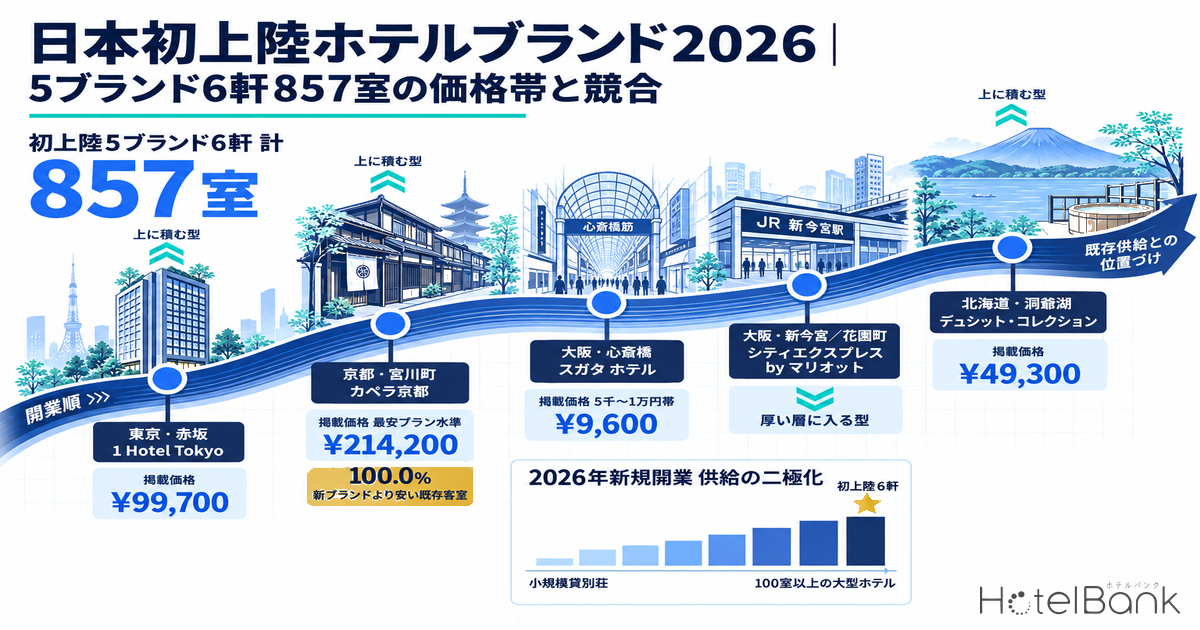
In 2026, five hotel brands made their first appearance in Japan, with six properties and 857 rooms in total, as far as can be confirmed from official company announcements. They are Capella Kyoto (カペラ京都, 89 rooms) in Kyoto’s Miyagawa-cho district, 1 Hotel Tokyo (211 rooms) in Akasaka, Tokyo, Sugata Hotel Osaka Shinsaibashi, Series by Marriott (スガタ ホテル 大阪心斎橋 シリーズ byマリオット, 256 rooms) in Shinsaibashi, Osaka, two City Express by Marriott (シティエクスプレス by マリオット) hotels in Osaka’s Nishinari Ward (243 rooms combined), and WE Hotel Toya – Dusit Collection (58 rooms) in Toyako Town, Hokkaido. This article matches each property against the existing hotels confirmed on sale in June–August 2026 within a 1 km radius (10 km for Lake Toya) and their listed prices, to quantify whether the new brands “stacked on top of” existing supply or “entered the thickest layer.” It also checks how rare such large branded projects are among the 1,612 properties that opened in the same year.
Metric Definitions Used in This Article
- ADR (average daily rate): An estimated settled rate (tax-exclusive equivalent) calculated by applying a segment-specific adjustment factor to the lowest-plan level each property publishes on OTAs (two guests in one room, per-room rate, tax included). Checked against property-level results disclosed by listed hotel REITs (91 properties, most recent three months), the median error is about 7%. This is an estimate and differs from each property’s actual settled prices and accounting figures. Area-level ADR is the median of the properties covered (the level of a typical property in the area).
- Listed price (lowest-plan level): The monthly level of the cheapest plan each property sells (two guests in one room, per room, tax included), averaged over the three months of June–August 2026. Because the adjustment factor for estimated settled ADR has not been validated for some segments (such as deluxe), this value is used to position price bands so that every property is measured with the same yardstick. It is not ADR. At ryokan and similar properties, the cheapest plan may include meals.
- Existing competitors: Properties within a 1 km radius of each new-brand hotel (10 km for Lake Toya only) that were confirmed on sale in at least two of the three months of June–August 2026. The new-brand hotels themselves and the two City Express hotels that opened simultaneously (including listings under their pre-rebranding names) are excluded.
- Data source: MetroEngines Research
- — 5 brands, 6 hotels, 857 rooms — Hotel brands that debuted in Japan in 2026 (as confirmed from official company announcements, as of September 2026)
- — Capella Kyoto ¥214,200 — Created a new top tier at a listed price above virtually all (100.0%) of the existing rooms within a 1 km radius (392 properties, 8,668 rooms)
- — Osaka’s two brands sit in the ¥5,000–¥10,000 band — Sugata Hotel is priced above 60.5% of existing rooms and City Express Shin-Imamiya above 68.7%, both inside the thickest layer
- — 4 of the 6 are conversions of existing hotels — More global brands are now usable in the midscale range, widening the conversion options for existing owners
- — Hotels with 100+ rooms are 8.2% of openings but 65.0% of rooms — Within the polarized 1,601 properties opening in 2026 (those with known room counts), the six debut hotels account for about 2% of all rooms
The 5 Brands and 6 Hotels That Debuted in Japan in 2026
First, the scope needs to be defined strictly. “Debut” here does not mean a hotel company’s first entry into Japan; it means the first hotel in Japan to open under that brand name. Dusit International, for example, already operates a property in Kyoto, but Lake Toya is the first in the country under the “Dusit Collection” brand. The list below covers only projects whose opening date, room count, and location could be confirmed from official company releases or media reports on them.
| Brand (home base) | Property | Location | Opening date | Rooms | Opening format |
|---|---|---|---|---|---|
| 1 Hotels (US) | 1 Hotel Tokyo | Akasaka, Minato Ward, Tokyo | March 5, 2026 | 211 rooms | New build (floors 38–43 of Akasaka Trust Tower, Tokyo World Gate Akasaka). Owned by Mori Trust and operated by MT&SH Hotel Management GK |
| Capella Hotels and Resorts (Singapore) | Capella Kyoto (カペラ京都) | Higashiyama Ward, Kyoto (Miyagawa-cho) | March 22, 2026 | 89 rooms | New build (site of the former Shinmichi Elementary School). Developed and owned by NTT Urban Development, managed as a business by NTT Urban Development Hotel Management, and operated by Capella Hotel Group |
| Series by Marriott (US) | Sugata Hotel Osaka Shinsaibashi, Series by Marriott (スガタ ホテル 大阪心斎橋 シリーズ byマリオット) | Minami-Semba, Chuo Ward, Osaka | April 1, 2026 | 256 rooms | Brand conversion of an existing hotel (formerly Bespoke Hotel Shinsaibashi). Agreement with Blackstone |
| City Express by Marriott (US) | City Express by Marriott Osaka Shin-Imamiya (シティエクスプレス by マリオット大阪新今宮) | Haginochaya, Nishinari Ward, Osaka | May 7, 2026 | 100 rooms | Brand conversion of an existing hotel (formerly FP HOTELS Namba Minami). Franchise agreement; operated by Shin-Imamiya Hospitality GK |
| Same as above | City Express by Marriott Osaka Namba South (シティエクスプレス by マリオット大阪難波南) | Hanazono-kita, Nishinari Ward, Osaka | May 7, 2026 | 143 rooms | Brand conversion of an existing hotel (formerly Hotel Blumen Hanazono-kita). Agreement and operator same as above |
| Dusit Collection (Thailand) | WE Hotel Toya – Dusit Collection | Toyako Town, Abuta District, Hokkaido | July 1, 2026 | 58 rooms | Brand conversion of an existing hotel (WE Hotel Toya) |
| Total | 5 brands, 6 hotels | 857 rooms |
Source: Compiled by the HotelBank Editorial Team from official company releases and media reports (see “References and Sources” at the end). Room counts are as published by each company
Of the six hotels, four (Series by Marriott, Dusit Collection, and the two City Express hotels) are existing buildings switched over to a new brand as they stood. City Express is a Marriott franchise brand, and it made its first entry into Asia Pacific (excluding Greater China) with two simultaneous openings in Osaka. The price range is wide as well, from ultra-luxury above ¥200,000 for two guests in one room down to midscale below ¥10,000. As far as 2026 is concerned, the formula “a foreign brand’s debut means a luxury hotel” holds only half the time.
As for the large projects announced for opening in 2027, at the time of writing (September 2026) we could not confirm any that has been officially announced as a brand’s first entry into Japan. Most are second or later properties of brands that already have a presence in the country. We intend to add them once announcements are made.
Estimated Settled ADR in the 5 Municipalities the New Brands Entered
Next, we establish the typical rate level in the municipalities the new brands entered. The table below compares the estimated settled ADR (area median) of each municipality as a three-month average for June–August 2026 against the same period a year earlier.
| Municipality | June–August 2025 | June–August 2026 | YoY | Properties covered (N) |
|---|---|---|---|---|
| Higashiyama Ward, Kyoto | ¥19,992 | ¥17,886 | -10.5% | 46〜51 |
| Minato Ward, Tokyo | ¥15,592 | ¥14,675 | -5.9% | 131〜133 |
| Chuo Ward, Osaka | ¥15,033 | ¥9,791 | -34.9% | 193〜194 |
| Nishinari Ward, Osaka | ¥4,250 | ¥4,589 | +8.0% | 31〜32 |
| Toyako Town, Hokkaido | ¥14,746 | ¥14,816 | +0.5% | 15 |
Source: MetroEngines Research; compiled by the HotelBank Editorial Team. Simple three-month average of the monthly area median of estimated settled ADR (tax-exclusive equivalent). N is the number of properties covered in each month
Source: MetroEngines Research; compiled by the HotelBank Editorial Team
The −34.9% in Osaka’s Chuo Ward is most naturally read as reflecting a high base of comparison, since the same period a year earlier fell during Expo 2025 Osaka, Kansai. Minato Ward and Higashiyama Ward were also below the previous year, but their absolute levels are high among the five municipalities, at about ¥17,900 for Higashiyama Ward and about ¥14,700 for Minato Ward. Nishinari Ward, by contrast, is low at about ¥4,600, a direct reflection of a market structure with many low-priced, hostel-type (simple lodging) properties. Toyako Town has a small sample of N=15 and was nearly flat.
In other words, the locations chosen by the new brands split into “high-rate tourism centers” and “low-rate gateway surroundings.” Which of the two a brand entered makes its relationship with existing supply entirely different.
Where They Entered Existing Supply — Price-Band Mix Within 1 km
This is the main subject. We gathered the existing properties confirmed on sale around each hotel in June–August 2026 and plotted the distribution of price bands on a room-count basis, then looked at where the listed price (lowest-plan level) of each new-brand hotel sits in that distribution.
| Area (new brand) | Existing competitors | Existing rooms | Existing median | New brand | Share of existing rooms cheaper than the new brand | New brand’s price band |
|---|---|---|---|---|---|---|
| Miyagawa-cho, Kyoto (Capella Kyoto) | 392 properties | 8,668 rooms | ¥26,700 | ¥214,200 | 100.0% | ¥200,000+ |
| Akasaka, Tokyo (1 Hotel Tokyo) | 59 properties | 10,302 rooms | ¥13,300 | ¥99,700 | 94.5% | ¥50,000–¥100,000 |
| Shinsaibashi, Osaka (Sugata Hotel) | 170 properties | 21,867 rooms | ¥8,900 | ¥9,600 | 60.5% | ¥5,000–¥10,000 |
| Shin-Imamiya / Hanazonocho, Osaka (City Express) | 96 properties | 5,824 rooms | ¥7,500 | ¥8,300 | 68.7% | ¥5,000–¥10,000 |
| Lake Toya, Hokkaido (Dusit Collection) | 46 properties | 1,819 rooms | ¥30,800 | ¥49,300 | 84.6% | ¥30,000–¥50,000 |
Source: MetroEngines Research; compiled by the HotelBank Editorial Team. All prices are listed prices (lowest-plan level, two guests in one room, tax included, June–August 2026 average). The City Express figure is for Shin-Imamiya (100 rooms); Namba South (143 rooms) is ¥7,800. Lake Toya uses a 10 km radius and the others a 1 km radius. Room counts are our own tallies
Source: MetroEngines Research; compiled by the HotelBank Editorial Team. Existing competitors’ rooms stacked by listed-price band and normalized to 100% for each area
The results split clearly in two. Capella Kyoto and 1 Hotel Tokyo are the “stack on top” type, sitting above more than 90% of existing rooms, and Dusit Collection at Lake Toya is close to this. By contrast, Osaka’s two brands are the “enter the thickest layer” type, placed right around the middle of existing rooms in the ¥5,000–¥10,000 band where rooms are most concentrated. We look at each area in turn below.
Miyagawa-cho, Kyoto: Capella Kyoto Created a New Layer Above Existing Price Bands
Within a 1 km radius of Capella Kyoto there are 392 existing properties with 8,668 rooms that were confirmed on sale in June–August 2026. More than half of the existing rooms in this catchment, which includes Gion, Kawaramachi, and Kiyomizu-Gojo, fall in the ¥5,000–¥15,000 listed-price bands, and the median of existing properties is ¥26,700.
Capella Kyoto’s listed price (lowest-plan level) averaged ¥214,200 over June–August, and the only property in the catchment above it was a single one-room rental. There are 27 existing properties with 100 or more rooms, of which 23 are in bands below ¥30,000 and only one exceeds ¥100,000. Only two existing properties, with 10 rooms in total, have rooms in the ¥200,000-and-above band. In other words, Capella Kyoto does not overlap on price with the existing thick layer; it has stacked a new top tier of 89 rooms above it.
Source: MetroEngines Research; compiled by the HotelBank Editorial Team. Rooms of existing competitors within a 1 km radius of Capella Kyoto (N=392 properties), tallied by listed-price band
In this structure, existing hotels and the new brand are unlikely to compete for the same guests on price. Rather, the larger effect is likely to be that the customer base of a global luxury brand is added to the Miyagawa-cho geisha district, deepening awareness of the area as a whole and the reasons to stay there.
Osaka Minami: Marriott’s Two Brands Enter the Thickest ¥5,000–¥10,000 Band
Osaka’s two brands entered in the opposite way. Within a 1 km radius of Sugata Hotel (Series by Marriott) in Shinsaibashi there are 170 existing properties with 21,867 rooms, of which about 60% (13,250 rooms) are concentrated in the ¥5,000–¥10,000 listed-price band. Sugata Hotel’s listed price is ¥9,600, squarely inside this band. Of the existing rooms, 60.5% are cheaper than Sugata Hotel, a position slightly above the middle.
The same is true of the two City Express hotels in Shin-Imamiya and Hanazonocho. Within a 1 km radius of Shin-Imamiya there are 96 existing properties with 5,824 rooms, and the two bands of under ¥5,000 and ¥5,000–¥10,000 account for a little over 80% of rooms. City Express Shin-Imamiya is at ¥8,300 and Namba South at ¥7,800, placed slightly above the existing median of ¥7,500.
Source: MetroEngines Research; compiled by the HotelBank Editorial Team. Rooms of existing competitors within a 1 km radius of Sugata Hotel (N=170 properties) and within a 1 km radius of City Express Osaka Shin-Imamiya (N=96 properties), tallied by listed-price band
Source: MetroEngines Research; compiled by the HotelBank Editorial Team. Circle size shows room count and color shows listed-price band (darker blue means a higher band). Stars mark the three new-brand hotels
What deserves attention here is that both brands, rather than “breaking out above on price,” are bringing a global loyalty program and standardized quality into the existing price band. Having entered the thick layer, their axis of differentiation is not price but the brand’s ability to deliver guests and the legibility of its service quality. For nearby existing hotels, this means “a new option that is easy to compare on booking sites” has been added to the same price band, which is also an opportunity to sharpen non-price appeal such as room types and breakfast.
Akasaka and Lake Toya: Joining the Existing Upper Tier
Within a 1 km radius of 1 Hotel Tokyo there are 59 existing properties with 10,302 rooms. The existing median is ¥13,300, and about 40% of rooms (4,185 rooms) are in the ¥10,000–¥15,000 band. 1 Hotel Tokyo’s listed price is ¥99,700, above 94.5% of existing rooms. Unlike Kyoto, however, there are already 1,733 existing rooms in the same ¥50,000–¥100,000 band and another 569 in the ¥100,000–¥200,000 band. The upper tier in Akasaka and Toranomon already has a certain depth, and 1 Hotel Tokyo has joined it with its own concept of “sustainable luxury.”
Lake Toya was examined within a 10 km radius. It is a small market of 46 existing properties with 1,819 rooms, and a little over half of the rooms (994 rooms) are in onsen hotels in the ¥20,000–¥30,000 band. WE Hotel Toya – Dusit Collection’s listed price is ¥49,300, above 84.6% of existing rooms. This positioning is supported by its product: all 55 lake-view rooms have a balcony with an open-air hinoki cypress bath. The routes by which Asian luxury brands are entering Japan are laid out in our article Dusit’s Japan Debut at Lake Toya: 8 Asian Luxury Brands’ Entry Routes.
Reading a “Debut” From an Investor’s Perspective — More Conversion Options for Existing Owners
For guests, a brand’s debut is the birth of a new hotel, but for investors and owners it means something slightly different: the range of brands usable in Japan — that is, new vehicles for management contracts and franchises — has grown.
| Type | Projects | What it means for existing owners |
|---|---|---|
| New build × management contract | Capella Kyoto, 1 Hotel Tokyo | An option as the top-tier tenant of a large development or redevelopment. The developer owns the asset and the brand handles operations |
| Brand conversion of an existing hotel | Series by Marriott, Dusit Collection | Connects the property to a global distribution network and membership base while keeping the building. An option for value enhancement after acquisition |
| Franchise | City Express by Marriott (both hotels converted from existing hotels) | A domestic operator runs the hotel and borrows the brand and reservation network. More global brands are now usable in the midscale range |
Source: Compiled by the HotelBank Editorial Team from official company releases and media reports
Particularly noteworthy is that two midscale brands, Series by Marriott and City Express, entered Japan in the same year. Until now, conversion to a global brand tended to be limited to upper-class properties able to command a certain rate. With more brands usable even at price points below ¥10,000, conversion is becoming a realistic option for existing properties of business-hotel scale as well.
On the economics of conversion, our earlier analysis of 15 hotels in Sapporo estimated that “the cost per room of converting an existing hotel to a foreign brand is about one-seventh that of a new build.” With construction costs remaining high, the trend of new brands arriving through conversion of existing stock rather than new construction is likely to continue.
6 Hotels Among 1,612 New Openings in 2026 — Polarized Supply
Finally, we place these six hotels within 2026’s new openings as a whole. Within the scope tracked by MetroEngines Research, 1,612 properties opening in 2026 (including scheduled openings) had an opening date confirmable from listings on major OTAs and similar channels, with 39,699 rooms in total (for those with known room counts). The average is 24.8 rooms, but the median is just 2 rooms, and vacation rentals make up about half of the properties (777).
| Size (rooms) | Properties | Share of properties | Rooms | Share of rooms |
|---|---|---|---|---|
| 1–2 rooms | 861 | 53.8% | 924 | 2.3% |
| 3–9 rooms | 268 | 16.7% | 1,465 | 3.7% |
| 10–29 rooms | 183 | 11.4% | 3,071 | 7.7% |
| 30–99 rooms | 157 | 9.8% | 8,443 | 21.3% |
| 100–199 rooms | 71 | 4.4% | 10,170 | 25.6% |
| 200+ rooms | 61 | 3.8% | 15,626 | 39.4% |
| Total | 1,601 | 100% | 39,699 | 100% |
Source: MetroEngines Research & Consulting (based on confirmed OTA listings, N=1,601 properties; excludes 11 properties with unknown room counts)
Source: MetroEngines Research & Consulting (based on confirmed OTA listings, N=1,601 properties)
By number of properties, small properties with 1–2 rooms account for 53.8%, while by number of rooms the 132 properties with 100 or more rooms (8.2%) supply 65.0%. New supply is split between “very small vacation rentals and whole-house rentals” and “large hotels with more than 100 rooms,” and the six debut-brand hotels (857 rooms) are only a further fraction of the large side. Their rooms amount to only about 2% of all rooms opening in 2026.
Even so, the significance of these few projects for the market is not small. In Kyoto and Akasaka they pushed up the price ceiling, and in Osaka they brought a global brand’s standard into the thickest price band. The small properties that make up most of supply carry the “volume,” while a handful of large branded projects change the “price-band structure” — 2026’s new supply can be described as that kind of division of roles.
A note on supply ahead. On the building-confirmation-application basis of the Ministry of Land, Infrastructure, Transport and Tourism’s “Building Dynamics Statistics Survey” (建築物動態統計調査), among the five municipalities covered here, lodging facilities with 53 rooms in Kyoto’s Higashiyama Ward and 117 rooms in Osaka’s Chuo Ward are scheduled for completion in 2028. *Based on building confirmation applications as of the survey date. The number of projects and rooms is expected to increase as further applications are filed, so these figures should be read as the lower bound of the confirmed pipeline at this point.
Frequently Asked Questions
Q. Which hotel brands debuted in Japan in 2026?
A. As far as can be confirmed from official company announcements, five brands with six hotels and 857 rooms in total: Capella Hotels and Resorts (Capella Kyoto, 89 rooms), 1 Hotels (1 Hotel Tokyo, 211 rooms), Series by Marriott (Sugata Hotel Osaka Shinsaibashi, 256 rooms), City Express by Marriott (Osaka Shin-Imamiya, 100 rooms; Osaka Namba South, 143 rooms), and Dusit Collection (WE Hotel Toya, 58 rooms).
Q. Do the debut brands compete on price with existing hotels?
A. It depends on the location. Capella Kyoto and 1 Hotel Tokyo are in a price band above more than 90% of existing rooms within a 1 km radius, so direct price competition is limited. Series by Marriott and City Express in Osaka, on the other hand, entered the ¥5,000–¥10,000 band (listed price), where the surrounding area has the most rooms.
Q. What does the arrival of new brands mean for owners of existing hotels?
A. It means more options for brand conversion and franchise affiliation. In 2026, four hotels opened through conversion of existing hotels, and two global brands usable in the midscale range were added.
Summary
The hotel brands that debuted in Japan in 2026 numbered five brands, six hotels, and 857 rooms as far as could be confirmed. Viewed in relation to surrounding existing supply, they split clearly in two: Capella Kyoto, 1 Hotel Tokyo, and Dusit Collection stack a layer above existing price bands, while Series by Marriott and City Express enter the thickest ¥5,000–¥10,000 band. The former push up the market’s ceiling; the latter add global-brand options to midscale.
Of the 1,612 properties newly opening in 2026, those with 100 or more rooms are only 8.2% but supply 65.0% of rooms. The debut brands are a very small part of that large side, and are best understood as changing not volume but the “price-band structure” and “owners’ options.” For existing hotels, this is a phase in which comparable alternatives increase in the same price band and, at the same time, their own conversion options widen.
Methodology and notes: The list of debut brands includes only those confirmed from official company releases and media reports on them, and is not exhaustive. Price-band comparisons use the June–August 2026 average of listed prices (lowest-plan level, two guests in one room, tax included) tracked by MetroEngines Research within the scope listed on major OTAs and similar channels, and are values as of the time of the survey. The number of newly opening properties covers those whose opening date could be confirmed from listings on major OTAs and similar channels; because OTA listings appear several months before opening, the later months of 2026 may increase with future listings. Estimated settled ADR by municipality is an estimate showing the level of a typical property in the area and differs from the actual settled prices of individual properties.
Related Reading
References and Sources
■ Data sources
The list of debut brands, opening dates, room counts, and opening formats are from official company releases and media reports on them. Estimated settled ADR by municipality, listed prices (lowest-plan level) and room counts of surrounding existing properties, and the number of properties newly opening in 2026 are tallies within the scope tracked by MetroEngines Research through listings on major OTAs and similar channels. Room counts scheduled for completion in 2028 are on the building-confirmation-application basis of the Ministry of Land, Infrastructure, Transport and Tourism’s “Building Dynamics Statistics Survey.”
■ Assumptions
Price-band positioning compares three-month averages for June–August 2026 of listed prices (lowest-plan level, two guests in one room, tax included). Existing competitors are properties within a 1 km radius of each new-brand hotel (10 km for Lake Toya only) confirmed on sale in at least two months of the same period, excluding the new-brand hotels themselves and the two City Express hotels (including listings under their pre-rebranding names). “Share of existing rooms cheaper than the new brand” is on a room-count basis. Estimated settled ADR is the simple three-month average of the monthly area median.
■ Limitations and caveats
The debut brands cover only confirmed projects and are not exhaustive. Listed price is not ADR (settled rate), and at ryokan and similar properties the cheapest plan may include meals. Because the number of newly opening properties is based on OTA listings, the later months of 2026 may increase, and 11 properties with unknown room counts are excluded from the size breakdown. Scheduled completions on a building-confirmation-application basis are the lower bound of the confirmed pipeline.
- NTT Urban Development, “First in Japan: ‘Capella Kyoto’ Opens Sunday, March 22” (in Japanese)
- MT&SH Hotel Management, “First in Japan: US-Born Sustainable Luxury Hotel ‘1 Hotel Tokyo’ to Open in Early March 2026” (PR TIMES, January 26, 2026; in Japanese)
- Kankokeizai Shimbun, “‘1 Hotel Tokyo,’ Committed to Coexistence With Nature, Opens in Akasaka” (in Japanese)
- Marriott International, “Agreement Signed for the First ‘Series by Marriott’ in Japan” (PR TIMES, February 24, 2026; in Japanese)
- Travel Watch, “‘Series by Marriott’ Debuts in Japan: ‘Sugata Hotel Osaka Shinsaibashi’ Opens in April as a Rebrand of an Existing Hotel” (in Japanese)
- Marriott International, “‘City Express by Marriott’ Opens Two Hotels in Osaka, Its First Entry Into Asia Pacific” (PR TIMES; in Japanese)
- Travel Watch, “Two ‘City Express by Marriott’ Hotels Open in Osaka: 100 Rooms at Shin-Imamiya Station and 143 Rooms at Hanazonocho Station” (in Japanese)
- Mynavi News, “Two ‘City Express by Marriott’ Hotels, a First for Japan, Open in Nishinari, Osaka” (in Japanese)
- Travel Voice, “Thai Luxury Hotel ‘Dusit’ Makes Its Japan Debut, Opening at Lake Toya, Hokkaido” (July 1, 2026; in Japanese)
- Travel Voice, “Where Are Luxury Hotels Headed in 2026?” (in Japanese)
- Ministry of Land, Infrastructure, Transport and Tourism, “Building Dynamics Statistics Survey” (建築物動態統計調査)
- Japan Tourism Agency, “Overnight Travel Statistics Survey” (宿泊旅行統計調査)
- MetroEngines Research — listed prices and estimated settled ADR (by municipality), newly opening properties (based on confirmed OTA listings)