

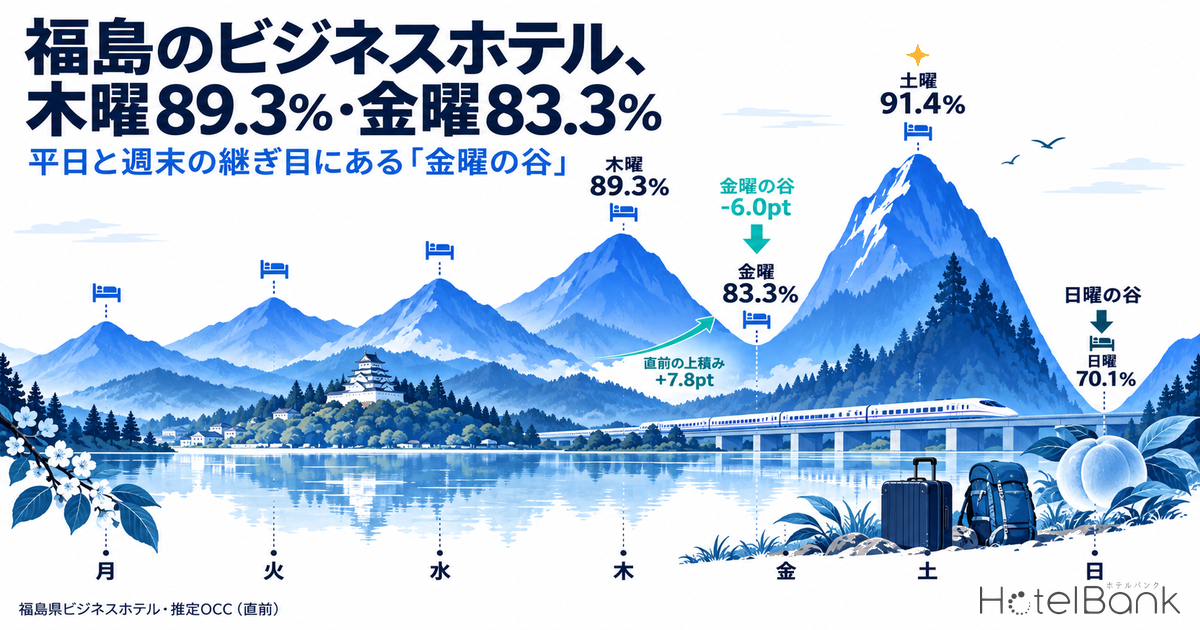
Averaging the estimated OCC (OTA listed-inventory basis) of business hotels in Fukushima Prefecture by day of week for June–July 2026, Thursday stands at 89.3% while Friday drops 6.0pt to 83.3%, before recovering to 91.4% on Saturday. Only Friday—the day between the weekday and weekend blocks—sinks a notch, and this article calls it the “Friday dip.” Sunday, at 70.1%, forms a deeper “Sunday dip” (21.3pt below Saturday), but the Friday dip has a distinct feature of its own. At 45 days before the stay date, Friday is 4.7pt ahead of Thursday, yet Thursday overtakes it with about 8 days to go. Friday fills early but fails to build close in. Using full daily data for the 46–48 properties in scope, this article verifies the shape of this seam and sets out measures to bridge the gap between business travel demand and leisure demand.
Scope: Business hotels in Fukushima Prefecture, N=46–48 properties / 5,425–5,479 rooms (based on major booking-site listings). This article covers occupancy only and does not compare prices by day of week. Occupancy is an estimate based on OTA listed inventory; definitions are given at the end of the article. Period: stay dates June 1 – July 31, 2026 (60 days, excluding the July 20 public holiday). Data as of: September 28, 2026.
• OCC (occupancy) = rooms sold as a share of total rooms in the area (an estimate based on OTA sales inventory). Referred to in this article as “estimated OCC.”
• This article covers only the day-of-week structure of occupancy and does not address ADR or price metrics.
• Source: MetroEngines Research (continuously tracks OTA public rates for approximately 168,000 properties, of which approximately 27,000 are confirmed operating)
- — Estimated OCC for Fukushima business hotels (June–July 2026 stay dates, final pre-arrival reading) shows a “Friday dip”: Thursday 89.3% → Friday 83.3%, down 6.0pt, before recovering to 91.4% on Saturday.
- — Friday leads Thursday by 4.7pt at 45 days out, but its pickup in the final 7 days is only +7.8pt (Thursday: +12.3pt), and Thursday overtakes it with about 8 days to go.
- — The Sunday dip (Sat → Sun −21.3pt) is about twice as deep as in Hyogo Prefecture (−11.1pt) and calls for different measures from the Friday dip.
Estimated OCC by Day of Week — From 89.3% on Thursday to 83.3% on Friday, Back to 91.4% on Saturday
The analysis covers stay dates from June 1 to July 31, 2026, using estimated OCC (OTA listed-inventory basis) observed on the day before each stay date. July 20 (Marine Day, a Monday public holiday) was excluded because its demand differs in nature from ordinary weekdays, and the remaining 60 days were simply averaged by day of week—8 to 9 days per weekday. The properties in scope are business hotels in Fukushima Prefecture that list at least 30% of their total rooms on OTAs and similar channels; the count on each stay date ranged from 46 to 48 properties and 5,425 to 5,479 rooms (based on major booking-site listings). The figures come from a cohort of all properties meeting these criteria, not from a sample.
Across the week, occupancy rises steadily toward the latter half: Monday 78.4%, Tuesday 83.1%, Wednesday 87.3%, Thursday 89.3%. This is the typical shape for business hotels that rely mainly on business and corporate demand. On Friday, however, it falls to 83.3%, and the following Saturday reaches 91.4%, the highest of the week. Friday sits at roughly the same level as Tuesday, forming a trough between the two peaks of Thursday and Saturday.
Source: Compiled by HotelBank Editorial Team from MetroEngines Research data (Fukushima N=46–48 properties / 5,425–5,479 rooms; Hyogo N=70–76 properties / 8,165–9,090 rooms. June–July 2026 stay dates, excluding July 20)
The Sunday dip is much deeper than Friday’s. Occupancy falls 21.3pt from 91.4% on Saturday to 70.1% on Sunday, the only day of the week that stays in the low 70s. Note that this Sunday average includes July 19 (91.6%), the middle day of a three-day weekend; excluding it, the average of the other 7 Sundays is 67.1%. Likewise, excluding July 18 (98.1%), the first day of that three-day weekend, the Saturday average is 90.5%—so the weekly shape holds even without the holiday weekend. Separate analysis of Fukushima’s October three-day weekend found ryokan already at 82.2% occupancy 45 days out, showing how early holiday-weekend bookings build in the prefecture.
The share of properties with no confirmable listed inventory (estimated sell-out rate) follows the same weekly shape. On Thursday, an average of 28.2% of properties showed no listed inventory, compared with 19.3% on Friday, 46.3% on Saturday and 14.1% on Sunday. Friday trails Thursday and Saturday not only in occupancy but also in the number of properties that sell out.
| Day | Days counted | Estimated OCC (final) | Change vs previous day | Sell-out rate (est.) |
|---|---|---|---|---|
| Mon | 8 | 78.4% | +8.3pt | 13.3% |
| Tue | 9 | 83.1% | +4.7pt | 18.8% |
| Wed | 9 | 87.3% | +4.2pt | 26.7% |
| Thu | 9 | 89.3% | +2.0pt | 28.2% |
| Fri | 9 | 83.3% | -6.0pt | 19.3% |
| Sat | 8 | 91.4% | +8.1pt | 46.3% |
| Sun | 8 | 70.1% | -21.3pt | 14.1% |
Source: Compiled by HotelBank Editorial Team from MetroEngines Research data (Fukushima business hotels N=46–48 properties / 5,425–5,479 rooms. Stay dates June 1 – July 31, 2026, excluding July 20. Monday’s change is vs Sunday)
The Friday Dip Forms in the Final Week — Thursday Overtakes Friday on the Booking Curve
For the same 60 days, we averaged by day of week the progression of estimated OCC from 45 days before the stay date to the day before (the booking curve). The number of properties and rooms observed for each stay date is the same cohort as in the table above, and observation coverage was at least 95.8% at every observation point.
At 45 days out, Saturday was furthest ahead at 62.1%, followed by Friday at 55.8%, Thursday at 51.1% and Sunday at 48.2%. Friday led Thursday by 4.7pt, and even at 30 days out the gap was 5.5pt (61.7% vs 56.2%). Bookings arrive first on Friday and Saturday, which draw on a mix of weekend leisure demand, while Thursday starts slowly.
The shape changes close in. At 14 days out, the gap narrows to 3.5pt (Friday 71.1%, Thursday 67.6%), and with 8 days to go Thursday (75.2%) overtakes Friday (74.7%). From there, Thursday climbs to 89.3% by the day before, while Friday stalls at 83.3%. Pickup over the final 7 days is just +7.8pt for Friday, versus +12.3pt for Thursday. Business and corporate bookings concentrate just before the stay date, and it is Monday through Thursday that benefit. Friday struggles to attract last-minute business bookings and loses in the final week the lead it built from early weekend bookings.
Source: Compiled by HotelBank Editorial Team from MetroEngines Research data (Fukushima business hotels N=46–48 properties / 5,425–5,479 rooms. Day-of-week averages of June–July 2026 stay dates, excluding July 20)
| Day | 45 days out | 30 days out | 7 days out | Final (day before) | Pickup, 45 days out → final | Pickup, final 7 days |
|---|---|---|---|---|---|---|
| Mon | 45.1% | 49.7% | 66.1% | 78.4% | +33.3pt | +12.3pt |
| Tue | 45.8% | 49.8% | 69.8% | 83.1% | +37.3pt | +13.3pt |
| Wed | 49.2% | 53.4% | 74.6% | 87.3% | +38.1pt | +12.7pt |
| Thu | 51.1% | 56.2% | 77.0% | 89.3% | +38.2pt | +12.3pt |
| Fri | 55.8% | 61.7% | 75.5% | 83.3% | +27.5pt | +7.8pt |
| Sat | 62.1% | 70.0% | 84.3% | 91.4% | +29.3pt | +7.1pt |
| Sun | 48.2% | 51.8% | 62.2% | 70.1% | +21.9pt | +7.9pt |
Source: Compiled by HotelBank Editorial Team from MetroEngines Research data (Fukushima business hotels N=46–48 properties / 5,425–5,479 rooms. Observations from 45 days before the stay date to the day before, averaged by day of week)
Reading the table across, the days of the week fall into two groups. Monday through Thursday are “late-filling days,” with pickup of +33.3 to +38.2pt from 45 days out to final and at least +12pt in the final 7 days alone. Friday through Sunday are “early-filling days,” with pickup of +21.9 to +29.3pt and only around +7pt in the final 7 days. Friday belongs to the latter group but cannot gather early bookings the way Saturday does. This appears to be what the Friday dip really is.
The Sunday dip is different in nature. At 45 days out, Sunday stands at 48.2%, slightly above Monday (45.1%) and Tuesday (45.8%), but its pickup through to final is the smallest of the week (+21.9pt), and from 13 days out onward it is the lowest day of the week. There is no phase in which it catches up with the other days. Demand itself is thin on Sundays, making the gap hard to fill through last-minute pricing or channel adjustments alone. Friday, by contrast, holds more bookings than Thursday up to 30 days out. If hotels can capture bookings to replace business demand during the final week, there is room to bring Friday closer to Thursday’s level.
Friday Dips in Hyogo Too — But the Depth of the Sunday Dip Differs
The Friday dip is not unique to Fukushima. Under the same conditions (June–July 2026 stay dates, excluding July 20, readings taken the day before), business hotels in Hyogo Prefecture (N=70–76 properties / 8,165–9,090 rooms, based on major booking-site listings) fall 5.5pt from 89.8% on Thursday to 84.3% on Friday, then recover to 90.1% on Saturday. The Thursday-to-Friday drop is nearly the same as Fukushima’s 6.0pt. Separate analysis of Hyogo over a wider June–August 2026 window put Thursday at 90.8% and Friday at 85.0%, showing the same Friday trough.
| Metric (estimated OCC, final) | Fukushima | Hyogo |
|---|---|---|
| Thursday | 89.3% | 89.8% |
| Friday | 83.3% | 84.3% |
| Saturday | 91.4% | 90.1% |
| Sunday | 70.1% | 79.0% |
| Thu → Fri change | -6.0pt | -5.5pt |
| Sat → Sun change | -21.3pt | -11.1pt |
| Scope | 46–48 properties / 5,425–5,479 rooms | 70–76 properties / 8,165–9,090 rooms |
Source: Compiled by HotelBank Editorial Team from MetroEngines Research data (stay dates June 1 – July 31, 2026, excluding July 20. Based on major booking-site listings)
The biggest difference is on Sunday. Hyogo’s Sunday stands at 79.0%, only 11.1pt below Saturday. Fukushima’s 21.3pt Sunday dip is about twice as deep. The Friday dip is common to both prefectures as a “pre-weekend break in business demand,” whereas the depth of the Sunday dip depends on whether local leisure demand extends to Sunday-night stays. For Fukushima business hotels, it helps to treat the Friday dip as a structural issue shared with other prefectures and the Sunday dip as a region-specific one.
For Revenue Managers of Fukushima Business Hotels — Implications and Action Plan
1. Manage Friday as a day that “leads but loses.” Across the market, Friday is ahead of Thursday at 45 and 30 days out (55.8% vs 51.1%, 61.7% vs 56.2%). Even if your own Friday on-the-books is above Thursday at these points, read it as a figure that is expected to be overtaken close in. It is more realistic to judge Friday not by “is it above Thursday?” but by “how far has the gap to Thursday narrowed from 14 days out onward?”
2. The difference in final-7-day pickup determines the size of the Friday dip. Thursday picks up +12.3pt versus +7.8pt for Friday. Splitting the bookings that land on Friday in the final week by type in your own reservation data—business travelers arriving a night early, pre-weekend stays, or the first night of a leisure multi-night stay—shows which demand you can add on top.
3. Design the Friday dip together with the Saturday peak. Saturday is the tightest day of the week, at 91.4% with an estimated sell-out rate of 46.3%, leaving room for guests who cannot secure Saturday inventory to shift to Friday–Saturday multi-night stays or Friday nights. Whether to prioritize Saturday single-night stays or multi-night stays starting Friday should be decided week by week while watching Saturday’s pace.
4. Tackle the Sunday dip with different measures from Friday. Sunday has the smallest pickup through to final of any day (+21.9pt from 45 days out to final) and is the lowest day of the week from 13 days out onward. Compared with Hyogo, its drop is about twice as large—a region-specific shape. Rather than trying to fill it with last-minute pricing, it fits better to sell Sunday as a night-before stay for business trips starting on Monday (Sunday-night check-in), or as an extension of a weekend multi-night stay.
| Timing | Measure | Decision trigger (figures from this article) | Aim |
|---|---|---|---|
| 45 days out | Open Friday–Saturday plans with a multi-night condition (2+ nights) early | Weeks where Saturday on-the-books is running above the market’s 45-days-out level of 62.1% | Pull early-filling Saturday demand into Friday |
| 45 days out | Prepare a product promoting Sunday as a “night-before stay for a Monday business trip” | When your Sunday has not reached the market’s 45-days-out level of 48.2% | Fill the Sunday dip (Sat → Sun −21.3pt) from the business-demand side |
| 30 days out | Review Friday’s pace alongside Saturday rather than Thursday | Weeks where Friday’s pace is below the market’s 30-days-out level of 61.7% | Spot shortfalls in capturing weekend demand early |
| 14 days out | Gradually relax Friday’s multi-night condition and widen sales for Friday single-night and pre-weekend stays | When the Friday–Thursday gap is narrowing faster than the market’s 3.5pt at 14 days out | Act before the late reversal (around 8 days out in the market) |
| Final 7 days | Offer Thursday business guests a Friday extension / return rooms vacated by business guests checking out early on Friday to sale sooner | When Friday’s final-7-day pickup is pacing below the market’s +7.8pt | Refill Friday rooms left empty when business demand drops off, within the final week |
| Final 7 days | In weeks when Saturday inventory is tight, prioritize Friday–Saturday multi-night stays over Saturday single nights | Weeks where Saturday’s pace is above the market’s 7-days-out level of 84.3% | Convert Saturday’s strength into Friday occupancy |
All of these measures start from a comparison against the market average, and how well they work depends on each hotel’s room mix, channels and location (near a station, near a highway interchange, close to a hot-spring area, etc.). A good first step is to lay your own day-of-week trends over the past few months alongside the tables in this article and check whether your Friday dip or Sunday dip is deeper. Market differences also exist across areas within the prefecture, such as Aizu, Urabandai, Iwaki and Koriyama, and are worth checking against your own location.
Summary — Three Yardsticks for Measuring Day-of-Week Dips
Estimated OCC for Fukushima business hotels in June–July 2026 was 89.3% on Thursday, 83.3% on Friday, 91.4% on Saturday and 70.1% on Sunday. The Friday dip (Thu → Fri −6.0pt) appears to a similar degree in Hyogo (−5.5pt), while the Sunday dip (Sat → Sun −21.3pt) was about twice as deep as Hyogo’s. When checking your own hotel’s day-of-week shape, three yardsticks are useful.
| Yardstick | What to look at | Market value, Fukushima business hotels |
|---|---|---|
| Depth of the dip | Difference in final OCC, Thu → Fri and Sat → Sun | -6.0pt / -21.3pt |
| Timing of the reversal | Days remaining when Thursday overtakes Friday’s lead | About 8 days out (gap of 3.5pt at 14 days out) |
| Late pickup | Pickup over the final 7 days | Thursday +12.3pt / Friday +7.8pt |
Source: Compiled by HotelBank Editorial Team from MetroEngines Research data
Friday is a day that “books early but fails to build close in,” sitting at the seam between business and leisure demand. The key to filling the dip lies in designs that connect demand from neighboring days: extensions for business stays continuing from Thursday, pre-weekend stays worked back from Saturday, and Friday–Saturday multi-night stays.
About the Data
■ Data Sources
- Source: MetroEngines Research (continuously tracks OTA public rates and listed inventory for approximately 168,000 properties). Tables and charts were created by the HotelBank Editorial Team from this data.
- Scope: Business hotels in Fukushima Prefecture, N=46–48 properties / 5,425–5,479 rooms (based on major booking-site listings; varies by stay date). Business hotels in Hyogo Prefecture used as a comparison: N=70–76 properties / 8,165–9,090 rooms.
- Data as of: September 28, 2026. Because sales status and inventory change daily, the figures in this article are a snapshot at the time of retrieval.
■ Calculation Assumptions
- Definition of estimated OCC (OTA listed-inventory basis): OTA listed-inventory occupancy = 100 − 100 × OTA listed rooms remaining ÷ total rooms. The scope is a fixed cohort (the same set of properties on every stay date) of properties listing at least 30% of their total rooms on OTAs. This is an estimate based on how inventory sold on OTAs is being absorbed and is defined differently from actual room occupancy (it tends to run high because rooms not listed are counted as sold).
- Booking curve: Based on observations from 45 days before the stay date up to the most recent reading. Day-of-week values are simple averages, by days remaining, of the curve for each stay date.
- Estimated OCC by day of week is the simple average, by day of week, of readings taken the day before each stay date from June 1 to July 31, 2026 (60 days excluding the July 20 public holiday; 8 days each for Monday, Saturday and Sunday, and 9 days each for Tuesday through Friday). The sell-out rate is the day-of-week average of the share of properties with no confirmable listed inventory on OTAs and similar channels (estimated). This article covers occupancy only and uses no price metrics.
■ Limitations and Caveats
- Estimated OCC is derived from the absorption of listed inventory on OTAs and does not match occupancy rates published by properties. It is a simple average across the whole prefecture and does not reflect differences by area (Aizu, Koriyama, Iwaki, etc.) or location. Booking curves are limited to within 45 days of the stay date to avoid observations taken before listing allocations are loaded. Each day-of-week figure is an average of 8–9 days and can swing depending on holidays and events.