

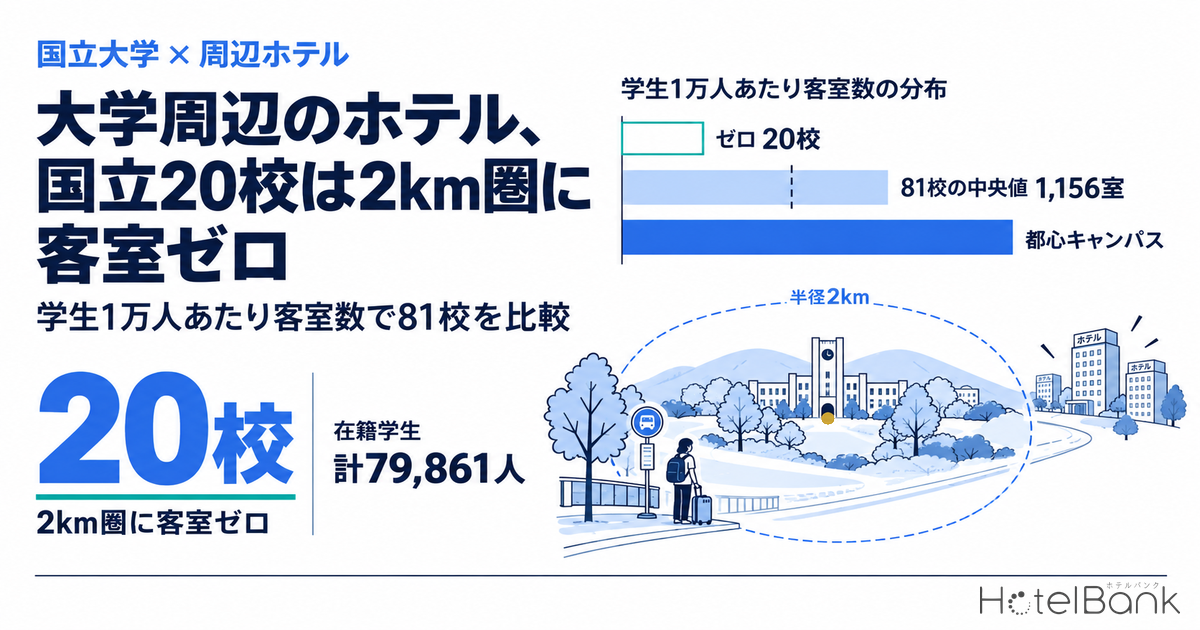
Japan’s national university campuses range enormously in location, from prime central-city sites to hillside land in the mountains. Taking the representative campus points of national universities recorded in the Ministry of Land, Infrastructure, Transport and Tourism (MLIT) National Land Numerical Information (Schools) dataset as the starting point, we used a geographic search of our accommodation database to total the guest rooms of operating lodging facilities within a 2km radius, then normalized the result by enrollment to compare 81 universities nationwide on “rooms per 10,000 students.” The conclusion up front: 20 universities have not a single room at a lodging facility we can confirm as operating within 2km of their campus.
Metric Definitions Used in This Article
- Campus point: Representative points extracted from the university records in MLIT’s National Land Numerical Information (Schools) where the founder is the national government. Points belonging to the same university within 1.5km of each other in a straight line were merged into a single campus point.
- Rooms within 2km: Total guest rooms at lodging facilities we have confirmed as operating (based on listings on major booking sites) within a 2km radius of any campus point of each university. Facilities whose operation we cannot confirm, such as training centers and corporate or association lodging, are excluded. Where the radii of multiple campuses overlap, each facility is counted only once.
- Rooms per 10,000 students: Rooms within 2km / number of students x 10,000. Students are the sum of undergraduate enrollment and graduate enrollment (doctoral, master’s and professional degree programs).
- Data sources: Campus coordinates = MLIT National Land Numerical Information (Schools) / Students and faculty/staff = National Institution for Academic Degrees and Quality Enhancement of Higher Education (NIAD-QE) “University Basic Information” (as of May 1, 2025) / Guest rooms = MetroEngines Research & Consulting
- – Of 81 national universities with undergraduate faculties, 20 have no rooms at a confirmed operating lodging facility within 2km of campus (79,861 students enrolled in total).
- – The median number of rooms per 10,000 students is 1,156. Universities polarize into 20 with zero and 20 with more than 5,000 rooms, and the absolute level reflects the size of the city market rather than the university.
- – Widening the radius to 5km cuts the zero-room group to 2 universities (Fukushima University and Toyohashi University of Technology). Whether supply looks thin depends heavily on defining the catchment as walking distance.
- – Planned projects due for completion from September 2026 onward (based on building-permit applications) total 13,950 rooms within 2km of 27 universities. None falls near the 20 zero-room universities; additions are skewed toward areas that already have deep inventory.
- – Zero rooms within 2km is not proof of demand. Near the University of Tsukuba there is also a training center outside our tally (156 rooms), so site evaluation must separately check lodging capacity outside the tally and business/tourism demand.
Why Divide Rooms by Students? On Absolute Counts, Central-City Campuses Top the List Automatically
Ranking universities only by the absolute number of rooms nearby produces an order that almost exactly mirrors the hierarchy of cities. The largest 2km room count, 23,257 rooms, surrounds the Yushima campus of the Institute of Science Tokyo, but this is not inventory drawn by the university; it is simply central Tokyo’s commercial inventory, running from Ochanomizu through Akihabara to Ueno, that happens to fall within 2km. The 17,236 rooms around the University of Tokyo’s Hongo/Yayoi campus and the 17,312 rooms around Hokkaido University’s Sapporo campus are of the same nature.
Dividing rooms by enrollment, by contrast, shows how much lodging capacity is attached relative to the population each university carries. The median across 81 universities is 1,156 rooms per 10,000 students. The distribution does not cluster around the middle, however; it splits toward the extremes. While 20 universities have zero, another 20 exceed 5,000 rooms, and these two groups account for nearly half of the total.
Note that this indicator measures both “shortage” and “saturation.” A university with a high value simply has its campus inside a large market that exists regardless of university demand, leaving little room to add new rooms. A university with a low value has no accommodation nearby despite a steady flow of university-related travel. It is the latter where development headroom becomes the question. We have applied the same approach with station ridership as the denominator in a separate nationwide analysis, which found a median of 20 rooms per 10,000 station riders.
20 Universities With Not a Single Room Within 2km: University of Tsukuba Has 16,684 Students and 6,742 Faculty/Staff
Twenty of 81 universities had not one operating room within a 2km radius of campus. They enroll 79,861 students in total, or 110,624 people including faculty and staff. The largest single case is the University of Tsukuba: with 16,684 students and 6,742 faculty and staff, its nearest lodging facility is 2.4km away in a straight line. Widening to 5km brings 19 facilities and 1,721 rooms into view, so the picture is not an absence of inventory but inventory clustered around Tsukuba Station sitting just outside the distance threshold.
Note, however, that this distance applies only to the facilities in our tally (lodging we confirm as operating). In Amakubo, about 1.4km from the University of Tsukuba campus point and about 1.2km from Tsukuba University of Technology, stands the Tsukuba Training Center (156 rooms), run by the Tsukuba Gakuto Fund Foundation, which also accepts general bookings and describes itself as the lodging closest to the University of Tsukuba. Because it is outside our tally it is not counted in the 2km room figure, but for the two Tsukuba universities the data cannot be read as “no accommodation at all within walking distance.” For the other zero-room universities too, lodging capacity outside the tally, such as training centers, university guest houses and corporate or association lodging, may exist nearby.
Of these 20, two still show no rooms even at 5km: Fukushima University (Kanayagawa) and Toyohashi University of Technology (Tenpaku-cho). Fukushima University has 4,528 students and its nearest facility is 6.9km away; Toyohashi University of Technology has 2,193 students and 5.9km. Asahikawa Medical University, by contrast, has zero within 2km but 25 facilities and 3,275 rooms within 5km, with downtown Asahikawa inventory functioning from 3.8km away. The same “zero within 2km” means something entirely different depending on how close a campus is to city-center inventory.
| University | Students | Distance to nearest lodging | Rooms within 5km | Facilities within 5km |
|---|---|---|---|---|
| Fukushima University | 4,528 | 6.9 km | 0 | 0 |
| Toyohashi University of Technology | 2,193 | 5.9 km | 0 | 0 |
| Asahikawa Medical University | 953 | 3.8 km | 3,275 | 25 |
| Gifu University | 7,340 | 3.6 km | 637 | 9 |
| Hokkaido University of Education | 5,231 | 3.3 km | 298 | 2 |
| Muroran Institute of Technology | 3,311 | 2.9 km | 744 | 7 |
| National Institute of Fitness and Sports in Kanoya | 854 | 2.9 km | 1 | 1 |
| Oita University | 5,508 | 2.7 km | 358 | 6 |
| Kochi University | 5,531 | 2.5 km | 1,277 | 22 |
| University of Miyazaki | 5,420 | 2.4 km | 79 | 4 |
| Hamamatsu University School of Medicine | 1,210 | 2.4 km | 245 | 3 |
| Tsukuba University of Technology | 322 | 2.4 km | 1,721 | 19 |
| University of Tsukuba | 16,684 | 2.4 km | 1,721 | 19 |
| Shiga University of Medical Science | 1,112 | 2.3 km | 1,225 | 22 |
| Hitotsubashi University | 6,162 | 2.2 km | 2,597 | 38 |
| Nagaoka University of Technology | 2,201 | 2.2 km | 270 | 3 |
| Hyogo University of Teacher Education | 1,494 | 2.2 km | 202 | 3 |
| Wakayama University | 4,465 | 2.2 km | 1,167 | 24 |
| Obihiro University of Agriculture and Veterinary Medicine | 1,373 | 2.0 km | 98 | 3 |
| Aichi University of Education | 3,969 | 2.0 km | 108 | 3 |
Mapping 149 Campus Points: 40 Have Zero Rooms Within 2km
Merging the campus points of the 81 universities yields 149 points. Viewed by point rather than by university, 40 points have no rooms within 2km. Among universities with multiple campuses, a frequent pattern is an urban main campus well served by inventory alongside suburban science, engineering or agriculture campuses with none. Kochi University (three points: Asakura, Oko and Monobe), Oita University (two: Dannoharu and Hasama) and the University of Miyazaki (two: Kibana and Kiyotake) had zero at every point.
Size and Supply Are Only Weakly Correlated: More Than 20,000 Students Yet Only About 1,500 Rooms
Plotting enrollment against rooms within 2km shows an upward trend, but with wide dispersion. Median enrollment is 5,770 students and the median room count within 2km is 755 rooms. Of the four quadrants these two lines create, the lower right (many students, few rooms) is the candidate pool for development headroom as defined in this article.
Narrowing to the 19 universities with 10,000 or more students makes this distortion even clearer. Osaka University has 23,234 students but 1,445 rooms within 2km (622 per 10,000 students), and Kyoto University has 22,365 students against 1,732 rooms (774 per 10,000). Both are among Japan’s largest universities, yet because their campuses sit in residential or academic districts (Suita, Toyonaka and Minoh; Yoshida), their 2km inventory does not even reach the median. For Kyoto University, widening to 5km makes the figure jump to 28,075 rooms. Even when a city’s overall inventory is plentiful, capacity within walking distance of campus is a separate question. Room stock within walking distance of major campuses is also tracked at the property level, with a focus on entrance-exam demand, in Exam-Night Hotels: Room Stock Around 10 Major Campuses (campus reference points and data dates differ, so individual figures do not match this article).
What Enrollment Alone Misses: Medical Universities Where Faculty and Staff Outnumber Students
An indicator based on enrollment has a weakness: at single-discipline medical universities with an affiliated hospital, faculty and staff outnumber students. Asahikawa Medical University has 953 students and 1,805 faculty/staff, Hamamatsu University School of Medicine 1,210 students and 2,123 faculty/staff, and Shiga University of Medical Science 1,112 students and 1,938 faculty/staff. All three have zero rooms within 2km, but looking at enrollment alone invites the misreading that this is “only natural for a small school.”
We therefore also calculated the same indicator using students plus faculty/staff as the denominator. The median across 81 universities is 926 rooms per 10,000 people, about 20% lower than the 1,156 rooms on a student basis. The greater the weight of faculty and staff, the more a student-based indicator understates how thin supply is. At universities with affiliated hospitals, a separate stream of demand from patients and their families also overlaps, so when evaluating sites it is better to consider enrollment and faculty/staff separately. We have also tallied lodging supply around Japan’s 88 advanced treatment hospitals themselves in a separate analysis, which found 20 of them with zero rooms within 2km.
| Radius | Per 10,000 students (median) | Per 10,000 students + faculty/staff (median) | Universities with zero rooms | Universities under 500 rooms per 10,000 students |
|---|---|---|---|---|
| 2km radius | 1,156 rooms | 926 rooms | 20 | 33 |
| 5km radius | 6,786 rooms | 4,582 rooms | 2 | 5 |
Widening the radius to 5km makes the median jump about 5.9-fold to 6,786 rooms, and the zero-room group shrinks from 20 universities to 2 (Fukushima University and Toyohashi University of Technology). Universities with fewer than 500 rooms per 10,000 students also shrink from 33 to 5. In other words, most “thin supply” judgments depend on defining the catchment as walking distance, and many universities have city inventory between 2km and 5km. Conversely, the five universities that remain below 500 rooms even at 5km (Fukushima University, Toyohashi University of Technology, National Institute of Fitness and Sports in Kanoya, University of Miyazaki and Aichi University of Education) can be treated as a thin-supply group at any radius. Adding faculty and staff to the denominator lowers the median by roughly 20% at 2km and 30% at 5km, but the zero-room universities stay the same.
The four graduate-only universities without undergraduate faculties (the Graduate University for Advanced Studies, SOKENDAI; the National Graduate Institute for Policy Studies; the Japan Advanced Institute of Science and Technology; and the Nara Institute of Science and Technology) are excluded from the 81. Their enrollment is small at 400-1,300 students, and for institutions such as SOKENDAI, which is based at research institutes across the country, the indicator takes values orders of magnitude apart and comparison loses meaning.
Planned Lodging Concentrates Where Supply Already Exists: None Near the 20 Zero-Room Universities
From planning data derived from MLIT’s Building Construction Statistics, we extracted projects due for completion from September 2026 onward with a known room count and overlaid them on the same 2km radii. Matches were found at 27 of the 81 universities, totaling 13,950 rooms. By breakdown, 14 projects and 2,845 rooms around Hiroshima University’s Higashi-Senda campus, 12 projects and 2,468 rooms around Hokkaido University’s Sapporo campus, 4 projects and 887 rooms at Yamagata University (Yamagata and Tsuruoka), and 4 projects and 863 rooms around Tohoku University’s Katahira campus show a strong pattern of additions at universities that already have substantial inventory within 2km.
At the 20 universities with zero rooms within 2km, by contrast, not a single planned project could be confirmed within 2km. From the supply side, walking-distance areas around these 20 universities are likely to remain empty for the next several years. Note, however, that the planning data is based on building-permit applications, which are usually filed one to two years before opening. Counts for future years are therefore a lower bound on the currently confirmed pipeline and are expected to rise as further applications are filed.
How to Read Development Headroom: Zero Rooms Within 2km Does Not Prove Demand
Finally, a note on interpretation. Zero rooms within 2km shows only that supply is thin; it does not by itself prove that demand exists. University-linked lodging demand is the sum of multiple streams, including academic conferences and symposia, joint research and corporate visits, ceremonies and open campus events, away trips for extracurricular activities, and families of patients at affiliated hospitals, and much of it is not smoothed across the year. Concentrated demand a few times a year is hard-pressed to sustain year-round occupancy, so whether separate business or tourism demand exists nearby is the dividing line for an investment decision.
The 2.0-2.5km distance band from campus is also a zone easily covered by local buses or bicycles. For universities where the “distance to nearest lodging” in the table stays in the 2km range, existing city inventory is likely functioning as de facto accommodation. Conversely, universities whose nearest facility is 3km or more away and whose 5km room count is only in the hundreds have a structure that existing inventory cannot fully absorb.
Structural gap
Thirteen universities have zero rooms within 2km and fewer than 1,000 rooms within 5km. Fukushima University and Toyohashi University of Technology have zero even at 5km, the University of Miyazaki 79 rooms, Obihiro University of Agriculture and Veterinary Medicine 98 and Aichi University of Education 108: existing inventory does not reach them in volume.
City inventory within reach
The remaining seven have zero within 2km but 1,000+ rooms within 5km, such as Asahikawa Medical University (3,275 rooms), Hitotsubashi University (2,597) and the University of Tsukuba (1,721). The issue is less new supply than how to close the distance to existing inventory.
Supply still being added
Thousands of rooms already sit within 2km, and planned projects are concentrating in the same radius, as around the central-city campuses of Hiroshima University, Hokkaido University and Tohoku University. This is explained more by the dynamics of the city market than by the university.
All 81 Universities, Sorted by Rooms per 10,000 Students (Ascending)
| University | Students | Faculty/staff | Campus point | Facilities within 2km | Rooms within 2km | Per 10,000 students | Rooms within 5km |
|---|---|---|---|---|---|---|---|
| Fukushima University | 4,528 | 784 | 1 | 0 | 0 | 0 | 0 |
| Toyohashi University of Technology | 2,193 | 534 | 1 | 0 | 0 | 0 | 0 |
| National Institute of Fitness and Sports in Kanoya | 854 | 201 | 1 | 0 | 0 | 0 | 1 |
| University of Miyazaki | 5,420 | 3,008 | 2 | 0 | 0 | 0 | 79 |
| Obihiro University of Agriculture and Veterinary Medicine | 1,373 | 370 | 1 | 0 | 0 | 0 | 98 |
| Aichi University of Education | 3,969 | 547 | 1 | 0 | 0 | 0 | 108 |
| Hyogo University of Teacher Education | 1,494 | 365 | 1 | 0 | 0 | 0 | 202 |
| Hamamatsu University School of Medicine | 1,210 | 2,123 | 1 | 0 | 0 | 0 | 245 |
| Nagaoka University of Technology | 2,201 | 565 | 1 | 0 | 0 | 0 | 270 |
| Hokkaido University of Education | 5,231 | 940 | 1 | 0 | 0 | 0 | 298 |
| Oita University | 5,508 | 2,687 | 2 | 0 | 0 | 0 | 358 |
| Gifu University | 7,340 | 3,162 | 1 | 0 | 0 | 0 | 637 |
| Muroran Institute of Technology | 3,311 | 514 | 1 | 0 | 0 | 0 | 744 |
| Wakayama University | 4,465 | 594 | 1 | 0 | 0 | 0 | 1,167 |
| Shiga University of Medical Science | 1,112 | 1,938 | 1 | 0 | 0 | 0 | 1,225 |
| Kochi University | 5,531 | 2,434 | 3 | 0 | 0 | 0 | 1,277 |
| University of Tsukuba | 16,684 | 6,742 | 1 | 0 | 0 | 0 | 1,721 |
| Tsukuba University of Technology | 322 | 270 | 1 | 0 | 0 | 0 | 1,721 |
| Hitotsubashi University | 6,162 | 1,180 | 1 | 0 | 0 | 0 | 2,597 |
| Asahikawa Medical University | 953 | 1,805 | 1 | 0 | 0 | 0 | 3,275 |
| Saitama University | 8,490 | 1,109 | 1 | 1 | 4 | 5 | 2,312 |
| Yokohama National University | 9,661 | 1,466 | 1 | 1 | 32 | 33 | 12,491 |
| University of the Ryukyus | 7,819 | 3,095 | 1 | 4 | 59 | 75 | 737 |
| Fukuoka University of Education | 2,669 | 446 | 1 | 1 | 27 | 101 | 215 |
| Shiga University | 3,836 | 558 | 1 | 5 | 41 | 107 | 666 |
| University of Toyama | 9,341 | 3,243 | 3 | 4 | 137 | 147 | 6,918 |
| Miyagi University of Education | 1,571 | 271 | 1 | 1 | 25 | 159 | 11,724 |
| Shizuoka University | 10,106 | 1,659 | 2 | 2 | 261 | 258 | 7,525 |
| Saga University | 6,614 | 2,666 | 3 | 7 | 189 | 286 | 1,978 |
| Tokyo Gakugei University | 5,252 | 771 | 1 | 4 | 159 | 303 | 1,147 |
| University of Electro-Communications | 4,917 | 831 | 1 | 4 | 183 | 372 | 738 |
| Joetsu University of Education | 1,099 | 355 | 1 | 1 | 42 | 382 | 1,351 |
| Tokyo University of Foreign Studies | 4,253 | 636 | 1 | 4 | 165 | 388 | 1,487 |
| Kanazawa University | 10,752 | 3,560 | 2 | 29 | 548 | 510 | 8,455 |
| Osaka University | 23,234 | 10,501 | 3 | 18 | 1,445 | 622 | 2,582 |
| Gunma University | 6,427 | 3,109 | 3 | 11 | 479 | 745 | 2,170 |
| Kyoto University | 22,365 | 11,469 | 1 | 120 | 1,732 | 774 | 28,075 |
| Yamaguchi University | 10,019 | 3,701 | 3 | 15 | 994 | 992 | 2,990 |
| Ibaraki University | 8,035 | 1,218 | 3 | 9 | 810 | 1,008 | 4,278 |
| Kitami Institute of Technology | 2,099 | 332 | 1 | 5 | 225 | 1,072 | 1,881 |
| Naruto University of Education | 969 | 368 | 1 | 4 | 112 | 1,156 | 770 |
| Kyushu Institute of Technology | 5,828 | 1,081 | 3 | 6 | 681 | 1,168 | 6,620 |
| Tokyo University of Agriculture and Technology | 5,945 | 1,040 | 2 | 15 | 755 | 1,270 | 1,541 |
| Kyoto Institute of Technology | 4,007 | 701 | 1 | 23 | 525 | 1,310 | 9,456 |
| Mie University | 7,178 | 2,946 | 1 | 7 | 1,051 | 1,464 | 1,399 |
| Niigata University | 12,159 | 4,604 | 2 | 16 | 1,782 | 1,466 | 6,696 |
| Kyushu University | 18,813 | 8,832 | 5 | 55 | 3,541 | 1,882 | 29,637 |
| Shimane University | 6,194 | 3,185 | 2 | 16 | 1,182 | 1,908 | 4,587 |
| Kyoto University of Education | 1,502 | 292 | 1 | 38 | 344 | 2,290 | 13,559 |
| Kobe University | 16,214 | 5,909 | 4 | 40 | 4,160 | 2,566 | 12,700 |
| Hirosaki University | 7,062 | 2,823 | 1 | 22 | 1,831 | 2,593 | 2,081 |
| Chiba University | 13,922 | 4,861 | 4 | 44 | 4,068 | 2,922 | 6,350 |
| University of Yamanashi | 4,823 | 3,150 | 2 | 19 | 1,473 | 3,054 | 3,416 |
| Kagoshima University | 10,213 | 4,061 | 2 | 26 | 3,200 | 3,133 | 8,305 |
| Tottori University | 6,308 | 3,128 | 2 | 19 | 2,002 | 3,174 | 3,067 |
| Nagasaki University | 9,307 | 4,504 | 2 | 53 | 3,110 | 3,342 | 6,014 |
| Yamagata University | 8,638 | 3,014 | 4 | 48 | 3,477 | 4,025 | 5,424 |
| Otaru University of Commerce | 2,343 | 326 | 1 | 21 | 977 | 4,170 | 1,590 |
| Tokushima University | 7,544 | 3,440 | 2 | 55 | 3,369 | 4,466 | 3,387 |
| Nagoya University | 15,959 | 7,227 | 3 | 52 | 7,306 | 4,578 | 27,819 |
| University of Fukui | 5,041 | 2,766 | 2 | 26 | 2,375 | 4,711 | 2,841 |
| Utsunomiya University | 5,133 | 875 | 1 | 24 | 2,596 | 5,057 | 4,930 |
| Shinshu University | 11,043 | 3,634 | 5 | 112 | 5,690 | 5,153 | 8,850 |
| Okayama University | 13,525 | 5,550 | 2 | 52 | 7,018 | 5,189 | 7,795 |
| Akita University | 5,135 | 2,313 | 2 | 18 | 2,817 | 5,486 | 3,666 |
| Kumamoto University | 9,946 | 3,301 | 2 | 56 | 6,184 | 6,218 | 7,736 |
| Tohoku University | 17,975 | 9,626 | 3 | 87 | 11,776 | 6,551 | 12,648 |
| Iwate University | 5,495 | 1,171 | 1 | 27 | 3,722 | 6,773 | 3,906 |
| Ehime University | 9,399 | 3,420 | 3 | 92 | 6,656 | 7,082 | 7,420 |
| University of Tokyo | 28,918 | 12,301 | 2 | 201 | 21,130 | 7,307 | 100,429 |
| Kagawa University | 6,489 | 2,563 | 4 | 60 | 4,825 | 7,436 | 5,462 |
| Nagoya Institute of Technology | 5,770 | 918 | 1 | 31 | 4,427 | 7,672 | 27,656 |
| Hiroshima University | 15,496 | 5,211 | 3 | 110 | 11,920 | 7,692 | 15,722 |
| Hokkaido University | 17,770 | 8,329 | 2 | 115 | 17,484 | 9,839 | 30,046 |
| Nara University of Education | 1,246 | 236 | 1 | 61 | 1,465 | 11,758 | 4,003 |
| Nara Women’s University | 2,671 | 452 | 1 | 92 | 3,663 | 13,714 | 4,062 |
| Institute of Science Tokyo | 13,492 | 8,363 | 4 | 197 | 23,702 | 17,567 | 92,141 |
| Ochanomizu University | 2,901 | 523 | 1 | 47 | 5,649 | 19,473 | 55,827 |
| Osaka Kyoiku University | 4,281 | 635 | 2 | 127 | 9,077 | 21,203 | 42,482 |
| Tokyo University of the Arts | 3,240 | 752 | 2 | 159 | 12,286 | 37,920 | 54,860 |
| Tokyo University of Marine Science and Technology | 2,666 | 710 | 2 | 104 | 16,316 | 61,200 | 86,617 |
Methodology and Scope
Campus coordinates were extracted from the university records (2021 edition) of MLIT’s National Land Numerical Information (Schools), filtered to those with a national founder. The dataset records the head office and main campus locations of each university and does not cover every satellite campus; for example, Kyoto University’s Uji and Katsura campuses, the University of Tokyo’s Kashiwa campus and the University of Tsukuba’s Tokyo campus are not included in this article’s radii. Because Tokyo Medical and Dental University and Tokyo Institute of Technology merged in October 2024 to form the Institute of Science Tokyo, the records of both are treated together as the Institute of Science Tokyo. This leaves 85 national universities, of which 81 have undergraduate faculties.
Guest room counts are based on a population of about 27,000 facilities and about 1.26 million rooms confirmed as operating, out of the roughly 138,000 domestic facilities tracked by MetroEngines Research. Facilities in operation with known latitude and longitude were included, totaling those within a great-circle distance of 2,000m from each campus point. This population does not include ryokan, minshuku and simple lodging not listed on major booking sites, so actual room stock may slightly exceed the figures shown here. The 87 facilities with no registered room count are treated as having zero rooms.
Student and faculty/staff numbers come from NIAD-QE’s University Basic Information (fiscal 2025, as of May 1 of that year). Students are the sum of undergraduate enrollment and graduate enrollment (doctoral, master’s and professional degree programs), excluding non-degree, auditing and research students and those in advanced or special courses. Faculty/staff is the sum of full-time academic staff and administrative staff.
Frequently Asked Questions
Q. Does “zero rooms within 2km” mean that hotels cannot be built near that university?
No. This article does not examine regulatory requirements such as zoning or local ordinances. It shows only the supply-side fact that no lodging facility we confirm as operating currently exists within 2km. There may also be lodging outside the tally, such as training centers or university guest houses, near a campus (see the University of Tsukuba example in the main text).
Q. Why a 2km radius?
Because it is roughly a 25-minute walk, close to the upper limit a campus visitor can walk from their accommodation. For comparison, the 5km radius is also shown so that the distance relationship with city inventory can be read.
Q. Are universities with many rooms per 10,000 students promising investment targets?
The opposite. A high value indicates that the campus sits within a large commercial market that exists independently of university demand, so headroom for adding new rooms is, if anything, limited.
Related Reading
References and Sources
■ Data sources
Campus points: national university records in MLIT National Land Numerical Information (Schools) (2021 edition). Students and faculty/staff: NIAD-QE University Basic Information (as of May 1, 2025). Guest rooms: 27,249 facilities and 1,266,938 rooms confirmed as operating by MetroEngines Research & Consulting. Planned lodging: planning data derived from MLIT Building Construction Statistics (completion scheduled from September 2026 onward, room count known).
■ Calculation assumptions
Distances are great-circle distances from each campus point. Points of the same university within 1.5km in a straight line were merged into one point, and facilities where the radii of multiple points overlap were counted only once. Rooms per 10,000 students = rooms within 2km / students x 10,000. The 87 facilities with no registered room count are treated as 0 rooms, and medians are simple medians of the 81 universities. The sensitivity in Table 2 was calculated from the values in Table 3.
■ Limitations
The tally is limited to facilities whose operation can be confirmed on major booking sites and excludes training centers, corporate or association lodging and university guest houses (the 156-room Tsukuba Training Center near the University of Tsukuba and Tsukuba University of Technology is one example). Campus points are representative points and do not cover every satellite campus. Planning data is based on building-permit applications, and future years represent a lower bound on the currently confirmed pipeline. Room counts measure supply and do not indicate occupancy or the size of demand.
■ Geospatial data
- MLIT National Land Numerical Information “School Data” (P29) – representative points, school classification and founder of national universities
- MLIT Building Construction Statistics – planned lodging facilities (based on building-permit applications)
■ University data
- NIAD-QE “University Basic Information” (FY2025) – students, academic staff and administrative staff
- Japan Association of National Universities “Overview of National Universities (Key Data)”
- Institute of Science Tokyo “Institute of Science Tokyo Established on October 1, 2024”
- MEXT “School Basic Survey – FY2024 Summary of Results”
■ Lodging market data
- MetroEngines Research & Consulting – locations and room counts of operating lodging facilities (N=27,249 facilities)