

Hyatt’s new Japan brand, Atona (吾汝), has announced five sites slated to open in 2028 or later: Yoichi in Hokkaido, Hakone in Kanagawa, Yufu in Oita, Yakushima in Kagoshima, and Kuju in Oita. None of them is a major city — all are regional destinations set against hot springs and nature. With opening still several years away, neither exact locations nor room counts have been disclosed. So what price level do these five places command today? Using MetroEngines Research & Consulting data, we measured lodging rates in the municipality of each site and laid them out as a rate map.
Metric Definitions Used in This Article
- ADR (average daily rate): an estimated settled rate (tax-excluded equivalent), derived by applying a category-specific adjustment factor to the lowest-plan level each property publishes on OTAs and elsewhere (2 guests per room, per-room price, tax included). Checked against property-level results disclosed by listed hotel REITs (91 properties, most recent 3 months), the median error is about 7%. It is an estimate and differs from each property’s actual transacted prices and accounting figures. Area-level ADR is the median of the properties covered (the level of a typical property in the area).
- Listed price: the area median of the average price across all plans, from room-only to meal-inclusive (2 guests per room, per-room price, tax included). Because its basis differs from the estimated settled ADR, do not subtract one from the other.
- Period: the 12 finalized months from September 2025 to August 2026. N = “properties for which an estimated settled ADR could be calculated / properties listed in the municipality”.
- Data source: MetroEngines Research & Consulting
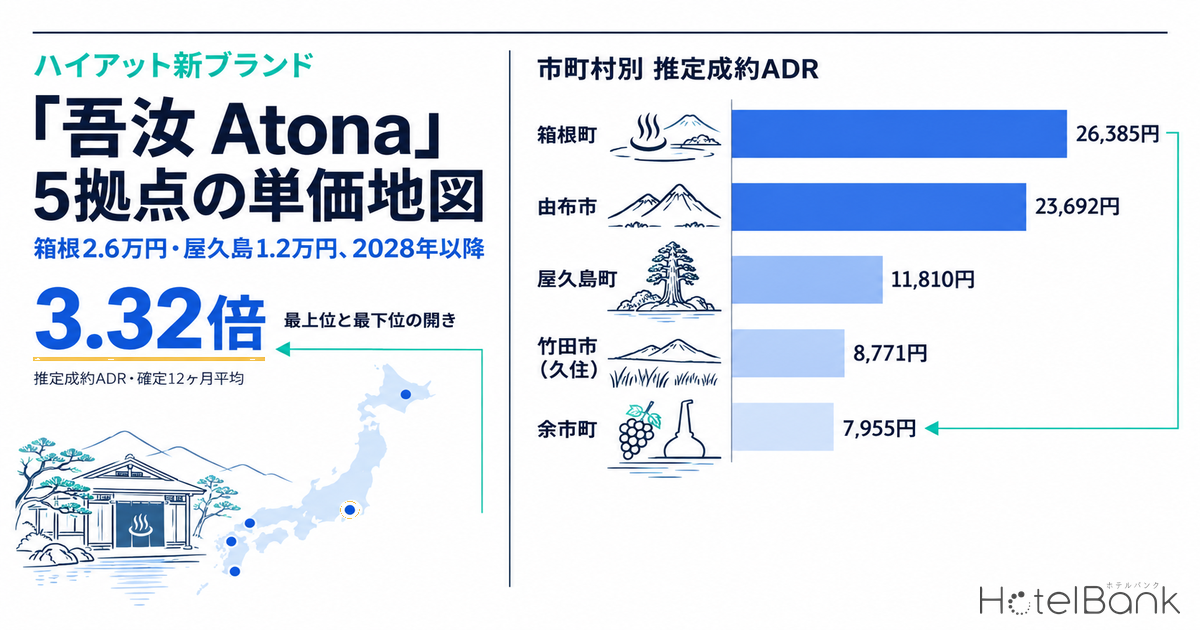
- — A 3.32x spread — Estimated settled ADR in the five host municipalities ranges from ¥26,385 in Hakone to ¥7,955 in Yoichi (12-month average of finalized data, September 2025 to August 2026).
- — Only 1.08x among ryokan — Hakone ¥25,646, Yufu ¥23,691. Once the property category is held constant, the top two sites sit at almost the same level.
- — Supply growth runs in reverse order to rates — Listed properties in Yoichi went from 6 to 15 in two years (+150%), followed by Hakone +32% and Taketa +6%.
- — “How hard it is to build” matters more than rates — All five sites include natural-park areas, and in Yufu a local ordinance has kept the largest new opening of the past decade to 45 rooms.
- — We include, as illustrative cases, an assumed rate range premised on capturing 3–5x the local market, and a two-way sensitivity of assumed ADR × annual OCC.
What Is Confirmed: Five Sites, 2028 or Later, 30–50 Rooms Each
According to Hyatt Japan’s press kit (April 2026), Hyatt operates 22 hotels under 9 brands in Japan, with 5,066 rooms in total. On top of that, 10 new hotel openings had been announced as of September 2025. Half of those 10 — five — are Atona.
The press kit is brief. All five sites carry the note “tentative name”, the opening is listed as “2028 or later”, and room counts are “TBD”. Moreover, Atona does not appear in the Hyatt brand portfolio listed in the same document (6 categories, 36 brands). In other words, Atona is positioned not as the Japan rollout of an existing brand but as a new brand launched out of Japan. The document also states that Masahiko Sakamura, Representative Director of Hyatt Japan, serves concurrently as co-representative of Atona Co., Ltd.
Meanwhile, public information at the brand launch describes Atona as small-scale luxury properties focused on hot springs and local culture, envisaging roughly 30–50 rooms per site, with Kiraku named as development partner. A restaurant preceding the brand, Kappo Atona, is also slated to open in autumn 2026 in Gion Shirakawa, Kyoto. These, however, are not confirmed per-site figures. This article does not speculate on room counts, investment amounts, or operating structures by site; it deals only with “the current rate level of each place”.
| Site (as listed in the press kit) | Region | Municipality | Planned opening | Rooms |
|---|---|---|---|---|
| Atona Yoichi (tentative name) | Hokkaido | Yoichi Town | 2028 or later | TBD |
| Atona Hakone (tentative name) | Kanto | Hakone Town | 2028 or later | TBD |
| Atona Yufu (tentative name) | Kyushu | Yufu City | 2028 or later | TBD |
| Atona Yakushima (tentative name) | Kyushu | Yakushima Town | 2028 or later | TBD |
| Atona Kuju (tentative name) | Kyushu | Taketa City | 2028 or later | TBD |
Source: Compiled by MetroEngines Research & Consulting from Hyatt Japan, “Press Kit, April 2026” (municipalities are our own mapping based on the site names; street addresses have not been disclosed)
Rate Map of the Five Sites: A 3.3x Spread, from ¥26,400 in Hakone to ¥8,000 in Yoichi
For each municipality hosting a site, we averaged the estimated settled ADR over the 12 finalized months from September 2025 to August 2026. Hakone Town is highest at about ¥26,400, followed by Yufu City at about ¥23,700. Yakushima Town came in at about ¥11,800, Taketa City at about ¥8,800 and Yoichi Town at about ¥8,000. Between top-ranked Hakone and bottom-ranked Yoichi, the gap is 3.32x.
Five sites of the same brand, launching in the same period, yet their current market levels differ this much. Luxury properties typically aim for a price band detached from the local market, so these figures do not directly indicate Atona’s assumed rates. Still, the local business environment — labor costs, procurement, the customer base of surrounding properties — sits on top of this level.
Source: MetroEngines Research & Consulting; Hyatt Japan, “Press Kit, April 2026” / Map tile attribution is shown at the bottom right of the map / Circles are placed at a representative point of each municipality and do not indicate property locations
Source: MetroEngines Research & Consulting (12-month average of finalized data, September 2025 to August 2026)
| Municipality | Estimated settled ADR | YoY | Listed price | N (calculated / listed) |
|---|---|---|---|---|
| Hakone Town (Kanagawa) | ¥26,385 | +3.4% | ¥51,764 | 186 / 386 |
| Yufu City (Oita) | ¥23,692 | +0.8% | ¥45,509 | 142 / 298 |
| Yakushima Town (Kagoshima) | ¥11,810 | +2.1% | ¥15,971 | 14 / 103 |
| Taketa City (Oita, Kuju) | ¥8,771 | -0.7% | ¥24,060 | 20 / 36 |
| Yoichi Town (Hokkaido) | ¥7,955 | -0.3% | ¥30,149 | 3 / 15 |
Source: MetroEngines Research & Consulting (12-month average of finalized data, September 2025 to August 2026; YoY compares with September 2024 to August 2025)
Year on year, all five municipalities stayed within ±3.5%. Hakone’s +3.4% is the largest move, while Taketa and Yoichi slipped slightly below the prior year. Even amid a nationwide inbound upswing, rates in these regional destinations have moved steadily.
Compared Ryokan to Ryokan, the Hakone–Yufu Gap Narrows to 8%
Atona has been announced as a hot-spring ryokan brand. So rather than all properties in each municipality, we re-aggregated using the ryokan category only. The picture shifts somewhat.
Ryokan in Hakone average about ¥25,600 and ryokan in Yufu about ¥23,700 — a gap of just 1.08x. On an all-property basis Hakone led Yufu by 1.11x, but among ryokan alone the gap narrows further. Hakone’s higher all-property average owes much to the depth of its non-ryokan categories. Yufu, conversely, is a market where ryokan rates essentially set the city-wide level.
| Municipality | Ryokan only: est. settled ADR | All properties: est. settled ADR | Ryokan N |
|---|---|---|---|
| Hakone Town | ¥25,646 | ¥26,385 | 153 / 175 |
| Yufu City | ¥23,691 | ¥23,692 | 128 / 133 |
| Yakushima Town | ¥9,671 | ¥11,810 | 5 / 5 |
| Taketa City | ¥9,243 | ¥8,771 | 15 / 15 |
| Yoichi Town | Not shown (1 property) | ¥7,955 | 1 / 1 |
Source: MetroEngines Research & Consulting (12-month average of finalized data, September 2025 to August 2026; no figure is shown for Yoichi because only one property falls in the ryokan category)
In Yakushima and Taketa, the ryokan N is small — 5 and 15 properties respectively. At this scale, price moves at a handful of properties can shift the average substantially, and that should be kept in mind when reading the figures.
Rate Rank and Supply Growth Run in Reverse — Yoichi’s Listed Properties Grew 2.5x in Two Years
As a second axis, we look at how the number of listed properties in each municipality changed over the past two years, comparing August 2024 with August 2026.
Yoichi grew 2.5x, from 6 properties to 15 (+150%). Hakone followed at +32%, Yufu +27%, Yakushima +10% and Taketa +6%. By rate, Hakone led and Yoichi trailed; by supply growth, that order is almost reversed.
Source: MetroEngines Research & Consulting (listed properties with observable prices in each month)
Another feature of Yoichi is an extremely wide gap between estimated settled ADR and listed price. Its estimated settled ADR of about ¥8,000 is the lowest of the five, yet its listed price of about ¥30,100 exceeds Taketa (about ¥24,100) and Yakushima (about ¥16,000). The ranking flips.
Source: MetroEngines Research & Consulting (12-month average of finalized data, September 2025 to August 2026; the two metrics have different bases and cannot be read as a price difference)
This gap needs careful reading. Yoichi’s estimated settled ADR rests on N=3 properties, only 20% of the 15 listed. These three cannot be said to represent the town’s market, and it is reasonable to assume the actual level is somewhat higher. On the other hand, the listed-price side shows Yoichi stepping up into the ¥30,000 range from July 2025 onward. That coincides with lodging demand built around wineries and a distillery starting to move, and relatively high-priced new properties joining the listings. In short, Yoichi is the only one of the five sites where “a market is still in the middle of forming”.
Seasonal Swings — Hakone Peaks in Summer and Autumn, Yufu Once in Winter
Overlaying monthly trends for 2025 and 2026 shows that even hot-spring destinations differ in their seasonal shape.
Hakone has two peaks, in November (about ¥28,900) and August (about ¥28,200), with a trough in June (about ¥22,700) — a two-season pattern of autumn foliage and summer holidays. Yufu, by contrast, is highest in December (about ¥27,100) and lowest in June (about ¥19,200): a single winter peak. In addition, Yufu’s June and July 2026 came in 12.8% and 11.4% below the same months a year earlier, showing softening outside peak months. This is probably not unrelated to listed properties increasing from 257 to 290 over the same period. For how Hakone’s autumn–winter room supply stacks up by price tier, see our analysis of Hakone’s 126-room luxury supply.
Source: MetroEngines Research & Consulting (2026 covers finalized January–August data)
Over the year, the swing from the lowest month is +27.7% in Hakone and +41.0% in Yufu, making Yufu the more seasonal market. A small 30–50-room luxury property has a predictable monthly fixed-cost load because it has few rooms, but the per-room burden in the off-season is heavier. How to level out the year is a question whose answer changes site by site.
What Matters More Than Rates: A Shared “Difficulty of Building” Across All Five Sites
Lining up the five sites, what stands out more than the rate differences is how similar their land-use regulations are. Much of Hakone lies within Fuji-Hakone-Izu National Park, and building or rebuilding within its special zones requires a permit under the Natural Parks Act. Taketa, home to the Kuju Highlands, includes part of Aso-Kuju National Park; Yakushima Town includes Yakushima National Park, and the island is also a UNESCO World Natural Heritage site. In Yufu, too, the area around Mt. Yufu is part of Aso-Kuju National Park.
Yufu is where the regulatory side bites hardest. By HotelBank’s analysis, the largest lodging property opened in Yufu between 2016 and 2025 had just 45 rooms. The city caps new development through its own ordinance, and as a result it has become “a town where rooms don’t increase”. The 30–50 rooms reportedly envisaged for Atona sits right on the edge of that cap. How the ordinance works as a de facto ceiling on room counts, and how that feeds back into rates, is a question that matters directly for the Yufu site.
| Municipality | Main natural-park area | Key siting considerations |
|---|---|---|
| Hakone Town | Fuji-Hakone-Izu National Park | Construction in special zones requires a Natural Parks Act permit. Rebuilding or converting existing properties tends to be the realistic option |
| Yufu City | Aso-Kuju National Park (around Mt. Yufu) | A city ordinance restrains the scale of new openings. The largest new opening in the past decade had 45 rooms |
| Yakushima Town | Yakushima National Park / World Natural Heritage | Remote island, adding transport costs for materials and staff. Of 103 listed properties, only 5 are in the ryokan category — a thin layer |
| Taketa City (Kuju) | Aso-Kuju National Park | 36 listed properties, the fewest of the five. Two-year growth of only +6%; the thinnest competitive field |
| Yoichi Town | Niseko-Shakotan-Otaru Kaigan Quasi-National Park (coastal area) | Listed properties grew 2.5x in two years. A market in formation, where the competitive picture at entry is most likely to change |
Source: Compiled from Ministry of the Environment national park materials, Hakone Town and MetroEngines Research & Consulting / Natural-park areas do not cover entire municipalities; feasibility in specific cases must be confirmed with the relevant authority
Note also that, of the five sites, Yakushima is a remote island and Taketa is an inland area with an advancing population decline. In such areas, capital-investment incentives such as accelerated depreciation and fixed-asset tax relief can become a premise of the investment decision. The lower a location’s rates, the more its business viability tends to move on these regulatory and fiscal conditions (for how island lodging rates are tiered, see Autumn on Japan’s Islands: 2.37x ADR Gap Across 10 Municipalities).
How Many Times the Local Market? Assumed Rate Ranges and a Two-Way Sensitivity (Illustrative)
Room counts and investment amounts by site are undisclosed, so there is not yet enough material to build a business plan. Even so, taking the municipal rate levels measured above as a starting point, we can lay out how the numbers move depending on how many times the local market a luxury property is assumed to capture. The following are our own illustrative cases, not planned figures for any Atona site.
As noted above, each of the five sites means building a new price band 3–5x removed from the local market. We therefore applied multiples of 2.0x (bear), 3.0x (base) and 5.0x (bull) to each municipality’s estimated settled ADR to produce assumed rate ranges.
| Municipality | Municipal est. settled ADR | Bear (2.0x) | Base (3.0x) | Bull (5.0x) |
|---|---|---|---|---|
| Hakone Town (Kanagawa) | ¥26,400 | ¥52,800 | ¥79,200 | ¥131,900 |
| Yufu City (Oita) | ¥23,700 | ¥47,400 | ¥71,100 | ¥118,500 |
| Yakushima Town (Kagoshima) | ¥11,800 | ¥23,600 | ¥35,400 | ¥59,000 |
| Taketa City (Oita, Kuju) | ¥8,800 | ¥17,500 | ¥26,300 | ¥43,900 |
| Yoichi Town (Hokkaido) | ¥8,000 | ¥15,900 | ¥23,900 | ¥39,800 |
Source: MetroEngines Research & Consulting (12-month average of finalized data, September 2025 to August 2026), with multiples set by us
In the base case, Hakone comes to about ¥79,200 and Yufu about ¥71,100 — a realistic band for luxury ryokan in Japan. Taketa, however, stops at about ¥26,300 and Yoichi at about ¥23,900; setting rates at the same brand level there would widen the distance from the local market even further. The lower a location’s rates, the more the choice of multiple drives the premises of the business case.
Next, we look at how annual room revenue per room changes along two axes: assumed ADR and annual OCC. This is simple room revenue excluding operating costs and ancillary income, shown per room with a small 30–50-room property in mind.
| Annual OCC 50% | Annual OCC 55% | Annual OCC 60% | Annual OCC 65% | Annual OCC 70% | |
|---|---|---|---|---|---|
| Assumed ADR ¥20,000 | ¥3.65M | ¥4.02M | ¥4.38M | ¥4.74M | ¥5.11M |
| Assumed ADR ¥40,000 | ¥7.30M | ¥8.03M | ¥8.76M | ¥9.49M | ¥10.22M |
| Assumed ADR ¥60,000 | ¥10.95M | ¥12.04M | ¥13.14M | ¥14.24M | ¥15.33M |
| Assumed ADR ¥80,000 | ¥14.60M | ¥16.06M | ¥17.52M | ¥18.98M | ¥20.44M |
| Assumed ADR ¥100,000 | ¥18.25M | ¥20.08M | ¥21.90M | ¥23.72M | ¥25.55M |
Source: Prepared by MetroEngines Research & Consulting (our illustrative case; not a revenue forecast for any specific site)
What stands out is an asymmetry in which lever matters: rate or occupancy. The center cell — assumed ADR ¥60,000, annual OCC 60% — yields about ¥13.14M per room per year. Raising the rate by one step (¥20,000) adds about ¥4.38M, whereas moving annual OCC by 5 points shifts revenue by only about ¥1.1M. A small luxury property has few rooms, so the room to build revenue through occupancy is structurally narrow. Where the rate can be set largely determines the business case.
Conversely, if the rate premise breaks, the downside follows the same gradient. Dropping assumed ADR from ¥60,000 to ¥40,000 brings revenue down to ¥8.76M per room per year even at 60% annual OCC. How to bridge the distance between the municipal market levels seen above and the rate assumed at opening is the first question to settle at each of the five sites.
Three Points Developers and Landowners Should Watch Now
First, Hakone is the only site where Hyatt is “layering a new brand onto a municipality where it already operates”. According to the press kit, the company already runs Hyatt Regency Hakone Resort and Spa (ハイアット リージェンシー 箱根 リゾート&スパ; 80 rooms, opened December 2006) in Hakone. Placing two properties under different brands in the same town suggests that Atona is targeting a different clientele from the existing resort format.
Second, supply in Yoichi is likely to change significantly over the next two years. Where listed properties went from 6 to 15 in two years, the competitive landscape when the site opens in 2028 or later will not match today’s. Landowners need the caution not to treat today’s scarce competition as an advantage at face value. Put the other way, it is also a place where room to enter remains before the market settles.
Third, the right moves differ between Yufu, with its clear size constraint, and Taketa and Yakushima, where the competitive layer is thin. In Yufu, with a track-record ceiling of 45 rooms, acquiring or rebuilding an existing property becomes the realistic option. Taketa (36 listed properties) and Yakushima (5 ryokan), on the other hand, have few comparables to begin with. With few precedents to refer to, demand assumptions have to be built up from the wider surrounding region.
What the five sites share is a structure in which “the average rate of the existing lodging market sits far below the rate assumed for a luxury property”. Hakone and Yufu at least have a foundation in the ¥20,000s, but Yakushima, Taketa and Yoichi are around ¥10,000. Since the business means building a price band 3–5x removed from the local market, securing and training staff, and weaving local ingredients and experiences into the rate, will weigh as heavily as site selection.
Summary
Estimated settled ADR in the municipalities hosting the five sites of Hyatt’s new Atona brand is about ¥26,400 in Hakone, about ¥23,700 in Yufu, about ¥11,800 in Yakushima, about ¥8,800 in Taketa and about ¥8,000 in Yoichi (all 12-month averages of finalized data, September 2025 to August 2026; see the tables above for exact values). The top-to-bottom spread is 3.32x. Narrowed to the ryokan category, the Hakone–Yufu gap shrinks to 1.08x, showing the two sit at similar market levels.
Supply growth, meanwhile, runs almost in reverse order to rates, with Yoichi standing out at 2.5x in two years. All five sites include natural-park areas, and Yufu has an ordinance restraining scale. More than high or low rates, it is the buildable scale and the permitting process that define the character of these five sites. Opening is planned for 2028 or later, and room counts and locations remain undisclosed. There is still time before the numbers are all in.
On the figures in this article: The estimated settled ADR and listed prices shown reflect the lodging market as a whole in each municipality and do not indicate assumed rates for any Atona site. Room counts, investment amounts and operating structures by site have not been disclosed and are not covered in this article. The planned opening is “2028 or later” and is not a confirmed opening date.
Related Articles
- Hakone’s 126-Room Luxury Supply: Listed +30.9%, Settled ADR +5.7%
- Autumn on Japan’s Islands: 2.37x ADR Gap Across 10 Municipalities
- Hyatt Centric Sapporo Opens: Foreign Brands Reshape Hokkaido ADR
References and Sources
■ Data sources
Municipal estimated settled ADR, listed prices and listed-property counts are compiled by MetroEngines Research & Consulting (September 2024 to August 2026). Estimated settled ADR is an estimate derived by applying a category-specific adjustment factor to the lowest-plan level each property publishes on OTAs and elsewhere; area-level values are the median of the properties covered. Brand and opening plans are from Hyatt Japan, “Press Kit, April 2026” and company press releases; regulations are from public materials of the Ministry of the Environment and Hakone Town.
■ Assumptions
The period is the 12 finalized months from September 2025 to August 2026; ADR is the simple average of monthly values. YoY compares with September 2024 to August 2025. N is “properties for which an estimated settled ADR could be calculated / properties listed in the municipality” as of the last month of the period (August 2026). Assumed rate ranges are our illustrative cases applying 2.0x (bear), 3.0x (base) and 5.0x (bull) to municipal estimated settled ADR. Annual room revenue in the two-way sensitivity is per-room room revenue computed as “assumed ADR × annual OCC × 365 days”, excluding operating costs, ancillary income and seasonal variation.
■ Limitations
The estimated settled ADR and listed prices shown reflect the lodging market as a whole in each municipality and do not indicate assumed rates for any Atona site. Room counts, investment amounts, operating structures and street addresses by site are undisclosed and not covered here. In Yakushima, Taketa and Yoichi, the estimated settled ADR is based on only a handful of properties, so moves at a few properties can shift the average. The assumed rate ranges and two-way sensitivity are our illustrative cases, not planned figures or revenue forecasts for any specific site. The planned opening is “2028 or later” and is not a confirmed opening date.
■ Market data
- MetroEngines Research & Consulting — municipal estimated settled ADR, listed prices and listed-property counts (September 2024 to August 2026)
■ Primary sources on the brand and opening plans
- Hyatt Japan, “Press Kit, April 2026” (日本ハイアット 株式会社「報道資料 2026年4月」)
- Hyatt Chain Services Limited press release: “Hyatt’s first luxury hot-spring ryokan brand, Atona” (PR TIMES, Japanese)
- Hyatt’s luxury ryokan Atona announces two more openings, in Kuju (Oita) and Yoichi (Hokkaido) (Travel Voice, October 31, 2025, Japanese)
- Hyatt’s first hot-spring ryokan Atona to open in Yufu, Yakushima and Hakone (Travel Watch, Japanese)
■ Regulations and natural parks
- Ministry of the Environment, Kanto Regional Environment Office, “Guide to Permit Applications in the Hakone Area of Fuji-Hakone-Izu National Park” (November 2019, Japanese)
- Ministry of the Environment, “Fuji-Hakone-Izu National Park: Overview and Park Plan” (Japanese)
- Hakone Town, “Fuji-Hakone-Izu National Park” (Japanese)
Source: Hyatt Japan, “Press Kit, April 2026”