

Nara Prefecture draws more than 40 million tourist visits a year, yet fewer than one in ten visitors actually stays overnight. This article uses the 308 properties and 8,496 rooms tracked by MetroEngines Research in the prefecture, together with estimated settled ADR by municipality, to examine Nara’s rate gap against Kyoto and Osaka, the price bands where highly rated properties cluster, and the gap between weekday and weekend rates in autumn (October–November). The structure of “many visitors, few overnight guests” also means there is substantial room to raise both room rates and length of stay.
Metric Definitions Used in This Article
- ADR (Average Daily Rate): An estimated settled rate (tax-excluded equivalent), calculated by applying a property-type correction factor to the lowest plan each property publishes on OTAs (per room, 2 guests per room, tax included). Checked against property-level results disclosed by listed hotel REITs (91 properties, most recent 3 months), the median error is about 7%. It is an estimate and differs from each property’s actual settled prices or accounting figures. Area-level ADR is the median of the target properties (the level of a typical property in the area). Property types covered: business, city, resort, ryokan and capsule.
- 12-month average: Simple average of monthly values for September 2025–August 2026, months whose stay dates have passed and are closed. Months from September 2026 onward are estimates based on rates listed at the time of research and are not compared with closed months.
- Listed price: The selling price published on OTAs and similar channels (per room, 2 guests per room, tax included). Weekday vs. weekend comparisons use each property’s lowest-plan listed price.
- Properties and rooms: Properties in Nara Prefecture tracked by MetroEngines Research whose selling prices were confirmed as listed in June–August 2026 (based on listings on major booking sites).
- Data sources: MetroEngines Research (prices and supply), Japan Tourism Agency “Overnight Travel Statistics Survey,” Nara Prefecture “Tourist Movement Survey,” HotelBank Editorial Team research (guest review scores)
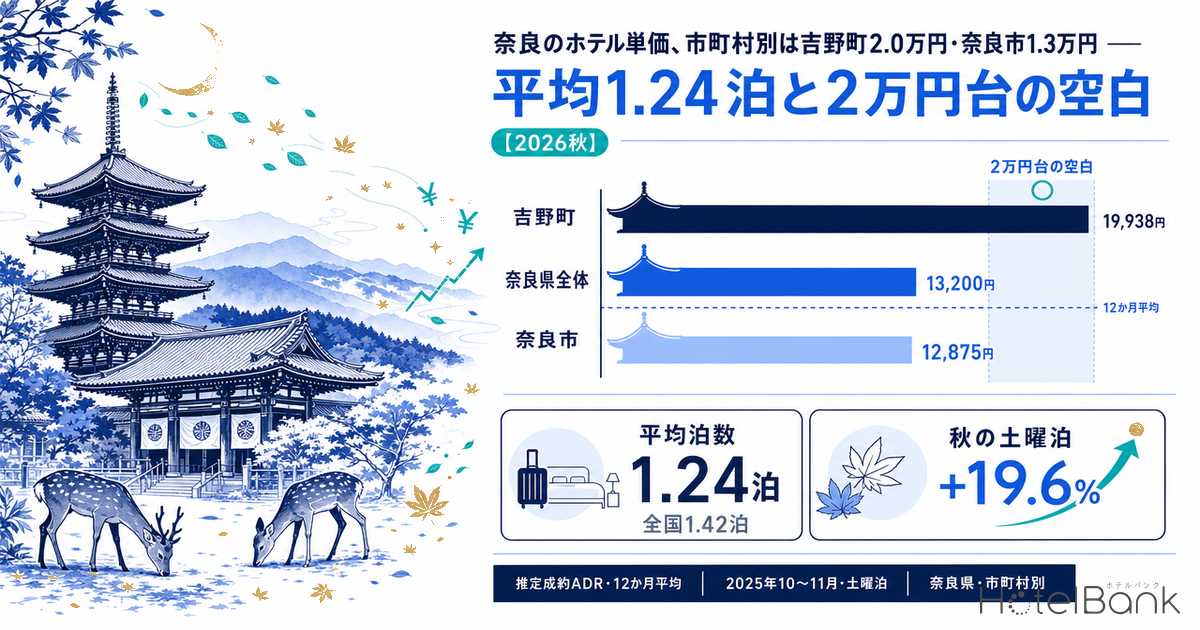
- — ¥13,200: Nara Prefecture’s estimated settled ADR (12-month average, September 2025–August 2026, 131–136 properties in scope) is 80% of Kyoto Prefecture’s ¥16,500 and 1.28x Osaka Prefecture’s ¥10,400.
- — Yoshino ¥19,900, Tenkawa ¥18,500: Among municipalities with 5+ properties in scope, the hot-spring towns of southern Nara outrank Nara City (¥12,900), while Tenri, Kashihara and Sakurai sit in the ¥7,000–8,000 range.
- — 1.24 nights: The 2025 average length of stay is below the national 1.42 nights. Reaching the national level would add roughly 453,000 guest-nights (+14.3%); combined with a 10% rise in guests, the gain grows to about 816,000 guest-nights (editorial estimate).
- — 363 rooms: The ¥20,000–35,000 band, where 75% of properties score 4.3+ in reviews, holds only 22 ryokan with 363 rooms. Just one property with 50+ rooms is priced at ¥20,000+: JW Marriott Hotel Nara.
- — +19.6%: Saturday nights in October–November 2025 were +19.6% above weekday nights (median, N=122 properties), while Friday nights were roughly at weekday levels. Nara City rose +33.7% vs. +13.2% in Yoshino District.
43.62 Million Visits but 2.745 Million Overnight Guests — Upside Signaled by a 1.24-Night Stay
According to Nara Prefecture’s “Tourist Movement Survey,” total tourist visits in 2024 reached 43.62 million, up 9.3% year on year. The estimated number of unique visits, which removes double-counting of visitors touring several sites, was 28.769 million, of which overnight guests accounted for just 2.745 million, or 9.5%. Meanwhile, spending per visitor was ¥33,284 for overnight guests versus ¥4,405 for day-trippers — a gap of about 7.6x — and overnight guest spending grew 24.7% from the previous year. In other words, converting even a small share of day-trippers into overnight guests would significantly lift tourism spending in the prefecture.
The Japan Tourism Agency’s “Overnight Travel Statistics Survey” (final figures for 2025) confirms the same structure. Nara Prefecture recorded 3,177,210 total guest-nights, ranking 42nd of Japan’s 47 prefectures, and 2,556,580 unique overnight guests. Dividing guest-nights by unique guests gives an average stay of 1.24 nights, below the national average of 1.42 nights, Kyoto Prefecture’s 1.73 nights and Osaka Prefecture’s 1.48 nights. For international guests alone, the figure is 1.34 nights, an even wider gap versus the national 1.81 nights.
That gap, however, can be read directly as upside. If the number of unique overnight guests stayed at the 2025 level and the average stay rose to the national 1.42 nights, total guest-nights would reach about 3.63 million — roughly 453,000 guest-nights (+14.3%) more than in 2025 (editorial estimate). With 36.5% of overnight guests coming from the Kanto region (per the same survey’s questionnaire, 3,009 respondents), giving long-distance visitors a reason to extend one night to two is arguably the single biggest opportunity for Nara’s lodging market. Across all prefectures, Nara stands out as one of the most day-trip-heavy destinations, which makes the conversion of day visits into overnight stays especially relevant here.
| Metric | Nara Prefecture | Comparison |
|---|---|---|
| Tourist visits (total, 2024) | 43.62 million | +9.3% YoY |
| Tourist visits (unique-visit estimate, 2024) | 28.769 million | Of which overnight: 2.745 million (9.5%) |
| Tourism spending per visitor (2024) | Overnight ¥33,284 / Day trip ¥4,405 | Overnight is about 7.6x day trip |
| Total guest-nights (2025, final) | 3,177,210 | 42nd of 47 prefectures |
| Unique overnight guests (2025, final) | 2,556,580 | — |
| Average length of stay (guest-nights ÷ guests, 2025) | 1.24 nights | National 1.42 / Kyoto 1.73 / Osaka 1.48 nights |
| International guest-nights (2025) | 520,130 | International average stay 1.34 nights (national 1.81) |
Source: Japan Tourism Agency “Overnight Travel Statistics Survey” (2025 annual, final figures); Nara Prefecture “Tourist Movement Survey Report” (2024). Compiled by the HotelBank Editorial Team.
Source: Japan Tourism Agency “Overnight Travel Statistics Survey” (2025 annual, final figures). Compiled by the HotelBank Editorial Team. Average length of stay = total guest-nights ÷ unique overnight guests.
Sensitivity Analysis: Additional Guest-Nights by Average Stay × Unique Guests
The roughly 453,000 guest-nights above is a single-point estimate that raises only the average stay to the national level while holding unique guests constant. To see the range when longer stays and more guests occur together, we estimated the increase in total guest-nights along two axes — average length of stay and unique overnight guests — starting from 2025’s 2,556,580 unique guests and 3,177,210 guest-nights (editorial estimate).
| Unique guests \ Average stay | 1.24 nights (2025) | 1.30 nights | 1.35 nights | 1.42 nights (national level) | 1.48 nights (Osaka level) |
|---|---|---|---|---|---|
| 2.557M (same as 2025) | ±0 (baseline) | +146k (+4.6%) | +274k (+8.6%) | +453k (+14.3%) | +607k (+19.1%) |
| 2.684M (+5%) | +159k (+5.0%) | +313k (+9.8%) | +447k (+14.1%) | +635k (+20.0%) | +796k (+25.0%) |
| 2.812M (+10%) | +318k (+10.0%) | +479k (+15.1%) | +619k (+19.5%) | +816k (+25.7%) | +985k (+31.0%) |
Source: Estimated by the HotelBank Editorial Team based on Japan Tourism Agency “Overnight Travel Statistics Survey” (2025 annual, final figures). Increase = unique guests × average stay − 3,177,210 guest-nights. All conditions other than average stay and unique guests are assumed unchanged from 2025.
Reading the table across, lifting the average stay by just 0.06 nights to 1.30 nights adds +146,000 guest-nights (+4.6%) — almost the same effect as increasing the number of guests by 5% (+159,000). Growing guests by 10% while moving toward the national 1.42 nights would expand the gain to +816,000 guest-nights (+25.7%). In every combination, a small increase in length of stay has an effect of the same order of magnitude as growth in guest numbers — which is why designing for the “second night” matters so much in Nara’s lodging market.
308 Properties and 8,496 Rooms, with 60% of the Stock Concentrated in Nara City
Among the properties tracked by MetroEngines Research, 308 properties with 8,496 rooms in Nara Prefecture had selling prices confirmed as listed in June–August 2026 (based on major booking sites). By municipality, Nara City accounts for 138 properties and 5,260 rooms, or 61.9% of the prefecture, followed by Tenri (10 properties, 589 rooms), Kashihara (11 properties, 476 rooms) and Sakurai (14 properties, 337 rooms). The 11 towns and villages of Yoshino District together total 65 properties and 589 rooms — the same room count as Tenri.
On the map, rooms are concentrated around the Kintetsu and JR Nara stations, with mid-sized clusters in Tenri, Kashihara and Sakurai in central Nara. By contrast, Yoshino, Tenkawa and Totsukawa in the south are dotted with small ryokan and minshuku (family-run inns) with few rooms per property. The median property in the prefecture has 9 rooms, and only 25 properties (4,380 rooms in total) have 100 or more rooms. Because large properties are scarce outside Nara City, the pricing of each individual property can easily sway the overall market level in central and southern Nara.
Source: MetroEngines Research; compiled by the HotelBank Editorial Team (308 properties / 8,496 rooms, based on listings on major booking sites). Circles = rooms by municipality; dots = properties (color = grade).
Estimated Settled ADR by Municipality — Yoshino and Tenkawa Rank Above Nara City
On a 12-month average for September 2025–August 2026 (closed stay dates), Nara Prefecture’s overall estimated settled ADR was ¥13,200. Limiting the ranking to municipalities with at least 5 properties in scope, Yoshino Town ranks highest at ¥19,900 (6–8 properties in scope), followed by Tenkawa Village at ¥18,500 (14–16) and Totsukawa Village at ¥14,400 (5–7). Nara City, at ¥12,900 (58–62), almost exactly matches the prefecture-wide level.
The three southern towns and villages outrank Nara City because they are stay-type destinations centered on ryokan offering half-board (dinner and breakfast) — think Mt. Yoshino’s cherry blossoms, Dorogawa Onsen and Totsukawa Onsen. Meanwhile, Sakurai (¥8,000), Tenri (¥7,600) and Kashihara (¥7,200) in the central and southern Nara Basin sit in a price range dominated by business hotels. Ikoma has only 3 properties in scope, so it is shown in the table as a reference value (¥6,200) and excluded from the ranking. Towns and villages with only 1–2 properties in scope show large rate swings, so the table below shows only their property counts.
Source: MetroEngines Research; compiled by the HotelBank Editorial Team. Estimated settled ADR (tax-excluded equivalent), 12-month average, September 2025–August 2026. Only municipalities with 5+ properties in scope are shown.
| Municipality | Properties | Rooms | Share of prefecture | Estimated settled ADR (12-month avg.) | Properties in ADR scope |
|---|---|---|---|---|---|
| Nara City | 138 | 5,260 | 61.9% | ¥12,875 | 58–62 |
| Tenri City | 10 | 589 | 6.9% | ¥7,633 | 7 |
| Kashihara City | 11 | 476 | 5.6% | ¥7,189 | 5 |
| Sakurai City | 14 | 337 | 4.0% | ¥7,964 | 6–7 |
| Yamatokoriyama City | 3 | 222 | 2.6% | — | 1–2 (not shown) |
| Oji Town | 1 | 191 | 2.2% | — | 1 (not shown) |
| Tenkawa Village | 22 | 176 | 2.1% | ¥18,475 | 14–16 |
| Yoshino Town | 16 | 154 | 1.8% | ¥19,938 | 6–8 |
| Heguri Town | 4 | 138 | 1.6% | — | 1–3 (not shown) |
| Kashiba City | 7 | 134 | 1.6% | — | 0 (out of scope) |
| Gojo City | 8 | 120 | 1.4% | — | 2 (not shown) |
| Ikoma City | 7 | 102 | 1.2% | ¥6,198 (reference) | 3 |
| Totsukawa Village | 9 | 100 | 1.2% | ¥14,362 | 5–7 |
| Of which: Yoshino District (11 towns/villages) | 65 | 589 | 6.9% | — | — |
| Nara Prefecture total | 308 | 8,496 | 100% | ¥13,220 | 131–136 |
Source: MetroEngines Research; compiled by the HotelBank Editorial Team. Properties and rooms are those confirmed as listed in June–August 2026. “Properties in ADR scope” is the number of properties of verified types for which a monthly estimated settled ADR could be calculated (monthly min–max).
Supply by Grade — Budget and Economy Make Up Half; the South Leans Luxury
Aggregating rooms by our in-house grade classification (unclassified properties are assigned by listed price range), the prefecture breaks down as Budget 33.1% (2,816 rooms), Economy 17.0% (1,447), Midscale 20.8% (1,768), Upper Midscale 12.0% (1,021) and Luxury 17.0% (1,444). Budget and Economy combined account for more than half, reflecting a thick supply of limited-service lodging suited to a destination within day-trip range.
Breaking it down by area reveals clear differences in character. Nara City has every grade from Budget to Luxury, whereas in “other municipalities” — including Tenri, Kashihara and Sakurai — Budget and Economy total 1,813 rooms, or 68.5%. In Yoshino District, Luxury and Upper Midscale together reach 350 rooms, or 59.4%: small in scale, but concentrated in high-priced inns.
Source: MetroEngines Research; compiled by the HotelBank Editorial Team (308 properties / 8,496 rooms). Grades are our in-house classification.
Highly Rated Properties Cluster in the ¥20,000+ Price Bands
Next, we divided the 128 properties (6,822 rooms) for which estimated settled ADR could be calculated in at least 8 of the 12 months into price bands, and counted how many of the 122 properties with 50+ reviews scored 4.3 or higher (out of 5). The share rated 4.3+ rises with price: 26% in the ¥8,000–12,000 band, 56% at ¥12,000–20,000, 75% at ¥20,000–35,000 and 89% at ¥35,000–60,000.
What stands out is the mismatch with supply. Of the 64 properties rated 4.3+, 26 (41%) are in the ¥20,000+ bands, yet those bands hold only 751 rooms — 11.0% of all rooms in scope. The ¥20,000–35,000 band in particular consists of 22 properties with 363 rooms, all ryokan and none larger than 42 rooms. Highly rated inns line this band, including Yoshino Onsen Motoyu (吉野温泉元湯, 4.89), Kouryokuen Nishisei (光緑園 西清, 4.71) and Hotel New Wakasa (ホテルニューわかさ, 4.66). In the ¥12,000–20,000 band, newer hotels are also earning high scores, such as MIROKU Nara by THE SHARE HOTELS (4.53) and Iroha Grand Hotel Kintetsu Nara Ekimae (いろはグランホテル近鉄奈良駅前, 4.44).
Source: MetroEngines Research; HotelBank Editorial Team research (review scores). Covers 128 properties with estimated settled ADR in 8+ months; review scores cover 122 properties with 50+ reviews.
| Estimated settled ADR band (12-month avg.) | Properties | Rooms | Rated 4.3+ / rated properties | High-rating share |
|---|---|---|---|---|
| Under ¥8,000 | 28 | 1,404 | 11 / 27 | 41% |
| ¥8,000–12,000 | 27 | 2,344 | 7 / 27 | 26% |
| ¥12,000–20,000 | 38 | 2,323 | 20 / 36 | 56% |
| ¥20,000–35,000 | 22 | 363 | 15 / 20 | 75% |
| ¥35,000–60,000 | 10 | 312 | 8 / 9 | 89% |
| ¥60,000 and above | 3 | 76 | 3 / 3 | 100% |
| Total | 128 | 6,822 | 64 / 122 | 52% |
Source: MetroEngines Research; compiled from HotelBank Editorial Team research.
Rate Gap with Kyoto and Osaka — Nara Sits in Between, with a Gap at ¥20,000–35,000
Comparing neighboring prefectures on the same 12-month average, Nara Prefecture’s estimated settled ADR (all verified property types) of ¥13,200 is 80% of Kyoto Prefecture’s ¥16,500 and 1.28x Osaka Prefecture’s ¥10,400. By property type, the gap with Kyoto is widest for business hotels (Nara ¥8,700 / Kyoto ¥13,900, 63%) and city hotels (¥15,100 / ¥23,700, 64%), while ryokan are ¥16,800, or 69% of Kyoto’s ¥24,400. Against Osaka, Nara is higher for city hotels and ryokan and slightly lower for business hotels. Note that Nara Prefecture has only 7 city hotels in scope.
Kyoto Prefecture’s median for city hotels and ryokan (around ¥24,000) falls squarely in the ¥20,000–35,000 band, where supply in Nara is thin. The only rooms in Nara in this band are the 363 ryokan rooms, and among properties with a calculable estimated settled ADR, just one property with 50+ rooms is priced at ¥20,000+: JW Marriott Hotel Nara (158 rooms). If Nara can attract travelers who stay in ¥20,000-range rooms in Kyoto with stays that combine temples and shrines, ancient burial mounds and hot springs, the mid-sized ¥20,000–35,000 band could become the price band with the greatest upside in the prefecture — a white space defined by the combination of property scale and price band.
| Property type | Nara | Kyoto | Osaka | Nara ÷ Kyoto |
|---|---|---|---|---|
| All (verified types) | ¥13,220 | ¥16,469 | ¥10,358 | 80% |
| Business | ¥8,690 | ¥13,892 | ¥10,016 | 63% |
| City | ¥15,103 | ¥23,722 | ¥13,490 | 64% |
| Ryokan | ¥16,822 | ¥24,378 | ¥11,470 | 69% |
| Properties in scope (monthly range) | 131–136 | 576–607 | 623–653 | — |
Source: MetroEngines Research; compiled by the HotelBank Editorial Team. Estimated settled ADR (tax-excluded equivalent), 12-month average, September 2025–August 2026. Median of target properties in each prefecture.
Source: MetroEngines Research; compiled by the HotelBank Editorial Team.
Weekdays vs. Weekends in Autumn (October–November) — Saturdays +19.6%, Fridays Near Weekday Levels
Because estimated settled ADR is a monthly metric, we compared day-of-week differences using each property’s lowest-plan listed price. The sample covers properties with estimated settled ADR in 8+ months whose daily listings could be confirmed; we took the median of an index setting the average weekday night (Sunday–Thursday nights, excluding nights before holidays) at 100. For October–November 2025 (stay dates passed), Saturday nights were 119.6 and nights before holidays 116.9, while Friday nights were 100.6 — barely different from weekdays. Listings for October–November 2026 at the time of research show the same shape: Saturday 119.4, Friday 100.0.
Differences by area are also large. The Saturday premium (median of each property’s Saturday ÷ weekday ratio) in autumn 2025 was +33.7% in Nara City, +13.2% in Yoshino District and +9.5% in other municipalities. Weekend demand is clearly reflected in rates in Nara City, while the premium in central and southern Nara is small. Properties with a Saturday premium of 30% or more account for 41.8% of the total, leaving room for the rest to introduce tiered weekend pricing. The fact that Friday rates are roughly at weekday levels can also be seen as an opportunity: pairing Friday nights with multi-night plans that create a second night, or Friday-only perks, could lift both length of stay and rates at the same time.
Source: MetroEngines Research; compiled by the HotelBank Editorial Team. Median index of each property’s lowest-plan listed price (2 guests per room, tax included), with the average weekday night = 100. 2025 N=122 properties; 2026 N=118 properties.
| Area | Oct–Nov 2025 (stay dates passed, closed) | Oct–Nov 2026 (listed at time of research) |
|---|---|---|
| Prefecture total | +19.6% (N=122) | +19.4% (N=118) |
| Nara City | +33.7% (N=53) | +34.0% (N=51) |
| Yoshino District | +13.2% (N=35) | +16.6% (N=34) |
| Other municipalities | +9.5% (N=34) | +12.5% (N=33) |
| Weekday-night lowest listed plan (median) | approx. ¥13,600 | approx. ¥14,800 |
| Saturday-night lowest listed plan (median) | approx. ¥19,200 | approx. ¥20,900 |
| Share of properties with a 30%+ Saturday premium | 41.8% | 40.7% |
Source: MetroEngines Research; compiled by the HotelBank Editorial Team. Premium = median of each property’s average Saturday-night price ÷ average weekday-night price.
Autumn Rate Ramp-Up — Nara City +72% from September to November
Using estimated settled ADR based on rates listed at the time of research, we compared the ramp-up from September to November 2026 (both are estimates based on current listings). Nara Prefecture as a whole rises from ¥13,200 to ¥17,900, or +36.1% — smaller than Kyoto Prefecture (+88.0%) but larger than Osaka Prefecture (+24.7%). By municipality, Nara City jumps from ¥11,200 to ¥19,300, +72.2%, as rates climb sharply in the autumn-foliage season. Yoshino Town (+18.0%) and Tenri City (+17.3%) also rise, while Tenkawa Village (−5.3%) and Totsukawa Village (+0.5%) show little seasonal variation — hot-spring areas with stable rates throughout the year.
Nara City’s estimated settled ADR in November is ¥19,300, about 70% of Kyoto Prefecture’s November level (¥26,100). For travelers who want to avoid Kyoto’s foliage-season crowds and prices, Nara can serve as a nearby alternative base (for Nara City rates and inventory during the exhibition period, see also Shosoin Exhibition 2026: Nara Weekday Rates +32% During 17-Day Run). Around the weekend that includes the November three-day holiday (Nov 21–23), combining weekend pricing with multi-night plans in municipalities beyond Nara City could help capture autumn demand across a wider area.
Source: MetroEngines Research; compiled by the HotelBank Editorial Team. Change in estimated settled ADR from September to November 2026 (estimate based on rates listed at the time of research). Properties in scope: Nara City 56–61, Tenkawa 14–16, Yoshino 6–7, Sakurai 6, Tenri 6–7, Totsukawa 5–6, Kashihara 4–5, Nara Prefecture 123–136, Kyoto Prefecture 572–595, Osaka Prefecture 633–643.
Summary — “Length of Stay” and the “¥20,000–35,000 Band” Are Nara’s Two Growth Levers
Relative to its large visitor numbers, Nara Prefecture’s lodging market has a low overnight ratio and short stays. Overnight guests made up 9.5% of unique visits in 2024, and the average stay in 2025 was 1.24 nights; simply matching the national 1.42 nights would add about 453,000 guest-nights. Given that overnight guests spend about 7.6x as much per person as day-trippers, converting visits into overnight stays and extending length of stay are arguably the most efficient ways to raise tourism spending in the prefecture.
On pricing, the prefecture-wide estimated settled ADR of ¥13,200 is 80% of Kyoto’s, and there is a tier in which the southern hot-spring areas of Yoshino, Tenkawa and Totsukawa outrank Nara City. Highly rated properties cluster in the ¥20,000+ bands, yet those bands hold only about 10% of rooms, and mid-sized hotels are almost absent from the ¥20,000–35,000 band. Autumn Saturday nights rise +19.6% while Friday nights stay near weekday levels, leaving room for tiered weekend pricing and multi-night plan design. From both the supply and pricing perspectives, Nara is at a stage where the numbers can support its shift from a “day-trip destination” to a “stay destination.”
⚠ Note on ADR for future dates: Estimated settled ADR for September 2026 onward and listed prices for October–November 2026 in this article are estimates based on selling prices published on OTAs and similar channels at the time of research (September 2026), and will change as check-in dates approach. Prices currently set high may be revised closer to the stay date. Because closed months (August 2026 and earlier) and months based on current listings (September 2026 onward) are calculated on different bases, this article does not compare the two.
For Hotels: Plan-Name Tips for This Theme
Most common selling points in published plan names for Nara Prefecture × autumn foliage (N=77) —
Kaiseki course 32%Dinner & breakfast 23%Breakfast included 17%Seasonal events 14%Wagyu / brand beef 10%Seasonal sale 9%
Examples of actual names (anonymized):
- [Autumn/Winter SALE][Long Stay ◆ Breakfast Included] 22-hour stay: check in 13:00, check out 11:00
- [Autumn/Winter SALE][Long Stay ◆ Room Only] 22-hour stay plan: check in 13:00, check out 11:00
- Enjoy the autumn leaves! A free glass of local sake! Premium local chicken grilled on a ceramic plate — with a choice of breakfast
* These are tendencies based on an aggregation of published plan names and do not indicate that naming causes sales.
Frequently Asked Questions
Q. What is the average hotel rate in Nara Prefecture?
A. The 12-month average estimated settled ADR (tax-excluded equivalent) for September 2025–August 2026 is ¥13,200 — 80% of Kyoto Prefecture’s ¥16,500 and 1.28x Osaka Prefecture’s ¥10,400. By property type: business ¥8,700, city ¥15,100, ryokan ¥16,800.
Q. Which municipalities in Nara Prefecture have the highest rates?
A. Among municipalities with 5+ properties in scope, Yoshino Town (¥19,900), Tenkawa Village (¥18,500) and Totsukawa Village (¥14,400) rank highest, all above Nara City’s ¥12,900. They are stay-type hot-spring and sightseeing destinations centered on ryokan offering half-board.
Q. What is the average length of stay in Nara Prefecture?
A. Based on the Japan Tourism Agency’s Overnight Travel Statistics Survey (2025 final figures), 3,177,210 guest-nights ÷ 2,556,580 unique guests = 1.24 nights. This is below the national 1.42, Kyoto’s 1.73 and Osaka’s 1.48 nights; reaching the national level would add about 453,000 guest-nights (editorial estimate).
Q. How much more expensive are autumn weekends than weekdays?
A. Based on each property’s lowest-plan listed price, Saturday nights in October–November 2025 were +19.6% above weekday nights (median, N=122 properties), nights before holidays +16.9% and Friday nights +0.6%. By area, the Saturday premium was +33.7% in Nara City, +13.2% in Yoshino District and +9.5% in other municipalities.
Q. Which price band has the fewest rooms in Nara Prefecture?
A. Of the 128 properties (6,822 rooms) with estimated settled ADR in 8+ months, the ¥20,000–35,000 band holds only 22 properties and 363 rooms (all ryokan, the largest with 42 rooms). This band has a high 75% share of properties rated 4.3+, and it overlaps with Kyoto Prefecture’s median for city hotels and ryokan (around ¥24,000).
Related Articles
References & Sources
■ Data sources
308 properties / 8,496 rooms in Nara Prefecture tracked by MetroEngines Research whose selling prices were confirmed as listed in June–August 2026 (based on major booking sites). Estimated settled ADR is aggregated monthly by prefecture, property type and municipality (September 2025–November 2026); day-of-week differences use each property’s lowest-plan listed price (October–November of 2025 and 2026). Lodging statistics: Japan Tourism Agency “Overnight Travel Statistics Survey,” 2025 final figures. Tourist visits and spending: Nara Prefecture “Tourist Movement Survey Report,” 2024.
■ Estimation assumptions
The 12-month average is a simple average of monthly values for closed months (September 2025–August 2026). The municipal ranking is limited to municipalities with 5+ properties in scope. Average length of stay = total guest-nights ÷ unique overnight guests. The length-of-stay uplift estimate and sensitivity table are editorial estimates that start from 2025 guest-nights and unique guests and vary only the average stay and unique guests, holding all other conditions constant. The Saturday premium is the median of each property’s average Saturday-night price ÷ average weekday-night price (Sunday–Thursday nights, excluding nights before holidays).
■ Limitations
Estimated settled ADR is an estimate that applies a property-type correction factor to lowest-plan rates (median error of about 7% when checked against results disclosed by listed hotel REITs) and differs from each property’s actual settled prices. Values for municipalities with only a few properties in scope (Yoshino 6–8, Totsukawa 5–7, Kashihara 5) and for Nara Prefecture’s city hotels (7 properties) can swing significantly when a single property enters or leaves the sample. Values from September 2026 onward are estimates based on listings at the time of research and are not compared with closed months. Review scores are limited to the 122 properties with 50+ reviews.
- MetroEngines Research — Estimated settled ADR (Nara, Kyoto and Osaka prefectures; by municipality), listed prices, room stock (Nara Prefecture: 308 properties, 8,496 rooms)
- Japan Tourism Agency, “Overnight Travel Statistics Survey,” 2025 annual figures (final) — Total guest-nights and unique overnight guests (Tables 2 and 3)
- Nara Prefecture Tourism Bureau, Tourism Strategy Division, “Nara Prefecture Tourist Movement Survey Report,” January–December 2024
- Nara Prefecture tourism data portal “Miru Nara”
- HotelBank Editorial Team research — Guest review scores (122 properties with 50+ reviews); aggregation of published plan names (Nara Prefecture × autumn foliage, N=77)