

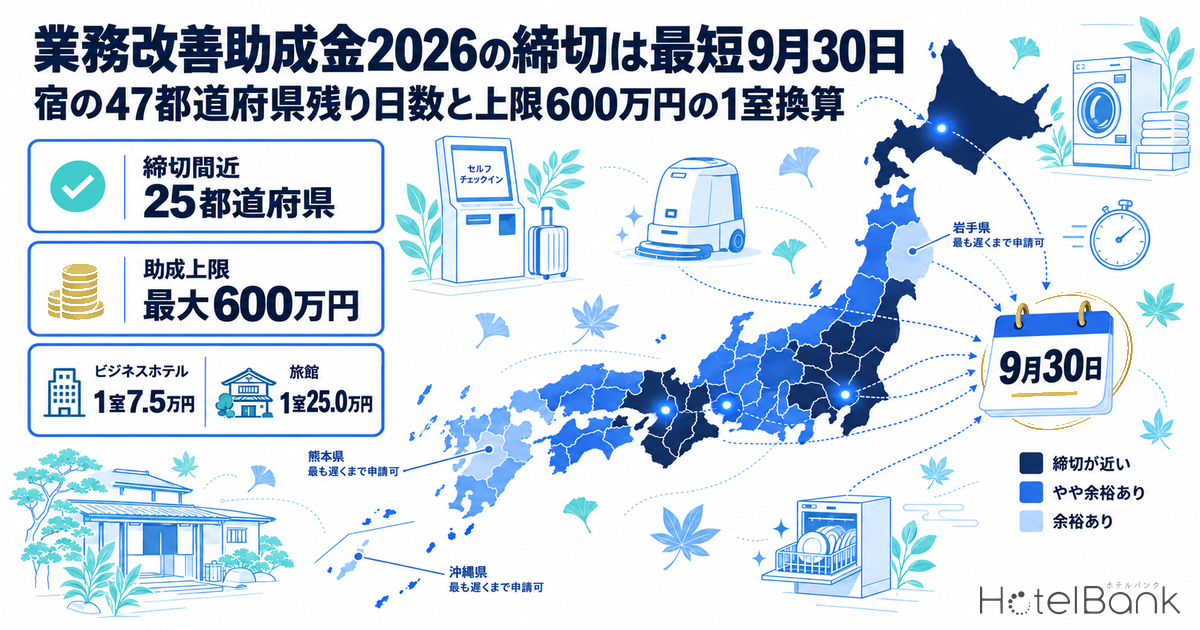
The Ministry of Health, Labour and Welfare’s (MHLW) FY2026 Business Improvement Subsidy (gyomu kaizen joseikin) opened for applications on September 1, 2026. The deadline is whichever comes first: “the day before the regional minimum wage takes effect in the prefecture where the applying workplace is located” or “November 30, 2026”. In the 15 prefectures where the new minimum wage takes effect on October 1, that makes September 30 the application deadline. Drawing on the official grant guidelines and implementation procedures, this article sets out the parts of the scheme lodging operators need to know, then presents a 47-prefecture deadline calendar, the out-of-pocket cost of five capex types a hotel or ryokan can claim, and an estimate of how much investment headroom per room the ¥6M cap gives a 100-room business hotel and a 30-room ryokan, checked against MetroEngines Research’s estimated settled ADR.
Metric Definitions Used in This Article
- ADR (average daily rate): an estimated settled rate (tax-excluded equivalent), calculated by applying a format-specific correction factor to the cheapest plan level each property publishes on OTAs (two guests per room, per-room rate, tax included). Checked against property-level results disclosed by listed hotel REITs (91 properties, most recent three months), the median error is about 7%. It is an estimate and differs from each property’s actual booked prices and accounting figures. The ADR by size band in this article is the median of each covered property’s 12-month average.
- Room occupancy: room occupancy rates from the Japan Tourism Agency’s Overnight Travel Statistics Survey (2025 annual figures, finalized; national, by type of accommodation).
- In-workplace minimum wage: the lowest hourly wage paid at the workplace. For the Business Improvement Subsidy, it means the lowest hourly wage among employees covered by employment insurance who have been employed for more than six months.
- Data sources: MHLW, Business Improvement Subsidy grant guidelines, implementation procedures and Q&A; MHLW, “FY2026 Regional Minimum Wage Council Recommendations”; Japan Tourism Agency, Overnight Travel Statistics Survey; MetroEngines Research
- — September 30: the application deadline in the 15 prefectures where the minimum wage takes effect on October 1. As of September 27, 2026, 25 prefectures have 7 days or less left, and only three—Iwate, Kumamoto and Okinawa—can apply until November 30.
- — Up to ¥6M: the cap on the ¥90 course when a special-case employer raises wages for 10 or more workers. The cap depends on how many workers get the raise: ¥4.5M for 8 or more, ¥3.6M for 6–7.
- — The order is a requirement: wages must be raised after applying and no later than the day before the new minimum wage takes effect; equipment contracts, delivery and payment must come after the grant decision. Raising wages before applying, or ordering before the grant decision, makes the cost ineligible.
- — ¥75,000 / ¥250,000 per room: the ¥6M cap (4/5 subsidy rate, ¥7.5M of investment) equals ¥75,000 of investment headroom per room for a 100-room business hotel and ¥250,000 per room for a 30-room ryokan.
- — About ¥55 to about ¥359 per room-night: the amount needed to recover a ¥1.5M out-of-pocket share within one year (0.68%–2.30% of estimated settled ADR). Cleaning supplies such as vacuum cleaners are ineligible, so plan them as a housekeeping management system or similar.
The Framework: Three Courses (¥50, ¥70 and ¥90 Raises) and a Cap of Up to ¥6M
The Business Improvement Subsidy covers part of the capital expenditure of small and medium-sized enterprises and micro-businesses that raise their in-workplace minimum wage by a set amount or more and, at the same time, invest in equipment or other measures that improve productivity. Lodging is classed as a “service industry” under the grant guidelines, so businesses with capital of ¥50M or less or with 100 or fewer regular employees are eligible (Implementation Procedures, Attachment 1, and Article 2 of the Grant Guidelines). For FY2026, the four courses of previous years (¥30, ¥45, ¥60 and ¥90) were reorganised into three courses: ¥50, ¥70 and ¥90 (MHLW, “Notice of Partial Changes to the Business Improvement Subsidy”).
The subsidy is the lower of “capital expenditure × subsidy rate” and “the cap for the course”. The cap rises in steps with the number of workers whose wages are raised: on the ¥90 course it is ¥4.5M for 8 or more workers and ¥6M when a special-case employer raises wages for 10 or more. Employers whose workplace has fewer than 30 people get a higher cap in the 1-worker and 2–3-worker bands (in parentheses in the table below).
| Workers receiving a raise | ¥50 course | ¥70 course | ¥90 course |
|---|---|---|---|
| 1 worker | ¥300,000 (¥400,000) | ¥400,000 (¥500,000) | ¥900,000 (¥1M) |
| 2–3 workers | ¥400,000 (¥700,000) | ¥500,000 (¥1M) | ¥1.5M (¥2.4M) |
| 4–5 workers | ¥700,000 | ¥1.3M | ¥2.7M |
| 6–7 workers | ¥900,000 | ¥1.8M | ¥3.6M |
| 8 or more | ¥1.1M | ¥2.3M | ¥4.5M |
| 10 or more (special-case employers only) | ¥1.3M | ¥3M | ¥6M |
Source: Compiled by the HotelBank Editorial Team from MHLW, “Guide to the FY2026 Business Improvement Subsidy”. Figures in parentheses are the caps for employers whose workplace has fewer than 30 people
Source: Compiled by the HotelBank Editorial Team from MHLW, “Guide to the FY2026 Business Improvement Subsidy” (caps for workplaces with 30 or more people)
The subsidy rate depends on the in-workplace minimum wage before the raise. For FY2026 the threshold moved from ¥1,000 to ¥1,050: below ¥1,050 the rate is 4/5, and at ¥1,050 or above it is 3/4. The “special-case employers” that can use the ¥6M band are either (a) employers whose in-workplace minimum wage is below ¥1,050 (the wage requirement), or (b) employers whose gross or operating profit margin, averaged over the six months before applying, has fallen by 3 percentage points or more year on year because of external factors such as soaring raw material costs (the price-surge requirement). Employers that qualify under (b) can also claim new PCs, tablets and similar devices, which are normally ineligible.
The range of eligible workplaces has also widened. Previously, only workplaces whose in-workplace minimum wage was no more than ¥50 above the pre-revision regional minimum wage could apply, but FY2026 carries over the rule in force since September 2025 and accepts workplaces paying less than the revised regional minimum wage. For example, in a region where the pre-revision minimum wage is ¥X and the increase is ¥63, workplaces whose in-workplace minimum wage is ¥X+51 to ¥X+62 are newly eligible (workplaces already paying exactly the revised minimum wage are not). In other words, the scheme is designed so that almost every workplace that has to raise wages because of this minimum wage revision can apply.
This is where lodging operators have room to act. A workplace whose in-workplace minimum wage equals the pre-revision regional minimum wage has to make the statutory increase (¥54–65 this time) anyway. By choosing the ¥90 course, it only needs to add ¥25–36 on top of the statutory increase, and that widens the subsidy cap substantially. Assuming 10 eligible workers each working 1,600 hours a year, the additional labor cost comes to ¥400,000–¥576,000 a year (excluding statutory welfare costs).
Deadline Calendar: 25 Prefectures Must Apply by October 3
The FY2026 regional minimum wage averages ¥1,177 nationwide on a weighted basis (+¥56 year on year), and the effective date varies by prefecture, from October 1 to December 2 (MHLW, “FY2026 Regional Minimum Wage Council Recommendations”). Because the Business Improvement Subsidy deadline is tied to this effective date, the same scheme has deadlines up to two months apart depending on the prefecture. On September 24, MHLW issued a renewed reminder that “in some prefectures the application deadline is the end of September” (MHLW, “Business Improvement Subsidy”).
Counting the days left as of September 27, 2026, 25 prefectures have 7 days or less (15 of them with a September 30 deadline), 9 have 8–30 days and 13 have 31 days or more. In Iwate, Kumamoto and Okinawa the new minimum wage takes effect on December 1 or later, so the deadline is the November 30 limit.
Source: Compiled by the HotelBank Editorial Team from MHLW, “FY2026 Regional Minimum Wage Council Recommendations” and MHLW, “Guide to the FY2026 Business Improvement Subsidy”. Days left are calendar days from September 27, 2026 to the application deadline
The table below lists, for all 47 prefectures, the minimum wage before and after the revision, the (scheduled) effective date and the application deadline, in order of fewest days left. Colors show the days-left band (navy = 7 days or less, blue = 8–30 days, light blue = 31 days or more). The rightmost column marks the 22 prefectures where the pre-revision regional minimum wage was below ¥1,050: workplaces there whose in-workplace minimum wage is close to the pre-revision minimum wage meet the wage requirement and may be able to use both the 4/5 subsidy rate and the ¥6M band.
| Prefecture | Regional minimum wage (before → after) | Increase | Effective date (scheduled) | Application deadline | Days left as of Sep 27 | Pre-revision minimum wage below ¥1,050 |
|---|---|---|---|---|---|---|
| Mie | ¥1,087 → ¥1,143 | +¥56 | Oct 1 (Thu) | Sep 30 (Wed) | 3 days | — |
| Hyogo | ¥1,116 → ¥1,172 | +¥56 | Oct 1 (Thu) | Sep 30 (Wed) | 3 days | — |
| Hokkaido | ¥1,075 → ¥1,131 | +¥56 | Oct 1 (Thu) | Sep 30 (Wed) | 3 days | — |
| Chiba | ¥1,140 → ¥1,195 | +¥55 | Oct 1 (Thu) | Sep 30 (Wed) | 3 days | — |
| Saitama | ¥1,141 → ¥1,196 | +¥55 | Oct 1 (Thu) | Sep 30 (Wed) | 3 days | — |
| Osaka | ¥1,177 → ¥1,231 | +¥54 | Oct 1 (Thu) | Sep 30 (Wed) | 3 days | — |
| Miyagi | ¥1,038 → ¥1,098 | +¥60 | Oct 1 (Thu) | Sep 30 (Wed) | 3 days | Yes |
| Toyama | ¥1,062 → ¥1,119 | +¥57 | Oct 1 (Thu) | Sep 30 (Wed) | 3 days | — |
| Gifu | ¥1,065 → ¥1,121 | +¥56 | Oct 1 (Thu) | Sep 30 (Wed) | 3 days | — |
| Aichi | ¥1,140 → ¥1,195 | +¥55 | Oct 1 (Thu) | Sep 30 (Wed) | 3 days | — |
| Niigata | ¥1,050 → ¥1,108 | +¥58 | Oct 1 (Thu) | Sep 30 (Wed) | 3 days | — |
| Tokyo | ¥1,226 → ¥1,280 | +¥54 | Oct 1 (Thu) | Sep 30 (Wed) | 3 days | — |
| Tochigi | ¥1,068 → ¥1,125 | +¥57 | Oct 1 (Thu) | Sep 30 (Wed) | 3 days | — |
| Kanagawa | ¥1,225 → ¥1,279 | +¥54 | Oct 1 (Thu) | Sep 30 (Wed) | 3 days | — |
| Kagawa | ¥1,036 → ¥1,092 | +¥56 | Oct 1 (Thu) | Sep 30 (Wed) | 3 days | Yes |
| Okayama | ¥1,047 → ¥1,104 | +¥57 | Oct 2 (Fri) | Oct 1 (Thu) | 4 days | Yes |
| Nagano | ¥1,061 → ¥1,117 | +¥56 | Oct 2 (Fri) | Oct 1 (Thu) | 4 days | — |
| Wakayama | ¥1,045 → ¥1,101 | +¥56 | Oct 3 (Sat) | Oct 2 (Fri) | 5 days | Yes |
| Shiga | ¥1,080 → ¥1,136 | +¥56 | Oct 3 (Sat) | Oct 2 (Fri) | 5 days | — |
| Ishikawa | ¥1,054 → ¥1,113 | +¥59 | Oct 3 (Sat) | Oct 2 (Fri) | 5 days | — |
| Gunma | ¥1,063 → ¥1,120 | +¥57 | Oct 3 (Sat) | Oct 2 (Fri) | 5 days | — |
| Tottori | ¥1,030 → ¥1,090 | +¥60 | Oct 3 (Sat) | Oct 2 (Fri) | 5 days | Yes |
| Nara | ¥1,051 → ¥1,107 | +¥56 | Oct 4 (Sun) | Oct 3 (Sat) | 6 days | — |
| Fukui | ¥1,053 → ¥1,112 | +¥59 | Oct 4 (Sun) | Oct 3 (Sat) | 6 days | — |
| Fukuoka | ¥1,057 → ¥1,114 | +¥57 | Oct 4 (Sun) | Oct 3 (Sat) | 6 days | — |
| Yamaguchi | ¥1,043 → ¥1,101 | +¥58 | Oct 8 (Thu) | Oct 7 (Wed) | 10 days | Yes |
| Shimane | ¥1,033 → ¥1,092 | +¥59 | Oct 10 (Sat) | Oct 9 (Fri) | 12 days | Yes |
| Hiroshima | ¥1,085 → ¥1,141 | +¥56 | Oct 11 (Sun) | Oct 10 (Sat) | 13 days | — |
| Akita | ¥1,031 → ¥1,090 | +¥59 | Oct 14 (Wed) | Oct 13 (Tue) | 16 days | Yes |
| Shizuoka | ¥1,097 → ¥1,154 | +¥57 | Oct 15 (Thu) | Oct 14 (Wed) | 17 days | — |
| Fukushima | ¥1,033 → ¥1,094 | +¥61 | Oct 16 (Fri) | Oct 15 (Thu) | 18 days | Yes |
| Ibaraki | ¥1,074 → ¥1,136 | +¥62 | Oct 18 (Sun) | Oct 17 (Sat) | 20 days | — |
| Miyazaki | ¥1,023 → ¥1,085 | +¥62 | Oct 24 (Sat) | Oct 23 (Fri) | 26 days | Yes |
| Kagoshima | ¥1,026 → ¥1,090 | +¥64 | Oct 25 (Sun) | Oct 24 (Sat) | 27 days | Yes |
| Aomori | ¥1,029 → ¥1,090 | +¥61 | Oct 29 (Thu) | Oct 28 (Wed) | 31 days | Yes |
| Kochi | ¥1,023 → ¥1,086 | +¥63 | Oct 29 (Thu) | Oct 28 (Wed) | 31 days | Yes |
| Yamagata | ¥1,032 → ¥1,092 | +¥60 | Oct 30 (Fri) | Oct 29 (Thu) | 32 days | Yes |
| Oita | ¥1,035 → ¥1,096 | +¥61 | Nov 1 (Sun) | Oct 31 (Sat) | 34 days | Yes |
| Yamanashi | ¥1,052 → ¥1,113 | +¥61 | Nov 1 (Sun) | Oct 31 (Sat) | 34 days | — |
| Tokushima | ¥1,046 → ¥1,103 | +¥57 | Nov 1 (Sun) | Oct 31 (Sat) | 34 days | Yes |
| Ehime | ¥1,033 → ¥1,093 | +¥60 | Nov 1 (Sun) | Oct 31 (Sat) | 34 days | Yes |
| Nagasaki | ¥1,031 → ¥1,087 | +¥56 | Nov 2 (Mon) | Nov 1 (Sun) | 35 days | Yes |
| Saga | ¥1,030 → ¥1,095 | +¥65 | Nov 15 (Sun) | Nov 14 (Sat) | 48 days | Yes |
| Kyoto | ¥1,122 → ¥1,180 | +¥58 | Nov 16 (Mon) | Nov 15 (Sun) | 49 days | — |
| Iwate | ¥1,031 → ¥1,090 | +¥59 | Dec 1 (Tue) | Nov 30 (Mon) | 64 days | Yes |
| Okinawa | ¥1,023 → ¥1,086 | +¥63 | Dec 2 (Wed) | Nov 30 (Mon) | 64 days | Yes |
| Kumamoto | ¥1,034 → ¥1,092 | +¥58 | Dec 1 (Tue) | Nov 30 (Mon) | 64 days | Yes |
Source: Compiled by the HotelBank Editorial Team from MHLW, “FY2026 Regional Minimum Wage Council Recommendations”. Effective dates may change depending on objections filed and other factors. If a deadline falls on a weekend or public holiday, check with the competent Labour Bureau how submissions are handled
Applications are submitted either in writing to the Employment Environment and Equal Employment Department (Office) of the Prefectural Labour Bureau with jurisdiction over the workplace, or electronically via jGrants (a gBizID Prime account is required). For postal applications, note that the reference date is the day the application reaches the Labour Bureau. In prefectures with only a few days left, the realistic sequence is to check your gBizID status first and, in parallel, gather quotations (for items of ¥100,000 or more, from at least two vendors for the same specification) and copies of the wage ledger.
Scheduling Pitfalls: Raising Wages Before Applying or Ordering Before the Grant Decision Can Disqualify You
The easiest thing to overlook in the Business Improvement Subsidy is the “order” of the wage increase and the capital expenditure. The order set out in the official procedures and Q&A is as follows; departing from it can make the costs ineligible.
1. Grant application: from September 1, 2026 to the day before the effective date or November 30, whichever is earlier
2. Wage increase: after the grant application, and no later than the day before the regional minimum wage takes effect. Amendments to work rules and their effective date must also come after the application. Increases made before applying are ineligible (Q&A Q15 and Q16). Splitting the increase into several steps is also not allowed
3. Equipment contract, delivery and payment: only after the grant decision. Anything contracted or delivered before the grant decision is ineligible, whatever the reason (Procedures, Attachment 3, Note 7(6); Q&A Q27)
4. Project completion: the latest of the delivery date, the payment completion date and the wage increase date must fall by January 31, 2027, within the fiscal year of the grant decision. With a justified reason, this can be extended to March 31 by applying in advance
In short, the wage increase has to be made by the day before the effective date without waiting for the grant decision, while equipment orders have to wait for it. Approaches such as “install the equipment first and apply later” or “we raised wages from October, so we’ll apply afterwards” are unlikely to receive the subsidy. Grants are also made within the budget, so the call may close even during the application period (leaflet, notes). Each workplace can apply once per fiscal year, and the annual cap per employer is ¥6M.
Capex Lodging Operators Can Claim: Price Ranges for Five Types and the Out-of-Pocket Share After the Subsidy
Eligible costs are “capital expenditure and similar that contributes to higher productivity and labor efficiency”: besides purchases of machinery and equipment, they include fees paid to system development companies, management consulting fees, and lease and license fees (the portion paid in the fiscal year of the grant decision). On the other hand, simple cost cutting (such as switching to LEDs), workplace improvements aimed at comfort (such as air conditioning or interior work), costs incidental to normal business activity (consumables, and cleaning supplies such as vacuum cleaners) and advertising are explicitly ineligible (Implementation Procedures, Attachment 3). Replacing ageing equipment is eligible only when a higher-capacity model than the existing one can demonstrate a productivity gain (Q&A Q30).
With that line in mind, we sorted the investments lodging operators can most readily consider into five types. The price ranges are guideline figures published by each company or outlet, and the assumed investment is a representative figure the editorial team set within each range. The out-of-pocket share applies subsidy rates of 4/5 and 3/4 to the assumed investment (tax excluded), assuming the ¥90 course, 8 or more workers and a ¥4.5M cap. For in-house laundry, a 4/5 rate would give a subsidy of ¥4.8M, above the cap, so the out-of-pocket share is calculated with the subsidy capped at ¥4.5M.
| Type / main equipment | Published price range (source) | Assumed investment (tax excl.) | Out-of-pocket (4/5 rate) | Out-of-pocket (3/4 rate) | Application points |
|---|---|---|---|---|---|
| Guest-room cleaning & linen process Housekeeping management system integrated with the PMS; large autonomous cleaning robots | Housekeeping management system (PMS-integrated, 100–300 rooms): ¥100,000–¥1M initial plus ¥30,000–¥200,000 a month (ripla) / large cleaning robots about ¥500,000–¥4M (Rent) | ¥2M | ¥400,000 | ¥500,000 | Show the reduction in waiting time for cleaning-completion notices and inspections in numbers. Cleaning supplies such as vacuum cleaners are explicitly ineligible, so confirm the equipment choice with the Labour Bureau in advance |
| Self check-in / automated payment kiosks Automated check-in kiosks (key card issuing, cashless payment) | About ¥800,000–¥2M for small and mid-sized hotels, ¥2M–¥5M for large ones (Selfregister.net) | ¥1.5M | ¥300,000 | ¥375,000 | General-purpose PCs and tablets are in principle ineligible. Devices clearly intended to run a dedicated check-in system may be eligible |
| PMS / channel manager PMS migration, centralised reservation management (initial setup + licenses) | PMS migration about ¥3M–¥6M (Ryokan News). Cloud-based systems for small properties from ¥0 initial cost | ¥4.5M | ¥900,000 | ¥1.125M | Fees paid to system companies are eligible costs. Licenses and maintenance are covered for the portion paid in the fiscal year of the grant decision (up to three years for lump-sum multi-year payments) |
| In-house laundry Commercial washers and dryers (20–40 kg class; upgrade to higher-end models or additional units) | Machine about ¥2M–¥3.5M; about ¥4M–¥8M including installation (Yamamoto Seisakusho) | ¥6M | ¥1.5M | ¥1.5M | Like-for-like replacements are ineligible. Show in numbers a higher capacity than the existing machine, such as throughput or drying time |
| Kitchen equipment Door-type dishwashers, combi steam ovens | Door-type dishwashers: list price ¥1.674M–¥2.489M (tax excl., Hoshizaki) | ¥2M | ¥400,000 | ¥500,000 | Show the reduction in washing and cooking time in numbers |
Source: Compiled by the HotelBank Editorial Team from each company’s published information (linked in the table), MHLW, “Business Improvement Subsidy Implementation Procedures” and MHLW, “Q&A”. Assumed investments are editorial settings
In guest-room cleaning, the core investment is systematising cleaning-completion notices and inspections to shorten the time it takes to return a room to sellable status. For self check-in kiosks, the key is to apply for them as terminals that run a dedicated check-in system; a plan that merely replaces general-purpose tablets is unlikely to qualify. PMS and channel managers are a type whose effect in cutting manual work, such as importing reservations and compiling sales, is easy to show in hours of work.
In-house laundry and kitchen equipment involve large amounts per item and make it easy to use up the cap. Dishwashers and combi steam ovens in particular make it easy to show reductions in cooking and dishwashing time in numbers. Note that the same capex cannot be subsidised twice by this and another subsidy, so when combining it with the SME Labor-Saving Investment Subsidy or similar programs, the eligible costs need to be planned separately (Q&A Q47).
Modelled at 100 and 30 Rooms: The ¥6M Cap Equals ¥75,000 and ¥250,000 of Investment Headroom per Room
So how substantial is the ¥6M cap relative to the size of a property? We estimated the investment headroom per room, and what recovering the out-of-pocket share from room revenue looks like, for two cases: a business hotel of about 100 rooms (Case A) and a ryokan of about 30 rooms (Case B).
Aggregating MetroEngines Research data on estimated settled ADR for business hotels with 80–120 rooms (N=1,326 properties) and ryokan with 20–40 rooms (N=1,395 properties) over September 2025–August 2026 gives medians of about ¥8,000 and about ¥15,600 respectively (both tax-excluded equivalent). For occupancy we used the Japan Tourism Agency’s finalized 2025 figures (business hotels 75.3%, ryokan 38.2%) (Japan Tourism Agency, Overnight Travel Statistics Survey, 2025 finalized figures, Table 8).
| Item | Case A: business hotel, 100 rooms | Case B: ryokan, 30 rooms |
|---|---|---|
| Estimated settled ADR (median, tax-excl. equivalent) | About ¥8,000 (N=1,326 properties) | About ¥15,600 (N=1,395 properties) |
| Room occupancy (Japan Tourism Agency, 2025 finalized, national) | 75.3% | 38.2% |
| Annual room-nights sold (estimate) | About 27,500 room-nights | About 4,200 room-nights |
| Investment needed for a ¥6M subsidy (4/5 / 3/4) | ¥7.5M / ¥8M | ¥7.5M / ¥8M |
| Investment headroom per room (4/5) | ¥75,000 | ¥250,000 |
| Subsidy per room | ¥60,000 | ¥200,000 |
| Out-of-pocket (4/5 / 3/4) | ¥1.5M / ¥2M | ¥1.5M / ¥2M |
| Per room-night amount to recover the out-of-pocket share in 1 year (4/5) | About ¥55 (0.68% of ADR) | About ¥359 (2.30% of ADR) |
| Same, recovered over 3 years (4/5) | About ¥18 (0.23% of ADR) | About ¥120 (0.77% of ADR) |
| Recovering the out-of-pocket share through working hours (at ¥1,200 an hour, 4/5) | 1,250 hours a year = about 3.4 hours of work saved per day recovers it in 1 year (same for both cases) | |
Source: Estimated settled ADR from MetroEngines Research, compiled by the HotelBank Editorial Team (September 2025–August 2026; properties with estimates for at least 10 of the 12 months). Room occupancy from the Japan Tourism Agency’s Overnight Travel Statistics Survey, 2025 finalized figures. Subsidy amounts per the MHLW Business Improvement Subsidy grant guidelines
Source: Compiled by the HotelBank Editorial Team from the MHLW Business Improvement Subsidy grant guidelines and MetroEngines Research (case with a 4/5 subsidy rate and a ¥6M cap)
Receiving the full ¥6M requires an investment of ¥7.5M at a 4/5 rate, or ¥8M at 3/4. Divided by room count, that is ¥75,000 per room (of which ¥60,000 is subsidy) for a 100-room business hotel and ¥250,000 per room (of which ¥200,000 is subsidy) for a 30-room ryokan. With the same cap, the fewer the rooms, the larger the amount per room: for a 30-room ryokan, even a PMS migration combined with kitchen equipment fits within the cap.
If the ¥1.5M out-of-pocket share (at 4/5) is to be recovered in one year, Case A spreads it over about 27,500 room-nights a year, i.e. about ¥55 per room-night, or 0.68% of estimated settled ADR. Case B sells fewer room-nights, about 4,200, so it comes to about ¥359 per room-night (2.30% of ADR), but on a three-year recovery it falls to about ¥120 (0.77%). Viewed in labor hours, ¥1.5M at ¥1,200 an hour is 1,250 hours a year: saving about 3.4 hours of work per day recovers it in one year, a yardstick that holds regardless of size.
However, the ¥6M band is available only when a “special-case employer” raises the wages of “10 or more” workers by ¥90 or more. If a 30-room ryokan has 6–7 eligible employment-insured workers, the ¥90 course cap is ¥3.6M (¥4.5M of investment at 4/5, ¥150,000 per room); with 4–5 it is ¥2.7M. The starting point for estimating your cap is to count, at your own property, “the employment-insured workers employed for more than six months who are paid less than the revised minimum wage”.
Sensitivity: How Investment Headroom and Recovery Amounts Move With Headcount and Occupancy
Cases A and B assume the most favourable condition: “a special-case employer raising wages for 10 or more workers”. In practice the cap depends on how many workers get the raise, and the per-room amount diverges further once divided by room count. Table 5 sets out investment headroom per room for each combination of room count and cap band, assuming the ¥90 course and a 4/5 subsidy rate.
| Rooms vs. workers receiving a raise | 4–5 workers (cap ¥2.7M, investment ¥3.375M) | 6–7 workers (cap ¥3.6M, investment ¥4.5M) | 8 or more (cap ¥4.5M, investment ¥5.625M) | 10 or more (special-case employers) (cap ¥6M, investment ¥7.5M) |
|---|---|---|---|---|
| 20 rooms | ¥169,000 | ¥225,000 | ¥281,000 | ¥375,000 |
| 30 rooms | ¥113,000 | ¥150,000 | ¥188,000 | ¥250,000 |
| 50 rooms | ¥68,000 | ¥90,000 | ¥113,000 | ¥150,000 |
| 100 rooms | ¥34,000 | ¥45,000 | ¥56,000 | ¥75,000 |
| 150 rooms | ¥23,000 | ¥30,000 | ¥38,000 | ¥50,000 |
Source: Compiled by the HotelBank Editorial Team from the caps in MHLW, “Guide to the FY2026 Business Improvement Subsidy”. Investment headroom per room = cap ÷ 4/5 subsidy rate ÷ rooms. Shaded cells are Cases A and B in the text
A 20-room property gets ¥169,000 per room even in the 4–5-worker band (¥2.7M cap), more than double what a 100-room hotel gets by using up the ¥6M band (¥75,000). Conversely, a 150-room property gets only ¥50,000 per room even in the ¥6M band, so it is easier to show impact by putting the money into back-of-house equipment such as kitchens or laundry, where a single item can use up the cap, rather than into guest-room investments.
On the recovery side, sensitivity is greatest for small ryokan that sell few room-nights. Table 6 varies the recovery amount for Case B (a 30-room ryokan with a ¥1.5M out-of-pocket share) across combinations of recovery period and annual room occupancy.
| Recovery period vs. annual room occupancy (assumed) | 30% | 38.2% (2025 finalized) | 50% | 60% |
|---|---|---|---|---|
| Recovered in 1 year | About ¥457 (2.93%) | About ¥359 (2.30%) | About ¥274 (1.76%) | About ¥228 (1.46%) |
| Recovered in 2 years | About ¥228 (1.46%) | About ¥179 (1.15%) | About ¥137 (0.88%) | About ¥114 (0.73%) |
| Recovered in 3 years | About ¥152 (0.97%) | About ¥120 (0.77%) | About ¥91 (0.58%) | About ¥76 (0.49%) |
Source: Estimated settled ADR from MetroEngines Research (September 2025–August 2026); 38.2% occupancy from the Japan Tourism Agency’s Overnight Travel Statistics Survey, 2025 finalized figures (ryokan, national). Other columns are editorial assumptions. Shaded cells are the same conditions as Table 4
At the national average ryokan occupancy (38.2%, 2025 finalized), a one-year recovery works out to about ¥359 per room-night (2.30% of ADR), but if occupancy is only 30% it rises to about ¥457 (2.93%). On the other hand, simply extending recovery to two years brings it down to about ¥228 (1.46%) even at 30% year-round occupancy. If you plan to recover the out-of-pocket share through a surcharge on room rates, check the relevant cell in Table 6 against your own occupancy; a recovery period of two to three years is realistic.
■ Estimate assumptions
- Estimated settled ADR: from our room-count data we extracted business hotels with 80–120 rooms (1,841 properties) and ryokan with 20–40 rooms (2,586 properties); for properties with estimates in at least 10 months of September 2025–August 2026 (business hotels N=1,326, ryokan N=1,395), we took the median of the 12-month average. The interquartile range is about ¥6,600–¥10,700 for business hotels and about ¥8,700–¥24,100 for ryokan
- Room occupancy: Japan Tourism Agency, Overnight Travel Statistics Survey, 2025 finalized figures, Table 8, national, by type of accommodation (business hotels 75.3%, ryokan 38.2%). Annual room-nights sold = rooms × 365 days × occupancy
- Subsidy: the ¥6M cap for the ¥90 course, 10 or more workers, special-case employer. Capital expenditure is calculated excluding tax (the input consumption tax credit is deducted from the subsidised amount)
- Additional wage increase: ¥25–36 (excluding the statutory increase of ¥54–65) × 10 workers × 1,600 hours a year. Excludes statutory welfare costs
- Working-hours conversion: ¥1,200 an hour (an editorial setting, rounding up the FY2026 national weighted-average minimum wage of ¥1,177)
What You Can Still Do in Time: How to Proceed by Days Left
In the 25 prefectures where the deadline falls between September 30 and October 3, the priority is to get an application accepted within the deadline rather than to polish it. Build the plan around equipment for which quotations are already in hand (kitchen equipment or commercial washers, for example, where a capacity comparison with the existing machine is easy to show in numbers), and immediately after applying, amend the work rules and raise wages by the day before the effective date. Wait for the grant decision before ordering equipment.
In prefectures with about a month left, investments that involve rethinking workflows, such as housekeeping management systems or a PMS, are also an option. Management consulting fees (workflow reviews by nationally certified professionals such as SME management consultants or labor and social security attorneys) are also eligible, so one approach is to quantify with an outside expert which processes’ working time will be cut and by how much, and then apply. Iwate, Kumamoto and Okinawa have until November 30, which also makes it easier to plan for the ¥6M band by combining several types.
In every case, effective dates may change depending on objections filed and other factors, so check MHLW’s Business Improvement Subsidy page and the guidance of the competent Labour Bureau just before applying. Inquiries are handled by the Business Improvement Subsidy call center (0120-366-440, weekdays 9:00–17:00).
Frequently Asked Questions
Q. Can we apply if we already pay at or above the revised minimum wage at the time of application?
A. No. If the employment-insured worker with the lowest hourly wage at the workplace is paid at or above the revised regional minimum wage, you cannot apply (Q&A Q3).
Q. We raised wages from October 1. Can we apply afterwards?
A. The wage increase must be made after the grant application; increases made before applying are ineligible (Q&A Q15 and Q16). “Applying after the increase”, which was allowed until partway through FY2025, is not possible in FY2026.
Q. We want to replace the vacuum cleaners used for guest-room cleaning.
A. Cleaning supplies such as vacuum cleaners are explicitly ineligible as costs incidental to normal business activity (Implementation Procedures, Attachment 3). Check with the Labour Bureau whether you can plan the investment as a system that shortens cleaning time, or as commercial equipment whose higher capacity than the existing machine can be shown in numbers.
Q. Are leased or subscription systems eligible?
A. Lease, license and maintenance contracts are covered for the portion paid in the fiscal year of the grant decision; multi-year lump-sum payments are covered for up to three years (Q&A Q38).
Q. Can a 30-room ryokan use the ¥6M cap?
A. The ¥6M band is limited to cases where a special-case employer raises the wages of 10 or more workers by ¥90 or more (Guide to the FY2026 Business Improvement Subsidy). With 6–7 eligible workers the ¥90 course cap is ¥3.6M, and with 4–5 it is ¥2.7M; at a 4/5 subsidy rate, investment headroom per room for a 30-room ryokan is ¥150,000 and ¥113,000 respectively (Table 5).
Summary
The FY2026 Business Improvement Subsidy has been reorganised into three courses (¥50, ¥70 and ¥90), the threshold for the 4/5 subsidy rate has risen to ¥1,050, and eligibility now extends to workplaces paying less than the revised regional minimum wage. Many lodging operators that must raise wages because of the minimum wage revision can now apply, but the deadline is tied to the day before the effective date, and in 25 prefectures applications must be in by October 3.
The ¥6M cap equals ¥75,000 of investment headroom per room for a 100-room business hotel and ¥250,000 for a 30-room ryokan, and a ¥1.5M out-of-pocket share works out to about ¥55 (100 rooms) to about ¥359 (30 rooms, one-year recovery) per room-night against estimated settled ADR. As long as the order is kept—raise wages after applying, order equipment after the grant decision—adding just ¥25–36 to the statutory increase can substantially widen the funds available for capital expenditure. Choose the investments you can still make in time for the days you have left.
Related Articles
References and Sources
■ Data sources
MHLW Business Improvement Subsidy grant guidelines, implementation procedures, Q&A (prepared September 8, 2026) and leaflet (FY2026); MHLW, “FY2026 Regional Minimum Wage Council Recommendations”; Japan Tourism Agency, Overnight Travel Statistics Survey, 2025 finalized figures, Table 8 (room occupancy, national, by type of accommodation); MetroEngines Research estimated settled ADR (September 2025–August 2026). Equipment price ranges are from each company’s published information shown in Table 3.
■ Estimate assumptions
Capital expenditure is tax-excluded, subsidy rates are 4/5 and 3/4, and caps are the ¥90 course caps by number of workers. Annual room-nights sold = rooms × 365 days × national room occupancy by type of accommodation (2025 finalized). Recovery amounts are simple division ignoring interest and tax effects, and ¥1,200 an hour is an editorial setting. In Table 6, occupancy figures other than 38.2% are assumptions. See also “■ Estimate assumptions” in the body.
■ Limitations and caveats
Days left are calendar days counted from September 27, 2026, and will be fewer on the day you read this (after September 30, the deadline in 15 prefectures has passed). Effective dates may change depending on objections filed and other factors. Assumed investments are editorial representative figures, and eligibility in individual cases is decided by the competent Prefectural Labour Bureau. Grants are made within the budget, so the call may close even during the application period. Estimated settled ADR is an estimate and differs from each property’s actual booked prices. Recovery amounts are guides based on national occupancy by type of accommodation and vary by location and season.
- MHLW, “Business Improvement Subsidy” (renewed reminder of the application period, September 24, 2026)
- MHLW, “Guide to the FY2026 Business Improvement Subsidy” (April 2026)
- MHLW, “Notice of Partial Changes to the FY2026 Business Improvement Subsidy” (April 2026)
- MHLW, “Business Improvement Subsidy Grant Guidelines” (FY2026)
- MHLW, “Business Improvement Subsidy Implementation Procedures” (applicable from April 22, 2026)
- MHLW, “Business Improvement Subsidy Q&A” (updated September 8, 2026)
- MHLW, “FY2026 Regional Minimum Wage Council Recommendations”
- Japan Tourism Agency, “Overnight Travel Statistics Survey”, 2025 finalized figures
- ripla, “Estimated costs of developing a housekeeping management system for hotels and lodging” (2026)
- Rent, “Prices of commercial cleaning robots” (May 31, 2026)
- Selfregister.net, “Prices of automated payment kiosks for hotels” (September 14, 2026)
- Ryokan News, “10 Hotel PMS Compared: Choosing by Cost, Features and Scale (2026 Edition)” (June 24, 2026)
- Yamamoto Seisakusho, “How to choose a commercial washing machine” (updated August 2026)
- Hoshizaki, “Commercial dishwashers: JWE series door-type lineup”
- MetroEngines Research & Consulting — estimated settled ADR (business hotels with 80–120 rooms N=1,326 properties, ryokan with 20–40 rooms N=1,395 properties, September 2025–August 2026)