

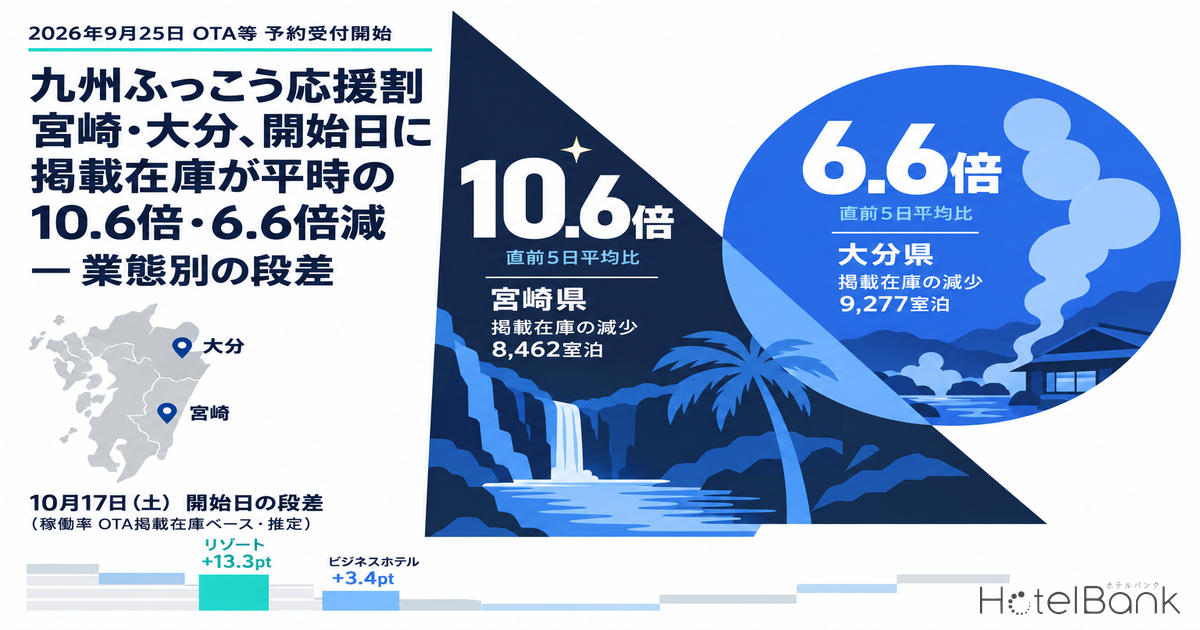
Bookings for the Kyushu Fukko Ouenwari (九州ふっこう応援割, the Kyushu recovery travel discount) opened on OTAs and similar channels in Miyazaki and Oita on September 25, 2026 (10:00 in Miyazaki, 12:00 in Oita). On launch day, listed inventory for October stays in Miyazaki fell by 8,462 room-nights in a single day, 10.6 times the daily average of the preceding five days. In Oita the drop was 9,277 room-nights, or 6.6 times. How that demand moved, however, differed sharply by property type. For October 17 (Sat), estimated occupancy (based on OTA-listed inventory) at Miyazaki resorts jumped +13.3pt in one day, while business hotels moved only +3.4pt. This article measures the launch-day step in Miyazaki and Oita, which started later than the other prefectures, by property type and by stay date, and sets out how hotels can sell the rooms that remain after the step.
Metric Definitions Used in This Article
- OCC (occupancy): Share of rooms sold out of total rooms in the area (an estimate based on OTA sales inventory). Written in the text as “estimated occupancy (based on OTA-listed inventory)”. It reflects how OTA-listed inventory is being absorbed and differs from a property’s actual overall occupancy.
- LT (lead time): Days until check-in. A booking curve is the path of remaining OTA inventory toward the check-in date. This article uses only observations within LT45.
- Step: The difference (pt) between the observation on the sales launch day and the observation on the previous day.
- Drop in listed inventory (room-nights): For each stay date from October 1 to 31, the total decrease in OTA-listed remaining rooms from the previous day to the current day. It is not a booking count; it also includes reductions from sell-outs, sales stops and inventory being re-listed.
- Data source: MetroEngines Research (property and room counts are based on listings on major booking sites)
- — Kyushu Fukko Ouenwari bookings opened on OTAs and similar channels in Miyazaki and Oita on September 25, 2026, making them the last group to launch among the seven prefectures (Kumamoto and Nagasaki on September 15, Fukuoka and Saga on September 24; Kagoshima was still undecided at the time of research).
- — In a single launch day, listed inventory for October stays fell by 8,462 room-nights in Miyazaki (10.6x the prior 5-day average) and 9,277 room-nights in Oita (6.6x).
- — For October 17 (Sat) stays, the largest launch-day steps were Miyazaki resorts at +13.3pt (12 properties) and Oita ryokan at +5.8pt (242 properties). Business hotels in both prefectures stayed in the +3pt range (observed September 25, 2026).
- — The step also appeared on weekdays. The October Mon–Thu average was +3.8pt in Miyazaki and +2.5pt in Oita, and November 7 (Sat) stays also moved, +5.0pt in Miyazaki and +4.3pt in Oita.
- — The right response depends on property type. Resorts and ryokan should hold rates on remaining rooms and push multi-night stays; business hotels should run the discount alongside business-travel demand; and in both prefectures hotels should build a separate entry point timed to the start of direct-booking sales (in Miyazaki, rolling out from September 28; in Oita, from October 9 for travel agencies and October 16 for accommodations).
Kyushu Fukko Ouenwari: Miyazaki and Oita were the last of the seven prefectures to launch
According to the Japan Tourism Agency (updated September 24, 2026), Kyushu Fukko Ouenwari covers stays from October 1. The discount is 50% of the travel or accommodation price (60% in Kumamoto and Kagoshima), capped per trip per person at ¥20,000 for a one-night stay (accommodation only or with transport), ¥30,000 for two or more nights with transport, and ¥35,000 for multi-stop trips. Sales start dates vary by prefecture: Kumamoto and Nagasaki on September 15, Fukuoka and Saga on September 24, and Miyazaki and Oita on September 25. Kagoshima had not set a date at the time of research.
| Prefecture | OTA sales start | Eligible stays | Discount |
|---|---|---|---|
| Kumamoto | Sep 15 | Oct 1 – Dec 25 | 60% |
| Nagasaki | Sep 15 | Oct 1 – Dec 25 | 50% |
| Fukuoka | Sep 24 | Oct 1 – Dec 15 | 50% |
| Saga | Sep 24 | Oct 1 – Dec 25 | 50% |
| Miyazaki | Sep 25 (from 10:00) | Oct 1 – Dec 25 | 50% |
| Oita | Sep 25 (from 12:00) | Oct 1 – Dec 25 | 50% |
| Kagoshima | TBD | TBD | 60% |
Source: Compiled by the HotelBank Editorial Team from the Japan Tourism Agency’s “Kyushu Fukko Ouenwari” page and official notices from Oita and Miyazaki prefectures
The staggered start put Miyazaki and Oita in a position to attract travelers who had watched the earlier prefectures. In Kumamoto, which launched first, some major booking sites were reported to have stopped issuing discount coupons by the morning of September 24 (Travel Watch, September 24, 2026). Miyazaki’s official site states that “the campaign will end once the budget limit is reached.” Direct sales (through accommodations and travel agencies) roll out in Miyazaki from September 28, while in Oita travel agencies start on October 9 and accommodations on October 16 (Oita Prefecture). In other words, September 25 was the day when only the OTA-type allocations moved at once in both prefectures.
Launch-day drop in listed inventory: 10.6x normal in Miyazaki, 6.6x in Oita
We first compare launch-day movement with normal days at the prefecture level. Summing the drop in listed inventory on launch day across all October stay dates and comparing it with the daily average of the five days before launch, Miyazaki fell by 8,462 room-nights (10.6x the prior 5-day average of 797 room-nights) and Oita by 9,277 room-nights (6.6x the average of 1,398 room-nights). Applying the same method to the earlier prefectures gives Saga 8.8x, Nagasaki 8.1x, Kumamoto 5.5x and Fukuoka 3.2x. Note that the multiple also depends on how thick the original inventory is, so it tends to be larger in prefectures with fewer rooms and slower normal movement.
Source: MetroEngines Research; compiled by the HotelBank Editorial Team (October stays, all property types. Property and room counts as in the table below, based on major booking site listings)
| Prefecture (launch) | Oct 17 (Sat): day before → launch day | Step | October listed inventory drop (launch day) | Prior 5-day daily average | Multiple | Properties / rooms |
|---|---|---|---|---|---|---|
| Miyazaki (9/25) | 69.7%→75.5% | +5.8pt | 8,462 room-nights | 797 room-nights | 10.6x | 161 / 6,914 |
| Saga (9/24) | 72.8%→78.2% | +5.4pt | 4,160 room-nights | 472 room-nights | 8.8x | 140 / 4,510 |
| Nagasaki (9/15) | 75.6%→78.4% | +2.8pt | 6,167 room-nights* | 760 room-nights* | 8.1x | 273 / 11,564 |
| Oita (9/25) | 83.2%→87.3% | +4.1pt | 9,277 room-nights | 1,398 room-nights | 6.6x | 479 / 10,952 |
| Kumamoto (9/15) | 79.9%→85.7% | +5.8pt | 15,646 room-nights* | 2,825 room-nights* | 5.5x | 383 / 14,362 |
| Fukuoka (9/24) | 81.2%→83.2% | +2.0pt | 14,786 room-nights | 4,577 room-nights | 3.2x | 441 / 29,815 |
*Nagasaki and Kumamoto launched on September 15, so figures cover the 24 stay dates from October 1 to 24 that can be compared within LT45. Other prefectures cover the 31 stay dates from October 1 to 31. Estimated occupancy (based on OTA-listed inventory) is for October 17 stays; property and room counts are the cohort for that date (based on major booking site listings).
Source: MetroEngines Research; compiled by the HotelBank Editorial Team
Measured by the step in estimated occupancy (based on OTA-listed inventory) for October 17 (Sat), Miyazaki rose +5.8pt (161 properties / 6,914 rooms, based on major booking site listings) and Oita +4.1pt (479 properties / 10,952 rooms). Oita was already at 83.2% the day before launch, 13.5pt higher than Miyazaki (69.7%). With fewer rooms left, the same discount tends to move the number less. Part of the gap in multiples can be explained by this difference in starting point.
Steps by property type: resorts moved most in Miyazaki, ryokan in Oita
Next, we break the same October 17 (Sat) date down by property type. In Miyazaki, resorts went from 82.1% to 95.4% (+13.3pt, 12 properties / 1,384 rooms), ryokan from 79.8% to 87.2% (+7.4pt, 28 properties / 376 rooms) and business hotels from 63.6% to 67.0% (+3.4pt, 44 properties / 4,084 rooms). In Oita, ryokan moved most, from 85.6% to 91.4% (+5.8pt, 242 properties / 3,755 rooms), followed by resorts from 82.6% to 86.5% (+3.9pt, 32 properties / 1,492 rooms) and business hotels from 83.5% to 86.7% (+3.2pt, 39 properties / 3,651 rooms) (all based on major booking site listings).
Source: MetroEngines Research; compiled by the HotelBank Editorial Team (October 17 stays, observed September 24 → 25. Property and room counts as in the table below, based on major booking site listings)
| Prefecture / type | Properties / rooms | Oct 17: 9/24→9/25 | Step | Rise over prior 22 days (LT45→LT23) | October listed inventory drop (launch day) | vs. prior 5-day avg |
|---|---|---|---|---|---|---|
| Miyazaki – Resort | 12 / 1,384 | 82.1%→95.4% | +13.3pt | +8.3pt | 4,899 room-nights | 31.4x |
| Miyazaki – Ryokan | 28 / 376 | 79.8%→87.2% | +7.4pt | +13.6pt | 399 room-nights | 9.6x |
| Miyazaki – Business | 44 / 4,084 | 63.6%→67.0% | +3.4pt | +12.4pt | 2,695 room-nights | 5.1x |
| Miyazaki – All types | 161 / 6,914 | 69.7%→75.5% | +5.8pt | +10.2pt | 8,462 room-nights | 10.6x |
| Oita – Ryokan | 242 / 3,755 | 85.6%→91.4% | +5.8pt | +11.6pt | 4,880 room-nights | 9.1x |
| Oita – Resort | 32 / 1,492 | 82.6%→86.5% | +3.9pt | +7.1pt | 1,079 room-nights | 8.4x |
| Oita – Business | 39 / 3,651 | 83.5%→86.7% | +3.2pt | +7.3pt | 1,950 room-nights | 5.2x |
| Oita – All types | 479 / 10,952 | 83.2%→87.3% | +4.1pt | +8.8pt | 9,277 room-nights | 6.6x |
Source: MetroEngines Research; compiled by the HotelBank Editorial Team
The key figure is the ratio of the one-day launch step to the build over the preceding 22 days (LT45→LT23). Miyazaki resorts gained +8.3pt over 22 days, then +13.3pt on launch day alone, exceeding the whole prior build. Ryokan moved about half of their 22-day build in one day, both in Miyazaki (+7.4pt vs. +13.6pt) and in Oita (+5.8pt vs. +11.6pt). Business hotels moved only about 30% in Miyazaki (+3.4pt vs. +12.4pt) and about 40% in Oita (+3.2pt vs. +7.3pt). The drop in listed inventory across October tells the same story: business hotels in both prefectures landed at roughly 5x the prior 5-day average (Miyazaki 5.1x, Oita 5.2x), suggesting that the discount works more strongly on leisure-oriented property types.
That said, Miyazaki resorts are a small sample of 12 properties, so movements in listed inventory at a few large properties heavily sway the aggregate. The group includes properties whose listed inventory dropped to zero in bulk on launch day, and some of them re-listed inventory at revised rates the next day. This step should be read as a sign that sales settings switched over sharply on launch day, not interpreted entirely as a build-up of bookings. City hotels (7 in Miyazaki, 8 in Oita) are excluded because each group has fewer than 10 properties.
Booking curves for October 17: a 22-day build versus a one-day step
The booking curves make the nature of the step easier to see. Below is estimated occupancy (based on OTA-listed inventory) for October 17 (Sat) stays, from LT45 (September 2) to LT22 on launch day (September 25). LT22 is the latest observation; nothing beyond it exists yet.
Source: MetroEngines Research; compiled by the HotelBank Editorial Team (Miyazaki, October 17 stays. All types 161 properties / 6,914 rooms; resorts 12 / 1,384; ryokan 28 / 376; business 44 / 4,084; based on major booking site listings)
Source: MetroEngines Research; compiled by the HotelBank Editorial Team (Oita, October 17 stays. All types 479 properties / 10,952 rooms; resorts 32 / 1,492; ryokan 242 / 3,755; business 39 / 3,651; based on major booking site listings)
In Oita, the curves for all four groups sat in a narrow 74–77% band at LT45, and the launch-day step also stayed within a 2.6pt spread across types (ryokan +5.8pt, business +3.2pt). In Miyazaki, by contrast, business hotels were at 51.2% and resorts at 73.8% at LT45, a 22.6pt gap that the step widened further. Miyazaki business hotels stood at 67.0% for October 17, leaving room to fill, and are now at the stage of filling it with demand other than the discount. How each property type’s curve rises in Miyazaki in normal times is analyzed in detail in Miyazaki Booking Curves by Type: Ryokan +13.8pt Fri→Sat, City Capped.
Steps by stay date: weekdays moved in the same direction
The step was not confined to weekends. Estimated occupancy (based on OTA-listed inventory) rose on launch day for all 31 October stay dates in both Miyazaki and Oita. In Miyazaki (157–161 properties / 6,690–6,914 rooms), the Mon–Thu average was +3.8pt and the Saturday average +5.0pt; in Oita (472–479 properties / 10,870–10,952 rooms), Mon–Thu averaged +2.5pt and Saturdays +3.4pt. Even on October 14 (Wed), Miyazaki moved from 56.7% to 61.6% (+4.9pt), as much as a Saturday.
Source: MetroEngines Research; compiled by the HotelBank Editorial Team (all property types, October 1–31 stays, observed September 24 → 25. Miyazaki 157–161 properties / 6,690–6,914 rooms; Oita 472–479 properties / 10,870–10,952 rooms; based on major booking site listings)
| Stay date | Miyazaki 9/24→9/25 | Step | Oita 9/24→9/25 | Step |
|---|---|---|---|---|
| Oct 10 (Sat), first day of 3-day weekend | 82.9%→89.4% | +6.5pt | 88.4%→90.9% | +2.5pt |
| Oct 14 (Wed) | 56.7%→61.6% | +4.9pt | 64.0%→66.6% | +2.6pt |
| Oct 17 (Sat) | 69.7%→75.5% | +5.8pt | 83.2%→87.3% | +4.1pt |
| Oct 24 (Sat) | 86.0%→88.8% | +2.8pt | 80.9%→84.5% | +3.6pt |
| Nov 3 (Tue, holiday) | 47.7%→51.0% | +3.3pt | 59.2%→61.9% | +2.7pt |
| Nov 7 (Sat) | 66.3%→71.3% | +5.0pt | 76.0%→80.3% | +4.3pt |
| October Mon–Thu average | — | +3.8pt | — | +2.5pt |
| October Saturday average | — | +5.0pt | — | +3.4pt |
Source: MetroEngines Research; compiled by the HotelBank Editorial Team (all property types. Miyazaki 159–161 properties / 6,786–6,914 rooms; Oita 474–479 properties / 10,896–10,952 rooms; based on major booking site listings)
Dates that were already full saw smaller steps. Miyazaki’s October 24 (Sat) had reached 86.0% the day before launch, and its step was only +2.8pt. Conversely, October 10 (Sat), the first day of a three-day weekend, jumped +6.5pt from 82.9%, as holiday demand and the discount overlapped. November 7 (Sat), a later stay date at LT43, still moved +5.0pt in Miyazaki and +4.3pt in Oita, showing that the launch-day step reached November stay dates as well as October.
What to do by property type: selling the rooms left after the step
Resorts and ryokan: hold rates on remaining rooms and extend stays with multi-night plans. For property types that moved sharply on launch day, the rooms that remain are few and tend to be chosen with or without the discount. Rather than rushing into further price cuts, the opportunity lies in holding rates on remaining rooms while designing multi-night stays that fill weekday nights. Because the discount cap applies per trip per person, the per-night discount thins out on accommodation-only multi-night stays. Even so, for the property, the discount can be the trigger that gets guests to stay longer and fills weekday nights. Multi-night plans that combine dinner-included and room-only nights can serve as that vehicle.
Business hotels: run the discount alongside business-travel demand. In both prefectures, the business-hotel step was about 5x the prior 5-day average, more modest than other types, and Miyazaki stood at 67.0% for October 17, with room still to fill. Corporate and business-travel demand is the core on weekdays, so taking in leisure guests through the discount while not filling weekday corporate allocations too early helps balance rate and occupancy. Multi-night plans without housekeeping or multi-night discounts with breakfast work for both business and leisure guests.
Timing of direct sales: build an entry point separate from the OTA allocations. Direct-sales discounts start rolling out in Miyazaki from September 28, and in Oita from October 9 for travel agencies and October 16 for accommodations. Once the OTA-type allocations approach their budget limits, inquiries may shift to official websites and phone bookings. Preparing direct-sales inventory and rates now creates upside for the dates that did not capture the launch-day step.
For hotels: plan-name hints for this theme
Most common selling points in multi-night plan names published in Oita Prefecture (N=369) —
Multi-night discount 98%Room only 34%Eco 24%Breakfast included 22%Discount 20%Hot spring / open-air bath 15%
Examples of actual names (anonymized):
- [For business travelers] Save on 2+ nights! Free natural hot spring bath & breakfast buffet (【ビジネス向け】2連泊以上でお得!天然温泉大浴場&朝食バイキング無料)
- Natural hot spring [Room only] Select dates only! Multi-night plan without housekeeping [Prepaid only] (天然温泉有【素泊り】お日にち限定!清掃なしの連泊プラン【事前決済のみ】)
- [21-day early booking] Save on 2+ nights ◆ Earth-friendly eco stay ◆ Free breakfast buffet (Miyazaki) (【21日前早期割引】2連泊以上でお得◆地球にやさしいエコステイ◆朝食ビュッフェが無料)
*These are trends based on aggregated public plan names and do not show that naming causes sales.
Frequently Asked Questions
Q. When can Kyushu Fukko Ouenwari be booked in Miyazaki and Oita?
A. On OTAs and similar channels, bookings opened on September 25, 2026 (10:00 in Miyazaki, 12:00 in Oita). Direct sales roll out in Miyazaki from September 28, and in Oita from October 9 for travel agencies and October 16 for accommodations. Eligible stays in both prefectures run from October 1 to December 25.
Q. How much did available rooms fall on launch day?
A. Listed inventory for October stays fell by 8,462 room-nights in Miyazaki (10.6x the prior 5-day average) and 9,277 room-nights in Oita (6.6x) in a single launch day. The drop in listed inventory includes sales stops and is not a booking count.
Q. Which property type moved the most?
A. For October 17 (Sat) stays, the largest steps were resorts in Miyazaki (+13.3pt) and ryokan in Oita (+5.8pt); business hotels in both prefectures stayed in the +3pt range.
Q. Why was the step different in Miyazaki and Oita?
A. The day before launch, Oita was already at 83.2% for October 17 (Sat) stays, 13.5pt higher than Miyazaki (69.7%). With fewer rooms left, the same discount tends to move the number less, and part of the gap in multiples can be explained by this difference in starting point.
Q. What should hotels do after the step?
A. This article gives three points. Resorts and ryokan should not rush further price cuts but hold rates on remaining rooms while filling weekday nights with multi-night stays; business hotels should run the discount alongside weekday corporate and business-travel demand; and in both prefectures hotels should prepare direct-sales inventory and rates in time for the start of direct booking (in Miyazaki, rolling out from September 28; in Oita, from October 9 for travel agencies and October 16 for accommodations).
Summary
Because Miyazaki and Oita were the last of the seven prefectures to launch Kyushu Fukko Ouenwari, inventory moved all at once on launch day. Listed inventory for October stays fell at 10.6x the normal pace in Miyazaki and 6.6x in Oita. For October 17 (Sat), the largest steps were Miyazaki resorts at +13.3pt and Oita ryokan at +5.8pt, while business hotels in both prefectures stayed in the +3pt range. Weekdays moved in the same direction, and the step extended to November stay dates. For the rooms left after the step, there is room to grow through rate-protected multi-night stays at leisure-oriented properties, running alongside business-travel demand at business hotels, and a separate entry point timed to the start of direct sales.
⚠ Note on forward-dated data: All estimated occupancy figures (based on OTA-listed inventory) in this article are as observed on September 25, 2026; October and November stay dates are still mid-booking-window. They will change as check-in approaches due to added inventory, cancellations and lifted sales stops.
Methodology
Listed inventory on major booking sites, observed daily by MetroEngines Research, was aggregated by prefecture × property type (all types, resort, ryokan, business). The scope is listed inventory for two guests per room, with observations within LT45 up to the September 25, 2026 observation. The step is the difference between the launch-day observation and the previous day’s observation; the drop in listed inventory is the total decrease in remaining rooms from the previous day to the current day, summed over October stay dates. Because the drop in listed inventory includes not only absorption by bookings but also reductions from property-side sales stops and re-listing, it is not a booking count. Property types with fewer than 10 properties (such as city hotels) are excluded. Kagoshima is excluded from the comparison because its sales start date was undecided at the time of research.
Related Articles
References and Sources
■ Data sources
Listed inventory on major booking sites observed daily by MetroEngines Research (two guests per room, up to the September 25, 2026 observation). Aggregated by prefecture × property type (all types, resort, ryokan, business); for October 17 stays the scope is 161 properties / 6,914 rooms in Miyazaki and 479 properties / 10,952 rooms in Oita (based on major booking site listings). Program details and sales start dates were confirmed with the Japan Tourism Agency, official notices from Oita and Miyazaki prefectures, and news reports.
■ Calculation assumptions
The step is the difference (pt) between the launch-day observation and the previous day’s observation. For the drop in listed inventory, the decrease in listed remaining rooms from the previous day to launch day was summed across each October stay date and compared with the daily average of the five days before launch (Nagasaki and Kumamoto launched on September 15, so they cover the 24 stay dates from October 1 to 24 that can be compared within LT45). Observations are limited to within 45 days of the stay date (LT45).
■ Limitations
Estimated occupancy (based on OTA-listed inventory) differs from a property’s actual overall occupancy. The drop in listed inventory includes sales stops and re-listing and is not a count of bookings or of discount redemptions. Miyazaki resorts are a small sample of 12 properties, so movements at a few large properties sway the aggregate. Movements in the hours before the sales start time (10:00 in Miyazaki, 12:00 in Oita) may also be included in the launch-day observation. October and November values are interim readings at the time of research and will change as stay dates approach.
- Japan Tourism Agency, “Kyushu Fukko Ouenwari” (updated September 24, 2026)
- Oita Prefecture, “Kyushu Fukko Ouenwari (Oita)”
- Miyazaki Prefecture, Kyushu Fukko Ouenwari official site
- Article on the booking launch of Kyushu Fukko Ouenwari in Miyazaki and Oita (Travel Watch, September 24, 2026)
- MetroEngines Research — estimated occupancy and booking curves based on listed inventory on major booking sites (Miyazaki 161 properties / 6,914 rooms, Oita 479 properties / 10,952 rooms and others, up to the September 25, 2026 observation)