

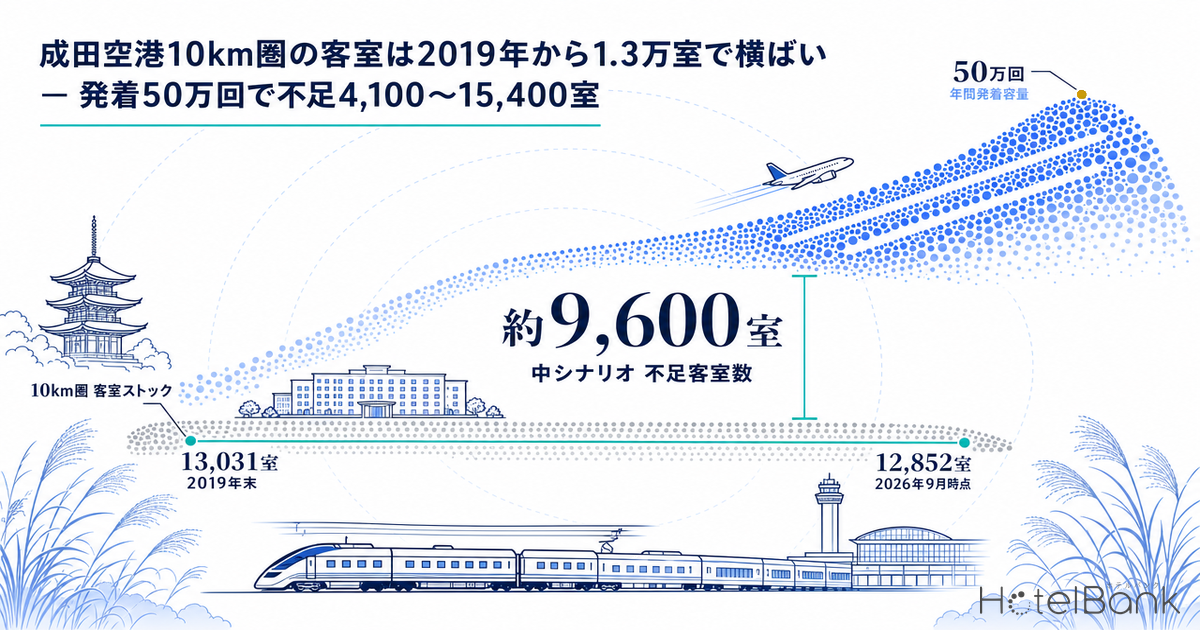
Hotel room stock within a 10km radius of Narita Airport has been essentially flat for seven years, moving from 13,031 rooms at the end of 2019 to 12,852 rooms as of September 2026. The airport, meanwhile, is pressing ahead with its “second opening”: a new 3,500m Runway C and a 1,000m extension of Runway B, both targeted for completion by the end of FY2028, which will lift annual slot capacity to 500,000 movements. The published picture for the 500,000-movement stage is roughly 75 million air passengers and about 70,000 on-airport employees — a steep rise from FY2025 actuals (42.59 million passengers). This article sets the airport’s capacity expansion against land, employment and room stock in the nine surrounding municipalities, and estimates how many hotel rooms will be needed from 2029 onward and at what room rates that new supply would pencil out.
Metric Definitions Used in This Article
- ADR (Average Daily Rate): An estimated settled room rate (tax-excluded equivalent), calculated by applying segment-specific adjustment factors to the lowest-plan price level each property publishes on OTAs (per room, two guests, tax included). Validated against property-level actuals disclosed by listed hotel REITs (91 properties, most recent three months), the median error is approximately 7%. These are estimates and differ from each property’s actual settled prices and accounting figures. Area-level ADR is the median of the properties covered (the level of a typical property in the area).
- OCC (Occupancy): Rooms sold as a share of total rooms in the area (an estimate based on OTA sales inventory). In this article it is labeled “occupancy (OTA-listed inventory basis, estimated)” and differs from a property’s actual overall occupancy.
- Room stock (within an X km radius): The total rooms of lodging facilities open and not yet closed at each year-end, located within circles of 5km, 10km and 15km radius from the center point of Narita Airport (35.7720°N, 140.3929°E). 2026 figures are as of September.
- Data sources: MetroEngines Research & Consulting (ADR, estimated occupancy, room stock); MLIT Real Estate Information Library (land prices, zoning, area classification); MLIT National Land Numerical Information (resident population); MIC/METI Economic Census (employment)
How This Article Differs from Earlier Coverage
An earlier HotelBank article on the 2026 winter schedule (starting October 25) covered added flights and current-period inventory at airports with increased service, counting Narita’s rooms at 23,630. That figure uses a different aggregation radius from this article and cannot be compared with the 12,852 rooms within 10km used here. Other earlier articles compared hotel supply across Japan’s privatized airports and across five airports (Kansai, Fukuoka, Naha, New Chitose and Chubu), and an investment map covered the whole of Chiba Prefecture in five areas. This article focuses on Narita alone and sets its long-term capacity expansion — from runway opening around 2029 to a new terminal in the 2030s — against land, employment and room stock in the nine surrounding municipalities.
- — 12,852 rooms: Rooms within 10km of Narita Airport have been flat from 13,031 at end-2019 to September 2026. 72.6% of those rooms sit within 5km of the airport
- — 340,000 → 500,000 movements: The new Runway C and Runway B extension are scheduled for completion by the end of FY2028. The 500,000-movement scenario assumes about 75 million passengers and about 70,000 on-airport employees
- — About ¥7,900, 19.8% swing: Narita City’s estimated settled ADR (Sep 2025–Aug 2026) shows little seasonality, and estimated occupancy ran at 81–84% in June–August 2026
- — Shortfall of 4,100–15,400 rooms: Required rooms within 10km at 500,000 movements, estimated under three scenarios. The mid scenario is about 9,600 rooms; even a conservative combination leaves about 6,200
- — Break-even ADR of about ¥10,700–¥14,000: An airport-front business hotel needs a rate 44–89% above the current level (about ¥7,400) to achieve a 7–8% GOP yield. A transit-type product needs about ¥4,200–¥5,600
The “Second Opening” Timeline — Runways by End of FY2028, a New Terminal in the 2030s
First, the schedule as confirmed in published materials. According to Chiba Prefecture’s page “Toward Narita Airport’s ‘Second Opening'” (updated July 4, 2025), the project to extend Runway B from 2,500m to 3,500m and build a new 3,500m Runway C targets completion by the end of FY2028. Aviation Wire (April 4, 2025) reported that Runway C is scheduled to enter service on March 31, 2029, with full-scale construction starting in May of that year. According to the same report, operating hours are also set to widen from the current 6:00–24:00 to 5:00–24:30.
On slot capacity, Narita International Airport Corporation (NAA) stated in materials dated January 24, 2025 that, thanks to rapid-exit taxiways and more advanced air traffic control, current handling capacity has reached 340,000 movements a year, and that it intends to operate this 340,000 as the annual slot limit until Runway C opens. In other words, the capacity added by Runway C is the 160,000-movement step from 340,000 to 500,000. Actual movements in FY2025 were 254,134, so the gap between current performance and 500,000 is larger still.
For the passenger terminal, MLIT’s study group on future enhancement of Narita Airport facilities published its final report in July 2026. According to Aviation Wire (July 6, 2026), the plan aims to open Step 1 in the 2030s, securing combined capacity of 75 million passengers a year — 40 million at the new terminal and 35 million at Terminal 2. For rail, a new elevated Keisei station with three platforms and five tracks will be built near Higashi-Narita Station, ultimately raising transport capacity to about 1.8 times the current level.
| Item | Details | Timing | Source (publication date) |
|---|---|---|---|
| New Runway C | 3,500m, south of Runway B | Scheduled to open March 31, 2029 | Aviation Wire (Apr 4, 2025) / Chiba Prefecture (updated Jul 4, 2025) |
| Runway B extension | 2,500m → 3,500m (1,000m northward) | Target completion by end of FY2028 | Chiba Prefecture (updated Jul 4, 2025) |
| Annual slot limit | Handling capacity of 340,000 operated as slot limit (until Runway C opens) → 500,000 | 500,000 after Runway C opens | NAA materials (Jan 24, 2025) |
| Assumptions at 500,000 movements | Approx. 75 million air passengers, approx. 3 million tonnes of cargo, approx. 70,000 on-airport employees | — | Chiba Prefecture (updated Jul 4, 2025) |
| New passenger terminal | Consolidation into one terminal. Step 1: new terminal 40 million + Terminal 2 35 million | Step 1 targeted to open in the 2030s | MLIT study group final report (Aviation Wire, Jul 6, 2026) |
| Rail access | New elevated Keisei station (3 platforms, 5 tracks) near Higashi-Narita Station; capacity ultimately about 1.8x | 2030s | Same as above |
| Airport City concept | “SORATO NRT Airport City Concept”: a wide-area economic zone centered on the airport, with international industry and logistics hubs | Name decided Jan 28, 2026; concept agreed by the Four-Party Council on Jun 12, 2025 | Chiba Prefecture |
| WING NRT (private) | International logistics hub in the Shimofukuda district of Narita City, site approx. 450,000㎡, floor area approx. 420,000㎡ (Hulic, JAL) | Site preparation complete around March 2027; operations planned for spring 2029 | LNEWS (Nov 18, 2025) / JAL (Jul 2025) |
| Iizasa district, Tako Town (private) | International air logistics hub of about 70ha by Goodman Group | Aiming to start operations by end of March 2029 | LNEWS (Mar 16, 2023) |
The SORATO NRT concept sets out to raise the airport’s international competitiveness together with industrial clustering around it, and designates zones close to the airport as international industry and logistics hubs. Private logistics developments are already in the site-preparation stage with operations targeted around 2029, so the number of people who “work” and who “visit” will grow on the same timeline as the airport’s capacity. The question this raises is the supply of rooms for those people to stay in.
Rooms Within 10km Flat Since 2019 — Over 70% Concentrated Within 5km of the Airport
Tracking year-end room counts within a 10km radius of the airport center using MetroEngines Research data, rooms rose from 11,459 rooms at 45 properties in 2017 to 13,031 rooms at 53 properties in 2019, then stayed flat through 12,852 rooms at 58 properties as of September 2026. Although five properties were added over seven years, the room count is 179 rooms lower. New additions have skewed toward small properties and have not been enough to lift total room supply.
Broken down by radius, the concentration is striking. The 5km circle holds 9,326 rooms at 24 properties, 72.6% of the rooms within 10km. The 5–10km band (including the Narita Station area, Kozunomori and northern Tomisato City) has 3,526 rooms at 34 properties, and the 10–15km band only 291 rooms at 20 properties. The large hotels in front of the airport absorb most of the demand, and room supply thins out toward the airport’s outer edge. Around the airport there are large hotels such as Hilton Narita (ヒルトン成田), with 548 rooms and 18 banquet rooms (Hilton “Company Overview,” updated August 25, 2026), which take in meeting and group demand in addition to overnight stays and serve as a receptacle for aviation demand.
| Radius | 2017 | 2019 | 2026 (as of Sep) | 2019→2026 | Main areas included |
|---|---|---|---|---|---|
| 5km radius | 19 properties / 8,525 rooms | 23 properties / 9,531 rooms | 24 properties / 9,326 rooms | −205 rooms | Airport grounds and the hotel cluster in front of the airport |
| 10km radius | 45 properties / 11,459 rooms | 53 properties / 13,031 rooms | 58 properties / 12,852 rooms | −179 rooms | Around JR/Keisei Narita stations, Kozunomori, northern Tomisato City, northern Shibayama Town |
| 15km radius | 54 properties / 11,676 rooms | 62 properties / 13,248 rooms | 78 properties / 13,143 rooms | −105 rooms | Most of Tomisato City, Shibayama Town and Tako Town |
The map below overlays the main lodging facilities with location data and 20 or more rooms (circle size = room count), commercial and industrial zoning districts in Narita City, Tomisato City, Shibayama Town and Tako Town, and the 2026 official land price points. Facilities line up from the west side of the airport to Narita Station, while there are almost none to the south and east of the airport.
Rates Are Flat Year-Round — Narita City’s Estimated Settled ADR Is ¥7,900 with a 19.8% Monthly Swing
Next, room rates. Over the latest 12 finalized months (September 2025–August 2026), Narita City’s estimated settled ADR averaged about ¥7,900 (monthly low about ¥7,300, high about ¥8,900). The estimate covered 27–29 properties per month (34–42 listed). The average for the same 12 months a year earlier (September 2024–August 2025) was about ¥8,200, a year-on-year change of −3.7%. By segment, business hotels (N=12 properties) averaged about ¥7,400 and city hotels (N=12 properties) about ¥9,100.
What stands out is how little rates move with the seasons. The swing — the difference between the 12-month high and low divided by the average — is only 19.8% in Narita City. Urayasu City, where tourism and event demand is strong within Chiba Prefecture, stands at 53.4%, and Mihama Ward in Chiba City at 35.7%; Narita is far below both. Unlike tourist destinations where rates jump in holiday seasons, Narita’s base appears to be demand with little month-to-month variation: connecting passengers and stays before early flights or after late arrivals, crew layovers, and airport-related business travel. The swing for the Chiba Prefecture median series is a similar 19.7%, but the prefectural figure is a composite of many areas; that a single city stays at this level reflects the character of Narita’s demand.
| Area | 12-month average | Min–max | Prior-year average | Properties in estimate (per month) | Notes |
|---|---|---|---|---|---|
| Narita City (all segments) | ¥7,876 | ¥7,346–¥8,907 | ¥8,175 | 27–29 | 34–42 properties listed |
| Narita City (business) | ¥7,409 | ¥6,918–¥7,864 | — | 12 | |
| Narita City (city hotels) | ¥9,074 | ¥8,228–¥10,342 | — | 12 | |
| Tomisato City | ¥6,232 | ¥5,774–¥7,055 | ¥5,579 | 2–3 | Reference only (fewer than 5 properties in estimate; 2–6 listed) |
| Katori City | ¥6,086 | ¥4,839–¥8,040 | ¥5,365 | 4–6 | Reference only (fewer than 5 properties in some months; 17 listed) |
| Chiba City, Chuo Ward | ¥9,654 | ¥8,528–¥10,879 | ¥9,166 | 32–35 | Prefectural capital comparison |
| Chiba City, Mihama Ward | ¥13,393 | ¥10,946–¥15,726 | ¥12,116 | 12–13 | Makuhari area |
| Urayasu City | ¥23,865 | ¥18,166–¥30,913 | ¥23,347 | 29–30 | Maihama area |
| Chiba Prefecture (overall) | ¥10,148 | ¥8,995–¥10,992 | — | 403–423 |
The depth of demand also shows in estimated occupancy. For a fixed set of properties in Narita City (15 properties / 4,272 rooms, based on listings on major booking sites), occupancy (OTA-listed inventory basis, estimated) was 83.8% in June 2026 (21 days observed), 81.4% in July and 81.6% in August. Occupancy has held above 80% without large rate moves, indicating stable demand volume.
| Stay month | Occupancy (est.) | Days observed | Coverage |
|---|---|---|---|
| June 2026 | 83.8% | 21 days | 15 properties / 4,272 rooms (based on listings on major booking sites) |
| July 2026 | 81.4% | 31 days | Same as above |
| August 2026 | 81.6% | 31 days | Same as above |
Few Residents, Many Workers — 5,234 Residents vs. 26,450 Workers Within 3km of the Airport
Few people live around the airport. According to MLIT’s future population estimates by 250m mesh, the resident population within 3km of the airport center is estimated at 5,234 in 2025 and 4,939 in 2040 (−5.5% vs. 2020). By contrast, the Economic Census (2021) counts 742 establishments and 26,450 workers in the same 3km circle — about five times as many people working there as living there. Office-type workers number only 991 (3.7%); the employment base is centered on frontline aviation, logistics and service jobs.
The 3km circle centered on JR Narita Station is different in character. Its resident population is 82,234 (2025) and is expected to hold roughly steady at 81,613 in 2040 (−0.8% vs. 2025; +1.2% vs. 2020). It has 2,929 establishments and 36,156 workers, with an office-type share of 8.1%, more than double the airport circle. The area in front of the airport is a “town of people who work and people in transit,” while the Narita Station area is a “town of people who live and work.” The former is positioned to absorb connecting, pre/post-flight, crew and airport-operations lodging demand; the latter, mixed demand including in-town business travel and tourism around Naritasan.
| Metric | Airport center | JR Narita Station center | Source |
|---|---|---|---|
| Resident population (2025) | 5,234 | 82,234 | MLIT National Land Numerical Information (future population estimates by 250m mesh) |
| Resident population (2040) | 4,939 | 81,613 | |
| Change 2020→2040 | −5.5% | +1.2% | |
| Share aged 65+ (2025) | 25.0% | 23.5% | Same as above |
| Establishments | 742 | 2,929 | MIC/METI Economic Census for Business Activity (2021) |
| Workers | 26,450 | 36,156 | |
| Office-type worker share | 3.7% | 8.1% | |
| Workers ÷ residents | approx. 5.1x | approx. 0.44x | Calculated from the above |
The map below color-codes resident population by 250m mesh for the two 3km circles centered on the airport and on JR Narita Station. Sparsely populated meshes spread around the airport, while residential areas cluster on the Narita Station and Kozunomori side. With on-airport employees planned to grow from about 43,000 to about 70,000, the Four-Party Council’s implementation plan targets about 38,000 employees living in the surrounding area with their families. Just as with housing, rooms for business travelers, trainees and construction workers will also be needed close to the airport.
Land Conditions — Urbanization Control Areas, Noise Zones, and Rising Land Prices South of the Airport
As a premise for finding hotel sites, first review land-use regulation around the airport. According to MLIT’s Real Estate Information Library, Narita City and Tomisato City are divided into urbanization promotion areas and urbanization control areas, and the airport grounds and the areas to their south and west fall within urbanization control areas. Eastern Narita City also includes areas without this division, and Shibayama Town and Tako Town are undivided city planning areas; their official land price points are likewise registered as undivided areas. Because development in urbanization control areas requires a permit, candidate hotel sites will mainly be commercial or quasi-industrial zoning districts in urbanization promotion areas, or hub zones designated in municipal plans.
In addition, the area around Narita Airport contains zones under the Act on Special Measures concerning Aircraft Noise around Specified Airports. According to Narita City’s explanation (updated July 14, 2025), in “prevention districts” at Lden 62dB or above, schools, hospitals, housing, nurseries, special nursing homes for the elderly and similar buildings must use effective soundproof construction, and in “special prevention districts” at Lden 66dB or above such buildings generally cannot be built. The same explanation states that shops, offices, factories, warehouses and leisure facilities are outside the scope of the regulation (unless they include a residential portion). Because hotels are not mentioned on that page, each site needs to be checked with the city’s responsible office and city planning maps. Note that plans including uses close to housing, such as company dormitories or long-stay accommodation, may be subject to soundproofing requirements or building restrictions. The extent of the zones can be checked in Narita City and Chiba Prefecture city planning information.
Land prices are rising notably south of the airport. In the official land prices as of January 1, 2026, a Category 1 low-rise exclusive residential site in Narita City southwest of the airport (6.1km from Higashi-Narita Station) was ¥36,700/㎡, up 14.7% year on year, and a site toward Shibayama-Chiyoda Station was ¥32,400/㎡, up 13.7% — among the highest increases in Narita City. An exclusive industrial site in Narita City (¥26,500/㎡, +10.9%) and one in Tomisato City (¥20,000/㎡, +11.1%) also rose by more than 10%, reflecting demand for logistics land. The commercial site in front of JR Narita Station is high at ¥293,000/㎡ (+2.8%), but its rate of increase is moderate.
| Location | Use / zoning | Nearest station (distance) | Price (¥/㎡) | YoY |
|---|---|---|---|---|
| Narita City | Commercial / Commercial district | Narita (0m) | 293,000 | +2.8% |
| Narita City | Commercial / Category 2 residential district | Kozunomori (200m) | 171,000 | +6.2% |
| Narita City | Residential / Category 1 low-rise exclusive residential district | Higashi-Narita (6,100m) | 36,700 | +14.7% |
| Narita City | Residential / Category 1 low-rise exclusive residential district | Shibayama-Chiyoda (5,500m) | 32,400 | +13.7% |
| Narita City | Industrial / Exclusive industrial district | Kuji (4,600m) | 26,500 | +10.9% |
| Tomisato City | Industrial / Exclusive industrial district | Enokido (5,000m) | 20,000 | +11.1% |
| Tomisato City | Commercial / Quasi-industrial district | Kozunomori (2,400m) | 84,000 | +7.7% |
| Shibayama Town | Industrial / Exclusive industrial district (undivided) | Shibayama-Chiyoda (2,900m) | 30,900 | +4.4% |
| Shibayama Town | Residential / Category 1 residential district (undivided) | Shibayama-Chiyoda (1,100m) | 17,700 | +4.1% |
| Tako Town | Commercial / Quasi-residential district (undivided) | Shibayama-Chiyoda (7,800m) | 23,900 | 0.0% |
| Narita City | Existing forest land in an urbanization control area | Higashi-Narita (4,200m) | 2,470 | 0.0% |
The Supply Outlook — Logistics Floor Space Moves First, While Hotel Plans Are Not Yet Visible
Next, new supply. Within what MetroEngines Research tracks, the lodging facilities confirmed as opening around Narita Airport in 2025 were limited to small ones, such as a 30-room cottage-style facility near the airport. Looking at hotel plans in Chiba Prefecture on a building-permit-application basis in MLIT’s Building Dynamics Statistics Survey, the five projects currently registered are in Funabashi City, Mihama Ward of Chiba City, Urayasu City and Yachimata City; none are in the nine municipalities around Narita Airport.
Building permit applications are usually filed one to two years before opening, so plans aiming to open in 2029 or later are likely yet to be filed. This result therefore does not prove that “there are no plans”; it is a lower bound showing that “no confirmed pipeline is visible as of the survey date.” Even so, while the WING NRT and Goodman logistics hubs are already in site preparation, hotel floor space has yet to take shape on the same timeline. That lodging supply is trailing behind airport capacity and logistics space means, for developers, that room for entry remains.
*Project counts based on building permit applications are as of the survey date and are expected to rise as further applications are filed. Please treat them as a lower bound of the currently confirmed pipeline. Opening counts based on confirmed OTA listings may also increase for the most recent months, as listings begin several months before opening.
Rooms Needed at 500,000 Movements — A Shortfall of 4,100–15,400 Rooms Across Three Scenarios
What follows is an estimate. We estimated the rooms needed at 500,000 movements by dividing lodging demand into three layers. The first layer is “passenger pre/post-flight stays” — connections, stays before early departures and after late arrivals. The second is airline “crew layovers.” The third is “other demand,” including business trips, training, construction and logistics-related visits inside and outside the airport, as well as tourism in central Narita.
For base-year demand, we assumed the 12,852 rooms within 10km are filled at 80% occupancy, giving about 3.75 million room-nights a year (rounding Narita City’s estimated occupancy of 81%-plus in July–August 2026). For crew layovers, we took half of FY2025’s 170,046 international passenger flights and 31,404 cargo flights as arrivals, and assumed 12 crew per passenger flight and 3 per cargo flight, 50% of flights with crew staying near the airport, and an average of 1.5 nights, giving about 0.80 million room-nights. Passenger pre/post-flight stays were set at 35% of base-year demand (about 1.31 million room-nights), with the remaining roughly 1.64 million room-nights treated as other demand. This yields unit rates of about 308 room-nights per 10,000 passengers and about 38 room-nights per on-airport employee per year.
For 500,000 movements, we applied 75 million passengers and 70,000 on-airport employees (both published by Chiba Prefecture) and the growth multiple in movements (about 1.97x FY2025 actuals). The low scenario assumes stronger rail capacity increases day trips and lowers the passenger unit rate by 20%; the high scenario assumes wider operating hours add early-morning and late-night flights and raise the unit rate by 20%.
| Item | Base year | Low scenario | Mid scenario | High scenario | Basis / notes |
|---|---|---|---|---|---|
| Annual aircraft movements | 254,134 | 500,000 (at the point capacity is reached) | NAA FY2025 actual / Chiba Prefecture | ||
| Air passengers | 42.59 million | 75 million | Same as above | ||
| On-airport employees | approx. 43,000 | approx. 70,000 | Four-Party Council implementation plan (2024 revision) | ||
| Room-nights per 10,000 passengers | 308 | 247 | 308 | 370 | Calculated by assigning 35% of base-year demand to passengers |
| Share of arriving flights whose crew stay near the airport | 50% | 40% | 50% | 60% | Crew per flight: 12 (passenger), 3 (cargo); average 1.5 nights |
| Room-nights per employee (other demand) | 38.1 | 30.5 | 38.1 | 43.8 | Base-year residual divided by number of employees |
| Assumed occupancy | 80% | 85% | 80% | 75% | With reference to Narita City’s estimated occupancy (81%-plus in Jul–Aug 2026) |
| Scenario | Passenger pre/post-flight | Crew layovers | Other demand | Total room-nights | Required rooms | Gap vs. current 12,852 rooms |
|---|---|---|---|---|---|---|
| Base year (FY2025) | 1.31M | 0.80M | 1.64M | 3.75M | 12,852 rooms | — |
| Low | 1.85M | 1.26M | 2.13M | 5.24M | approx. 16,900 rooms | approx. 4,100 short |
| Mid | 2.31M | 1.58M | 2.67M | 6.56M | approx. 22,500 rooms | approx. 9,600 short |
| High | 2.78M | 1.89M | 3.07M | 7.73M | approx. 28,300 rooms | approx. 15,400 short |
In the mid scenario, the shortfall against current stock is about 9,600 rooms. That would take rooms within 10km to about 1.75 times today’s level — equivalent to 48 hotels of 200 rooms each. Even the low scenario requires about 4,100 additional rooms (about 20 hotels of 200 rooms). Because the figures shift with the assumptions, Table 9 shows the results of moving the main assumptions one at a time from the mid scenario. Even in a conservative combination where both the passenger and employee unit rates fall by 20%, a shortfall of about 6,200 rooms remains. Table 9-2 moves occupancy and unit rates simultaneously; in all nine combinations, the shortfall exceeds 5,000 rooms.
| Assumption changed | Total room-nights | Required rooms | Room shortfall |
|---|---|---|---|
| Mid scenario (base) | 6.56M | 22,451 rooms | 9,599 rooms |
| Assumed occupancy 85% (full-year average assumption) | 6.56M | 21,131 rooms | 8,279 rooms |
| Assumed occupancy 75% (full-year average assumption) | 6.56M | 23,948 rooms | 11,096 rooms |
| Passenger unit rate −20% | 6.09M | 20,867 rooms | 8,015 rooms |
| Employee unit rate −20% | 6.02M | 20,624 rooms | 7,772 rooms |
| Crew stay share 40% | 6.24M | 21,373 rooms | 8,521 rooms |
| Passenger and employee unit rates both −20% | 5.56M | 19,040 rooms | 6,188 rooms |
| Assumed occupancy \ unit rate | Unit rate −20% | Unit rate base | Unit rate +20% |
|---|---|---|---|
| Assumed occupancy 75% (full-year average assumption) | 7,457 rooms | 11,096 rooms | 14,735 rooms |
| Assumed occupancy 80% (full-year average assumption) | 6,188 rooms | 9,599 rooms | 13,011 rooms |
| Assumed occupancy 85% (full-year average assumption) | 5,068 rooms | 8,279 rooms | 11,489 rooms |
This estimate describes the picture at the point movements reach 500,000; it does not assume when that will happen. It also does not account for reductions from rebuilding or closure of existing hotels, or for demand absorbed outside the 10km circle (central Narita or toward Chiba City). Since movements will grow in stages, the room shortfall will not appear all at once; it is likely to surface gradually between the opening of Runway C and Step 1 of the new terminal.
Break-Even ADR by Product Type — Working Back from Construction and Land Costs
Even when the volume of rooms needed is clear, supply will not materialize unless those rooms can be sold at a rate that makes them profitable. We therefore estimated break-even ADRs, worked back from total investment, for three product types likely around the airport. Construction cost starts from the 2025 steel-frame cost of ¥2.405 million per tsubo (about ¥728,000 per ㎡) based on MLIT’s Building Construction Starts statistics; we also show values that include cost escalation during construction assuming a 2029 opening (+5.3% in 2026 and +5.0% in 2027 per Turner & Townsend forecasts, and +4.5% in 2028 as this article’s assumption). For land cost, we referred to the standard land price observed in urbanization promotion areas southwest of the airport (a commercial site in Narita City at ¥40,000/㎡, July 1, 2026) and set it at ¥40,000/㎡.
| Item | Airport-front business hotel | Crew / long-stay | Transit |
|---|---|---|---|
| Size | 200 rooms | 150 rooms | 150 units |
| Floor area per room | 30㎡ | 35㎡ (with kitchenette) | 12㎡ (cabin type) |
| Floor area / site area | 6,000㎡ / 2,000㎡ | 5,250㎡ / 1,800㎡ | 1,800㎡ / 600㎡ |
| Assumed occupancy | 85% | 90% (assumes airline contracts) | 90% |
| GOP margin / rooms revenue share | 50% / 95% | 55% / 97% | 45% / 90% |
| Based on 2025 actual construction costs | |||
| Total investment (building + land + FF&E and pre-opening 12%) | ¥4.97bn (¥24.84M per room) | ¥4.35bn (¥29.00M per room) | ¥1.49bn (¥9.94M per unit) |
| Break-even ADR (7% GOP yield) | ¥10,650 | ¥10,898 | ¥4,235 |
| Break-even ADR (8% GOP yield) | ¥12,172 | ¥12,455 | ¥4,840 |
| Including cost inflation during construction (construction cost × 1.155) | |||
| Total investment | ¥5.73bn (¥28.64M per room) | ¥5.01bn (¥33.43M per room) | ¥1.72bn (¥11.46M per unit) |
| Break-even ADR (7% GOP yield) | ¥12,279 | ¥12,564 | ¥4,883 |
| Break-even ADR (8% GOP yield) | ¥14,033 | ¥14,358 | ¥5,580 |
| Comparison: Narita City current level | Business ¥7,409 | All segments ¥7,876 | — |
The result is clear. The break-even ADR for an airport-front business hotel is about ¥10,700 to secure a 7% GOP yield at 2025 construction costs, and about ¥14,000 to achieve 8% including inflation — 44–89% above the current level for business hotels in Narita City (about ¥7,400). The crew / long-stay type also needs about ¥10,900–¥14,400, likewise well above current levels. With construction costs up sharply over two years, new builds are hard to justify at current rates, and this gap between current rates and the break-even line is likely one reason room supply has stayed flat even as demand has grown.
Seen another way, this indicates room for rate growth. When rooms fall short at 500,000 movements, existing airport-front hotels will have more opportunity to raise rates, and the closer the area’s rate level moves to the break-even line, the easier it becomes for new supply to pencil out. The transit type has a small investment per unit and a break-even ADR of about ¥4,200–¥5,600, making it a product that can move first on small plots near the terminals. For the crew / long-stay type, locking in occupancy through multi-year contracts with airlines or logistics operators would allow a structure that secures yield while keeping rates down.
Investment and Development Takeaways — Where, What and When
Airport front / south of the airport: rooms for business and crew
72.6% of rooms are within 5km, and workers outnumber residents about five to one within 3km of the airport. Runway C is being built south of Runway B, and the logistics hub in the Iizasa district of Tako Town also adjoins Runway C. There are opportunities for crew / long-stay products and lodging-focused hotels for business travelers. Sites require checking zoning in urbanization promotion and undivided areas, as well as the aircraft noise zones.
Narita Station / Kozunomori: rooms for mixed demand
A resident population of 82,000 is expected to hold through 2040, and the office-type worker share is high at 8.1%. Land prices are high at ¥293,000/㎡ for the station-front commercial site, but the area combines airport access with in-town business and tourism demand. There is room to consider mid-sized hotels near the station, or mixed-use developments combining long-stay and residential demand.
Near the terminals: rooms for transit
The break-even ADR is low at about ¥4,200–¥5,600, and investment per unit stays around ¥10–11.5 million. With operating hours planned to widen to 5:00–24:30, such products can capture short-stay demand before early departures and after late arrivals. The key is securing plots in line with the layout of the new terminal and the planned new rail station.
In terms of timing, there are three milestones: Runway C opening in March 2029, logistics hubs starting operations around spring 2029, and Step 1 of the new terminal in the 2030s. Given that it takes one to two years from building permit application to opening, projects aiming to open in 2029–2030 need to lock in sites and business structures in 2026–2027. In reviews by regional banks and funds, a practical point will be to allow ranges for occupancy and unit rates as in the Table 9 sensitivity analysis, and then check whether there are contracts (crew or corporate contracts) that close the gap between break-even ADR and current ADR, or a phased opening plan.
Summary
Rooms within 10km of Narita Airport have remained flat, from 13,031 at the end of 2019 to 12,852 as of September 2026. On the airport side, completion of Runway C and the Runway B extension (end of FY2028) will expand annual slot capacity from 340,000 to 500,000 movements, with a published picture of about 75 million passengers and about 70,000 on-airport employees. Narita City’s estimated settled ADR is about ¥7,900 with a small seasonal swing of 19.8%, and estimated occupancy exceeds 80% — stable year-round demand is filling the rooms.
Our estimate shows a shortfall of about 4,100–15,400 rooms within 10km at 500,000 movements (about 9,600 in the mid scenario). At current construction costs, however, an airport-front business hotel needs a rate of about ¥10,700–¥14,000, and closing the gap with current rate levels is the condition for new supply. Rate upside from capacity expansion, contract demand from crews and logistics, and small-format products near the terminals are all entry points for turning the room shortfall into an investment opportunity. With logistics floor space already moving ahead, where, in what format and when to provide hotel rooms is the next question for spreading the benefits of the “second opening” to the surrounding region.
Note on estimates: Required rooms and break-even ADRs are simplified estimates based on the assumptions shown in Tables 7 and 10; actual investment decisions require a detailed, site-specific feasibility study. ADRs in this article are estimates (median error of about 7% when validated against REIT-disclosed actuals) and, like REIT-disclosed settled ADRs, are at a tax-excluded equivalent level. Estimated occupancy is based on the sell-through of inventory sold on OTAs and differs from a property’s actual overall occupancy. Airport and surrounding development schedules reflect information as of each publication date and may change.
Related Articles
- Chitose & Tomakomai Worker Lodging — 7 New Hotels, 738 Rooms in 2026
- Kaihin-Makuhari 1,000-Room ¥30bn Mixed-Use Development — Absorption Capacity of Chiba’s Largest Pipeline
References and Sources
■ Data sources
Room stock is the total rooms of open facilities at each year-end within radii of 5, 10 and 15km from the airport center (35.7720°N, 140.3929°E); 2026 is as of September. Estimated settled ADR is monthly values for Narita City and other cities/wards in Chiba Prefecture (September 2024–August 2026; estimate covers N=27–29 properties per month and others). Estimated occupancy is for a fixed set of 15 properties / 4,272 rooms in Narita City, June–August 2026. Land prices, zoning, population and employment are from data published by MLIT, MIC and METI; airport schedules and capacity are from materials published by Chiba Prefecture, Narita International Airport Corporation and MLIT.
■ Estimation assumptions
Required rooms take base-year (FY2025) demand within 10km as 12,852 rooms × 80% occupancy (full-year average assumption) × 365 days (about 3.75 million room-nights), decomposed into three layers: crew layovers (50% of arriving flights staying near the airport for an average of 1.5 nights), passenger pre/post-flight stays (35% of base-year demand) and other demand (residual). At 500,000 movements, 75 million passengers, 70,000 on-airport employees and about 1.97x movements are applied; the low and high scenarios vary unit rates and occupancy. Break-even ADR is worked back as the room rate securing a 7% or 8% GOP yield, assuming 2025 steel-frame construction cost (about ¥728,000 per ㎡), land cost of ¥40,000/㎡, and FF&E and pre-opening costs of 12%.
■ Limitations
The estimate describes the point at which 500,000 movements are reached and does not include timing; it does not account for rebuilding or closure of existing hotels or for demand absorbed outside the 10km circle. Break-even ADR is a simplified estimate excluding rent, property taxes and repair reserves. Estimated settled ADR is an estimate (median error of about 7% against REIT-disclosed actuals), and estimated occupancy is an OTA-listed-inventory-based estimate that differs from a property’s actual overall occupancy. Project counts based on building permit applications are lower bounds as of the survey date.
■ Market data
- MetroEngines Research & Consulting — Room stock time series (N=58 properties within 10km), estimated settled ADR (Narita City N=27–29 properties and others), estimated occupancy (Narita City, 15 properties / 4,272 rooms)
■ Airport and government publications
- Chiba Prefecture, “Toward Narita Airport’s ‘Second Opening'” (updated July 4, 2025; Japanese)
- Chiba Prefecture, “About the SORATO NRT Airport City Concept” (Japanese)
- Chiba Prefecture, “Name decided for the new metropolitan area centered on Narita Airport: SORATO NRT” (Japanese)
- Narita International Airport Corporation, “SORATO NRT Airport City Concept” (Japanese)
- Narita International Airport Corporation, “Airport Operations (FY2025)” (posted June 25, 2026; Japanese)
- Narita International Airport Corporation, “Operations beyond 300,000 annual slots” (January 24, 2025; Japanese)
- Four-Party Council on Narita Airport, “Implementation Plan for Community Development around Narita Airport” (revised edition; Japanese)
- Narita City, “About the Aircraft Noise Prevention Act and the Special Measures Act for Aircraft Noise” (updated July 14, 2025; Japanese)
■ Government statistics and public data
- MLIT Real Estate Information Library — official land prices (January 1, 2026), standard land prices, zoning, area classification
- MLIT National Land Numerical Information, “Future population estimates by 250m mesh”
- MIC/METI, “Economic Census for Business Activity” (2021)
- MLIT, “Statistics on Building Construction Starts” / MLIT, “Building Dynamics Statistics Survey”
■ News and press releases
- Narita Airport’s Runway C to open March 2029, full construction from May (Aviation Wire, April 4, 2025; Japanese)
- Narita Airport: new elevated Keisei station and double-tracking, rail capacity 1.8x in final report (Aviation Wire, July 6, 2026; Japanese)
- JAL, “Development and operation of the international logistics hub ‘WING NRT’ in the Shimofukuda district of Narita City” (July 2025; Japanese)
- Hulic and JAL to start operating a large logistics hub near Narita Airport in spring 2029 (LNEWS, November 18, 2025; Japanese)
- Goodman to develop a state-of-the-art air logistics hub adjacent to Narita Airport (LNEWS, March 16, 2023; Japanese)
- Kenbiya, “Development trends around Narita Airport” (September 6, 2026; Japanese)
- Hilton press releases (Japan)
Source: Hilton, “Company Overview” (updated August 25, 2026)