

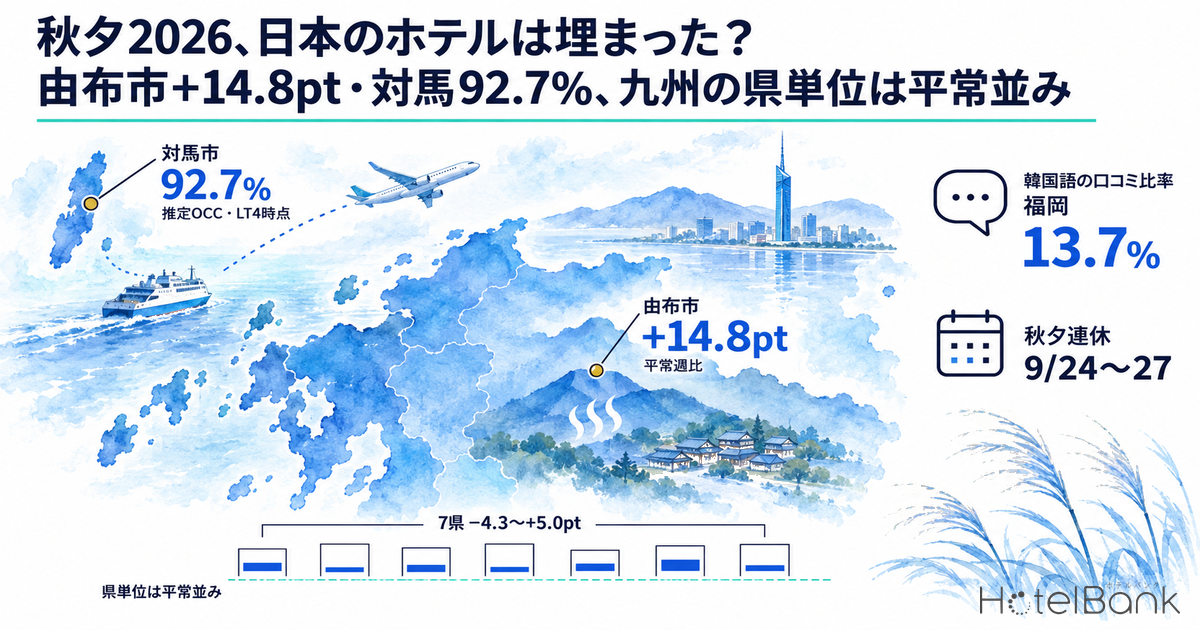
Korea’s Chuseok holiday ran from Thursday, September 24 to Sunday, September 27 in 2026 — right after Japan’s five-day Silver Week (SW, September 19–23). How much of the post-SW inventory was absorbed at hotels in Kyushu, Yamaguchi and San’in, the regions with the densest air and sea links to Korea? Comparing seven prefectures in Kyushu, San’in and nearby with the inland prefectures of Nagano and Gifu, which have few Korea routes, using MetroEngines Research inventory data: at prefecture level, all seven stayed within −4.3 to +5.0pt of a normal week. Yufu City, however, rose +14.8pt and Tsushima City reached 92.7% — Korean demand showed up in “points”, not in “prefectures”.
Metric Definitions Used in This Article
- OCC (occupancy): rooms sold as a share of total rooms in the area (an estimate based on OTA sales inventory). In this article it is calculated on a fixed population of properties that list at least 30% of their total rooms on OTAs and similar channels (the same set of properties for every stay date). It is an estimate based on how inventory sold on OTAs and similar channels is drawn down, and differs from each property’s actual occupancy.
- LT (lead time): the number of days before the stay date. LT0 = the stay date itself. To remove differences in observation timing between stay dates, all area comparisons are aligned at LT4 (4 days before the stay date).
- Normal week: the average of eight days with the same weekday sequence, Thursday–Sunday September 3–6 and Thursday–Sunday September 10–13, which were not affected by Silver Week.
- Set price: the published price of each property’s cheapest plan (per room, 2 guests, tax-inclusive). For dates already past, it is the last published price observed just before the stay date.
- Data sources: MetroEngines Research (inventory and prices); HotelBank Editorial Team research (reviews)
- — Estimated OCC (at LT4) over the Chuseok holiday (September 24–27, 2026) was −4.3 to +5.0pt against a normal week across the seven Kyushu and San’in prefectures. At prefecture level it stayed roughly normal.
- — The upside appeared in “points”. Yufu City went from 58.4% to 73.2% (+14.8pt) and Tsushima City from 78.4% to 92.7% (+14.3pt), the top two of 12 municipalities.
- — Yufu’s two Chuseok days ran about 15pt above a normal week from 45 days out, so the uplift came from early bookings, not last-minute ones.
- — The “raised minus lowered” share of set prices was Oita +13.7pt, Gifu +13.3pt and Nagano +10.9pt, matching the prefectures where inventory absorption was at or above normal-week levels.
- — The Korean-language share of reviews was 13.7% in Fukuoka, against 0.6% in Nagano and 0.5% in Shimane. The control prefecture Gifu (+8.7pt) has a 16.3% English share and is supported by a different market from Korea.
Korea’s Chuseok 2026 was a “short four-day holiday”, and Japan was the top destination
Chuseok itself fell on Friday, September 25 in 2026, with the 24th (Thursday) and 26th (Saturday) as public holidays, so the holiday ran four days including Sunday. With a shorter holiday than usual, Korean bookings have concentrated on nearby overseas trips. According to The Korea Economic Daily, reporting figures from Korean travel booking companies, Japan was the most popular overseas destination for the Chuseok holiday, with Osaka, Fukuoka and Tokyo ranking first to third among cities. In NOL Universe’s figures, Japan’s share was 52.5%, up 10.3pt from 42.2% a year earlier (as reported by Global Economic). Our pre-holiday analysis of how Kyushu and Kansai would absorb this demand is in Chuseok Sep 24-27: Only Fukuoka, Saga, Kyoto Hold After Silver Week.
The outbound volume is large as well. Incheon International Airport Corporation projected about 1.14 million passengers for September 23–27, an average of 228,000 a day, 4.8% more per day than over last year’s Chuseok holiday. Departures were expected to peak on the 24th (Thursday) at 131,999 (as reported by Asia Economy).
Inbound statistics also show Korea’s weight rising. According to Japan National Tourism Organization (JNTO) estimates, visitor arrivals to Japan in August 2026 were 3,098,900 (−9.6% YoY), and Korea was the largest market at 850,500 (+28.7% YoY). China fell sharply to 418,000 (−59.0% YoY), making Korean holidays an important market supporting autumn demand across Japan (JNTO, “Visitor Arrivals to Japan (August 2026 Estimates)”).
Normal at prefecture level — the seven Kyushu and San’in prefectures ranged from −4.3 to +5.0pt against a normal week
Weekdays right after Silver Week are a period when domestic holiday demand drops out and inventory tends to remain. Indeed, all nine prefectures had drawn inventory down to 93% to nearly 100% on Saturday, September 19 and Sunday, September 20, but over the four days of the Chuseok holiday they returned to the high 60s to 80s. What matters is the level they returned to; against a normal week, it looks like this.
Source: compiled by HotelBank Editorial Team from MetroEngines Research (estimates at LT4 for each date; target properties and rooms in the table below)
| Prefecture | Properties / rooms | Normal-week average | During SW (Sep 19 & 20) | Chuseok holiday (Sep 24–27) | vs normal week |
|---|---|---|---|---|---|
| Fukuoka | 441 / 29,808 | 84.6% | 93.3% | 80.3% | −4.3pt |
| Saga | 139 / 4,509 | 71.0% | 94.9% | 72.9% | +1.9pt |
| Nagasaki | 268 / 11,664 | 69.5% | 94.8% | 67.8% | −1.7pt |
| Oita | 471 / 10,911 | 67.9% | 96.4% | 68.9% | +1.0pt |
| Yamaguchi | 141 / 7,130 | 71.7% | 97.7% | 73.2% | +1.5pt |
| Tottori | 126 / 5,426 | 76.8% | 99.8% | 73.3% | −3.5pt |
| Shimane | 205 / 6,767 | 73.2% | 99.7% | 78.2% | +5.0pt |
| Nagano (control) | 727 / 22,725 | 80.2% | 97.2% | 81.2% | +1.0pt |
| Gifu (control) | 311 / 11,544 | 77.6% | 98.8% | 86.3% | +8.7pt |
Source: compiled by HotelBank Editorial Team from MetroEngines Research (properties / rooms are the population for the September 25 stay date, based on listings on major booking sites)
Of the seven Kyushu and San’in prefectures, four came in above a normal week — Shimane (+5.0pt), Saga (+1.9pt), Yamaguchi (+1.5pt) and Oita (+1.0pt) — while Fukuoka (−4.3pt), Tottori (−3.5pt) and Nagasaki (−1.7pt) were slightly below. In other words, judging by prefecture-wide inventory, Chuseok demand did little more than “bring the post-SW dip back to normal-week levels”.
What stands out instead is the inland control group. Gifu rose from 77.6% in a normal week to 86.3% over the Chuseok holiday, +8.7pt, the largest gain of the nine prefectures. Nagano also held at normal levels, +1.0pt. Measured by the drop from the SW level, Gifu (−12.5pt), Fukuoka (−13.0pt) and Nagano (−16.0pt) fell least, and Nagasaki (−27.0pt) and Oita (−27.5pt) most. The density of Korea routes alone does not explain how firm demand stayed after Silver Week.
Fukuoka’s figures need careful reading. Its normal-week level is already high at 84.6%, filled by urban business demand, so there is little room to add on top. In addition, the “Kyushu Fukko Ouenwari” travel discount (60% off the travel price in Kumamoto and Kagoshima, 50% in the other five prefectures) starts with stays from Thursday, October 1 across the seven Kyushu prefectures. Fukuoka and Saga had only opened bookings at noon on September 24, making this a period when domestic trips in the last week of September were likely to be pushed into October (Japan Tourism Agency, “Kyushu Fukko Ouenwari”).
This “vs normal week” figure can move depending on which weeks and which observation point are used as the baseline. We therefore recalculated the same gap with the observation point moved from LT4 to LT7 and LT14, and with the normal week taken as only the first week of September (Sep 3–6) or only the second (Sep 10–13).
| Prefecture | LT4, 2-week avg (this article) | LT7, 2-week avg | LT14, 2-week avg | LT4, week 1 only | LT4, week 2 only |
|---|---|---|---|---|---|
| Fukuoka | −4.3 | −3.5 | −1.8 | −2.2 | −6.4 |
| Saga | +1.9 | +2.6 | +5.1 | +5.7 | −1.9 |
| Nagasaki | −1.7 | −1.2 | −0.9 | +0.9 | −4.1 |
| Oita | +1.0 | +1.1 | +1.7 | +4.6 | −2.7 |
| Yamaguchi | +1.5 | +1.7 | +2.4 | +3.0 | +0.1 |
| Tottori | −3.5 | −3.8 | −2.9 | −7.8 | +0.8 |
| Shimane | +5.0 | +5.7 | +9.5 | +8.8 | +1.4 |
| Nagano (control) | +1.0 | +1.3 | +2.1 | +1.4 | +0.7 |
| Gifu (control) | +8.7 | +9.2 | +10.0 | +9.8 | +7.7 |
Source: compiled by HotelBank Editorial Team from MetroEngines Research (target properties in each prefecture as in Table 1; estimates, observations through September 23)
Under every definition, the gaps for the seven Kyushu and San’in prefectures stay within −7.8 to +9.5pt, so the reading of “normal” at prefecture level does not change. Gifu was the largest of the nine prefectures in all five variants (+7.7 to +10.0pt). On the other hand, using only week 1 as the baseline puts Saga and Oita at +4 to +6pt, and using only week 2 puts Fukuoka at −6.4pt — the sign for individual prefectures flips with the baseline. Small prefecture-level differences (around ±2pt) are best read as within the margin of error.
What worked were “points” — Yufu City +14.8pt, Tsushima City 92.7%
Broken down by municipality, the upside becomes clear in destinations with strong ties to Korean demand. The hot-spring town of Yufu City (Yufuin) went from 58.4% in a normal week to 73.2% over the Chuseok holiday, +14.8pt, and Tsushima City, home to Hitakatsu Port with its international ferry route from Busan, went from 78.4% to 92.7%, +14.3pt — the top two of 12 municipalities.
Source: compiled by HotelBank Editorial Team from MetroEngines Research (estimates at LT4 for each date; Tsushima City’s population is small at 10 properties / 117 rooms)
| Municipality | Properties / rooms | Normal-week average | Chuseok holiday (Sep 24–27) | vs normal week |
|---|---|---|---|---|
| Yufu | 168 / 1,703 | 58.4% | 73.2% | +14.8pt |
| Tsushima | 10 / 117 | 78.4% | 92.7% | +14.3pt |
| Matsue | 55 / 3,158 | 76.0% | 83.9% | +7.9pt |
| Takayama | 123 / 3,641 | 76.5% | 84.0% | +7.5pt |
| Beppu | 147 / 4,104 | 67.0% | 72.1% | +5.1pt |
| Shimonoseki | 35 / 1,620 | 74.2% | 78.9% | +4.7pt |
| Matsumoto | 84 / 3,369 | 87.9% | 92.2% | +4.3pt |
| Yonago | 33 / 1,741 | 82.2% | 79.7% | −2.5pt |
| Fukuoka Hakata Ward | 155 / 13,539 | 89.0% | 85.5% | −3.5pt |
| Fukuoka Chuo Ward | 84 / 5,672 | 87.4% | 82.8% | −4.6pt |
| Nagasaki City | 60 / 3,658 | 72.2% | 66.2% | −6.0pt |
| Kitakyushu Kokurakita Ward | 19 / 2,971 | 90.9% | 78.2% | −12.7pt |
Source: compiled by HotelBank Editorial Team from MetroEngines Research (properties / rooms are the population for the September 25 stay date, based on listings on major booking sites)
Yufu is a hot-spring town where ordinary weekday inventory absorption tends to stay in the 50s to 60s, so reaching the 70s over the four Chuseok days is a large move for weekdays. Beppu City (+5.1pt) also came in above a normal week. Fukuoka’s Hakata Ward (85.5%) and Chuo Ward (82.8%), meanwhile, were slightly below a normal week, but their levels themselves remain high, in the 80s. The urban areas that Korean travellers visit most are already full, so any add-on is hard to see in the numbers.
On the control side too, Matsue City (+7.9pt), Takayama City (+7.5pt) and Matsumoto City (+4.3pt) came in above a normal week. Takayama and Matsumoto are destinations with many travellers from Europe, North America and Australia, so autumn demand is likely lifting them independently of the Korean holiday.
Yufu City’s booking curve — running about 15pt above a normal week from 45 days out
To check whether Yufu’s upside came from last-minute bookings or had built up early, we look at booking curves for four stay dates, setting the Thursday and Friday of a normal week (Sep 10 and 11) beside the Thursday and Friday of the Chuseok holiday (Sep 24 and 25).
Source: compiled by HotelBank Editorial Team from MetroEngines Research (Yufu City, 168 properties / 1,703 rooms [September 25 stay date], based on listings on major booking sites; LT45 to LT1, observations through September 23)
The two Chuseok days were already at 60–61% at LT45 (45 days before the stay date), about 15pt above the normal week’s 42–46%. That gap barely narrowed right up to the stay date. In other words, Yufu’s uplift came not from a last-minute rush but from bookings made more than a month and a half ahead. It suggests a steady number of travellers, groups and individuals alike, who secure this hot-spring town early for Chuseok.
A limited-service hotel in Hitakatsu, Tsushima — its public allocation for Chuseok day sold out at LT37
Looking at Tsushima’s upside property by property, the inventory of Hotel A (243 rooms), a limited-service hotel near Hitakatsu Port, makes the pattern easy to see. On some dates Hotel A’s public allocation as a share of total rooms falls short of the aggregation threshold, so it is not included in the Tsushima City population in the previous section (10 properties / 117 rooms). It is a separate property from the city figures, confirming movement in the same direction. For the stay on Chuseok day, Friday, September 25, it had 12 rooms left at LT45 and reached 0 of 243 rooms left at LT37, and the additional allocation that followed (9 rooms at LT21) was also quickly absorbed. The Thursday, September 24 stay also hit 0 rooms left at LT31, and after an additional 43 rooms appeared at LT13, it was back to 0 by LT4 (because the added rooms numbered 5 or more and persisted for several days, we infer that the hotel added allocation rather than that these were cancellations).
Source: compiled by HotelBank Editorial Team from MetroEngines Research (remaining rooms for one property, observations through September 23; the public allocation on OTAs and similar channels is at most about 40–50% of total rooms as observed)
For comparison, on the same weekday, the normal-week Friday of September 11 still had 62 rooms left at LT1, and the pre-SW Friday of September 18 had 12 left at LT2. Inventory for Chuseok day was absorbed more than a month earlier than on an ordinary Friday. Note that the remaining rooms here are within the public allocation offered on OTAs and similar channels (at most about 40–50% of total rooms as observed), and do not mean the whole hotel was full.
Did properties raise set prices? — “Raises” outnumbered cuts in Oita, Gifu and Nagano
Next, we look at how properties priced the Chuseok holiday. Comparing the published price of each property’s cheapest plan with a comparison date, we counted changes above +3% as “raised” and below −3% as “lowered”. The comparison date is the same weekday of the previous week for Thursday and Friday (Sep 17 and 18), and, because the previous weekend fell in Silver Week, the same weekday two weeks earlier for Saturday and Sunday (Sep 12 and 13). Most properties held prices unchanged (about 50–70% in each prefecture); the difference lies in how the rest moved.
Source: compiled by HotelBank Editorial Team from MetroEngines Research (published prices of the cheapest plan, per room, 2 guests, tax-inclusive)
| Prefecture | Properties with comparable prices | Comparisons (property × date) | Raised | Lowered | Net |
|---|---|---|---|---|---|
| Fukuoka | 183 | 719 | 24.5% | 25.2% | −0.7pt |
| Saga | 154 | 562 | 17.1% | 16.4% | +0.7pt |
| Nagasaki | 163 | 636 | 13.5% | 17.6% | −4.1pt |
| Oita | 233 | 866 | 27.8% | 14.1% | +13.7pt |
| Yamaguchi | 157 | 606 | 15.2% | 16.9% | −1.7pt |
| Tottori | 153 | 585 | 15.5% | 14.0% | +1.5pt |
| Shimane | 202 | 780 | 19.1% | 12.2% | +6.9pt |
| Nagano | 231 | 855 | 24.9% | 14.0% | +10.9pt |
| Gifu | 210 | 740 | 25.9% | 12.7% | +13.3pt |
Source: compiled by HotelBank Editorial Team from MetroEngines Research (properties among those with tracked inventory whose prices were observed on both the comparison date and the target date)
Three prefectures saw the share of raises clearly exceed the share of cuts — Oita (+13.7pt), Gifu (+13.3pt) and Nagano (+10.9pt) — and each matches a prefecture where inventory absorption was at or above normal-week levels. By municipality, Yufu City had 37.5% raised and 9.0% lowered (648 comparisons), with many properties lifting prices in line with rising absorption. Fukuoka’s Hakata Ward also had 43.0% raised and 26.2% lowered (640 comparisons), and on Friday, September 25, Chuseok day itself, 56% of properties priced above the previous Friday.
In Fukuoka, Nagasaki and Yamaguchi, raises and cuts were roughly equal, and the prevailing practice across each prefecture was to hold normal-week prices. Holding prices in prefectures where inventory stayed at normal-week levels is a judgement in line with demand.
Depth of the receiving base — Korean-language reviews at 13.7% in Fukuoka, under 1% in Nagano and Shimane
Finally, we check from reviews how many Korean guests each area has hosted. Of the guest reviews compiled by the HotelBank Editorial Team over the most recent 24 months (in six languages: Japanese, Korean, English, Chinese [Traditional and Simplified] and Thai), the share written in Korean is listed by prefecture.
Source: HotelBank Editorial Team research (guest reviews by language, most recent 24 months)
| Prefecture | Reviews compiled | Korean share | English share | Properties with 5+ favourable mentions of multilingual service |
|---|---|---|---|---|
| Fukuoka | 318,127 | 13.7% (43,642) | 8.7% | 82 |
| Oita | 135,363 | 6.8% (9,151) | 6.7% | 15 |
| Saga | 43,437 | 4.7% (2,056) | 2.9% | 4 |
| Nagasaki | 102,096 | 3.2% (3,245) | 6.3% | 7 |
| Tottori | 52,224 | 2.7% (1,423) | 2.3% | — |
| Gifu | 129,279 | 1.6% (2,089) | 16.3% | 8 |
| Yamaguchi | 57,449 | 1.5% (841) | 1.9% | — |
| Nagano | 257,019 | 0.6% (1,502) | 14.1% | 4 |
| Shimane | 55,528 | 0.5% (275) | 2.2% | — |
Source: HotelBank Editorial Team research (NLP analysis. Multilingual service = number of properties with at least 5 reviews in the most recent 24 months that speak favourably of staff language support. “—” = prefectures where no such property appears in the data)
Fukuoka’s Korean share stands out at 13.7% (43,642 reviews), followed by Oita at 6.8% and Saga at 4.7%. The control prefectures Nagano (0.6%) and Gifu (1.6%) have little Korean but high English shares of 14.1% and 16.3%, above every Kyushu prefecture. The firmness of Gifu and Nagano inventory over the Chuseok holiday can be read as support from a market other than Korea.
Properties with at least five reviews speaking favourably of staff language support numbered 82 in Fukuoka and 15 in Oita. Reviews include comments such as “there was a staff member who could speak Korean” and “from the lobby on, there were employees who spoke Korean”, showing that being able to guide guests in Korean earns good ratings. No such properties yet appear in the data for Yamaguchi, Tottori or Shimane, leaving room to grow for properties that can promote Korean-language service.
What properties can do — put Korean holidays on the pricing calendar
The data point to three moves properties can make.
1. Put Korean public holidays on the pricing calendar the same way as domestic holidays. In Yufu and Tsushima, Chuseok inventory ran above normal-week levels from more than 45 days out. Chuseok and Lunar New Year (Seollal) change dates every year, so check next year’s dates early; for properties with many Korean guests, stepping up price tiers early, as for a domestic holiday, is an opportunity to grow revenue.
2. Compare absorption speed at LT30–45 with a normal week. Tsushima’s Hotel A sold out its public allocation for Chuseok day at LT37. A date absorbing clearly faster than the same weekday in a normal week is a sign that demand has arrived early. Raising prices step by step only on those dates works best for small properties with little inventory.
3. Make Korean-language service visible in reviews. In Fukuoka and Oita, many reviews praise staff who can help guests in Korean. Showing the languages you support on booking pages and in the property leads to bookings for the next holiday.
Note that this analysis does not look directly at bookings by nationality; it is an inference from inventory and price movements in areas closely tied to Korean demand. With the travel discount starting in each Kyushu prefecture on October 1, October inventory movements need to be read alongside the recovery in domestic demand.
Note on observation timing: inventory and prices in this article are based on data as of the survey (observations through September 23, 2026). Stays on Saturday, September 26 and Sunday, September 27 were still ahead of their stay dates, so they use LT4 estimates and published prices at the survey date, and will change before the stay date. Hotel A’s remaining rooms are as observed on September 23 and may change with later inventory additions or cancellations.
Frequently Asked Questions
Q. How much did Korea’s Chuseok holiday lift occupancy at Japanese hotels?
A. Estimated OCC across the seven Kyushu and San’in prefectures (at LT4, September 24–27, 2026) was −4.3 to +5.0pt against a normal week, roughly normal at prefecture level. A clear upside appeared only in certain municipalities with strong ties to Korean travellers, such as Yufu City (+14.8pt) and Tsushima City (+14.3pt).
Q. Why did Fukuoka come in below a normal week?
A. Fukuoka’s normal-week estimated OCC is already high at 84.6% (the September 2026 normal-week average), leaving little room to add. In addition, the Kyushu Fukko Ouenwari travel discount starts with stays from October 1, so domestic trips were likely to shift into October. The levels in Hakata and Chuo wards themselves stayed in the 80s.
Q. When did Chuseok bookings start coming in?
A. In Yufu City, estimated OCC for the Thursday and Friday of the Chuseok holiday was already 60–61% 45 days out (42–46% on the same weekdays of a normal week), about 15pt higher. Tsushima’s Hotel A sold out its public allocation for Chuseok day 37 days ahead.
Q. Did hotels raise prices for Chuseok?
A. Most properties (about 50–70% in each prefecture) held prices unchanged. Among properties that moved prices, raises clearly outnumbered cuts in three prefectures — Oita, Gifu and Nagano — and in Yufu City 37.5% raised and 9.0% lowered.
Q. What should properties do to capture Korean holiday demand?
A. The starting point is to put Korean public holidays such as Chuseok and Lunar New Year (Seollal) on the pricing calendar the same way as domestic holidays, and to compare inventory absorption speed 45 to 30 days out with a normal week. If you can guide guests in Korean, showing that on booking pages and in the property is also effective.
Related Articles
References and Sources
■ Data sources
MetroEngines Research inventory trend data (estimated OCC by prefecture and municipality, property-level remaining-room trends) and published prices of the cheapest plan (per room, 2 guests, tax-inclusive); guest reviews compiled by the HotelBank Editorial Team, by language and by tag (most recent 24 months). Visitor arrivals, outbound passenger projections and booking trends are based on releases from JNTO and the Japan Tourism Agency and on Korean media reports.
■ Calculation assumptions
Estimated OCC was calculated from remaining rooms at 4 days before the stay date (LT4) for a fixed population of properties that list at least 30% of total rooms on OTAs and similar channels (the same set of properties for every stay date in September 2026). The normal week is the average of the eight days September 3–6 and September 10–13 (Thursday–Sunday). For prices, Chuseok Thursday and Friday were compared with the same weekdays of the previous week (Sep 17 and 18) and Saturday and Sunday with the same weekdays two weeks earlier (Sep 12 and 13), and changes beyond ±3% were classed as “raised” or “lowered”. The sensitivity table (Table 2) recalculates with different observation points (LT4 / LT7 / LT14) and normal-week definitions.
■ Limitations and caveats
Estimated OCC is an estimate based on how inventory sold on OTAs and similar channels is drawn down, and differs from each property’s actual occupancy. Bookings by nationality are not observed; Korea’s contribution is inferred from movements in inventory, prices and reviews. Prices for the September 26 and 27 stays are published prices at the survey date and may change before the stay date (on re-aggregation, prefecture-level raised/lowered shares moved by at most ±0.4pt). Tsushima City has no observation for the September 3 stay, so its normal week is a seven-day average. Hotel A is not part of the Tsushima City population.
- Japan National Tourism Organization (JNTO), “Visitor Arrivals to Japan (August 2026 Estimates)” (September 16, 2026, in Japanese)
- Travel Voice, “Foreign visitors to Japan: 3.1 million in August 2026” (September 16, 2026, in Japanese)
- Japan Tourism Agency, “Kyushu Fukko Ouenwari” (in Japanese)
- Asia Economy, “Incheon Airport expects 228,000 passengers a day over Chuseok” (September 22, 2026, in Korean)
- The Korea Economic Daily, “Japan travel trends ahead of Chuseok” (September 21, 2026, in Korean)
- Global Economic, “Short holiday makes short-haul overseas travel popular” (September 24, 2026, in Korean)
- MetroEngines Research — inventory trends by prefecture and municipality (estimated OCC), property-level remaining-room trends, published prices of the cheapest plan
- HotelBank Editorial Team research — guest reviews by language and tag analysis (most recent 24 months)